Involuntary Churn: How to Stop Losing Revenue to Failed Payments
Involuntary churn is the revenue you lose to expired cards and declined charges — not to unhappy customers. Here's how to measure it, model it, and recover 40-70% of it with dunning, retries, and clean billing contact data.
TL;DR
- Involuntary churn is churn nobody chose. The customer still wants your product; the payment just failed — expired card, insufficient funds, issuer fraud block, or a billing contact who left the company.
- It's bigger than teams assume. For most subscription businesses, failed payments account for roughly 20-40% of total monthly churn, and 4-9% of annual recurring revenue passes through a "failed" state at least once.
- Most of it is recoverable. Smart retries, card account updaters, and a human-sounding dunning sequence typically recover 40-70% of failed charges — without a single discount.
- Your recovery ceiling is set by contact data, not billing logic. If dunning emails land in a dead inbox, no retry schedule saves you.
- Measure it separately from voluntary churn. Blending the two hides the cheapest revenue win you have.
What is involuntary churn?#
Involuntary churn is when a paying customer stops paying because a transaction failed — not because they decided to leave. The subscription lapses, the account gets downgraded or suspended, and on your dashboard it looks identical to a cancellation. It isn't.
Think of it like a gym membership that dies because your bank reissued your debit card after a fraud alert. You never wanted to quit. You just never got around to updating the card on file, and three months later you realize you stopped going because you stopped being billed. The gym lost a member it never had to lose.
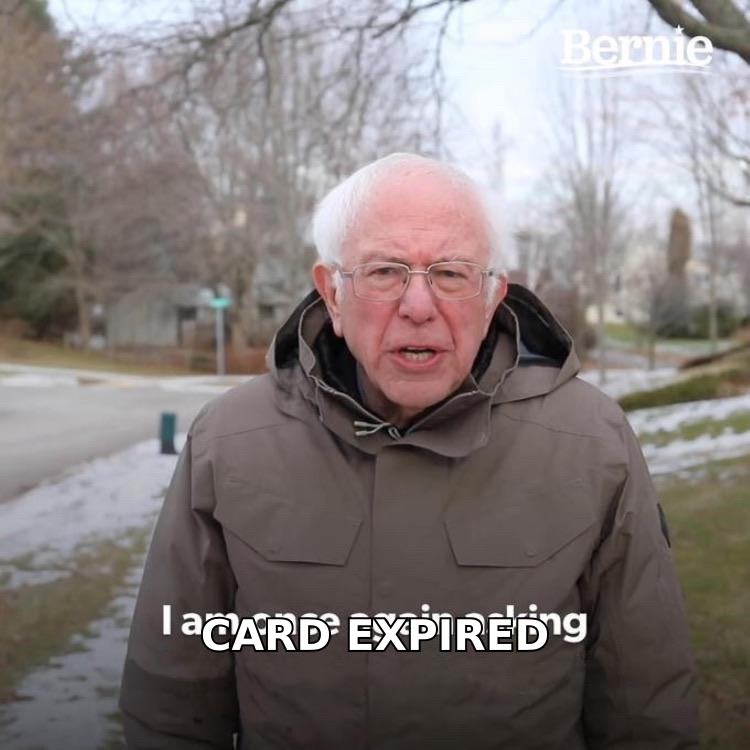
Voluntary churn is a product, pricing, or value problem. Involuntary churn is an operations problem. That distinction matters because the fixes are completely different: one requires roadmap changes and months of work, the other requires a retry schedule and a working email address.
If you want the textbook framing, churn rate covers the general concept — but almost no standard churn definition splits out the involuntary slice, which is exactly why so many teams under-count it.
How is involuntary churn different from voluntary churn?#
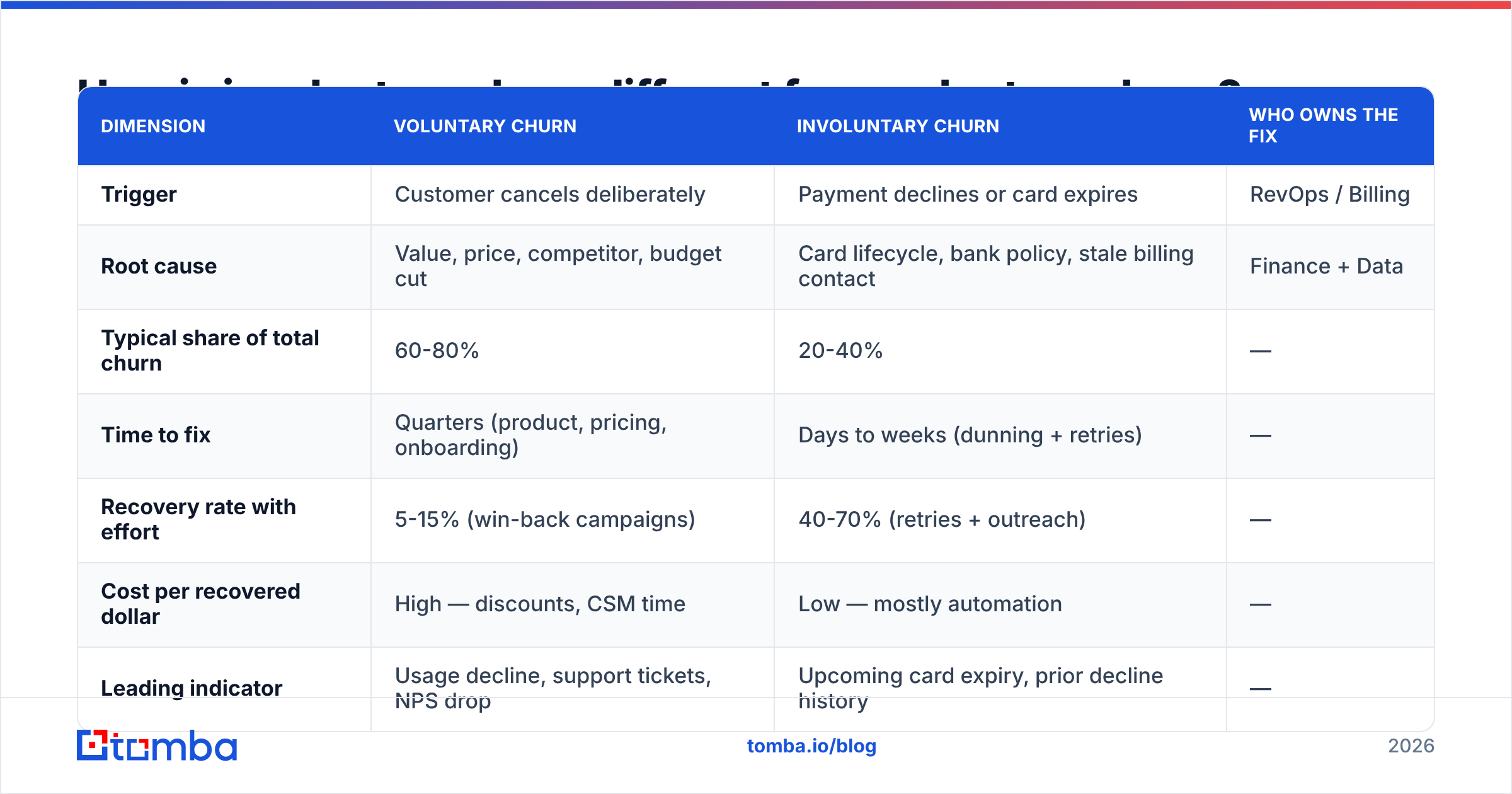
Here's the side-by-side that should live in every revenue operations dashboard:
| Dimension | Voluntary churn | Involuntary churn | Who owns the fix |
|---|---|---|---|
| Trigger | Customer cancels deliberately | Payment declines or card expires | RevOps / Billing |
| Root cause | Value, price, competitor, budget cut | Card lifecycle, bank policy, stale billing contact | Finance + Data |
| Typical share of total churn | 60-80% | 20-40% | — |
| Time to fix | Quarters (product, pricing, onboarding) | Days to weeks (dunning + retries) | — |
| Recovery rate with effort | 5-15% (win-back campaigns) | 40-70% (retries + outreach) | — |
| Cost per recovered dollar | High — discounts, CSM time | Low — mostly automation | — |
| Leading indicator | Usage decline, support tickets, NPS drop | Upcoming card expiry, prior decline history | — |
Read the bottom half of that table again. Involuntary churn is the only churn category where a small operations project moves the number in a single billing cycle.
How much revenue does involuntary churn actually cost you?#
Run the arithmetic on your own numbers before you trust any benchmark.
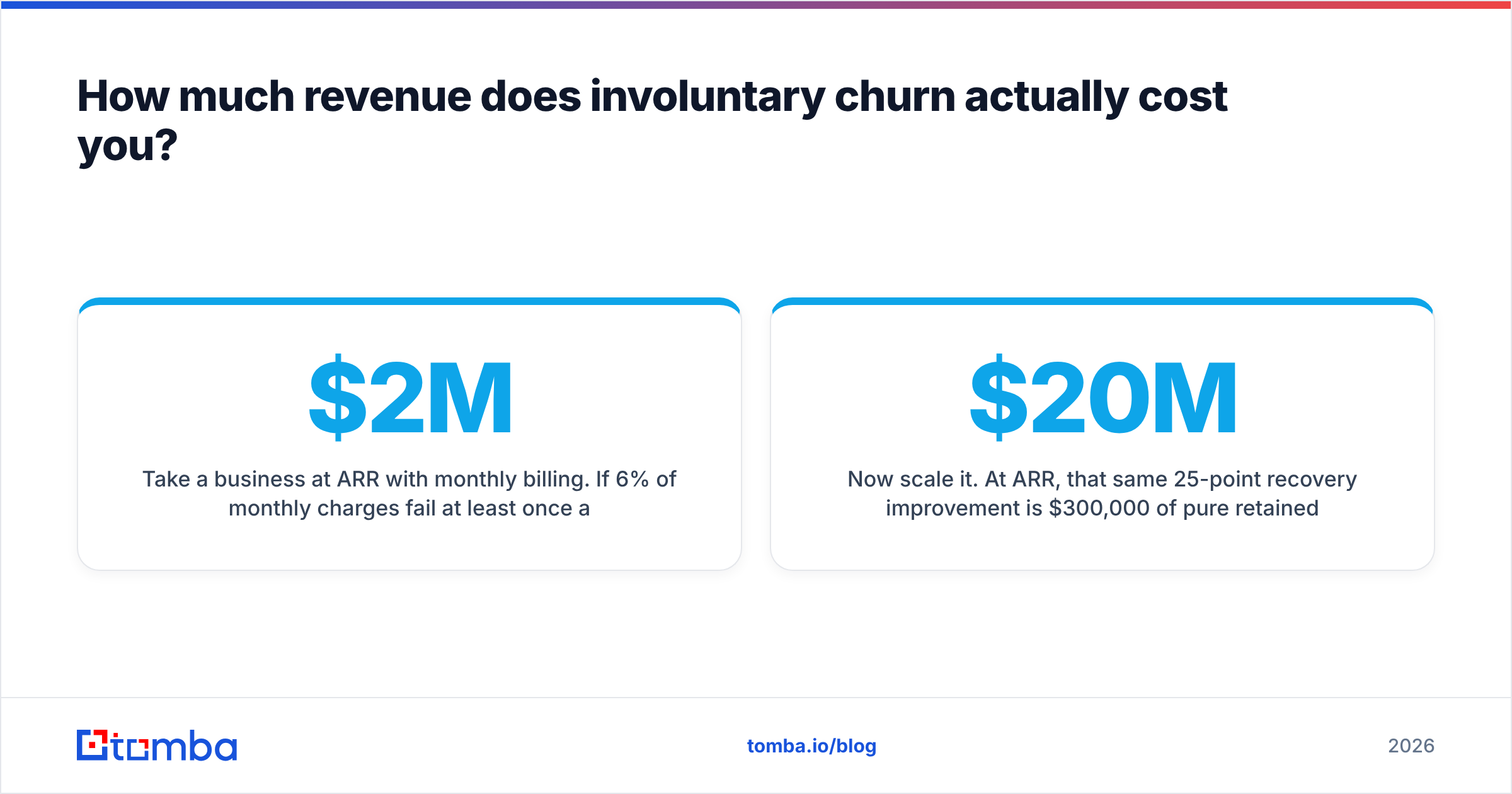
Take a business at $2M ARR with monthly billing. If 6% of monthly charges fail at least once and you recover 50% of them through basic retries, you're permanently losing about 3% of billings — roughly $60,000 a year. Push recovery to 75% with a proper dunning stack and you keep an extra $30,000 with no new customers, no new headcount, and no discounting.
Now scale it. At $20M ARR, that same 25-point recovery improvement is $300,000 of pure retained revenue. It's the cheapest acquisition channel you own, because the customer is already sold.
Three multipliers make the true cost higher than the raw number:
- Lost expansion. A churned-by-accident account can't upgrade next quarter. You lose the base revenue and its growth curve.
- Wasted CAC. You paid to acquire that logo. Losing it to an expired Visa is the most expensive way possible to waste sales and marketing spend.
- Compounding NRR damage. Net revenue retention is the headline metric most B2B boards track. Involuntary churn drags it down silently, and nobody in the QBR can explain why.
Why do payments fail in the first place?#
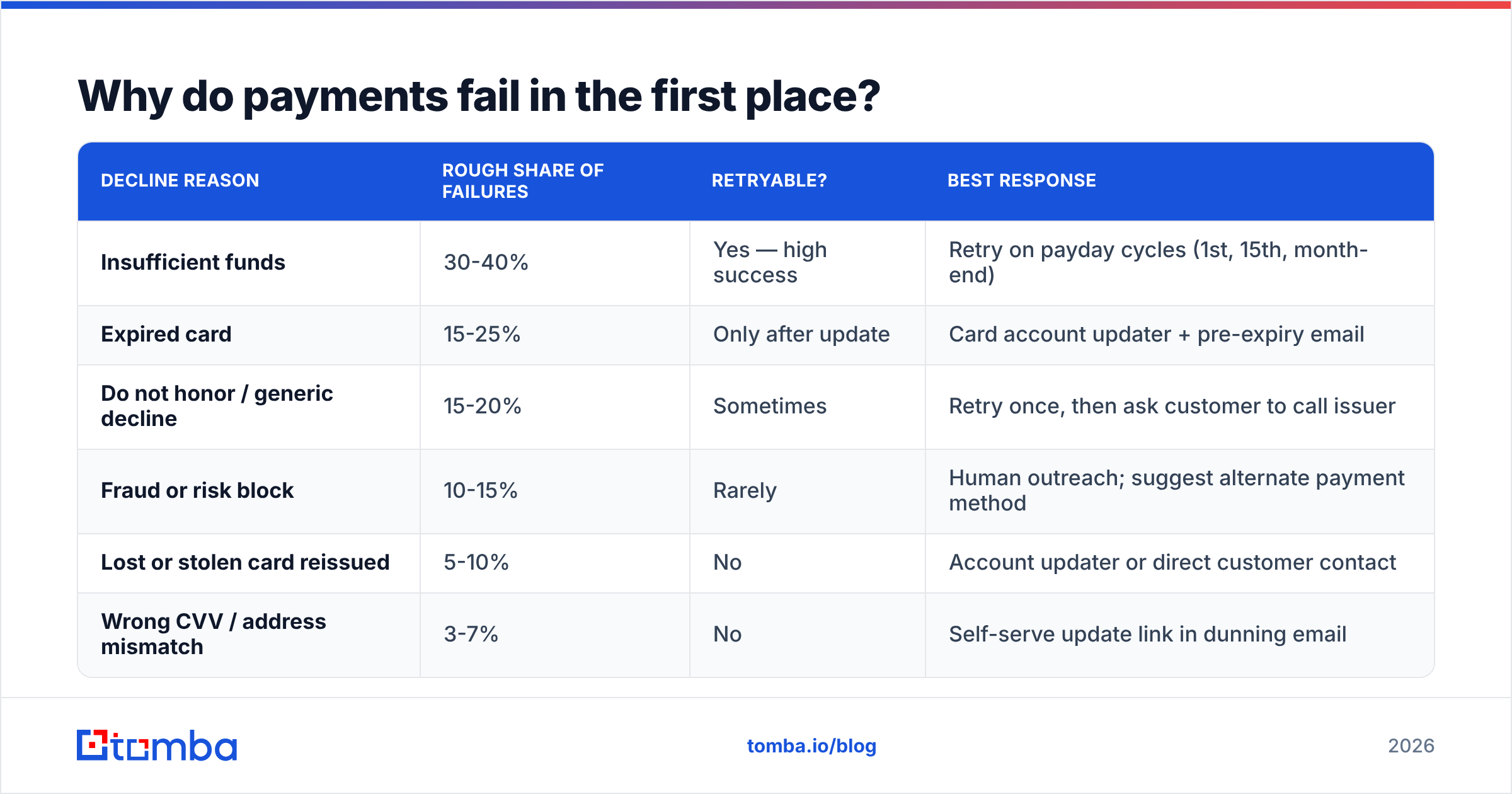
Declines are not random. They cluster into a handful of causes, and each one demands a different response.
| Decline reason | Rough share of failures | Retryable? | Best response |
|---|---|---|---|
| Insufficient funds | 30-40% | Yes — high success | Retry on payday cycles (1st, 15th, month-end) |
| Expired card | 15-25% | Only after update | Card account updater + pre-expiry email |
| Do not honor / generic decline | 15-20% | Sometimes | Retry once, then ask customer to call issuer |
| Fraud or risk block | 10-15% | Rarely | Human outreach; suggest alternate payment method |
| Lost or stolen card reissued | 5-10% | No | Account updater or direct customer contact |
| Wrong CVV / address mismatch | 3-7% | No | Self-serve update link in dunning email |
The strategic takeaway: about half of all declines are soft — the card is fine, the timing is wrong. Those recover on their own with intelligent retry logic. The other half are hard — the card is dead, and no amount of retrying resurrects it. Hard declines require a human to take an action, which means they require a message that actually reaches a human.
That's where most recovery programs quietly fail.
What does a modern involuntary churn recovery stack look like?#
Five layers, in order of leverage:
- Pre-dunning (days -14 to -3). Email customers whose card expires before the next renewal. This is the highest-ROI message in the entire stack because it prevents the failure instead of chasing it. Conversion on pre-dunning notices routinely beats post-failure dunning by 2-3x.
- Card account updater. Your processor pings the card networks for refreshed credentials when a card is reissued. Visa Account Updater and Mastercard Automatic Billing Updater are the two that matter. It's usually a checkbox and a small per-query fee, and it silently kills a quarter of your involuntary churn.
- Smart retries (days 0 to 21). Not "retry every 3 days, four times." Retry based on decline code, local payday calendars, issuer behavior, and time of day. Processors that model this well see meaningfully higher recovery than fixed schedules.
- Dunning sequence (days 1 to 25). Three to five emails, escalating in urgency, each with a one-click update-payment link. Add in-app banners and, for accounts above a revenue threshold, a phone call or a CSM Slack message.
- Grace period and soft downgrade. Never hard-suspend on day one. Give 14-21 days of full access, then downgrade rather than delete. The account that's still logging in is an account you can still save.
Which involuntary churn tools should you compare?#
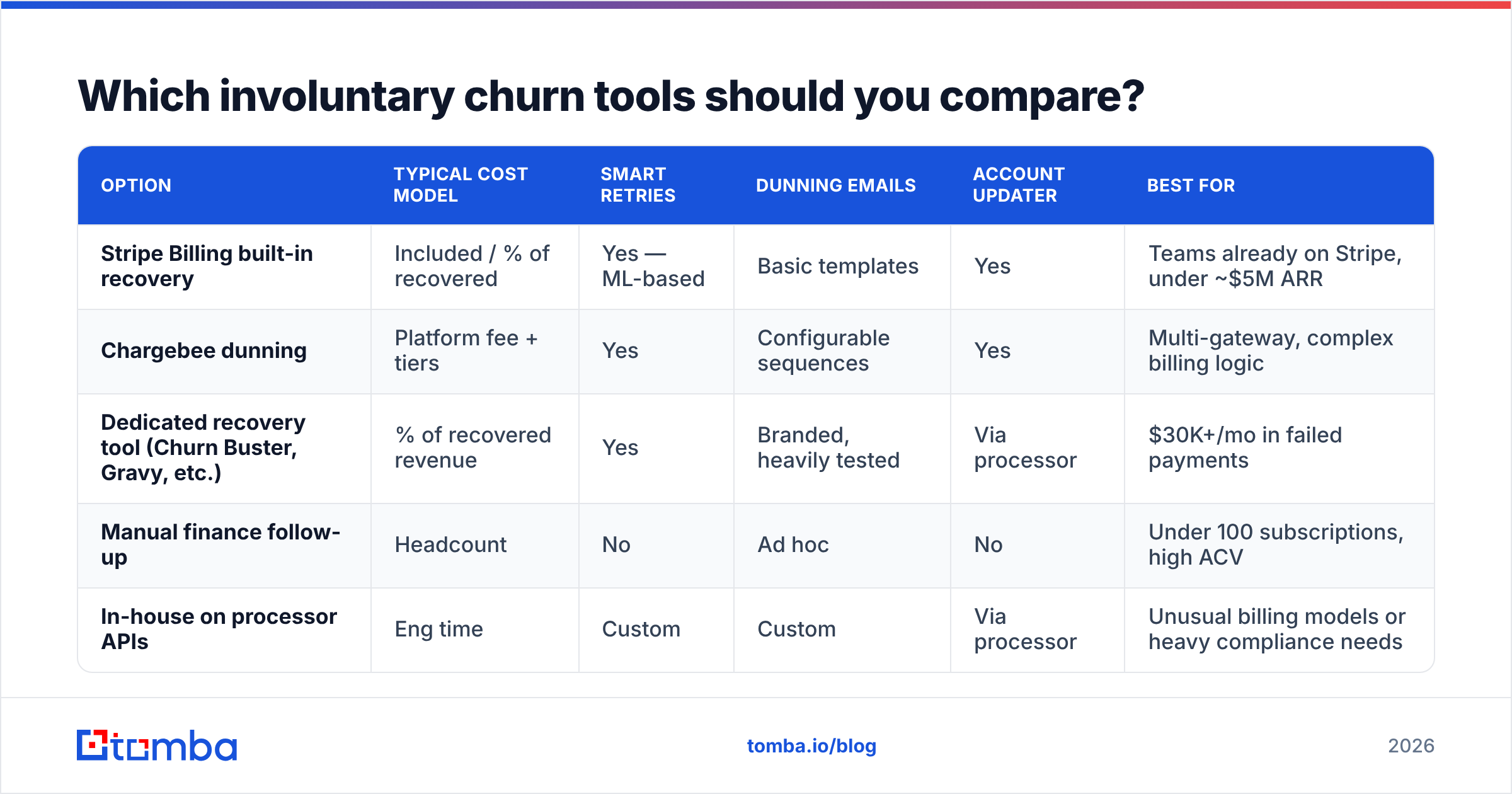
Most teams start with what their billing provider includes, then graduate to a dedicated recovery tool once failed payments exceed roughly $20-30K per month. Here's the honest landscape:
| Option | Typical cost model | Smart retries | Dunning emails | Account updater | Best for |
|---|---|---|---|---|---|
| Stripe Billing built-in recovery | Included / % of recovered | Yes — ML-based | Basic templates | Yes | Teams already on Stripe, under ~$5M ARR |
| Chargebee dunning | Platform fee + tiers | Yes | Configurable sequences | Yes | Multi-gateway, complex billing logic |
| Dedicated recovery tool (Churn Buster, Gravy, etc.) | % of recovered revenue | Yes | Branded, heavily tested | Via processor | $30K+/mo in failed payments |
| Manual finance follow-up | Headcount | No | Ad hoc | No | Under 100 subscriptions, high ACV |
| In-house on processor APIs | Eng time | Custom | Custom | Via processor | Unusual billing models or heavy compliance needs |
A useful buying heuristic: if a dedicated tool charges 15-25% of recovered revenue and lifts recovery from 50% to 70%, it pays for itself only when your failed-payment volume is large enough that the 20-point lift exceeds the fee. Do that math with real numbers, not vendor case studies. Vendor-neutral reviews on G2 are useful for support quality but nearly useless for recovery-rate claims — nobody publishes their losses.
Why do dunning emails fail to reach anyone?#
Because the email on the billing record is frequently wrong, and nobody checks.
This is the part of involuntary churn that billing tools cannot solve. Your recovery stack can have perfect retry logic and beautiful email templates, and still recover nothing if the sequence goes to accounting@ at a company that switched to a new AP platform, or to the ops manager who left eight months ago. In B2B, the billing contact is often the least stable contact in the account — controllers and office managers turn over faster than the champions your CSMs track.
Three data hygiene moves that raise the ceiling on every downstream tactic:
- Verify billing emails on a schedule. Run your billing contact list through an email verifier quarterly. Hard bounces on a dunning sequence are a silent failure — the email service reports "delivered attempts," finance reports "customer ignored us," and both are wrong.
- Keep a secondary contact per account. One billing contact is a single point of failure. Use data enrichment to attach a finance lead and an ops lead alongside the primary, so the day-7 dunning email can escalate to a second human instead of shouting into the same dead mailbox.
- Rebuild contacts when the primary bounces. When a billing address goes dead, you need a replacement inside the same company, fast. A domain search against the customer's domain surfaces current finance and operations contacts so your recovery sequence can pivot in hours rather than after the subscription lapses.
For high-ACV accounts, add a phone step. A two-minute call from finance recovers invoices that six emails won't, and pulling current B2B phone numbers for the billing owner turns a dead-end dunning thread into a resolved payment the same day.
How do you write a dunning sequence that doesn't sound like collections?#
Tone is the whole game. Your customer did not do anything wrong — a bank did. Write like you're doing them a favor, because you are.
A sequence that consistently works:
- Day 0 — "Heads up, your card didn't go through." Neutral, short, one button: Update payment method. No urgency, no threat. Many of these convert purely because the person had no idea.
- Day 3 — "Still can't process your payment." Add the specific reason if your processor exposes it ("your card expired," "your bank declined the charge"). Specificity doubles action rates.
- Day 7 — Escalate the recipient, not the tone. Send to the secondary contact. Add an in-app banner for anyone logging in.
- Day 14 — State the consequence plainly, with a date. "Your workspace moves to read-only on March 3." Clear, calm, factual. Include the amount and the invoice link.
- Day 21 — Last-chance plus a human. Signed by a real person with a real reply-to address. For accounts over your threshold, this is a phone call instead.
Two rules that matter more than the copy: send from a monitored inbox that a human actually reads, and make the update link work without a login. Every extra authentication step costs you recovered revenue. Before you launch, sanity-check the sequence against a spam checker — billing emails with urgent subject lines and payment links are exactly the pattern spam filters distrust, and a dunning email in the junk folder is churn you paid to cause.
How should you measure involuntary churn?#
Four metrics, tracked monthly, separate from voluntary churn:
- Failed payment rate — failed charges ÷ total charge attempts. Your baseline. Above 8% suggests a gateway or customer-mix problem, not a dunning problem.
- Recovery rate — failed charges eventually collected ÷ total failed charges. The number your recovery stack actually moves. Under 50% means you're leaving money on the table; over 80% is excellent.
- Days to recovery — median time from first failure to successful charge. Shorter is better, and it correlates strongly with whether the customer stays past the next renewal.
- Involuntary share of gross churn — how much of your churn is accidental. If this is over 35%, stop your retention roadmap work and fix billing first. It's faster and cheaper.
Report all four next to voluntary churn in the same view. The moment leadership sees that a quarter of "churn" was never a decision, involuntary churn stops being a finance footnote and becomes a funded project.
Where should you start this quarter?#
Pick the three cheapest wins in order: turn on your processor's card account updater, add a pre-expiry email at day -14, and verify every billing contact in your database. None of those require engineering sprints. Together they typically move recovery rate 15-25 points within two billing cycles.
Then measure, and only then evaluate a dedicated recovery vendor. Buying tooling before you've fixed contact data just automates emails to inboxes that don't exist.
Fix the data layer first. Tomba's email finder helps you rebuild billing and finance contacts across your customer base — so when a card fails, your dunning sequence reaches a person who can actually update it. Start free with 25 searches a month, or check Tomba pricing — Starter is $49/mo and Growth is $99/mo — and run your billing contact list through it before your next renewal batch.
Related guides#
// get started
Find, verify and enrich your first contacts today
Start on the free plan with 25 searches a month, then scale when your team is ready.
Free plan · No credit card required · GDPR & CCPA
// about the author