Is Best Regards Professional? What to Use in Emails in 2026
"Best regards" is safe, slightly formal, and almost never wrong — but it is not always the strongest close. Here is when it works, when it reads cold, and which sign-offs actually earn replies.
TL;DR
- Yes, "best regards" is professional. It is the lowest-risk sign-off in business email — formal enough for a CFO, warm enough for a peer, and never misread as sarcastic.
- It is safe, not strong. In cold outbound and quick internal threads, shorter closes ("Best," "Thanks,") read faster and feel less templated.
- Capitalization matters more than people think: "Best regards," is correct. "Best Regards," is a mild formatting tell that you copied a template.
- The sign-off is maybe 2% of why someone replies. Relevance, correct name spelling, and a verified address decide the other 98%.
- Pick two sign-offs — one formal, one casual — and stop rotating. Consistency beats cleverness.
What does "best regards" actually mean?#
"Best regards" is a valediction — the closing formula that sits between your last sentence and your name. It is a compressed version of "I send you my best regards," a phrase that has been drifting through English correspondence since the era of letters that took three weeks to arrive. Wikipedia's entry on valedictions traces the whole family: "yours sincerely," "yours faithfully," "kind regards," "best regards."
What survives in 2026 is the social signal, not the literal meaning. Nobody reading "best regards" pictures you dispatching regards. They read three things:
- You know the conventions. You did not end an email to a stranger with "later" or nothing at all.
- You are being polite, not warm. Regards is respectful distance. It does not claim a friendship you do not have.
- You probably wrote this email rather than dictating it in four seconds. A sign-off is effort, however small.
That third signal is why the phrase persists in an era of Slack threads and one-line replies. It marks an email as a considered message.
Is best regards professional in 2026?#
Yes — and there is no serious counter-argument. Ask whether "best regards" is professional and you get one answer from every etiquette guide, every corporate style manual, and every sales team that has ever A/B tested a template: it is professional, neutral, and safe.
The more useful question is whether "safe" is what your specific email needs.
Sign-offs sit on a formality curve. "Yours faithfully" is ceremonial and, outside UK legal and academic correspondence, slightly odd. "Cheers" is regional and can read as either charming or flippant depending on which side of an ocean your reader sits. "Best regards" lands almost exactly in the middle — which is why it never offends and also why it never distinguishes you.

Here is the honest positioning:
- Best regards is the right default for first contact with someone senior, external counsel, procurement, government bodies, and any thread where the relationship is undefined.
- Best regards is slightly heavy for a reply three messages deep into a thread with a colleague you talk to daily. Dropping to "Best," or nothing at all is correct there, not rude.
- Best regards is invisible in cold outbound. It will not hurt you. It will not help you either. The prospect's eyes have already left the page by then.
When should you use best regards — and when should you not?#
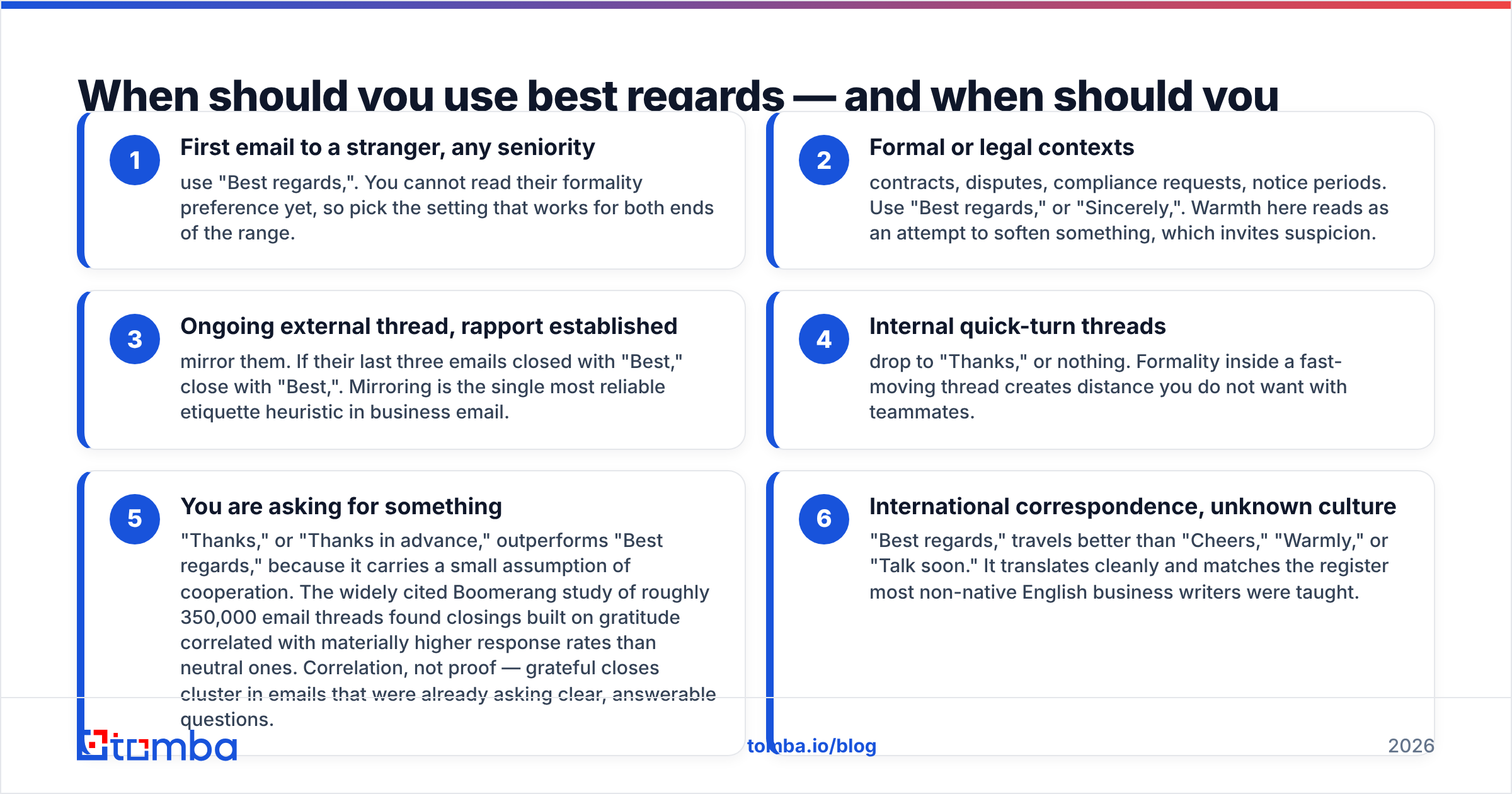
Use this as a decision list rather than a rule:
- First email to a stranger, any seniority — use "Best regards,". You cannot read their formality preference yet, so pick the setting that works for both ends of the range.
- Formal or legal contexts — contracts, disputes, compliance requests, notice periods. Use "Best regards," or "Sincerely,". Warmth here reads as an attempt to soften something, which invites suspicion.
- Ongoing external thread, rapport established — mirror them. If their last three emails closed with "Best," close with "Best,". Mirroring is the single most reliable etiquette heuristic in business email.
- Internal quick-turn threads — drop to "Thanks," or nothing. Formality inside a fast-moving thread creates distance you do not want with teammates.
- You are asking for something — "Thanks," or "Thanks in advance," outperforms "Best regards," because it carries a small assumption of cooperation. The widely cited Boomerang study of roughly 350,000 email threads found closings built on gratitude correlated with materially higher response rates than neutral ones. Correlation, not proof — grateful closes cluster in emails that were already asking clear, answerable questions.
- International correspondence, unknown culture — "Best regards," travels better than "Cheers," "Warmly," or "Talk soon." It translates cleanly and matches the register most non-native English business writers were taught.
The pattern: use "best regards" when the cost of seeming too casual is higher than the cost of seeming generic. In most first-contact business email, it is.
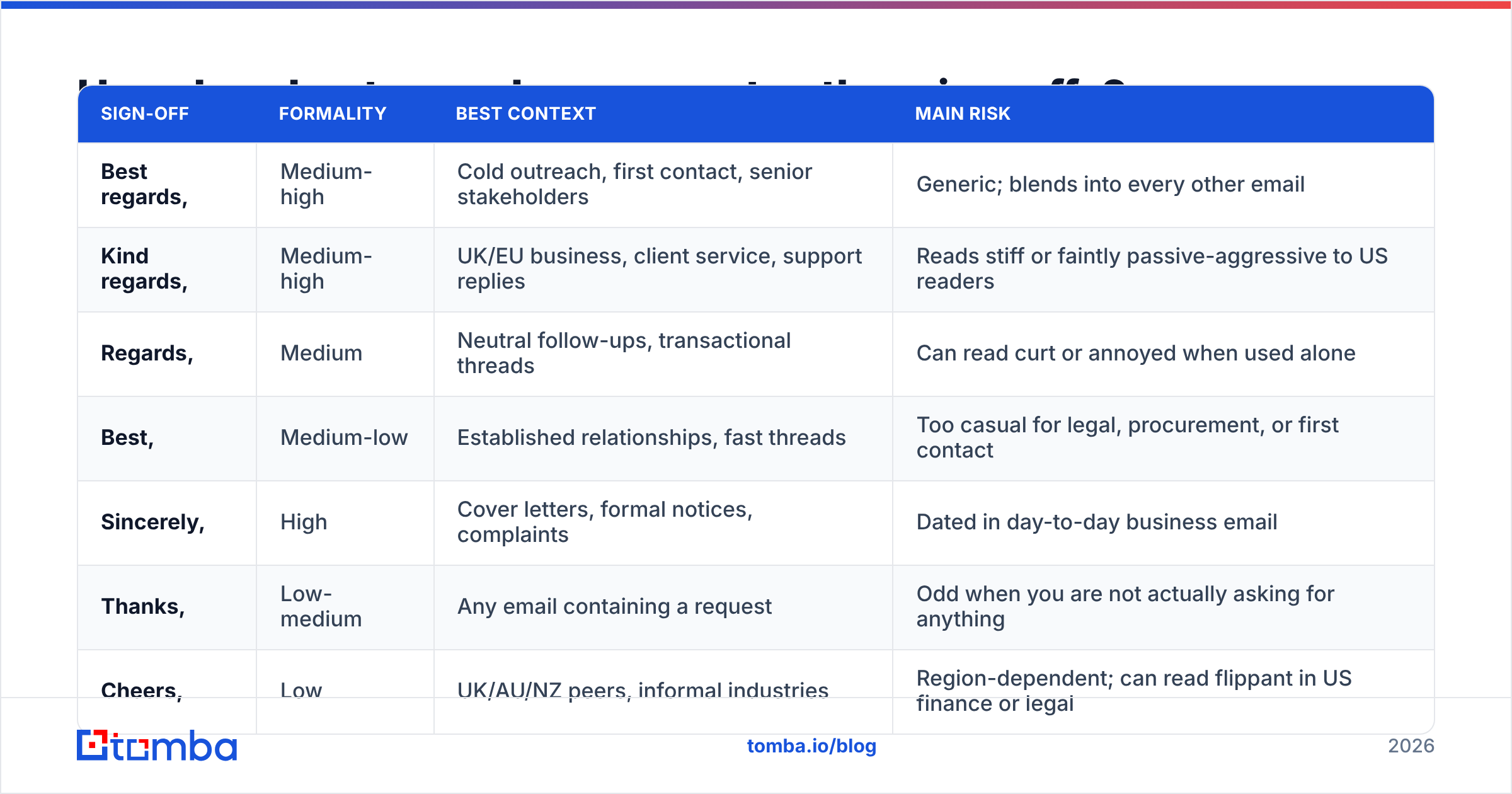
How does best regards compare to other sign-offs?#
| Sign-off | Formality | Best context | Main risk |
|---|---|---|---|
| Best regards, | Medium-high | Cold outreach, first contact, senior stakeholders | Generic; blends into every other email |
| Kind regards, | Medium-high | UK/EU business, client service, support replies | Reads stiff or faintly passive-aggressive to US readers |
| Regards, | Medium | Neutral follow-ups, transactional threads | Can read curt or annoyed when used alone |
| Best, | Medium-low | Established relationships, fast threads | Too casual for legal, procurement, or first contact |
| Sincerely, | High | Cover letters, formal notices, complaints | Dated in day-to-day business email |
| Thanks, | Low-medium | Any email containing a request | Odd when you are not actually asking for anything |
| Cheers, | Low | UK/AU/NZ peers, informal industries | Region-dependent; can read flippant in US finance or legal |
| Warmly, | Low-medium | Coaching, HR, community, long relationships | Overfamiliar with strangers; can feel performative |
| Talk soon, | Low | Post-call follow-ups where a next step exists | A small lie if no next contact is scheduled |
| (No sign-off) | Minimal | Fast internal threads, 5th+ reply in a chain | Reads abrupt on first contact or with externals |
Two things fall out of this table.
First, there is no sign-off that is right everywhere. "Best regards" is right in the most places, which is a different claim.
Second, the differences between adjacent options are small. If you are agonizing between "Best regards," and "Kind regards," you are optimizing a rounding error. Spend that attention on your subject line instead — our subject line generator and subject line tester will move your open rate far more than any valediction.
Is "Best Regards" or "Best regards" correct?#
"Best regards," with a lowercase r. Capitalize only the first word of a closing phrase, then a comma, then your name on the next line.
This is the standard in every major style guide, and it is a small credibility marker. "Best Regards" with two capitals is not wrong enough to cost you a deal, but it is one of the reliable fingerprints of a template that has been copy-pasted through six people without anyone reading it closely. The same goes for "Best Regards!" — exclamation marks belong in the body, not the close.
Format the whole block like this:
Thanks for the detail on the Q3 rollout — I'll send the revised scope Thursday.

Best regards,
Amira Haddad
Head of Partnerships, Northwind
+1 415 555 0134
Four rules for the block itself:
- One blank line between your last sentence and the sign-off.
- Comma after the sign-off, never a period or a semicolon.
- Your actual first name, not your full legal name, unless the context is formal.
- A signature that fits on a phone screen — name, role, company, one contact method. Anything longer gets skipped. If yours has accumulated banners, awards, and a quote, rebuild it with an email signature generator and cut it in half.
Does the sign-off actually change your reply rate?#
Barely. And pretending otherwise is how sales teams waste weeks.
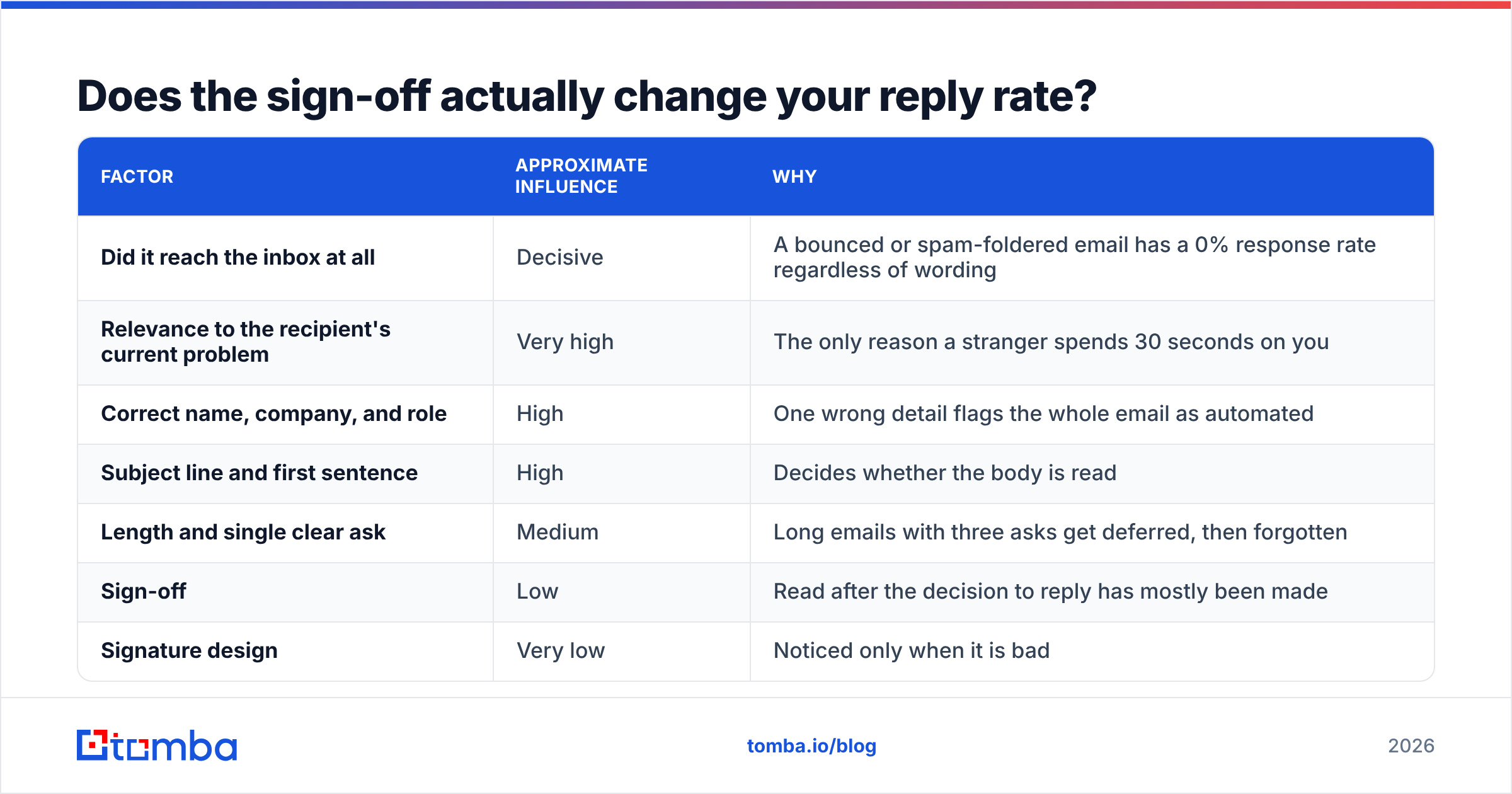
Here is a rough, honest breakdown of what determines whether a cold business email gets answered:
| Factor | Approximate influence | Why |
|---|---|---|
| Did it reach the inbox at all | Decisive | A bounced or spam-foldered email has a 0% response rate regardless of wording |
| Relevance to the recipient's current problem | Very high | The only reason a stranger spends 30 seconds on you |
| Correct name, company, and role | High | One wrong detail flags the whole email as automated |
| Subject line and first sentence | High | Decides whether the body is read |
| Length and single clear ask | Medium | Long emails with three asks get deferred, then forgotten |
| Sign-off | Low | Read after the decision to reply has mostly been made |
| Signature design | Very low | Noticed only when it is bad |
The sign-off is the last line of an email that already succeeded or failed. This is why "which closing is most professional" is a comfortable question — it is easy to answer and it changes nothing. The uncomfortable question is whether your list is accurate.

If you are running outbound at any scale, the sequence that actually matters is: build a clean list, verify every address, personalize the first line, then worry about the closing. A polished "Best regards," at the bottom of an email sent to a dead mailbox is decoration on a message nobody will see. Catching those before you send is what an email verifier is for, and getting the name and role right in the first place is the job of data enrichment.
For the broader mechanics of getting into the inbox, HubSpot's sales resource library covers sequencing and follow-up cadence well, and G2's reviews of sales engagement tools are a reasonable sanity check before you buy anything in this category.
What are the most common sign-off mistakes?#
Rotating sign-offs inside one thread. You open with "Best regards," reply with "Cheers," and close with "Warmly,". It reads as inconsistent — or worse, as three different people operating one mailbox. Pick a formal default and a casual default, then stick to them.
Using "Regards," alone when you are frustrated. A bare "Regards," after a tense exchange is read as a slammed door in roughly every office on earth. If you are annoyed, that is exactly when to use the full "Best regards," — the extra word neutralizes the tone.
Sign-offs that promise things. "Talk soon," when no call is booked. "Looking forward to your reply," when you have no reason to expect one. These read as pressure. If you want a next step, put it in the body as a specific ask with a date.
Stacking closers. "Thanks so much in advance for your time and consideration, I really appreciate it. Best regards," is four closings in a trench coat. One is enough.
Templated warmth. "Warmly," to someone who has never heard of you is a mismatch between the claimed relationship and the actual one, and readers feel it instantly even if they cannot articulate why. Warmth has to be earned by the body of the email.
Forgetting the sign-off exists in automated sequences. Merge-field errors, double signatures from your client and your sequencing tool, and stray HTML all cluster at the bottom of the email. Send a test to yourself on mobile before every campaign. If you are building sequences from scratch, our library of cold email templates gives you closes that have already been cleaned up.
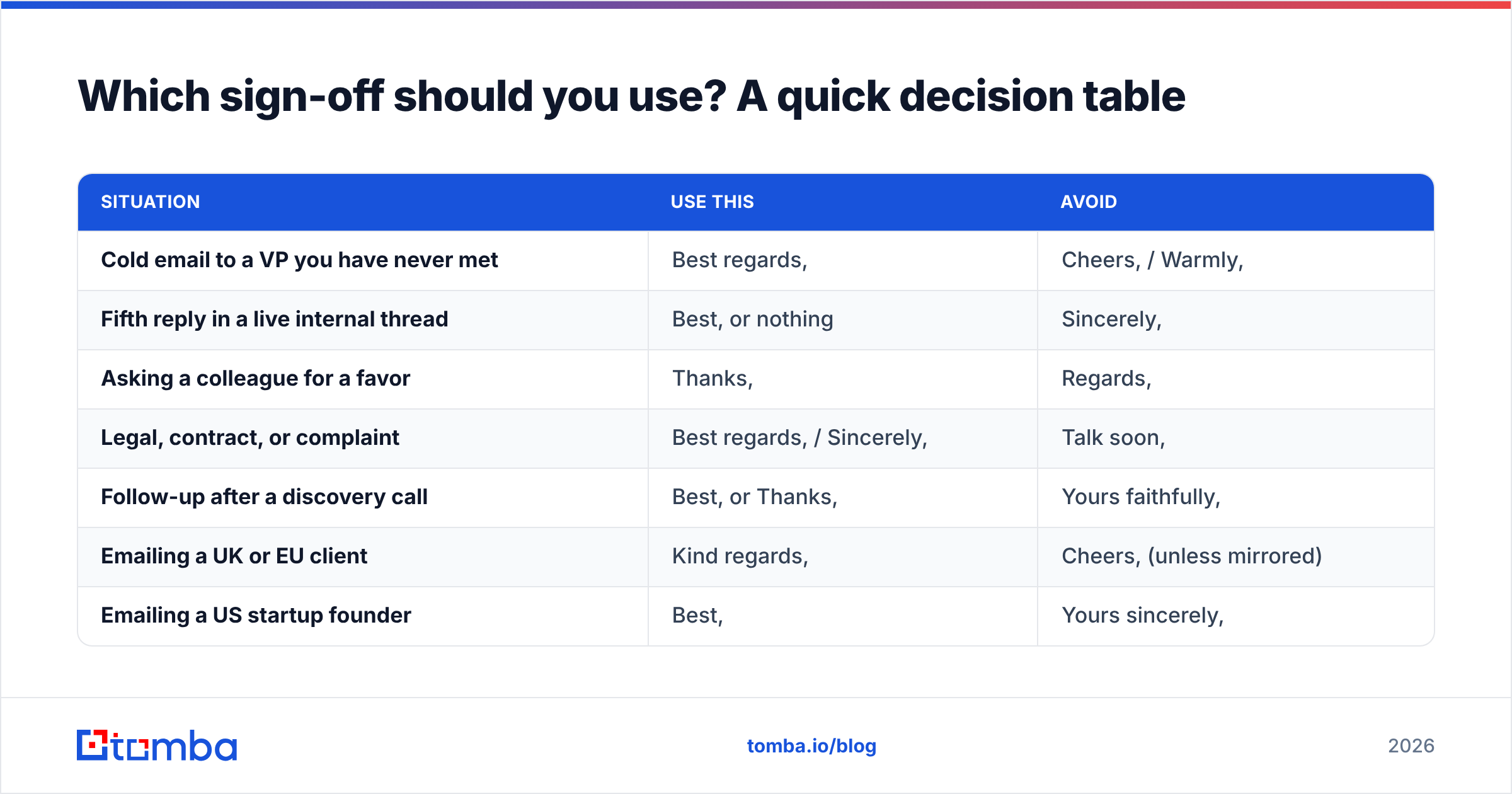
Which sign-off should you use? A quick decision table#
| Situation | Use this | Avoid |
|---|---|---|
| Cold email to a VP you have never met | Best regards, | Cheers, / Warmly, |
| Fifth reply in a live internal thread | Best, or nothing | Sincerely, |
| Asking a colleague for a favor | Thanks, | Regards, |
| Legal, contract, or complaint | Best regards, / Sincerely, | Talk soon, |
| Follow-up after a discovery call | Best, or Thanks, | Yours faithfully, |
| Emailing a UK or EU client | Kind regards, | Cheers, (unless mirrored) |
| Emailing a US startup founder | Best, | Yours sincerely, |
| Customer support resolution | Kind regards, / Thanks, | Warmly, |
Print that, or do not. The underlying rule is two sentences long: default to "Best regards," when the relationship is undefined, and mirror the other person once it is defined.
The part that actually moves your numbers#
"Best regards" is professional. It was professional in 2016, it is professional in 2026, and it will still be professional when whatever replaces email finally arrives. You can stop thinking about it.
What deserves the attention you were about to spend on your closing line is the accuracy of the address you are sending to. A perfectly written email to a guessed address bounces, damages your sender reputation, and quietly degrades every campaign you run afterward.
Start there. Use the Tomba Email Finder to get the verified business address behind a name and a domain, confirm it before it enters your sequence, and then close however you like. The free tier covers 25 searches a month; paid plans start at $49/mo on Starter, with Growth at $99/mo — full Tomba pricing is on the site. Get the address right, and the sign-off takes care of itself.
Related guides#
// get started
Find, verify and enrich your first contacts today
Start on the free plan with 25 searches a month, then scale when your team is ready.
Free plan · No credit card required · GDPR & CCPA
Get the Tomba newsletter
Product and data updates
// about the author