Is Business Development Sales or Marketing? A 2026 Breakdown
Business development gets filed under sales at one company and marketing at the next. Here is where BD actually belongs, what the role owns, who it should report to, and how to measure it.
TL;DR
- Business development is neither sales nor marketing in the strict sense. It is a market-creation function that borrows the research habits of marketing and the conversation habits of sales.
- In practice, 2026 org charts put BD under sales roughly two-thirds of the time, because BD is measured on pipeline and pipeline lives in the sales org.
- The split that matters is not "sales vs marketing" but transactional BD (outbound SDR/BDR work) vs strategic BD (partnerships, channels, new markets). They need different people, different comp plans, and different bosses.
- Getting the reporting line wrong is expensive: BD under marketing gets measured on MQLs it cannot control; BD under sales gets quota-crushed out of doing long-cycle partnership work.
- Whatever the reporting line, BD only works on top of clean contact data. Bad emails and stale titles kill BD faster than a bad script.
What is business development, actually?#
Business development is the work of creating new ways for a company to make money — new segments, new partners, new channels, new geographies — and then proving those ways are real by sourcing the first deals.
Think of a company as a restaurant. Marketing designs the sign, the menu, and the smell that drifts onto the sidewalk. Sales is the server who takes the order from someone already seated. Business development is the person who goes out and asks whether a second location near the stadium would work, talks to the stadium operator about a concession deal, and brings back the first three catering contracts to prove it.
That is why the question "is business development sales or marketing" never resolves cleanly. BD does demand generation like marketing and direct outreach like sales, but its output is neither leads nor closed revenue. Its output is validated access to a market that did not exist for you last quarter. Wikipedia's definition of business development leans the same direction: it frames BD as the creation of long-term value through customers, markets, and relationships — three words that deliberately span both departments.
Is business development sales or marketing?#
Short answer: it is a sales-adjacent function that uses marketing's tools, and in most 2026 org charts it reports to the sales or revenue leader.
Here is the honest reasoning.
BD gets measured on pipeline — meetings booked, opportunities created, partner-sourced revenue. Pipeline is a sales metric. If you park BD under a CMO who is graded on MQLs, brand, and content velocity, BD's numbers become orphans in the marketing dashboard. Within two quarters someone asks why the BD team is not writing case studies.
But BD's methods are marketing methods. A good BD rep does segment research, builds an ICP hypothesis, tests messaging against it, and reads the response data like a campaign analyst. They are running a manual, high-touch campaign with a sample size of 300 instead of 30,000.
So the accurate framing is: BD is sales by reporting line, marketing by method, and strategy by intent.

How does BD differ from sales and marketing day to day?#
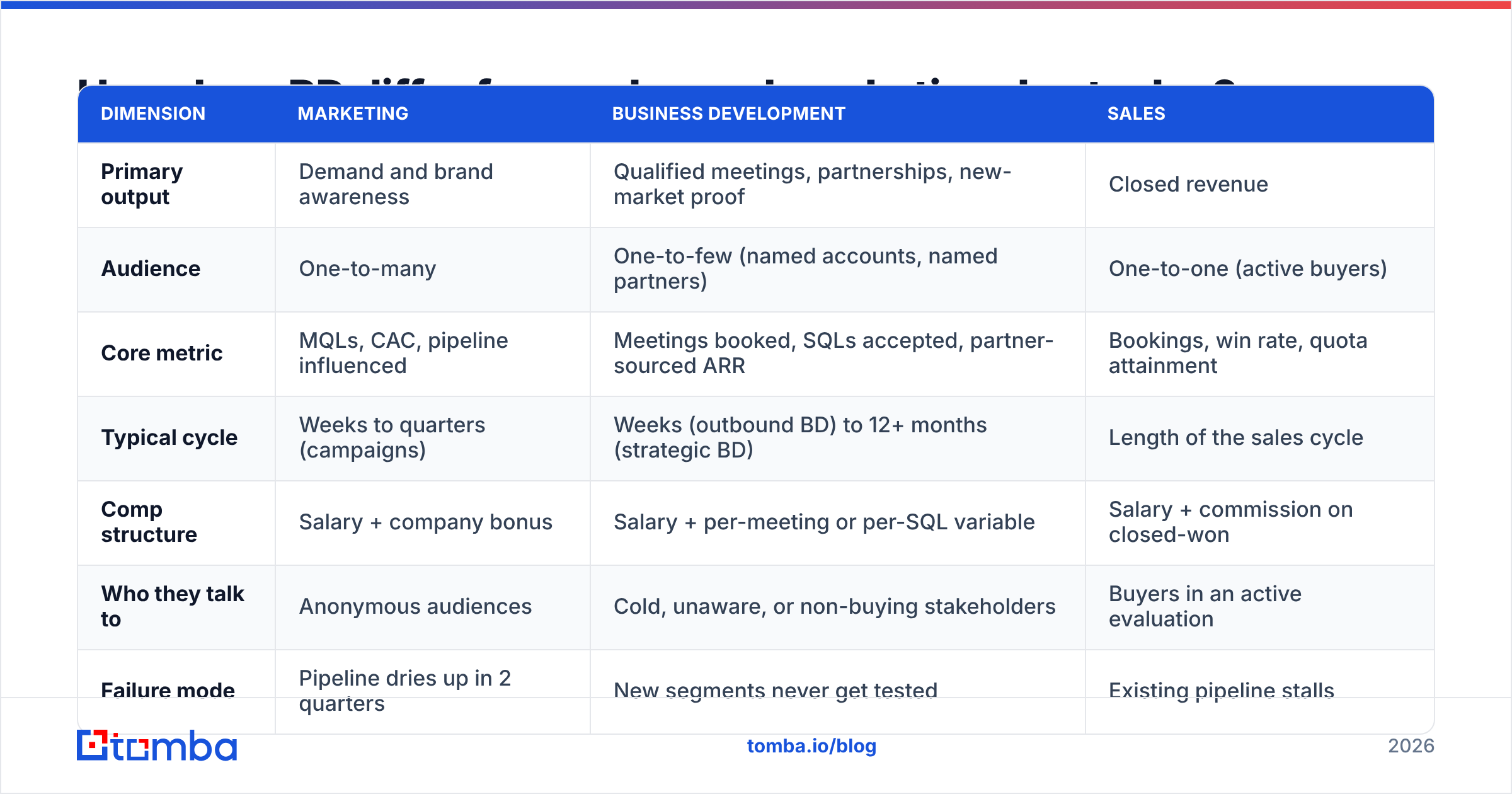
The clearest way to see the boundary is to put the three functions side by side on the things that actually differ — what they own, how they are paid, and what breaks when they fail.
| Dimension | Marketing | Business Development | Sales |
|---|---|---|---|
| Primary output | Demand and brand awareness | Qualified meetings, partnerships, new-market proof | Closed revenue |
| Audience | One-to-many | One-to-few (named accounts, named partners) | One-to-one (active buyers) |
| Core metric | MQLs, CAC, pipeline influenced | Meetings booked, SQLs accepted, partner-sourced ARR | Bookings, win rate, quota attainment |
| Typical cycle | Weeks to quarters (campaigns) | Weeks (outbound BD) to 12+ months (strategic BD) | Length of the sales cycle |
| Comp structure | Salary + company bonus | Salary + per-meeting or per-SQL variable | Salary + commission on closed-won |
| Who they talk to | Anonymous audiences | Cold, unaware, or non-buying stakeholders | Buyers in an active evaluation |
| Failure mode | Pipeline dries up in 2 quarters | New segments never get tested | Existing pipeline stalls |
| Usually reports to | CMO | CRO / VP Sales (sometimes CEO) | CRO / VP Sales |
Two rows in that table do most of the arguing. "Audience" is why BD feels like marketing — BD talks to people who are not buying anything today. "Core metric" is why BD lives in sales — meetings and SQLs roll up to a revenue number, not a brand number.
What does a business development rep actually do all day?#
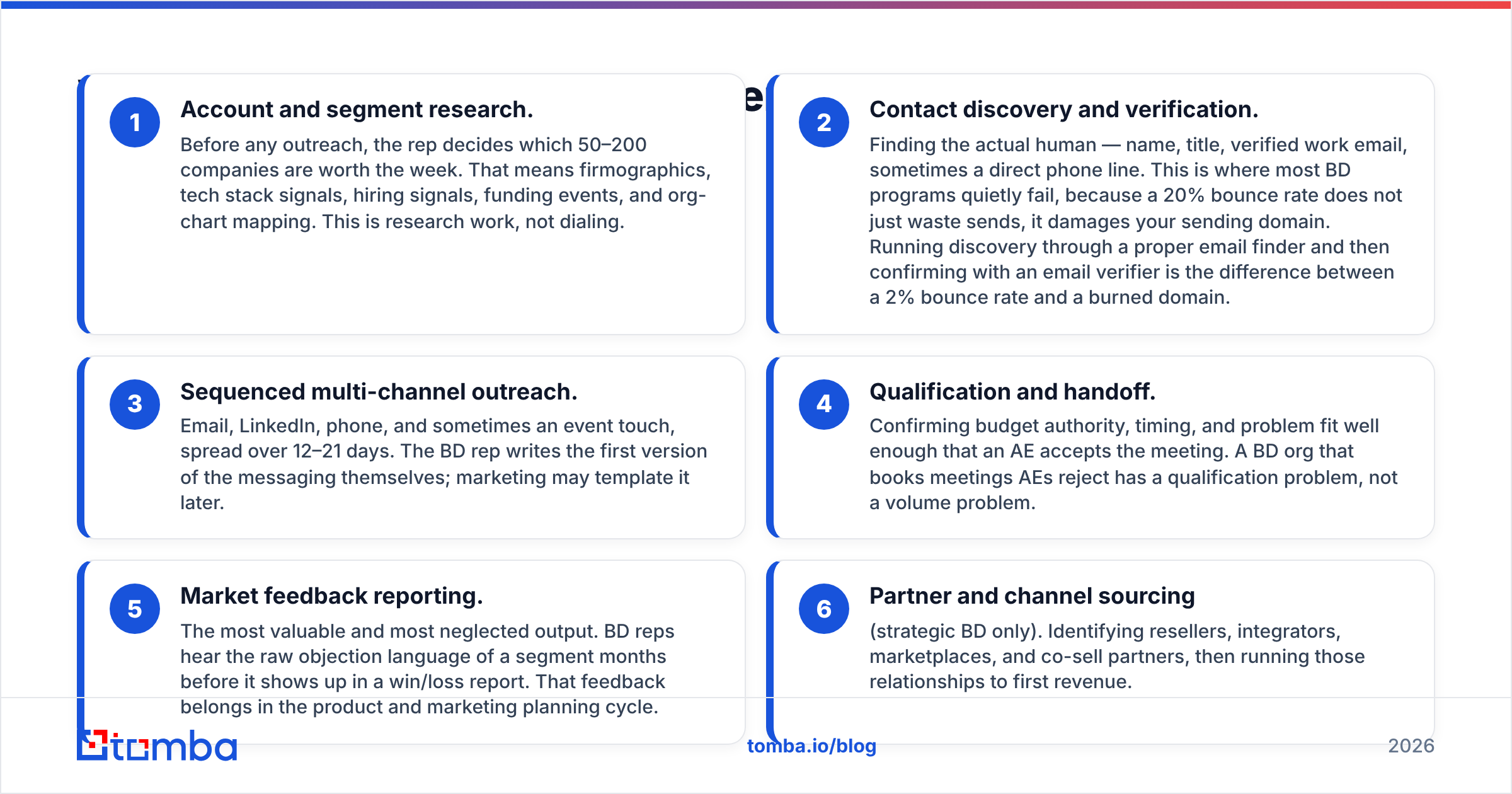
If you strip away the job-title inflation, the BDR day decomposes into five repeatable jobs. This is the part hiring managers consistently underestimate.
- Account and segment research. Before any outreach, the rep decides which 50–200 companies are worth the week. That means firmographics, tech stack signals, hiring signals, funding events, and org-chart mapping. This is research work, not dialing.
- Contact discovery and verification. Finding the actual human — name, title, verified work email, sometimes a direct phone line. This is where most BD programs quietly fail, because a 20% bounce rate does not just waste sends, it damages your sending domain. Running discovery through a proper email finder and then confirming with an email verifier is the difference between a 2% bounce rate and a burned domain.
- Sequenced multi-channel outreach. Email, LinkedIn, phone, and sometimes an event touch, spread over 12–21 days. The BD rep writes the first version of the messaging themselves; marketing may template it later.
- Qualification and handoff. Confirming budget authority, timing, and problem fit well enough that an AE accepts the meeting. A BD org that books meetings AEs reject has a qualification problem, not a volume problem.
- Market feedback reporting. The most valuable and most neglected output. BD reps hear the raw objection language of a segment months before it shows up in a win/loss report. That feedback belongs in the product and marketing planning cycle.
- Partner and channel sourcing (strategic BD only). Identifying resellers, integrators, marketplaces, and co-sell partners, then running those relationships to first revenue.
Items 1, 2, and 5 are marketing-shaped. Items 3, 4, and 6 are sales-shaped. That is the whole tension in one list.
What is the difference between transactional BD and strategic BD?#
This is the distinction that actually changes how you hire — and it matters far more than the sales-versus-marketing debate.
Transactional BD (the BDR/SDR model) is volume outbound. The rep owns a target list, a sequence, and a meeting quota. Cycle time is measured in days. You hire for resilience, coachability, and writing ability. You promote into AE roles in 12–18 months. This function belongs under sales, full stop.
Strategic BD (the partnerships model) is low-volume, high-stakes. One person might work six relationships for a year. You hire for commercial judgment, contract literacy, and the patience to survive a 9-month integration review. Measuring this person on meetings booked is malpractice. This function often belongs directly under the CEO or a Chief Partnership Officer, especially in companies under 200 people.
Companies get into trouble when they hire a transactional BDR and hand them a strategic BD mandate — or worse, when they hire a strategic BD leader and then put a weekly meeting quota on them. HubSpot's sales resource library has years of data showing the same pattern: BD roles with mismatched comp plans churn faster than any other GTM seat.
Who should business development report to?#
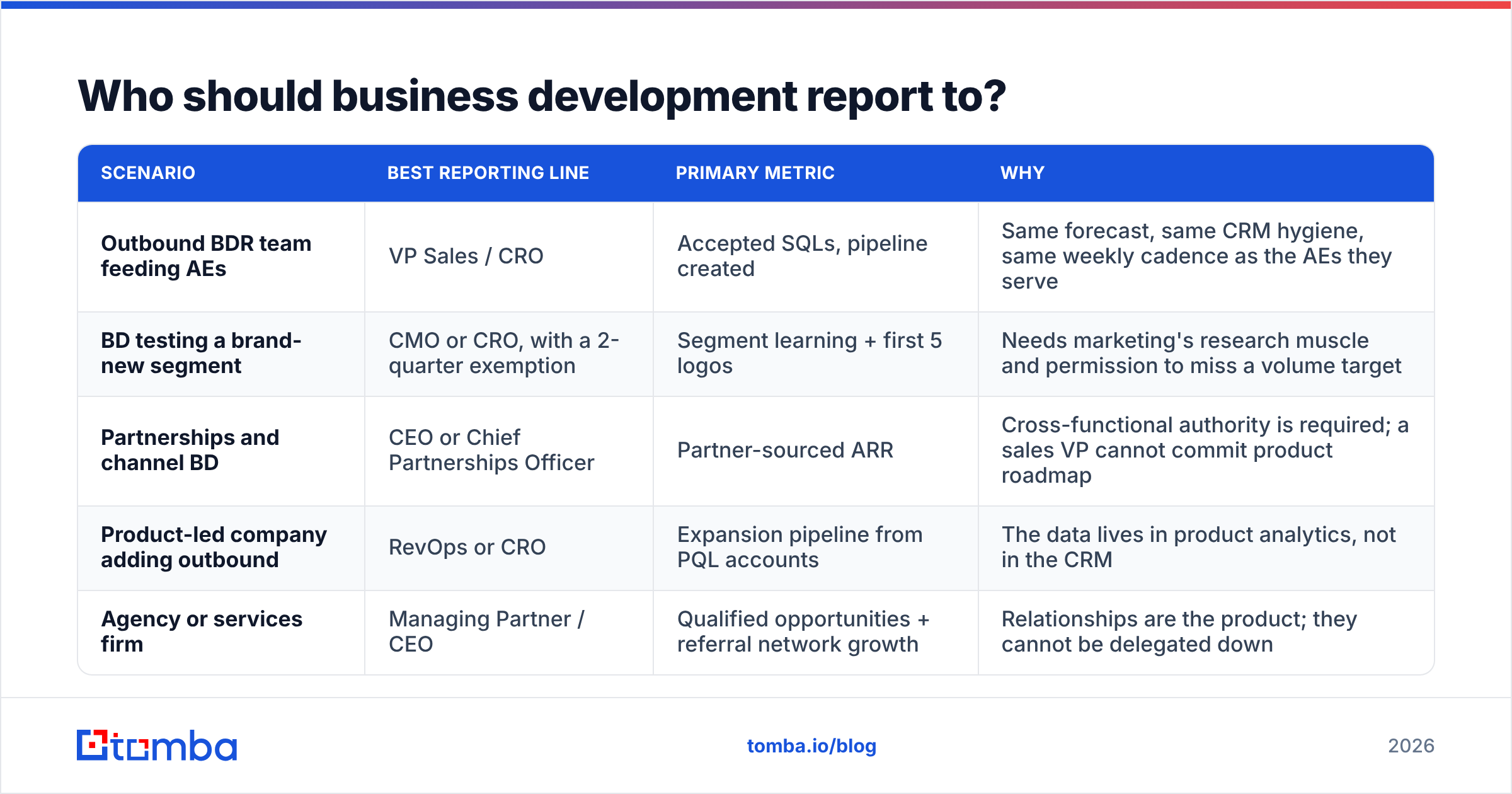
Pick the reporting line from the mandate, not from the headcount budget.
| Scenario | Best reporting line | Primary metric | Why |
|---|---|---|---|
| Outbound BDR team feeding AEs | VP Sales / CRO | Accepted SQLs, pipeline created | Same forecast, same CRM hygiene, same weekly cadence as the AEs they serve |
| BD testing a brand-new segment | CMO or CRO, with a 2-quarter exemption | Segment learning + first 5 logos | Needs marketing's research muscle and permission to miss a volume target |
| Partnerships and channel BD | CEO or Chief Partnerships Officer | Partner-sourced ARR | Cross-functional authority is required; a sales VP cannot commit product roadmap |
| Product-led company adding outbound | RevOps or CRO | Expansion pipeline from PQL accounts | The data lives in product analytics, not in the CRM |
| Agency or services firm | Managing Partner / CEO | Qualified opportunities + referral network growth | Relationships are the product; they cannot be delegated down |
The rule underneath the table: whoever is accountable for the number BD produces should own BD. If nobody can name that number, you do not have a reporting-line problem, you have a strategy problem.

How do you measure business development in 2026?#
Stop measuring activity. Measure acceptance and progression.
The metrics that hold up:
- Accepted meetings, not booked meetings. A meeting only counts once the AE accepts it into the pipeline. This single change ends the volume-gaming problem overnight.
- SQL-to-opportunity conversion. If BD-sourced meetings convert to opportunities at less than half the rate of inbound, your targeting is off, not your scripts.
- Pipeline-to-close rate by source. BD-sourced deals often close at a lower rate but a higher ACV than inbound. Track both, and compare the blended CAC.
- Time-to-first-revenue for partners. For strategic BD, this is the only metric that matters in year one.
- Data health. Bounce rate, catch-all rate, and contact freshness. Gartner's research on B2B sales and revenue technology has consistently flagged data decay as the top hidden tax on outbound performance — roughly a quarter to a third of B2B contact records go stale each year through job changes alone.
That last one is unglamorous and decisive. A BD team with a 25% stale-contact rate is running at 75% capacity before anyone writes a subject line. Routine contact enrichment and periodic re-verification of the account list are maintenance work, not optional projects.
Does the answer change for small companies?#
Yes, and it changes in a predictable way.
Under roughly 20 employees, business development is the founder. There is no meaningful split between sales and marketing because one person does both, plus the partnership calls. The right move is not to hire a BD title — it is to give the founder better lists and better tooling so their outreach hours convert.
Between 20 and 100 employees, BD becomes the first specialized outbound seat, reporting to whoever owns revenue. This is where the MQL handoff definitions need to be written down, because ambiguity here produces the classic "marketing says it sent 400 leads, sales says it got 12" argument.
Above 100 employees, the transactional and strategic branches should formally separate. Trying to keep them in one team past this point produces a department that is mediocre at both.
Note that in services businesses, agencies, and consultancies, BD stays closer to marketing for far longer — because thought leadership is the prospecting channel. A partner writing a well-read industry piece is doing business development through a marketing instrument. Salesforce's sales operations material documents this variance across industries well; the function is genuinely shaped by how buyers in your category prefer to be reached.
What should you do with this?#
Answer three questions in writing, this week:
- Is your BD mandate transactional, strategic, or both? If "both," you need two comp plans.
- What single number is BD accountable for? Name it, then confirm the person BD reports to is also accountable for it.
- How fresh is the contact data BD is working from? If you cannot answer, that is your first fix.
The organizational debate is genuinely interesting, but it is downstream of execution. A BD team under the "wrong" leader with verified contact data and clear qualification criteria will outperform a perfectly organized BD team emailing addresses scraped eighteen months ago.
Give your BD team lists that actually connect#
Business development lives or dies on whether the message reaches a real person at a real address. Tomba's Email Finder resolves verified work emails from a name and domain, with domain search for mapping entire target accounts and built-in verification so your bounce rate stays where your deliverability needs it. Start on the free tier at 25 searches per month, or move to Starter at $49/mo when your BD motion is running daily; full Tomba pricing scales to Growth at $99/mo and Pro at $249/mo. Fix the data layer first — then argue about the org chart.
Related guides#
// get started
Find, verify and enrich your first contacts today
Start on the free plan with 25 searches a month, then scale when your team is ready.
Free plan · No credit card required · GDPR & CCPA
Get the Tomba newsletter
Product and data updates
// about the author