Is Cold Calling Dead in 2026? What the Data Actually Says
Cold calling isn't dead — but the version most reps were taught is. Here's what connect rates look like in 2026, which calls still book meetings, and how to stop burning dials on bad data.
TL;DR
- Cold calling is not dead. The spray-and-pray version of it is — random lists, no research, 100 dials a day at whatever number a scraper coughed up.
- Connect rates on mobile-verified, well-researched lists routinely land in the 8-15% range. Connect rates on stale office lines sit closer to 1-2%. Same activity, ten times the output difference. The variable is data, not the channel.
- Phone still wins on speed-to-meeting for mid-market and enterprise. Email still wins on scale and cost per touch. The teams hitting quota use both, sequenced.
- The biggest hidden tax on calling is dialing wrong numbers: direct dials rot at roughly 25-30% a year as people change roles.
- Fix the list before you fix the script. A verified mobile number plus a researched opener beats a clever pitch delivered to a disconnected desk phone.
Is cold calling dead in 2026?#
No — but the honest answer is more useful than the headline. Cold calling as a volume game is mostly dead. Cold calling as a precision game is one of the highest-conversion channels left in B2B, precisely because so many teams abandoned it for automated email.
Here's the tension every sales leader feels. Inboxes are saturated. Google and Microsoft tightened bulk-sender rules, spam filters got smarter, and reply rates on unsegmented cold email have compressed for three straight years. Meanwhile the phone — the channel everyone declared dead in 2019 — has less competition on it than at any point in the last decade. Fewer reps calling means the buyers who do pick up are hearing from three vendors a week instead of thirty.
The catch: picking up is rarer, and the cost of a wasted dial is much higher than the cost of a wasted email. A bad email costs you a fraction of a cent. A bad dial costs you 90 seconds of a rep's day. At 60 dials a day with a 2% connect rate, you are paying a fully-loaded rep to listen to voicemail beeps for six hours.
That math is the whole argument. Cold calling dies when your list is bad. It thrives when your list is good.
What do the numbers actually say about cold call connect rates?#
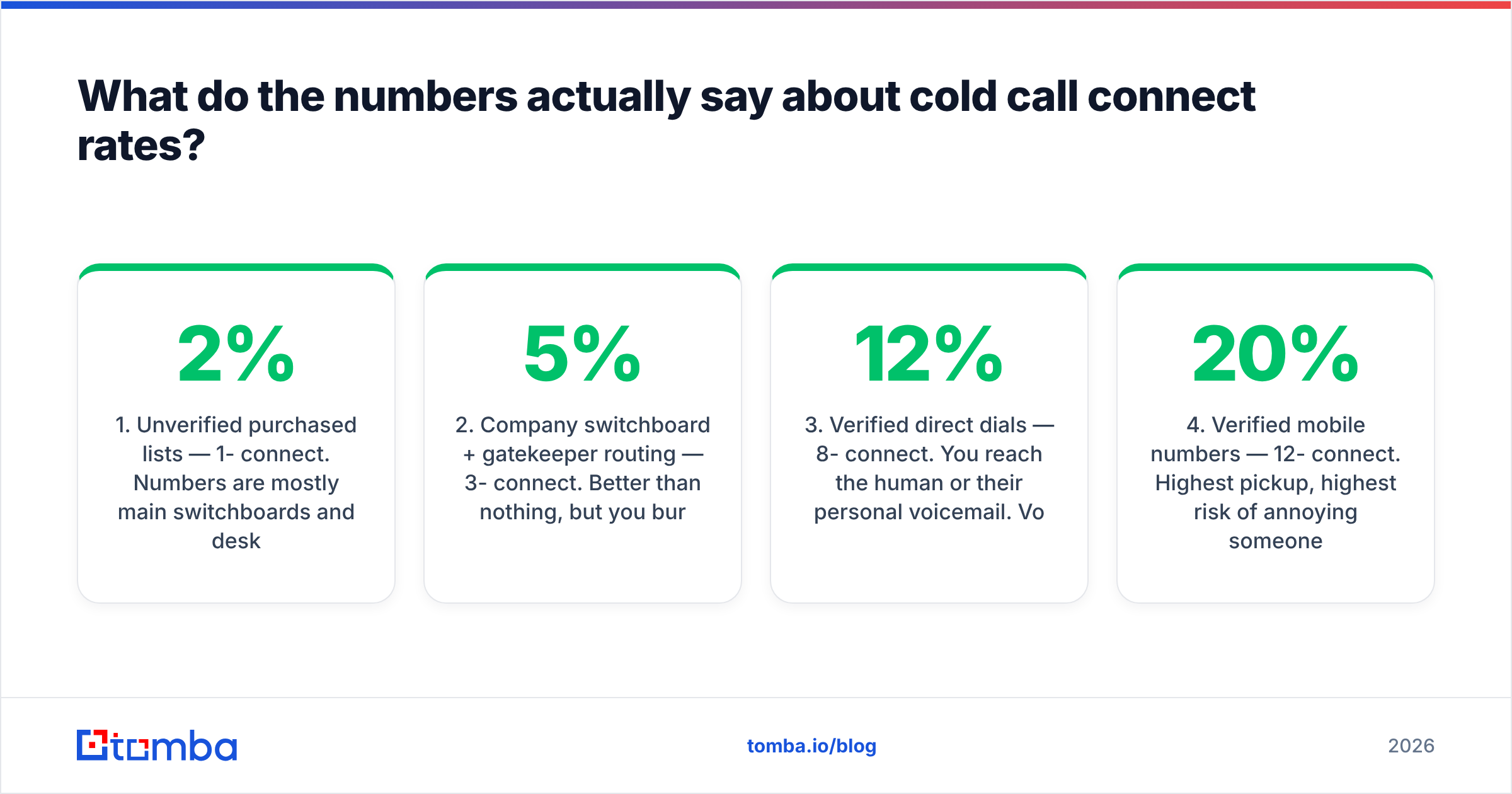
Published benchmarks vary wildly because "connect rate" means different things to different teams. Here's the range you see across most B2B SaaS and services orgs, and what drives the spread:
- Unverified purchased lists — 1-2% connect. Numbers are mostly main switchboards and desk lines nobody sits at anymore. Most dials die in a directory tree.
- Company switchboard + gatekeeper routing — 3-5% connect. Better than nothing, but you burn a quarter of every call on navigation, and gatekeepers are trained to block.
- Verified direct dials — 8-12% connect. You reach the human or their personal voicemail. Voicemail here is actually valuable because it's tied to a real identity.
- Verified mobile numbers — 12-20% connect. Highest pickup, highest risk of annoying someone at a bad moment. Works best with warm context (they downloaded something, viewed pricing, changed jobs).
- Triggered calls on an intent signal — 15-25% connect and far higher meeting rates. The call has a reason attached to it. "I saw you're hiring three SDRs" converts differently than "I'm calling about our platform."
Dial-to-meeting ratios follow the same ladder. Industry-wide, teams commonly report somewhere between 1 meeting per 40 dials (good) and 1 per 150+ (typical). HubSpot's sales research library and Gartner's sales practice both land on the same structural point: buyer accessibility, not rep effort, is the constraint.
The number nobody puts on a slide: contact data decay. B2B contact records go stale at roughly 25-30% per year, and direct dials rot faster than email addresses because people keep an inbox through a role change but drop the desk phone immediately. A list you bought 14 months ago is, statistically, about a third fiction.
Why does cold calling feel dead to most reps?#
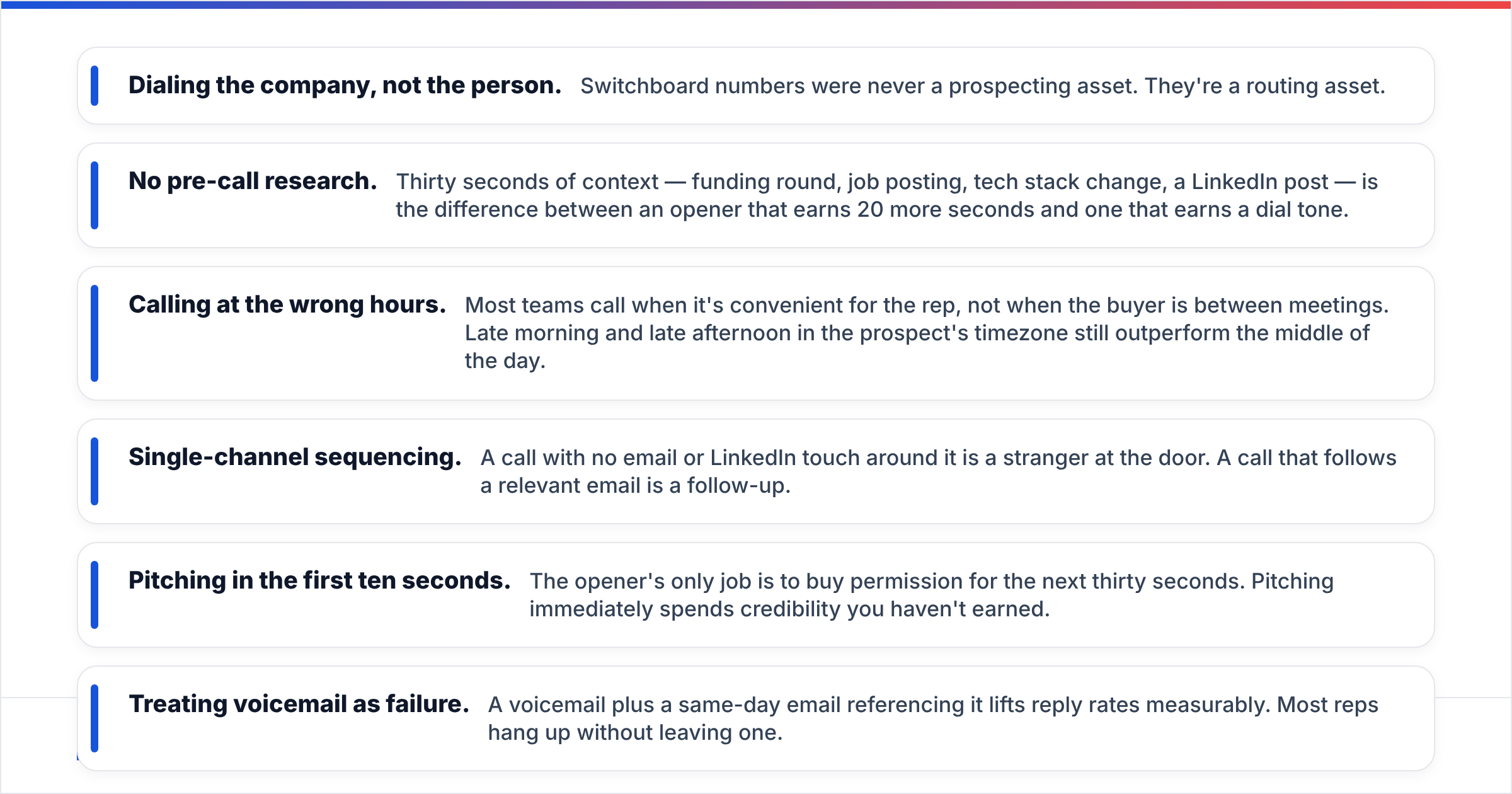
Because the thing they're doing genuinely doesn't work. Six failure modes account for almost all of it:
- Dialing the company, not the person. Switchboard numbers were never a prospecting asset. They're a routing asset.
- No pre-call research. Thirty seconds of context — funding round, job posting, tech stack change, a LinkedIn post — is the difference between an opener that earns 20 more seconds and one that earns a dial tone.
- Calling at the wrong hours. Most teams call when it's convenient for the rep, not when the buyer is between meetings. Late morning and late afternoon in the prospect's timezone still outperform the middle of the day.
- Single-channel sequencing. A call with no email or LinkedIn touch around it is a stranger at the door. A call that follows a relevant email is a follow-up.
- Pitching in the first ten seconds. The opener's only job is to buy permission for the next thirty seconds. Pitching immediately spends credibility you haven't earned.
- Treating voicemail as failure. A voicemail plus a same-day email referencing it lifts reply rates measurably. Most reps hang up without leaving one.
Fix those six and calling stops feeling dead — without changing a single word of your value prop.
Cold calling vs cold email vs LinkedIn: which channel actually wins?#
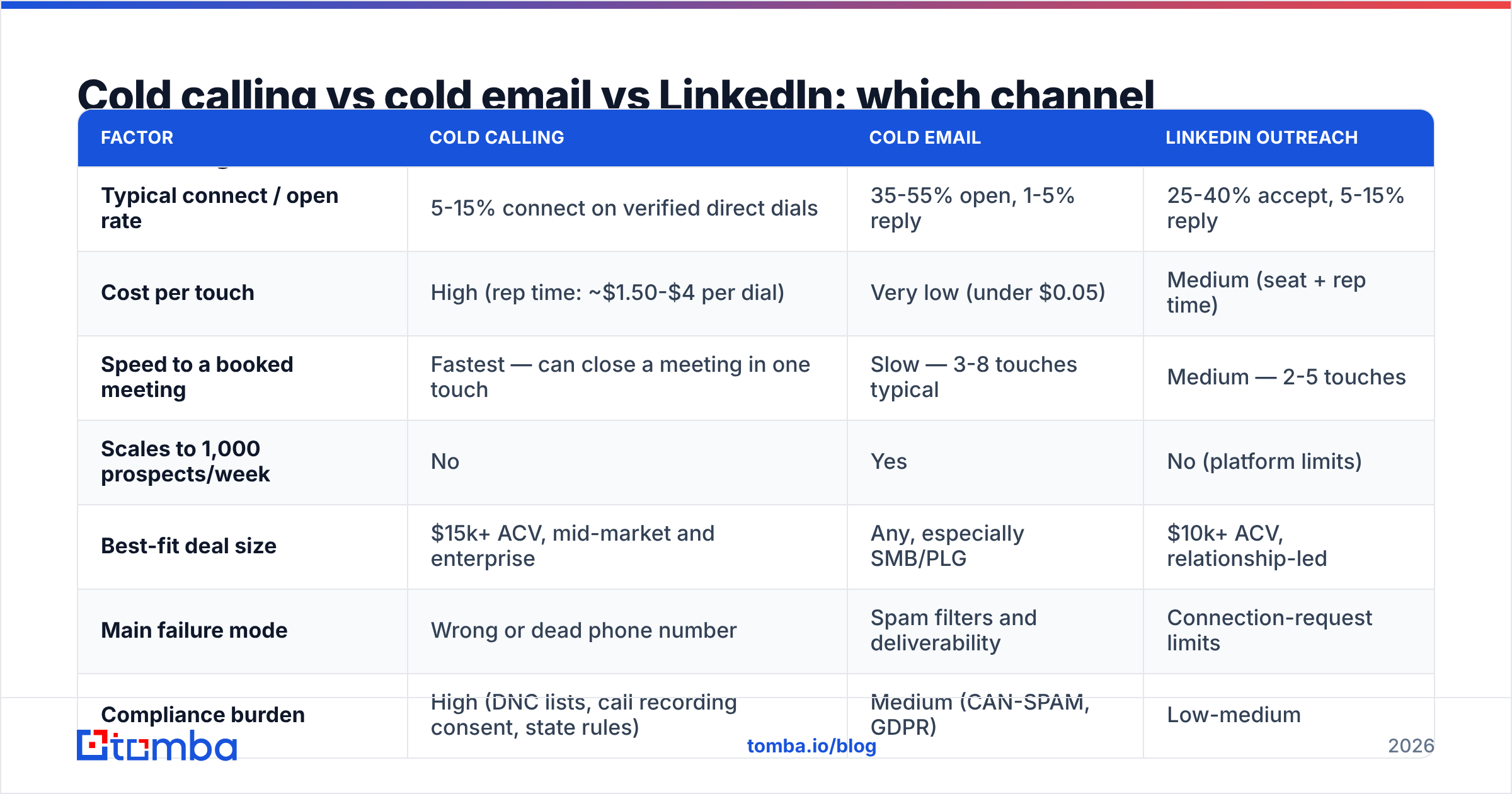
None of them wins outright. They win different jobs. Here's the honest side-by-side:
| Factor | Cold calling | Cold email | LinkedIn outreach |
|---|---|---|---|
| Typical connect / open rate | 5-15% connect on verified direct dials | 35-55% open, 1-5% reply | 25-40% accept, 5-15% reply |
| Cost per touch | High (rep time: ~$1.50-$4 per dial) | Very low (under $0.05) | Medium (seat + rep time) |
| Speed to a booked meeting | Fastest — can close a meeting in one touch | Slow — 3-8 touches typical | Medium — 2-5 touches |
| Scales to 1,000 prospects/week | No | Yes | No (platform limits) |
| Best-fit deal size | $15k+ ACV, mid-market and enterprise | Any, especially SMB/PLG | $10k+ ACV, relationship-led |
| Main failure mode | Wrong or dead phone number | Spam filters and deliverability | Connection-request limits |
| Compliance burden | High (DNC lists, call recording consent, state rules) | Medium (CAN-SPAM, GDPR) | Low-medium |
| Data you must have right | Verified mobile/direct dial | Verified, deliverable email | Accurate LinkedIn profile URL |
Read the table as a routing rule, not a verdict. If your ACV is $8k and you need 400 conversations a month, calling is economically irrational — email and LinkedIn outreach carry the volume. If your ACV is $60k and you have 300 named accounts for the year, every one of those accounts deserves a dial, and email is the support channel.
The strongest pattern in 2026 is the sequenced triple: a researched email Monday, a LinkedIn touch Tuesday, a call Wednesday that references both. Each channel makes the next one cheaper.
What kind of cold calling still works in 2026?#
Three formats survive, and they share one trait: the call has a reason to exist beyond your quota.
The trigger call. Something changed at the account — a funding round, a new VP in your buyer persona, a tech stack swap, a hiring spree in a department you serve. You call within days. The opener writes itself: "I saw you just brought on a new Head of RevOps — most teams re-evaluate their data stack in the first 90 days. Is that on your list?"
The warm-signal call. Someone from the account hit your pricing page, opened three emails, or downloaded a comparison guide. You're not cold, you're ambiguous — and ambiguity is a great reason to call. Website visitor identification turns anonymous traffic into a named account you can actually dial.
The referral-adjacent call. You spoke with someone else at the company, or in the same portfolio, or at a peer company solving the identical problem. The opener carries borrowed credibility, which is the only kind available on a first call.
What's dead: calling down an alphabetical list of companies in an industry vertical with a generic pitch. That was already marginal in 2016. In 2026 it is a payroll expense with no output.
/blog/generated/memes/2026-09-14/is-cold-calling-dead-meme-2.png
How do you build a call list that doesn't waste dials?#
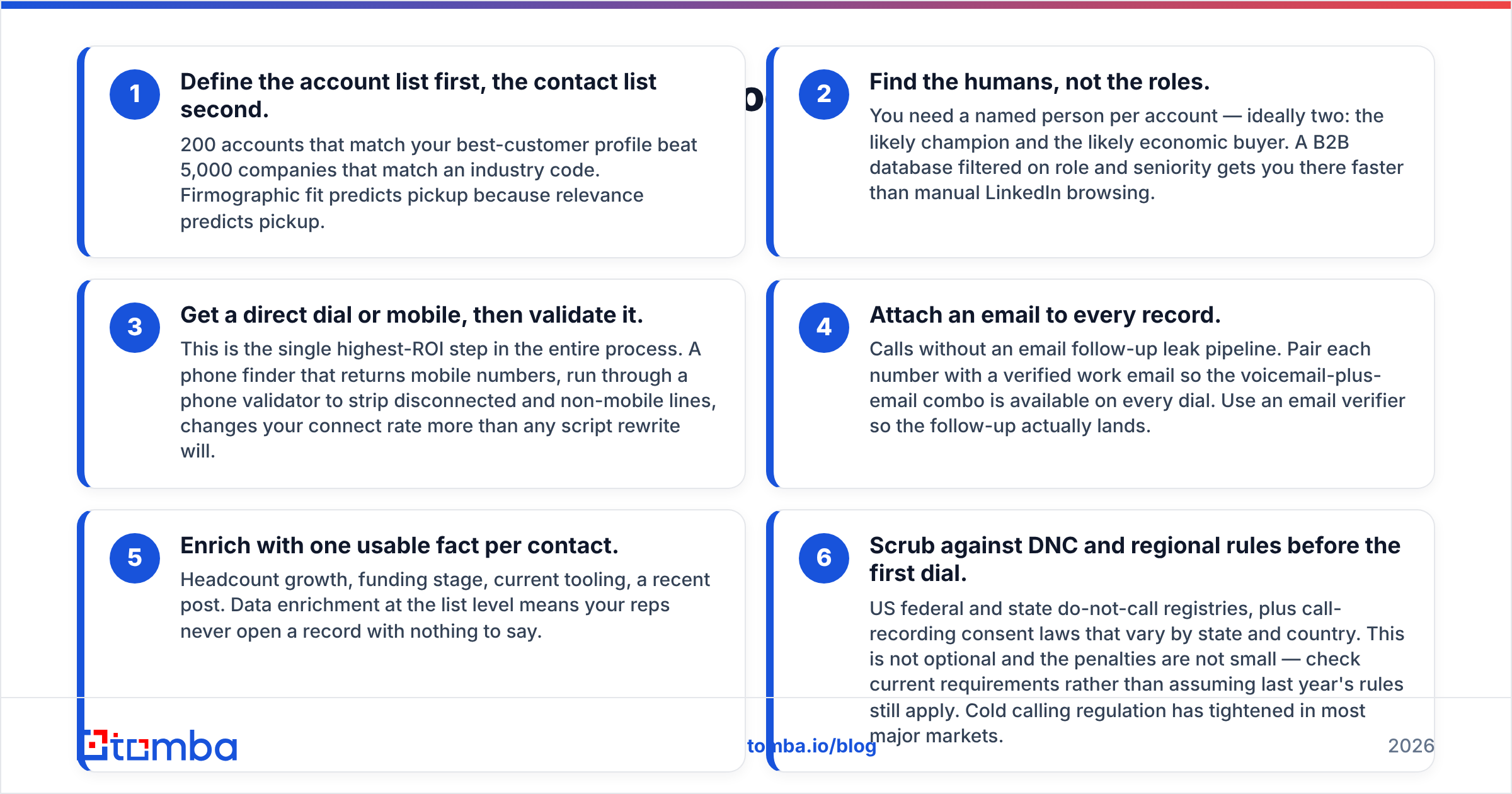
This is where most of the leverage sits, and it's unglamorous. A five-step build:
- Define the account list first, the contact list second. 200 accounts that match your best-customer profile beat 5,000 companies that match an industry code. Firmographic fit predicts pickup because relevance predicts pickup.
- Find the humans, not the roles. You need a named person per account — ideally two: the likely champion and the likely economic buyer. A B2B database filtered on role and seniority gets you there faster than manual LinkedIn browsing.
- Get a direct dial or mobile, then validate it. This is the single highest-ROI step in the entire process. A phone finder that returns mobile numbers, run through a phone validator to strip disconnected and non-mobile lines, changes your connect rate more than any script rewrite will.
- Attach an email to every record. Calls without an email follow-up leak pipeline. Pair each number with a verified work email so the voicemail-plus-email combo is available on every dial. Use an email verifier so the follow-up actually lands.
- Enrich with one usable fact per contact. Headcount growth, funding stage, current tooling, a recent post. Data enrichment at the list level means your reps never open a record with nothing to say.
- Scrub against DNC and regional rules before the first dial. US federal and state do-not-call registries, plus call-recording consent laws that vary by state and country. This is not optional and the penalties are not small — check current requirements rather than assuming last year's rules still apply. Cold calling regulation has tightened in most major markets.
Do those six and a rep's day changes shape: fewer dials, more conversations, better conversations.
What does a modern cold call actually sound like?#
Short. Permission-based. Research-led. Roughly:
"Hi Dana — Mo from Tomba. I know I'm interrupting. I saw you posted two SDR roles last week. When teams scale outbound that fast, list quality usually breaks before the headcount does. Is that a live problem for you, or are you already sorted?"
Four things are happening there. You named the interruption (disarms the reflex hang-up). You proved research in one sentence. You made a specific claim about their situation, not about your product. You gave them an easy exit, which paradoxically makes people stay.
The goal of the call is not the sale. It's a 15-minute calendar slot. Anything that doesn't serve that goal is cut.
Objection handling in 2026 is mostly the same three: "send me an email" (fine — ask one qualifying question first so the email is relevant), "we already use X" (great — ask what they'd change about X), and "not a priority" (ask what is, then decide whether to nurture or drop).
When should you stop cold calling?#
Some honest disqualifiers. Stop calling if:
- Your ACV is under roughly $5k and your sales cycle is self-serve. The unit economics never close.
- Your buyer is a developer or an IC engineer. They will not answer, and calling actively damages your brand with that audience.
- You can't source direct dials for more than 30% of your target list. You'll spend the budget on switchboards.
- Your team has no call coaching function. Uncoached calling produces bad habits at scale, and bad habits at scale burn accounts you can't re-approach for a year.
In those cases, put the effort into email and LinkedIn, and revisit the phone when deal sizes grow. There's no prize for using a channel that doesn't fit your model — and plenty of well-reviewed sales teams on G2 run entirely without a dialer.
So what's the verdict?#
Cold calling is not dead. It's expensive, and expense exposes bad data in a way email never did. Email lets you hide a 40%-wrong list behind volume. The phone doesn't — every wrong number is a rep standing still.
If you're deciding whether to keep a calling motion in 2026, don't run the experiment on your current list. Rebuild the list first: 200 fit-scored accounts, named contacts, validated mobile numbers, one enrichment fact per record, scrubbed against DNC. Then run 500 dials and measure. Teams that do this almost always find the channel wasn't broken — the inputs were.
Start with the data layer. Tomba's Email Finder gives you verified work emails for every named contact on your call list, so every voicemail gets a same-day follow-up that actually lands — and it pairs with domain search, phone lookup, and enrichment in one place. The free tier covers 25 searches a month if you want to test the accuracy on your own accounts first; paid plans start at $49/mo. See Tomba pricing for the full breakdown.
Related guides#
// get started
Find, verify and enrich your first contacts today
Start on the free plan with 25 searches a month, then scale when your team is ready.
Free plan · No credit card required · GDPR & CCPA
Get the Tomba newsletter
Product and data updates
// about the author