Is Cold Email Dead in 2026? What the Data Actually Says
Cold email isn't dead — the version that worked in 2019 is. Here's what changed with sender rules, reply rates, and list quality, and what still books meetings in 2026.
TL;DR
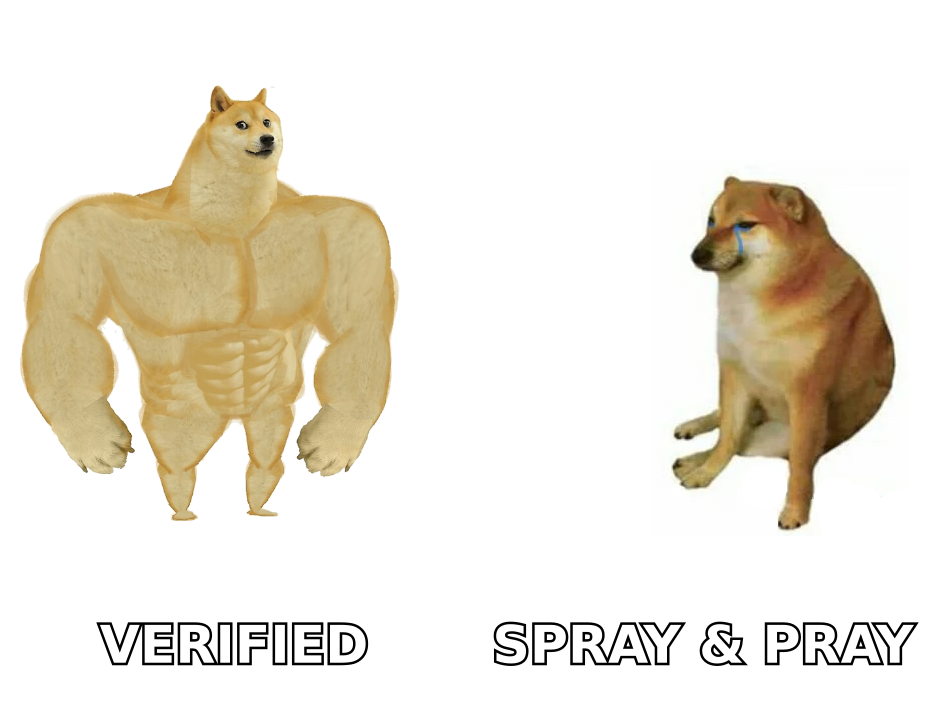
- Cold email is not dead. The high-volume, unverified, 10,000-sends-a-week version of it is — and it died for specific, documented reasons.
- Google and Yahoo's bulk sender requirements (enforced since 2024) and Microsoft's 2025 tightening turned deliverability from a soft variable into a hard gate. Spam complaint rates above 0.3% now cost you the inbox, not just a few opens.
- Reply rates on well-targeted, verified lists have held remarkably steady — typically 3–8% for tightly-scoped ICP campaigns. Reply rates on scraped, unverified lists have collapsed toward zero.
- The single biggest lever is list quality, not copy. A 15% bounce rate will sink a campaign that has perfect messaging.
- The practical move in 2026: send fewer emails to better-verified contacts, across more domains, with a real research signal in line one.
Is cold email dead in 2026?#
No — but the honest answer is more useful than the headline. Cold email as a channel is performing roughly where it was five years ago for teams that do it well. Cold email as a volume tactic is genuinely finished, and anyone telling you otherwise is selling sending infrastructure.
Here's the distinction that matters. In 2019, you could buy a list, load it into a sequencer, send 300 emails a day from a single domain, and expect something between 1% and 3% to reply. The math worked because the inbox providers were permissive and buyers were less saturated. That exact playbook in 2026 produces a domain that gets flagged in week two and a reply rate that rounds to nothing.
Meanwhile, teams sending 40 highly-targeted emails a day — to contacts that were verified in the last 30 days, with a first line that proves the sender read something real — are still booking meetings at rates that make the channel the cheapest pipeline source they have.
So the question isn't "is cold email dead." It's "which version of cold email are you running?"
What actually changed between 2019 and 2026?#
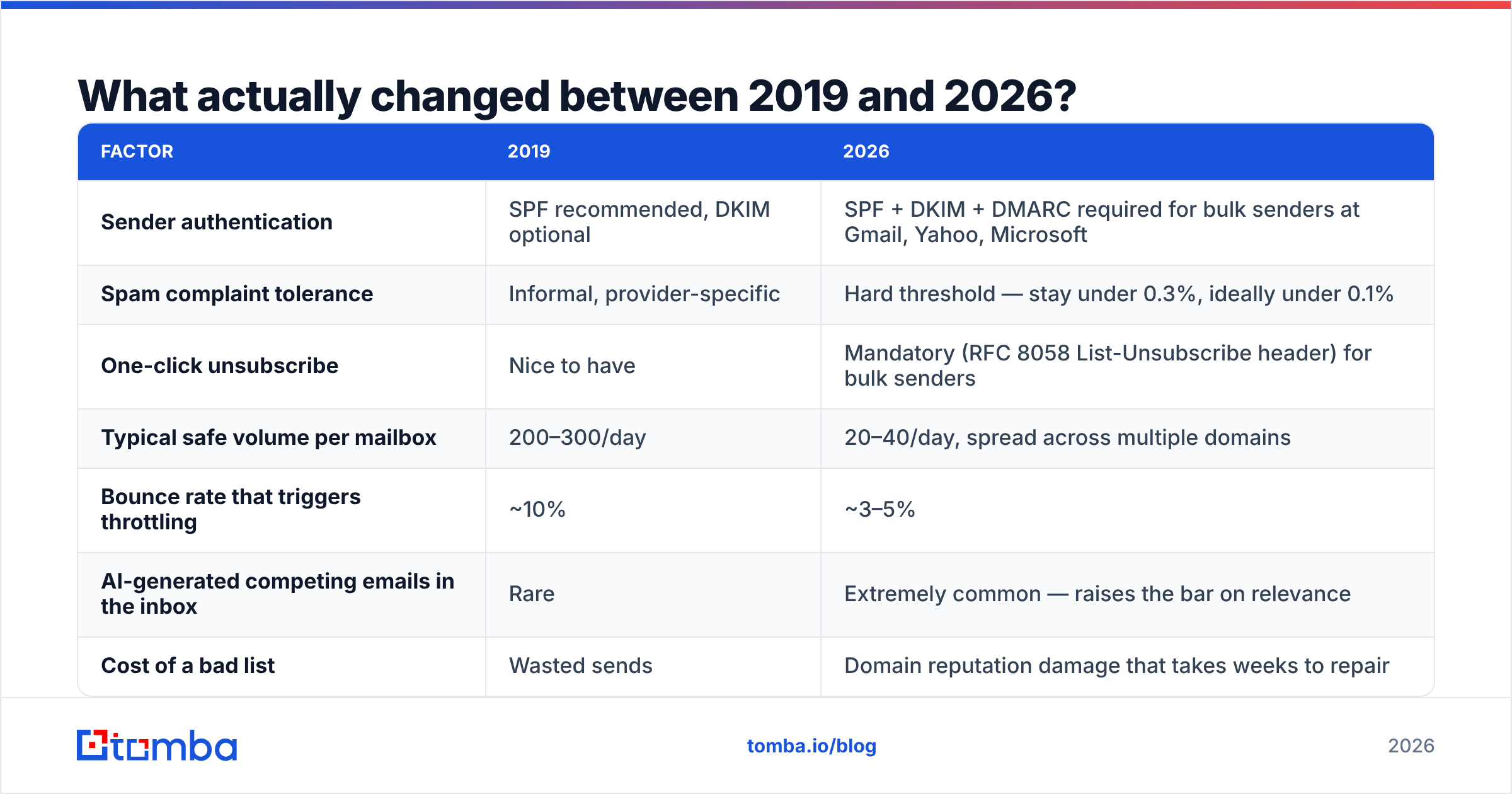
Four structural shifts, all of which compound. None of them killed the channel; together they raised the floor on execution quality.
| Factor | 2019 | 2026 |
|---|---|---|
| Sender authentication | SPF recommended, DKIM optional | SPF + DKIM + DMARC required for bulk senders at Gmail, Yahoo, Microsoft |
| Spam complaint tolerance | Informal, provider-specific | Hard threshold — stay under 0.3%, ideally under 0.1% |
| One-click unsubscribe | Nice to have | Mandatory (RFC 8058 List-Unsubscribe header) for bulk senders |
| Typical safe volume per mailbox | 200–300/day | 20–40/day, spread across multiple domains |
| Bounce rate that triggers throttling | ~10% | ~3–5% |
| AI-generated competing emails in the inbox | Rare | Extremely common — raises the bar on relevance |
| Cost of a bad list | Wasted sends | Domain reputation damage that takes weeks to repair |
The most underrated row in that table is the last one. In 2019, a bad list cost you money. In 2026, it costs you your sending infrastructure. That asymmetry is why list hygiene moved from a back-office chore to the first thing a competent outbound team fixes.
Google's own email sender guidelines spell out the requirements in plain language, and they are not negotiable. If you send more than 5,000 messages a day to Gmail addresses, you're a bulk sender by their definition, and the authentication and complaint-rate rules apply to you regardless of whether you think of yourself as a marketer.
Why do most cold email campaigns fail now?#
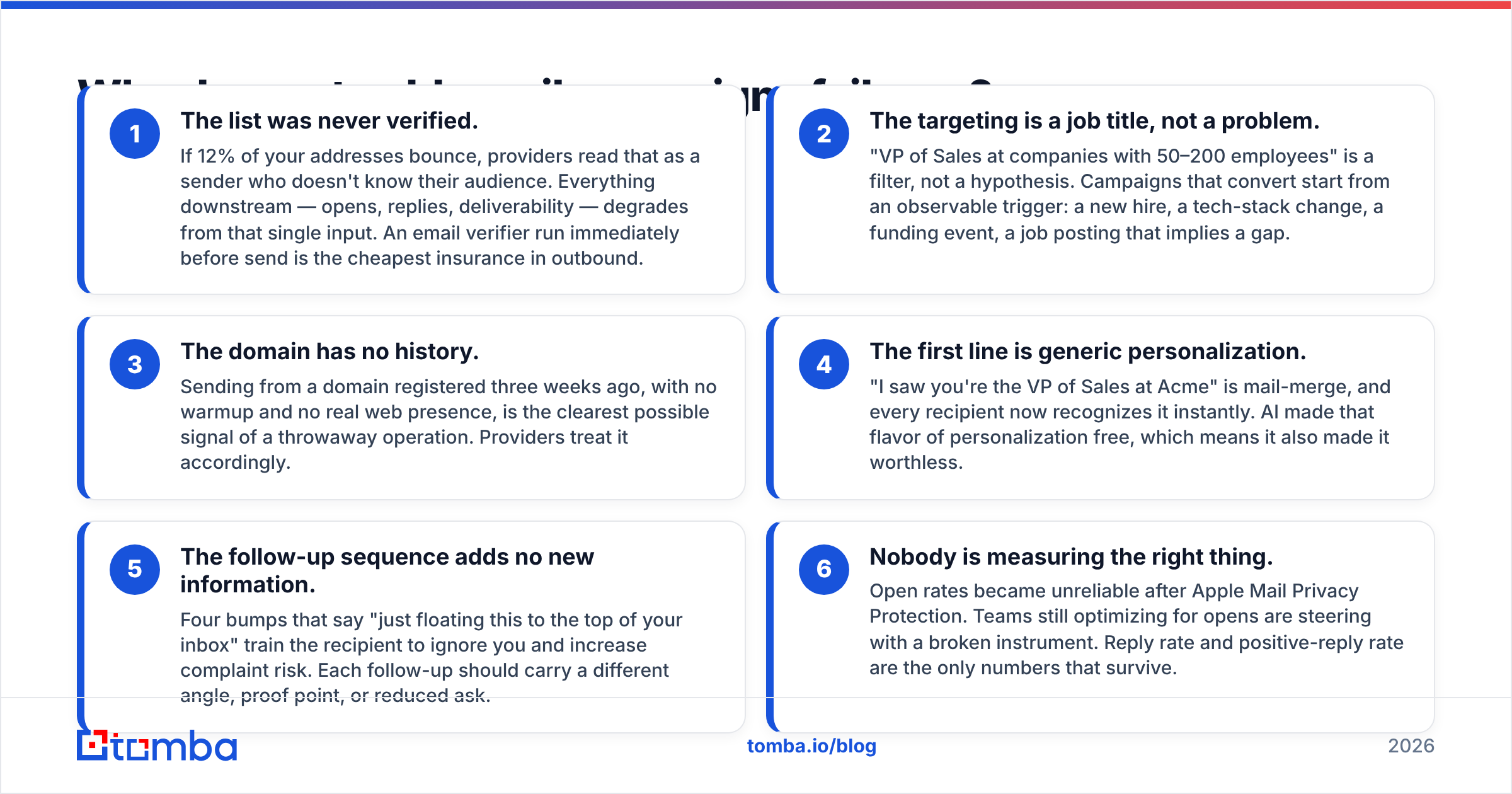
When a campaign underperforms, teams usually rewrite the copy. In our experience reviewing outbound programs, copy is rarely the primary cause. The failure modes stack in a predictable order:
- The list was never verified. If 12% of your addresses bounce, providers read that as a sender who doesn't know their audience. Everything downstream — opens, replies, deliverability — degrades from that single input. An email verifier run immediately before send is the cheapest insurance in outbound.
- The targeting is a job title, not a problem. "VP of Sales at companies with 50–200 employees" is a filter, not a hypothesis. Campaigns that convert start from an observable trigger: a new hire, a tech-stack change, a funding event, a job posting that implies a gap.
- The domain has no history. Sending from a domain registered three weeks ago, with no warmup and no real web presence, is the clearest possible signal of a throwaway operation. Providers treat it accordingly.
- The first line is generic personalization. "I saw you're the VP of Sales at Acme" is mail-merge, and every recipient now recognizes it instantly. AI made that flavor of personalization free, which means it also made it worthless.
- The follow-up sequence adds no new information. Four bumps that say "just floating this to the top of your inbox" train the recipient to ignore you and increase complaint risk. Each follow-up should carry a different angle, proof point, or reduced ask.
- Nobody is measuring the right thing. Open rates became unreliable after Apple Mail Privacy Protection. Teams still optimizing for opens are steering with a broken instrument. Reply rate and positive-reply rate are the only numbers that survive.
Fix those six in order and copy quality becomes the marginal factor it actually is.
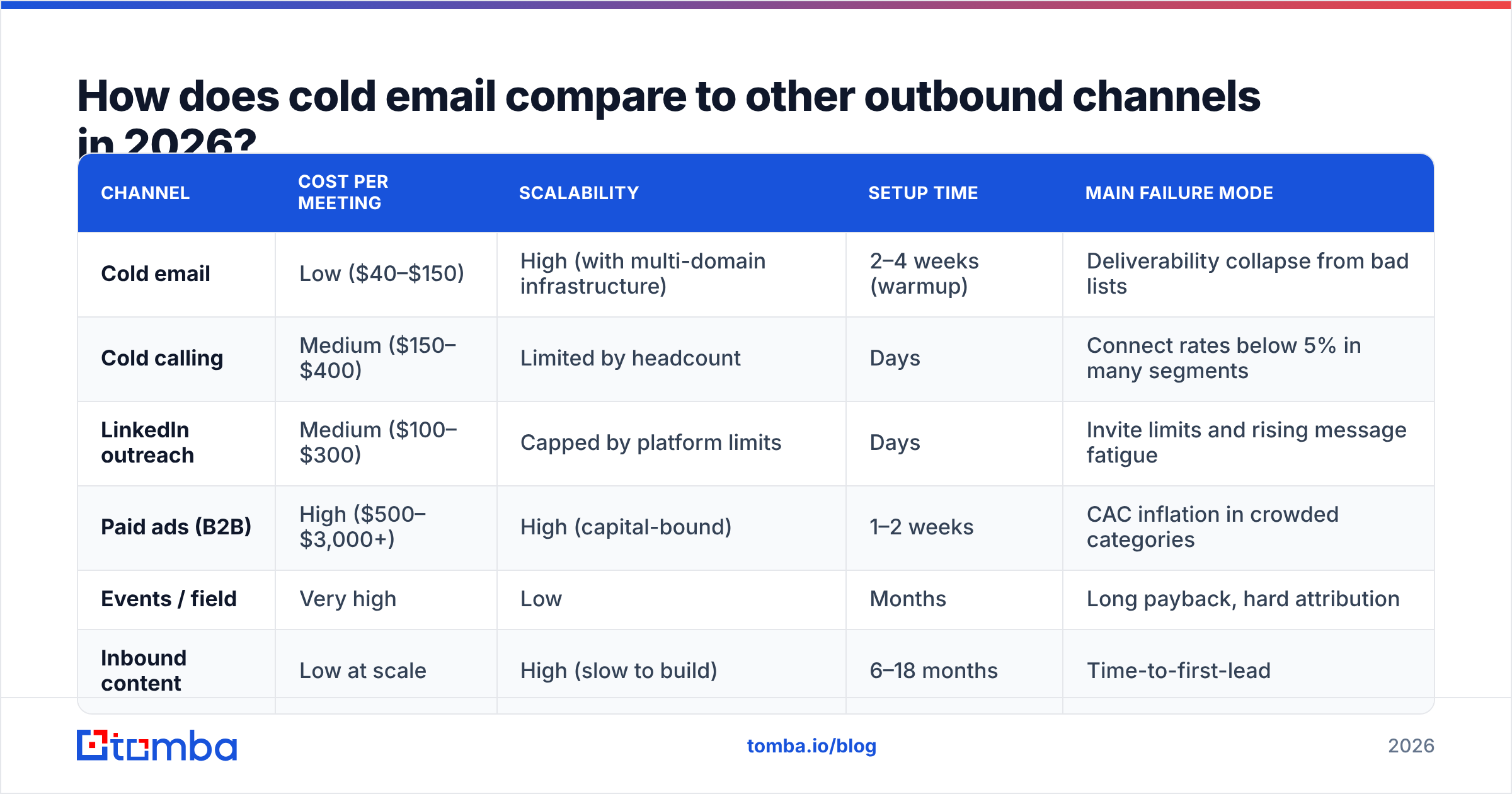
How does cold email compare to other outbound channels in 2026?#
This is where the "cold email is dead" narrative usually comes from — people compare cold email to whatever channel they're currently selling. Here's the honest side-by-side.
| Channel | Cost per meeting | Scalability | Setup time | Main failure mode |
|---|---|---|---|---|
| Cold email | Low ($40–$150) | High (with multi-domain infrastructure) | 2–4 weeks (warmup) | Deliverability collapse from bad lists |
| Cold calling | Medium ($150–$400) | Limited by headcount | Days | Connect rates below 5% in many segments |
| LinkedIn outreach | Medium ($100–$300) | Capped by platform limits | Days | Invite limits and rising message fatigue |
| Paid ads (B2B) | High ($500–$3,000+) | High (capital-bound) | 1–2 weeks | CAC inflation in crowded categories |
| Events / field | Very high | Low | Months | Long payback, hard attribution |
| Inbound content | Low at scale | High (slow to build) | 6–18 months | Time-to-first-lead |
Cold email keeps winning on one axis that nothing else touches: cost per qualified conversation at volume, with a setup horizon measured in weeks rather than quarters. That's why it persists despite being harder than it used to be. Gartner's sales research has consistently pointed at buyers preferring self-directed, low-friction first contact — which is exactly what a short, relevant email is and exactly what a cold call is not.
The strongest programs don't pick one. They use cold email as the scaled first touch, LinkedIn as the warm-up and credibility layer, and calls for the accounts that showed a signal. Our take on LinkedIn outreach covers how the two channels reinforce each other rather than compete.
What does a working cold email system look like in 2026?#
Think of it like a restaurant kitchen. The ingredients (your list) determine the ceiling on the dish. The recipe (your copy) determines how close to that ceiling you get. Most teams obsess over the recipe while buying spoiled ingredients.
A system that works in 2026 has five components:
- A narrow, trigger-based list. 200–500 contacts per campaign, not 20,000. Every contact should share a specific, observable reason to hear from you this month.
- Verified contact data. Bounce rate under 2% before you press send. This means real-time verification, not a list that was accurate when it was scraped nine months ago. Catch-all domains need their own handling — a standard verifier returns "unknown" on them, which is where a catch-all verifier earns its keep.
- Distributed sending infrastructure. Three to five secondary domains, each with two to three mailboxes, each warmed for at least three weeks, each sending 20–40 messages a day. Never your primary domain.
- Authentication and compliance done properly. SPF, DKIM, DMARC, one-click unsubscribe headers, a physical address in the footer, and a genuine honoring of opt-outs. The CAN-SPAM Act and GDPR set the legal floor; the providers set a stricter practical one.
- A measurement loop on replies, not opens. Track positive reply rate per segment, per trigger, per sequence. Kill what doesn't clear your threshold after 150 sends.
What reply rates should you actually expect?#
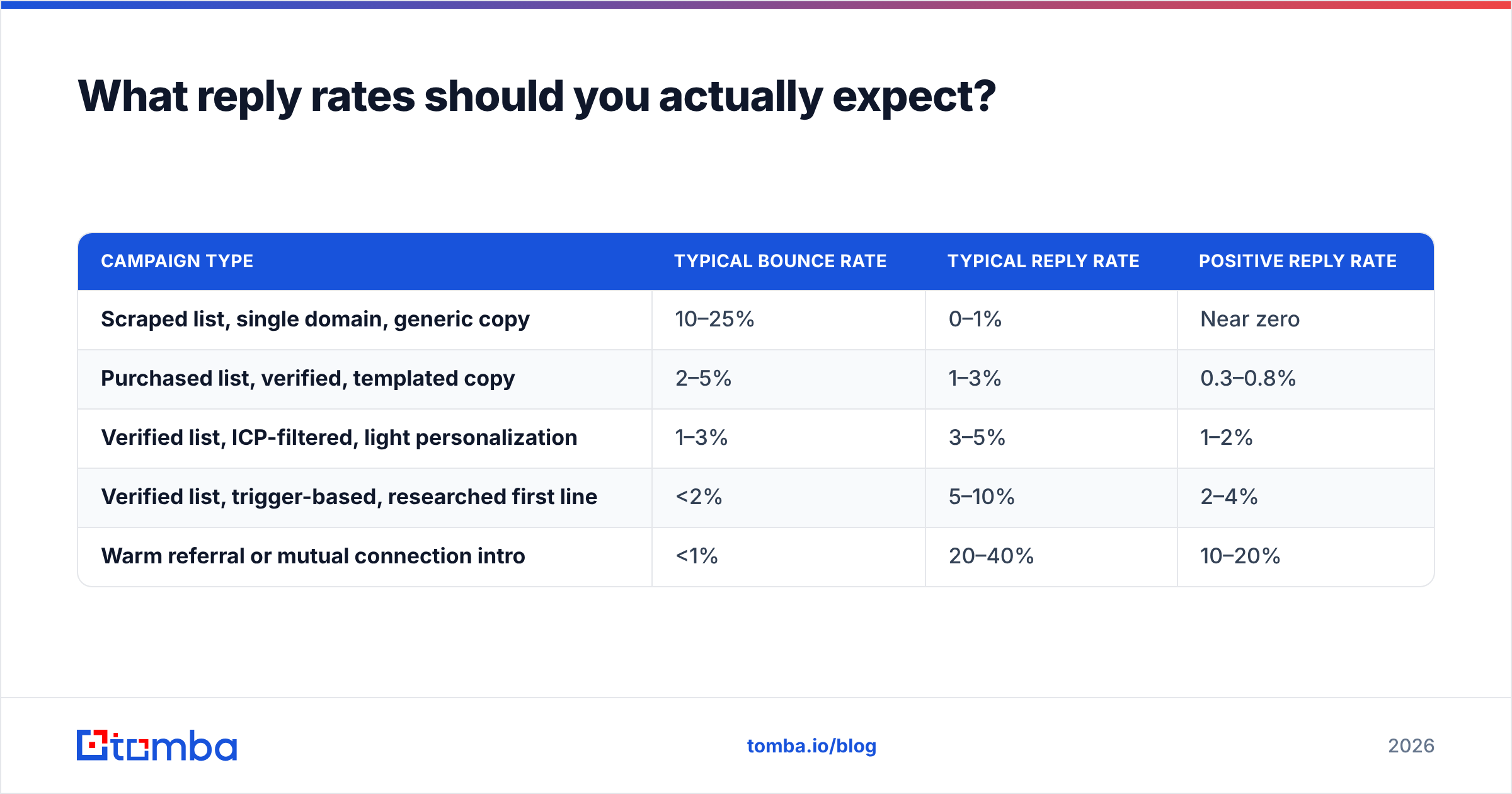
Benchmarks get quoted loosely, so treat all published numbers — including these — as ranges rather than promises. What's consistent across the outbound teams we see is the shape of the distribution:
| Campaign type | Typical bounce rate | Typical reply rate | Positive reply rate |
|---|---|---|---|
| Scraped list, single domain, generic copy | 10–25% | 0–1% | Near zero |
| Purchased list, verified, templated copy | 2–5% | 1–3% | 0.3–0.8% |
| Verified list, ICP-filtered, light personalization | 1–3% | 3–5% | 1–2% |
| Verified list, trigger-based, researched first line | <2% | 5–10% | 2–4% |
| Warm referral or mutual connection intro | <1% | 20–40% | 10–20% |
Two things jump out. First, the gap between row one and row four is roughly 10x on reply rate — and almost none of it comes from copywriting talent. It comes from who you emailed and why. Second, the compliance-adjacent metric (bounce rate) tracks the performance metric almost perfectly. That's not a coincidence: the same discipline that produces a clean list produces a relevant one.
HubSpot's sales statistics roundup is a reasonable sanity check on the broader industry ranges, though as always, your segment, geography, and offer will move these numbers more than any benchmark article can predict.
What should you do if your cold email stopped working?#
Work the diagnosis in this order. Don't skip to step four, which is where most teams start.
Step 1 — Check whether you're landing at all. Send test messages to seed accounts across Gmail, Outlook, and a corporate Microsoft 365 tenant. If you're in spam, nothing else matters. Check your domain against blacklists and confirm your SPF record resolves correctly.
Step 2 — Audit the list. Re-verify every contact. If more than 3% are invalid or risky, your data source is the problem, not your sequence. Stale data is the quiet killer: contact records decay at roughly 2–3% per month as people change roles.
Step 3 — Narrow the targeting until it feels uncomfortably small. If you can't articulate in one sentence why this specific person should care this specific month, you're not ready to send.
Step 4 — Rewrite the first line, not the whole email. One sentence proving you did research beats four paragraphs of value props. Cut the email to under 90 words.
Step 5 — Reduce volume and increase domains. Counter-intuitive but reliable: halving daily volume per mailbox while doubling mailbox count almost always raises total replies, because reputation recovers.
Step 6 — Change the ask. "Worth a 15-minute call?" is a bigger commitment than it sounds. "Is this a priority this quarter, yes or no?" gets replies from people who would never book a call, and those replies tell you who to pursue.
Does AI make cold email better or worse?#
Both, asymmetrically. AI made it trivially easy to generate 10,000 personalized-sounding emails, which flooded inboxes with mediocre messages and raised recipient skepticism. That's the "worse" half, and it's the real reason the channel feels harder.
The "better" half is that AI is genuinely useful for the parts of outbound that were previously too expensive to do at scale: reading a prospect's recent content, summarizing a company's public signals, drafting five angle variations for a single account. Used that way — as research leverage rather than send-volume leverage — it widens the gap between careful senders and careless ones.
The practical rule: use AI to decide who to email and what they care about. Write the actual sentence yourself, or at minimum edit it until it doesn't sound like every other automated email that landed that morning. If your message would be equally true for 500 other companies, it's not personalized, no matter what generated it.
So is cold email dead — or just harder?#
Harder, more technical, and considerably less forgiving. Also still one of the highest-ROI ways to start a B2B conversation, which is why the obituaries keep getting written and keep being wrong.
The teams declaring it dead are almost always describing the failure of an approach they didn't update: same volume, same list vendors, same templates, same single domain. The teams quietly hitting quota with it changed one thing above all — they stopped treating contact data as a commodity.
If your outbound has stalled, start with the list. Run your target accounts through the Tomba Email Finder to get verified, source-attributed addresses instead of guessed patterns, verify them immediately before send, and cut your daily volume in half while you rebuild reputation. The free tier gives you 25 searches a month to test the data quality against contacts you already know; paid plans start at $49/mo, and you can compare the tiers on the Tomba pricing page. Better inputs are the cheapest fix available to any cold email program in 2026 — and the only one that makes every other fix work.
Related guides#
// get started
Find, verify and enrich your first contacts today
Start on the free plan with 25 searches a month, then scale when your team is ready.
Free plan · No credit card required · GDPR & CCPA
// about the author