Is Saturday a Good Time to Send an Email? The 2026 Data
Saturday is the day most B2B senders skip without ever testing it. Here's what open-rate, reply-rate and deliverability data actually says about weekend sends — plus a low-risk way to test Saturday on your own list.
TL;DR
- For most B2B cold outreach, Saturday is a weak send day: reply rates typically run 30–50% below Tuesday–Thursday, because your buyer isn't in their inbox and your email gets buried under Monday's arrivals.
- Saturday is not universally bad. Consumer newsletters, e-commerce promos, founder-to-founder outreach, and audiences in Gulf/Israel work weeks can beat weekday benchmarks on Saturday.
- Low inbox competition is real, but it only matters if the recipient opens on Saturday. Low volume plus low attention equals low results.
- Send-day is a second-order variable. List quality, sender reputation, and relevance move reply rates far more than shifting your send from Tuesday to Saturday.
- Test it properly: a 500-contact holdout split across two Saturdays and two Tuesdays, measured on replies — not opens — will tell you more than any industry benchmark.
What actually happens when you send an email on Saturday?#
Three things happen at once, and they pull in opposite directions.
Inbox competition drops hard. Most B2B senders cluster on Tuesday, Wednesday and Thursday mornings. Saturday inbound volume to a typical corporate mailbox falls sharply — often by half or more compared with a Tuesday. Your email sits near the top of a short list instead of position 40 in a crowded one.
Attention drops harder. The corporate buyer you're emailing is not at their desk. They may glance at their phone, triage by subject line, and archive anything that isn't urgent. Weekend mobile checks are skim sessions, not decision sessions.
Monday burial is the real killer. An email that arrives Saturday at 10am is, by Monday at 9am, sitting under 60+ newer messages. If the recipient didn't act on it over the weekend, it is functionally invisible. This is the mechanic that most "low competition on weekends!" advice ignores.
So the honest answer to "is Saturday a good time to send an email" is: it depends entirely on whether your recipient's attention moves with the calendar week or against it.
Is Saturday a good time to send an email for B2B cold outreach?#
Usually not — and the gap is measurable.
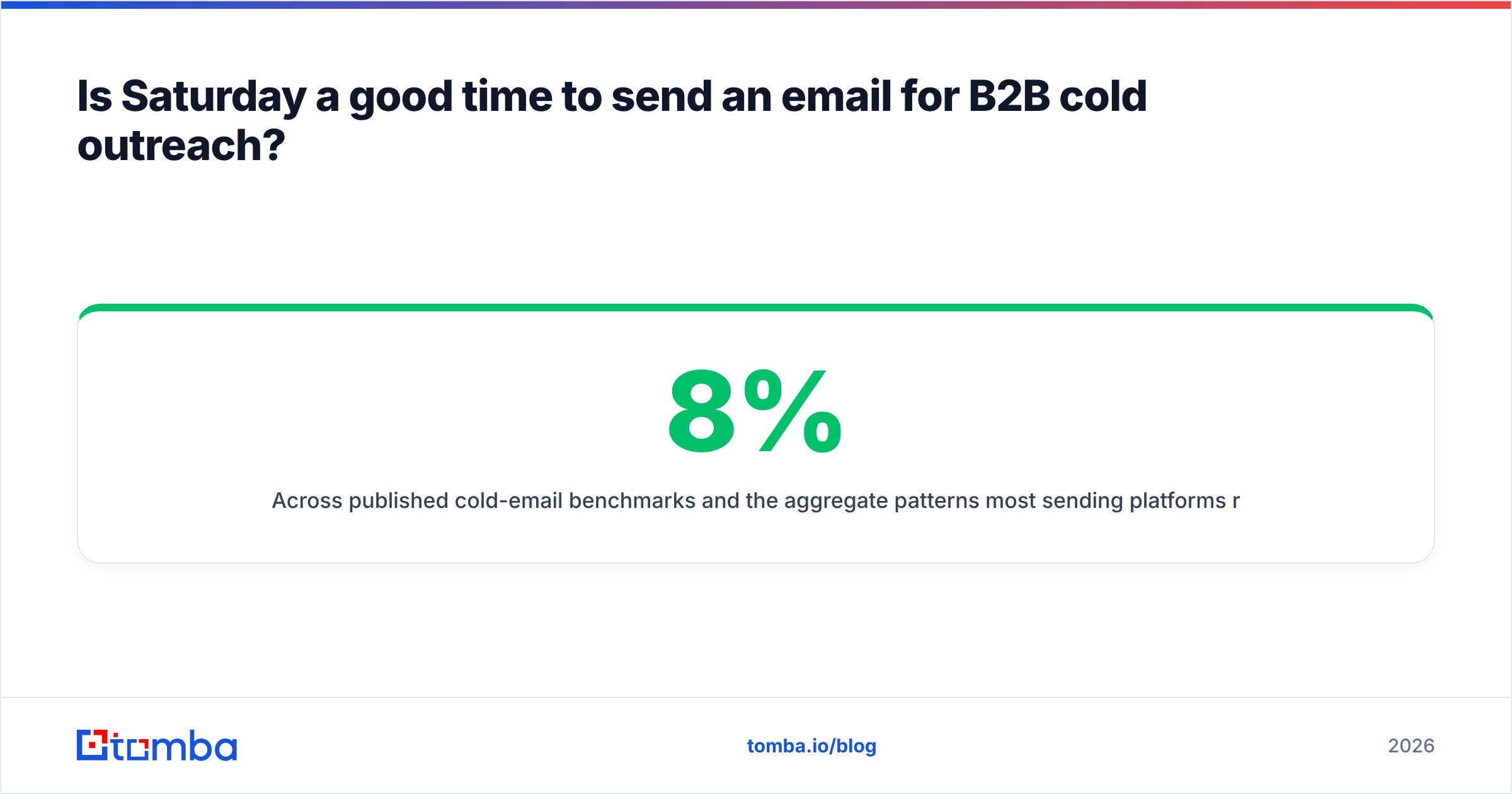
Across published cold-email benchmarks and the aggregate patterns most sending platforms report, weekday sends (Tuesday through Thursday) tend to land reply rates in the 3–8% range for a well-targeted, verified list. Saturday sends on the same list profile typically land in the 1.5–4% range. Open rates narrow the gap — Saturday opens often look only 10–20% lower — which is exactly why send-day tests that measure opens instead of replies produce misleading conclusions.
Here's the trap: Saturday frequently wins on open rate and loses on reply rate. A bored phone-check open is not intent. If your reporting dashboard leads with open rate, Saturday will look better than it is. Since Apple Mail Privacy Protection inflates opens further on mobile-heavy weekend traffic, the distortion compounds.
Three specific B2B cases where Saturday underperforms badly:
- Enterprise and mid-market sales. Anyone with a calendar controlled by an assistant, a procurement process, or an internal approval chain will not act on Saturday.
- Sequences with a meeting-booking CTA. "Grab 15 minutes next week" requires the recipient to open their calendar. They won't on a Saturday.
- Regulated industries. Finance, healthcare and legal contacts are the most likely to have genuinely disconnected weekend devices.
How does Saturday compare to the other six days?#
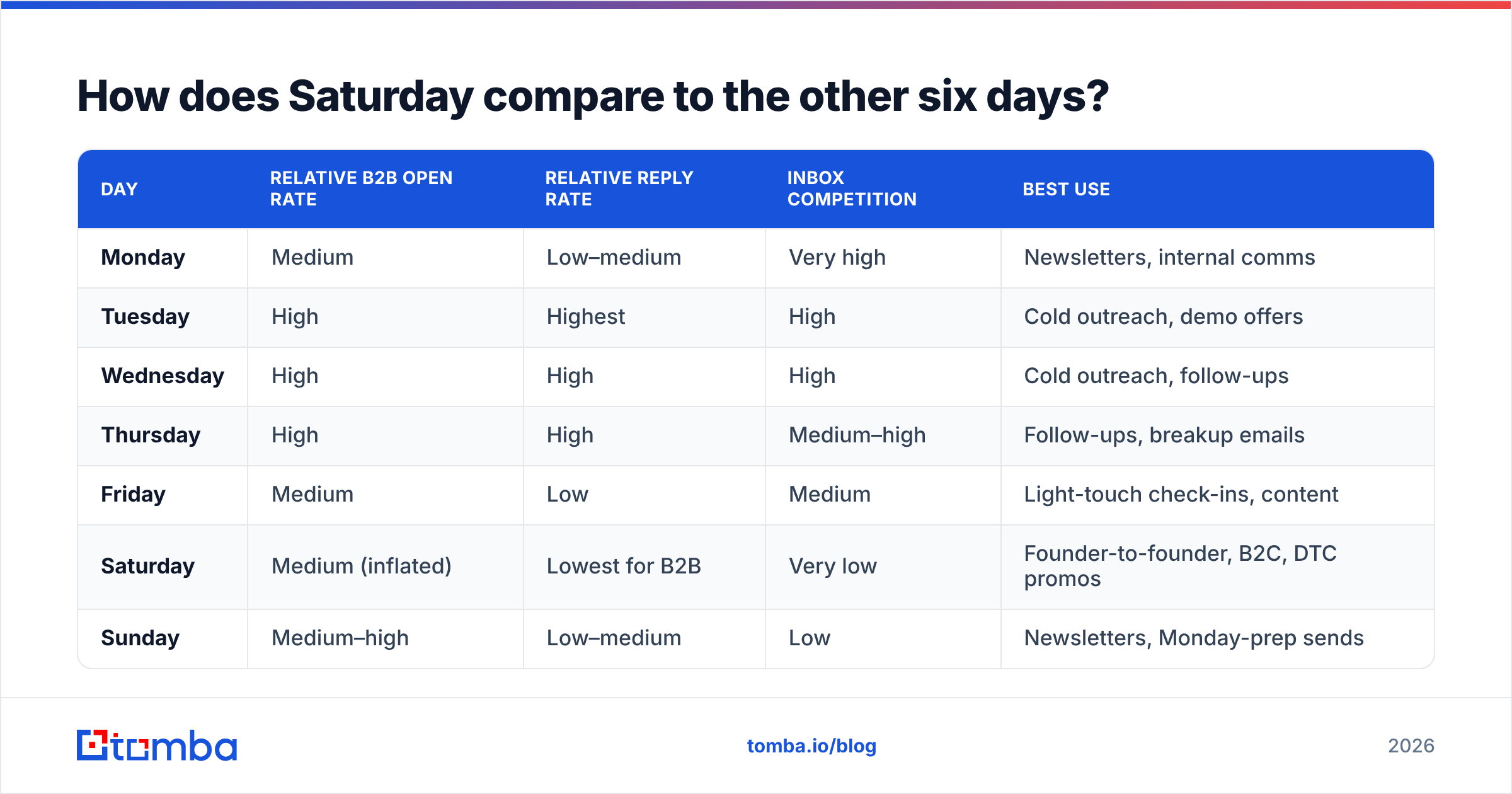
The table below summarizes the directional pattern most B2B senders see. Treat these as starting hypotheses for your own test, not as gospel — your ICP's behavior beats any benchmark.
| Day | Relative B2B open rate | Relative reply rate | Inbox competition | Best use |
|---|---|---|---|---|
| Monday | Medium | Low–medium | Very high | Newsletters, internal comms |
| Tuesday | High | Highest | High | Cold outreach, demo offers |
| Wednesday | High | High | High | Cold outreach, follow-ups |
| Thursday | High | High | Medium–high | Follow-ups, breakup emails |
| Friday | Medium | Low | Medium | Light-touch check-ins, content |
| Saturday | Medium (inflated) | Lowest for B2B | Very low | Founder-to-founder, B2C, DTC promos |
| Sunday | Medium–high | Low–medium | Low | Newsletters, Monday-prep sends |
Two things worth noticing. First, Sunday evening usually outperforms Saturday for B2B — the recipient is mentally re-entering work mode and pre-triaging Monday. Second, Friday is often worse than people assume: attention is already gone, but you don't get Saturday's low-competition benefit.
Which audiences actually open on Saturday?#
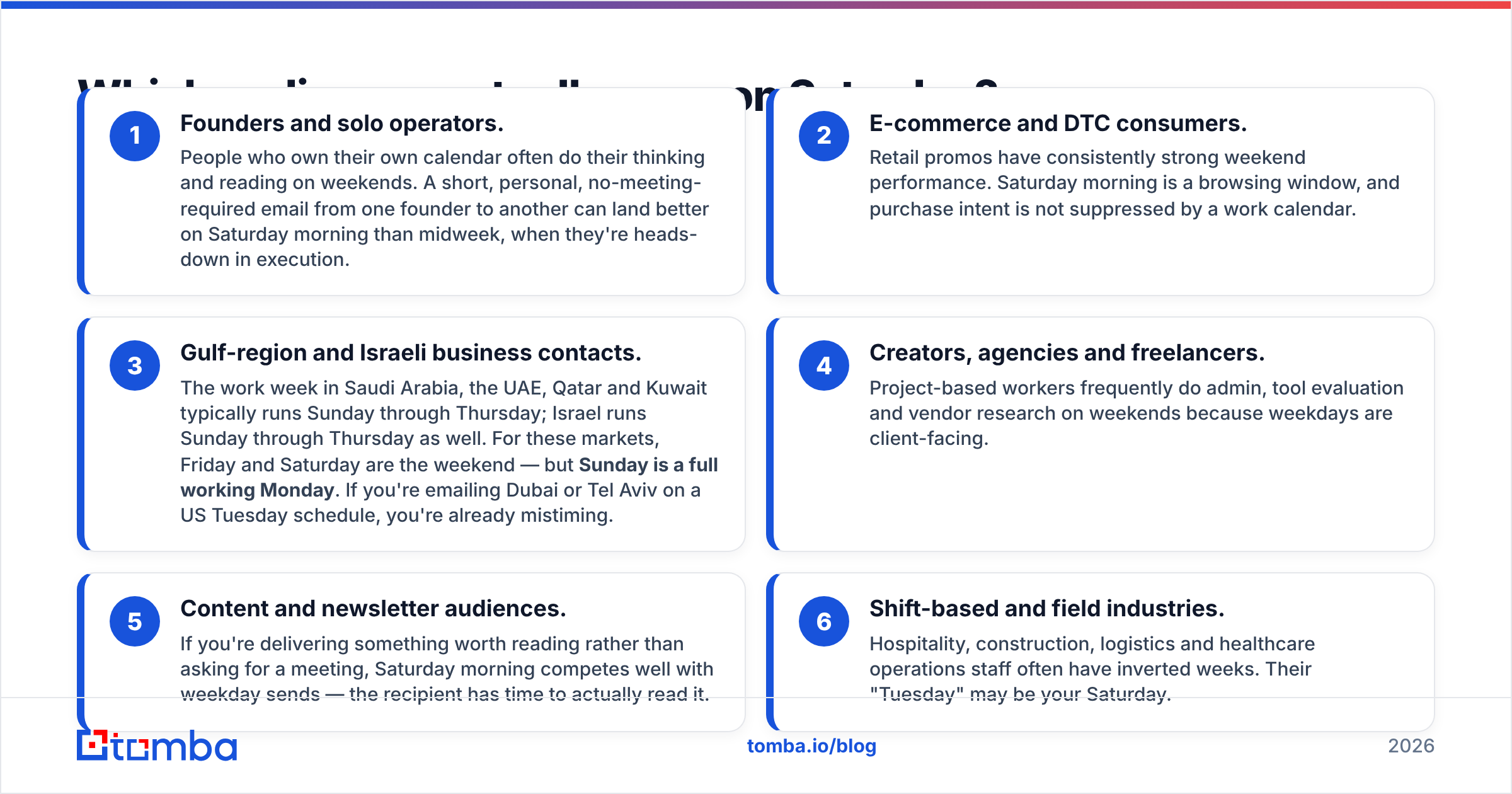
There are real segments where a Saturday send beats a Tuesday one. If your list matches these profiles, don't let generic B2B advice talk you out of testing.
- Founders and solo operators. People who own their own calendar often do their thinking and reading on weekends. A short, personal, no-meeting-required email from one founder to another can land better on Saturday morning than midweek, when they're heads-down in execution.
- E-commerce and DTC consumers. Retail promos have consistently strong weekend performance. Saturday morning is a browsing window, and purchase intent is not suppressed by a work calendar.
- Gulf-region and Israeli business contacts. The work week in Saudi Arabia, the UAE, Qatar and Kuwait typically runs Sunday through Thursday; Israel runs Sunday through Thursday as well. For these markets, Friday and Saturday are the weekend — but Sunday is a full working Monday. If you're emailing Dubai or Tel Aviv on a US Tuesday schedule, you're already mistiming.
- Creators, agencies and freelancers. Project-based workers frequently do admin, tool evaluation and vendor research on weekends because weekdays are client-facing.
- Content and newsletter audiences. If you're delivering something worth reading rather than asking for a meeting, Saturday morning competes well with weekday sends — the recipient has time to actually read it.
- Shift-based and field industries. Hospitality, construction, logistics and healthcare operations staff often have inverted weeks. Their "Tuesday" may be your Saturday.
The pattern across all six: Saturday works when the email asks for attention rather than a calendar action.
What time on Saturday performs best?#
If you're going to send on Saturday, the hour matters more than it does on weekdays.
- 8am–11am local time is the strongest window. Weekend inbox checks cluster in the morning, before the day's plans take over.
- Avoid 12pm–5pm. This is the weekend's lowest-attention block across virtually every dataset.
- 6pm–9pm Saturday is a secondary window, better suited to consumer sends than B2B.
- Never send at 3am "to be at the top of the inbox." You'll be at the top for four hours, then buried by the rest of the morning, and some filtering systems treat unusual-hour bulk sends as a mild negative signal.
Always send on the recipient's local time, not yours. A "Saturday 9am" send from New York hits Sydney at 11pm Saturday and Riyadh at 4pm — the worst possible slot in one of the few regions where Saturday is actually a weekend workday adjacent to their Sunday start.
Does sending on Saturday hurt deliverability?#
No — the day of the week is not a direct ranking factor for mailbox providers. But there are two indirect effects worth understanding.
Engagement signals compound. Gmail and Outlook weight recent recipient engagement heavily. If your Saturday sends generate systematically lower opens, replies and "not spam" signals than your weekday sends, you're slowly feeding the filter a worse engagement profile. Over months, that can drag down email deliverability for your whole domain, not just your Saturday campaigns.
Volume spikes look unnatural. If your domain sends 200 emails Monday–Friday and 3,000 on Saturday, that pattern is unusual for a legitimate business sender. Keep weekend volume within the normal range of your weekday volume. If you're still ramping a new domain, run the numbers through an email warmup calculator before adding a weekend send day at all.
Bounces hurt on any day. This is where most "Saturday didn't work" conclusions actually come from. A list with 12% invalid addresses will produce bad numbers on every single day of the week — and the sender will blame the calendar. Run the list through an email verifier before you draw any conclusion about timing. If your hard-bounce rate is above 2%, timing is not your problem.
How do you test Saturday sends without burning your list?#
Most send-time "tests" are worthless because they compare two different campaigns to two different segments in two different weeks. Here's a design that actually produces a signal.
Step 1 — Fix everything except the day. Same offer, same subject line, same sender, same sequence length, same ICP filter. One variable only.
Step 2 — Split randomly, not sequentially. Do not send Tuesday to the first 250 contacts and Saturday to the next 250. Alphabetical or import-order splits correlate with company size, source and data age. Randomize.
Step 3 — Use at least 500 contacts per arm. Below that, a reply-rate difference of two percentage points is noise. If you can only afford 200 per arm, run the test across four weeks instead of two.
Step 4 — Measure replies and meetings, not opens. Opens are the metric most contaminated by privacy proxies and idle mobile checks — the exact behavior that inflates Saturday.
Step 5 — Repeat across two calendar weeks. A single Saturday can be ruined by a holiday weekend, a news cycle, or a major industry event. Two Saturdays versus two Tuesdays is the minimum credible sample.
Step 6 — Segment the results afterward. Even if Saturday loses overall, check whether it won for a subgroup — founders under 20 employees, or a specific region. That's usually where the real insight hides.
While you're isolating variables, resist the urge to also test a new subject line in the same run. If you want subject-line data, run that separately with a subject line tester before the send-day experiment, so the copy is already locked.
What should you do instead if Saturday underperforms?#
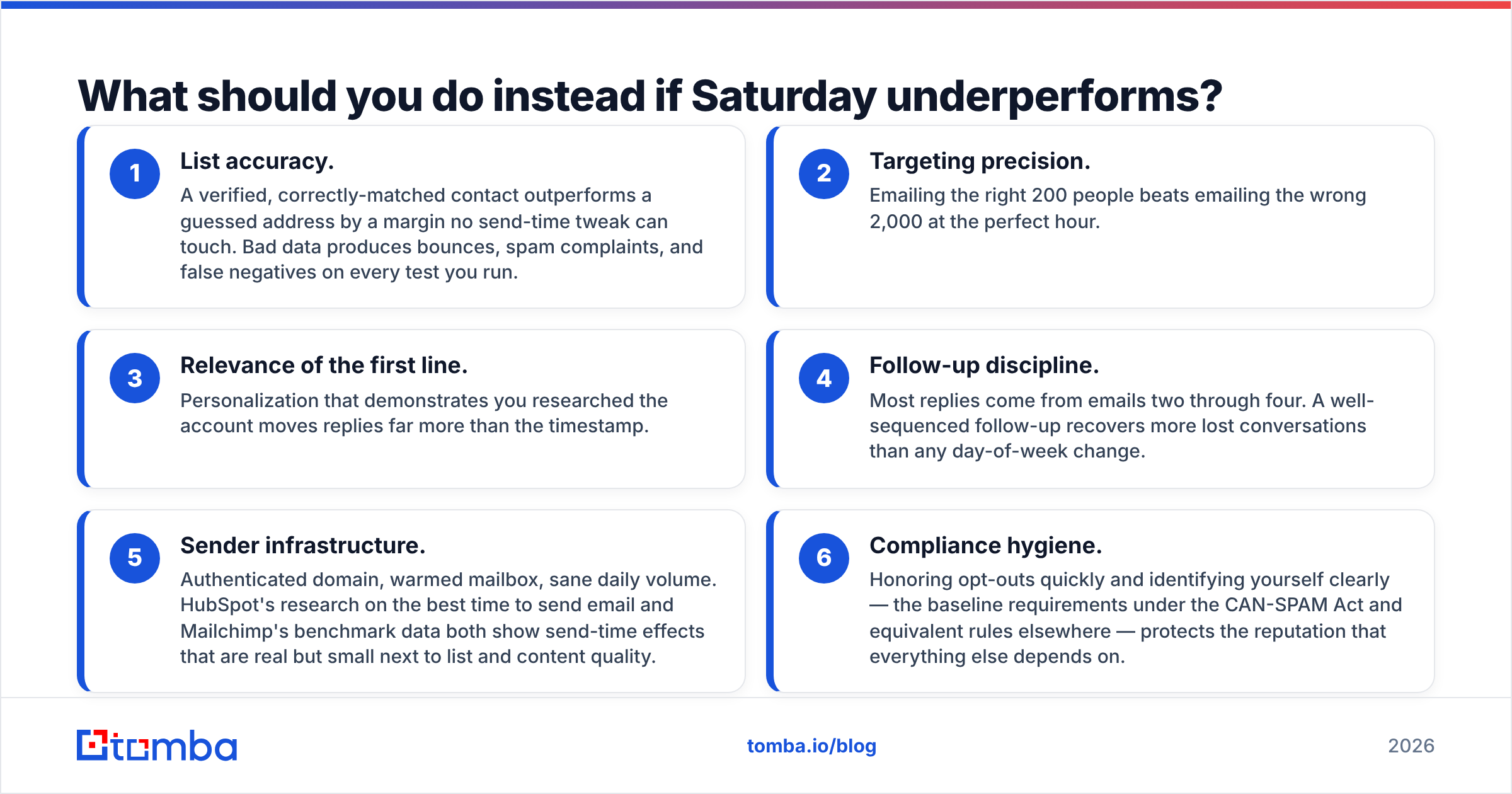
If your test confirms the default pattern — Saturday loses for your B2B list — the fix isn't to hunt for a magic hour. It's to stop over-optimizing a second-order variable.
Ranked by actual impact on reply rate:
- List accuracy. A verified, correctly-matched contact outperforms a guessed address by a margin no send-time tweak can touch. Bad data produces bounces, spam complaints, and false negatives on every test you run.
- Targeting precision. Emailing the right 200 people beats emailing the wrong 2,000 at the perfect hour.
- Relevance of the first line. Personalization that demonstrates you researched the account moves replies far more than the timestamp.
- Follow-up discipline. Most replies come from emails two through four. A well-sequenced follow-up recovers more lost conversations than any day-of-week change.
- Sender infrastructure. Authenticated domain, warmed mailbox, sane daily volume. HubSpot's research on the best time to send email and Mailchimp's benchmark data both show send-time effects that are real but small next to list and content quality.
- Compliance hygiene. Honoring opt-outs quickly and identifying yourself clearly — the baseline requirements under the CAN-SPAM Act and equivalent rules elsewhere — protects the reputation that everything else depends on.
A useful rule of thumb: if changing your send day moves your reply rate by more than a point or two, the underlying campaign is probably fragile for other reasons.
So, is Saturday a good time to send an email — yes or no?#
For B2B cold outreach with a meeting CTA: no. Send Tuesday through Thursday, morning local time, and spend the energy you'd waste on send-time tinkering on list quality instead.
For newsletters, consumer offers, founder-to-founder notes, and Gulf/Israel-region contacts: test it. Saturday morning has a genuine low-competition advantage, and for audiences whose attention isn't governed by a corporate calendar, that advantage converts.
For everyone: stop guessing and run the split. Two Saturdays against two Tuesdays, 500 contacts per arm, measured on replies. That single experiment is worth more than every benchmark article on the internet, including this one — because it's measured on your list.
And that last point is the one that actually decides the outcome. Send-day experiments only produce trustworthy numbers when the underlying addresses are real, current, and attached to the right person. If a third of your list bounces or lands on an unmonitored alias, you'll conclude "Saturday doesn't work" when what you've really measured is data decay.
Start by fixing the input. Tomba Email Finder pulls verified professional addresses by domain, name or company, so the list you're testing on is one you can trust the results from. The free tier gives you 25 searches a month to check your data quality before committing; paid plans start at $49/mo on Starter and $99/mo on Growth if you need volume — see the full Tomba pricing breakdown. Get the list right first, then argue about the calendar.
Related guides#
// get started
Find, verify and enrich your first contacts today
Start on the free plan with 25 searches a month, then scale when your team is ready.
Free plan · No credit card required · GDPR & CCPA
// about the author