Istariai vs Kipplo: Which Email Finder Wins in 2026?
Istariai and Kipplo are two low-profile email finders competing for the same budget. Here's an honest look at coverage, verification, pricing transparency, and when a bigger-footprint tool is the safer call.
TL;DR
- Istariai and Kipplo are both small, low-footprint email-finding tools. Neither publishes the kind of accuracy methodology, uptime record, or third-party review volume you'd expect from a tool you're about to route your whole pipeline through.
- The decision between them is less "which has better data" and more "which one can you actually verify before you commit budget" — and on that test, both score poorly against established finders.
- If you need a decision today: run the same 100-contact sample through both, measure bounce rate on a real send, and keep whichever clears 97% deliverable.
- A tool with a public free tier, documented API, and visible review history (Tomba, Hunter, Apollo, BookYourData) removes most of the risk that makes this comparison hard in the first place.
- Budget reality: a $49/mo plan with 25 free monthly searches to test it is a lower-risk starting point than any tool that won't show you pricing until you book a call.
Who are Istariai and Kipplo?#
Both names show up in the same corner of the market: lightweight B2B contact-finding tools aimed at solo founders, agencies, and small outbound teams who don't want to pay Apollo or ZoomInfo money.
Here's the honest framing, and it matters more than any feature table: neither Istariai nor Kipplo has the public footprint of an established email finder. At the time of writing, you won't find either one with hundreds of verified reviews on G2's lead intelligence category, a published data-sourcing policy, or a status page with historical uptime. That isn't automatically disqualifying — every tool starts somewhere — but it changes how you should evaluate them. You can't outsource the judgement to reviews. You have to test.
So this post does two things. First, it gives you the criteria that actually separate a good email finder from a bad one. Second, it applies those criteria to Istariai and Kipplo as fairly as the available information allows, and tells you when to walk to a tool with a longer track record instead.
How do you judge an email finder in 2026?#
Five criteria decide whether a finder earns its place in your stack. Everything else is noise.
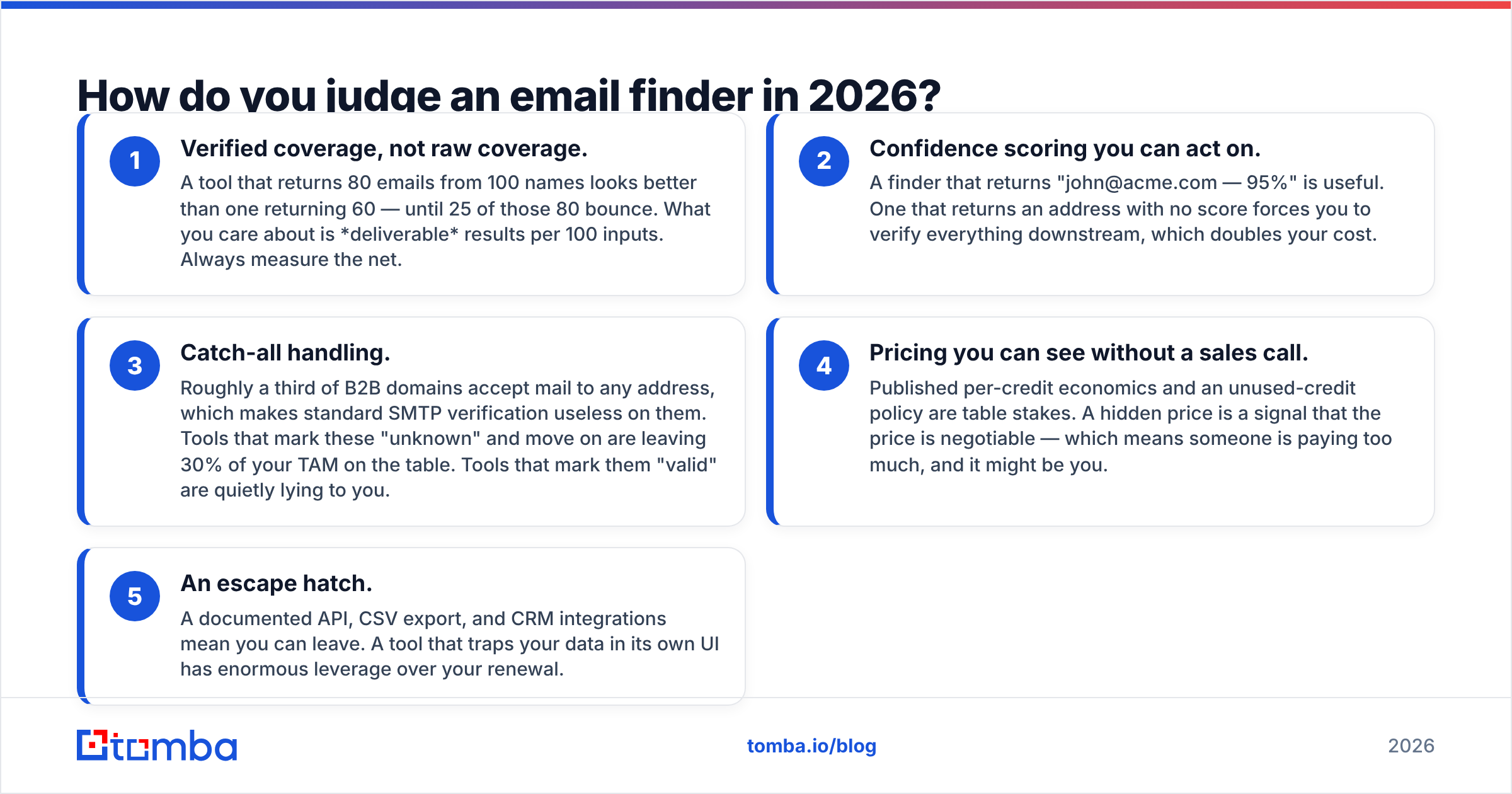
- Verified coverage, not raw coverage. A tool that returns 80 emails from 100 names looks better than one returning 60 — until 25 of those 80 bounce. What you care about is deliverable results per 100 inputs. Always measure the net.
- Confidence scoring you can act on. A finder that returns "john@acme.com — 95%" is useful. One that returns an address with no score forces you to verify everything downstream, which doubles your cost.
- Catch-all handling. Roughly a third of B2B domains accept mail to any address, which makes standard SMTP verification useless on them. Tools that mark these "unknown" and move on are leaving 30% of your TAM on the table. Tools that mark them "valid" are quietly lying to you.
- Pricing you can see without a sales call. Published per-credit economics and an unused-credit policy are table stakes. A hidden price is a signal that the price is negotiable — which means someone is paying too much, and it might be you.
- An escape hatch. A documented API, CSV export, and CRM integrations mean you can leave. A tool that traps your data in its own UI has enormous leverage over your renewal.
Score any tool against those five and the shortlist gets short fast.
Istariai vs Kipplo: how do they compare on paper?#
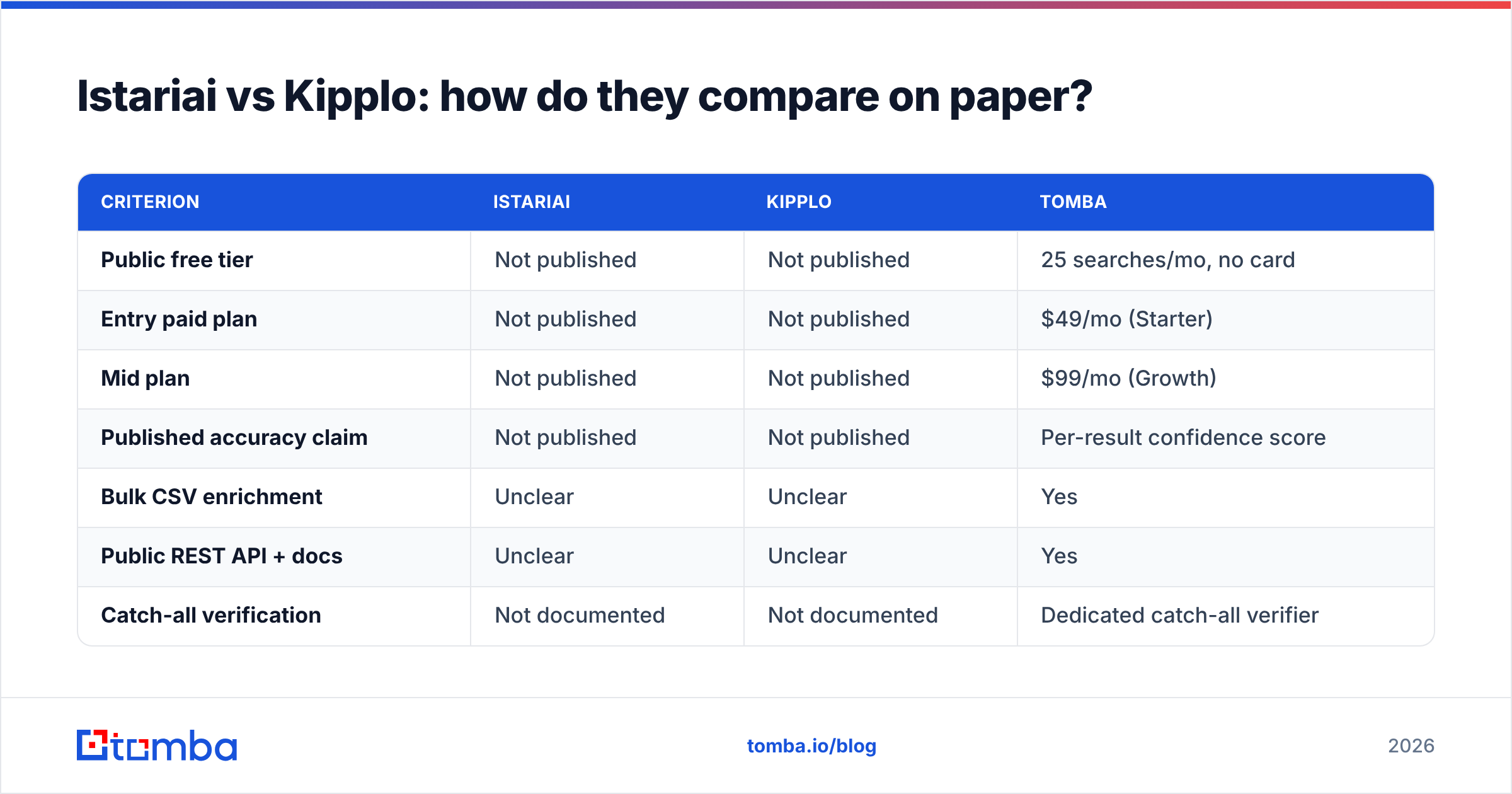
The table below reflects what each vendor publishes publicly at the time of writing, with Tomba included as a known-quantity benchmark so you have a reference point with published numbers. Where a vendor does not publish a figure, the cell says so — we're not going to invent one.
| Criterion | Istariai | Kipplo | Tomba |
|---|---|---|---|
| Public free tier | Not published | Not published | 25 searches/mo, no card |
| Entry paid plan | Not published | Not published | $49/mo (Starter) |
| Mid plan | Not published | Not published | $99/mo (Growth) |
| Published accuracy claim | Not published | Not published | Per-result confidence score |
| Bulk CSV enrichment | Unclear | Unclear | Yes |
| Public REST API + docs | Unclear | Unclear | Yes |
| Catch-all verification | Not documented | Not documented | Dedicated catch-all verifier |
| Third-party review volume | Minimal | Minimal | Established on G2/Capterra |
| Data-sourcing disclosure | Not published | Not published | Published sources page |

Read that table honestly and the conclusion writes itself: the Istariai vs Kipplo question can't be settled from public information. Six of the nine rows are blanks for both tools. That's the finding, not a failure of research.
What it means practically is that if one of these tools landed on your shortlist through a cold email, a Product Hunt launch, or an agency recommendation, you should treat it as unproven until your own test data says otherwise. Below is how to get that data in an afternoon.

Which one has better data accuracy?#
Nobody can answer this for you from the outside — and you should be suspicious of any blog that claims to.
Accuracy in this category is not a single number. It varies enormously by segment. A tool tuned on US SaaS companies will look brilliant on your US SaaS list and fall apart on German manufacturing SMEs. A tool built on scraped public web data will beat a licensed-database tool on startups and lose badly on enterprises with locked-down web presence.

The one reliable measurement is your own bounce rate on your own list. Here's the protocol:
- Take 100 real target contacts — names plus company domains, from your actual ICP, not a demo list.
- Run all 100 through each tool.
- Record hit rate (addresses returned) and, separately, verified hit rate (addresses the tool marks as confidently valid).
- Run every returned address through an independent email verifier — not the finder's own verifier, which has an obvious incentive to grade its own homework.
- Send a low-volume, genuinely relevant campaign to the survivors and record the hard bounce rate.
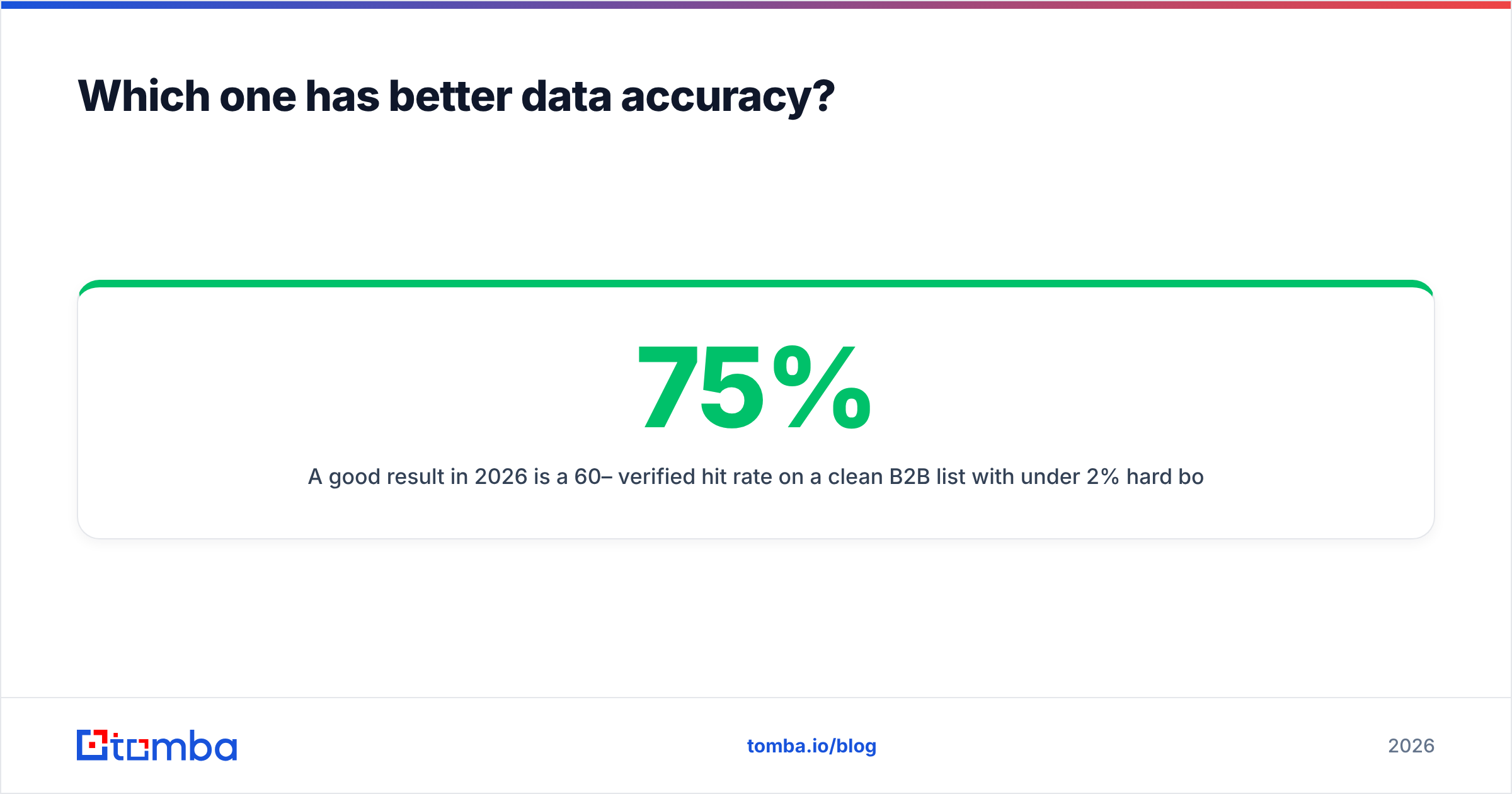
A good result in 2026 is a 60–75% verified hit rate on a clean B2B list with under 2% hard bounces. A tool that returns 90% of addresses but bounces at 8% is actively damaging your sender reputation, and that damage costs far more than the subscription saved.
If either Istariai or Kipplo clears that bar on your segment, use it. If neither does, you've spent an afternoon and learned something worth far more than the time.
What does each one actually cost?#
This is where the comparison gets uncomfortable. Neither tool publishes a full pricing table with per-credit economics, rollover policy, and overage rates in a way you can compare line by line.
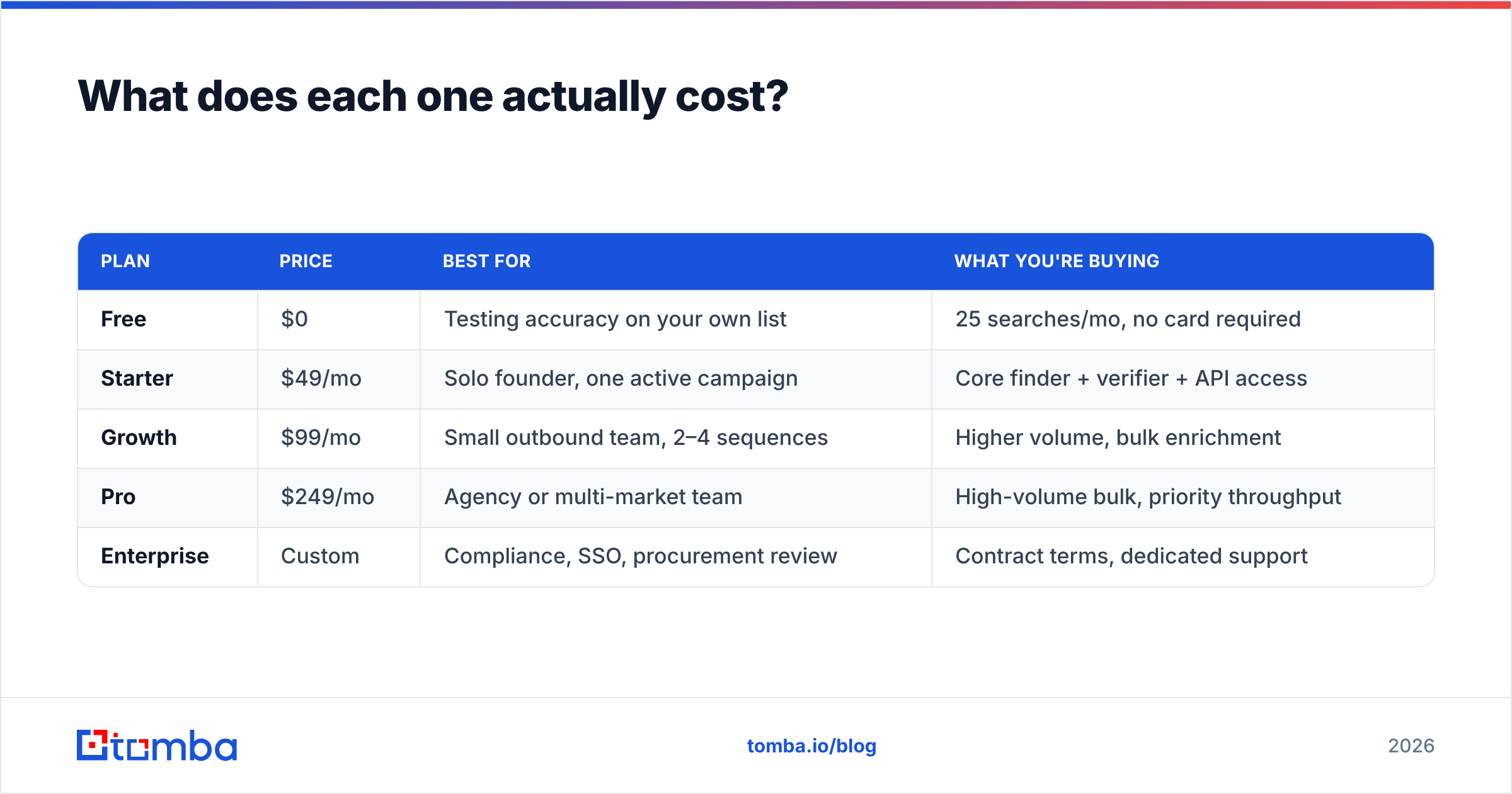
Compare that to how a transparent pricing page reads:
| Plan | Price | Best for | What you're buying |
|---|---|---|---|
| Free | $0 | Testing accuracy on your own list | 25 searches/mo, no card required |
| Starter | $49/mo | Solo founder, one active campaign | Core finder + verifier + API access |
| Growth | $99/mo | Small outbound team, 2–4 sequences | Higher volume, bulk enrichment |
| Pro | $249/mo | Agency or multi-market team | High-volume bulk, priority throughput |
| Enterprise | Custom | Compliance, SSO, procurement review | Contract terms, dedicated support |
Full Tomba pricing is public for a reason: you can model your cost per verified contact before you spend anything.
When you evaluate Istariai or Kipplo, demand the same three numbers in writing before you pay:
- Cost per verified result, not per search. A search that returns nothing should not consume a credit. Ask explicitly whether it does.
- Rollover policy. Unused credits expiring monthly is a hidden 20–30% price increase for anyone with uneven campaign volume.
- Overage rate. The number you find out about after you've already blown through your allowance is always the expensive one.
If a vendor won't put those three in an email, that's your answer.
Is catch-all handling a dealbreaker for either tool?#
It's the single most common reason a cheap finder turns out to be expensive.
Think of a catch-all domain like an apartment building with no name plates on the mailboxes. The postal service will accept anything addressed to that building — it just won't tell you whether apartment 4B exists. Standard SMTP verification asks "will you accept mail for this address?", the server says yes to everything, and the tool records a false positive.
Neither Istariai nor Kipplo documents a specific catch-all methodology publicly. That's a genuine risk, because the failure mode is silent: your verified list looks clean, your campaign sends, and three days later your bounce rate is 9% and your domain reputation is in the basement.
Tools that solve this use pattern inference, historical engagement signals, and cross-source corroboration rather than a single SMTP handshake — that's what a dedicated catch-all verifier is for. If you sell into enterprise or into markets with heavy Microsoft 365 usage, where catch-all configurations are common, ask both vendors directly: what do you return for a catch-all domain, and what is your measured false-positive rate on those? A vendor who has thought about this will have an answer ready. One who hasn't will change the subject.

Which should you pick — Istariai, Kipplo, or something else?#
Here's the verdict, stated plainly.
Pick Istariai or Kipplo if: one of them clears your 100-contact bounce test on your specific segment, the pricing they quote you in writing beats the alternatives on cost-per-verified-contact, and your volume is low enough that a vendor disappearing wouldn't break your pipeline. Small tools sometimes have genuinely excellent coverage in a narrow niche, and if that niche is yours, the lack of brand recognition costs you nothing.
Pick an established finder if: you're routing more than a few thousand contacts a month, you need an API your engineers can build against, you have procurement or compliance requirements, or you simply don't have an afternoon to spend benchmarking two unknowns. In that case the shortlist is the tools with published pricing, real review volume, and documented data sourcing — Tomba, Hunter, Apollo, and BookYourData all qualify, each with a different strength. BookYourData leans toward pre-built verified lists; Apollo bundles sequencing; Tomba focuses on finder-plus-verifier accuracy with a developer-friendly API.
Pick neither and fix the upstream problem if: your real issue is list quality, not tool choice. Plenty of teams blame their email finder for a 1.5% reply rate when the actual problem is targeting. Read HubSpot's ongoing sales research on outbound benchmarks before you assume the tool is the bottleneck.
How do you test both in under an hour?#
A tight evaluation loop, in order:
- Build one 100-row control list. Same names, same domains, exported once. Every tool gets the identical input or the comparison is meaningless.
- Run it through each tool's bulk upload. Time it. A tool that takes six hours on 100 rows will take a week on 10,000.
- Export and normalise. Strip duplicates, lowercase everything, and note which tool flagged which address as risky or unknown.
- Cross-verify independently. Push all outputs through a neutral verifier and compare each tool's self-reported confidence against the independent verdict. The gap between those two numbers is the tool's honesty score.
- Send small and real. 50 genuinely relevant emails from a warmed domain. Measure hard bounces at 72 hours.
- Compute cost per landed email. Total spend divided by messages that actually reached an inbox. This is the only pricing number that matters.
You can run steps 1–4 for free on most reputable platforms — a free tier exists precisely so you can do this. If a vendor won't let you test before paying, you've learned something about how confident they are in their own data. For teams doing this at scale, the same workflow runs headlessly through the Tomba API, which means you can re-benchmark quarterly instead of trusting a one-time result.
What's the bottom line on Istariai vs Kipplo?#
Neither tool has published enough for anyone to responsibly declare a winner, and you should distrust any comparison post that does. What you can control is the test. Run the 100-contact protocol, measure cost per landed email, and let your own data pick.
What you shouldn't do is commit a quarter's outbound volume to an unproven finder because it was cheap. The cost of a bad list isn't the subscription — it's the domain reputation you spend three months rebuilding.
If you'd rather skip the uncertainty and start with a tool whose pricing, data sources, and accuracy scoring are all public, start with the Tomba Email Finder. The free tier gives you 25 searches a month with no card, which is more than enough to run the exact benchmark described above — against Istariai, against Kipplo, and against Tomba itself. Test all three on your own list, then decide with evidence instead of marketing copy.
Related guides#
// get started
Find, verify and enrich your first contacts today
Start on the free plan with 25 searches a month, then scale when your team is ready.
Free plan · No credit card required · GDPR & CCPA
// about the author