Istari.ai vs LeadGibbon: Which B2B Data Tool Wins in 2026?
One tool maps entire markets from company websites. The other hands you a spreadsheet of contacts. Here is where Istari.ai and LeadGibbon actually compete, where they don't, and which one belongs in your 2026 stack.
TL;DR
- These two tools are not really competitors. Istari.ai is a web-mining market intelligence engine that classifies millions of company websites. LeadGibbon is a contact database and email finder built for SDRs who need a list by Friday.
- Pick Istari.ai if your question is "which companies in this market should we even care about?" — market sizing, industry classification, technology adoption signals, territory planning.
- Pick LeadGibbon if your question is "who do I email at these companies, and will the address bounce?"
- Neither one fully covers the other's job. Istari.ai gives you firmographic depth with no inbox at the end of it. LeadGibbon gives you inboxes with shallow market context.
- The cheapest working stack in 2026 is usually a market-intelligence layer for targeting plus a dedicated email finder for contact discovery and verification — not one tool trying to be both.
What is Istari.ai, and who actually uses it?#
Istari.ai is a German AI company that does large-scale web mining. Instead of buying a static contact list, you point it at a market and it reads company websites — text, structure, self-descriptions, technology mentions — then classifies what those companies actually do.
Think of it like a satellite pass over a city versus a phone book. The phone book tells you who lives at number 42. The satellite tells you which districts are growing, which factories have new roofs, and where the construction cranes are clustered. Different questions, different instruments.
The typical Istari.ai buyer is not an SDR. It's:
- Economic development agencies and policy researchers mapping regional industry clusters.
- Market intelligence and strategy teams sizing a segment before committing headcount to it.
- Investors and corp-dev teams screening for companies that match a thesis (AI adoption, sustainability language, specific product categories).
- Large B2B vendors building a total addressable market model that standard SIC/NAICS codes fail to describe.
The output is a structured view of a market — company-level attributes derived from web text, refreshed as sites change. You can read more on the official Istari.ai site. What you do not get is a verified personal email for the VP of Operations at each of those companies.
What is LeadGibbon, and what does it actually hand you?#
LeadGibbon sits at the other end of the funnel. It's a B2B lead database with a browser extension workflow: you filter a list (or work from LinkedIn/Sales Navigator), pull matching contacts, and export names, titles, companies, and email addresses — typically straight into Google Sheets or a CSV.
The value proposition is speed and simplicity. A rep who knows their ICP can go from "I need 300 marketing directors at mid-market SaaS companies" to a downloadable list in under an hour. There's no modelling, no market map, no classification layer. It's a lookup tool, and it's honest about that.
Where it gets uncomfortable is in the two places every contact database gets uncomfortable: coverage (does the person exist in the index at all?) and freshness (was that email valid when the index was built, or is it valid today?). B2B contact data decays roughly 25–30% per year as people change jobs — a figure repeated across vendor research and visible in any list you re-verify six months after buying it.

How do Istari.ai and LeadGibbon compare head-to-head?#
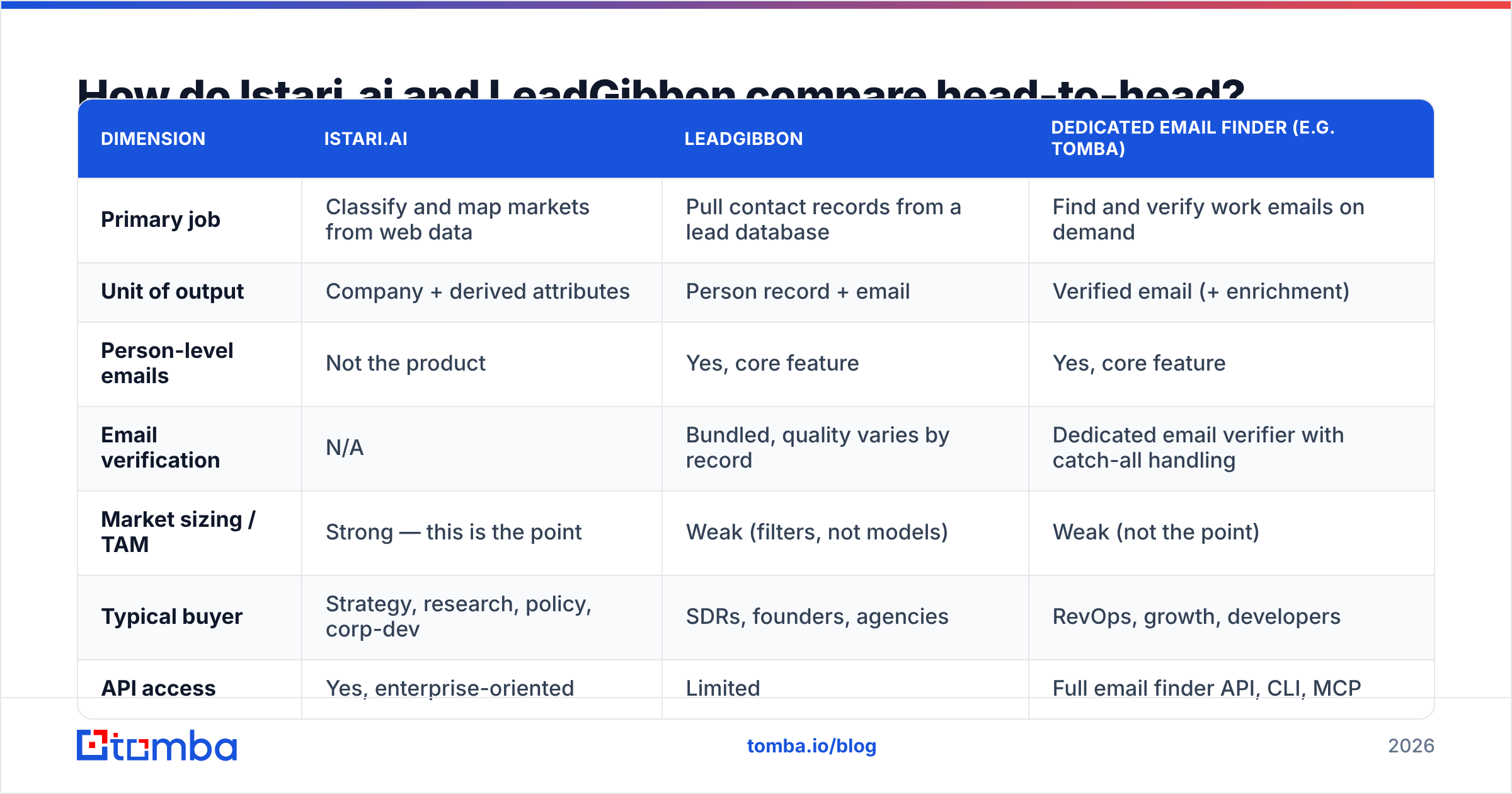
| Dimension | Istari.ai | LeadGibbon | Dedicated email finder (e.g. Tomba) |
|---|---|---|---|
| Primary job | Classify and map markets from web data | Pull contact records from a lead database | Find and verify work emails on demand |
| Unit of output | Company + derived attributes | Person record + email | Verified email (+ enrichment) |
| Person-level emails | Not the product | Yes, core feature | Yes, core feature |
| Email verification | N/A | Bundled, quality varies by record | Dedicated email verifier with catch-all handling |
| Market sizing / TAM | Strong — this is the point | Weak (filters, not models) | Weak (not the point) |
| Typical buyer | Strategy, research, policy, corp-dev | SDRs, founders, agencies | RevOps, growth, developers |
| API access | Yes, enterprise-oriented | Limited | Full email finder API, CLI, MCP |
| Time to first usable list | Days to weeks (a project) | Minutes to hours | Minutes |
| Pricing model | Custom / enterprise quote | Credit-based subscription | Free tier, then $49–$249/mo |
The table makes the real story obvious: the overlap between these two products is thin. If you're comparing them because a colleague put both on the same slide, someone has conflated "B2B data" with "B2B contacts." They are not the same purchase.
Which one gives you contactable leads?#
LeadGibbon, and it isn't close. Istari.ai is not trying to be a prospecting database, and evaluating it as one is like reviewing a telescope for its ability to read a menu.
But "gives you contacts" and "gives you contacts you can actually email" are different claims. Here is what separates a usable list from an expensive bounce generator:
- Syntax and MX validity. The address is well-formed and the domain accepts mail. Table stakes; every vendor does this.
- Mailbox-level confirmation. The specific inbox exists. This is where cheap lists quietly fail, because SMTP probing at scale is hard and some providers deliberately obscure results.
- Catch-all handling. Roughly 15–20% of B2B domains accept everything, so a naive checker marks every guess as valid. A real catch-all verifier scores these separately instead of shipping them as "OK."
- Role-account flagging.
info@,sales@, andsupport@inflate list counts and destroy reply rates. They should be labelled, not counted. - Recency stamping. When was this record last confirmed? A list without a last-verified date is a list you have to re-verify yourself.
- Bounce guarantee mechanics. Read the fine print: many "guarantees" credit you back the credit, not the domain reputation you burned.
Run any vendor's export through those six checks before you judge it. Most "the data was bad" complaints on G2 trace back to items 3 and 5, not to the vendor being fraudulent.
Where does Istari.ai win outright?#
Three scenarios, and they're all upstream of outbound:
Market definition when the taxonomy fails you. Standard industry codes are terrible at describing modern companies. A firm registered as "software publishing" might be a robotics integrator, a fintech, or a staffing agency with an app. Istari.ai reads what the company says about itself, which produces segments that match how buyers actually cluster.
Signal detection at scale. If you want to know which companies in a region mention specific technologies, certifications, or capability language, web mining finds it. A contact database has no opinion on this because it never read the website.
Research defensibility. When output feeds a board deck, a public report, or a policy recommendation, methodology matters more than speed. That's Istari.ai's home turf and LeadGibbon's blind spot.
Where does LeadGibbon win outright?#
Speed to first campaign. A rep with a clear ICP can build and export a list the same day. No onboarding project, no data science conversation.
Cost predictability for small teams. Credit-based subscriptions in the sub-$100/month range are budget-invisible at a five-person startup. Enterprise market-intelligence contracts are not.
Workflow fit. The extension-plus-Sales-Navigator motion is how most SDRs already work. Tools that fight the existing workflow lose regardless of data quality.
Simplicity as a feature. There is a real category of buyer who wants a spreadsheet of names and emails and nothing else. LeadGibbon serves that buyer without asking them to learn a platform.
What does each one actually cost in 2026?#
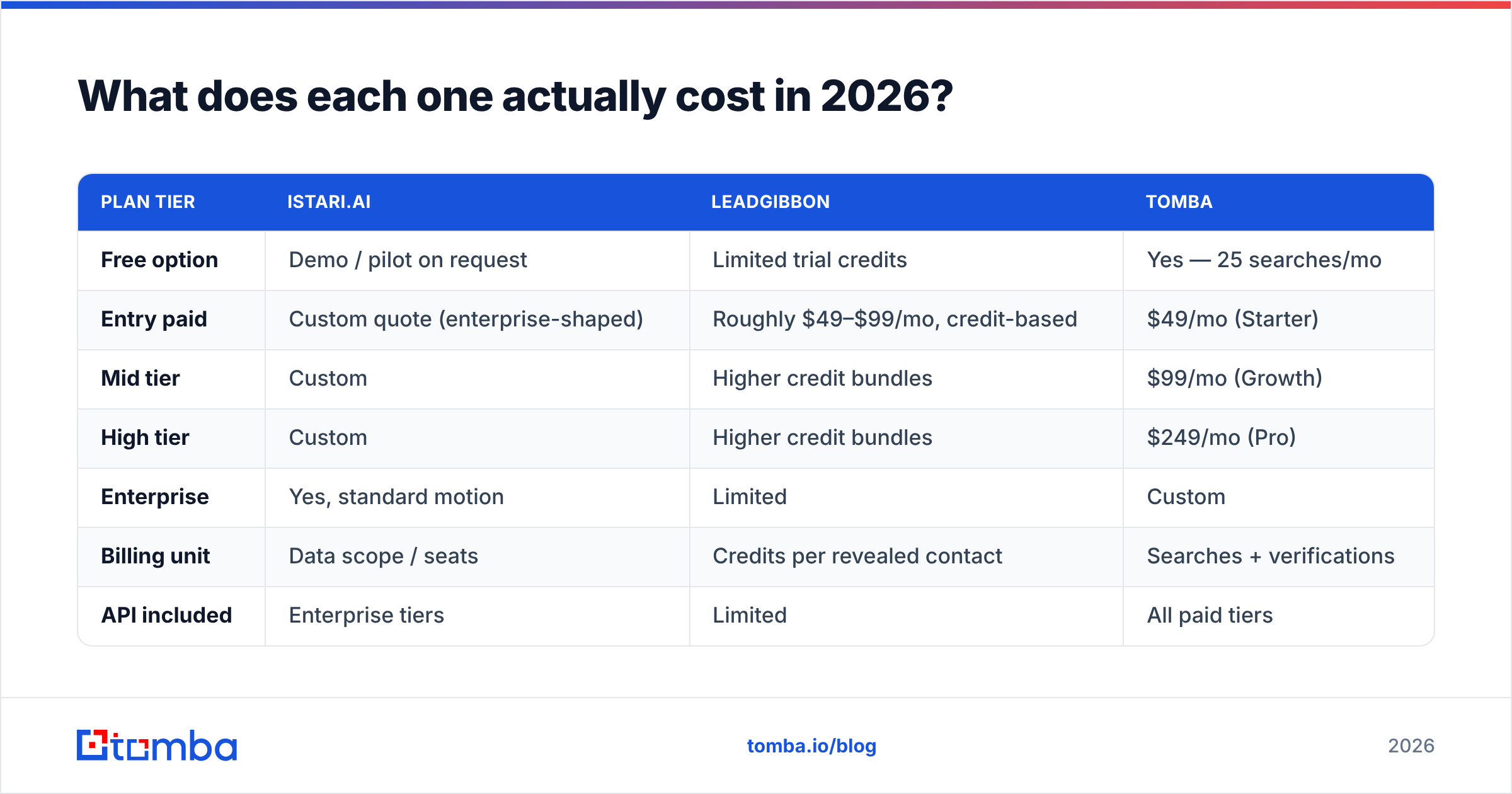
Published pricing moves, so treat these as shape rather than gospel and check the vendor pages before you budget.
| Plan tier | Istari.ai | LeadGibbon | Tomba |
|---|---|---|---|
| Free option | Demo / pilot on request | Limited trial credits | Yes — 25 searches/mo |
| Entry paid | Custom quote (enterprise-shaped) | Roughly $49–$99/mo, credit-based | $49/mo (Starter) |
| Mid tier | Custom | Higher credit bundles | $99/mo (Growth) |
| High tier | Custom | Higher credit bundles | $249/mo (Pro) |
| Enterprise | Yes, standard motion | Limited | Custom |
| Billing unit | Data scope / seats | Credits per revealed contact | Searches + verifications |
| API included | Enterprise tiers | Limited | All paid tiers |
Two cost traps worth naming.
The first is credit burn on unusable records. If 20% of what you pull is a catch-all guess or a role account, your effective cost per contactable person is 25% higher than the sticker price. Always compute cost per verified contact, never cost per credit.
The second is the enterprise floor. Market-intelligence platforms price against strategy budgets, not sales-tooling budgets. If you're a 10-person team hoping Istari.ai will double as your prospecting list, the quote will end that conversation quickly.

Can you use Istari.ai and LeadGibbon together?#
Yes, and for a certain kind of team it's the correct architecture. The pattern looks like this:
- Define the market with web mining. Use Istari.ai to produce a company universe that matches your real ICP rather than a code-based approximation. Output: a list of domains.
- Score and prioritise. Rank those domains by fit signals — size, technology mentions, growth language, geography.
- Find the people. Run the prioritised domains through a domain search or a contact database to surface named decision-makers per company.
- Verify before send. Push every address through verification, with explicit catch-all scoring, and drop or quarantine anything that doesn't clear.
- Enrich for personalisation. Add titles, seniority, LinkedIn profiles, and phone numbers via data enrichment so the first line of your email isn't generic.
- Feed the CRM, not a CSV graveyard. Sync into HubSpot or Salesforce so records age with timestamps. HubSpot's own sales data guidance makes the point better than any vendor pitch: data you can't see decaying is data you'll eventually trust when you shouldn't.
Step 3 is where the "one tool for everything" plan usually breaks. A market-intelligence platform hands you domains; converting domains into verified, named contacts is a different technical problem — pattern detection, SMTP validation, catch-all inference — and it's worth using a tool built specifically for it.
How do you judge data accuracy without taking anyone's word for it?#
Run the same 100-domain test against every vendor on your shortlist. Not their sample list — yours.
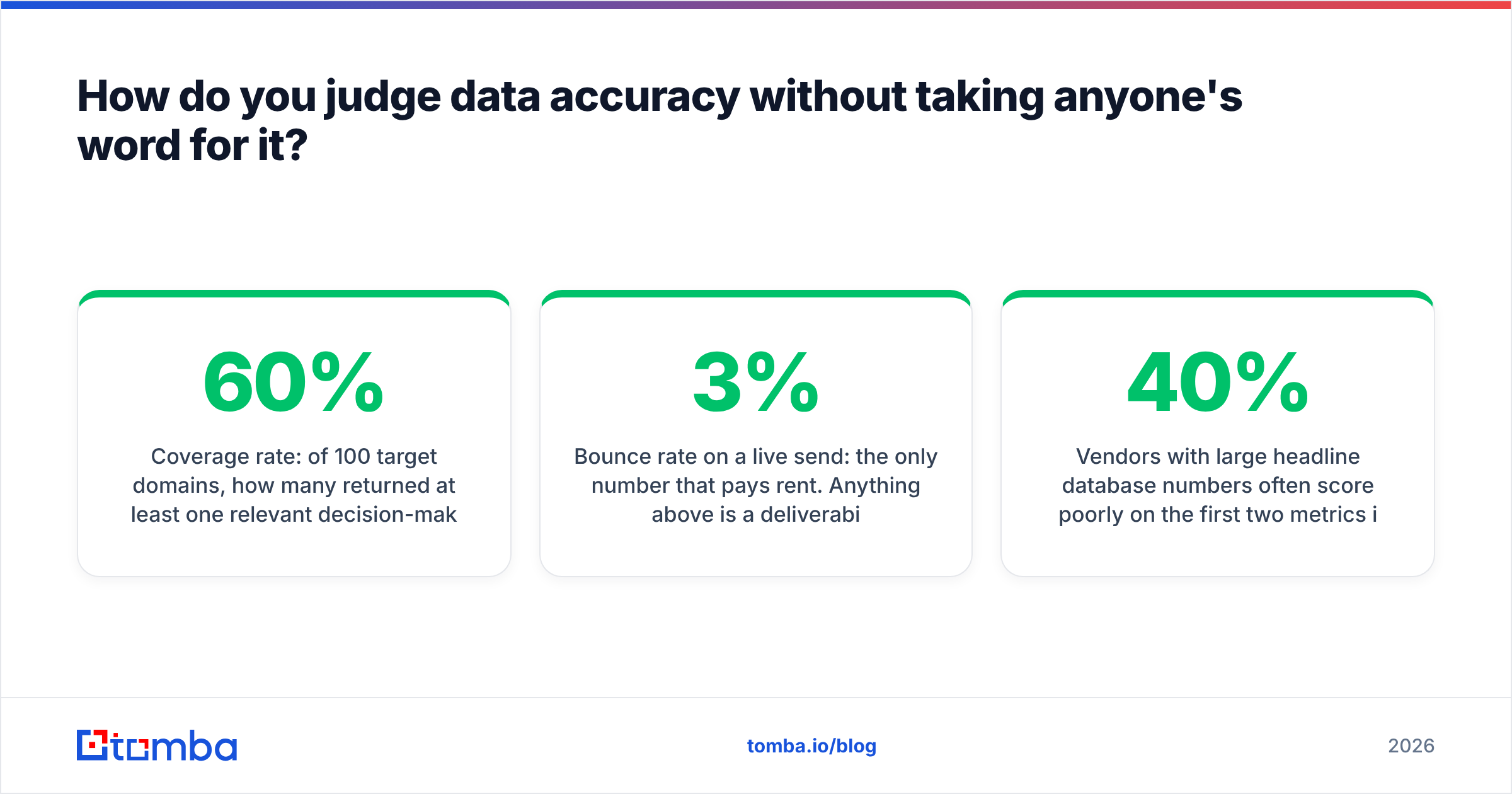
- Coverage rate: of 100 target domains, how many returned at least one relevant decision-maker? Below 60% and the tool doesn't fit your segment, whatever its overall database size.
- Verified rate: of the returned addresses, how many pass independent verification? Use a neutral free email checker rather than the vendor's own scoring.
- Bounce rate on a live send: the only number that pays rent. Anything above 3% is a deliverability problem, not a data preference.
- Role-account share: what percentage are generic inboxes? High shares mean the vendor is padding coverage.
- Job-change drift: re-run the same 100 domains 90 days later. The delta tells you how alive the index is.
Vendors with large headline database numbers often score poorly on the first two metrics in niche or non-US markets. A 700-million-record database that covers 40% of your German mittelstand list is worse than a smaller index that covers 80% of it. Test regionally if you sell regionally.
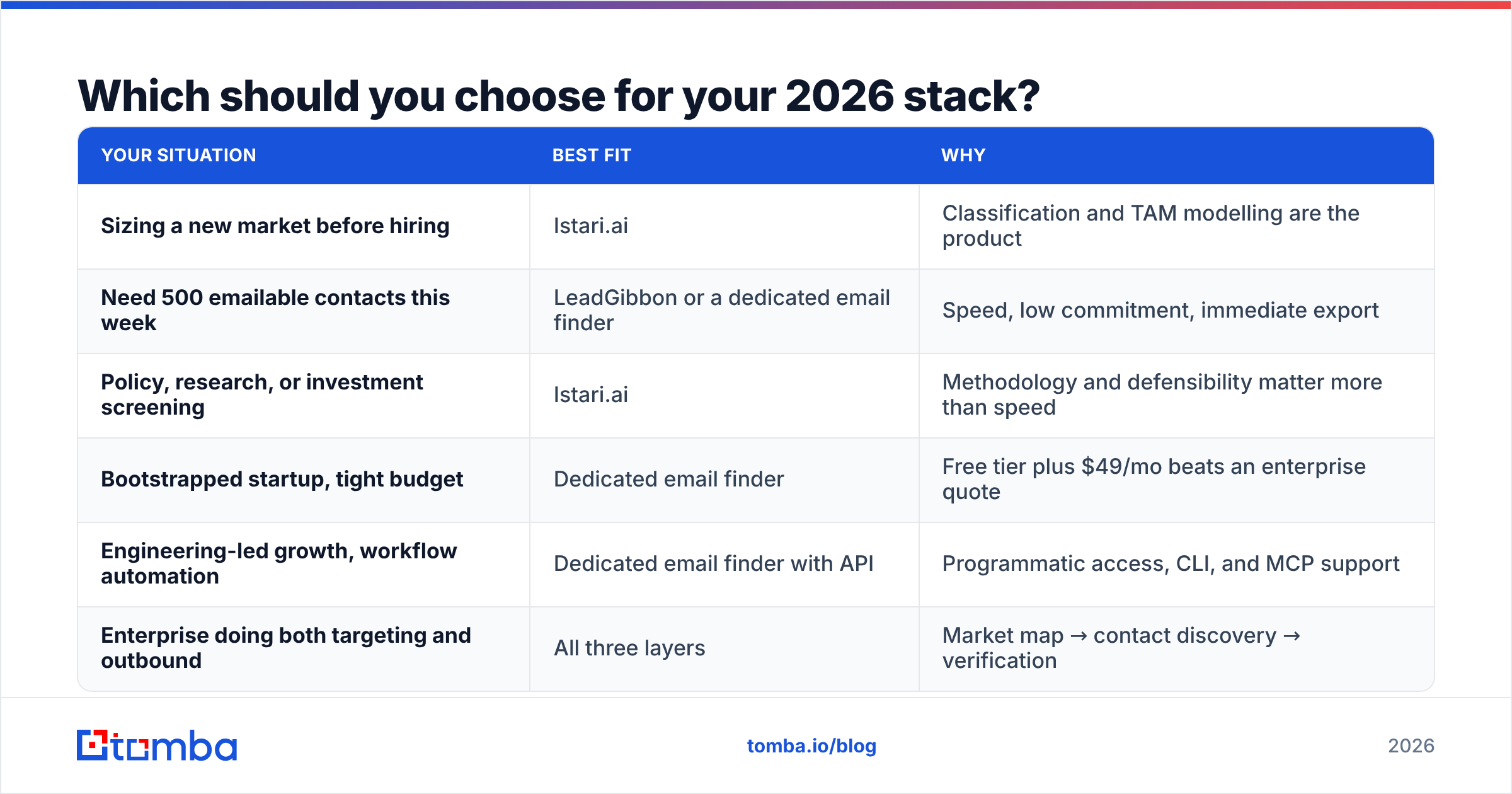
Which should you choose for your 2026 stack?#
| Your situation | Best fit | Why |
|---|---|---|
| Sizing a new market before hiring | Istari.ai | Classification and TAM modelling are the product |
| Need 500 emailable contacts this week | LeadGibbon or a dedicated email finder | Speed, low commitment, immediate export |
| Policy, research, or investment screening | Istari.ai | Methodology and defensibility matter more than speed |
| Bootstrapped startup, tight budget | Dedicated email finder | Free tier plus $49/mo beats an enterprise quote |
| Engineering-led growth, workflow automation | Dedicated email finder with API | Programmatic access, CLI, and MCP support |
| Enterprise doing both targeting and outbound | All three layers | Market map → contact discovery → verification |
The honest summary: comparing Istari.ai vs LeadGibbon is comparing a market map to an address book. Both are legitimate purchases. Neither replaces the other, and if you buy one expecting the other's job, you'll write a bad review that's really a scoping error.
If you want to pressure-test alternatives before committing, the Apollo alternative and RocketReach alternative breakdowns cover the adjacent contact-data vendors most teams shortlist alongside LeadGibbon.
Where does Tomba fit?#
In the layer both of these tools leave thin: turning a target domain into a verified, contactable person.
If you already know which companies you want — from Istari.ai, from a market map you built yourself, from a conference attendee list, or from a website-visitor export — the Tomba Email Finder resolves those domains into named decision-makers with mailbox-level verification and explicit catch-all scoring, so your bounce rate stays where it should be. It starts free at 25 searches per month, moves to $49/month at Starter, and every paid tier includes API access for teams that would rather script it than click it. Full Tomba pricing is public — no quote call required.
Run 100 of your own domains through it, compare the verified rate against whatever you're using now, and let the bounce log decide.
Related guides#
// get started
Find, verify and enrich your first contacts today
Start on the free plan with 25 searches a month, then scale when your team is ready.
Free plan · No credit card required · GDPR & CCPA
// about the author