IT Demand Generation: The 2026 Playbook for Tech Marketers
IT buyers research in private and surface only when they are already shortlisting. Here is how demand generation actually works for technology audiences in 2026: channels, budget splits, metrics, and the contact-data layer that makes outbound land.
TL;DR
- IT demand generation is not lead generation with a new label. Lead gen harvests contact details; demand gen creates the awareness that makes someone want to search for you in the first place.
- Technology buyers do 70–80% of their evaluation before they talk to a vendor, and most of that happens in places you cannot track: Slack groups, peer communities, Reddit threads, private podcasts.
- Split budget roughly 60% create-demand / 30% capture-demand / 10% experiments, and stop judging create-demand channels with capture-demand metrics.
- Your MQL count is the least useful number on the dashboard. Track qualified pipeline, self-reported attribution, and branded search volume instead.
- Outbound still works for IT, but only when the contact data underneath it is verified. Bad data is the single fastest way to burn a sending domain and a territory.
What is IT demand generation, and how is it different from lead generation?#
IT demand generation is the practice of creating and capturing interest in a technology product among technical and technical-adjacent buyers: CTOs, VPs of Engineering, IT directors, security leads, platform teams, and the procurement people who sign off on their choices.
The difference from lead generation is a matter of sequence. Demand generation makes someone care. Lead generation collects their email once they already do. Most teams that say "our demand gen isn't working" are actually running lead gen with a bigger budget, and they wonder why the leads do not convert.
Here is the practical breakdown of what sits inside an IT demand generation program:
- Demand creation — podcasts, technical blog posts, open-source contributions, conference talks, community participation. Nobody fills in a form. You are buying future intent.
- Demand capture — branded search ads, comparison pages, category keywords, review-site presence. These catch people who already decided they need something like you.
- Demand conversion — free tiers, sandboxes, API keys, docs-first onboarding. For IT audiences, the product itself is the demo.
- Demand activation — outbound to accounts showing intent signals, backed by verified contact data and a message that references a real technical problem.
- Demand measurement — self-reported attribution, branded search trends, pipeline by source cohort. Not last-touch.
Miss step one and steps two through five compete for a pool of demand you did not create. That is why so many IT marketing teams feel stuck fighting for the same 2% of in-market buyers as every competitor.
Why does the standard B2B playbook break on IT buyers?#
Because the people you need to reach have a professional allergy to marketing. An engineer who spends their day filtering alerts is exceptionally good at filtering a nurture sequence.
Three structural differences matter:
The buying committee is large and adversarial. Gartner's research on B2B buying groups has consistently found six to ten stakeholders in a typical enterprise technology purchase, each arriving with their own information set. In IT specifically, the security reviewer's job is literally to say no. You are not persuading one person, you are arming a champion to survive a committee.
The research happens where you cannot see it. Vendor-neutral communities, private Slack instances, colleagues' opinions. This is what people mean by "dark social." Your analytics will attribute the eventual conversion to a branded Google search, which tells you nothing about the three months of reading that preceded it.
Technical credibility is binary. One inaccurate benchmark, one marketing claim the docs contradict, and you are out. IT audiences forgive a boring landing page. They do not forgive a false one.
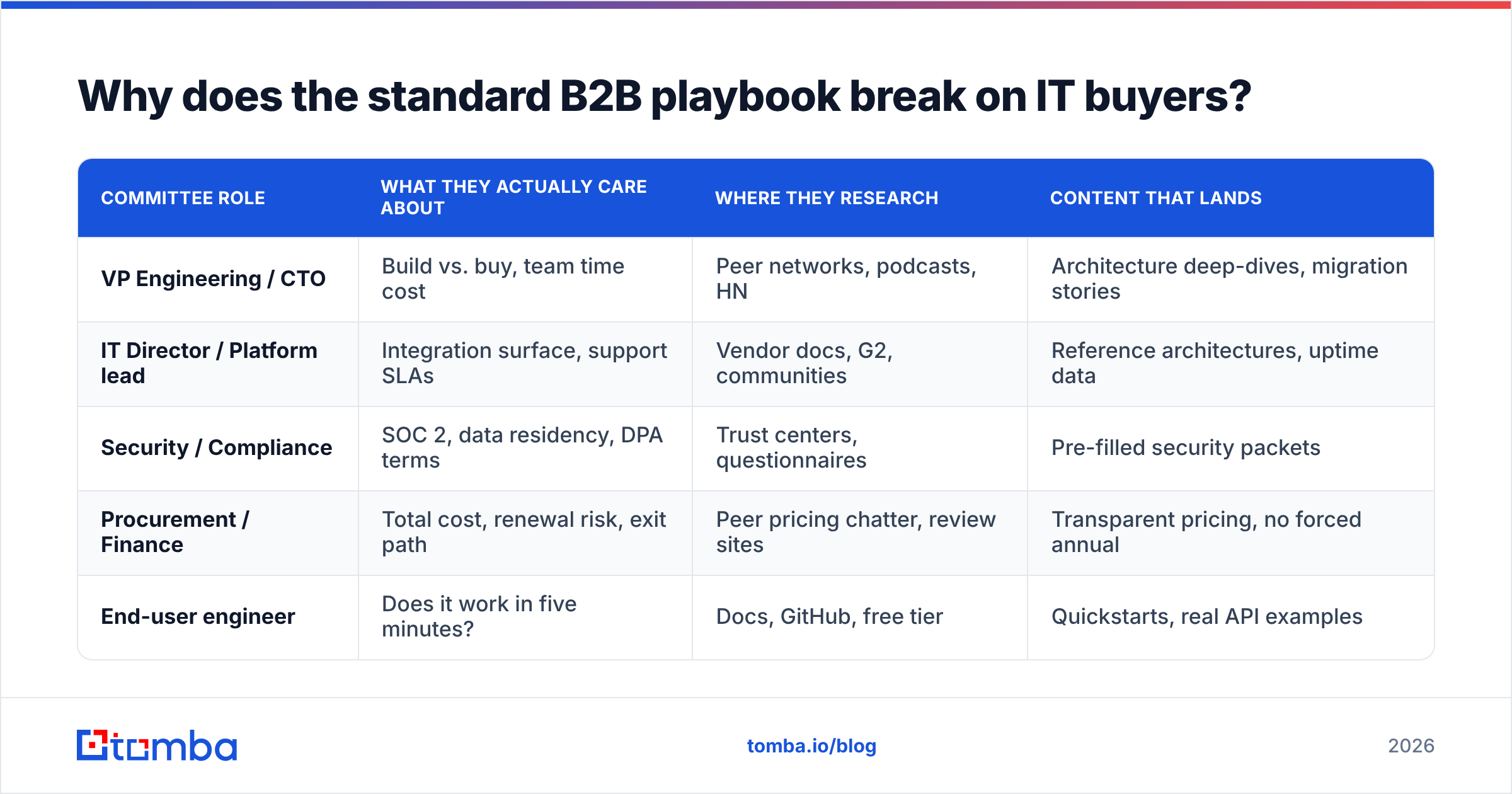
| Committee role | What they actually care about | Where they research | Content that lands |
|---|---|---|---|
| VP Engineering / CTO | Build vs. buy, team time cost | Peer networks, podcasts, HN | Architecture deep-dives, migration stories |
| IT Director / Platform lead | Integration surface, support SLAs | Vendor docs, G2, communities | Reference architectures, uptime data |
| Security / Compliance | SOC 2, data residency, DPA terms | Trust centers, questionnaires | Pre-filled security packets |
| Procurement / Finance | Total cost, renewal risk, exit path | Peer pricing chatter, review sites | Transparent pricing, no forced annual |
| End-user engineer | Does it work in five minutes? | Docs, GitHub, free tier | Quickstarts, real API examples |
Print that table and check your content library against it. Most IT marketing teams have four assets for the CTO row and nothing for the security row, which is precisely where deals actually die.
Which channels actually work for IT demand generation in 2026?#
The honest answer is that channel performance depends far more on your category maturity than on the channel itself. If nobody knows your category exists, paid search has nothing to capture. If your category is crowded, review sites and comparison content do the heavy lifting.
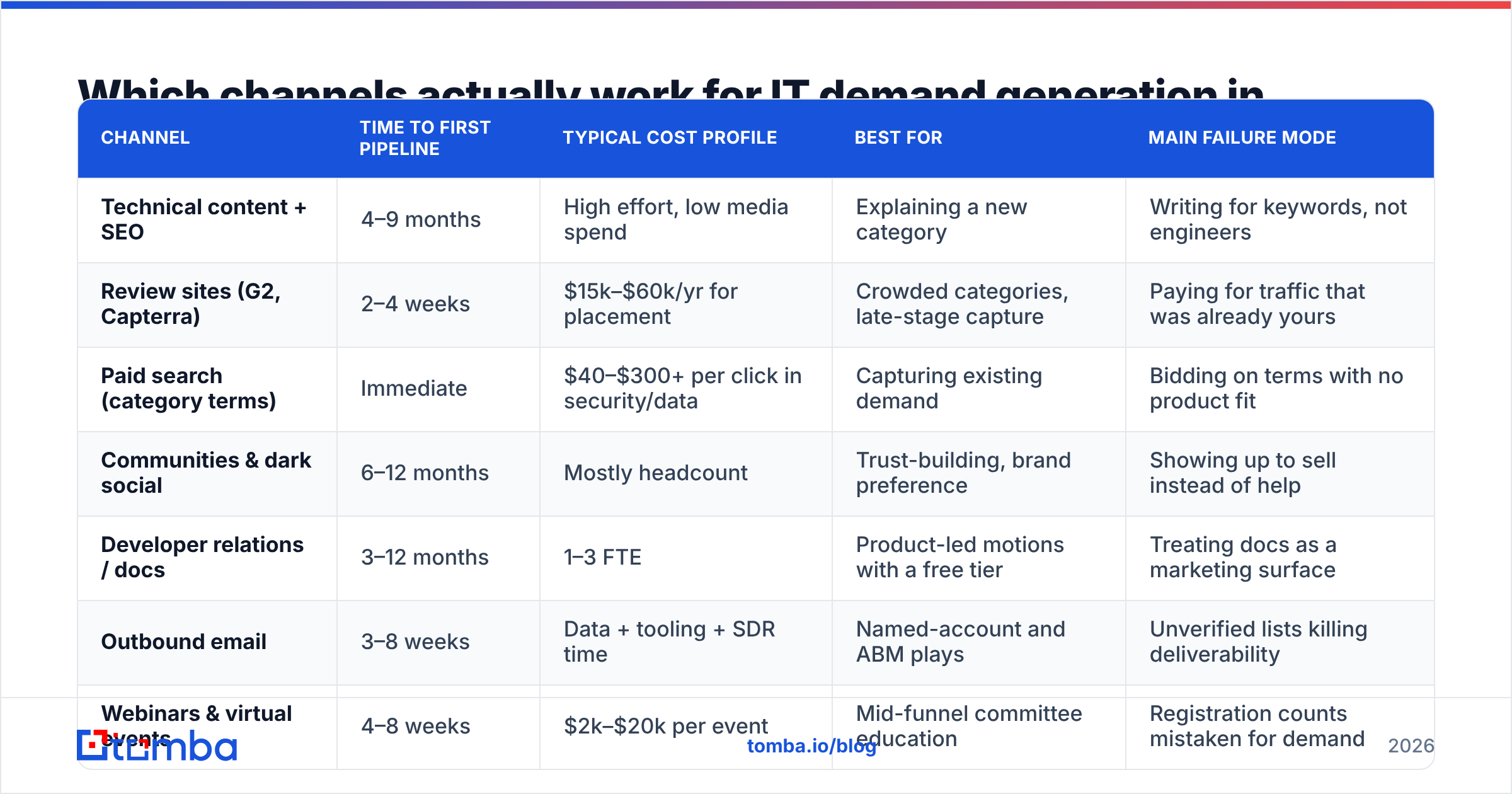
That said, here is how the major channels compare for technology audiences based on how they behave, not on vendor case studies:
| Channel | Time to first pipeline | Typical cost profile | Best for | Main failure mode |
|---|---|---|---|---|
| Technical content + SEO | 4–9 months | High effort, low media spend | Explaining a new category | Writing for keywords, not engineers |
| Review sites (G2, Capterra) | 2–4 weeks | $15k–$60k/yr for placement | Crowded categories, late-stage capture | Paying for traffic that was already yours |
| Paid search (category terms) | Immediate | $40–$300+ per click in security/data | Capturing existing demand | Bidding on terms with no product fit |
| Communities & dark social | 6–12 months | Mostly headcount | Trust-building, brand preference | Showing up to sell instead of help |
| Developer relations / docs | 3–12 months | 1–3 FTE | Product-led motions with a free tier | Treating docs as a marketing surface |
| Outbound email | 3–8 weeks | Data + tooling + SDR time | Named-account and ABM plays | Unverified lists killing deliverability |
| Webinars & virtual events | 4–8 weeks | $2k–$20k per event | Mid-funnel committee education | Registration counts mistaken for demand |
Two notes on reading this table. First, "time to first pipeline" is not a ranking. A channel that takes nine months can still be your cheapest source of qualified pipeline in year two. Second, the failure modes are more predictive than the costs. Almost every channel works when executed by someone who understands the audience; almost none work when run as a checkbox.
If you want a sanity check on how your category is actually described by buyers rather than by vendors, read the unfiltered review text on G2 before you write a single line of positioning. The language buyers use in reviews is the language that should appear in your ads.
How should you split budget between creating and capturing demand?#
Start at 60/30/10 and adjust from there.
- 60% create demand. Content, community, podcasts, events, original research, developer relations. This is the part finance will question every quarter because it does not produce a clean cost-per-lead number.
- 30% capture demand. Branded and category search, review-site presence, comparison pages, retargeting. This is where you should expect efficient, measurable return.
- 10% experiments. New channels, weird formats, sponsorships you cannot yet justify. Kill them ruthlessly at 90 days.
The split shifts with category maturity. If you sell into a category that already has a Gartner Magic Quadrant, flip toward capture: the demand exists and your job is to win the shortlist. If you are creating a category, push create-demand toward 70% and accept a longer payback window.
The mistake that wrecks this model is applying capture-demand measurement to create-demand spend. A podcast will never show a respectable cost-per-MQL, because its job is to make the branded search happen six months later. If your CFO demands last-touch ROI on every line item, you will end up with a budget that is 100% capture and a pipeline that shrinks every year as the demand you never created runs out.
What metrics should you track for IT demand generation?#
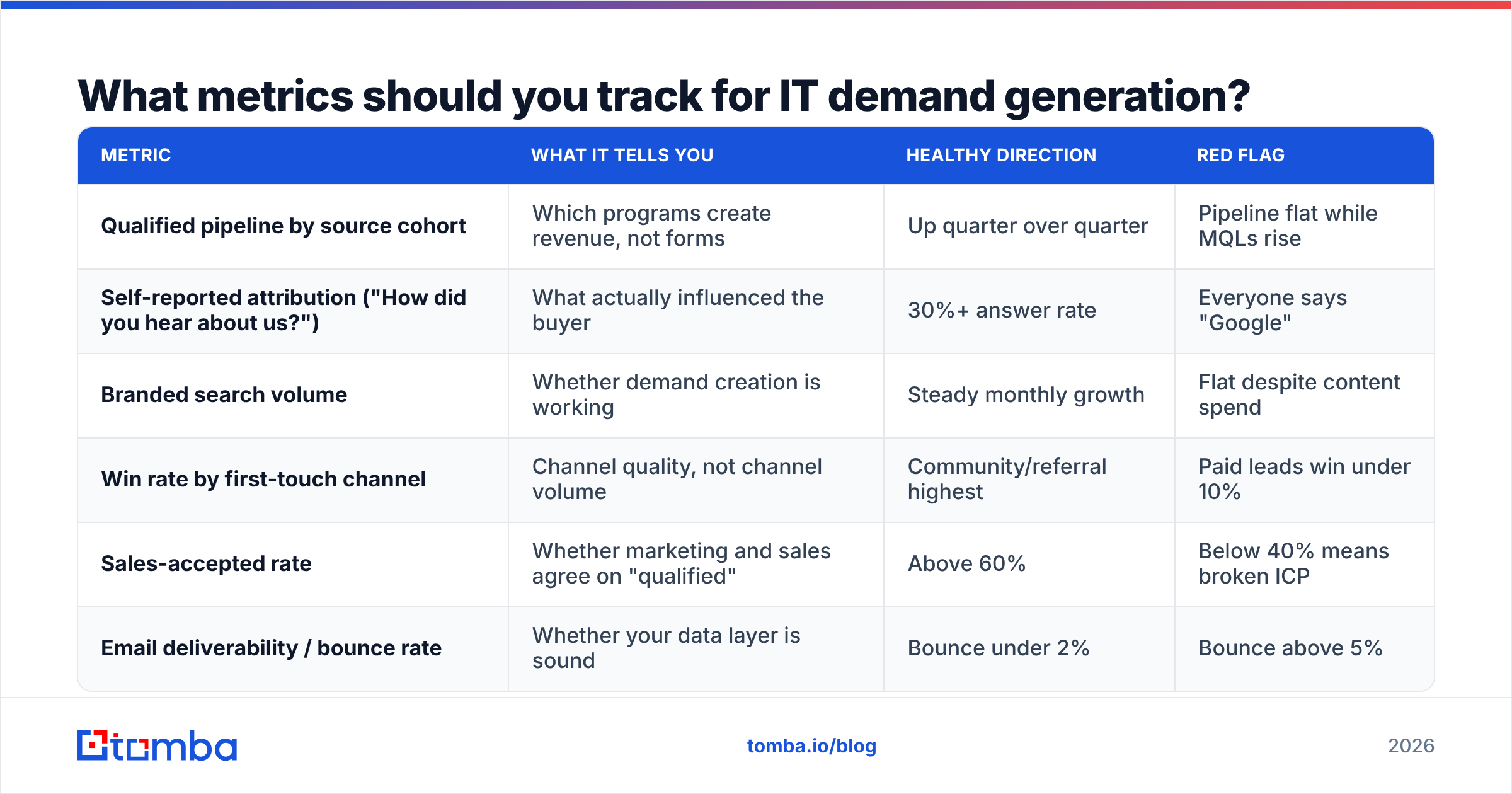
Replace volume metrics with intent and outcome metrics. The table below is the minimum viable dashboard:
| Metric | What it tells you | Healthy direction | Red flag |
|---|---|---|---|
| Qualified pipeline by source cohort | Which programs create revenue, not forms | Up quarter over quarter | Pipeline flat while MQLs rise |
| Self-reported attribution ("How did you hear about us?") | What actually influenced the buyer | 30%+ answer rate | Everyone says "Google" |
| Branded search volume | Whether demand creation is working | Steady monthly growth | Flat despite content spend |
| Win rate by first-touch channel | Channel quality, not channel volume | Community/referral highest | Paid leads win under 10% |
| Sales-accepted rate | Whether marketing and sales agree on "qualified" | Above 60% | Below 40% means broken ICP |
| Email deliverability / bounce rate | Whether your data layer is sound | Bounce under 2% | Bounce above 5% |
The self-reported attribution field is the highest-leverage thing on this list and the cheapest to implement. One open-text question on your demo form, reviewed monthly, will tell you more about your demand generation than any multi-touch attribution model you can buy. HubSpot's own research team has published extensively on this pattern in their marketing research library, and the consistent finding is that buyers name channels your analytics never recorded.

How does contact data fit into IT demand generation?#
Demand creation earns you the right to reach out. Contact data determines whether the outreach arrives.
This is the part most demand gen frameworks skip, and it is where programs quietly bleed. You build an account list from intent signals, hand it to SDRs, and 18% of the emails bounce because the list was scraped in 2023. Now your email deliverability is damaged, your domain reputation drops, and even the accounts with correct addresses stop seeing you in the inbox.
A workable data layer for IT demand generation looks like this:
- Define the account list from real signals — product usage, docs traffic, review-site activity, hiring patterns for the technologies you integrate with.
- Find the right people, not just any people. Use a domain search to map who actually works in engineering and platform roles at the account, then narrow to the two or three who match your committee map.
- Verify before you send. Run every address through an email verifier and handle catch-all domains explicitly rather than guessing. Enterprise IT organizations run catch-all configurations more often than the average company, which is exactly why generic verification tools misreport them.
- Enrich for context. Role, seniority, tech stack, and company size turn a generic sequence into a message that references the buyer's actual environment. Data enrichment is what separates relevant outbound from spam.
- Refresh on a cadence. Technology teams reorganize constantly. A list older than six months is a different list.
Several providers serve this layer well depending on your motion. Curated list vendors such as BookYourData are a reasonable fit when you want pre-built, human-checked lists for a defined segment; API-first tools fit better when enrichment needs to run continuously inside your own systems. Match the tool to whether your data need is a one-time purchase or an ongoing pipeline.
What are the most common IT demand generation mistakes?#
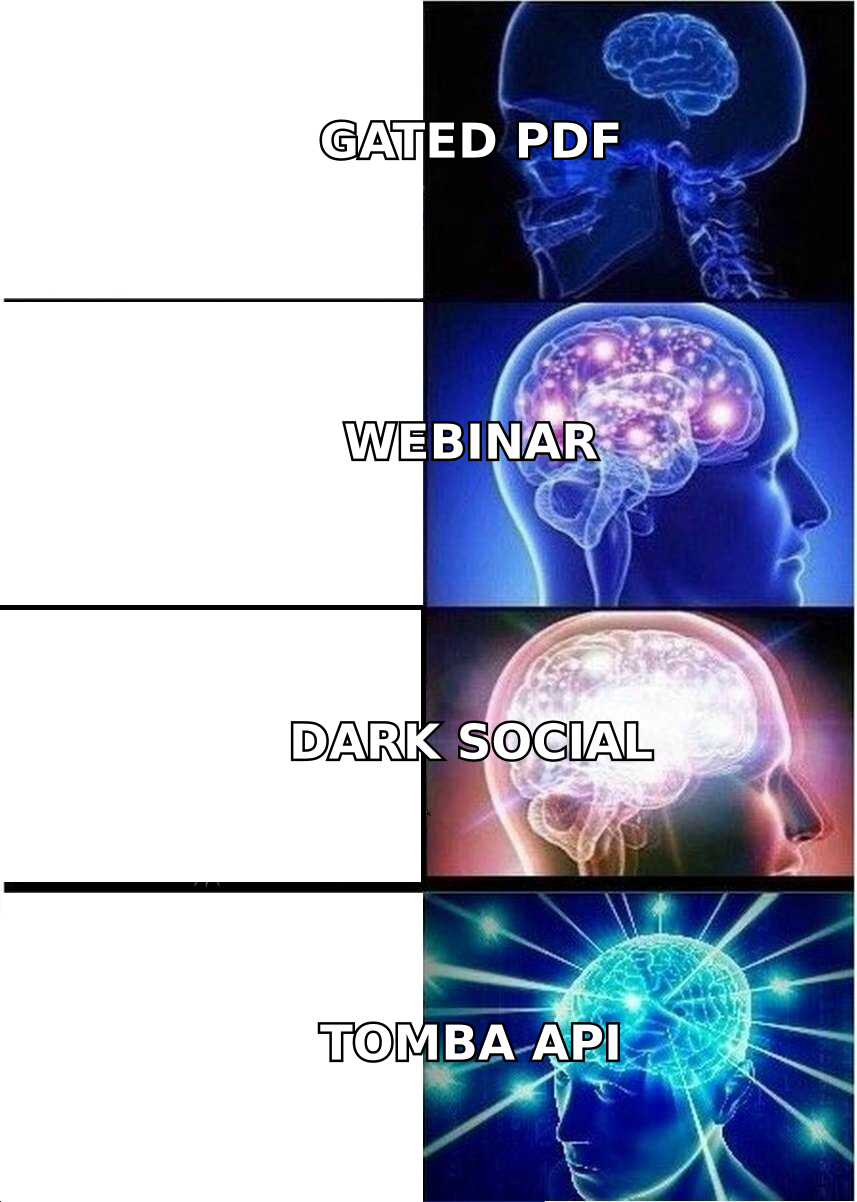
- Gating everything. A gated PDF in front of technical content converts a reader into a hostile lead. Ungate the education, gate the interactive tools.
- Marketing to the title, not the problem. "Digital transformation for IT leaders" means nothing. "Cut your Kubernetes control-plane spend by 30%" means something.
- Ignoring the security reviewer. Publish a trust page, a pre-filled security questionnaire, and your subprocessor list. You will shorten deal cycles by weeks.
- Running outbound on unverified data. See the previous section. This is a self-inflicted wound.
- Cutting create-demand in a down quarter. It is the only line item where cuts show no immediate pain and maximum delayed damage.
- Measuring dark social with a UTM. You cannot. Ask the buyer instead.
- Copying a playbook from a different category. The PLG motion that worked for a developer tool with a free tier will not work for a $400k security platform with a nine-month cycle.
For a broader view of how demand programs connect to forecasting and territory design, it is worth reading up on how revenue operations teams structure the handoff between marketing-sourced and sales-sourced pipeline. Most attribution arguments are really RevOps definition problems in disguise.
Where should you start if you are building this from zero?#
Pick one create-demand channel you can sustain for twelve months, one capture-demand channel you can measure weekly, and fix your data layer before you scale either. Three things done properly beat nine done partially, and IT audiences notice the difference immediately.
Then instrument the feedback loop: self-reported attribution on every form, branded search tracked monthly, pipeline reviewed by cohort rather than by last touch. Within two quarters you will know which half of your budget is working, which is more than most technology marketing teams can say.
When the demand creation is running and you need to activate named accounts, the data underneath the outreach is what decides whether any of it lands. Start with the Tomba Email Finder to build verified, role-accurate contact lists for the accounts already showing intent. The free tier includes 25 searches per month so you can test accuracy against your own target list before committing, and paid plans start at $49/mo on Starter, $99/mo on Growth, and $249/mo on Pro — see Tomba pricing for the full breakdown. Verify first, send second, and let your demand generation program reach the people it worked so hard to earn.
Related guides#
// get started
Find, verify and enrich your first contacts today
Start on the free plan with 25 searches a month, then scale when your team is ready.
Free plan · No credit card required · GDPR & CCPA
Get the Tomba newsletter
Product and data updates
// about the author