IT Lead Generation Services: A 2026 Buyer's Guide
Most IT lead generation services sell you meetings, not pipeline. Here's how the four delivery models actually price out, what a qualified IT lead really costs, and when building in-house beats outsourcing.
TL;DR
- IT lead generation services fall into four models — appointment-setting agencies, managed SDR-as-a-service, data-and-tooling providers, and intent/ABM platforms. They are not interchangeable, and most buyers pick the wrong one.
- Typical 2026 pricing: $3,000–$12,000/mo retainers, $350–$900 per qualified appointment, or $49–$249/mo if you run outbound in-house with your own data stack.
- The agency premium is mostly labor and process, not data. Most vendors buy from the same handful of contact databases you can license directly.
- Outsourcing makes sense when your ACV is above roughly $25K and your sales team is closing-capacity-constrained. Below that, the math usually breaks.
- Whatever model you choose, contact accuracy is the upstream variable that decides everything downstream — bounce rate, domain reputation, and cost per meeting.
Selling IT services — managed services, cloud migration, cybersecurity, custom development, staff augmentation — has a specific problem. Your buyers are IT directors, CTOs, VPs of Infrastructure, and CISOs. They are the most pitched people in the enterprise, their inboxes run the most aggressive spam filtering in the building, and they treat unsolicited outreach as a security signal rather than a sales conversation.
That's why IT lead generation services exist as a distinct category, and why they cost more per meeting than almost any other vertical. This guide breaks down what you're actually buying, what it should cost, and where the money leaks.
What Are IT Lead Generation Services?#
IT lead generation services are outsourced or productized systems that identify, contact, and qualify technology buyers on your behalf, then hand off meetings or marketing-qualified leads to your sales team.
The category spans four distinct delivery models:
- Appointment-setting agencies — You pay per booked meeting or per retainer. The agency owns the list, the sending infrastructure, and the SDR labor. You get a calendar invite. Best for teams with closers but no prospecting capacity.
- Managed SDR-as-a-service — A dedicated rep (or pod) works exclusively on your account, using your messaging and often your domains. More expensive, more controllable, and the output looks like an extension of your team rather than a vendor feed.
- Data and tooling providers — You license contact data, verification, and enrichment, then run outbound yourself. Costs shift from labor to software. This is where data enrichment and email-finding platforms live.
- Intent and ABM platforms — Vendors like 6sense, Demandbase, and G2 Buyer Intent surface accounts already researching your category. They do not generate contact-level pipeline on their own; they tell you where to point everything else.
Most buyers think they're comparing vendors. They're actually comparing models, and the models have wildly different cost structures, control levels, and failure modes.
Ignore that — use the placeholder below.
How Much Do IT Lead Generation Services Cost in 2026?#
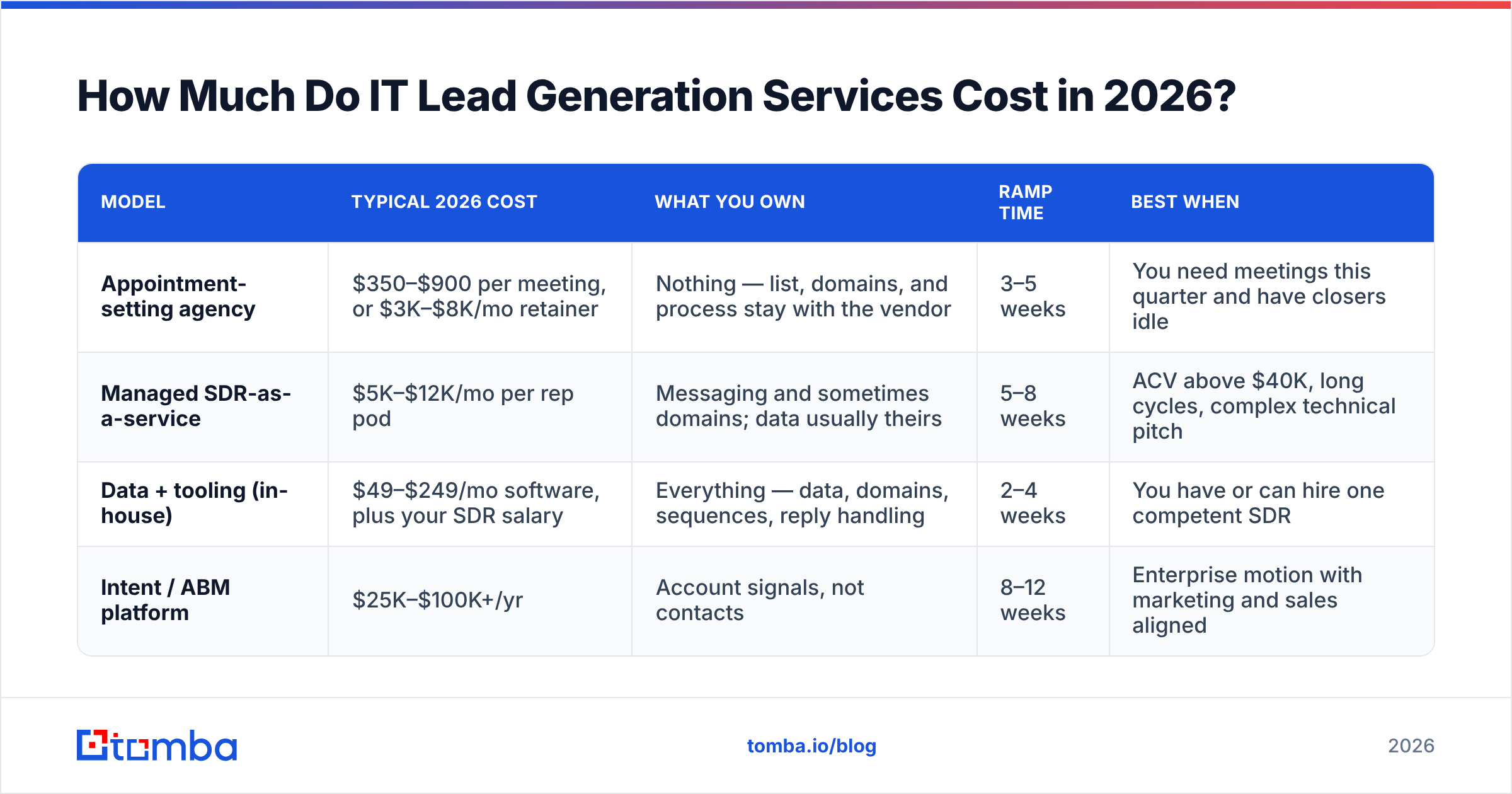
Pricing in this category is deliberately opaque, because the underlying unit economics vary by how hard your ICP is to reach. Here's what current market rates look like across the four models.
| Model | Typical 2026 cost | What you own | Ramp time | Best when |
|---|---|---|---|---|
| Appointment-setting agency | $350–$900 per meeting, or $3K–$8K/mo retainer | Nothing — list, domains, and process stay with the vendor | 3–5 weeks | You need meetings this quarter and have closers idle |
| Managed SDR-as-a-service | $5K–$12K/mo per rep pod | Messaging and sometimes domains; data usually theirs | 5–8 weeks | ACV above $40K, long cycles, complex technical pitch |
| Data + tooling (in-house) | $49–$249/mo software, plus your SDR salary | Everything — data, domains, sequences, reply handling | 2–4 weeks | You have or can hire one competent SDR |
| Intent / ABM platform | $25K–$100K+/yr | Account signals, not contacts | 8–12 weeks | Enterprise motion with marketing and sales aligned |
Two numbers matter more than the sticker price.
Cost per qualified meeting (CPQM). Retainers hide this. A $6,000/mo retainer producing 12 meetings is $500 each. The same retainer producing 4 meetings — common in cybersecurity and compliance niches — is $1,500 each. Always convert to CPQM before comparing.
Show rate and qualification rate. Agencies that get paid per booked meeting have a structural incentive to book anything. Industry show rates for outsourced IT appointments run 55–75%. A $450 meeting at a 60% show rate is really a $750 meeting. Negotiate on held, qualified meetings or you're paying for no-shows.
What Makes IT Buyers Harder to Reach Than Other Verticals?#
Four things, and each one has a cost consequence.
- Aggressive filtering. IT departments run the strictest inbound mail policy in the company — they configured it. Cold sends into IT need clean sender reputation, correct SPF/DKIM/DMARC, and near-zero bounce rates, or you land in quarantine rather than spam. Nobody ever tells you.
- Committee buying. Gartner's research on B2B buying groups consistently puts enterprise technology purchases at six to ten stakeholders. You are not finding "the decision maker." You are building a multi-threaded map — infrastructure lead, security lead, procurement, finance, and a skeptical architect who will veto quietly.
- Vendor fatigue. An IT director at a 500-person company receives 30–60 vendor pitches a week. Generic differentiation ("we reduce costs and improve efficiency") is indistinguishable from noise.
- Data decay is faster. Tech job mobility is high. Contact records in IT go stale meaningfully faster than in, say, manufacturing or healthcare administration. A list built nine months ago is substantially wrong today.
That last point is the one buyers underweight. Every model above — agency, SDR pod, in-house — sits on top of contact data. If the data is 70% accurate, you burn 30% of your sending volume generating bounces that degrade the domain you need for the other 70%.
Should You Outsource or Build IT Lead Generation In-House?#
Run the math before the meeting with the agency, not after.
The break-even question is straightforward: at what point does a fully loaded in-house SDR cost less per qualified meeting than an agency retainer?
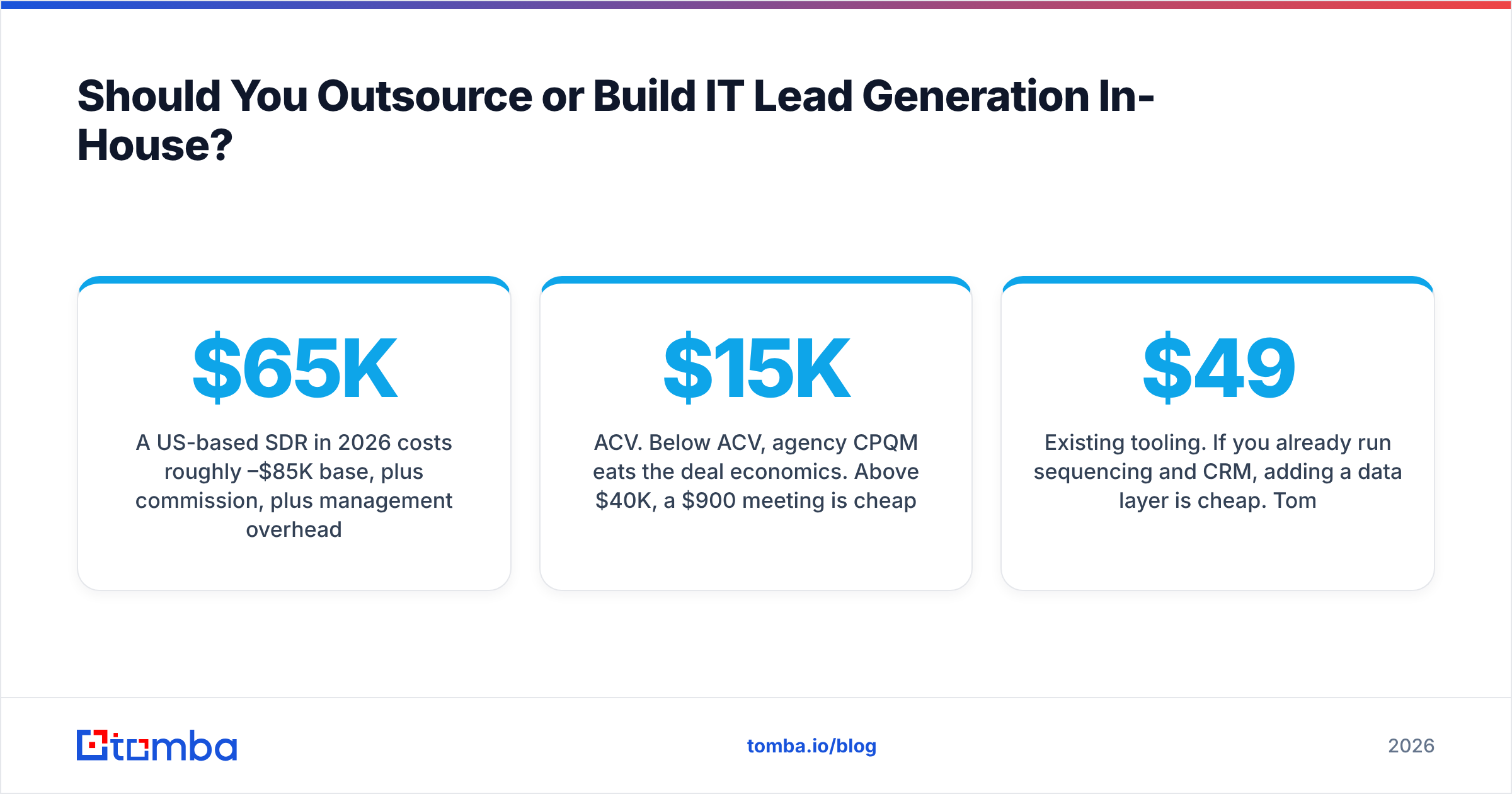
A US-based SDR in 2026 costs roughly $65K–$85K base, plus commission, plus management overhead — call it $110K fully loaded, or about $9,200/mo. A competent SDR working a well-defined IT ICP should produce 10–18 qualified meetings a month once ramped. That's $510–$920 per meeting — squarely in agency territory, except you keep the domain reputation, the sequences, the objection library, and the person.
The variables that flip the answer:
- Time to first meeting. An agency books in weeks 3–5. An in-house hire books in months 2–3. If your board wants pipeline this quarter, you buy time, not efficiency.
- ACV. Below $15K ACV, agency CPQM eats the deal economics. Above $40K, a $900 meeting is cheap.
- Message complexity. If your pitch requires understanding Kubernetes cost allocation or SOC 2 audit scope, an outsourced SDR handling four accounts will not carry it convincingly. Technical depth is the strongest argument for in-house or dedicated-pod models.
- Existing tooling. If you already run sequencing and CRM, adding a data layer is cheap. Tomba's bulk email finder and email verifier cover the contact side at $49/mo Starter or $99/mo Growth — which is roughly 1.5% of a single agency retainer.
How Do You Evaluate an IT Lead Generation Vendor?#
Ask these seven questions, and treat evasion on any of them as a hard signal.
- Where does your contact data come from? Most agencies license from the same three or four providers, then resell it inside a service wrapper. That's fine — but it means their data is not a differentiator, and you should not pay a premium for it as though it were. Check the vendor's own data sources disclosure standard against theirs.
- Whose domains do you send from? If they send from your primary domain, a bad campaign damages your corporate email forever. Insist on separate sending domains. If they send from theirs, ask what their current bounce and complaint rates are.
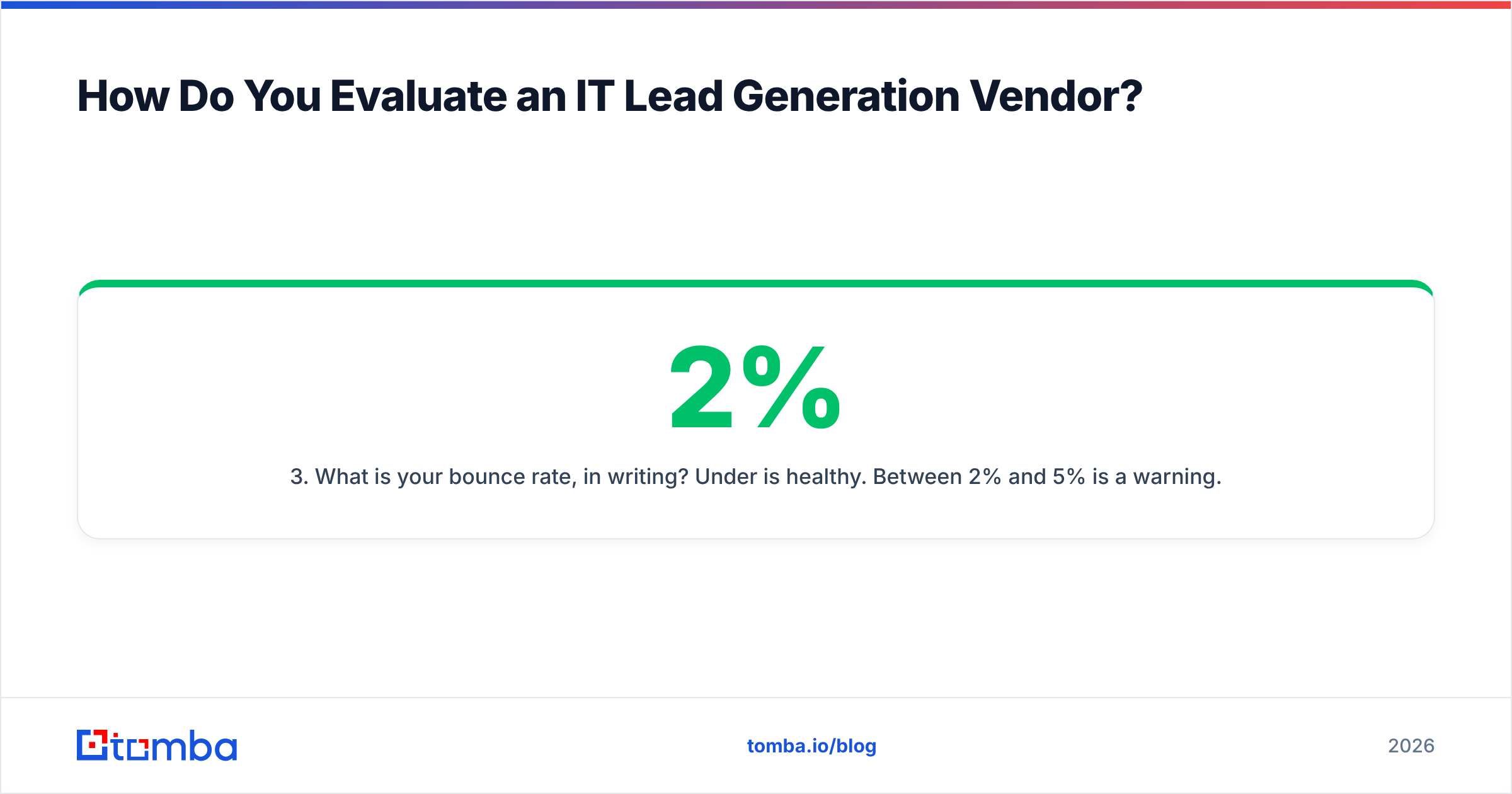
- What is your bounce rate, in writing? Under 2% is healthy. Between 2% and 5% is a warning. Above 5% means they are not verifying, and your email deliverability will suffer wherever the sends originate.
- Do you charge for booked meetings or held-and-qualified meetings? Only the second one aligns incentives.
- Who writes the copy, and can I see three examples from IT campaigns? Ask specifically for the sequences, not the case-study PDF.
- What's the contract minimum and the exit clause? Six-month minimums are standard. Twelve-month with no performance clause is a red flag.
- Can I talk to a client who churned? The good ones will actually give you a name.
Independent review data helps triangulate. Check vendor profiles on G2 and Capterra and read the two-star reviews specifically — five-star reviews tell you about onboarding, two-star reviews tell you about month seven.
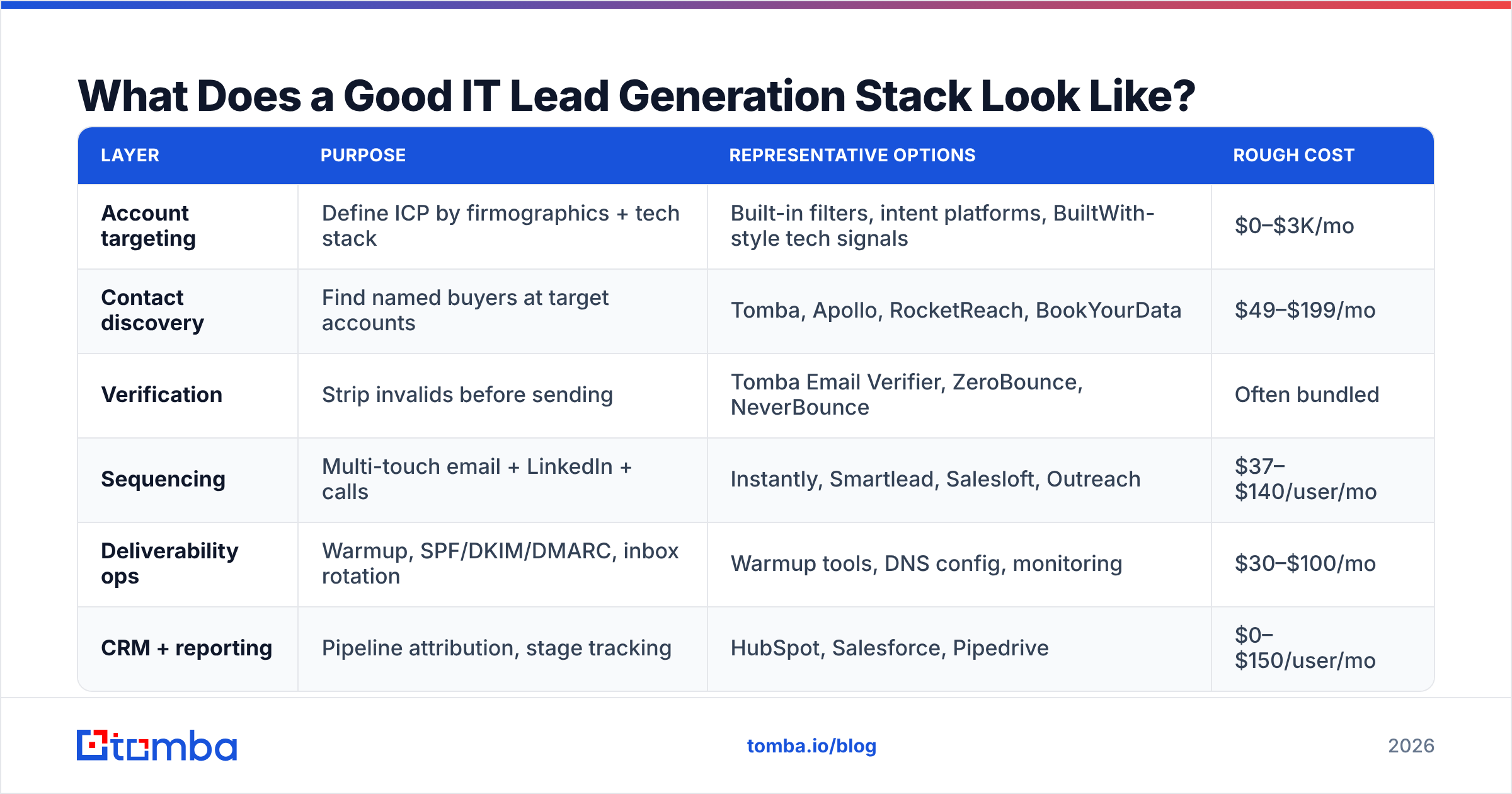
What Does a Good IT Lead Generation Stack Look Like?#
If you go in-house or run a hybrid, here's the functional stack, layer by layer.
| Layer | Purpose | Representative options | Rough cost |
|---|---|---|---|
| Account targeting | Define ICP by firmographics + tech stack | Built-in filters, intent platforms, BuiltWith-style tech signals | $0–$3K/mo |
| Contact discovery | Find named buyers at target accounts | Tomba, Apollo, RocketReach, BookYourData | $49–$199/mo |
| Verification | Strip invalids before sending | Tomba Email Verifier, ZeroBounce, NeverBounce | Often bundled |
| Sequencing | Multi-touch email + LinkedIn + calls | Instantly, Smartlead, Salesloft, Outreach | $37–$140/user/mo |
| Deliverability ops | Warmup, SPF/DKIM/DMARC, inbox rotation | Warmup tools, DNS config, monitoring | $30–$100/mo |
| CRM + reporting | Pipeline attribution, stage tracking | HubSpot, Salesforce, Pipedrive | $0–$150/user/mo |
A note on where teams overspend: the sequencing and CRM layers get the most budget attention and matter the least to outcome. The discovery and verification layers get the least attention and determine whether anything below them works at all. Reversing that priority is the single highest-leverage change most IT outbound teams can make.
For teams already running HubSpot or Salesforce, plugging a data layer directly into the CRM through Tomba's integrations removes the CSV round-trip that quietly reintroduces stale records.
What Results Should You Expect From IT Lead Generation Services?#
Benchmarks for cold outbound into IT buyers, assuming verified data and correct technical setup:
- Deliverability: 92%+ inbox placement. Below 85% means a technical problem, not a copy problem.
- Open rate: 35–50%. Treat this as directional only — Apple Mail Privacy Protection has made open rates unreliable since 2021.
- Reply rate: 3–8% for a well-targeted IT campaign. Above 10% usually means your list is tiny and hyper-qualified, which is good.
- Positive reply rate: 1–2.5% of sends. This is the number that predicts meetings.
- Meeting-to-opportunity: 30–50% for managed services and infrastructure offers; lower for security, which has longer evaluation cycles.
- Ramp to steady state: 6–10 weeks regardless of model. Anyone promising pipeline in week two is either buying meetings off a list they've already burned or setting you up for a renewal conversation you won't enjoy.
Anchor your vendor conversation to positive reply rate and meeting-to-opportunity. Those two numbers are hard to game. Opens and "leads generated" are not.
When Do IT Lead Generation Services Actually Fail?#
The failure modes are predictable and mostly avoidable:
- The offer wasn't ready. No agency can sell an undifferentiated managed services pitch into a saturated market. If your own team can't book meetings with the pitch, outsourcing it multiplies the failure rate, it doesn't fix it.
- The list was bought, not built. Purchased lists of "IT decision makers" are typically resold, stale, and already burned by three competitors. Build from verified, current data or don't build.
- No one handled replies. Meetings die in the gap between "interested" and "booked." If the agency hands off raw replies and your AE responds in two days, you lose most of them.
- Domain damage. A single high-bounce campaign on a primary domain can take months to recover. Use separate sending domains, always.
- Attribution chaos. Without clear stage definitions, month four turns into an argument about what counted as a lead. Define "qualified" in the contract, in writing, with examples.
Get the Data Layer Right First#
Before you sign a retainer, test the cheapest variable: contact accuracy. Pull 200 target IT buyers at your ICP accounts, verify them, and send a small, well-crafted sequence yourself. You'll learn more about your offer's actual market response in three weeks than any agency pitch deck will tell you — and you'll walk into vendor negotiations knowing your real baseline reply rate.
Tomba Email Finder is built for exactly that test: find verified professional emails by domain, name, or company, with verification built in so bounces never reach your sending domain. Start on the free tier at 25 searches a month, or run a full ICP build on Starter at $49/mo — see Tomba pricing for the full breakdown. If the numbers work, you've got an in-house motion. If they don't, you now know precisely what to hold an agency accountable for.
Related guides#
// get started
Find, verify and enrich your first contacts today
Start on the free plan with 25 searches a month, then scale when your team is ready.
Free plan · No credit card required · GDPR & CCPA
// about the author