The IT Sales Pitch Framework That Wins Technical Buyers
Most IT pitches die in the first two minutes because they open with features instead of risk, cost, and proof. Here is the structure, sequencing, and evidence that actually moves a technical buying committee in 2026.
TL;DR
- An IT sales pitch fails or survives in the first 90 seconds, and it survives only if you lead with a risk or cost the buyer already believes in — not with your architecture diagram.
- You are never pitching one person. The median enterprise IT purchase now involves 6–10 stakeholders, and each one kills deals for a different reason.
- The three pitch structures that work (Problem-Cost-Proof, Status Quo Risk, and Technical Deep-Dive) map to three different buyer types. Pick wrong and you lose regardless of how good the product is.
- Technical buyers accept four kinds of proof: benchmark numbers, reference architecture, a named peer customer, and a sandbox they can break. Testimonials alone do nothing.
- The best pitch in the world still needs to reach the right inbox. Verified contact data for the CIO, the IT director, and the security lead is the unglamorous half of the job.
What is an IT sales pitch, and why is it different from a normal sales pitch?#
An IT sales pitch is a compressed argument for changing a system that currently works well enough. That last part is what makes it different.
When you pitch a marketing tool, the buyer is usually trying to do something new. When you pitch IT — managed services, infrastructure, security tooling, ITSM platforms, cloud migration — the buyer already has something running. Ripping it out means downtime risk, migration hours, retraining, and a very public failure if it goes wrong. The person you are pitching gets no promotion for saying yes and gets fired for saying yes badly.
So the burden of proof is inverted. In most B2B sales you argue "here is the upside." In IT sales you argue "here is why the risk of staying is higher than the risk of moving." Everything else in your deck is supporting material for that one sentence.
Two practical consequences:
- Your champion is rarely your economic buyer. The IT manager who loves your product has to sell it internally to a CFO who does not care about your product at all.
- Your pitch has to survive being retold badly. Your champion will paraphrase you in a 10-minute internal meeting you are not in. If your pitch cannot compress into three sentences they can remember, it dies in that room.
Why do most IT sales pitches fail?#
Because they are built for the seller's comfort, not the buyer's decision. Four failure patterns show up over and over:
You open with the company slide. Founded in 2014, 200 employees, offices in three countries. Nobody has ever bought infrastructure because of a founding date. You have spent your best 45 seconds on information the buyer could have read on your About page.
You pitch features to someone who buys outcomes. A CIO does not buy "automated patch orchestration." They buy "we stop failing the quarterly vulnerability audit." Same product, different sentence, wildly different conversion.
You ignore the cost of change. If you never name migration effort, the buyer assumes it is enormous and silently disqualifies you. Naming it — "four weeks, two of your engineers part-time, we do the data mapping" — makes you the safe option instead of the unknown one.
You never reach the person who can say yes. This is the quiet killer. Plenty of well-built pitches never get delivered because the prospecting layer underneath them is broken: outdated contact lists, generic info@ addresses, and bounce rates that wreck sender reputation before the message lands.

Who is actually in the room when you pitch IT?#
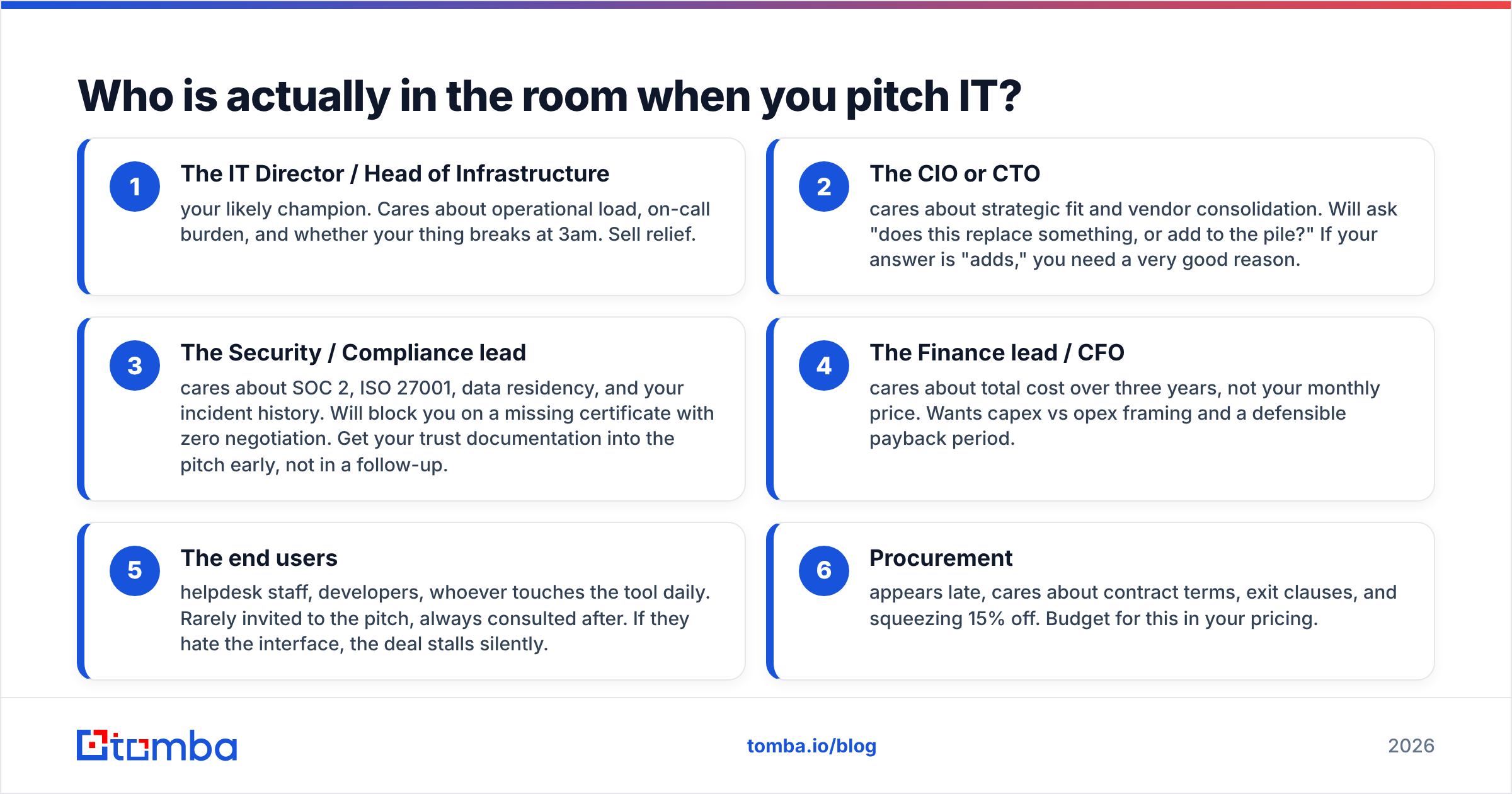
Treat this as the single most important prep step. Gartner's research on B2B buying has consistently shown that enterprise purchases run through large, distributed buying groups rather than a single decision-maker — and IT purchases sit at the high end of that range. Each role has a veto and a distinct objection:
- The IT Director / Head of Infrastructure — your likely champion. Cares about operational load, on-call burden, and whether your thing breaks at 3am. Sell relief.
- The CIO or CTO — cares about strategic fit and vendor consolidation. Will ask "does this replace something, or add to the pile?" If your answer is "adds," you need a very good reason.
- The Security / Compliance lead — cares about SOC 2, ISO 27001, data residency, and your incident history. Will block you on a missing certificate with zero negotiation. Get your trust documentation into the pitch early, not in a follow-up.
- The Finance lead / CFO — cares about total cost over three years, not your monthly price. Wants capex vs opex framing and a defensible payback period.
- The end users — helpdesk staff, developers, whoever touches the tool daily. Rarely invited to the pitch, always consulted after. If they hate the interface, the deal stalls silently.
- Procurement — appears late, cares about contract terms, exit clauses, and squeezing 15% off. Budget for this in your pricing.
Build one slide, one line, or one sentence for each of these. Not six decks — six sentences inside one deck. Your champion will use those exact lines to defend you internally.
Which IT sales pitch structure should you use?#
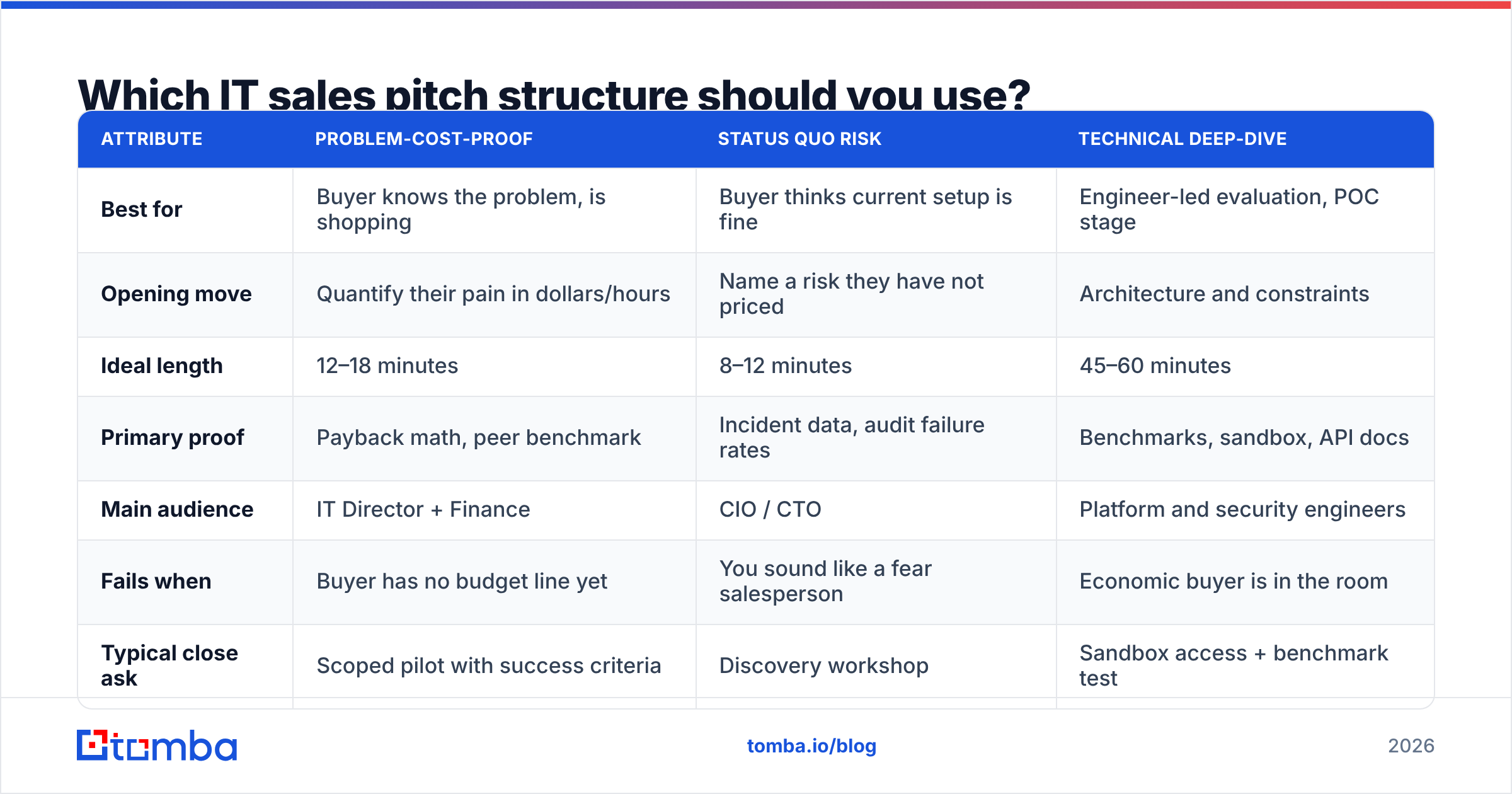
There are three that reliably work. The right one depends on how aware the buyer already is of the problem.
| Attribute | Problem-Cost-Proof | Status Quo Risk | Technical Deep-Dive |
|---|---|---|---|
| Best for | Buyer knows the problem, is shopping | Buyer thinks current setup is fine | Engineer-led evaluation, POC stage |
| Opening move | Quantify their pain in dollars/hours | Name a risk they have not priced | Architecture and constraints |
| Ideal length | 12–18 minutes | 8–12 minutes | 45–60 minutes |
| Primary proof | Payback math, peer benchmark | Incident data, audit failure rates | Benchmarks, sandbox, API docs |
| Main audience | IT Director + Finance | CIO / CTO | Platform and security engineers |
| Fails when | Buyer has no budget line yet | You sound like a fear salesperson | Economic buyer is in the room |
| Typical close ask | Scoped pilot with success criteria | Discovery workshop | Sandbox access + benchmark test |
The mistake most reps make is running Technical Deep-Dive on everyone, because it is the pitch they are most confident delivering. It is also the pitch that bores a CFO into silence.
A practical rule: if the prospect booked the call, use Problem-Cost-Proof. If you booked the call, use Status Quo Risk. Save the deep-dive for the second meeting with the people who will actually implement.
How do you open the first 90 seconds?#
Open with a number that belongs to them, not to you.
Weak open: "We're a leading provider of managed IT services helping companies modernize their infrastructure."
Strong open: "You're running Windows Server 2019 across what looks like about 40 endpoints, and extended support pricing jumped this year. Most teams your size are paying $18–24k a year just to stay patched on a stack they planned to retire. I want to show you what the migration actually costs, including the parts vendors usually leave out."
The second version does four things in under 20 seconds: proves you did homework, names a cost they already feel, promises specificity, and signals you will discuss downsides. That last signal is the credibility unlock. HubSpot's sales research has repeatedly found that discovery quality, not presentation polish, is what separates the top of the funnel from a closed deal.
Then earn the next five minutes with a single question: "Before I go further — is patching the thing that actually hurts, or is it something else?" You just converted a pitch into a conversation, and you get to re-aim.
What proof do technical buyers actually accept?#
Technical buyers have a functioning lie detector. They discount marketing language automatically. Four categories of evidence survive that filter:
- Reproducible numbers. "P95 latency under 40ms at 10k concurrent connections, here's the test harness" beats "blazing fast" every time. If you cannot share the methodology, do not share the number.
- Named peer references. Not "a Fortune 500 client." A named company in their industry, at roughly their size, with a specific before/after. Anonymous case studies read as fabricated, fairly or not.
- Reference architecture. A diagram showing exactly where your product sits relative to their existing stack — their identity provider, their monitoring, their ticketing system. This answers the "does it add to the pile" question visually.
- Something they can break. A sandbox, a free tier, an API key, a trial cluster. Nothing shortens an IT sales cycle like an engineer who has already run your quickstart. Public peer reviews on platforms like G2 help, but hands-on beats read-about.
Add a fifth, optional but powerful: a limitation you volunteer. "We don't do on-prem deployments, and if that's a hard requirement you should look at X instead." Sellers are terrified of this. Buyers remember it for months, and it is the fastest way to be believed on everything else you said.
How do you handle "we already have a vendor"?#
You will hear this on most first calls. The wrong response is to attack the incumbent — your buyer chose them, so you are calling your buyer's judgment bad.
The right response has three beats:
Acknowledge and get specific. "Makes sense — most teams at your stage are on something. Out of curiosity, what does it do well?" Genuine question. You need to know what you must match.
Find the seam. Every incumbent has a gap: a module they charge extra for, a support tier that is slow, a renewal price that jumped 30%, an integration that never shipped. Ask what they wish it did.
Propose coexistence, not replacement. "You don't need to rip anything out. Run us alongside on one team for 30 days and compare the ticket resolution times." Now the risk of trying you is near zero, and you have a foot in the environment. Full replacement conversations get easier from the inside.
Renewal timing matters more than anything you say. Ask directly: "When's the contract up?" If it is 11 months out, stop selling and start nurturing — a well-timed check-in at month nine beats eight pushy emails in month one. Track it in your CRM as a dated trigger, not a vague "revisit later."
How do you price the ask at the end of the pitch?#
Never end on price alone. End on a scoped next step that has a success criterion attached.
Bad close: "Our enterprise plan is $4,000 a month. Should I send over the contract?"
Good close: "Here's what I'd propose. A 30-day pilot on your service desk team — 20 seats, no charge. Success looks like mean time to resolution dropping below four hours. If we hit it, we talk about the full rollout at $4,000 a month. If we don't, you've lost a month and learned something. Fair?"
You have replaced a yes/no financial decision with a low-risk experiment that has a defined finish line. And you have pre-negotiated the criteria on which you will later be judged, which is worth more than the discount procurement will ask for anyway.
For the finance stakeholder, always present three-year total cost, not monthly. IT buyers compare against a status quo that has hidden costs — support contracts, engineer hours, downtime. A single table with "your current all-in cost" vs "our all-in cost" beats a pricing page.
How do you get your IT pitch in front of the right person?#
This is where most IT pitch efforts quietly break. You can have the best Status Quo Risk narrative in your category and still lose because the email went to a shared info@ address or bounced off a former employee's mailbox.
The workflow that holds up:
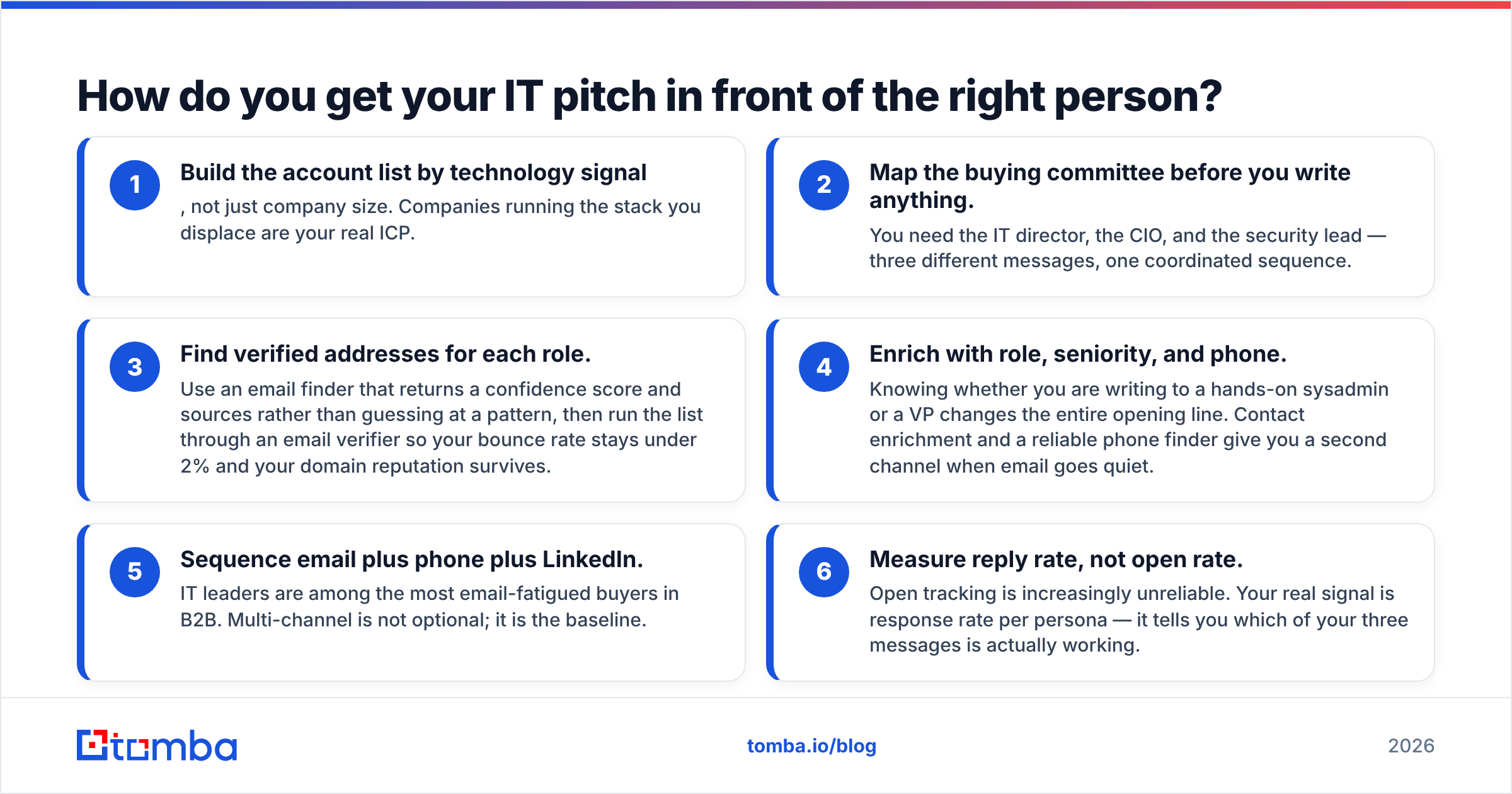
- Build the account list by technology signal, not just company size. Companies running the stack you displace are your real ICP.
- Map the buying committee before you write anything. You need the IT director, the CIO, and the security lead — three different messages, one coordinated sequence.
- Find verified addresses for each role. Use an email finder that returns a confidence score and sources rather than guessing at a pattern, then run the list through an email verifier so your bounce rate stays under 2% and your domain reputation survives.
- Enrich with role, seniority, and phone. Knowing whether you are writing to a hands-on sysadmin or a VP changes the entire opening line. Contact enrichment and a reliable phone finder give you a second channel when email goes quiet.
- Sequence email plus phone plus LinkedIn. IT leaders are among the most email-fatigued buyers in B2B. Multi-channel is not optional; it is the baseline.
- Measure reply rate, not open rate. Open tracking is increasingly unreliable. Your real signal is response rate per persona — it tells you which of your three messages is actually working.
Do this well and your pitch gets delivered to a named human who owns the problem. Do it badly and the quality of your deck is irrelevant.
What should you measure to know your pitch is working?#
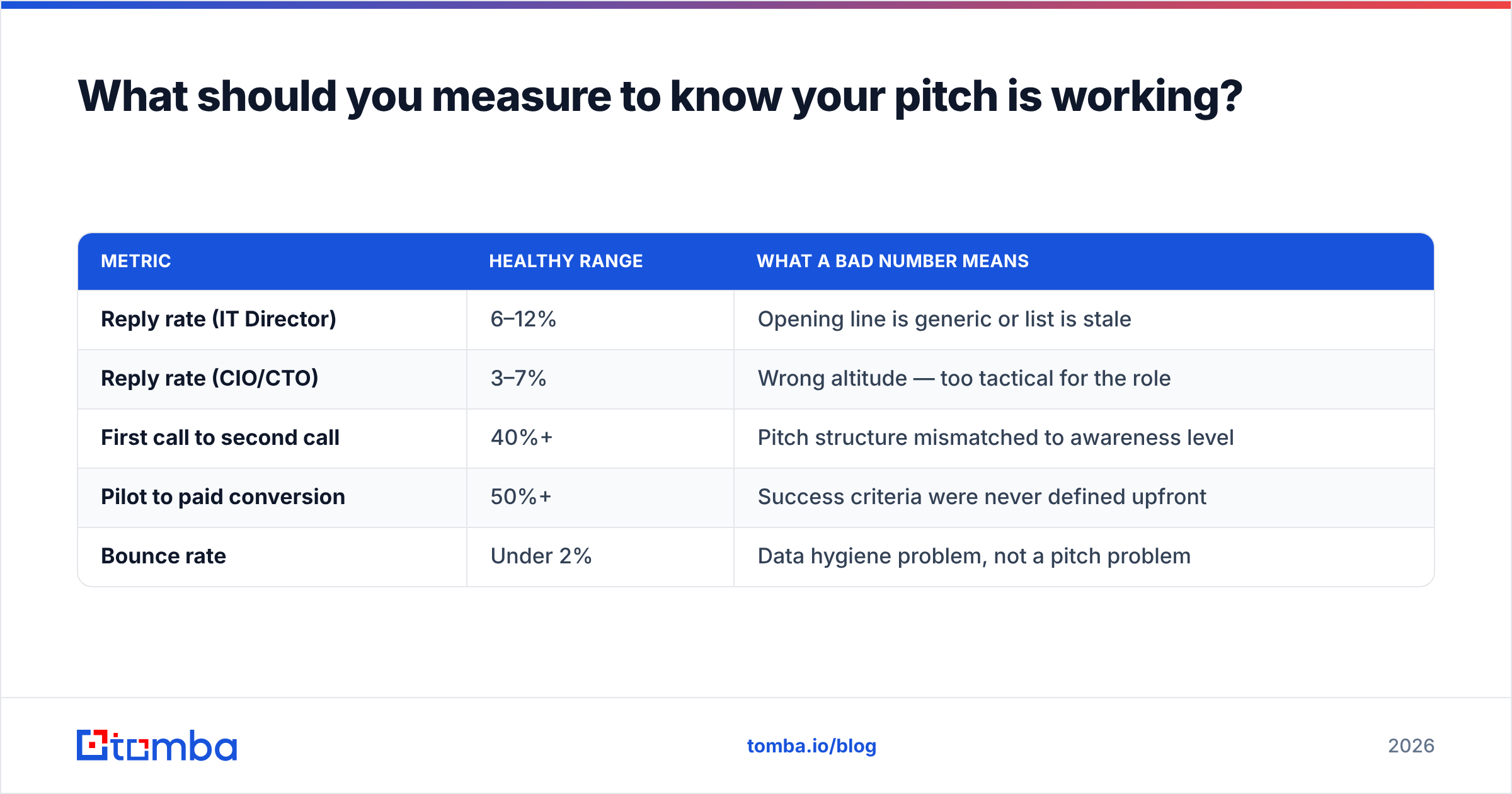
Track four things per persona, weekly:
| Metric | Healthy range | What a bad number means |
|---|---|---|
| Reply rate (IT Director) | 6–12% | Opening line is generic or list is stale |
| Reply rate (CIO/CTO) | 3–7% | Wrong altitude — too tactical for the role |
| First call to second call | 40%+ | Pitch structure mismatched to awareness level |
| Pilot to paid conversion | 50%+ | Success criteria were never defined upfront |
| Bounce rate | Under 2% | Data hygiene problem, not a pitch problem |
If your bounce rate is bad, fix that before you touch a single slide. No amount of narrative work compensates for messages that never arrive.
Where should you start?#
Pick one persona — the IT Director is usually the most responsive — and rewrite your opening 90 seconds around a cost they already feel. Then rebuild your target list so those 90 seconds reach a real inbox.
That second half is what Tomba's Email Finder is built for: search by company domain or by name, get verified work emails for the IT director, the CIO, and the security lead with confidence scores and source attribution, and export straight into your sequencing tool. The free tier gives you 25 searches a month to test the data against accounts you already know, and paid plans start at $49/mo on Tomba pricing if the accuracy holds up for your segment. Build the pitch, then make sure it lands.
Related guides#
// get started
Find, verify and enrich your first contacts today
Start on the free plan with 25 searches a month, then scale when your team is ready.
Free plan · No credit card required · GDPR & CCPA
// about the author