It Was a Pleasure Meeting You Email Sample: 7 Templates
Seven copy-paste follow-up emails for after a conference, demo, interview, or intro call — plus the timing rules, subject lines, and phrasing swaps that decide whether you get a reply or silence.
TL;DR
- "It was a pleasure meeting you" is a frame, not a message. On its own it gives the reader nothing to reply to — the email lives or dies on the specific detail and the single next step you attach to it.
- Send within 24 hours for events and interviews, same business day for a discovery call. After 72 hours the recipient no longer reliably remembers your face.
- Use the phrase in the body, never in the subject line. Subject lines built on pleasantries get ignored; subject lines built on the shared context get opened.
- Seven ready-to-send samples below cover conferences, interviews, demos, warm intros, networking events, post-webinar, and the "we met but you don't remember me" case.
- If you left the conversation without an email address, a verified lookup beats guessing — a bounced follow-up is worse than no follow-up.
What does "it was a pleasure meeting you" actually do in an email?#
It buys you about three seconds of goodwill. That is the whole job.
Think of it like the handshake at the start of a second meeting: nobody remembers the handshake, but skipping it feels cold, and lingering on it too long feels strange. The phrase re-establishes that you are a known quantity rather than a stranger in the inbox. What it cannot do is give the reader a reason to write back. That has to come from the next two sentences.
The failure pattern is predictable. Someone gets back from a conference with forty badge scans, opens their laptop, and sends forty versions of: "It was a pleasure meeting you at SaaStr! Let me know if you'd like to chat further." Nothing in that email proves the sender remembers the conversation, and "let me know" puts all the work on the recipient. Reply rates on that template hover near zero.
The version that works does three things in under 120 words: names the specific thing you discussed, connects it to something useful, and proposes one concrete next step with a time attached.
What are the five parts of a follow-up that gets answered?#
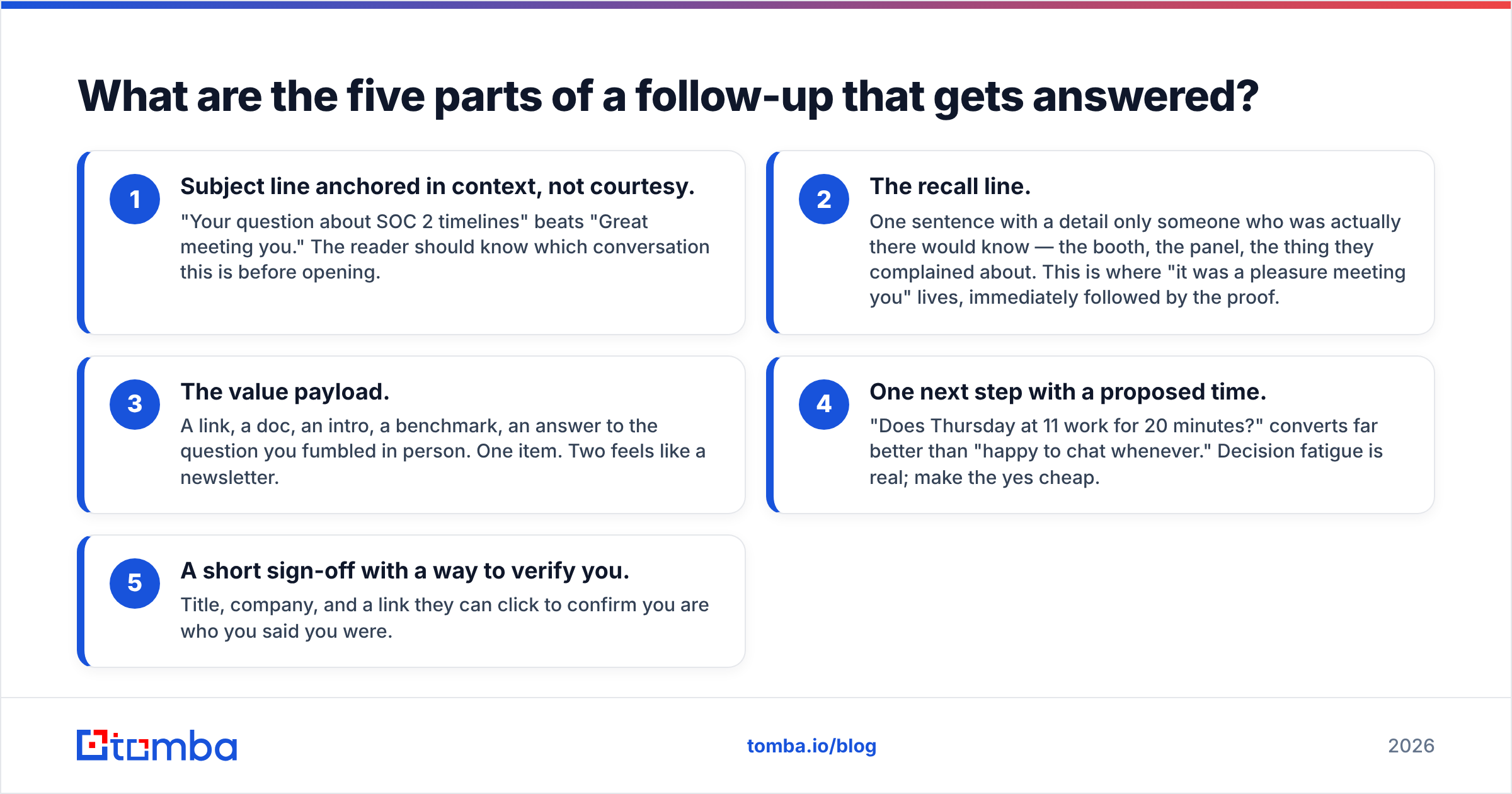
Near-universal structure across every sample below:
- Subject line anchored in context, not courtesy. "Your question about SOC 2 timelines" beats "Great meeting you." The reader should know which conversation this is before opening.
- The recall line. One sentence with a detail only someone who was actually there would know — the booth, the panel, the thing they complained about. This is where "it was a pleasure meeting you" lives, immediately followed by the proof.
- The value payload. A link, a doc, an intro, a benchmark, an answer to the question you fumbled in person. One item. Two feels like a newsletter.
- One next step with a proposed time. "Does Thursday at 11 work for 20 minutes?" converts far better than "happy to chat whenever." Decision fatigue is real; make the yes cheap.
- A short sign-off with a way to verify you. Title, company, and a link they can click to confirm you are who you said you were.
Cut anything that does not fit one of those five slots. The most common edit in a good follow-up is deleting the second paragraph entirely.
When should you send it?#
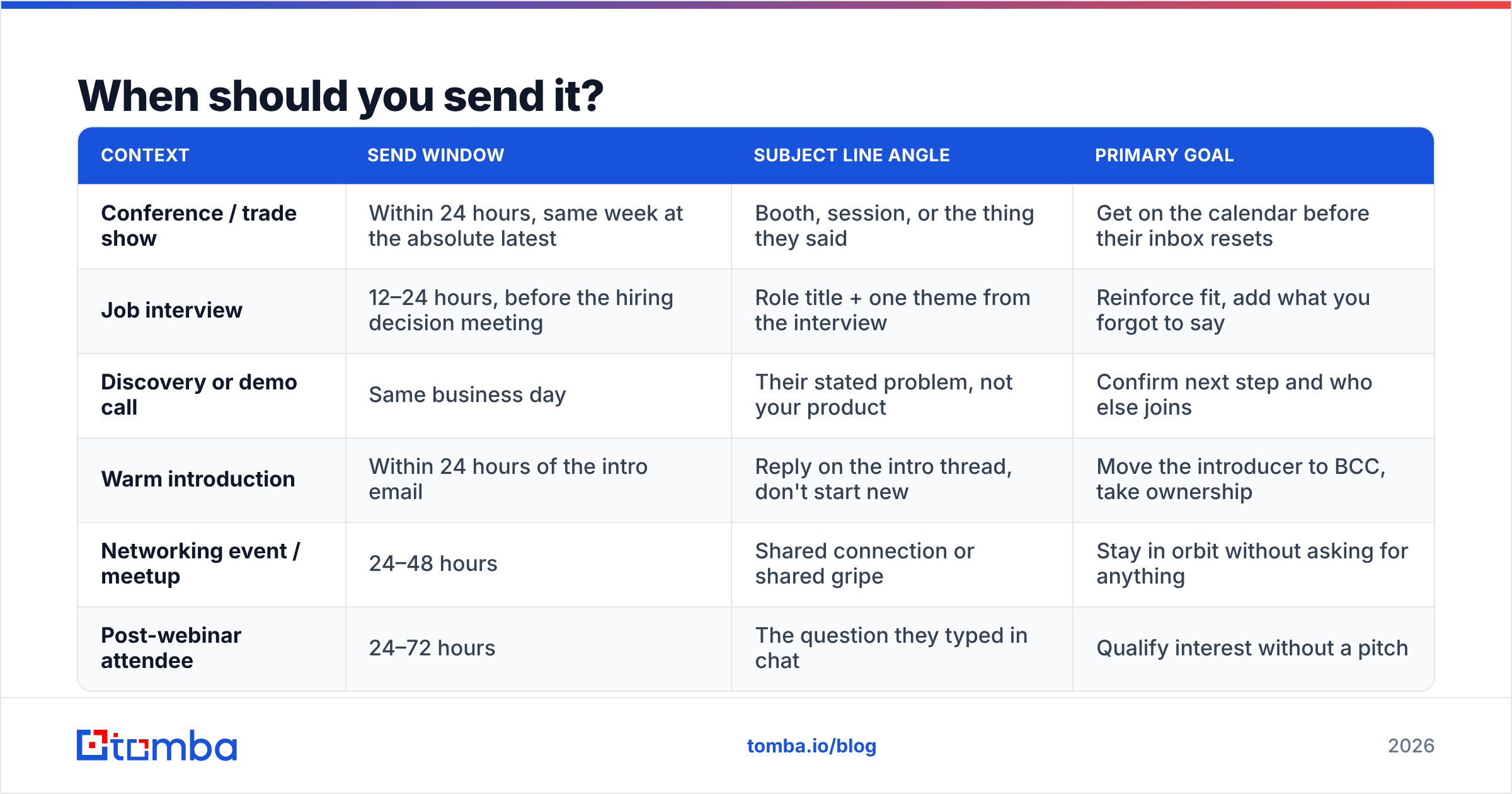
Timing changes the reply rate more than wording does. The window is tied to how memorable the original interaction was — a 45-minute demo survives a week, a 90-second hallway chat does not survive a weekend.
| Context | Send window | Subject line angle | Primary goal |
|---|---|---|---|
| Conference / trade show | Within 24 hours, same week at the absolute latest | Booth, session, or the thing they said | Get on the calendar before their inbox resets |
| Job interview | 12–24 hours, before the hiring decision meeting | Role title + one theme from the interview | Reinforce fit, add what you forgot to say |
| Discovery or demo call | Same business day | Their stated problem, not your product | Confirm next step and who else joins |
| Warm introduction | Within 24 hours of the intro email | Reply on the intro thread, don't start new | Move the introducer to BCC, take ownership |
| Networking event / meetup | 24–48 hours | Shared connection or shared gripe | Stay in orbit without asking for anything |
| Post-webinar attendee | 24–72 hours | The question they typed in chat | Qualify interest without a pitch |
Two practical rules. First, a follow-up sent Tuesday morning outperforms the same email sent Friday at 4pm — not because of any magic hour, but because Friday emails compete with Monday triage. Second, if you missed the window entirely, do not pretend you didn't. "I've been meaning to write since we spoke at the Denver meetup" is more credible than acting like six weeks was normal.
What are the best it was a pleasure meeting you email samples?#
Seven templates. Swap the brackets, delete anything that does not apply, and keep the total under 150 words.
1. After a conference or trade show#
Subject: Your question about migrating off spreadsheets
Hi [Name],
It was a pleasure meeting you at [Event] — you asked how teams handle the messy middle when they move reporting out of spreadsheets, and I gave you a half answer while the booth was three deep.
Here's the fuller version: [one-line answer or link to a specific resource].
You mentioned [Company] is planning that move in Q1. Worth 20 minutes to compare notes? I have Thursday 11am or Friday 2pm ET open.
[Your name], [Title] at [Company]
Why it works: the recall detail is a question they asked, not a fact about you. That is the single highest-signal thing you can reference.
2. After a job interview#
Subject: Thank you — [Role] interview follow-up
Hi [Name],
Thank you for your time today. It was a pleasure meeting you and [Second interviewer], and the conversation about how the team handles [specific challenge] made the role a lot more concrete for me.
One thing I underplayed: at [Previous company] I [specific, measurable thing] — which is close to the [problem] you described.
Happy to send [work sample / references] if useful. Looking forward to hearing about next steps.
[Your name]
Send one per interviewer, not one group email. Vary the middle paragraph so the copies do not read identically when they compare notes — and they do compare notes.
3. After a discovery call or demo#
Subject: Recap + next step for [Their company]
Hi [Name],
Great speaking with you this morning. Quick recap so we're aligned:
- You're losing roughly [X hours/week] to [manual process]
- Decision involves [Name] on the [security/finance] side
- Timeline is [quarter]
Next step we agreed on: [specific action] by [date]. I've attached [doc] for [stakeholder].
Did I get anything wrong? Happy to be corrected.
[Your name]
"Did I get anything wrong?" is the highest-reply-rate closing line in B2B sales email, because correcting someone is easier than committing to something.
4. After a warm introduction#
Subject: Re: Intro — [Your name] <> [Their name]
[Introducer] — thank you, moving you to BCC.
[Name], it was a pleasure meeting you briefly at [context] / good to be connected. [Introducer] mentioned you're working through [problem].
I've spent the last [time period] on exactly that at [Company]. If it's useful, I can share [specific thing] — no pitch attached.
Would [day, time] work for a short call?
Always reply on the existing thread. Starting a fresh email wastes the introducer's credibility.
5. After a networking event, no ask attached#
Subject: The [topic] article you mentioned
Hi [Name],
It was a pleasure meeting you at [event] — your point about [thing] stuck with me, especially the part about [detail].
You mentioned you were looking for [resource]. Here it is: [link]. Also thought of you when I read [second link].
No agenda — just glad to have met someone else who thinks [shared view]. Let me know if you're at [next event].
The no-ask follow-up is underrated. It costs you one email and buys you the right to ask for something in three months.
6. After a webinar or panel where they were in the audience#
Subject: Your chat question about [topic]
Hi [Name],
You asked during yesterday's session whether [question] — we ran out of time before I could answer properly.
Short version: [two-sentence answer].
If you want the longer version, I put together [resource]. And if [their company] is actively working on this, I'm happy to walk through what we've seen work at similar teams.
[Your name]
7. When you're not sure they remember you#
Subject: We met at [event] — [specific detail]
Hi [Name],
We spoke briefly at [event] near [memorable landmark: the coffee line, the Acme booth, the rooftop panel]. I was the one who [distinguishing detail].
You mentioned [thing]. I came across [resource] and thought of that conversation.
If the timing's off, no problem at all — happy to circle back next quarter.
Naming your own distinguishing detail is not awkward, it is generous. It saves the reader the embarrassment of not remembering.
Which phrasing should you actually use?#
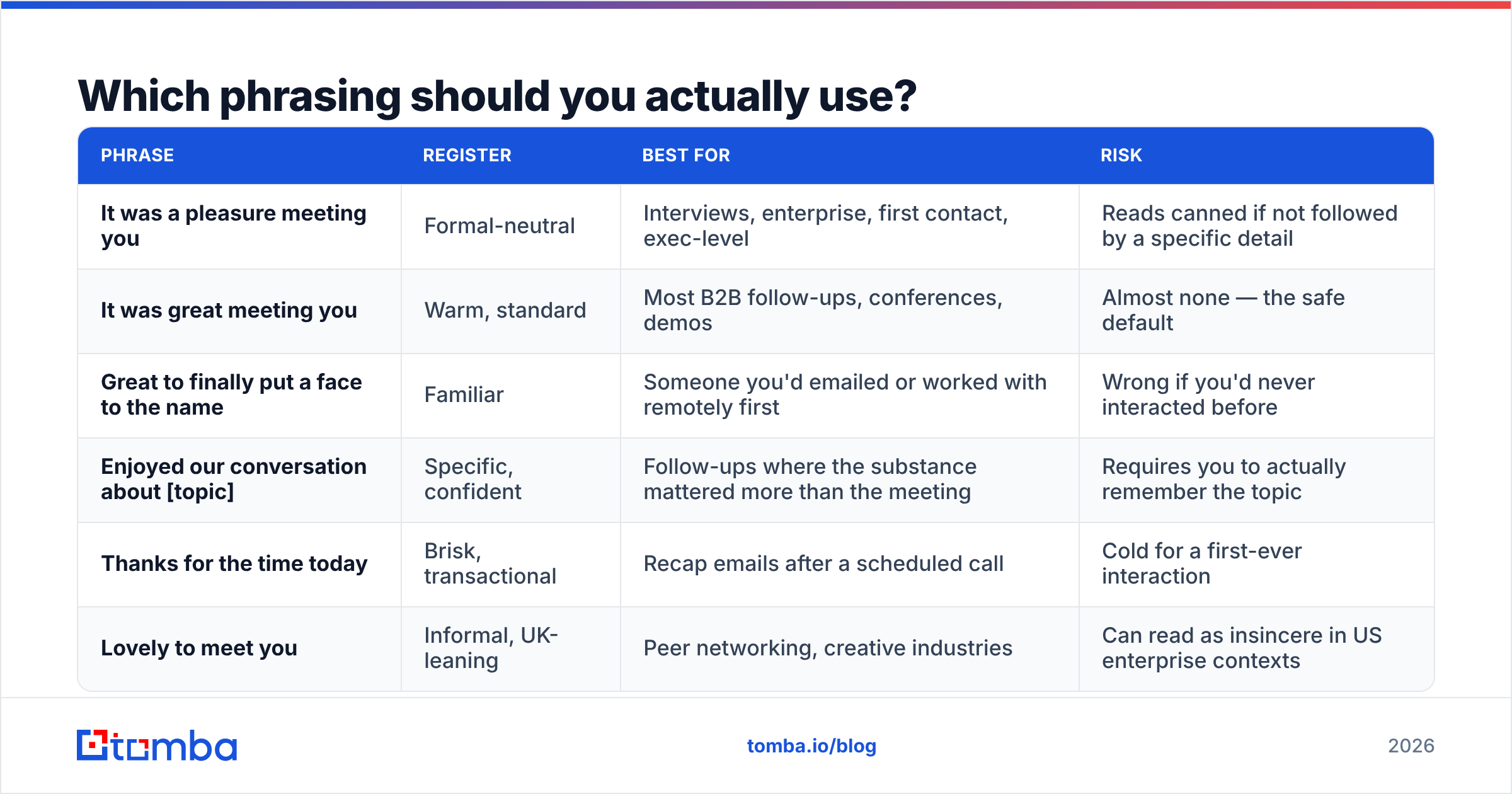
"It was a pleasure meeting you" is slightly formal. That is fine for interviews, enterprise buyers, and first contact with someone senior. It is stiff for a peer you met at a meetup. Match the register to the room.
| Phrase | Register | Best for | Risk |
|---|---|---|---|
| It was a pleasure meeting you | Formal-neutral | Interviews, enterprise, first contact, exec-level | Reads canned if not followed by a specific detail |
| It was great meeting you | Warm, standard | Most B2B follow-ups, conferences, demos | Almost none — the safe default |
| Great to finally put a face to the name | Familiar | Someone you'd emailed or worked with remotely first | Wrong if you'd never interacted before |
| Enjoyed our conversation about [topic] | Specific, confident | Follow-ups where the substance mattered more than the meeting | Requires you to actually remember the topic |
| Thanks for the time today | Brisk, transactional | Recap emails after a scheduled call | Cold for a first-ever interaction |
| Lovely to meet you | Informal, UK-leaning | Peer networking, creative industries | Can read as insincere in US enterprise contexts |
One more rule: never open with "I hope this email finds you well." It signals template. Recipients have learned to skim past it, which means your recall detail — the part doing the real work — gets skimmed too.
What kills these emails?#
Six things, in rough order of damage:
- No specific detail. If the email would still make sense sent to a different person, it will not get a reply.
- Two or more asks. "Let's grab coffee, and also here's a demo link, and also would you mind intro'ing me to your VP?" Pick one.
- The pleasantry subject line. "Great meeting you!" competes with every other badge-scan email in their inbox that week. The one referencing their own question wins.
- Length. Over 150 words and the reader switches from reading to scanning. Scanning finds no clear ask and moves on.
- Attachments on first contact. A 4MB PDF on a first follow-up trips spam filters and reads as a pitch deck ambush. Link instead.
- A wrong or guessed address. This one is silent and therefore worst — you never learn the email bounced, you just assume they ignored you.
That last point deserves its own section, because it is the most common invisible failure in this whole workflow.
What if you never got their email address?#
This happens constantly. You had a real conversation, exchanged first names and companies, and then you both walked to the next session. Or you have a badge scan with a typo'd address. Or you have a LinkedIn connection and no inbox.
Guessing the pattern is tempting — firstname.lastname@company.com is right often enough to feel like a strategy. It is not. Guessed addresses bounce, bounces hurt your sender reputation, and a damaged sending domain quietly suppresses every future email you send, including the ones to people who do want to hear from you.
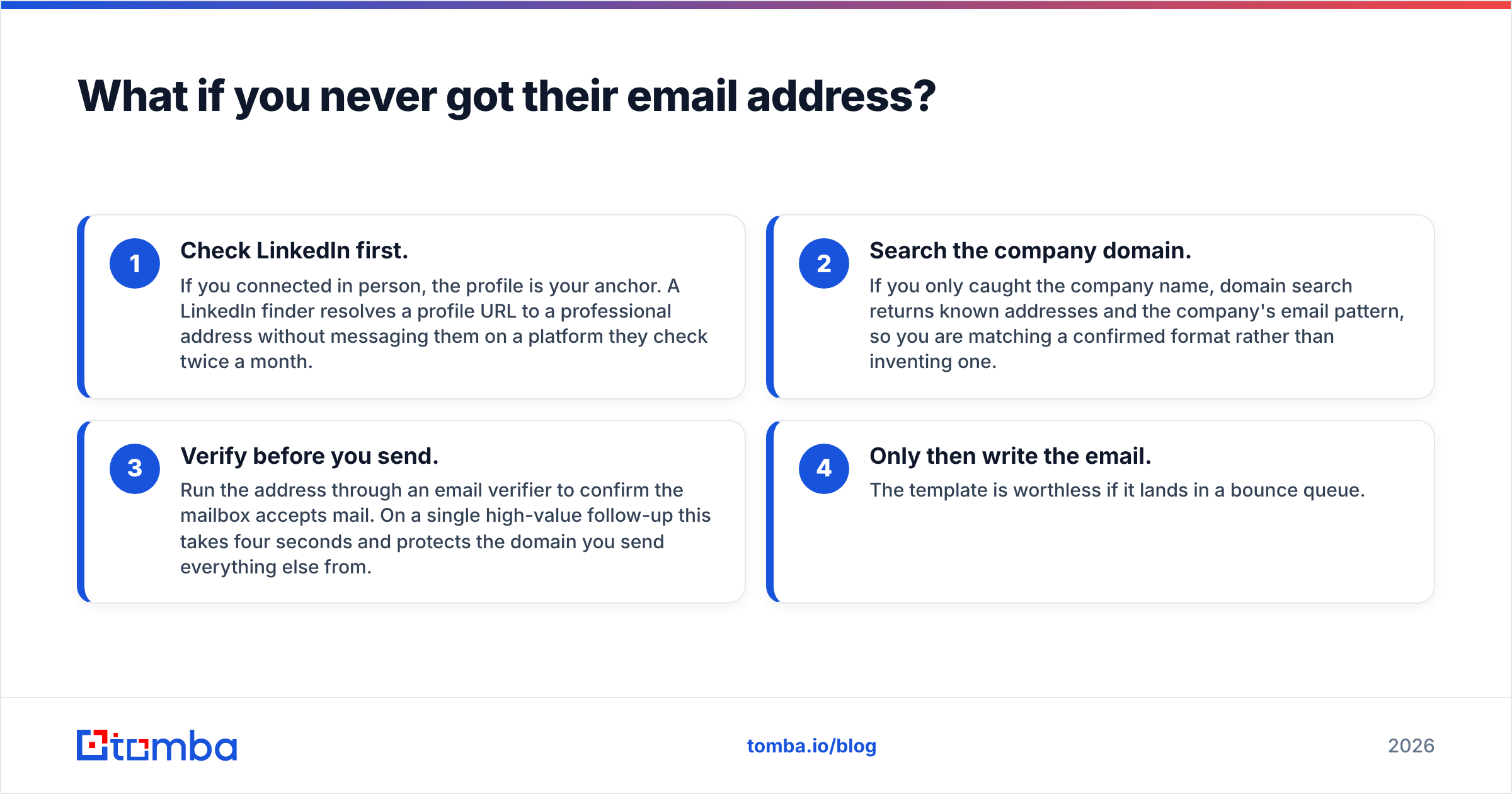
The cleaner path, in order:
- Check LinkedIn first. If you connected in person, the profile is your anchor. A LinkedIn finder resolves a profile URL to a professional address without messaging them on a platform they check twice a month.
- Search the company domain. If you only caught the company name, domain search returns known addresses and the company's email pattern, so you are matching a confirmed format rather than inventing one.
- Verify before you send. Run the address through an email verifier to confirm the mailbox accepts mail. On a single high-value follow-up this takes four seconds and protects the domain you send everything else from.
- Only then write the email. The template is worthless if it lands in a bounce queue.
For interviews and warm intros you usually already have the address, so skip straight to writing. For conference lists of forty badge scans with three typos each, a bulk verification pass before the first send is the difference between a clean campaign and a blacklisting.
Worth reading alongside this: HubSpot's sales blog has good longitudinal data on follow-up cadence, and Gartner's sales research covers how B2B buying groups have grown — which is why the "who else should be on this thread?" question in sample #3 matters more every year.
How many follow-ups are too many?#
For a first meeting, send the initial email plus a maximum of two nudges, spaced roughly four and ten business days out. Then stop and move them to a quarterly touch.
The nudges should not repeat the pleasantry. Sample nudge:
Subject: Re: Your question about SOC 2 timelines
Hi [Name] — bumping this in case it got buried. Still happy to send over [thing]. If the timing's wrong, tell me and I'll check back in [quarter].
Two lines. No guilt, no "just circling back on my previous email," no fake urgency. Giving the recipient a graceful exit is what makes the third email acceptable rather than annoying.
If you are running this at volume — say, every attendee from a booth — build the sequence around segments, not one universal template. Attendees who asked a technical question get sample #1. Attendees who only scanned get sample #7. Attendees who booked a meeting on the spot get sample #3. Three variants beat one generic blast by a wide margin, and building them takes an afternoon.
Start with a deliverable address#
The best-written "it was a pleasure meeting you" email in the world is worth nothing if it goes to an address that does not exist. Before you send the templates above, confirm you are writing to a real, active mailbox.
Tomba's Email Finder turns a name and a company domain into a verified professional address, with the source and confidence score attached so you know what you are sending to. The free tier covers 25 searches a month — enough for a conference badge stack or a week of post-interview follow-ups — and paid plans start at $49/mo if you are working a larger list. Check Tomba pricing for the full breakdown, then go send the email while they still remember your face.
Related guides#
// get started
Find, verify and enrich your first contacts today
Start on the free plan with 25 searches a month, then scale when your team is ready.
Free plan · No credit card required · GDPR & CCPA
// about the author