Jabmo Pricing, Reviews, Pros and Cons: A 2026 Buyer's Guide
Jabmo never published a price list, so buyers negotiate blind. Here is what industrial ABM platforms actually cost, what reviewers praise and complain about, and when a $49/mo data stack beats a five-figure contract.
TL;DR
- Jabmo has never published a public price list. Every deal is a custom annual quote, and buyer reports cluster in the $25,000–$60,000/year range for mid-market industrial accounts, with enterprise deployments going higher.
- The platform was built for manufacturing, industrial, healthcare and life-sciences companies — long sales cycles, distributor channels, low-volume/high-value deals. If that is not you, most of what you pay for goes unused.
- Reviewers consistently praise the account-level advertising reach and the hands-on managed service. They consistently complain about contract rigidity, reporting depth, and attribution that is hard to defend to a CFO.
- Jabmo's brand has moved under Expandi Group ownership, so confirm the current product roadmap, support model and renewal terms in writing before you sign anything.
- Before you spend five figures on account-based advertising, check whether your contact data is even usable. Clean, verified contacts at $49/mo fix more pipeline problems than an ABM platform does.
What is Jabmo and who actually uses it?#
Jabmo is an account-based marketing (ABM) platform aimed at a narrow, unglamorous, and very profitable slice of B2B: manufacturers, industrial suppliers, healthcare systems and life-sciences vendors selling complex products into a handful of global accounts.
The everyday analogy: most marketing tools are billboards on a busy highway — you pay for volume and hope the right driver sees you. Jabmo is closer to hiring someone to stand outside twelve specific buildings, all day, with a sign addressed to the people inside. You are not buying reach. You are buying precision against a named account list.
Technically, the platform combines IP-and-cookie-based account identification, cross-channel account-based advertising (display, social, and in some configurations connected TV), website visitor de-anonymisation, and an engagement dashboard that scores account-level intent rather than individual lead behaviour. A managed-service layer sits on top: Jabmo's team helps build target account lists, launch campaigns and interpret results. That service layer is a genuine differentiator for teams without an in-house ABM operator — and it is also a large part of why the contract is expensive.
If you want the neutral background on the category itself, Wikipedia's account-based marketing entry is a decent primer on why B2B teams flipped from lead-based to account-based models in the first place.
How much does Jabmo pricing actually cost in 2026?#
Short answer: nobody knows publicly, and that is deliberate. Jabmo does not list prices. There is no self-serve tier, no free trial, and no published credit system. You book a discovery call, share your target account count and ad budget, and receive a custom annual proposal.
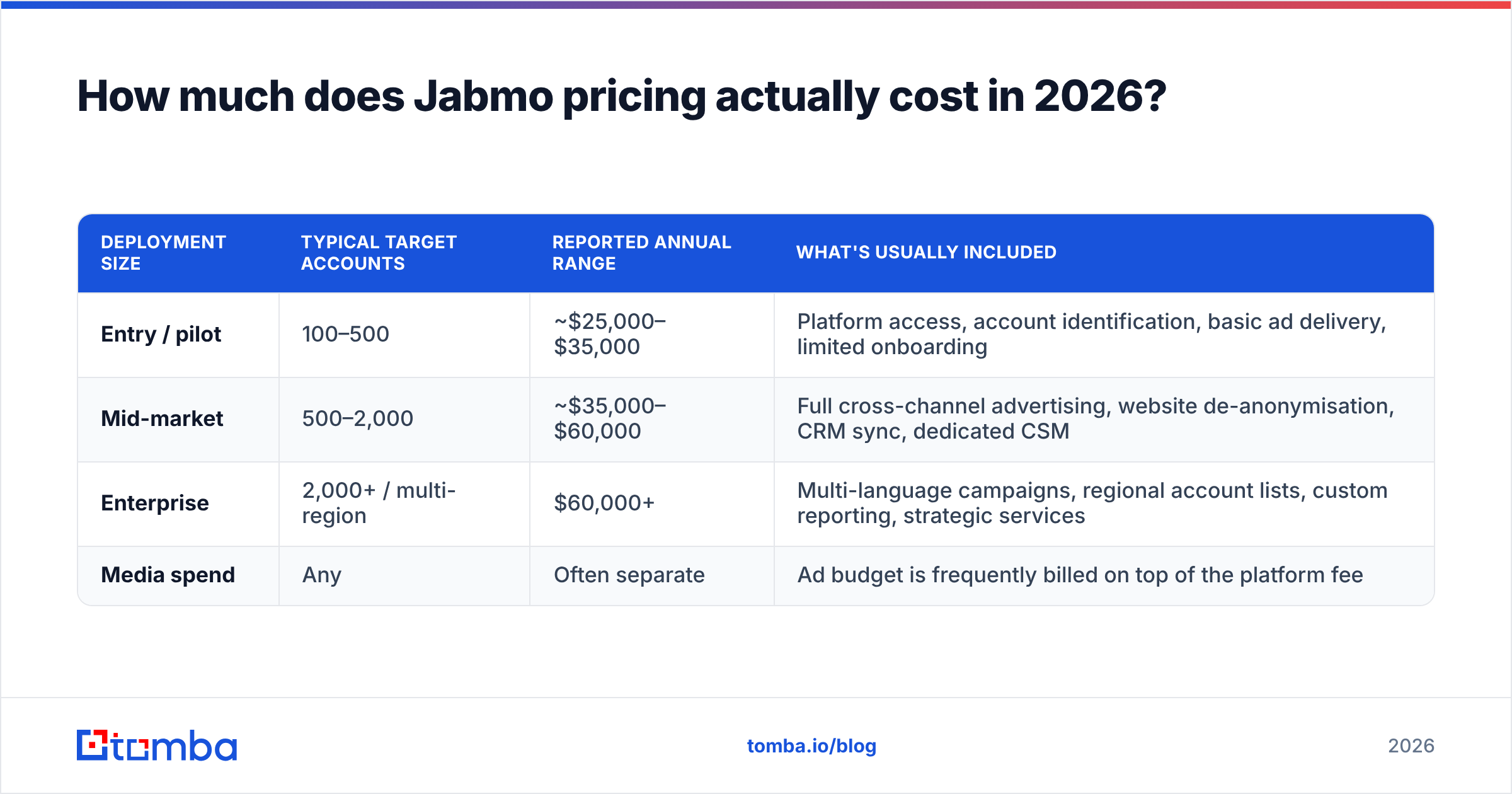
Based on buyer reports on review platforms, RFP disclosures, and the general shape of the ABM advertising market, here is a realistic planning range. Treat these as estimates for budgeting, not quotes:
| Deployment size | Typical target accounts | Reported annual range | What's usually included |
|---|---|---|---|
| Entry / pilot | 100–500 | ~$25,000–$35,000 | Platform access, account identification, basic ad delivery, limited onboarding |
| Mid-market | 500–2,000 | ~$35,000–$60,000 | Full cross-channel advertising, website de-anonymisation, CRM sync, dedicated CSM |
| Enterprise | 2,000+ / multi-region | $60,000+ | Multi-language campaigns, regional account lists, custom reporting, strategic services |
| Media spend | Any | Often separate | Ad budget is frequently billed on top of the platform fee |
That last row is the one that surprises people. In many ABM advertising contracts, the software fee and the media spend are separate lines. A $40,000 platform commitment plus a $60,000 annual ad budget is a $100,000 program, not a $40,000 one. Ask explicitly whether media is pass-through, marked up, or bundled — the answer materially changes your cost per engaged account.
What drives the number up?#
Five variables move a Jabmo-style quote more than anything else:
- Target account count. Pricing scales with the size of your named-account list, not with your revenue. A 300-account list is dramatically cheaper than a 3,000-account list.
- Geographic coverage. Multi-region campaigns in EMEA and APAC add cost through localisation, separate ad buys, and regional identification coverage.
- Managed service depth. A light-touch CSM is standard. Strategy workshops, creative production and campaign operations are add-ons.
- Contract length. Two- and three-year terms usually unlock 10–20% discounts. They also remove your ability to leave if results disappoint in month seven.
- Integration requirements. Standard CRM and MAP connectors are typically included; custom data warehouse pipes or bespoke attribution models are quoted separately.
What do Jabmo reviews say — the honest pros and cons?#
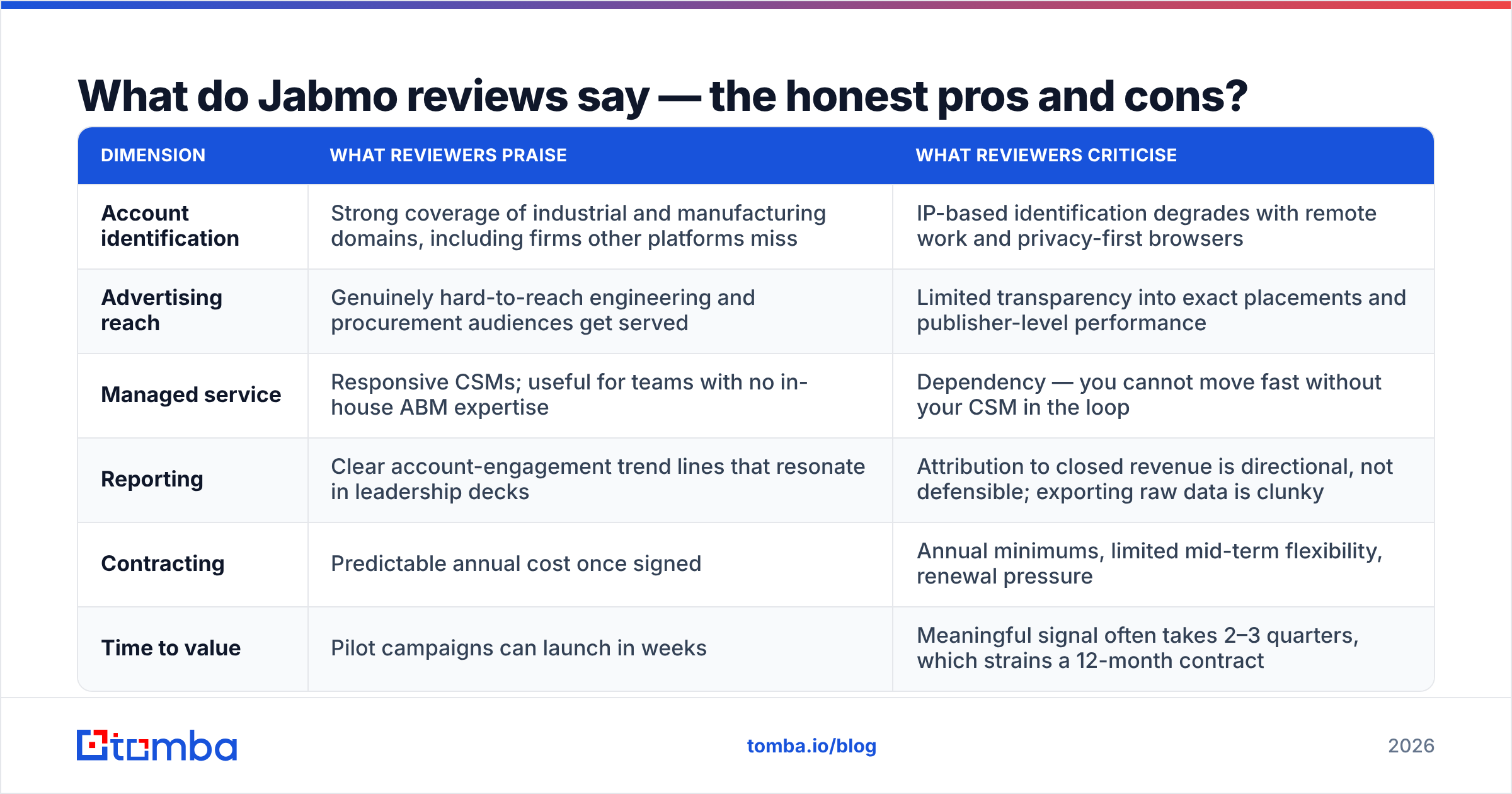
Pull the themes out of user reviews on G2's account-based advertising category and Capterra's ABM software listings and a consistent picture forms. Reviewers are generally positive about outcomes and generally frustrated about control.
| Dimension | What reviewers praise | What reviewers criticise |
|---|---|---|
| Account identification | Strong coverage of industrial and manufacturing domains, including firms other platforms miss | IP-based identification degrades with remote work and privacy-first browsers |
| Advertising reach | Genuinely hard-to-reach engineering and procurement audiences get served | Limited transparency into exact placements and publisher-level performance |
| Managed service | Responsive CSMs; useful for teams with no in-house ABM expertise | Dependency — you cannot move fast without your CSM in the loop |
| Reporting | Clear account-engagement trend lines that resonate in leadership decks | Attribution to closed revenue is directional, not defensible; exporting raw data is clunky |
| Contracting | Predictable annual cost once signed | Annual minimums, limited mid-term flexibility, renewal pressure |
| Time to value | Pilot campaigns can launch in weeks | Meaningful signal often takes 2–3 quarters, which strains a 12-month contract |
The sharpest recurring criticism is not about the product's capability. It is about proof. ABM advertising creates lift you can see at the account level — more sessions, more pages, more named-account form fills — but converting that into a CFO-proof revenue number requires attribution discipline most teams do not have. If your CFO expects a clean ROI table at renewal and you cannot produce one, the renewal conversation gets ugly regardless of how good the campaigns were.
What are Jabmo's biggest hidden costs?#
The licence fee is the part you negotiate. These are the parts you discover:
- Media spend on top of platform fee. Covered above, and the single largest budget surprise.
- Creative production. Account-based ads need variants by segment, region and language. Someone has to make forty banner sizes. That is agency time or internal design time.
- Data hygiene work. Account identification tells you a company visited. It does not tell you who to email. Turning account signal into a named contact still requires a contact-data layer — which is a separate line item most ABM budgets forget.
- Internal headcount. Even with managed service, a functioning ABM program consumes roughly 0.5–1.0 FTE of marketing ops attention.
- Sales enablement. If reps ignore the account-engagement alerts, you bought a very expensive dashboard. Enablement time is a real cost.
Add these up and the true first-year cost of an ABM program is frequently 1.8–2.5x the software quote. Budget accordingly, or you will be defending an overrun in Q3.
How does Jabmo compare to other ABM platforms?#
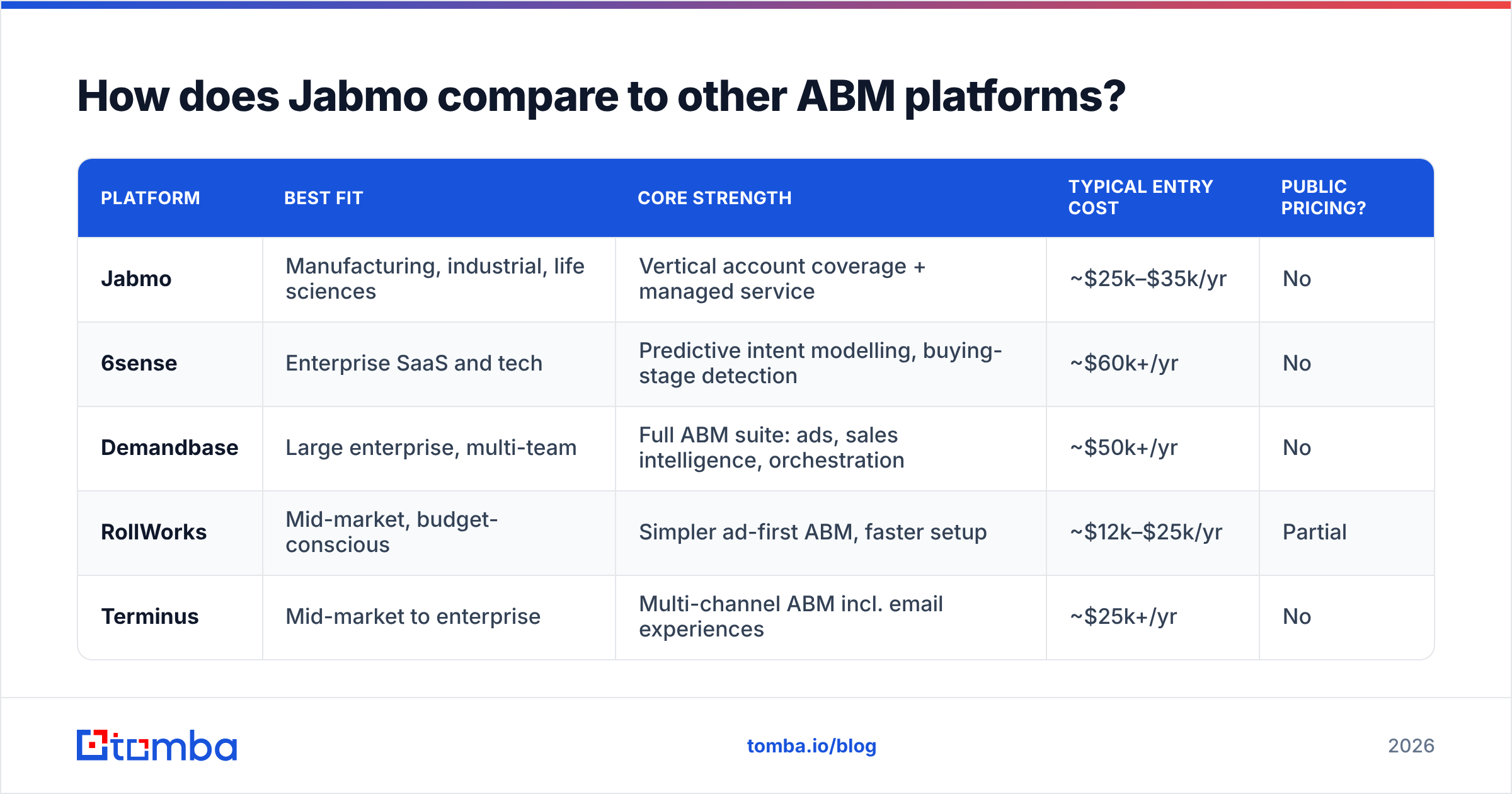
Jabmo competes in a category dominated by broader, more expensive platforms. The honest positioning: Jabmo is narrower and more vertical-specific than its rivals, which is an advantage if you are in its verticals and a disadvantage if you are not.
| Platform | Best fit | Core strength | Typical entry cost | Public pricing? |
|---|---|---|---|---|
| Jabmo | Manufacturing, industrial, life sciences | Vertical account coverage + managed service | ~$25k–$35k/yr | No |
| 6sense | Enterprise SaaS and tech | Predictive intent modelling, buying-stage detection | ~$60k+/yr | No |
| Demandbase | Large enterprise, multi-team | Full ABM suite: ads, sales intelligence, orchestration | ~$50k+/yr | No |
| RollWorks | Mid-market, budget-conscious | Simpler ad-first ABM, faster setup | ~$12k–$25k/yr | Partial |
| Terminus | Mid-market to enterprise | Multi-channel ABM incl. email experiences | ~$25k+/yr | No |
If you are evaluating the bigger suites, it is worth reading up on the 6sense alternative and Demandbase alternative landscape before you anchor on a single vendor's framing. Every ABM vendor's discovery call is designed to make its own architecture look inevitable.
The question nobody in the demo asks#
Do you have enough named accounts to justify account-based advertising at all?
ABM economics work when your total addressable market is small and each deal is large. A useful rule: if your TAM is fewer than ~2,000 accounts and your average contract value is above ~$50,000, ABM advertising can pay for itself. If your TAM is 40,000 accounts and your ACV is $8,000, you are better served by volume outbound and content — and an ABM platform will burn budget producing beautiful engagement charts attached to no revenue.
Is Jabmo worth it for your team?#
Here is a straight verdict rather than a hedge.
Jabmo is worth it if: you sell industrial or life-sciences products, your named-account list is under 2,000, your ACV clears $50,000, your buying committees contain 6+ people you cannot reach through normal channels, and you have executive patience for a 9–12 month proof window.
Jabmo is not worth it if: you need self-serve flexibility, your budget is under $30,000/year all-in, you are pre-product-market-fit, your ACV is small, or your leadership demands last-touch attribution. In all of those cases the contract will outlast your enthusiasm.
One more caveat on diligence. Jabmo's brand has moved under Expandi Group ownership, which means roadmap, support staffing and renewal terms may differ from what older reviews describe. Ask directly: who owns the product today, who is my support contact, what has shipped in the last two quarters, and what happens to my data if the product is sunset? Get the answers in the contract, not the deck.
What should you fix before buying an ABM platform?#
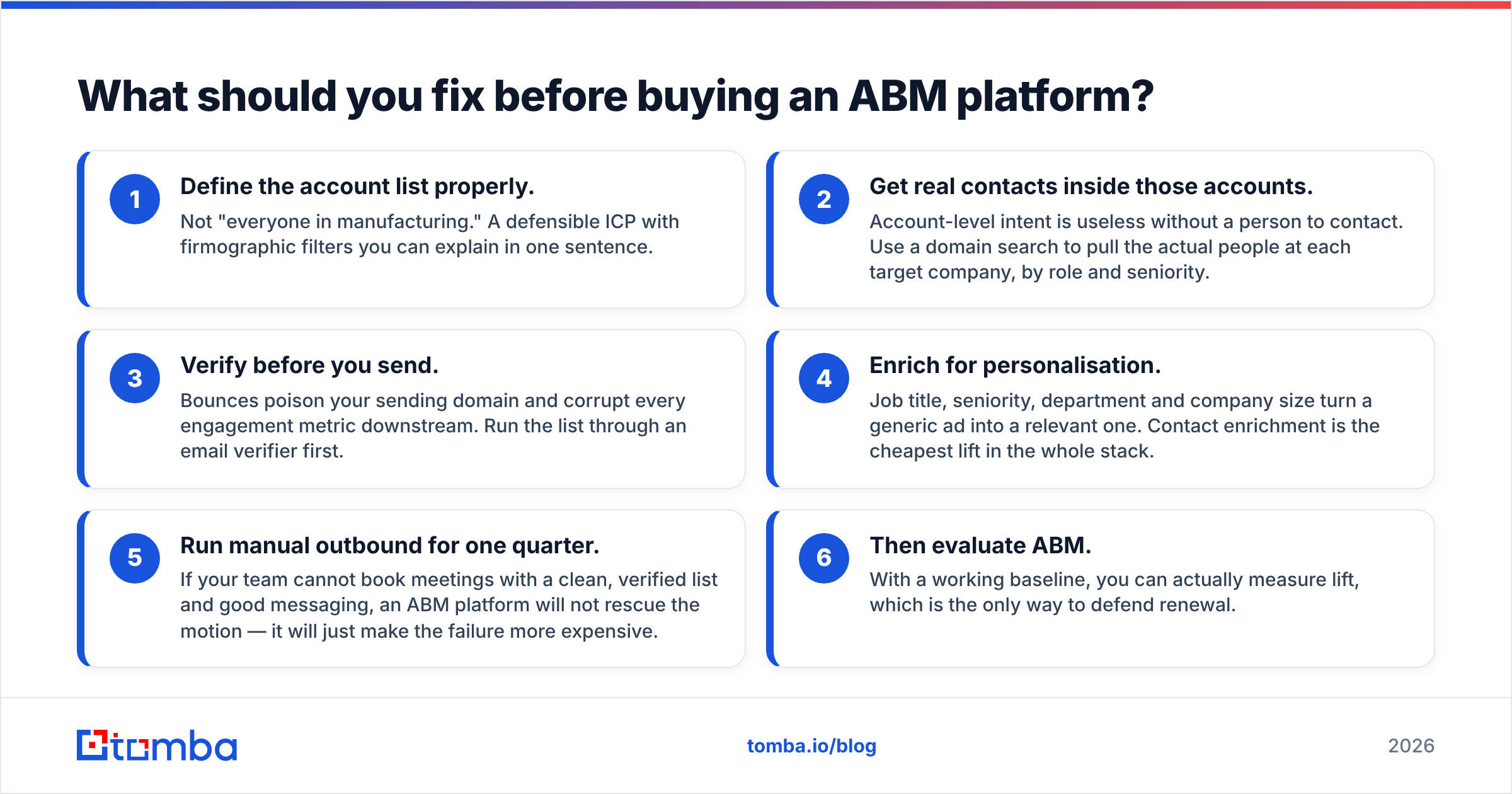
Most ABM disappointments trace back to a data problem the platform was never designed to solve. The sequence that actually works:
- Define the account list properly. Not "everyone in manufacturing." A defensible ICP with firmographic filters you can explain in one sentence.
- Get real contacts inside those accounts. Account-level intent is useless without a person to contact. Use a domain search to pull the actual people at each target company, by role and seniority.
- Verify before you send. Bounces poison your sending domain and corrupt every engagement metric downstream. Run the list through an email verifier first.
- Enrich for personalisation. Job title, seniority, department and company size turn a generic ad into a relevant one. Contact enrichment is the cheapest lift in the whole stack.
- Run manual outbound for one quarter. If your team cannot book meetings with a clean, verified list and good messaging, an ABM platform will not rescue the motion — it will just make the failure more expensive.
- Then evaluate ABM. With a working baseline, you can actually measure lift, which is the only way to defend renewal.
That sequence costs a few hundred dollars to test. The ABM contract costs five figures. Do the cheap experiment first.
On the data-vendor side, the field is broader than most buyers realise — verified-contact specialists like BookYourData, enrichment APIs, and self-serve finders all solve overlapping problems at very different price points. Compare on accuracy and refund policy rather than database size claims, which are close to meaningless as a comparison metric. Tomba publishes its data sources for exactly this reason.
Frequently asked questions#
Does Jabmo have a free trial? No. Like most enterprise ABM platforms, evaluation happens through a demo and, occasionally, a paid pilot. Ask for a 90-day pilot with a defined exit clause rather than committing to 12 months up front.
Is Jabmo pricing negotiable? Yes, meaningfully. Account count, contract length and managed-service depth are all levers. End-of-quarter and end-of-fiscal-year timing helps. Multi-year commitments yield the largest discounts and the largest regret risk.
Can Jabmo replace my CRM or sales engagement tool? No. It sits alongside them. It feeds account engagement signals into your CRM; it does not manage deals, sequences or reply handling.
What's the cheapest way to test account-based marketing? Pick 50 target accounts, find and verify the decision-makers manually, run a coordinated email plus LinkedIn plus targeted-ad push, and measure meeting rate against your baseline. Total cost: under $100 in tooling and a few weeks of effort.
Where to start instead#
If you have read this far, you are probably weighing a five-figure commitment against a much smaller problem: you know which companies to target, you just cannot reliably reach the right people inside them.
That is a contact-data problem, not an ABM-platform problem — and it is far cheaper to solve. Tomba's Email Finder pulls verified professional emails by domain, name or company, so you can build a real target-account contact list before you commit budget to account-based advertising. The free tier gives you 25 searches a month to test the data quality yourself, and paid plans start at $49/mo. Full Tomba pricing is public — which, after an afternoon of ABM discovery calls, is a refreshing change.
Prove the motion with clean data first. Buy the platform second.
Related guides#
Ready to find emails that actually work?
Join 150,000+ professionals who stopped guessing and started sending. Free credits on signup — no credit card required.
Get the Tomba newsletter
Practical outbound tactics and product updates — once every two weeks.
About the author