Jeeva AI Alternatives: 9 Tools Compared for 2026 Pipelines
Jeeva AI sells autonomous AI sales agents, but seat-based pricing and thin verification push many teams elsewhere. Here are nine alternatives compared on data quality, pricing, and what each one actually replaces.
TL;DR
- Jeeva AI bundles an "AI SDR" agent — prospecting, enrichment, sequencing, and reply handling — into one seat-priced subscription. That bundle is the reason to buy it and the reason to leave it.
- Most teams that churn off Jeeva do so for one of three reasons: per-seat pricing that scales badly, contact data that misses in non-US or long-tail markets, or a sequencer they already pay for elsewhere.
- If your gap is data, look at Tomba, Findymail, or BookYourData. If your gap is sending, look at Instantly, Smartlead, or Saleshandy. If you genuinely want the full agent, Artisan and 11x are the closest like-for-like swaps.
- Unbundling is usually cheaper: a verified data source ($49–$99/mo) plus a sending tool ($37–$97/mo) beats most all-in-one AI SDR contracts at 3+ seats.
- Whatever you pick, verification is the load-bearing step. A 6% bounce rate will sink a domain faster than any AI copy will save it.
What is Jeeva AI and who is it actually for?#
Jeeva AI is an AI SDR platform. You describe an ideal customer profile, and its agents build a lead list, enrich it, write personalized emails and LinkedIn messages, run the sequence, and triage replies. The pitch is headcount replacement: one agent instead of one junior SDR, priced per agent seat rather than per credit.
That pitch lands for a specific buyer — a seed-to-Series-A team with no SDR bench, a founder doing outbound between board meetings, or a sales lead who wants a pipeline number without hiring. For that buyer, the bundle is genuinely convenient. You don't stitch together four vendors.
It lands badly for a different buyer: anyone who already owns a sending platform, anyone selling into EMEA or APAC where US-skewed databases thin out, and anyone whose list volume grew past the point where flat seat pricing looks like a good deal. The most common complaint in G2 reviews of AI SDR tools as a category isn't that the AI writes badly — it's that the underlying contact data was wrong, so good copy went to a dead mailbox.
That distinction matters more than any feature grid. Before you shop for Jeeva AI alternatives, decide which layer you're actually replacing.
Why do teams look for Jeeva AI alternatives?#
Four recurring reasons, roughly in order of how often they show up in switching conversations:
- Seat-based pricing doesn't flex with volume. An AI agent priced like a human works when you need one. At three or four agents, you're paying enterprise money for what is, functionally, a data feed plus a sequencer. Credit-based vendors let you buy exactly the volume you use.
- Data coverage gaps outside North America. AI SDR platforms typically license or scrape a general B2B database. Coverage on US enterprise is fine. Coverage on a 40-person German manufacturer or a Singapore fintech is where lists start returning
[email protected]guesses that never get verified. - Duplicate spend on the sending layer. If you already run Instantly, Smartlead, or HubSpot Sequences, you are paying twice for the same outbox. Teams in that position usually want the data half only.
- Limited control over the output. Autonomous agents are opaque by design. When reply rates dip, you want to see the exact list logic, the exact verification status, and the exact copy variant that underperformed. Bundled agents make that audit harder than a stack you assembled yourself.
None of those are indictments of the product. They're mismatches between a bundled tool and an unbundled need.
What are the best Jeeva AI alternatives in 2026?#
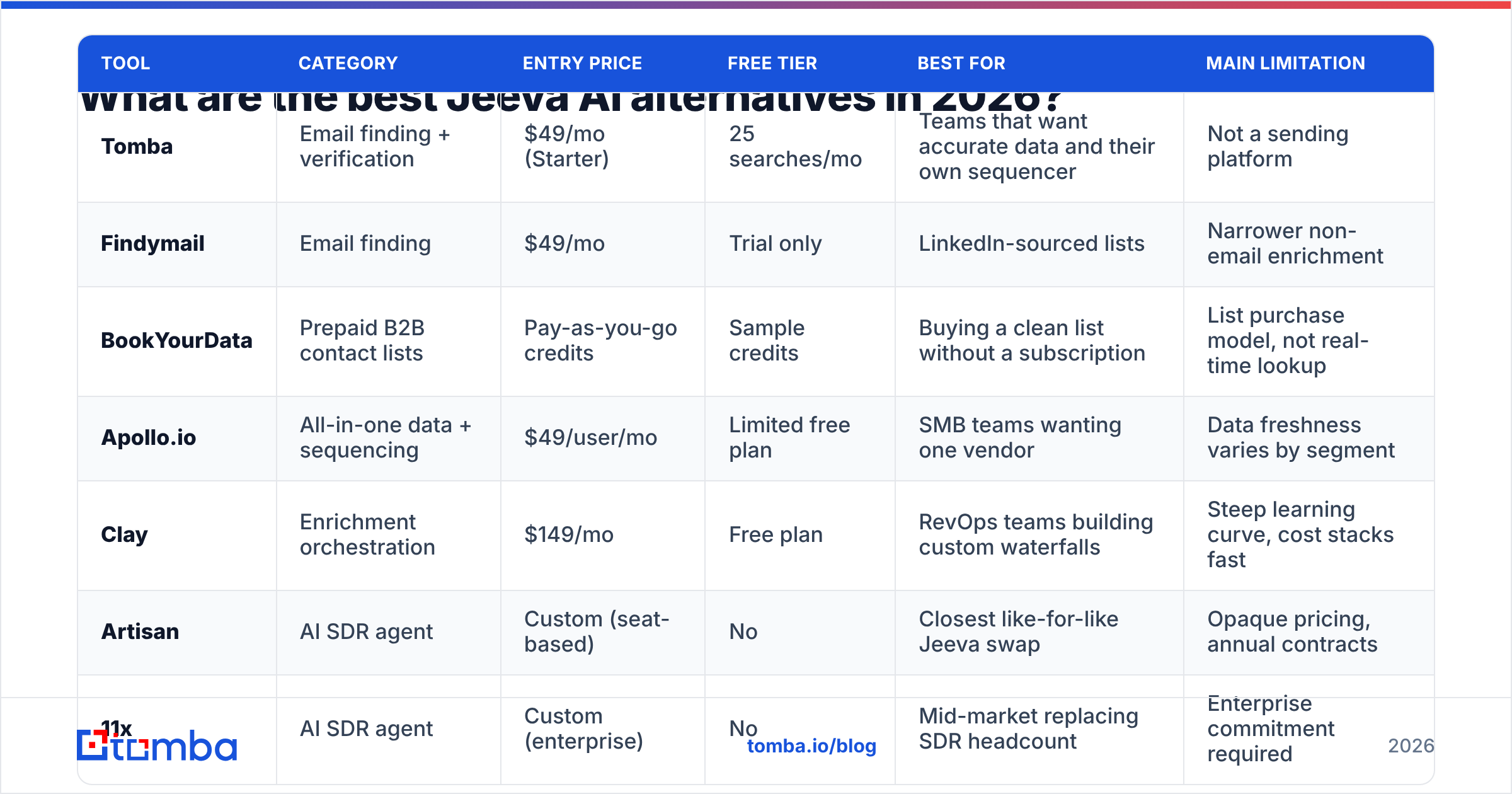
Here's the full comparison. Prices are entry paid tiers as published by each vendor; verify before you buy, since this category re-prices constantly.
| Tool | Category | Entry price | Free tier | Best for | Main limitation |
|---|---|---|---|---|---|
| Tomba | Email finding + verification | $49/mo (Starter) | 25 searches/mo | Teams that want accurate data and their own sequencer | Not a sending platform |
| Findymail | Email finding | $49/mo | Trial only | LinkedIn-sourced lists | Narrower non-email enrichment |
| BookYourData | Prepaid B2B contact lists | Pay-as-you-go credits | Sample credits | Buying a clean list without a subscription | List purchase model, not real-time lookup |
| Apollo.io | All-in-one data + sequencing | $49/user/mo | Limited free plan | SMB teams wanting one vendor | Data freshness varies by segment |
| Clay | Enrichment orchestration | $149/mo | Free plan | RevOps teams building custom waterfalls | Steep learning curve, cost stacks fast |
| Artisan | AI SDR agent | Custom (seat-based) | No | Closest like-for-like Jeeva swap | Opaque pricing, annual contracts |
| 11x | AI SDR agent | Custom (enterprise) | No | Mid-market replacing SDR headcount | Enterprise commitment required |
| Instantly | Sending + warmup | $37/mo | Trial | High-volume cold email infrastructure | Data add-on is secondary to sending |
| Smartlead | Sending + inbox rotation | $39/mo | Trial | Agencies running many client domains | No native prospecting database |

Which alternative replaces the data layer?#
Tomba is the straightforward swap if what you needed from Jeeva was contacts, not an agent. It runs domain search across a company, an email finder for named prospects, and an email verifier that includes catch-all handling — the case where most tools shrug and return "unknown." Pricing is credit-based: free at 25 searches/mo, $49/mo Starter, $99/mo Growth, $249/mo Pro, custom at Enterprise. Everything is exposed through the Tomba API, so you can wire it into whatever sequencer or CRM you already run instead of adopting a new UI.
Findymail covers similar ground with a strong LinkedIn-sourced workflow and a bounce guarantee. If your prospecting starts in Sales Navigator and ends in a CSV, it fits naturally.
BookYourData takes a different and genuinely useful approach: prepaid credits against a pre-built B2B contact database with a stated accuracy guarantee. You're not running lookups — you're filtering a database and buying the rows you want. For a team that needs 5,000 verified contacts once, that beats committing to a monthly subscription. It's the right call when your buying motion is project-based rather than continuous.
Which alternative replaces the agent itself?#
If you liked the autonomous model and just want a different vendor, Artisan and 11x are the two most direct competitors. Both sell AI SDR agents with similar scope: list building, personalization, multichannel sequencing, reply handling. Both price on enterprise terms with annual commitments, which means the evaluation is a procurement exercise, not a credit-card signup.
Be honest about the diligence here. Ask for bounce rate on a sample of 500 contacts in your segment, not their demo segment. Ask what happens to your sequences and data if you don't renew. Ask whether the "AI personalization" is reading the prospect's actual website or interpolating a company name into a template — the difference shows up in reply rates within two weeks.
Which alternative replaces the sending layer?#
Instantly and Smartlead are the volume-sending workhorses. Both handle inbox rotation, warmup, and multi-domain setups — the infrastructure work that determines whether your mail reaches an inbox or a spam folder. Neither is a prospecting database; you feed them lists. Saleshandy sits between the two with a lighter footprint and built-in lead finding.
Pairing one of these with a dedicated data source is the unbundled stack most teams land on after leaving an all-in-one. It costs less and each layer is replaceable independently.
Is unbundling actually cheaper than an AI SDR?#
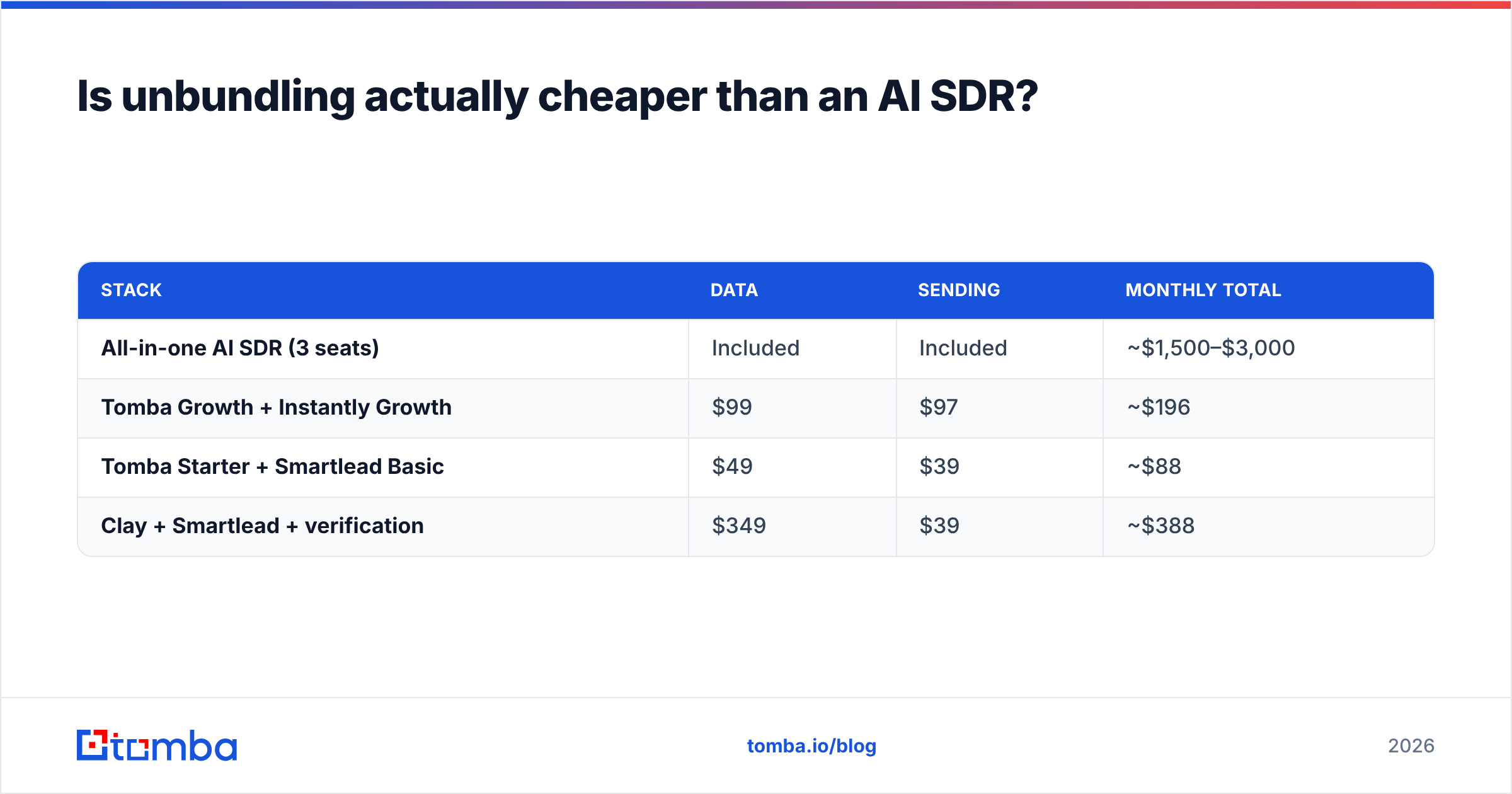
Usually, yes — and the gap widens with team size. Rough monthly math for a three-person outbound team sending 6,000 emails/month:
| Stack | Data | Sending | Monthly total |
|---|---|---|---|
| All-in-one AI SDR (3 seats) | Included | Included | ~$1,500–$3,000 |
| Tomba Growth + Instantly Growth | $99 | $97 | ~$196 |
| Tomba Starter + Smartlead Basic | $49 | $39 | ~$88 |
| Clay + Smartlead + verification | $349 | $39 | ~$388 |
The all-in-one figure is a range because seat pricing in this category is negotiated, not published. Even at the low end, the unbundled stack is an order of magnitude cheaper. What you give up is the single pane of glass and the "it just runs" promise — real value if nobody on your team wants to own the plumbing.
The counter-argument is honest too: if your alternative to an AI SDR is no outbound at all because nobody has time, then $1,500/mo for pipeline that otherwise wouldn't exist is a fine trade. The unbundled stack assumes someone owns it.

How should you evaluate data quality before switching?#
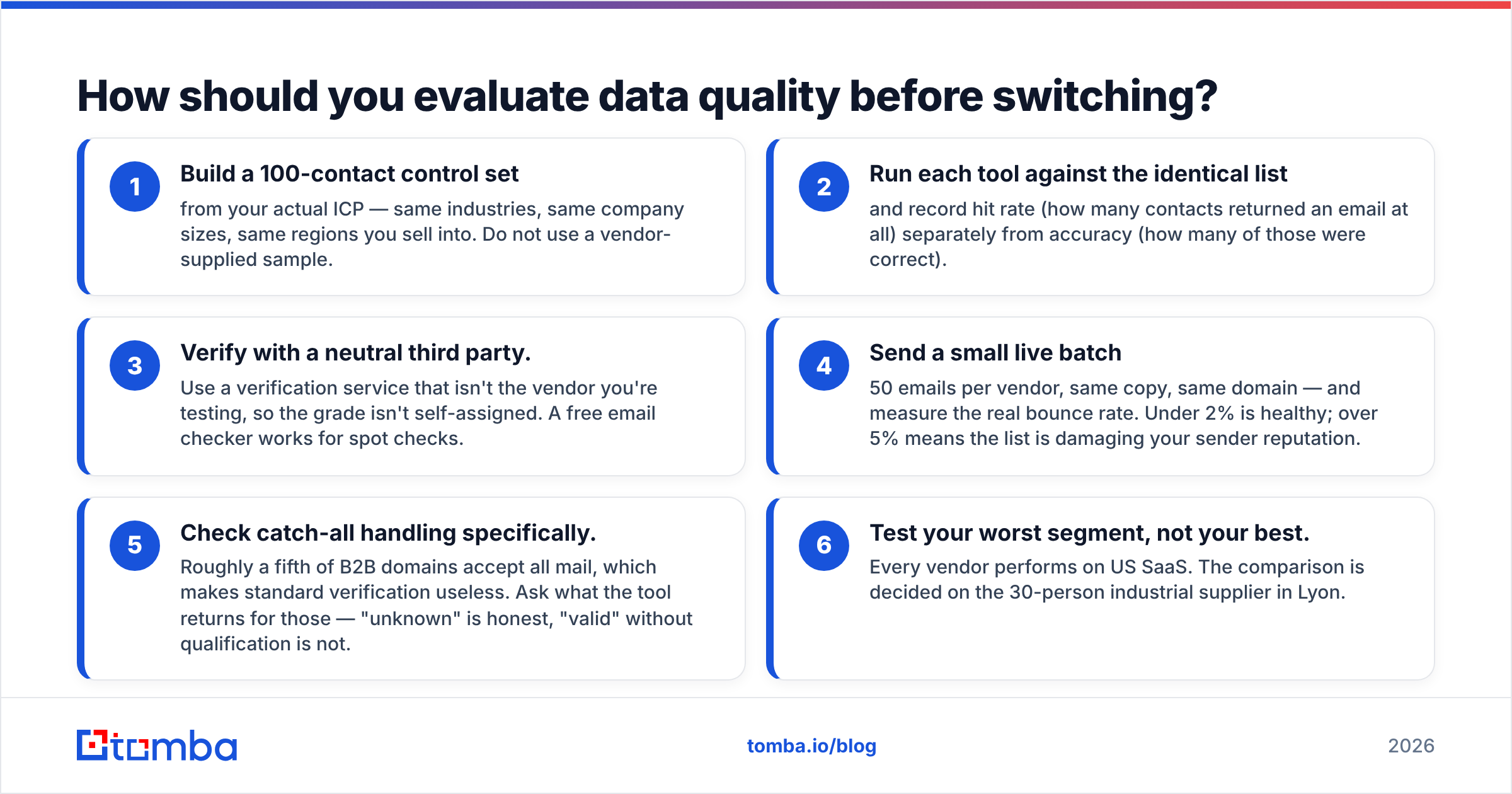
Run the same test against every vendor on your shortlist. It takes an afternoon and saves a quarter.
- Build a 100-contact control set from your actual ICP — same industries, same company sizes, same regions you sell into. Do not use a vendor-supplied sample.
- Run each tool against the identical list and record hit rate (how many contacts returned an email at all) separately from accuracy (how many of those were correct).
- Verify with a neutral third party. Use a verification service that isn't the vendor you're testing, so the grade isn't self-assigned. A free email checker works for spot checks.
- Send a small live batch — 50 emails per vendor, same copy, same domain — and measure the real bounce rate. Under 2% is healthy; over 5% means the list is damaging your sender reputation.
- Check catch-all handling specifically. Roughly a fifth of B2B domains accept all mail, which makes standard verification useless. Ask what the tool returns for those — "unknown" is honest, "valid" without qualification is not.
- Test your worst segment, not your best. Every vendor performs on US SaaS. The comparison is decided on the 30-person industrial supplier in Lyon.

That last point is where most switching decisions are actually made. Hit rate on easy targets converges across vendors; it diverges hard on the long tail.
Does an AI SDR beat a human SDR with good tools?#
Not yet, and the honest framing is that it's the wrong comparison. Autonomous agents are good at volume, consistency, and never forgetting a follow-up. They're weak at the things that win deals: reading a trigger event correctly, knowing which of two personas to approach first, and recognizing when a "not now" is actually a "not you."
Research from HubSpot and other GTM analysts consistently shows personalization quality — not send volume — driving reply-rate differences. AI narrows the personalization cost, but it doesn't remove the judgment layer. The teams getting the best results in 2026 use agents for research and first-draft copy, and keep a human on segmentation and reply handling.
Practically, that means you want a stack where you can see and change every step, which argues for the unbundled approach again. If you want a market-level view of how these categories are consolidating, Gartner tracks the sales engagement space closely.
What should you do in your first week after switching?#
- Re-verify your existing list before the first send. Lists decay roughly 2–3% per month from job changes alone. A twelve-month-old list is already a quarter wrong. Run it through bulk verification before it touches a new sending domain.
- Warm up new domains properly. If you switched sending tools, you may be on new domains. Two to three weeks of ramped volume, not a cold blast on day one.
- Rebuild sequences from your best performers, not from vendor templates. Export what worked in Jeeva before you cancel — reply rates by variant, not just the copy.
- Instrument bounce rate per source. If you're now blending two data sources, tag them so you know which one is costing you deliverability.
- Set a 30-day checkpoint. Compare reply rate and meetings booked against your Jeeva baseline. If it's worse, you either have a data problem or a copy problem, and the bounce rate tells you which.
Which Jeeva AI alternative should you pick?#
Decide by what you're missing, not by feature count:
- You need better contacts, you already have a sequencer → a dedicated data tool. Tomba if you want real-time lookup and an API; BookYourData if you'd rather buy a clean list outright.
- You need sending infrastructure, your data is fine → Instantly or Smartlead.
- You want one vendor and have budget → Apollo at the SMB end, Artisan or 11x if you're committed to the agent model.
- You have a RevOps person who enjoys this → Clay, paired with a verification step.
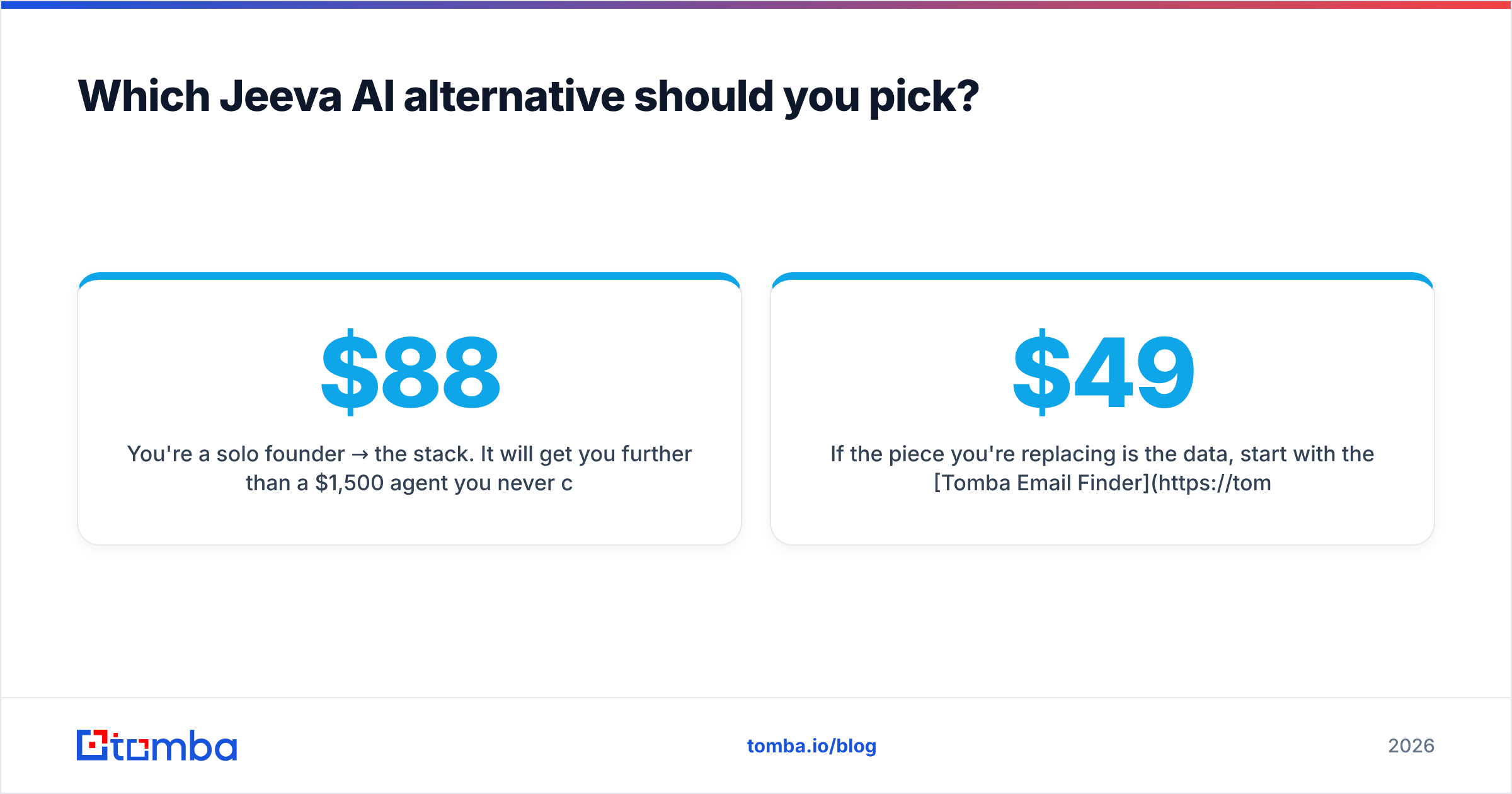
- You're a solo founder → the $88/mo stack. It will get you further than a $1,500/mo agent you never configure properly.
The stacks that hold up over two or three years share one trait: each layer is swappable. Bundles are fastest to start and hardest to leave.
If the piece you're replacing is the data, start with the Tomba Email Finder. The free tier gives you 25 searches a month — enough to run the 100-contact control test above against your real ICP before you spend anything. Paid plans start at $49/mo with verification and catch-all handling included, and full Tomba pricing is public, so you can do the math against your current contract without booking a call.
Related guides#
// get started
Find, verify and enrich your first contacts today
Start on the free plan with 25 searches a month, then scale when your team is ready.
Free plan · No credit card required · GDPR & CCPA
// about the author