Jeeva AI Pros and Cons: An Honest 2026 Review for Sales Teams
Jeeva AI promises an autonomous SDR that researches, writes, and sends. Here is where that promise holds up, where it quietly breaks, and what to check before you sign an annual contract.
TL;DR — the Jeeva AI pros and cons, in short:
- Jeeva AI is an AI SDR platform. It stitches together lead sourcing, research, multichannel sequencing, and reply handling, so one rep can run the workload of a small outbound team.
- The strongest pros are speed to first campaign, cheap coverage of long-tail accounts, and the fact that it removes the most boring 60% of SDR work.
- The biggest cons are data quality you do not control, personalization that feels generic at scale, thin transparency into why a lead was chosen, and pricing that is almost always quote-based and annual.
- AI SDRs amplify whatever data you feed them. A bad list plus an autonomous sender equals a burned domain, faster.
- Best fit: seed-to-Series-B teams with a proven ICP and no SDR bench. Worst fit: complex enterprise sales with long committees and strict compliance review.
What is Jeeva AI, exactly?#
This review of the Jeeva AI pros and cons starts with the product itself. Jeeva AI is an AI sales agent platform that collapses the SDR stack into one tool. Instead of buying a data provider, a sequencer, an enrichment tool, and a meeting scheduler, you buy one system. It claims to find the accounts, research them, write the outreach, send it across email and LinkedIn, and triage the replies.
Think of it like hiring a very fast intern who never sleeps, never complains about list-building, and never pushes back on a bad ICP. That last part is the whole story of this review. The speed is real. So is the missing judgment.
The category label is "AI SDR" or "digital worker," and Jeeva sits alongside vendors like 11x, Regie.ai, AiSDR, and Artisan. Gartner's coverage of AI in sales frames this cohort as augmentation tooling rather than headcount replacement. That framing matters when you weigh the vendor pitch, which leans much harder on "replace an SDR" than the evidence supports.
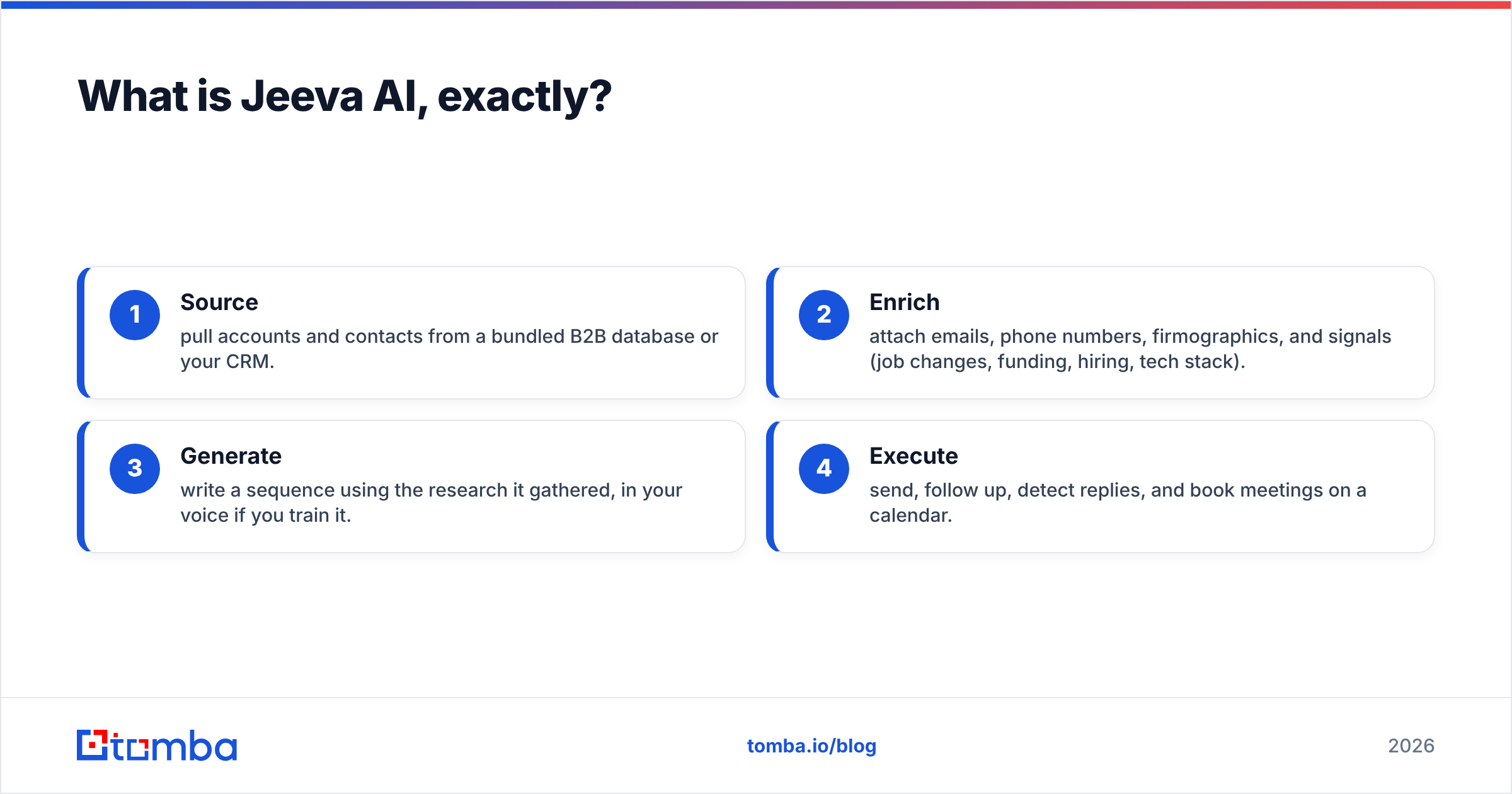
Under the hood, every tool in this category does four jobs:
- Source — pull accounts and contacts from a bundled B2B database or your CRM.
- Enrich — attach emails, phone numbers, firmographics, and signals (job changes, funding, hiring, tech stack).
- Generate — write a sequence using the research it gathered, in your voice if you train it.
- Execute — send, follow up, detect replies, and book meetings on a calendar.
Jeeva does all four. It works. The real question is whether each step works well enough that the combined output is worth paying for.
What are the main pros of Jeeva AI?#
1. Time to first campaign is genuinely short. This is the honest headline. A team with a defined ICP can go from signup to a live multichannel sequence in days. A traditional stack takes three to six weeks. If you are testing whether outbound works at all for your motion, that compression is worth real money.
2. It covers the long tail you would otherwise ignore. Human SDRs rationally focus on the top 200 accounts. An AI agent will happily work account 1,400, which is exactly the segment most teams never touch. Marginal pipeline from accounts you were never going to call is the cleanest ROI story an AI SDR has.
3. Multichannel is native, not bolted on. Email plus LinkedIn plus follow-up cadence in one workflow removes a class of coordination bugs — the duplicate touch, the LinkedIn connect that arrives three weeks after the email, the rep who forgets step four.
4. Reply triage saves more hours than sending does. The underrated win is the inbox. Sorting "not now," "wrong person," "unsubscribe," and "actually interested" is tedious, high-volume, low-skill work. Automating it returns hours per rep per week with low downside risk.
5. It lowers the cost of being wrong. Testing five ICP hypotheses with humans costs a quarter. Testing five with an agent costs a week. That experimentation velocity is a strategic advantage even if the raw reply rates are mediocre.

What are the biggest cons of Jeeva AI?#
1. You inherit the data, and you do not control it. This is the single biggest risk with any bundled AI SDR. The agent sources contacts from a database you did not choose, cannot audit, and cannot easily swap. When bounce rates climb, you are stuck negotiating with a vendor instead of fixing your own pipeline. Most teams that run AI SDRs well still send every address through an independent email verifier first. A 6% bounce rate on autonomous volume will burn your domain in about two weeks.
2. "Personalization" at scale still reads like personalization at scale. The research layer will find the funding round, the new VP, the blog post. It then writes a first line that is accurate and flat. Buyers have seen two years of AI outbound, so they spot the pattern. Relevance is not the same thing as resonance, and the gap shows up in reply quality more than reply rate.
3. Limited explainability. When the agent picks 400 accounts, it is often hard to reconstruct why. For a CRO who needs to defend segment strategy to a board, "the model selected them" is not an answer. Tools that expose filters and scoring logic are easier to govern.
4. Pricing is opaque and usually annual. Jeeva, like most of this category, has no public self-serve price list. Expect a quote, a seat-or-agent-based structure, and an annual commitment. Verify current terms directly on jeeva.ai rather than trusting any third-party number, including numbers in this post. The catch: you commit before you have proof, which flips the normal SaaS trial dynamic.
5. Deliverability risk is concentrated. An autonomous sender increases volume faster than your domain reputation can absorb it. Any AI SDR rollout needs warmup discipline, sending domain separation, and SPF/DKIM/DMARC hygiene that many buyers skip in the excitement of launch week.
6. It does not fix a weak offer. No agent rescues a message that has no reason to exist. HubSpot's sales research has been consistent for years: reply rates track relevance and timing, not volume. AI raises volume cheaply and relevance slowly.
How does Jeeva AI compare to other approaches?#
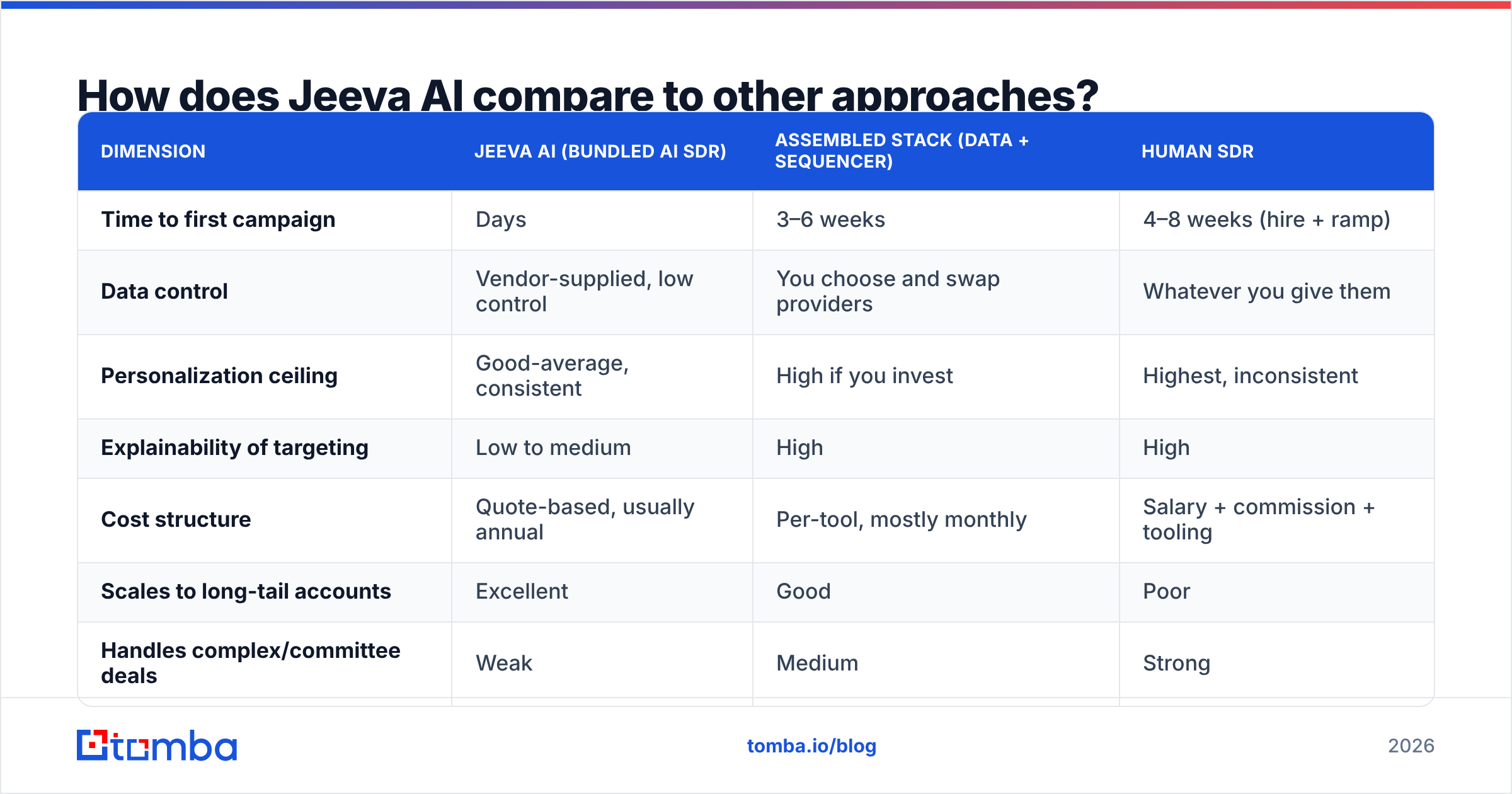
Here is the honest structural comparison. Ignore vendor feature lists. Compare what you are actually buying: control, speed, and the cost of being wrong.
| Dimension | Jeeva AI (bundled AI SDR) | Assembled stack (data + sequencer) | Human SDR |
|---|---|---|---|
| Time to first campaign | Days | 3–6 weeks | 4–8 weeks (hire + ramp) |
| Data control | Vendor-supplied, low control | You choose and swap providers | Whatever you give them |
| Personalization ceiling | Good-average, consistent | High if you invest | Highest, inconsistent |
| Explainability of targeting | Low to medium | High | High |
| Cost structure | Quote-based, usually annual | Per-tool, mostly monthly | Salary + commission + tooling |
| Scales to long-tail accounts | Excellent | Good | Poor |
| Handles complex/committee deals | Weak | Medium | Strong |
| Deliverability risk | Concentrated, needs guardrails | Distributed, controllable | Low |
| Best for | Fast ICP testing, no SDR bench | Teams with RevOps capacity | Enterprise, high ACV |
A few notes on alternatives people compare against Jeeva:
- Regie.ai leans harder into content and message generation quality, with a shallower data layer.
- 11x and Artisan sell the same "digital worker" narrative; differences are mostly in database coverage and CRM depth.
- BookYourData is a solid option when the bottleneck is the list itself rather than the sending — pay-as-you-go, filter-rich, verified B2B contacts, which pairs well with a sequencer you already like.
- Assembled stacks (your own data provider + Instantly/Smartlead/Outreach) stay the default for teams with a RevOps person, because every layer is swappable when one degrades.
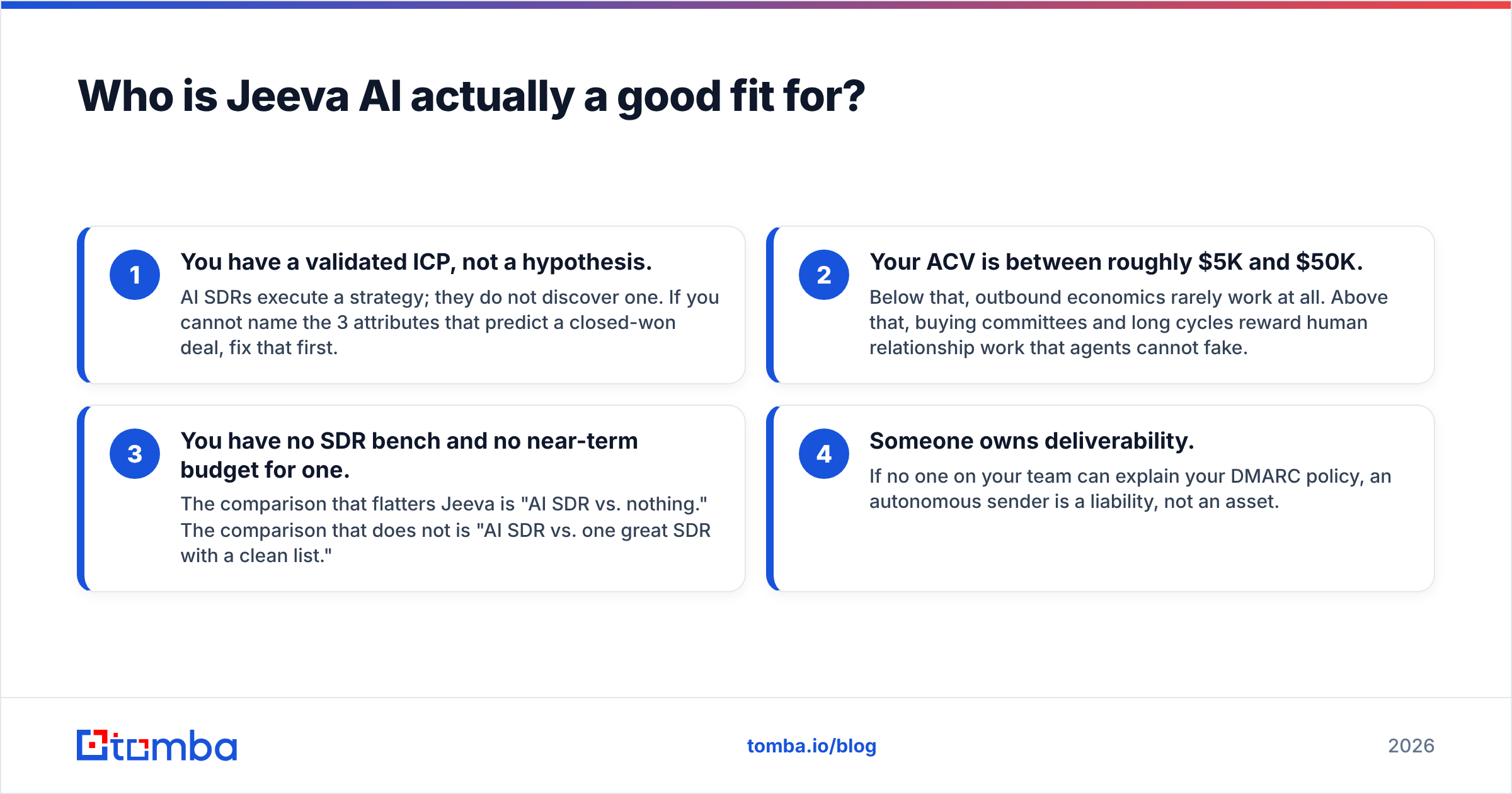
Who is Jeeva AI actually a good fit for?#
Use these four filters honestly.
- You have a validated ICP, not a hypothesis. AI SDRs execute a strategy; they do not discover one. If you cannot name the 3 attributes that predict a closed-won deal, fix that first.
- Your ACV is between roughly $5K and $50K. Below that, outbound economics rarely work at all. Above that, buying committees and long cycles reward human relationship work that agents cannot fake.
- You have no SDR bench and no near-term budget for one. The comparison that flatters Jeeva is "AI SDR vs. nothing." The comparison that does not is "AI SDR vs. one great SDR with a clean list."
- Someone owns deliverability. If no one on your team can explain your DMARC policy, an autonomous sender is a liability, not an asset.
If you fail two or more of those, buy a data source and a sequencer instead and keep the money.
What does an AI SDR rollout actually look like if you do it right?#
The teams that get value from Jeeva, or any peer product, treat the agent as an execution layer. The data underneath it stays theirs. The steps below are the difference between a 2% reply rate and a blocked domain.
- Separate your sending domains. Never run autonomous outbound from your primary domain. Use dedicated sending domains with their own reputation, so a bad week does not take down your invoices and support email.
- Verify everything, regardless of source. Run the agent's sourced contacts through independent validation before send. A bulk verify pass costs a fraction of a percent of the campaign budget, and it removes the failure mode that kills most rollouts.
- Enrich before you personalize. Better inputs beat better prompts. Firmographics, role seniority, and tech-stack signals from your own data enrichment layer give the model something real to work with.
Once the plumbing is safe, tune the output:
- Cap volume for the first 30 days. Start at 20–30 sends per mailbox per day. Climb only if bounce rate stays under 2% and spam complaints stay near zero.
- Human-review the first 200 messages. Read them. All of them. You will find the tonal failure modes in the first fifty, and fixing them once compounds across every later send.
- Measure positive reply rate, not reply rate. "Take me off this list" is a reply. Track meetings booked per 1,000 contacts and cost per qualified meeting, then compare against your human baseline before renewal.
Jeeva AI pros and cons: is it worth it in 2026?#
Verdict: worth a pilot if you have a proven ICP and no SDR team; skip it if you have either a strong SDR or a weak offer.
Jeeva AI is a competent product in a category that oversells itself. The pros sit in speed and coverage. The cons sit in control — of data, of targeting logic, and of contract terms. Nothing about it is a scam. Plenty about it is easy to buy for the wrong reasons.
The practical recommendation: negotiate a quarterly pilot rather than an annual contract. Insist on exporting your own contact list, so you are not locked into vendor data. Track cost per qualified meeting from day one. If the agent cannot beat a human baseline on that single metric within 90 days, the renewal conversation writes itself.
And whatever you decide about the agent layer, own your data layer. The teams that get burned by AI SDRs are rarely burned by the AI. They are burned by unverified addresses hitting spam traps at machine speed. Verification and enrichment are the cheapest insurance in the whole outbound stack.
Own the input, not just the output. Before you hand any AI agent your outbound volume, make sure the contacts it sends to are real. Tomba Email Finder finds verified professional email addresses by domain, name, or company, with accuracy scoring on every result — so your agent spends its sends on people who exist. Start free with 25 searches per month, or scale up from $49/mo on Starter; see Tomba pricing for Growth ($99/mo) and Pro ($249/mo) tiers with bulk and API access.
Related guides#
// get started
Find, verify and enrich your first contacts today
Start on the free plan with 25 searches a month, then scale when your team is ready.
Free plan · No credit card required · GDPR & CCPA
// about the author