Jeeva AI vs Overloop AI: AI SDR Comparison for 2026
Both promise an AI SDR that books meetings while you sleep. One is an agent swarm built for enterprise pipeline, the other a multichannel sequencer with AI bolted on. Here is how Jeeva AI and Overloop AI actually differ.
TL;DR
- Jeeva AI is an agent-first platform: you hire a set of AI workers (prospecting, inbox, LinkedIn, research) that run continuously and report like a junior SDR team. Pricing is demo-led and lands in enterprise territory.
- Overloop AI is a multichannel outbound sequencer that added an AI campaign builder on top of a mature email + LinkedIn engine. It is self-serve, cheaper, and far easier to audit.
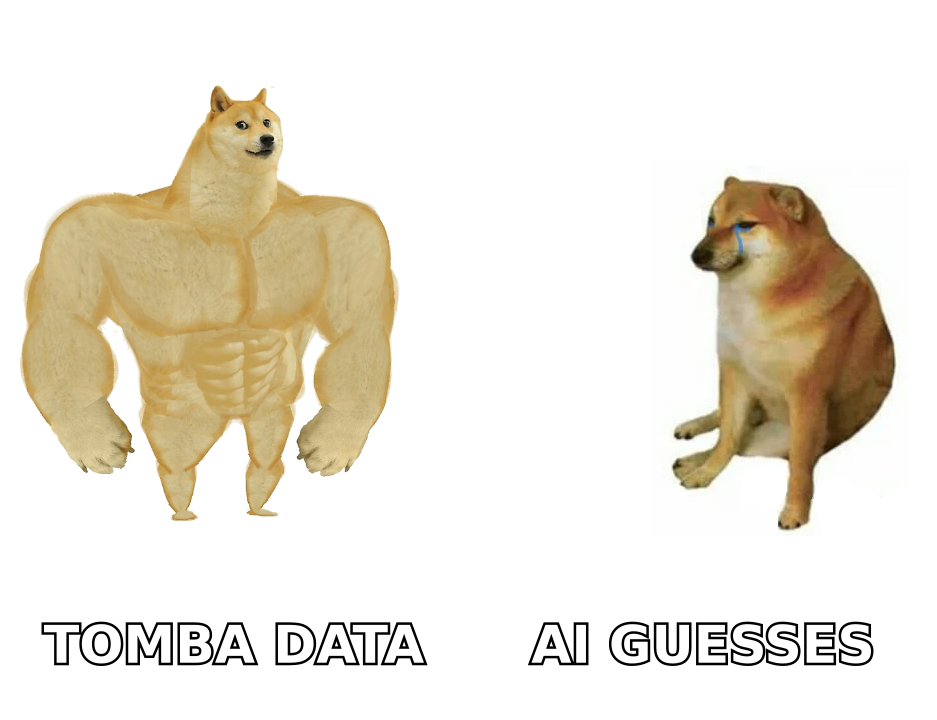
- Pick Jeeva if you are replacing headcount and have RevOps capacity to supervise agents. Pick Overloop if you already have a repeatable motion and want AI to speed up campaign creation, not own it.
- Neither tool is a data vendor in the strict sense. Both resell and infer contact data, and both will happily send to addresses they never verified.
- The cheapest reliability upgrade for either stack is a dedicated finder and verifier in front of the sequencer, which is where a tool like Tomba earns its keep.
What are Jeeva AI and Overloop AI?#
They solve the same business problem from opposite ends of the stack.
Jeeva AI positions itself as an AI SDR workforce. Instead of buying a tool and running campaigns yourself, you configure agents with an ICP, a value proposition and a set of guardrails, then let them identify accounts, research signals, write sequences, send, and triage replies. The pitch is headcount substitution. The interface reflects that: you are managing workers, reviewing their output, and approving escalations rather than building sequences step by step.
Overloop came from the other direction. It started life as Prospect.io, a solid multichannel outbound tool with email sequences, LinkedIn steps, calling tasks and a built-in contact finder. Overloop AI is the newer layer: describe your campaign in plain language, and it drafts the audience, the copy and the cadence for you to edit. The underlying engine is still a sequencer you fully control.
That difference in origin explains almost every practical tradeoff below. Jeeva asks you to trust an autonomous system. Overloop asks you to run a system faster.
Sorry — rendered correctly below.
How do Jeeva AI and Overloop AI compare head-to-head?#
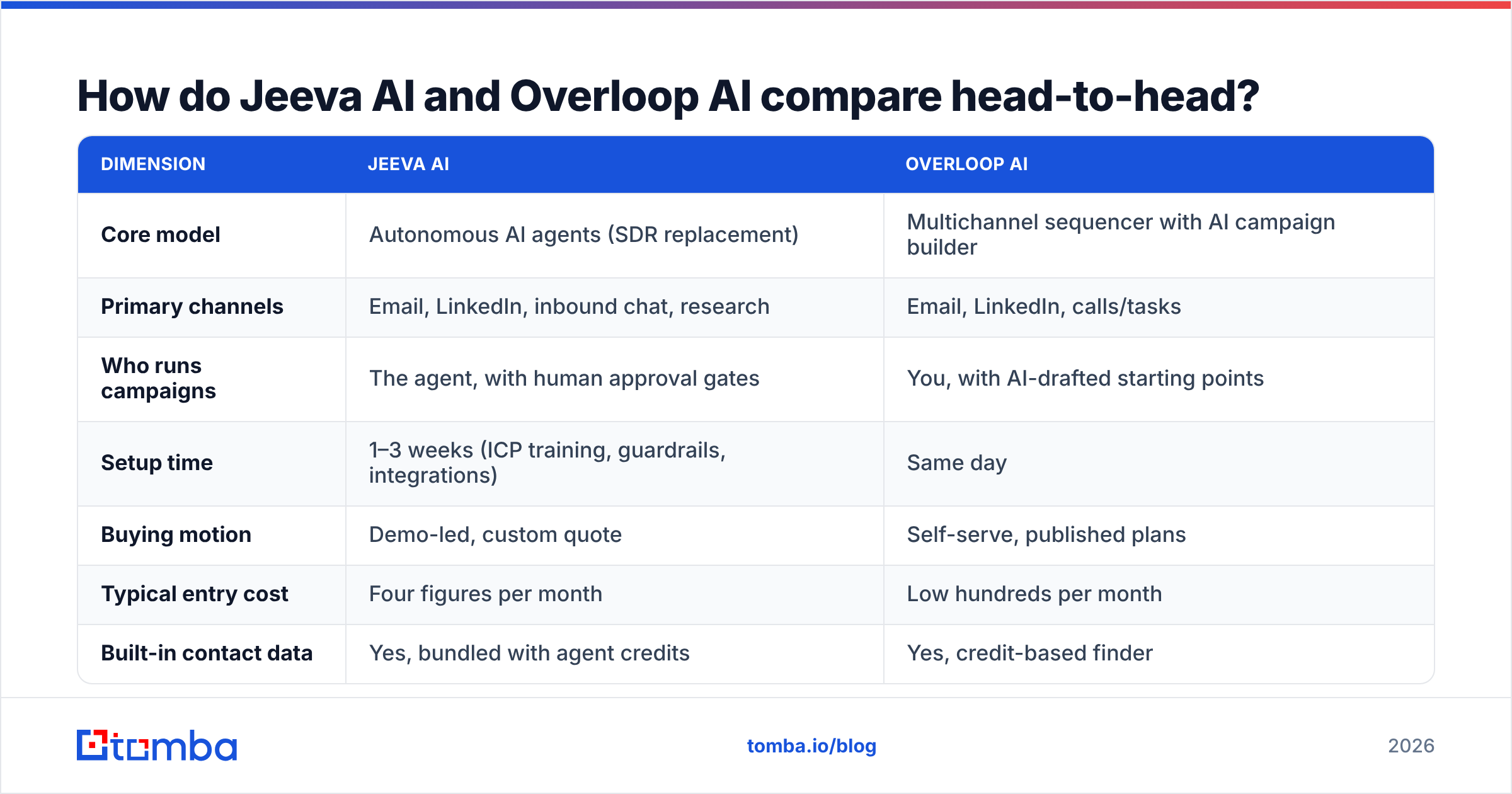
| Dimension | Jeeva AI | Overloop AI |
|---|---|---|
| Core model | Autonomous AI agents (SDR replacement) | Multichannel sequencer with AI campaign builder |
| Primary channels | Email, LinkedIn, inbound chat, research | Email, LinkedIn, calls/tasks |
| Who runs campaigns | The agent, with human approval gates | You, with AI-drafted starting points |
| Setup time | 1–3 weeks (ICP training, guardrails, integrations) | Same day |
| Buying motion | Demo-led, custom quote | Self-serve, published plans |
| Typical entry cost | Four figures per month | Low hundreds per month |
| Built-in contact data | Yes, bundled with agent credits | Yes, credit-based finder |
| Deliverability controls | Managed by the platform | Manual (sending limits, warmup via integrations) |
| CRM depth | HubSpot, Salesforce sync | HubSpot, Pipedrive, Salesforce sync |
| Best for | Teams replacing or scaling past 2–3 SDRs | Founders and small teams running their own motion |
| Weakest point | Opacity — hard to audit why an agent did something | AI layer is thinner; still your job to think |
The honest summary: these are not really competitors for the same buyer. They show up in the same search results because both say "AI SDR," but a two-person startup evaluating Jeeva and a 40-rep sales org evaluating Overloop are both shopping in the wrong aisle.
What does Jeeva AI do best?#
Jeeva's strength is continuity. A human SDR works 6 productive hours a day and forgets to follow up. An agent does not. The platform's research agent pulls context on an account, the outbound agent drafts based on that context, and the inbox agent classifies replies and keeps threads moving without a rep touching them.
Three things it genuinely does better than a sequencer:
- Signal-to-sequence latency. When a trigger fires (funding, hiring, tech change), the agent can act within the hour rather than waiting for a weekly list refresh.
- Reply handling at volume. Classifying "not now," "wrong person," and "send me pricing" across thousands of threads is exactly the work that breaks small teams.
- Consistency of research depth. Every prospect gets the same level of pre-send research, which is almost never true with humans.
The cost of that is supervision. Autonomous systems fail quietly. If the ICP definition drifts or the agent starts interpreting a weak signal as a strong one, you find out three weeks later in your reply rate, not in a dashboard alert. Budget for a RevOps owner who reviews agent output weekly. Without one, you are paying enterprise prices for unmonitored volume.
What does Overloop AI do best?#
Overloop's strength is that you can see everything. Every step, every delay, every condition is visible and editable. When a campaign underperforms, you can isolate the variable — the subject line, the second touch timing, the LinkedIn connection step — and change one thing.
It is also genuinely multichannel in the way most "multichannel" tools are not. LinkedIn steps are first-class, not an afterthought, and call tasks slot into the same cadence so an SDR's day is one queue instead of four tabs. Reviews on G2 consistently point at the same two things: fast setup and a clean sequence builder.
Where it falls short of Jeeva: the AI layer drafts, it does not decide. It will write you a competent three-touch sequence from a prompt, but it will not notice that your reply rate collapsed in the finance vertical and rebuild the targeting. That judgment stays with you.
How do Jeeva AI and Overloop AI handle data and deliverability?#
This is where both tools have the same structural weakness, and it deserves a section on its own because it determines whether anything else matters.
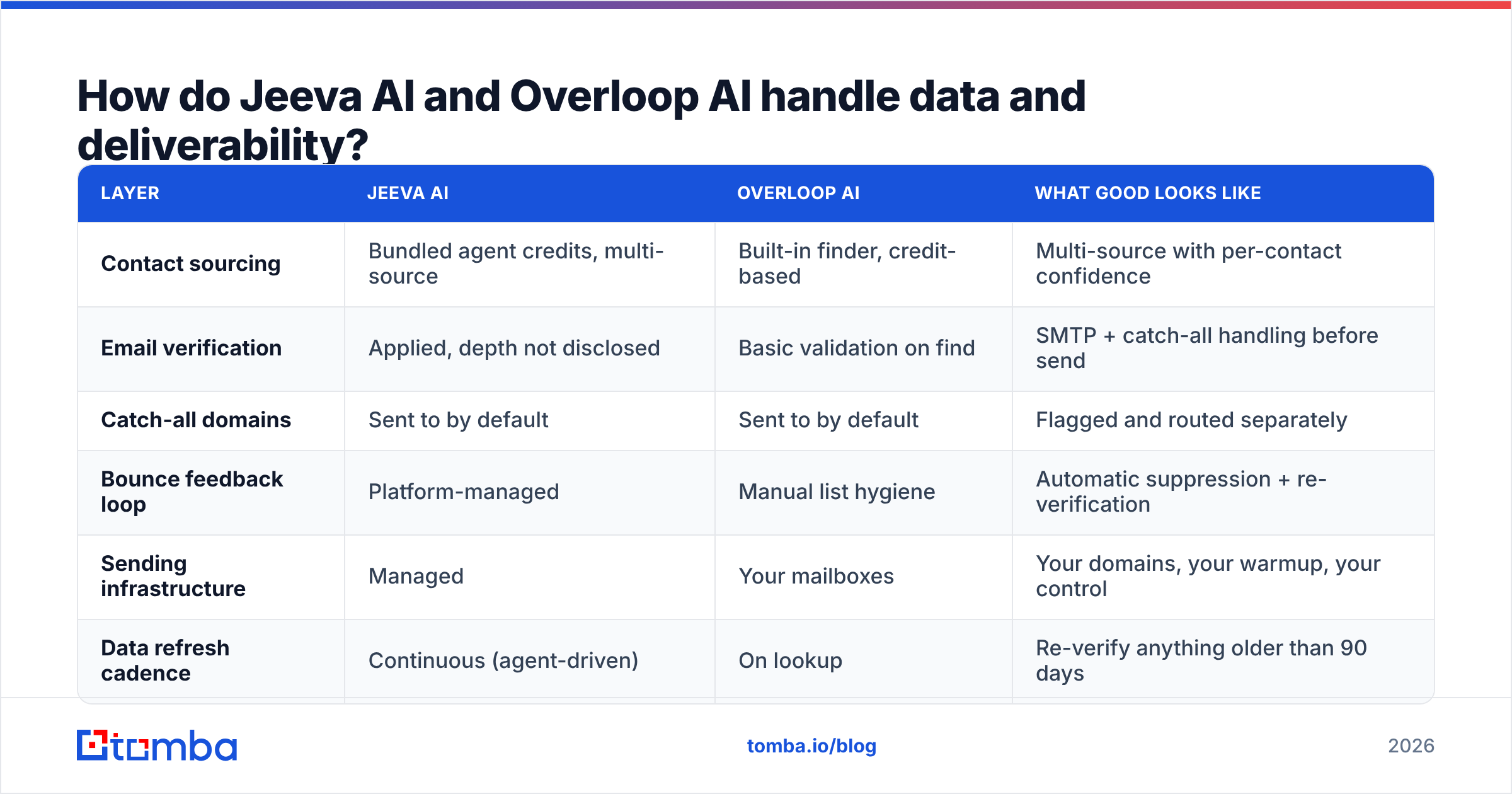
| Layer | Jeeva AI | Overloop AI | What good looks like |
|---|---|---|---|
| Contact sourcing | Bundled agent credits, multi-source | Built-in finder, credit-based | Multi-source with per-contact confidence |
| Email verification | Applied, depth not disclosed | Basic validation on find | SMTP + catch-all handling before send |
| Catch-all domains | Sent to by default | Sent to by default | Flagged and routed separately |
| Bounce feedback loop | Platform-managed | Manual list hygiene | Automatic suppression + re-verification |
| Sending infrastructure | Managed | Your mailboxes | Your domains, your warmup, your control |
| Data refresh cadence | Continuous (agent-driven) | On lookup | Re-verify anything older than 90 days |
Two patterns cause most of the damage in AI-driven outbound:
- Volume outpaces verification. An agent that can generate 5,000 contacts a week will generate 5,000 contacts a week whether or not 12% of them bounce. At a 12% bounce rate your domain reputation is already degrading, and by the time open rates drop the damage takes weeks to undo. Run everything through a real email verifier before it touches a sequence.
- Catch-all domains get treated as valid. A large share of enterprise domains accept every address at the SMTP layer. Bundled verification often marks these "valid" because the server said yes. They are not valid — they are unknown. A dedicated catch-all verifier separates the two so you can send to them from a secondary domain instead of your primary.
Neither platform is unusual here. Bundled data is a convenience feature for both, not their core competency, and treating it as a substitute for a dedicated data layer is the single most common reason AI SDR pilots underperform their demo.

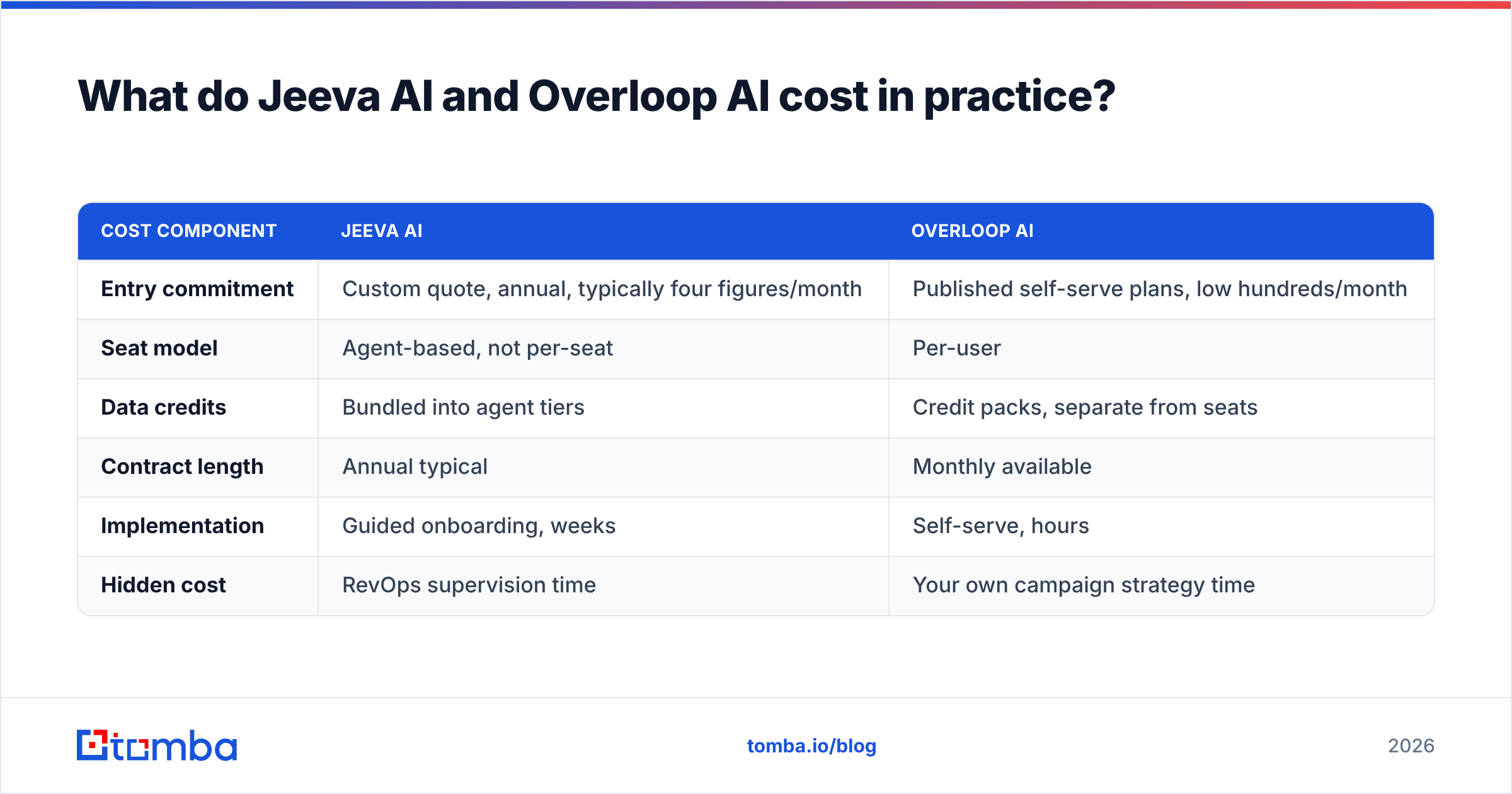
What do Jeeva AI and Overloop AI cost in practice?#
Published pricing moves, so confirm both on the vendors' own pages before you budget. As of early 2026 the shape looks like this:
| Cost component | Jeeva AI | Overloop AI |
|---|---|---|
| Entry commitment | Custom quote, annual, typically four figures/month | Published self-serve plans, low hundreds/month |
| Seat model | Agent-based, not per-seat | Per-user |
| Data credits | Bundled into agent tiers | Credit packs, separate from seats |
| Contract length | Annual typical | Monthly available |
| Implementation | Guided onboarding, weeks | Self-serve, hours |
| Hidden cost | RevOps supervision time | Your own campaign strategy time |
The number that actually matters is cost per meeting booked, and that is dominated by data quality rather than software price. A $2,000/month agent platform running on 80%-accurate contact data loses to a $300/month sequencer running on 97%-accurate data almost every time, because bounced sends do not just waste credits — they compound into deliverability damage that suppresses the sends that would have worked.
Before you compare platform invoices, price the data layer separately. Tomba pricing starts free at 25 searches a month and runs $49/month for Starter, $99/month for Growth and $249/month for Pro — a rounding error against either platform's contract, and the input that determines whether the rest of the spend converts.
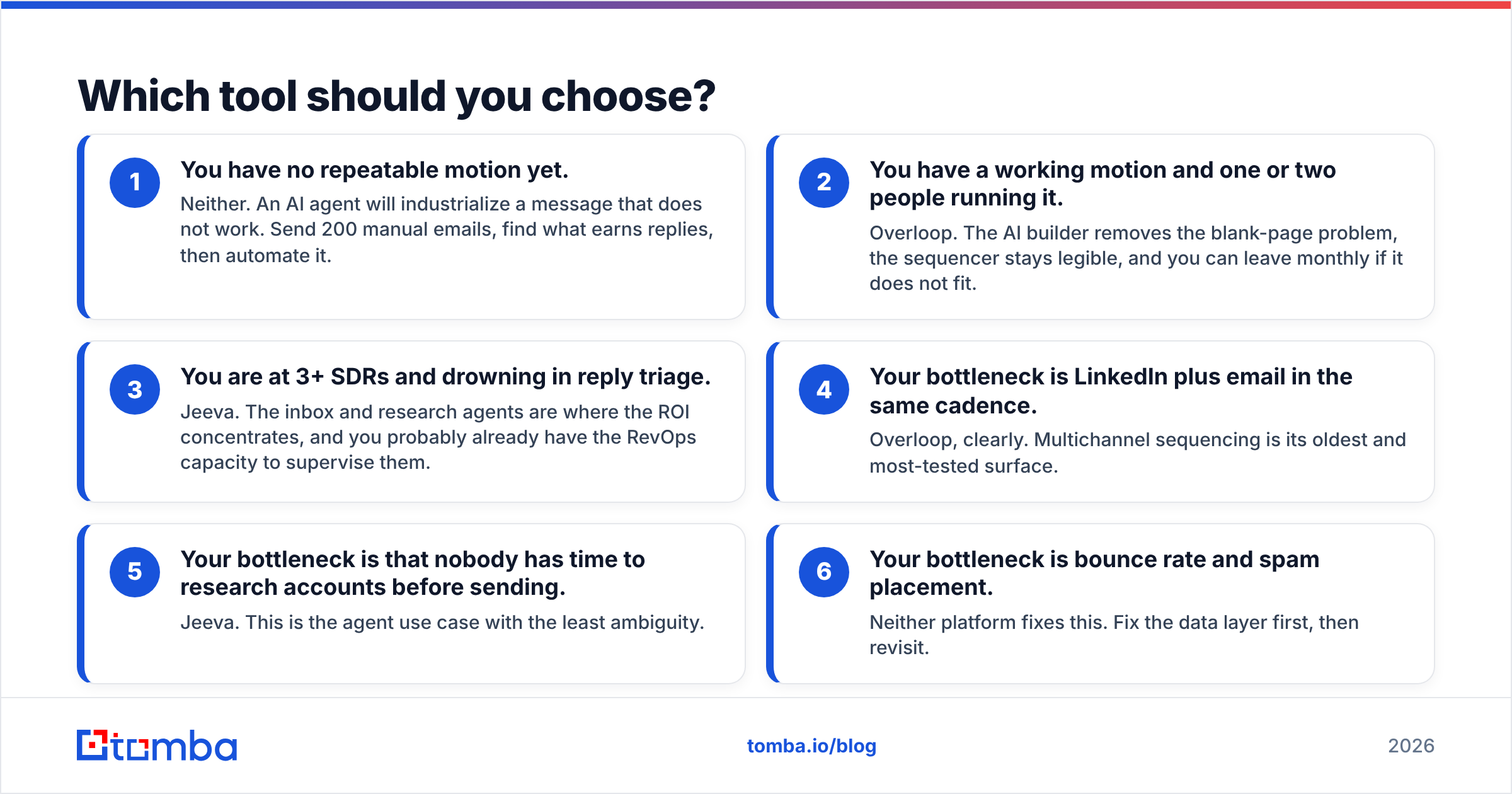
Which tool should you choose?#
Match the tool to your constraint, not your ambition.
- You have no repeatable motion yet. Neither. An AI agent will industrialize a message that does not work. Send 200 manual emails, find what earns replies, then automate it.
- You have a working motion and one or two people running it. Overloop. The AI builder removes the blank-page problem, the sequencer stays legible, and you can leave monthly if it does not fit.
- You are at 3+ SDRs and drowning in reply triage. Jeeva. The inbox and research agents are where the ROI concentrates, and you probably already have the RevOps capacity to supervise them.
- Your bottleneck is LinkedIn plus email in the same cadence. Overloop, clearly. Multichannel sequencing is its oldest and most-tested surface.
- Your bottleneck is that nobody has time to research accounts before sending. Jeeva. This is the agent use case with the least ambiguity.
- Your bottleneck is bounce rate and spam placement. Neither platform fixes this. Fix the data layer first, then revisit.
If you are evaluating adjacent options at the same time, it is worth reading up on the broader Overloop alternative landscape — the AI SDR category consolidated fast in 2025 and several tools now overlap heavily on features while differing wildly on data sourcing.
What does a sane AI outbound stack look like in 2026?#
Separate the four jobs and buy the best tool for each:
- Find — a dedicated email finder that returns a confidence score and a source, so you know what you are sending to. Use domain search when you are working accounts rather than named individuals.
- Verify — SMTP-level validation plus explicit catch-all handling, run immediately before send, not at list-build time.
- Sequence — Overloop, Jeeva, or whatever fits your team shape. This is the most replaceable layer in the stack.
- Enrich — firmographic and role context, either from the platform or via a data enrichment call in your own pipeline, so your AI has real inputs to personalize on.
Teams that wire it this way can swap the sequencing layer in an afternoon. Teams that buy one platform for all four jobs end up renegotiating an annual contract because the data went stale.
The honest verdict#
Jeeva AI is the more ambitious product and the riskier purchase. It is trying to replace a function, not accelerate one, and when it works the leverage is real. It demands supervision, a clear ICP, and a budget that survives a 90-day ramp.
Overloop AI is the safer, more boring, more likely-to-be-used purchase. It does what it says, you can see how, and you can leave. For most teams under 10 reps, that is the correct answer even though it is the less exciting one.
Both are downstream of the same dependency. Whichever you pick, the agent or the sequence is only as good as the address it sends to, and neither vendor's bundled data is built to be the system of record for that.
Start with the data layer. Run your target accounts through Tomba Email Finder before a single sequence goes live — free for your first 25 searches, $49/month on Starter, with SMTP verification and catch-all detection built in. Feed clean, scored contacts into Jeeva or Overloop and you will find out what the platform is actually worth, instead of measuring your bounce rate.
Related guides#
// get started
Find, verify and enrich your first contacts today
Start on the free plan with 25 searches a month, then scale when your team is ready.
Free plan · No credit card required · GDPR & CCPA
// about the author