Jeeva AI vs Seamless.AI: Which One Fits Your 2026 Outbound?
One sells you an autonomous AI SDR, the other sells you a contact database with an AI wrapper. Here's how Jeeva AI and Seamless.AI actually compare on data quality, pricing transparency, and what happens after the demo ends.
Jeeva AI vs Seamless.AI is not a like-for-like fight. Jeeva AI sells an autonomous AI SDR. Seamless.AI sells a B2B contact database with AI search on top. This Jeeva AI vs Seamless.AI guide covers data quality, pricing, and the job each tool is actually built to do.
TL;DR
- Not the same category. Jeeva AI vs Seamless.AI pits an AI SDR against a database. Jeeva AI runs agents that research, write, and follow up. Seamless.AI hands you a contact database. Compare the two only if one budget has to cover both jobs.
- Seamless.AI wins on coverage, loses on accuracy. Real-time scraping returns more records. Many of those emails are pattern guesses, not verified addresses.
- Jeeva AI wins on workflow, loses on clarity. Neither vendor lists full prices. Jeeva's agent model makes your bill harder to predict as you scale.
- Both are costly ways to buy contact data. If you only need the data layer, a finder plus a verifier costs far less and feeds the sequencer you already run.
Our pick: Jeeva AI if you're replacing headcount and can live with quote-only pricing. Seamless.AI if you need volume lists today. Neither if what you need is accurate emails.
What is Jeeva AI?#
Jeeva AI calls itself an "AI SDR" platform. The software does the job of a sales development rep instead of handing a rep a list. You set an ideal customer profile and connect your inbox and CRM. The agents then find prospects, research them, write the first touch, run follow-ups, and sort replies.
The pitch is headcount replacement. A junior SDR costs $70k-plus fully loaded and books maybe eight meetings a month. Jeeva asks for a software fee instead, for an agent that works around the clock. Several agents ship in one subscription: an outbound agent, an inbound agent, and a LinkedIn agent. You can read the current product breakdown on jeeva.ai.
One point matters most here. Jeeva's contact data is a means to an end. The platform sources contacts, but the headline feature is the workflow, not the data.
What is Seamless.AI?#
Seamless.AI is a B2B contact database. You search by title, industry, company size, or tech stack. It returns names, emails, direct dials, and LinkedIn URLs. The selling point is real-time search: it crawls and builds the record when you run the query, rather than serving a list that was refreshed last quarter.
Seamless is older than this wave of AI SDR tools. It has a large G2 footprint and a big SMB following among teams that build volume lists. AI features sit on top — writing help, buyer intent, a Chrome extension. The core product is still the database and the credits you spend inside it.
That is the core of Jeeva AI vs Seamless.AI. The split is simple: Seamless.AI gives you fuel. Jeeva AI claims to give you the whole engine.

Jeeva AI vs Seamless.AI: how do they compare feature by feature?#
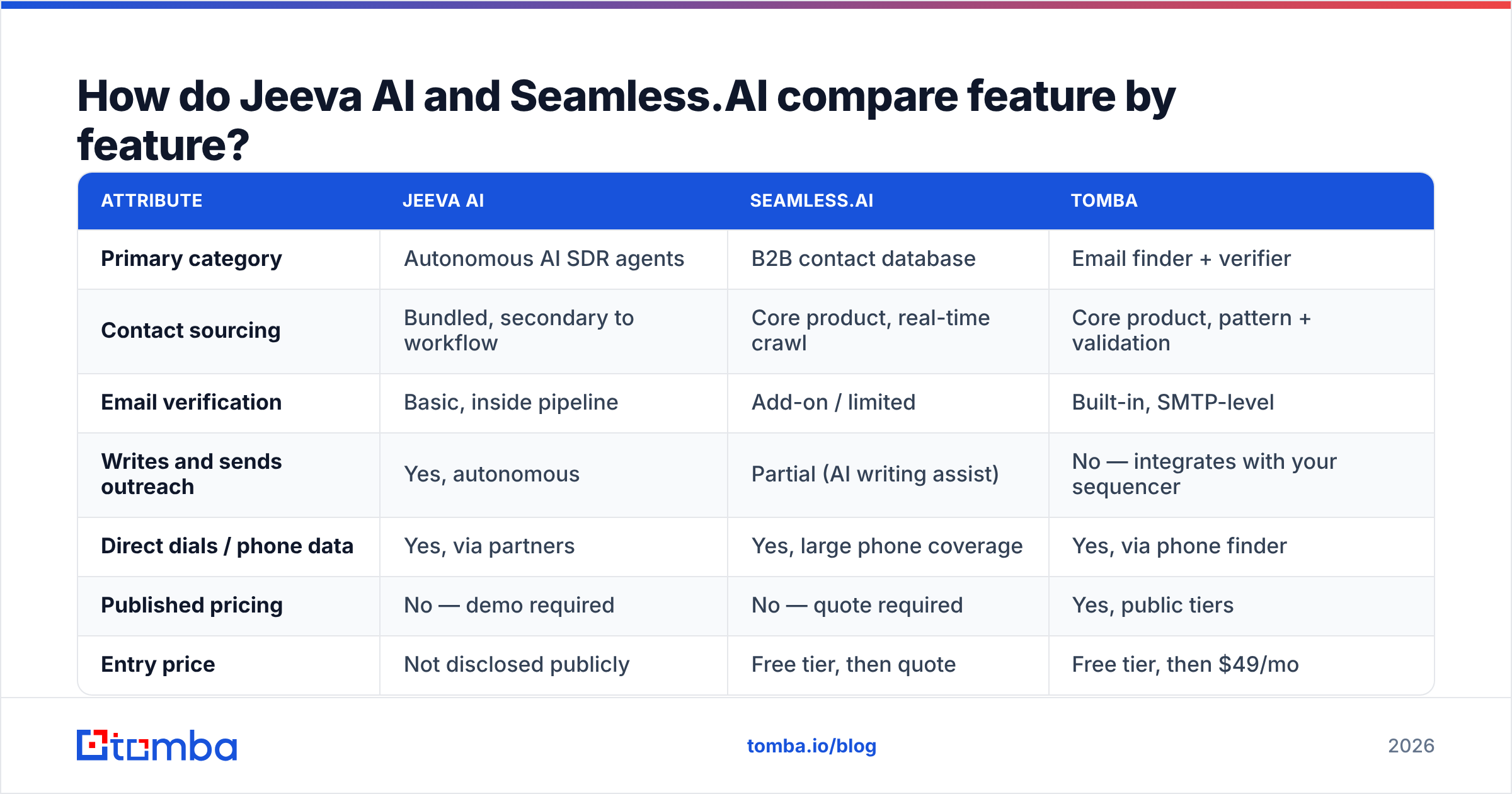
Here's the Jeeva AI vs Seamless.AI side-by-side on the things that change your monthly outcome. Where a vendor hides a number, we say so rather than invent one.
| Attribute | Jeeva AI | Seamless.AI | Tomba |
|---|---|---|---|
| Primary category | Autonomous AI SDR agents | B2B contact database | Email finder + verifier |
| Contact sourcing | Bundled, secondary to workflow | Core product, real-time crawl | Core product, pattern + validation |
| Email verification | Basic, inside pipeline | Add-on / limited | Built-in, SMTP-level |
| Writes and sends outreach | Yes, autonomous | Partial (AI writing assist) | No — integrates with your sequencer |
| Direct dials / phone data | Yes, via partners | Yes, large phone coverage | Yes, via phone finder |
| Published pricing | No — demo required | No — quote required | Yes, public tiers |
| Entry price | Not disclosed publicly | Free tier, then quote | Free tier, then $49/mo |
| Free tier | Trial / demo only | ~50 credits | 25 searches/mo |
| API access | Limited | Available on higher tiers | Full REST API on all paid tiers |
| Best fit | Teams replacing SDR headcount | SMB teams building volume lists | Teams that own their own sequencing |
The table shows the real decision. These are not two versions of one product. You are choosing how much of your outbound stack a single vendor gets to own.
Which tool has better data accuracy?#
Short answer: on Jeeva AI vs Seamless.AI data, Seamless returns more records, Jeeva returns fewer but richer ones, and neither publishes an audited bounce rate.
This is where buyers get burned, so it pays to be precise. Vendors use the word "accuracy" for three different things:
- Coverage — how much of your list returns any email at all. Seamless.AI does well here, because real-time crawling casts a wide net.
- Validity — how many of those emails accept mail. Guessed patterns fail this test. An address built from
first.last@domain.comlooks fine and bounces hard. - Freshness — whether the person still works there. B2B churn is high. A record that was right nine months ago bounces today.
Seamless.AI users in G2 reviews report the same pattern: strong coverage, patchy validity. You burn credits on records you then have to clean. Jeeva AI's agents buy from third-party data partners, so its accuracy is only as good as those suppliers — and that layer stays hidden.

Either way, budget for a verify step before anything hits your sending domain. Unverified lists are the fastest way to torch sender reputation. No amount of AI writing saves an email that never lands. An email verifier run on the export costs cents per thousand, and it heads off a problem that takes months to undo.
Jeeva AI vs Seamless.AI: how does pricing compare?#
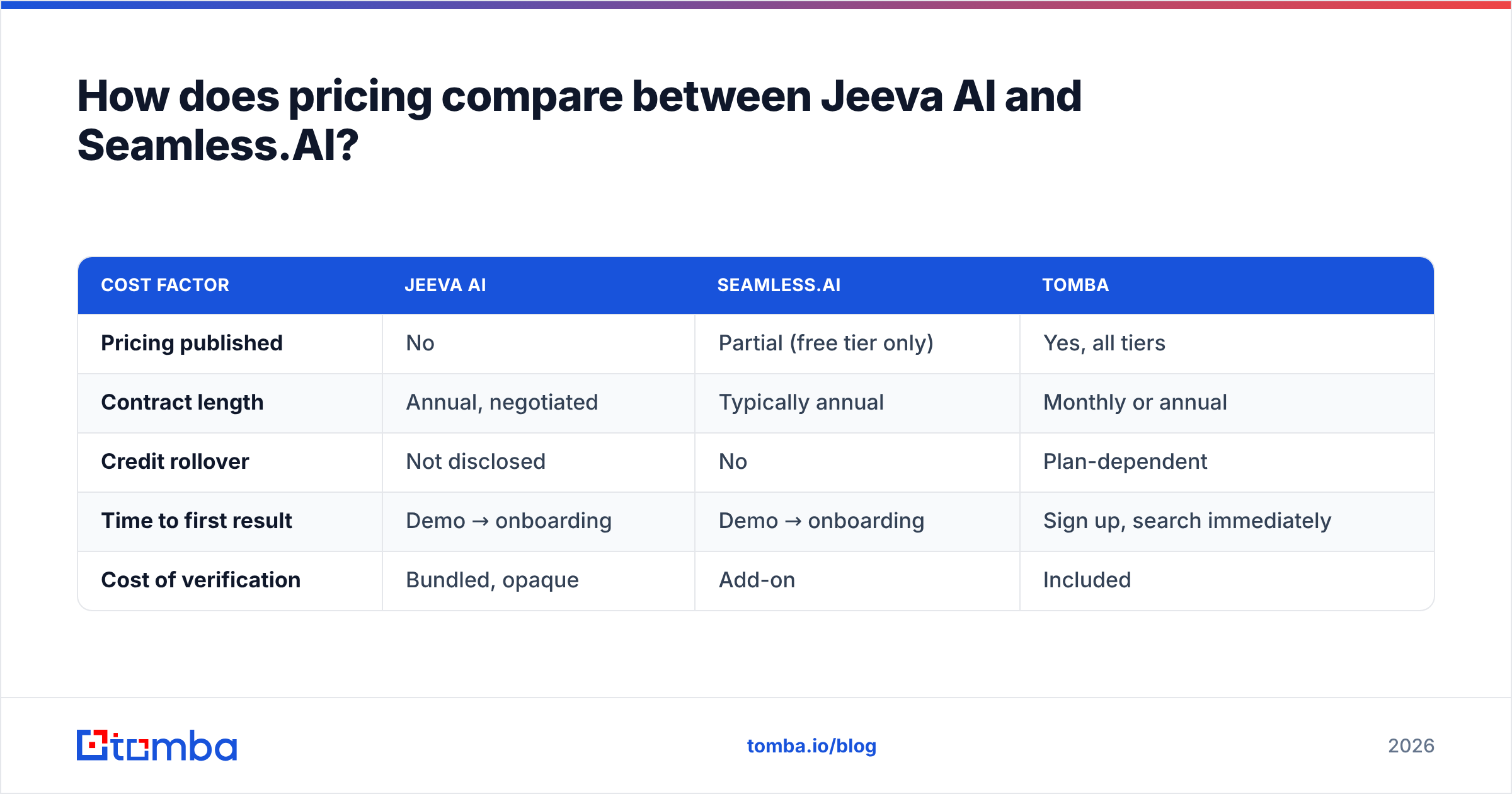
Jeeva AI vs Seamless.AI pricing shares one habit: neither vendor publishes a full price list. That is a finding in itself. Both send you to a sales call. Both price per seat, with usage caps set by negotiation.
What we can say with confidence:
- Seamless.AI starts with a small free credit allowance, then moves to annual per-seat contracts. Buyers report low-to-mid four figures per seat per year. Credits reset each month and do not roll over. Running dry mid-month is the most common complaint.
- Jeeva AI sells a platform subscription priced against an SDR salary, not against other software. That framing is on purpose: it anchors you at $60k-plus, not at $99/mo. Expect a much higher number than a pure database tool.
- Neither price is knowable before a demo. That makes planning awkward for a two-person team, rather than a funded sales org.
Compare that with tools that post their numbers. Tomba's pricing runs Free (25 searches/mo), Starter at $49/mo, Growth at $99/mo, Pro at $249/mo, and custom Enterprise. No call needed. That gap is not a small perk. It is the difference between piloting this afternoon and waiting nine days for a quote.
| Cost factor | Jeeva AI | Seamless.AI | Tomba |
|---|---|---|---|
| Pricing published | No | Partial (free tier only) | Yes, all tiers |
| Contract length | Annual, negotiated | Typically annual | Monthly or annual |
| Credit rollover | Not disclosed | No | Plan-dependent |
| Time to first result | Demo → onboarding | Demo → onboarding | Sign up, search immediately |
| Cost of verification | Bundled, opaque | Add-on | Included |
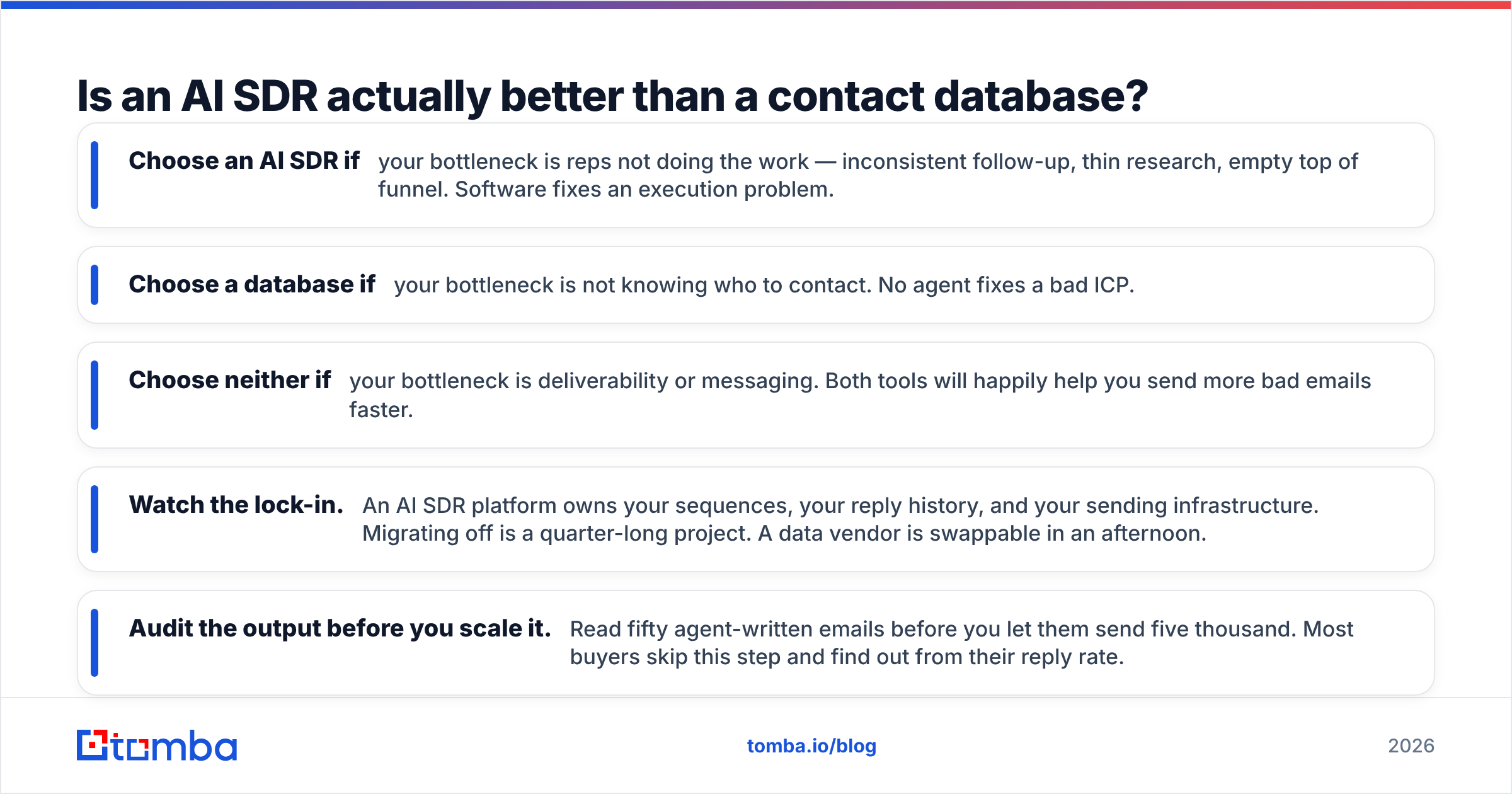
Is an AI SDR actually better than a contact database?#
Not yet, for most teams — though the gap is closing faster than skeptics claim.
AI SDRs are good at three things. They read a company's last four blog posts and pull out a hook. They never forget touch four. They hold a steady quality bar at volume. They are still weak on judgment. They cannot tell "not now" from "you've misread my business," and they do not know when to stay quiet.
Here's the honest Jeeva AI vs Seamless.AI framing for the buy decision:
- Choose an AI SDR if your problem is reps not doing the work — weak follow-up, thin research, an empty funnel. Software fixes execution.
- Choose a database if your problem is not knowing who to contact. No agent fixes a bad ICP.
- Choose neither if your problem is deliverability or messaging. Both tools will help you send bad email faster.
- Watch the lock-in. An AI SDR platform owns your sequences, your reply history, and your sending setup. Leaving takes a quarter. Swapping a data vendor takes an afternoon.
- Audit the output first. Read fifty agent-written emails before you let them send five thousand. Most buyers skip this and learn it from the reply rate.
The response rate math matters more than the feature list. A tool that doubles your sends and halves your replies is a lateral move that costs more.
Jeeva AI vs Seamless.AI: which should you choose for your team?#

The Jeeva AI vs Seamless.AI call gets simple once you name your bottleneck.
Pick Jeeva AI if: you have a clear ICP, an outbound motion that already works, and a hiring decision in front of you. The value case is "instead of hiring SDR number three." If you are still testing whether outbound works at all, an agent will scale your doubt, not settle it.
Pick Seamless.AI if: you need a lot of contacts across a broad territory, and you already own a sequencer and a verify step. Its coverage is genuinely strong. Plan to clean the export, and push back hard on credit caps. That is where the contract pain lives.
Pick neither if: the real job is "get accurate, verified email addresses for this list of companies." That is a data problem, not an agent problem, and it costs far less to solve head-on. Run a domain search across your target accounts, verify the output, and feed the sequencer you already pay for.
Look at the wider field before you sign anything annual. BookYourData suits teams that prefer prepaid, pay-as-you-go lists with a bounce guarantee over a seat-based plan. That is a different commercial model, and it fits lumpy, campaign-driven demand. If Seamless is the one on your shortlist, our Seamless.AI alternative breakdown covers the swap in detail.
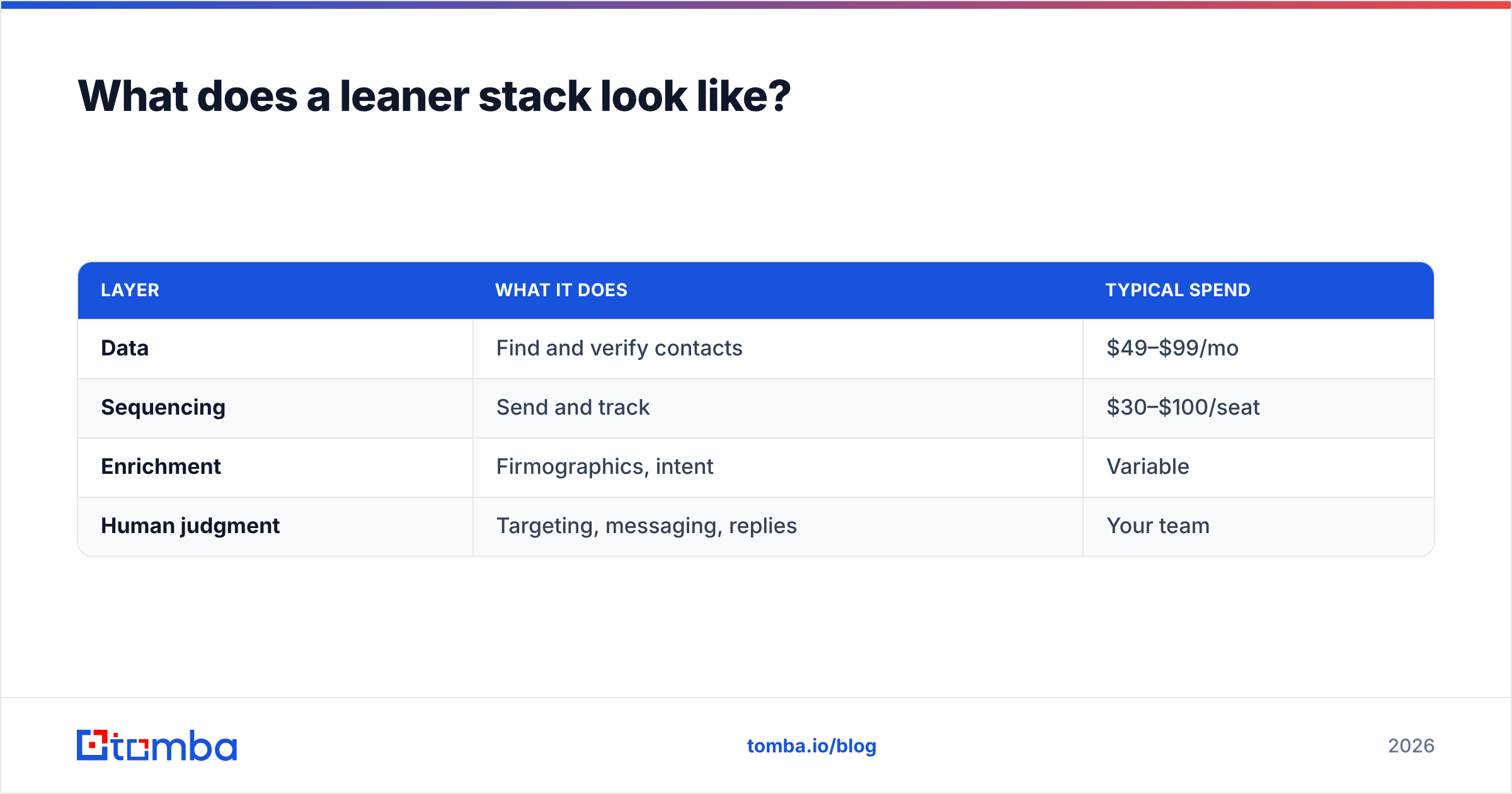
What does a leaner stack look like?#
Jeeva AI vs Seamless.AI both ask you to buy a bundle. Teams with the best outbound economics in 2026 tend to unbundle instead:
| Layer | What it does | Typical spend |
|---|---|---|
| Data | Find and verify contacts | $49–$99/mo |
| Sequencing | Send and track | $30–$100/seat |
| Enrichment | Firmographics, intent | Variable |
| Human judgment | Targeting, messaging, replies | Your team |
That stack costs less than one seat on most all-in-one AI SDR platforms. Every layer is replaceable on its own. When a vendor slips, you swap one piece instead of reopening your whole go-to-market.
The trade-off is real: you own the wiring. With no ops capacity, the bundled platform earns its premium. With one person who can call an API, unbundling wins on both cost and freedom. Tomba's bulk email finder and API exist for that pattern. Upload the account list, get verified contacts back, and push them wherever your workflow lives.
The bottom line#
Jeeva AI vs Seamless.AI is not a fair fight, because each tool solves a different problem. Jeeva bets that the SDR role gets automated. Seamless bets that reps will always need better lists. Both bets may pay off.
Neither one solves the cheap part well: contacts that are real, current, and safe to send to. If that is your gap, fix it first, before you sign an annual platform contract.
Try Tomba Email Finder free — 25 searches a month, no demo call, no credit card. Run it against fifty accounts from your current list. Compare the bounce rate with what you pay today, and let the numbers pick your stack. Paid plans start at $49/mo with verification included, and the API is on every tier.
Related guides#
// get started
Find, verify and enrich your first contacts today
Start on the free plan with 25 searches a month, then scale when your team is ready.
Free plan · No credit card required · GDPR & CCPA
// about the author