Jeeva AI vs Snovio (2026): AI SDR or Outreach Platform?
Jeeva AI sells autonomous SDR agents. Snov.io sells a hands-on outreach suite with its own email finder. They solve different problems — here's which one actually fits your team, your budget, and your data-quality bar.
TL;DR — Jeeva AI vs Snovio in 30 seconds
- These are not the same category of tool. Jeeva AI sells autonomous AI SDR agents that research, write, and send on your behalf. Snov.io sells a hands-on sales engagement suite: email finder, verifier, drip campaigns, light CRM.
- Snov.io is the cheaper, more predictable entry point. Self-serve pricing, a free trial tier, and credits you can reason about. Jeeva AI is quote-led and lands in the "AI SDR headcount replacement" budget bracket.
- Neither is best-in-class at raw contact data. Both bundle finding and verification with sending, and bundled data is where accuracy usually slips.
- Pick Jeeva AI if you have no SDR capacity and want an agent to run the motion. Pick Snov.io if you want to control the sequence and keep costs flat.
- Pick a dedicated data layer either way. A specialist email finder feeding whichever sender you choose beats trusting one vendor's bundled list.
If you searched "Jeeva AI vs Snovio" (Snov.io is the official spelling), you are probably comparing two tools that showed up in the same roundup but do genuinely different jobs. This post separates them: what each one is, where its data comes from, what it costs, and which one survives contact with a real quota.
What is Jeeva AI?#
Jeeva AI is an AI SDR platform. You do not build a sequence step by step. You hire agents with job descriptions: an inbound agent that qualifies and replies to form fills, an outbound agent that builds lists and writes first-touch emails, a LinkedIn agent that handles connection requests and follow-ups, and an enrichment agent that fills in missing fields before anything sends.
The pitch is headcount arithmetic. A junior SDR in North America costs roughly $60k–$85k fully loaded and books a known number of meetings per month. Jeeva prices its agents at a fraction of that, with no ramp time. That framing explains the pricing model. You are not buying credits. You are buying an outcome envelope, usually on an annual contract.
What you give up is granularity. When an agent writes 400 emails this week, you approve a policy, not 400 drafts. Teams with a strong brand voice or a compliance review step tend to find that uncomfortable. Teams drowning in an untouched TAM tend to find it liberating.
What is Snov.io?#
Snov.io is the older, broader product: a sales engagement suite that started as an email finder and grew outward. You get domain-level prospect search, a bulk email finder, an email verifier, multichannel drip campaigns (email plus LinkedIn steps), a warm-up product, and a lightweight CRM to track deals without paying for Salesforce.
Snov.io's design assumption is the opposite of Jeeva's. You already know who you want to reach and what you want to say. The tool just makes that cheap and repeatable. Everything is credit-metered and visible. You build sequences by hand, A/B test subject lines yourself, and own every word that leaves your domain.
It is popular with agencies and small B2B teams for exactly that reason: predictable pricing, no annual commitment, and a stack you can learn in an afternoon. Its G2 reviews consistently praise the price-to-feature ratio and consistently flag data coverage gaps on smaller or non-US companies.

Jeeva AI vs Snovio: how do they compare side by side?#
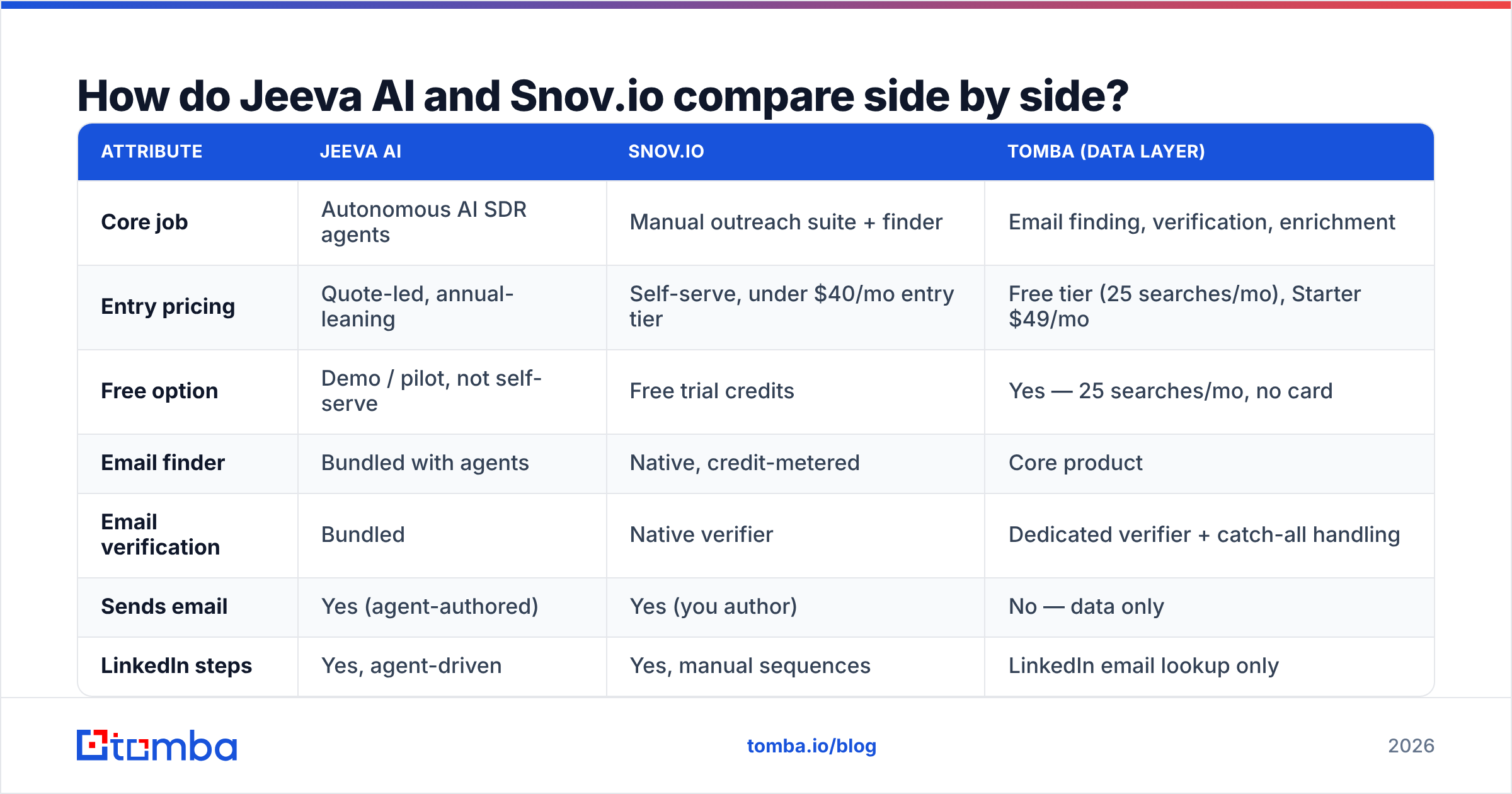
| Attribute | Jeeva AI | Snov.io | Tomba (data layer) |
|---|---|---|---|
| Core job | Autonomous AI SDR agents | Manual outreach suite + finder | Email finding, verification, enrichment |
| Entry pricing | Quote-led, annual-leaning | Self-serve, under $40/mo entry tier | Free tier (25 searches/mo), Starter $49/mo |
| Free option | Demo / pilot, not self-serve | Free trial credits | Yes — 25 searches/mo, no card |
| Email finder | Bundled with agents | Native, credit-metered | Core product |
| Email verification | Bundled | Native verifier | Dedicated verifier + catch-all handling |
| Sends email | Yes (agent-authored) | Yes (you author) | No — data only |
| LinkedIn steps | Yes, agent-driven | Yes, manual sequences | LinkedIn email lookup only |
| CRM | Light, agent-facing | Built-in mini CRM | None — integrates with yours |
| API access | Available on higher tiers | Available | Full API on all paid plans |
| Best for | Teams with no SDR capacity | Agencies, lean B2B teams | Any stack needing clean contacts |
| Learning curve | Low to use, low control | Medium, high control | Low |
The table makes the real decision visible. Jeeva and Snov.io overlap on sending. They barely overlap on philosophy. And neither of them is where you should source your most important asset — the contact list itself.
Which tool has better contact data?#
Honest answer: neither has a decisive edge, and both are mid-pack against dedicated providers.
Here is why bundled data underperforms, in the order it bites you:
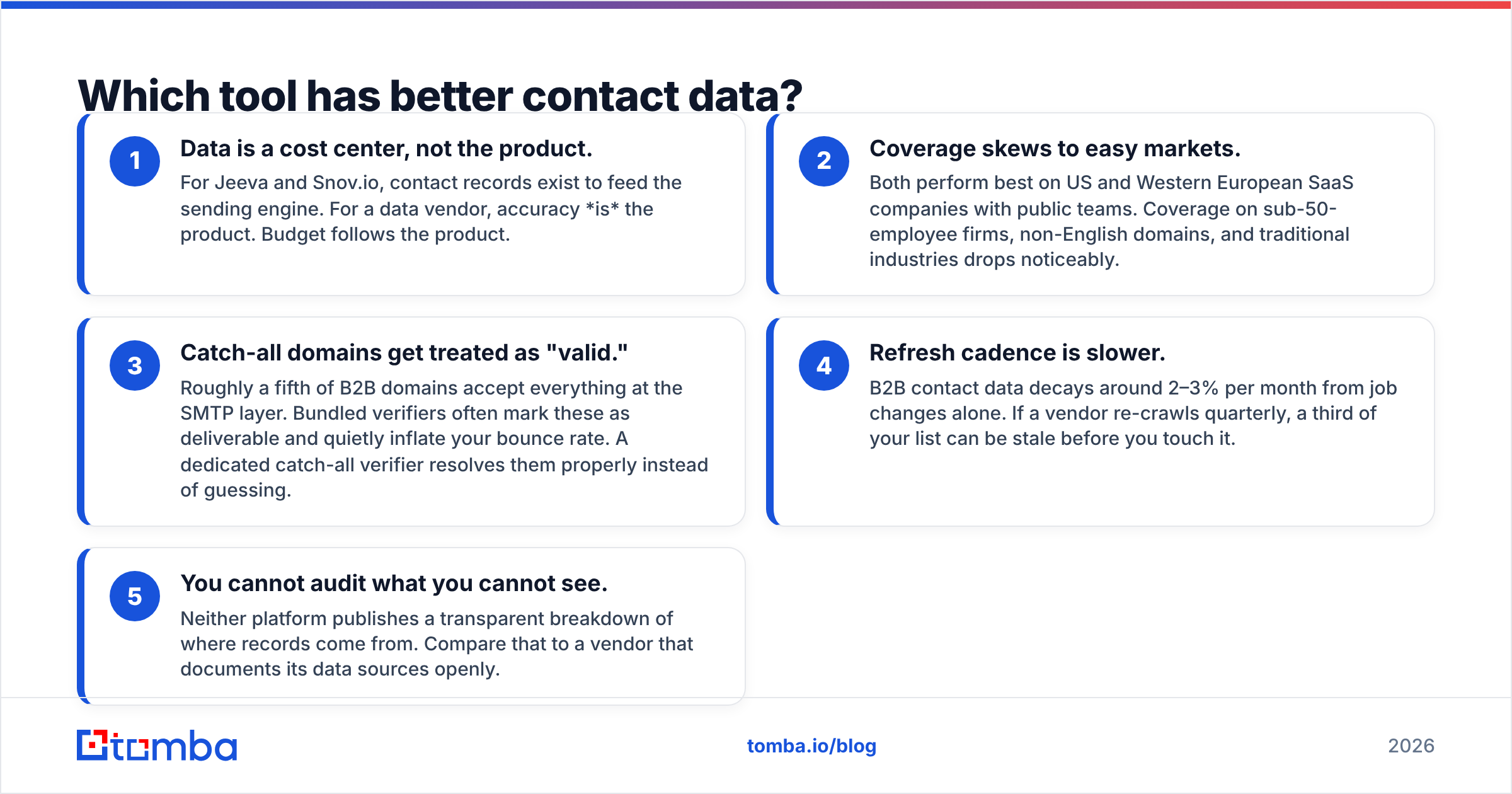
- Data is a cost center, not the product. For Jeeva and Snov.io, contact records just feed the sending engine. For a data vendor, accuracy is the product.
- Coverage skews to easy markets. Both do best on US and Western European SaaS firms with public teams. Coverage drops on small, non-English, and traditional companies.
- Catch-all domains get treated as "valid." About a fifth of B2B domains accept every address at the SMTP layer. Bundled verifiers call these deliverable, so your bounce rate climbs. A dedicated catch-all verifier sorts them out.
- Refresh cadence is slower. B2B data decays 2–3% per month from job changes alone. Quarterly re-crawls leave a third of your list stale.
- You cannot audit what you cannot see. Neither platform says where its records come from. A good vendor documents its data sources openly.
The practical consequence is simple. If your bounce rate creeps above 3%, mailbox providers start to throttle you. The AI SDR that was meant to save you headcount now burns domain reputation at machine speed. Autonomy multiplies whatever quality you feed it — in both directions.
How much do Jeeva AI and Snov.io cost in 2026?#
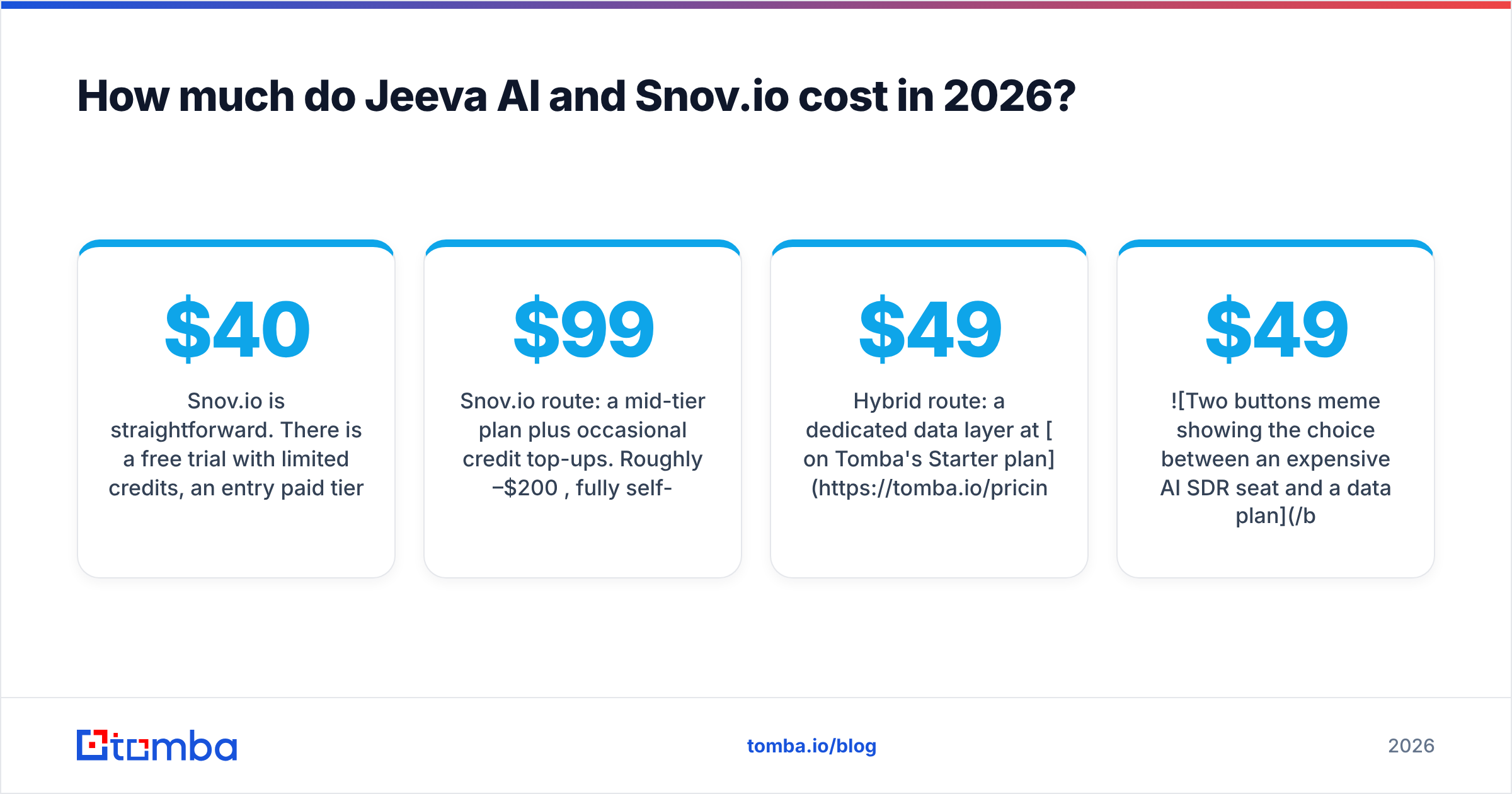
Snov.io is straightforward. There is a free trial with limited credits, an entry paid tier under $40 per month, and mid-tier plans around the $99 mark. Higher tiers unlock more credits, more mailboxes, and team seats. Credits are consumed by searches, verifications, and sends, so heavy list-building months cost more than quiet ones. Annual billing knocks off the usual 20–25%.
Jeeva AI does not publish a full self-serve price list. Deals are scoped by agent count, seat count, and volume. Pilots are common before an annual commitment. Expect a figure that sits next to an SDR salary line, not a SaaS tool line — that is the comparison the product makes. Always confirm current numbers with the vendor. AI SDR pricing has moved fast since 2024.
A worked example. Say you need 5,000 verified contacts a month and enough sending capacity for a 3-touch sequence:
- Snov.io route: a mid-tier plan plus occasional credit top-ups. Roughly $99–$200/month, fully self-managed, plus your own time building sequences.
- Jeeva AI route: an annual contract in the low-to-mid four figures per month, with the agents doing the list building, writing, and follow-up.
- Hybrid route: a dedicated data layer at $49/month on Tomba's Starter plan feeding whichever sender you prefer, so you stop paying premium rates for mediocre records.
The hybrid is not a plug. It is the arrangement most mature outbound teams converge on, because sending and sourcing have different cost curves and different vendor incentives.

Is an AI SDR actually better than a manual outreach suite?#
It depends entirely on what your bottleneck is.
If your bottleneck is capacity — you have a defined ICP, proven messaging, and nobody to execute it — an AI SDR is the right shape of solution. Jeeva AI turns an unworked TAM into activity without a hiring cycle. The output will be roughly as good as a first-month SDR: competent, generic, occasionally off-key.
If your bottleneck is message-market fit — you are still figuring out which angle lands — automation makes things worse. You need to read replies, rewrite, and iterate weekly. Snov.io's manual control is a feature here, not a limitation. Handing a half-formed message to an agent that sends 2,000 copies of it is an expensive way to learn.
If your bottleneck is data — and for most teams it quietly is — neither tool fixes it. A 12% bounce rate does not care whether a human or an agent typed the email. Fix the list first, then decide who sends.
One more consideration that rarely appears in comparison posts: reply handling. Jeeva's agents can triage and respond to inbound replies, which is genuinely useful at volume. Snov.io routes replies to your inbox and stops there. If you are generating 100+ replies a month and losing some in the shuffle, that difference is worth real money.
When should you choose Snov.io over Jeeva AI?#
Choose Snov.io when:
- You want one bill under $150/month covering finding, verifying, sending, and basic pipeline tracking.
- You run client campaigns. Agencies need per-client separation, exportable data, and no long contracts. Snov.io fits that operating model; annual AI SDR contracts generally do not.
- Your brand voice is non-negotiable. Regulated industries, technical audiences, or founder-led sales where every sentence matters.
- You are testing outbound for the first time. Start cheap, learn what works, then decide whether to automate it.
- You need a CRM but don't have one. Snov.io's built-in pipeline is basic but genuinely usable for teams under ten people.
Choose Jeeva AI when:
- You have budget but no bodies. The agents are a headcount substitute, and they are priced as one.
- Your TAM is large and undifferentiated. Thousands of similar accounts where personalization beyond firmographics adds little.
- Inbound volume is drowning you. Automated qualification and reply handling is where AI SDR tools earn their keep fastest.
- You already have clean data. The agents amplify list quality; give them a good list and they perform, give them a scraped one and they torch your domain.
What should you use instead if neither fits?#
Plenty of teams land on a third arrangement: keep sending in a tool you already own (Instantly, Smartlead, HubSpot Sequences, Outreach) and buy data separately.
That split matters because the two markets have opposite economics. Sending platforms compete on deliverability infrastructure and UI. Data platforms compete on crawl breadth, refresh rate, and verification depth. Buying both from one vendor means one of the two is a side project.
If you go that route, the data layer needs four things: a bulk email finder that handles CSV upload at list scale, an email verifier with real catch-all resolution, an email finder API so enrichment happens the moment a lead enters your CRM, and transparent sourcing you can defend in a GDPR conversation.
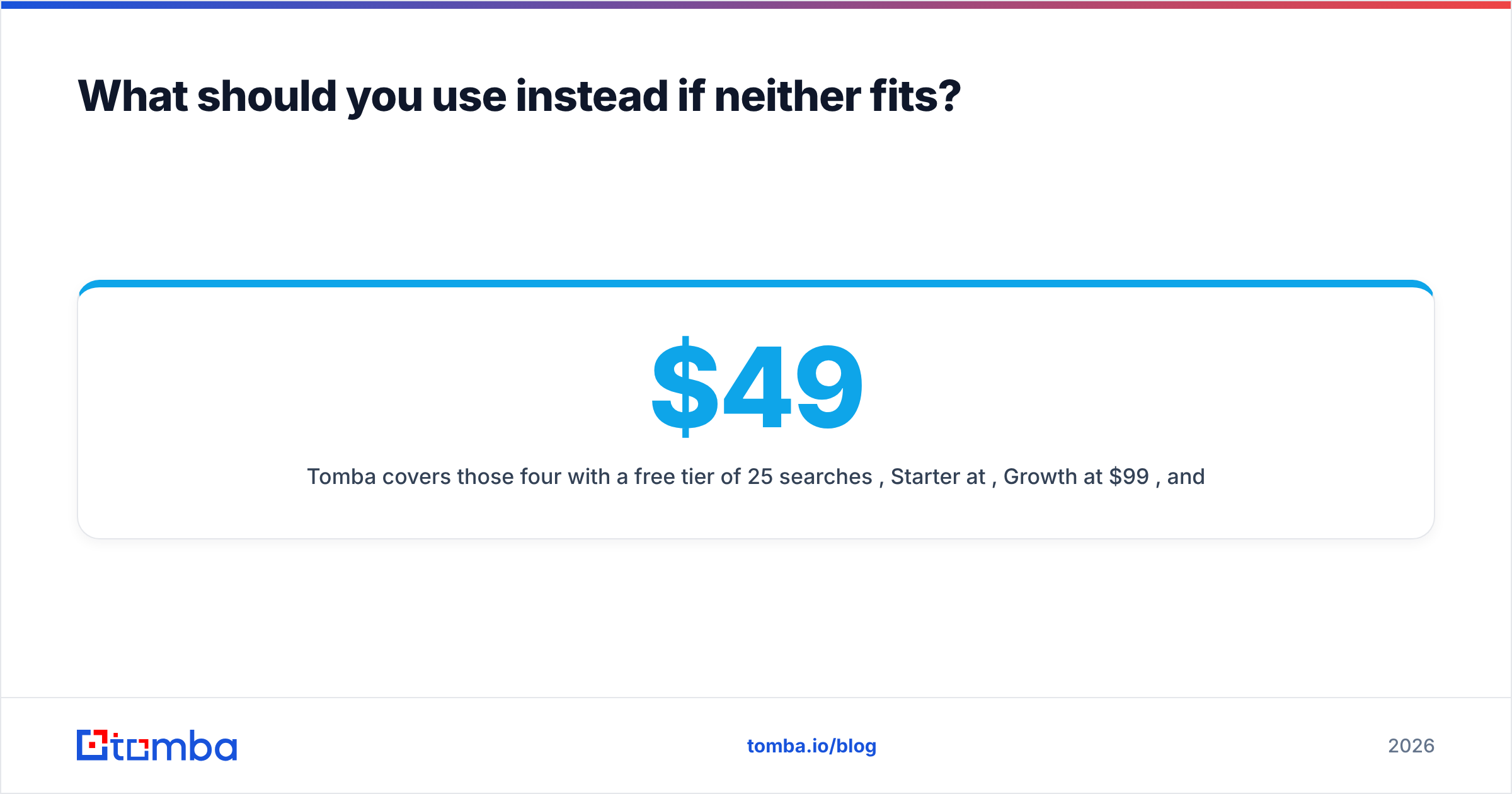
Tomba covers those four with a free tier of 25 searches per month, Starter at $49/month, Growth at $99/month, and Pro at $249/month. You can run it alongside Snov.io's sending, alongside Jeeva's agents, or alongside whatever you migrate to next year — which is the point of decoupling the layers.
What's the verdict on Jeeva AI vs Snovio?#
Snov.io wins on price, control, and flexibility. It is the safer default for teams under twenty people, for agencies, and for anyone still iterating on messaging. You will hit its data ceiling eventually; supplement it when you do.
Jeeva AI wins on leverage. If the alternative is hiring an SDR and you have a large, homogeneous market plus messaging that already converts, agents get you to volume faster than a job posting does. Budget accordingly and treat the pilot seriously.
Both lose on data. That is not a knock on either vendor. It is structural. Sourcing and sending pull in different directions, and the tool that does both well at once does not exist yet.
Before you commit to either platform, fix the input. Run a sample of your current list through a dedicated verifier and see what the real deliverable rate is. If it comes back above 95%, your bundled data is fine and you can pick on features alone. If it comes back at 80%, no amount of AI authorship or sequence tuning will save the campaign.
Start with the list. Tomba's Email Finder gives you 25 free searches per month, no card required. Benchmark your Jeeva AI vs Snovio shortlist against a dedicated data source before you renew anything. Find the addresses, verify them, export them into whichever sender you prefer, and let the AI argue about subject lines once the emails actually arrive.
Related guides#
// get started
Find, verify and enrich your first contacts today
Start on the free plan with 25 searches a month, then scale when your team is ready.
Free plan · No credit card required · GDPR & CCPA
// about the author