Jeeva AI vs Success.ai (2026): Which AI SDR Actually Delivers?
Two AI SDR platforms, two very different bets. We compare Jeeva AI and Success.ai on data accuracy, pricing transparency, automation depth, and who each one actually fits — plus an honest look at where both leave gaps.
Jeeva AI vs Success.ai is a choice between two very different bets. One sells autonomous AI agents. The other sells cheap reach. This guide weighs both on data quality, price, and fit.
TL;DR
- Jeeva AI sells autonomy. Its AI agents research, write, send, and follow up with little human input. It is priced like an enterprise platform, and the pricing is quote-only.
- Success.ai sells volume and price. You get a large bundled B2B contact database, plus near-unlimited email sending and warmup. Tiers are self-serve, so most SMBs can expense them without procurement.
- Jeeva AI vs Success.ai is not a contest of data quality. Neither is built for that job. Both rent or license contact data. Both will send to addresses they never checked.
- If your bounce rate is above 3%, a new AI SDR tool will not fix it. Fix the data layer first.
- Best fit: Jeeva AI for funded teams that want to replace SDR headcount. Success.ai for lean teams that need cheap reach. An unbundled stack for anyone who cares more about deliverability than dashboards.
What are Jeeva AI and Success.ai?#
They solve the same business problem from opposite ends of the market.
Jeeva AI calls itself an "AI SDR". It is a set of digital sales agents. You hand them an ICP. They find matching accounts and contacts, research them, and draft the outreach. Then they run sequences across email and LinkedIn, and hand replies to a human. The pitch is headcount replacement: one seat instead of a junior SDR salary. You set a goal, not a campaign.
Success.ai is a bundled outbound platform. You get a contact database of (marketed) hundreds of millions of B2B profiles. You also get unlimited email accounts, built-in warmup, a sequencer, an AI writer, and a deliverability layer. It is all one subscription. The pitch is unit economics. You buy from one vendor instead of three, and you pay less than one of them would cost.
Jeeva AI vs Success.ai turns on that framing gap more than on any feature checkbox. Jeeva asks you to trust an agent. Success.ai asks you to trust a bundle. Each bet carries its own risk.
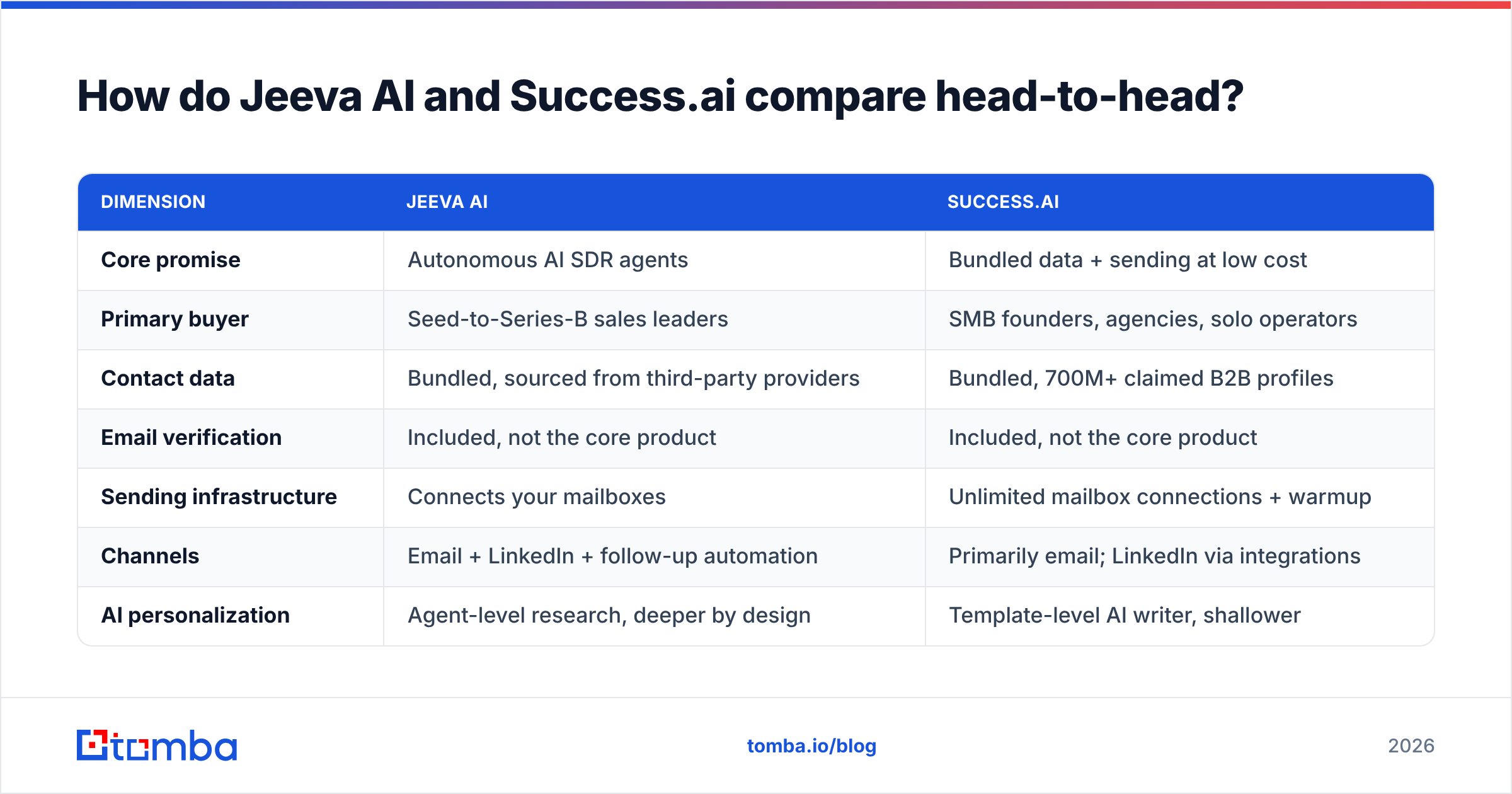
Jeeva AI vs Success.ai: how do they compare head-to-head?#
| Dimension | Jeeva AI | Success.ai |
|---|---|---|
| Core promise | Autonomous AI SDR agents | Bundled data + sending at low cost |
| Primary buyer | Seed-to-Series-B sales leaders | SMB founders, agencies, solo operators |
| Contact data | Bundled, sourced from third-party providers | Bundled, 700M+ claimed B2B profiles |
| Email verification | Included, not the core product | Included, not the core product |
| Sending infrastructure | Connects your mailboxes | Unlimited mailbox connections + warmup |
| Channels | Email + LinkedIn + follow-up automation | Primarily email; LinkedIn via integrations |
| AI personalization | Agent-level research, deeper by design | Template-level AI writer, shallower |
| Pricing model | Quote-only, enterprise-style | Published self-serve tiers, annual discounts |
| Setup effort | Higher — ICP definition, guardrails, QA | Lower — import list, connect inbox, send |
| Best for | Replacing or augmenting SDR headcount | Maximizing volume per dollar |
Read that table as two different jobs, not two grades of the same product. Nobody picks on features alone. They pick based on whether they are buying labor or buying reach.

What does Jeeva AI actually do well?#
Four things stand out when you run it for a full quarter.
- Research depth per contact. Jeeva's agents pull public signals — funding, hiring, tech stack, recent posts — and fold them into the first line. That beats a merge-tag "I saw you work at {{company}}". It shows up in reply quality, not just open rates.
- Multi-touch work without a babysitter. Follow-ups, channel switching, and reply triage run on their own. Nobody has to advance each step by hand. For a two-person GTM team, that is the real value.
- CRM hygiene as a side effect. Agents log activity as they work. So the CRM stays closer to the truth than it does under a human SDR who updates records on Friday.
- Speed to first campaign. Onboarding is guided. You are not writing seven email drafts before anything ships.
The trade-off is control. An agent may write something off-brand, or target an account you would have cut. You find out after the send. Teams that run Jeeva well add a human QA step in week one and never drop it. Teams that skip it end up apologizing to a prospect.
The second trade-off is price opacity. Jeeva does not publish rates, so your cost depends on how well you negotiate and how big your seat count looks. Check current numbers with the vendor. Anything you read in a blog post, this one included, is a snapshot.
Where does Success.ai win?#
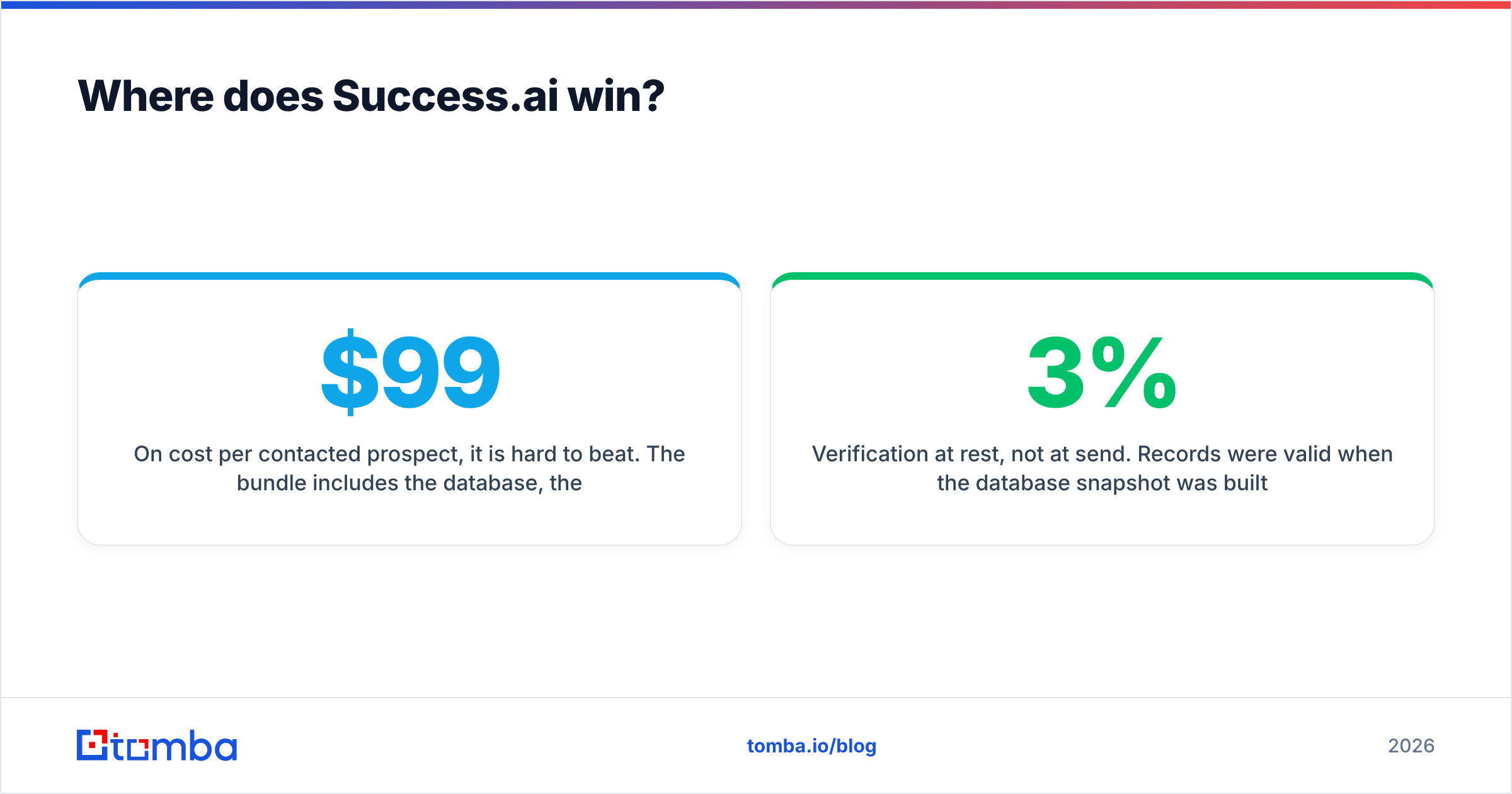
On cost per contacted prospect, it is hard to beat. The bundle covers the database, the sending, and the warmup. You are not stacking a $99 data tool on top of a $97 sequencer on top of a warmup tool. For an agency running outbound for eight clients, that is the whole argument.
It also fixes the most common wound in cold email: sending it all from one mailbox. Unlimited mailbox connections and built-in warmup make inbox rotation the default, not an upgrade. If you know anything about email deliverability, you know that beats any AI writing feature.
Where it gets weaker:
- Personalization ceiling. The AI writer turns out competent, generic copy. It is spin-syntax with better grammar, not research.
- Data freshness on long-tail accounts. Big bundled databases are strong on well-covered mid-market US firms. They are much thinner on European SMBs, non-English markets, and roles that changed hands last month.
- Verified at rest, not at send. Records were valid when the snapshot was built. B2B contact data decays by roughly 2–3% a month through job changes alone. On a list you bought six months ago, that adds up fast.
That last point is the one that quietly kills campaigns, and it applies to Jeeva too.
Is the data underneath either platform good enough?#
This is the question that decides your results. Both vendors would rather you asked about AI features instead.
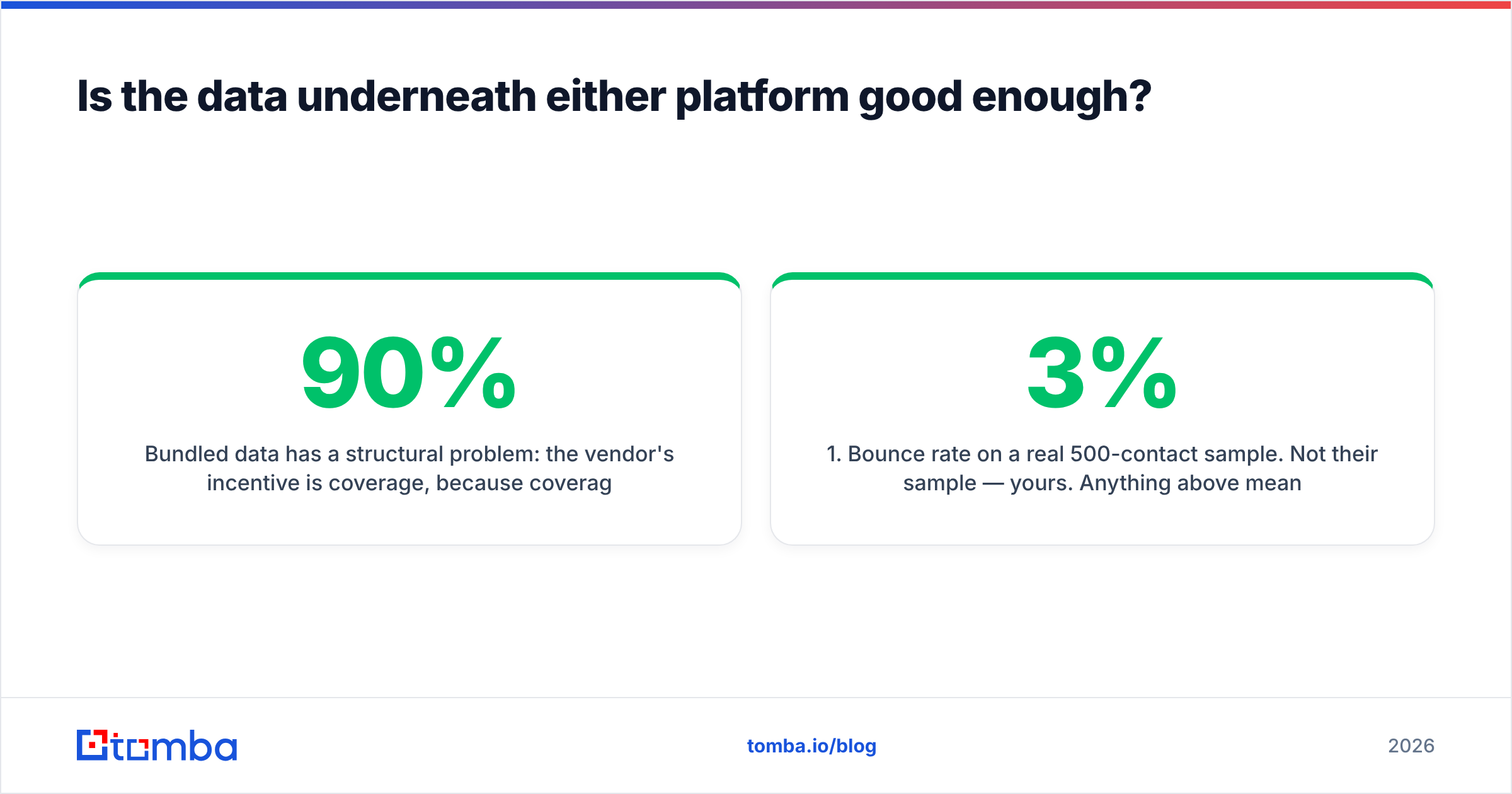
Bundled data has a built-in problem. The vendor is paid for coverage, because coverage is what sells. A database that returns a likely address for 90% of your list demos better than one that confirms 65% and tells you the truth about the rest. But "likely" costs you your sender reputation.
Here is what to check before you commit to either platform.
- Bounce rate on a real 500-contact sample. Not their sample — yours. Above 3% means you are burning domain reputation to hit volume targets.
- Catch-all handling. Ask flat out: does the tool mark catch-all domains as "valid"? Many bundled verifiers do. That inflates the pass rate and hides the risk. A dedicated catch-all verifier treats these as their own category instead of rounding them up to green.
- Recency of the record. Ask when each contact was last confirmed, not when it was first collected. If the platform cannot answer per record, assume the answer is "a while ago".
The last three checks are the ones buyers skip. They also settle Jeeva AI vs Success.ai more often than any AI feature does.
- Coverage in your real ICP geography. Test 100 contacts in your weakest market, not your strongest.
- Re-verification policy. Does the platform re-check an address at send time, or only at import? The gap between those two moments is where bounces live.
- Export rights. If you cannot export contacts and verify them elsewhere, you cannot audit the vendor's quality claims. That is exactly why some bundles restrict it.
Run those six checks and the comparison stops being about AI features. Independent user reviews on G2 help too, but filter for reviewers in your company size band. Enterprise praise for a bundled database tells you very little about a 40-person SaaS ICP in Germany.
How much do Jeeva AI and Success.ai really cost?#
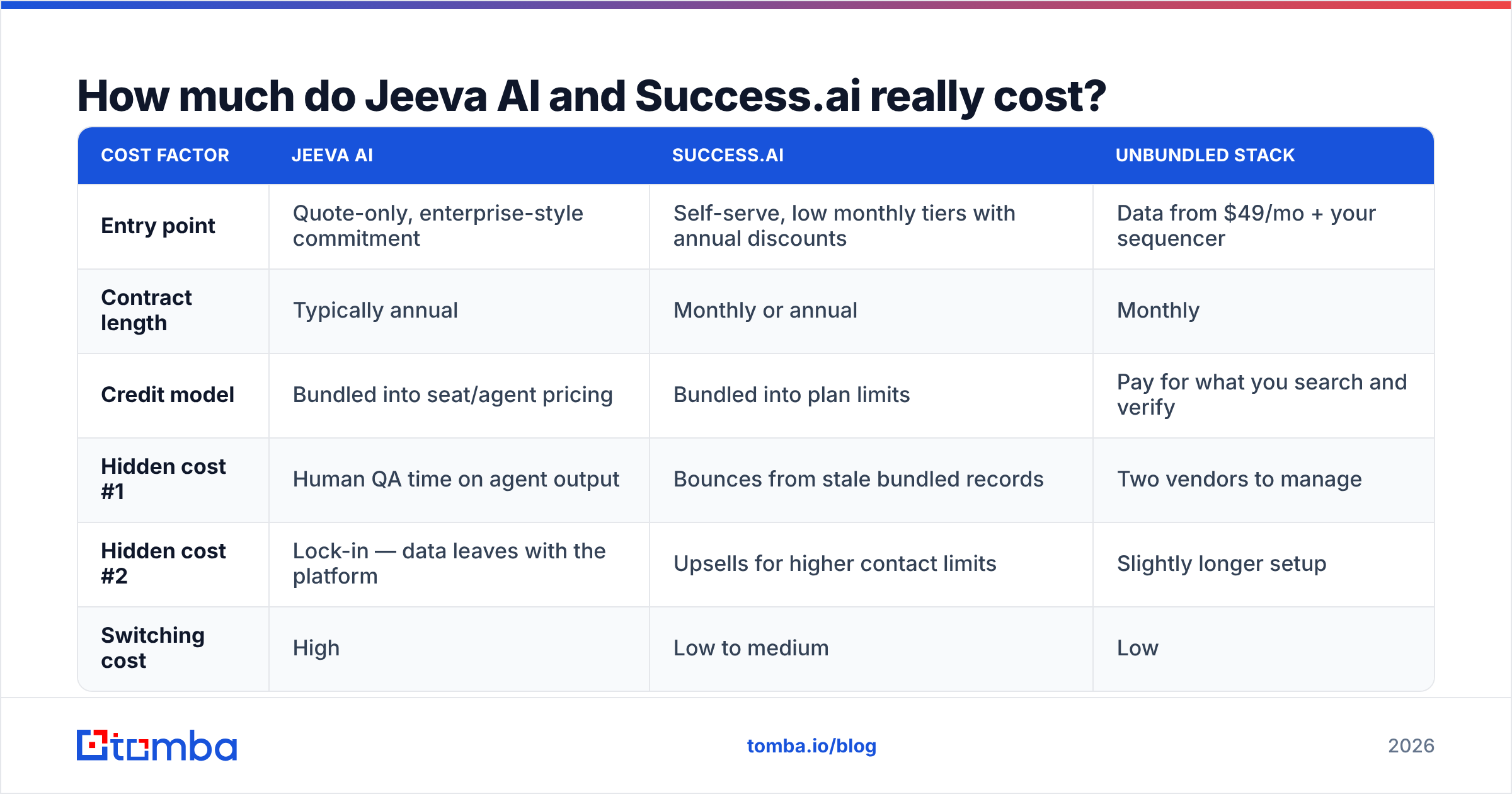
Published pricing moves constantly here. Treat the shape of the cost as the takeaway, not the exact number.
| Cost factor | Jeeva AI | Success.ai | Unbundled stack |
|---|---|---|---|
| Entry point | Quote-only, enterprise-style commitment | Self-serve, low monthly tiers with annual discounts | Data from $49/mo + your sequencer |
| Contract length | Typically annual | Monthly or annual | Monthly |
| Credit model | Bundled into seat/agent pricing | Bundled into plan limits | Pay for what you search and verify |
| Hidden cost #1 | Human QA time on agent output | Bounces from stale bundled records | Two vendors to manage |
| Hidden cost #2 | Lock-in — data leaves with the platform | Upsells for higher contact limits | Slightly longer setup |
| Switching cost | High | Low to medium | Low |
The honest framing on Jeeva AI vs Success.ai pricing: Jeeva is expensive, but it replaces labor. Success.ai is cheap, but you pay the gap in deliverability risk unless you run your own verification pass. The unbundled option is a dedicated data provider feeding a sequencer you already own. It is usually the cheapest per delivered, accurate contact. That is the only unit that tracks pipeline.
For reference, Tomba pricing starts with a free tier at 25 searches a month. Paid plans run $49/mo for Starter, $99/mo for Growth, and $249/mo for Pro. You spend credits on finding and verifying, not on a bundled seat you may not use.

Which one should you choose?#
Match the Jeeva AI vs Success.ai call to your tightest constraint, not to the demo you enjoyed most.
- Choose Jeeva AI if you have budget but not headcount. Your ACV has to be high enough that a 5% lift in reply rate pays for the platform. You also need a human to review agent output each week.
- Choose Success.ai if you are cost-constrained and running high-volume outbound. The winning move there is more qualified touches. You also need to know how to manage inbox rotation and warmup.
- Choose neither if one in five of your sends bounces. No AI SDR fixes a broken data layer. It just automates the bouncing.
- Choose a hybrid if you want the best outcome and can manage two vendors. Pull verified contacts from a dedicated provider, then push them into whichever sending platform you prefer.
That hybrid is more common than vendor marketing admits. Teams buy the sequencer they like, then feed it clean data from a specialist. In both cases, the bundle's data was the weakest part.
What does the unbundled alternative look like in practice?#
Three moving parts, each doing one job well.
Find. Use a dedicated email finder or domain search to build the list from the companies you actually want. Filtering a static database and hoping the record is current is not the same thing. Pulling by domain gives you the org chart as it stands today.
Verify. Run every address through a real email verifier right before the send, not at import time. This one step is what separates a 1% bounce rate from a 6% one. It is also the step bundled platforms are least motivated to enforce.
Enrich and send. Layer firmographic and role data via data enrichment, then push into your sequencer. Running this at any scale? Wire it through the Tomba API. Then each contact is verified the moment it enters a sequence, instead of in a manual monthly chore.
The cost of this setup is one extra integration. The upside is that you own your data and can audit its quality yourself. Switching sending platforms later will not mean rebuilding your contact base.
FAQ#
Is Jeeva AI better than Success.ai? For personalization depth and hands-off multi-channel follow-up, yes. For cost per contact and sending infrastructure, Success.ai wins. Jeeva AI vs Success.ai is not a contest on one axis.
Can I use both? You can, but you will pay twice for databases that overlap. If you are tempted, that is usually a sign to unbundle the data layer instead.
Do either of them guarantee inbox placement? No vendor can. Placement depends on your domain age, your auth records, your content, and list quality. Check your SPF record and warm your domains either way.
Which has better data accuracy? Neither publishes audited accuracy figures. Test both on a sample from your own ICP and measure bounce rate. It is the only number that cannot be marketed at you.
Start with data you can trust#
Jeeva AI vs Success.ai is the wrong first question if your list is stale. Whichever AI SDR platform you pick, its output is capped by the contacts going in. Run your list through the Tomba Email Finder before your next campaign. Find verified professional addresses by domain, name, or company, confirm them at send time, and let your sequencer do the job it is good at. The free tier gives you 25 searches a month to benchmark your current platform. If the gap surprises you, you have found your real bottleneck.
Related guides#
// get started
Find, verify and enrich your first contacts today
Start on the free plan with 25 searches a month, then scale when your team is ready.
Free plan · No credit card required · GDPR & CCPA
// about the author