Jet Leads Pro Reviews (2026): Is It Worth Your Budget?
Jet Leads Pro sells cheap B2B lead lists, but the public reviews are thin and the data claims are hard to verify. Here is a neutral 2026 breakdown of what to test before you pay for a single record.
TL;DR
- Jet Leads Pro is marketed as a low-cost B2B lead list and contact-data source. Its public footprint — verified reviews, documented accuracy methodology, transparent pricing — is thin compared with established vendors, so treat every claim as unproven until you test it yourself.
- The single biggest risk with any budget lead-list vendor is not price. It is bounce rate. A $50 list that burns your sending domain costs far more than a $249/mo subscription that does not.
- Before you buy, demand three things: a live sample of 50 records in your exact ICP, a written bounce guarantee with a refund mechanism, and a named data-sourcing and GDPR position.
- If you need contacts you can send to today, a verification-first tool like Tomba Email Finder or a transparent pay-as-you-go database like BookYourData is a lower-variance choice than an unbenchmarked list vendor.
- Verdict: possibly fine for cheap volume plays in low-stakes markets; not a safe default for a team whose domain reputation matters.
What is Jet Leads Pro?#
Jet Leads Pro positions itself the way most budget lead vendors do: bulk B2B contact records — names, job titles, company data, email addresses, sometimes phone numbers — sold cheaper than the well-known platforms, usually as downloadable lists or credit packs rather than a full prospecting workspace.
That category is real and legitimate. Plenty of teams buy lists. The problem is that the category is also where the least accountable vendors live, because a CSV is easy to sell and hard to audit. You do not find out that 28% of the records are dead until your outbound campaign has already told Google and Microsoft that you are a low-quality sender.
So this review is not "Jet Leads Pro good" or "Jet Leads Pro bad." It is a framework for pricing the risk — and an honest note on what is and is not verifiable about this vendor in 2026.

Why are Jet Leads Pro reviews so hard to verify?#
When a tool has thousands of customers, you can triangulate. You read G2 and Capterra, you find three Reddit threads, you see a Chrome Web Store rating, you see the vendor's own changelog. When those signals are missing or sparse, you are effectively buying blind.
Here is what a credible review trail looks like, and what to check for this vendor specifically:
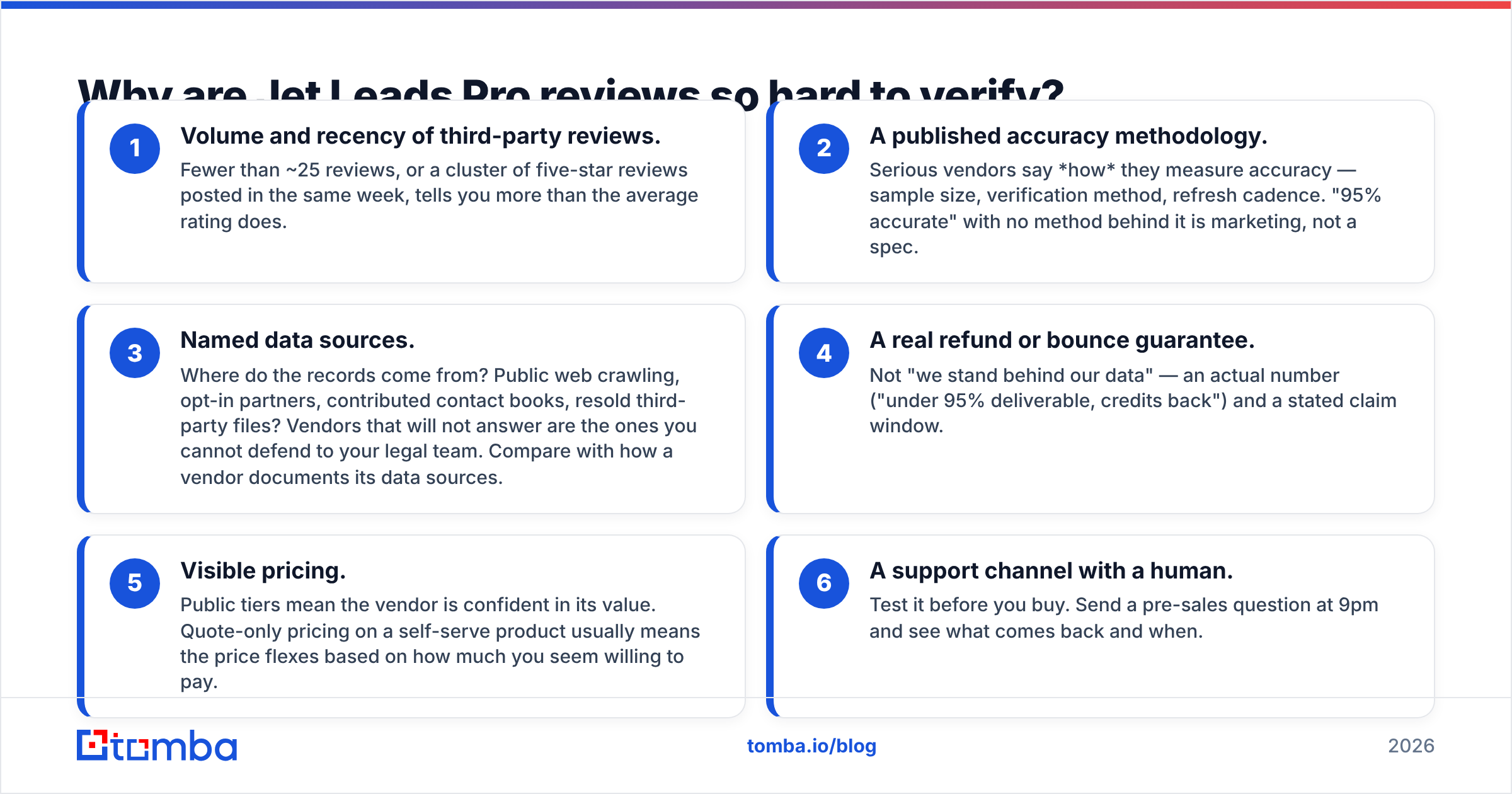
- Volume and recency of third-party reviews. Fewer than ~25 reviews, or a cluster of five-star reviews posted in the same week, tells you more than the average rating does.
- A published accuracy methodology. Serious vendors say how they measure accuracy — sample size, verification method, refresh cadence. "95% accurate" with no method behind it is marketing, not a spec.
- Named data sources. Where do the records come from? Public web crawling, opt-in partners, contributed contact books, resold third-party files? Vendors that will not answer are the ones you cannot defend to your legal team. Compare with how a vendor documents its data sources.
- A real refund or bounce guarantee. Not "we stand behind our data" — an actual number ("under 95% deliverable, credits back") and a stated claim window.
- Visible pricing. Public tiers mean the vendor is confident in its value. Quote-only pricing on a self-serve product usually means the price flexes based on how much you seem willing to pay.
- A support channel with a human. Test it before you buy. Send a pre-sales question at 9pm and see what comes back and when.
If Jet Leads Pro clears all six, the price is genuinely attractive. If it clears two, you are buying a lottery ticket with your sender reputation as the stake.
How accurate is the data, really?#
Accuracy is the entire product. Everything else — UI, filters, integrations — is packaging.

Two numbers matter and they are not the same:
Coverage is the percentage of your target list where the vendor returns any contact. Accuracy is the percentage of those returned contacts that actually deliver and belong to the right person. A vendor can juice coverage to 90% by guessing patterns like first.last@domain.com and never checking whether the mailbox exists. That looks great in a demo and detonates in your inbox.
Run this test on any vendor, including this one, before you spend real money:
- Pull 100 companies you know well — ideally where you already have 10–20 confirmed contacts.
- Ask for those records from the vendor. Measure coverage against the full 100 and accuracy against the contacts you can independently confirm.
- Push everything through an independent email verifier — not the vendor's own checker. A vendor grading its own homework is not evidence.
- Count catch-all domains separately. Catch-alls accept everything at SMTP level, so a naive verifier marks them "valid" when they may be dead. Handle them with a dedicated catch-all verifier or exclude them from your first sends.
- Track your real bounce rate on the first 500 sends. Anything above 3% means stop, clean, and renegotiate.
A budget vendor that survives that test is a bargain. One that will not let you run it is telling you the answer.
How does Jet Leads Pro compare to established alternatives?#
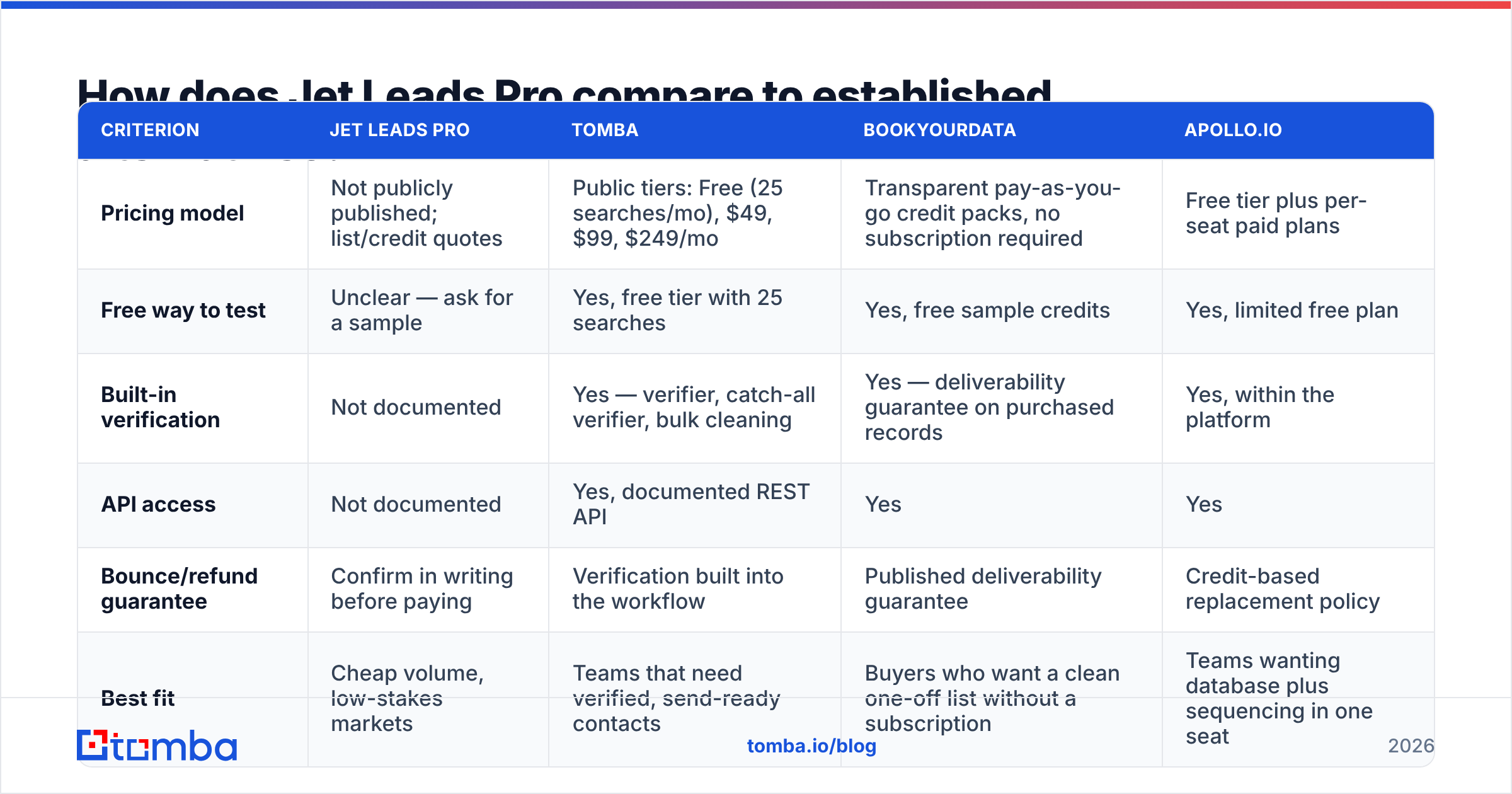
Here is the honest comparison table. Where a value is not publicly documented, it says so rather than inventing a number — and "not published" is itself a data point when you are choosing where to put your budget.

| Criterion | Jet Leads Pro | Tomba | BookYourData | Apollo.io |
|---|---|---|---|---|
| Pricing model | Not publicly published; list/credit quotes | Public tiers: Free (25 searches/mo), $49, $99, $249/mo | Transparent pay-as-you-go credit packs, no subscription required | Free tier plus per-seat paid plans |
| Free way to test | Unclear — ask for a sample | Yes, free tier with 25 searches | Yes, free sample credits | Yes, limited free plan |
| Built-in verification | Not documented | Yes — verifier, catch-all verifier, bulk cleaning | Yes — deliverability guarantee on purchased records | Yes, within the platform |
| API access | Not documented | Yes, documented REST API | Yes | Yes |
| Bounce/refund guarantee | Confirm in writing before paying | Verification built into the workflow | Published deliverability guarantee | Credit-based replacement policy |
| Best fit | Cheap volume, low-stakes markets | Teams that need verified, send-ready contacts | Buyers who want a clean one-off list without a subscription | Teams wanting database plus sequencing in one seat |
Two things to read out of that table.
First, BookYourData and Tomba solve different shapes of the same problem. BookYourData is genuinely good when you want a defined list, bought once, with a deliverability guarantee attached and no recurring commitment — its pay-as-you-go model is one of the more buyer-friendly structures in this market. Tomba is better when finding and verifying contacts is a continuous motion inside your workflow rather than a purchase event.
Second, the column with the most "not documented" entries is the one carrying the most risk. That is not an accusation — it is arithmetic.

What does a bad lead list actually cost you?#
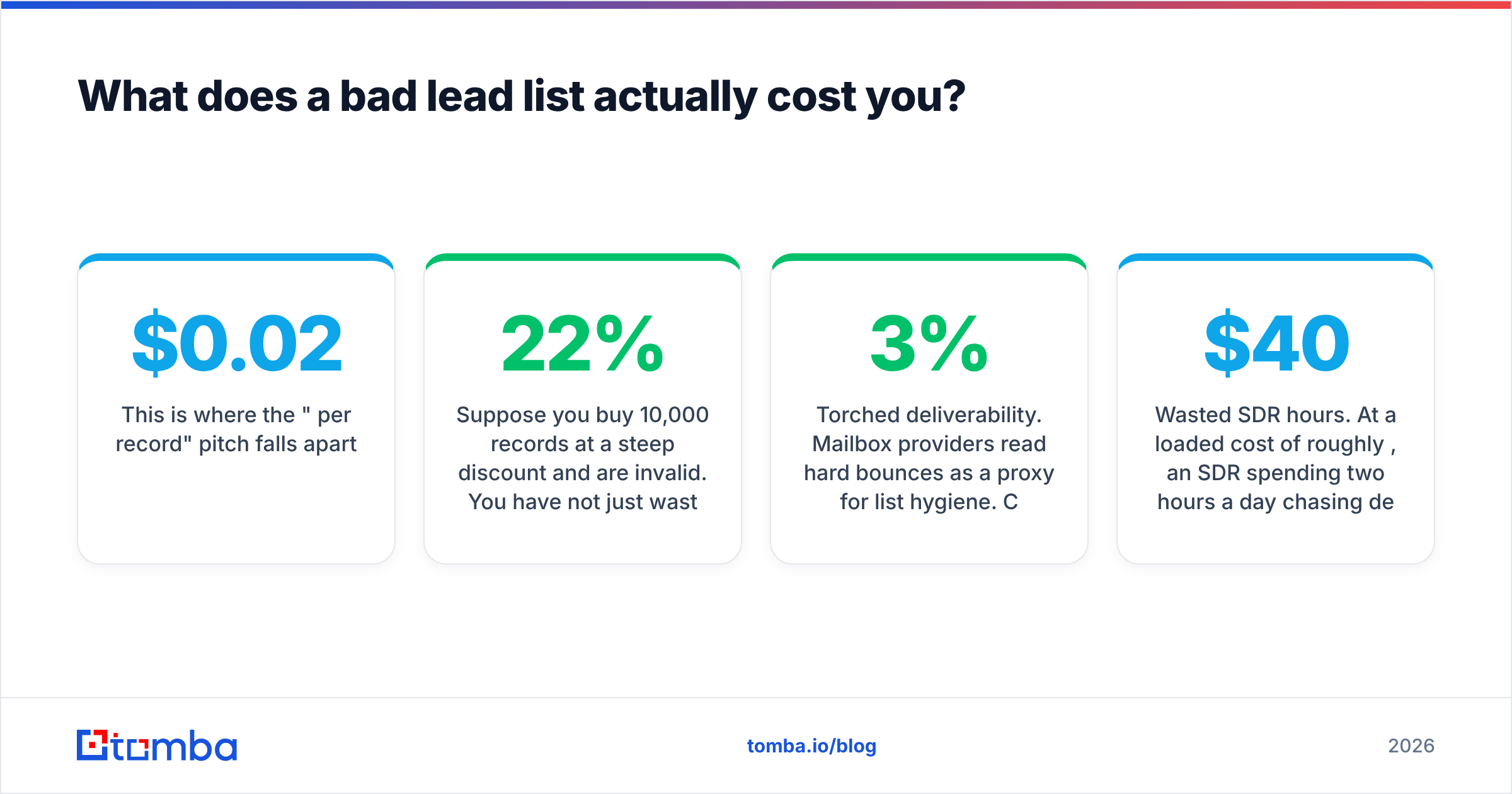
This is where the "$0.02 per record" pitch falls apart.
Suppose you buy 10,000 records at a steep discount and 22% are invalid. You have not just wasted a fifth of the list. You have:
- Torched deliverability. Mailbox providers read hard bounces as a proxy for list hygiene. Cross roughly 2–3% and your inbox placement drops for every campaign, including the good ones, for weeks.
- Burned a sending domain. Recovering a damaged domain means warming a replacement, which is a 3–6 week project before you send a single real pitch.
- Polluted your CRM. Bad records propagate into reporting, scoring, and attribution. Six months later nobody trusts the pipeline numbers.
- Wasted SDR hours. At a loaded cost of roughly $40/hour, an SDR spending two hours a day chasing dead records costs you more per month than any of these tools.
Against that, the difference between a $50 list and a $99/mo verified workflow stops looking like a saving. Check the Tomba plans against your monthly SDR cost and the comparison resolves itself quickly.
There is also a compliance dimension. If you are selling into the EU or UK, purchased contact data pulls you into GDPR territory — lawful basis, legitimate interest assessments, and the ability to say where a record came from. A vendor that cannot document sourcing cannot help you answer a data subject access request, and the liability lands on you, not them.
What do buyers typically complain about with budget list vendors?#
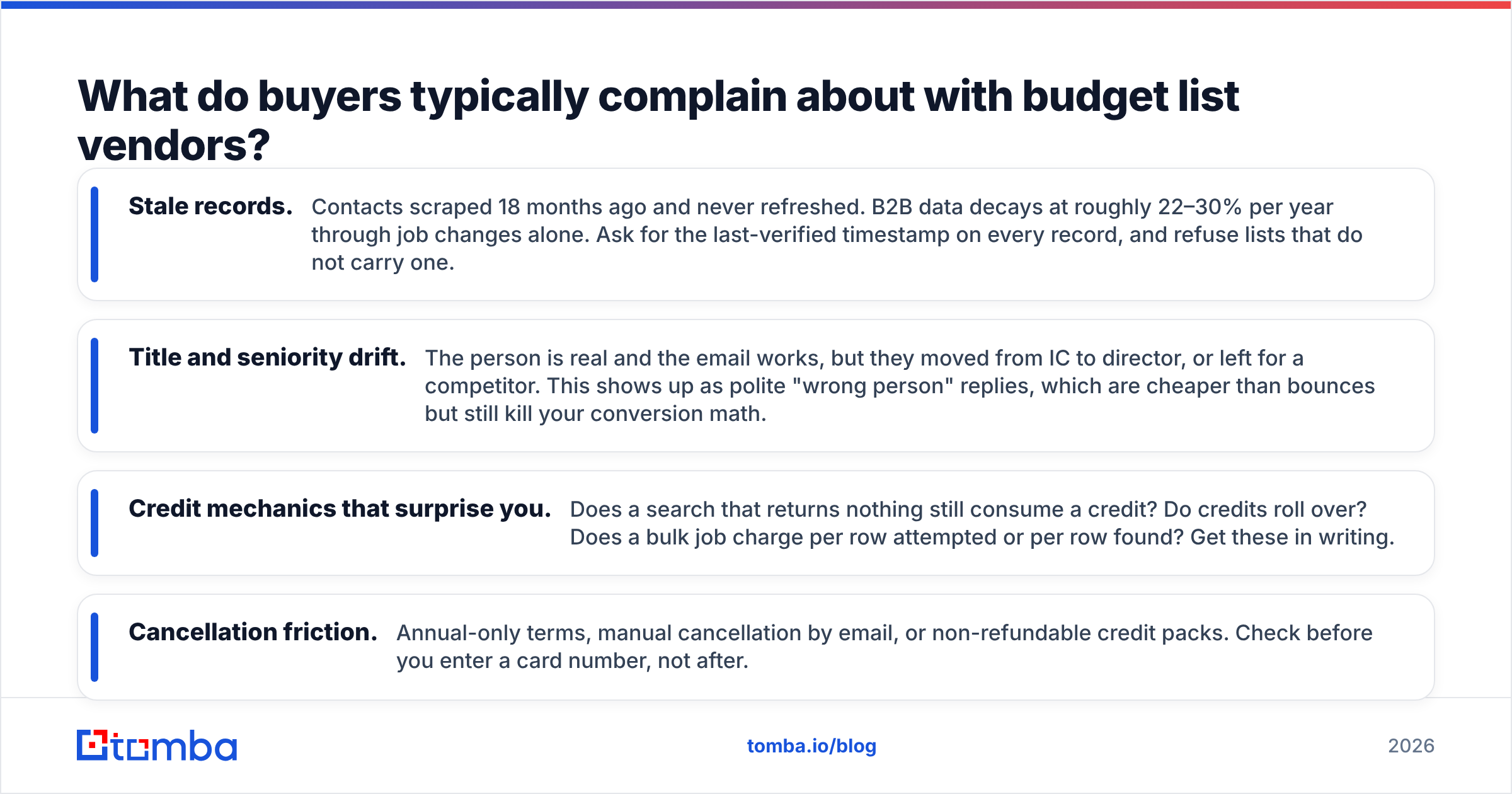
Across this category — not specific to any one vendor — the recurring complaints cluster into four patterns. Use them as your pre-purchase question list:
- Stale records. Contacts scraped 18 months ago and never refreshed. B2B data decays at roughly 22–30% per year through job changes alone. Ask for the last-verified timestamp on every record, and refuse lists that do not carry one.
- Title and seniority drift. The person is real and the email works, but they moved from IC to director, or left for a competitor. This shows up as polite "wrong person" replies, which are cheaper than bounces but still kill your conversion math.
- Credit mechanics that surprise you. Does a search that returns nothing still consume a credit? Do credits roll over? Does a bulk job charge per row attempted or per row found? Get these in writing.
- Cancellation friction. Annual-only terms, manual cancellation by email, or non-refundable credit packs. Check before you enter a card number, not after.
None of this means a low-cost vendor is automatically bad. It means the burden of proof sits with the cheap option, and the way you discharge that burden is a paid pilot at the smallest possible size.
Who is Jet Leads Pro actually for?#
Be honest about your own situation, because the right answer changes.
It may work for you if: you are running high-volume, low-ACV outbound in a market where domain reputation is disposable; you have your own verification layer in front of every send; you are buying a small list to test a hypothesis, not to fuel a quarter; and you can absorb a 25% waste rate without it mattering.
Look elsewhere if: you are selling enterprise deals where a wrong-contact email reaches a buying committee; you send from your primary corporate domain; you need API access to enrich records inside a CRM workflow; you operate in the EU and need documented sourcing; or you cannot afford a three-week deliverability recovery.
For the second group, the practical setup is a verification-first stack: find contacts with a tool that verifies as it finds, run everything through bulk verification before it touches your sequencer, and re-verify anything older than 90 days.
What should you do before you pay?#
Run this in order. It takes about an hour and it has saved more outbound programs than any subject-line framework ever will.
- Request a 50-record sample in your exact ICP — right industry, right headcount band, right geography. Generic samples are curated showcases.
- Verify the sample with an independent tool. Record coverage, valid rate, catch-all rate, and role-account rate (
info@,sales@) separately. - Ask, in writing: where does this data come from, when was it last verified, and what is the refund policy if bounces exceed 5%?
- Send a pre-sales support question and time the response.
- Start with the smallest possible paid commitment. No annual contracts on an unbenchmarked vendor. Ever.
- Measure the first 500 sends against your baseline bounce and reply rates before scaling anything.
If a vendor makes any of those six steps difficult, that is your review.
Ready to stop gambling on list quality? Tomba Email Finder finds professional email addresses by domain, name, or company — and verifies them in the same workflow, so what lands in your sequencer is already send-ready. Start on the free tier with 25 searches a month, benchmark it against whatever list you are considering, and only upgrade when the numbers earn it. That is the same test we just told you to run on everyone else.
Related guides#
// get started
Find, verify and enrich your first contacts today
Start on the free plan with 25 searches a month, then scale when your team is ready.
Free plan · No credit card required · GDPR & CCPA
// about the author