Jet Leads Pro vs Kaspr: Which B2B Contact Data Tool Wins?
Kaspr has Cognism behind it and a phone-first database. Jet Leads Pro is cheaper and quieter. We break down accuracy, credits, GDPR exposure and what each one actually costs per usable contact.
TL;DR
- Kaspr is the safer buy. It is owned by Cognism, publishes its data practices, and its phone coverage in Western Europe is genuinely good. You pay for that maturity in per-seat pricing.
- Jet Leads Pro is the cheaper, thinner option. It competes on price and volume, not on verification depth or documentation. Treat its exports as raw material, not finished leads.
- Neither tool verifies aggressively enough on its own. Both push unverified or partially verified rows into your sequencer. Budget for a separate verification step or your bounce rate will tell the story for you.
- Per-seat vs per-credit is the real decision. Kaspr charges by seat, which punishes teams where only two reps prospect heavily. Credit-pooled tools are cheaper at the same volume.
- If you mostly need email, not phone, both are overkill. A dedicated finder at $49/mo covers the same job for a fraction of the spend.
What are Jet Leads Pro and Kaspr?#
Start with the honest framing: these two tools are not peers in maturity, and you should price that into your decision.
Kaspr is a LinkedIn-first contact data tool. You install the Chrome extension, open a LinkedIn profile or a Sales Navigator list, and it surfaces phone numbers and email addresses for those people. Kaspr was acquired by Cognism in 2022, which matters more than most acquisitions do: it inherited Cognism's compliance posture, its European data sourcing, and its enterprise-grade legal review. The official Kaspr site documents its plans and data handling publicly, and it carries a substantial review volume on G2.
Jet Leads Pro sits in the crowded tier below that. It is a smaller, lower-profile lead-data vendor competing primarily on price and export volume. Public documentation is thin compared to Kaspr, independent review coverage is limited, and published pricing has moved around. That is not automatically disqualifying — plenty of good tools start small — but it changes how you should evaluate it. With a vendor this size, you verify claims yourself instead of trusting the marketing page.
Here is the core distinction that drives everything else in this comparison:
| Dimension | Jet Leads Pro | Kaspr |
|---|---|---|
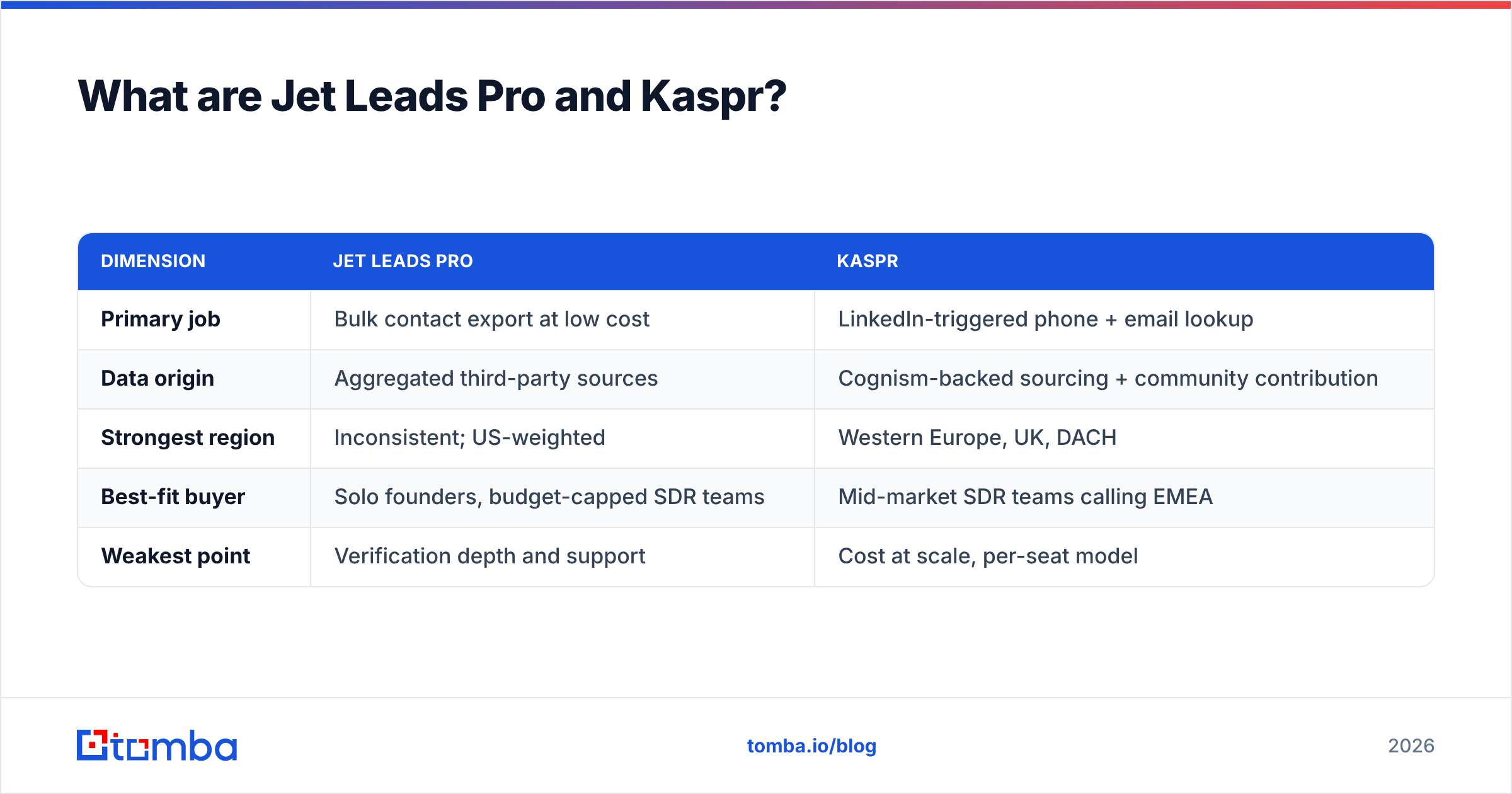
| Primary job | Bulk contact export at low cost | LinkedIn-triggered phone + email lookup |
| Data origin | Aggregated third-party sources | Cognism-backed sourcing + community contribution |
| Strongest region | Inconsistent; US-weighted | Western Europe, UK, DACH |
| Best-fit buyer | Solo founders, budget-capped SDR teams | Mid-market SDR teams calling EMEA |
| Weakest point | Verification depth and support | Cost at scale, per-seat model |
That table is the whole argument in miniature. Kaspr is a phone-calling tool that also does email. Jet Leads Pro is a volume tool that hopes you do not check the bounce report too closely.

How do Jet Leads Pro and Kaspr compare head-to-head?#
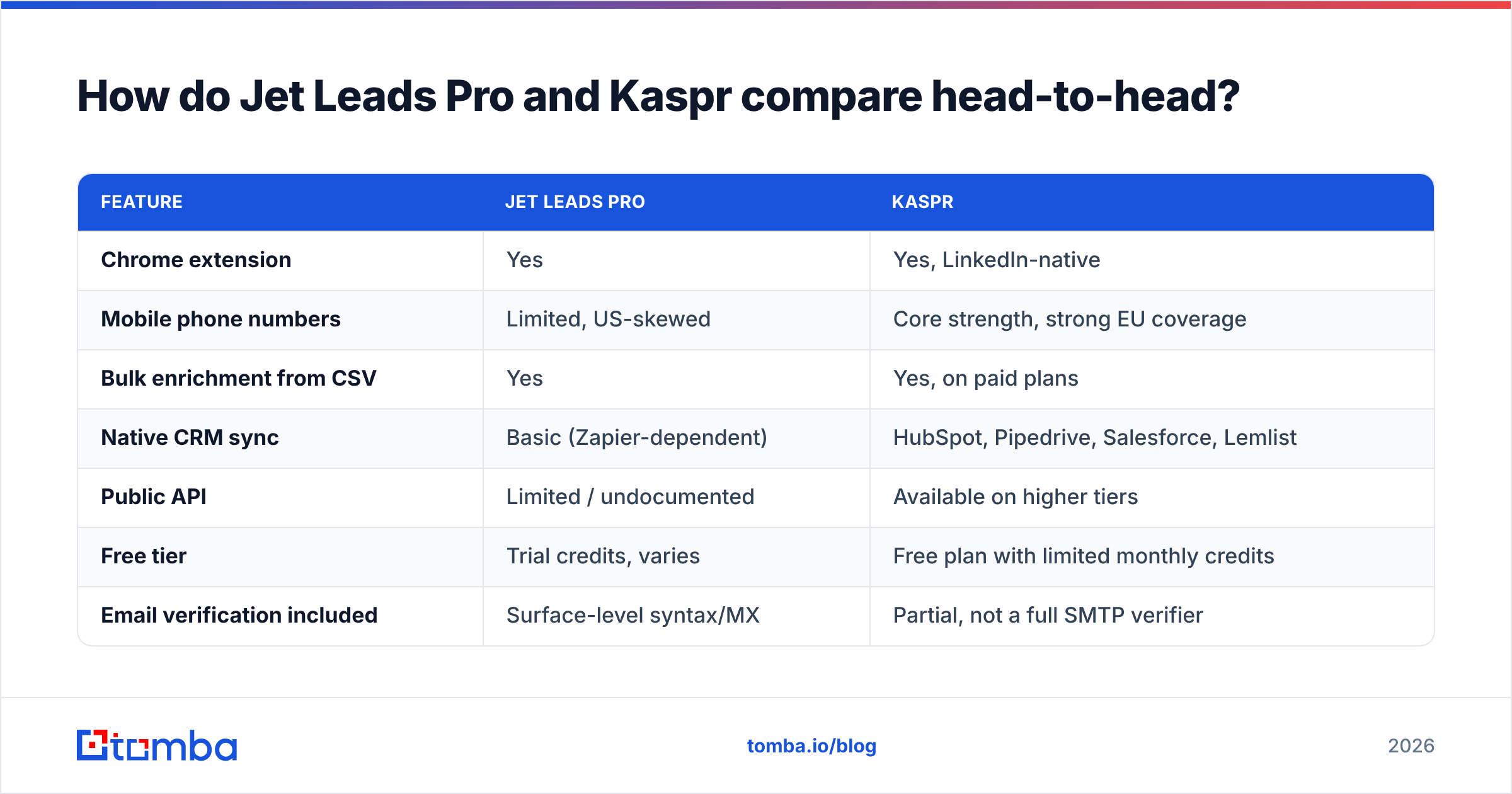
Feature parity is closer than the price gap suggests. The difference shows up in what happens after export.

| Feature | Jet Leads Pro | Kaspr |
|---|---|---|
| Chrome extension | Yes | Yes, LinkedIn-native |
| Mobile phone numbers | Limited, US-skewed | Core strength, strong EU coverage |
| Bulk enrichment from CSV | Yes | Yes, on paid plans |
| Native CRM sync | Basic (Zapier-dependent) | HubSpot, Pipedrive, Salesforce, Lemlist |
| Public API | Limited / undocumented | Available on higher tiers |
| Free tier | Trial credits, varies | Free plan with limited monthly credits |
| Email verification included | Surface-level syntax/MX | Partial, not a full SMTP verifier |
| Independent review volume | Low | High (G2, Capterra) |
| GDPR documentation | Sparse | Published, Cognism-aligned |
Two rows deserve extra attention.
Native CRM sync. Kaspr writing directly into HubSpot or Salesforce removes a whole category of CSV-shuffling work. If your reps live in the CRM, that alone can justify the price difference. Jet Leads Pro leaning on Zapier means someone owns and maintains that automation, and someone debugs it when a field mapping silently breaks.
Independent review volume. This is not a vanity metric. When a tool has thousands of public reviews, you can search for your exact use case — "Kaspr DACH mobile numbers," "Kaspr credit rollover" — and find people who already tested it. With a low-profile vendor, you are the test.
Which one finds more accurate emails?#
Kaspr wins on documented accuracy, but neither tool is a verification product, and that gap is where money leaks.

The mechanics matter here. Most contact-data tools return an email in one of three states:
- SMTP-confirmed valid — the receiving server acknowledged the mailbox. Safe to send.
- Pattern-guessed — the tool inferred
first.last@domain.comfrom a known company format. Might be right. Might bounce. - Catch-all domain — the server accepts everything, so nothing can be confirmed at the SMTP layer. Requires a specialised check.
Vendors routinely report categories 1, 2, and 3 together as "found." Your sequencer does not care about that distinction, so a 92% "found rate" can still produce an 11% bounce rate. That is the number that gets your domain flagged.
In practice, Kaspr's emails hold up better than Jet Leads Pro's on mid-market European companies, because the underlying Cognism data pipeline is doing more work upstream. On US SMB domains, the gap narrows — both tools fall back to pattern inference more often than either would like to admit.
The fix is the same regardless of which you buy: run every list through a dedicated email verifier before it touches a sending domain, and route anything flagged as catch-all through a proper catch-all verifier instead of guessing. A tool that tells you "this one is unverifiable, do not send" is worth more than one that pads its found rate.

Who wins on phone numbers?#
Kaspr, clearly, and it is not close in Europe.
Phone data is the reason Kaspr exists. Its mobile coverage across the UK, France, Germany, and the Netherlands is among the better options at its price point, and the numbers are current more often than the market average. If your motion is cold calling EMEA mid-market, that coverage is the product.
Jet Leads Pro returns phone numbers too, but the coverage is patchier and skews toward switchboard lines rather than direct mobiles. A switchboard number is not a dial — it is a gatekeeper. If you are measuring connect rate, that distinction shows up within a week.
Three practical notes on phone data from either vendor:
- Validate before dialling. Disconnected and reassigned numbers are a real percentage of any B2B phone dataset. A phone validator pass costs less than a rep's wasted hour.
- Check line type. Mobile, landline, and VoIP have very different pickup rates. Tools that do not expose line type are hiding a quality signal.
- Know your regulatory exposure. Cold-calling rules differ sharply by country. Coverage in a market does not mean permission to dial in that market.
If phone is a secondary need rather than the core motion, paying Kaspr's per-seat rate for it is hard to justify. A dedicated phone finder bolted onto a cheaper email stack usually lands at a lower blended cost.
How does pricing really work?#
The sticker price is not the decision. Cost per usable contact is.
Kaspr prices per seat with a monthly credit allocation attached to each seat. That model is fine when every seat prospects equally. It gets expensive fast in the common real-world setup: two heavy prospectors, four occasional users, and a manager who logs in monthly. You pay six seats to serve two workloads.
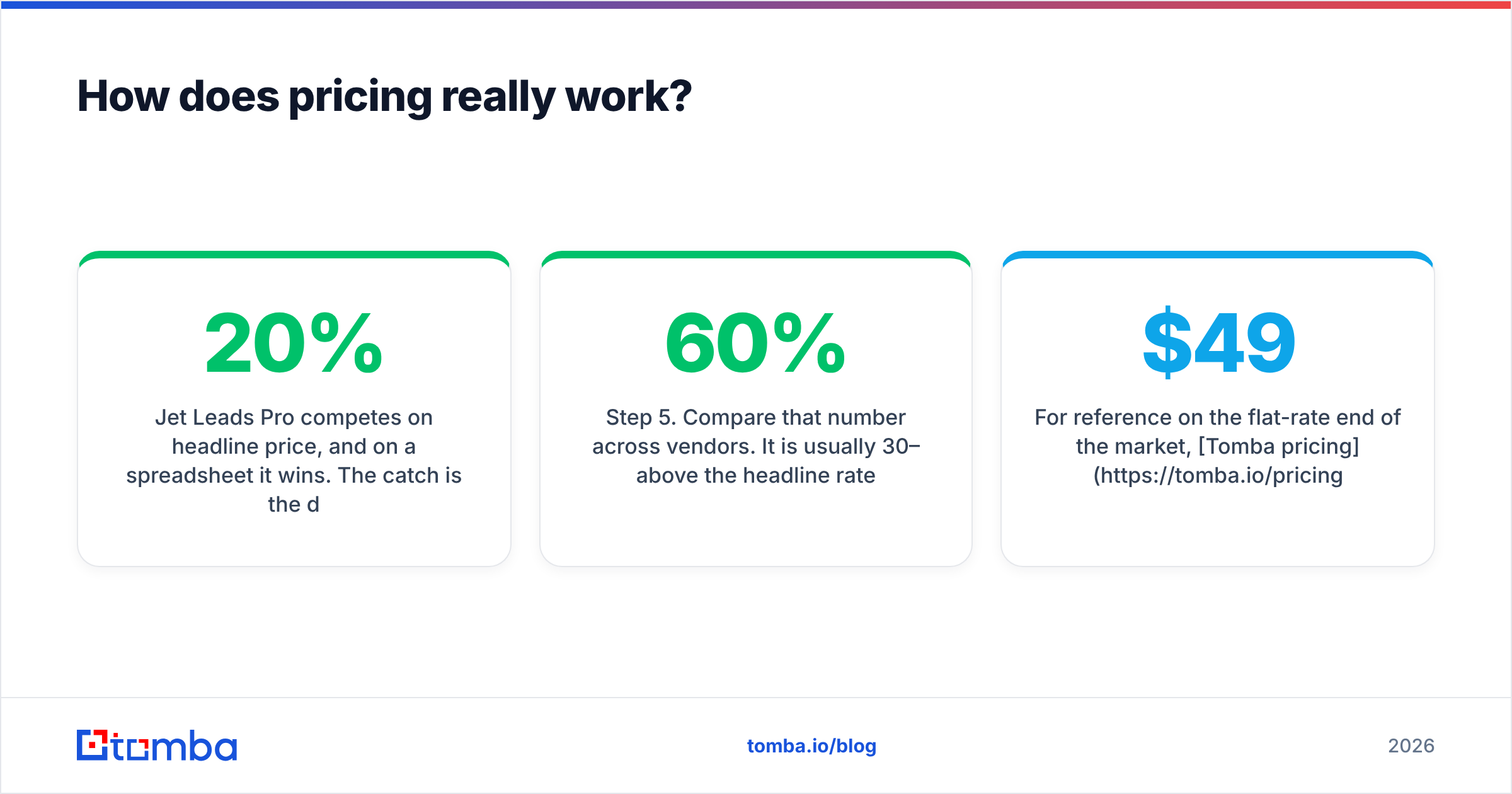
Jet Leads Pro competes on headline price, and on a spreadsheet it wins. The catch is the denominator. If 20% of exported emails bounce or belong to people who left the company, your real cost per usable contact is 25% higher than the invoice suggests — before you count the deliverability damage.
Run the arithmetic yourself with your own numbers:
- Step 1. Take your monthly invoice.
- Step 2. Divide by contacts actually exported, not credits allocated.
- Step 3. Multiply by your verified-valid rate (run a sample of 500 through an independent verifier to get this honestly).
- Step 4. Add the cost of the verification layer you now know you need.
- Step 5. Compare that number across vendors. It is usually 30–60% above the headline rate.
For reference on the flat-rate end of the market, Tomba pricing runs a free tier at 25 searches per month, Starter at $49/mo, Growth at $99/mo, and Pro at $249/mo, with credits pooled across the account rather than locked to seats. Pooled credits are the structural advantage: the manager who logs in twice a month costs nothing extra.
Is either tool GDPR-safe?#
Kaspr documents its position; Jet Leads Pro largely does not. If you sell into the EU, that difference is a procurement blocker, not a preference.
Kaspr inherits Cognism's compliance apparatus — notification processes, data subject request handling, published sourcing claims. That does not make cold outreach automatically lawful in every EU jurisdiction, but it gives your legal team something to review. When a prospect's DPO emails you asking where you got their mobile number, you have an answer.
With a smaller vendor that publishes little about sourcing, you carry that risk yourself. Before you buy, ask for three things in writing: where the data originates, what the data subject request process is, and whether the vendor acts as controller or processor. A vendor that cannot answer those quickly is telling you something.
This is also an argument for sourcing contact data from public, attributable signals rather than opaque aggregation. A domain search that returns the public web sources behind each address gives you a defensible provenance trail. Aggregated databases with no source attribution do not.
Which should you pick for your team?#
Match the tool to the motion, not to the feature list.
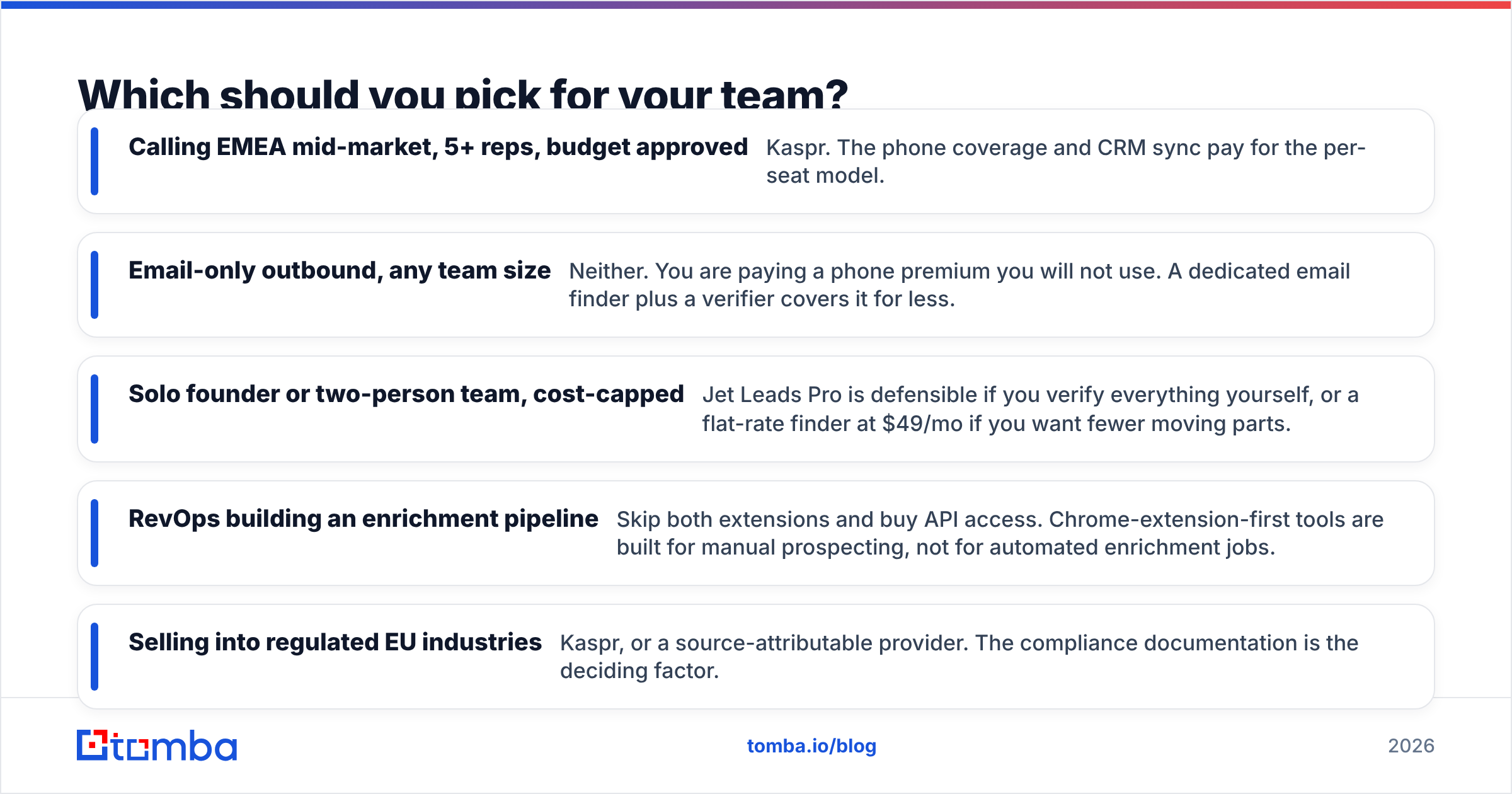
- Calling EMEA mid-market, 5+ reps, budget approved — Kaspr. The phone coverage and CRM sync pay for the per-seat model.
- Email-only outbound, any team size — Neither. You are paying a phone premium you will not use. A dedicated email finder plus a verifier covers it for less.
- Solo founder or two-person team, cost-capped — Jet Leads Pro is defensible if you verify everything yourself, or a flat-rate finder at $49/mo if you want fewer moving parts.
- RevOps building an enrichment pipeline — Skip both extensions and buy API access. Chrome-extension-first tools are built for manual prospecting, not for automated enrichment jobs.
- Selling into regulated EU industries — Kaspr, or a source-attributable provider. The compliance documentation is the deciding factor.
What about running a leaner stack instead?#
The honest third answer: many teams comparing these two are solving an email problem with a phone-priced tool.
If your outbound is email-led and phone is occasional, the stack that usually wins on cost per meeting looks like this — a finder for discovery, a verifier as a hard gate before sending, and a phone lookup called only for accounts that reach late-stage. Three focused tools, pooled credits, no per-seat tax on people who barely log in.
Tomba fits that shape. The email finder handles name-and-domain lookups and bulk jobs, the verifier catches the catch-all and role-account rows before they reach your sequencer, and everything is reachable through the Tomba API when you outgrow clicking through a browser extension. Credits pool across the account, so the pricing scales with volume rather than headcount.
The verdict#
If you need European mobile numbers and you have the budget, buy Kaspr. It is the more mature product, the compliance story is documented, and the phone data is the genuine differentiator. If you are cost-constrained and willing to own verification yourself, Jet Leads Pro is a workable input source — just never treat its output as send-ready.
And if you look at your actual motion and realise you are 90% email, stop paying for phone infrastructure you touch twice a quarter.
Start with the free tier. Run 25 lookups through the Tomba Email Finder, push the same 25 names through whichever tool you are currently paying for, and compare verified-valid rates side by side. It takes twenty minutes and it settles the argument with data instead of a feature table. If the numbers favour your incumbent, keep it. If they do not, $49/mo buys you the Starter plan and a pooled credit model that does not charge you per seat.
Related guides#
// get started
Find, verify and enrich your first contacts today
Start on the free plan with 25 searches a month, then scale when your team is ready.
Free plan · No credit card required · GDPR & CCPA
// about the author