Jet Leads Pro vs Minelead: Which Email Finder Wins in 2026?
Jet Leads Pro and Minelead both promise cheap, fast email discovery. We compare data depth, verification, catch-all handling, API quality and real cost per usable contact — plus where each one quietly falls short.
TL;DR
- Minelead is the more established of the two. It has a public site, a documented API, a Chrome extension, and a real free tier. You can evaluate it in an afternoon.
- Jet Leads Pro is thinly documented. Public pricing, data-sourcing disclosures, and third-party reviews are sparse — which is itself a procurement signal you should weigh before you wire it into a sequencer.
- Neither tool wins on catch-all domains. Roughly 20-30% of B2B domains are catch-all, and both tools tend to return those as "unknown" or, worse, as deliverable.
- Cost per usable contact beats cost per credit. A $19/mo plan that returns 40% guesses is more expensive than a $49/mo plan that returns 93% verified hits.
- If your list is enterprise-grade or API-driven, a platform with explicit catch-all verification and a documented data-sourcing policy — like Tomba's email finder — is the safer third option.
What are Jet Leads Pro and Minelead?#
Both products sit in the same category: B2B email discovery tools that take a name and a domain (or just a domain) and return work email addresses.
Minelead is the better-known entry. It's an email-finding service built around domain search — you feed it stripe.com and it returns the addresses it has indexed for that domain, along with a guessed pattern like {first}@stripe.com. It layers on a verification endpoint, a browser extension, bulk upload, and a REST API. There's a free tier with a small monthly quota, which makes evaluation cheap. You can see the current feature set on Minelead's own site.
Jet Leads Pro is the harder one to pin down. As of this writing, it presents as a lead-generation / email-finder offering, but public documentation is limited: there's no widely indexed API reference, no substantial review footprint on G2, and no published data-sourcing statement. I want to be straight with you rather than invent specifics — where I don't have verified numbers below, the table says so.
That gap matters more than it sounds. When a vendor doesn't publish where its data comes from, how often it refreshes, or what its verification pipeline actually does, you're buying a black box. For a tool that touches your sending domain's reputation, that's a real risk, not a pedantic one.

How do Jet Leads Pro and Minelead compare head-to-head?#
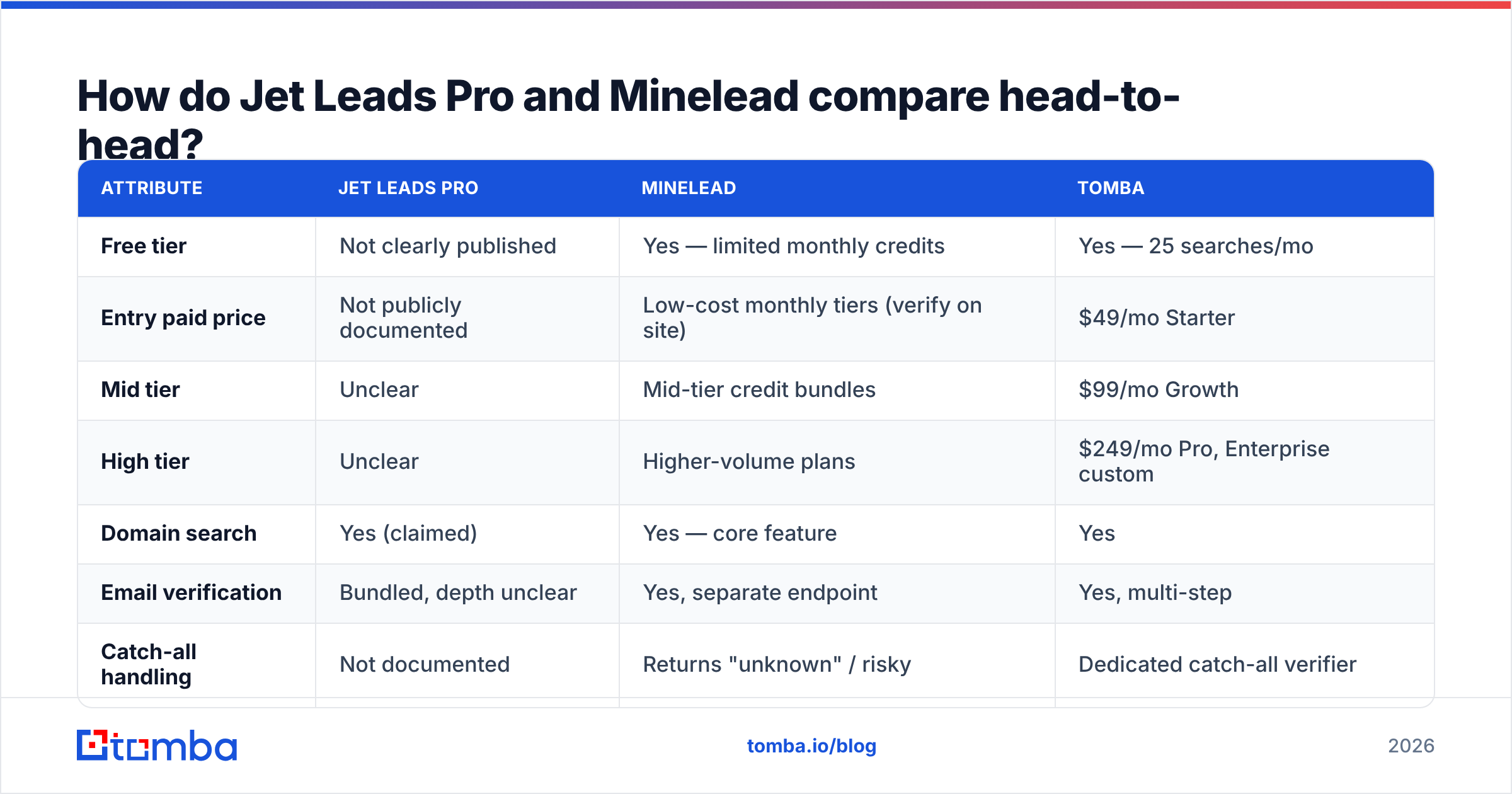
Here's the practical comparison. I've included Tomba as a third column because most people evaluating these two are really asking "is the cheap option good enough, or do I need the real thing?"
| Attribute | Jet Leads Pro | Minelead | Tomba |
|---|---|---|---|
| Free tier | Not clearly published | Yes — limited monthly credits | Yes — 25 searches/mo |
| Entry paid price | Not publicly documented | Low-cost monthly tiers (verify on site) | $49/mo Starter |
| Mid tier | Unclear | Mid-tier credit bundles | $99/mo Growth |
| High tier | Unclear | Higher-volume plans | $249/mo Pro, Enterprise custom |
| Domain search | Yes (claimed) | Yes — core feature | Yes |
| Email verification | Bundled, depth unclear | Yes, separate endpoint | Yes, multi-step |
| Catch-all handling | Not documented | Returns "unknown" / risky | Dedicated catch-all verifier |
| Public API docs | Not readily available | Yes, REST | Yes, REST + CLI + MCP |
| Browser extension | Unclear | Yes | Yes |
| Bulk CSV processing | Claimed | Yes | Yes |
| Spreadsheet add-ons | No | No | Google Sheets, Excel, Airtable |
| Phone numbers | No | No | Yes |
| Published data sources | No | Partial | Yes, documented |
| Third-party review volume | Very low | Moderate | Moderate |
Two things jump out. First, Minelead is a legitimate, functional tool at the budget end — it does what it says, and the free tier lets you verify that yourself. Second, the "unclear" column is doing a lot of work for Jet Leads Pro, and you should treat every one of those cells as a question to answer before you hand over a credit card, not after.
Which one actually finds more valid emails?#
This is the only question that matters, and it's the one vendors are most creative about.
Every email finder reports two numbers, and they're frequently conflated:
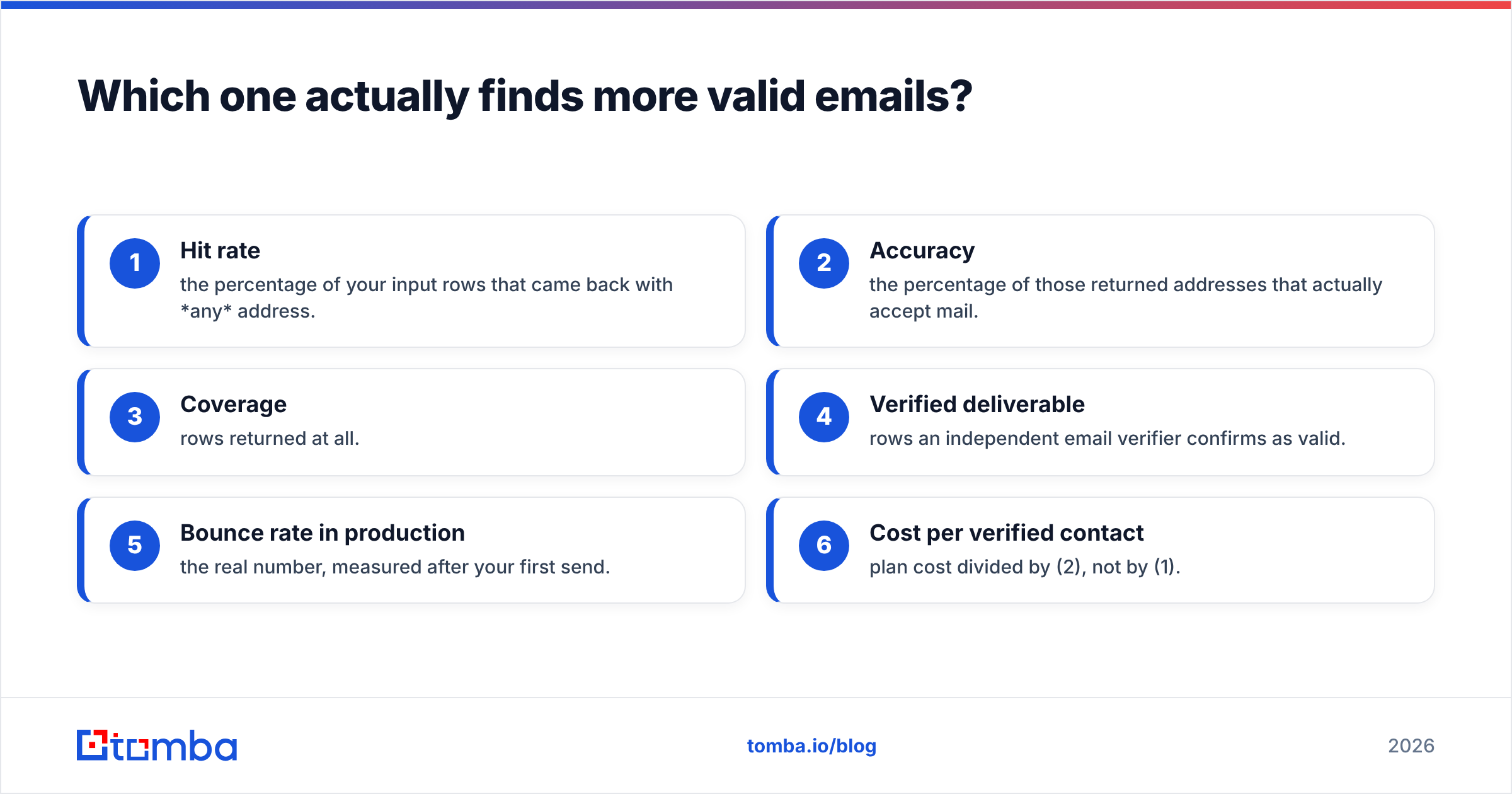
- Hit rate — the percentage of your input rows that came back with any address.
- Accuracy — the percentage of those returned addresses that actually accept mail.
A tool can post a spectacular 85% hit rate by pattern-guessing every row (first.last@domain.com works often enough to look impressive). If a third of those guesses bounce, you've bought a 57% effective accuracy rate and a damaged sender reputation. Budget finders lean hard on permutation guessing because it's nearly free to compute.

The honest way to compare Jet Leads Pro and Minelead is to run the same 200-row list through both and measure four things:
- Coverage — rows returned at all.
- Verified deliverable — rows an independent email verifier confirms as valid.
- Bounce rate in production — the real number, measured after your first send.
- Cost per verified contact — plan cost divided by (2), not by (1).
Run that test with the same list, the same week, same domains. Vendor-published benchmarks are almost always run on curated domain sets that flatter the tool.
In my experience with tools in this price band, coverage on well-known domains (public SaaS companies, mid-market tech) is comparable across the board — everyone has scraped the same public sources. The divergence shows up on long-tail domains: regional firms, agencies, manufacturers, anything under ~50 employees. That's exactly where budget tools quietly switch from "found in index" to "generated a guess."
What happens on catch-all domains?#
This is where both tools have a structural problem, and it's worth understanding rather than skimming.
A catch-all (or "accept-all") domain is configured to accept mail sent to any address at that domain — asdkjhqwe@company.com gets a 250 OK from the mail server just like ceo@company.com does. The SMTP handshake that most verifiers rely on therefore returns a positive result for garbage. Somewhere between a fifth and a third of B2B domains are configured this way, and the share skews higher among larger companies.
Budget finders handle catch-alls in one of three ways:
- Return them as "valid." Cheap, and catastrophic — you send to guesses and the bounces land on your domain.
- Return them as "unknown" and charge you anyway. Honest, but you've paid for a row you can't use.
- Run a secondary signal — historical engagement data, pattern confidence scoring, or an independent source — to resolve them.
Minelead falls into the second bucket: it will flag risky/unknown results rather than pretend. That's the right behaviour, but it means a meaningful slice of your paid credits produce nothing actionable. Jet Leads Pro's handling isn't publicly documented, which means you need to test it explicitly — feed it a list of known catch-all domains and see what comes back. If everything returns "valid," stop there.
Only a handful of tools run a genuine resolution step. If catch-alls are more than a rounding error in your ICP, a dedicated catch-all verifier is the difference between a 1% and a 6% bounce rate.
Which has the better API and developer experience?#
If you're piping contacts into a CRM or enriching rows inside a workflow, the API is the product.
Minelead publishes a straightforward REST API with search and verification endpoints, key-based auth, and JSON responses. It's serviceable. What it doesn't have is the surrounding ecosystem — no official CLI, no spreadsheet add-ons, and a limited native integration list, so you'll be writing glue code or leaning on Zapier-style middleware.
Jet Leads Pro doesn't publish an API reference I could verify. If you need programmatic access, ask for the docs before you subscribe, and specifically ask about: rate limits, credit consumption on failed lookups, webhook support for bulk jobs, and whether the verification confidence score is exposed in the response payload. That last one is the tell — vendors confident in their pipeline expose the score; vendors guessing return a bare boolean.
For reference, a mature stack looks like a documented REST API, plus a CLI, plus native integrations into HubSpot, Salesforce, Pipedrive and Sheets, so non-engineers can work without filing tickets.

How should you choose between them?#
Work through these in order. It takes an afternoon and saves a quarter.
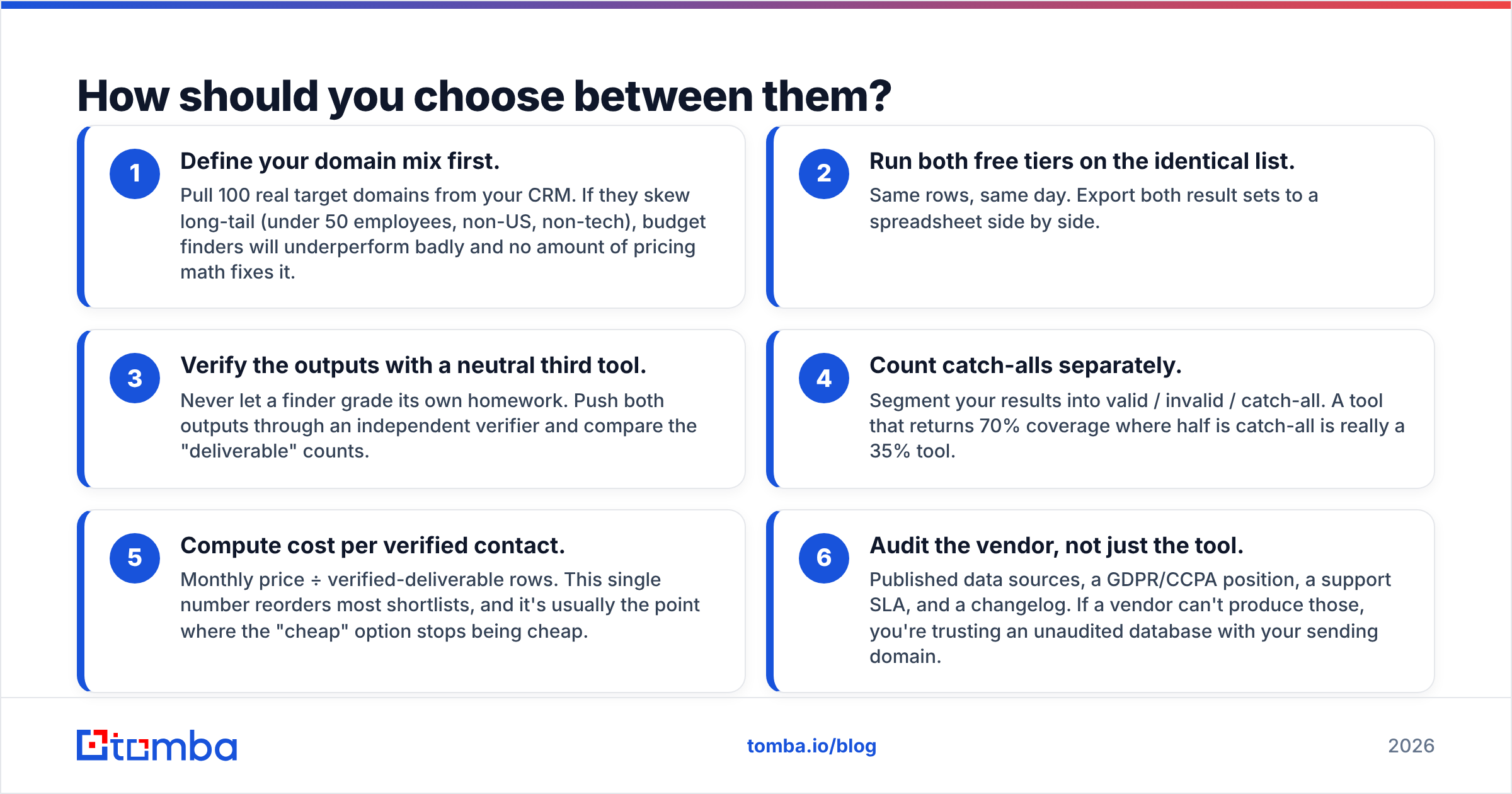
- Define your domain mix first. Pull 100 real target domains from your CRM. If they skew long-tail (under 50 employees, non-US, non-tech), budget finders will underperform badly and no amount of pricing math fixes it.
- Run both free tiers on the identical list. Same rows, same day. Export both result sets to a spreadsheet side by side.
- Verify the outputs with a neutral third tool. Never let a finder grade its own homework. Push both outputs through an independent verifier and compare the "deliverable" counts.
- Count catch-alls separately. Segment your results into valid / invalid / catch-all. A tool that returns 70% coverage where half is catch-all is really a 35% tool.
- Compute cost per verified contact. Monthly price ÷ verified-deliverable rows. This single number reorders most shortlists, and it's usually the point where the "cheap" option stops being cheap.
- Audit the vendor, not just the tool. Published data sources, a GDPR/CCPA position, a support SLA, and a changelog. If a vendor can't produce those, you're trusting an unaudited database with your sending domain.
Where does Tomba fit into this comparison?#
Fairly: Tomba is a step up in price from Minelead's entry tier and it is not the cheapest option in this category. If your total need is 200 lookups a month on well-known domains, Minelead's free or entry plan will genuinely serve you, and you should use it.

Tomba becomes the right call at the point where three things become true at once:
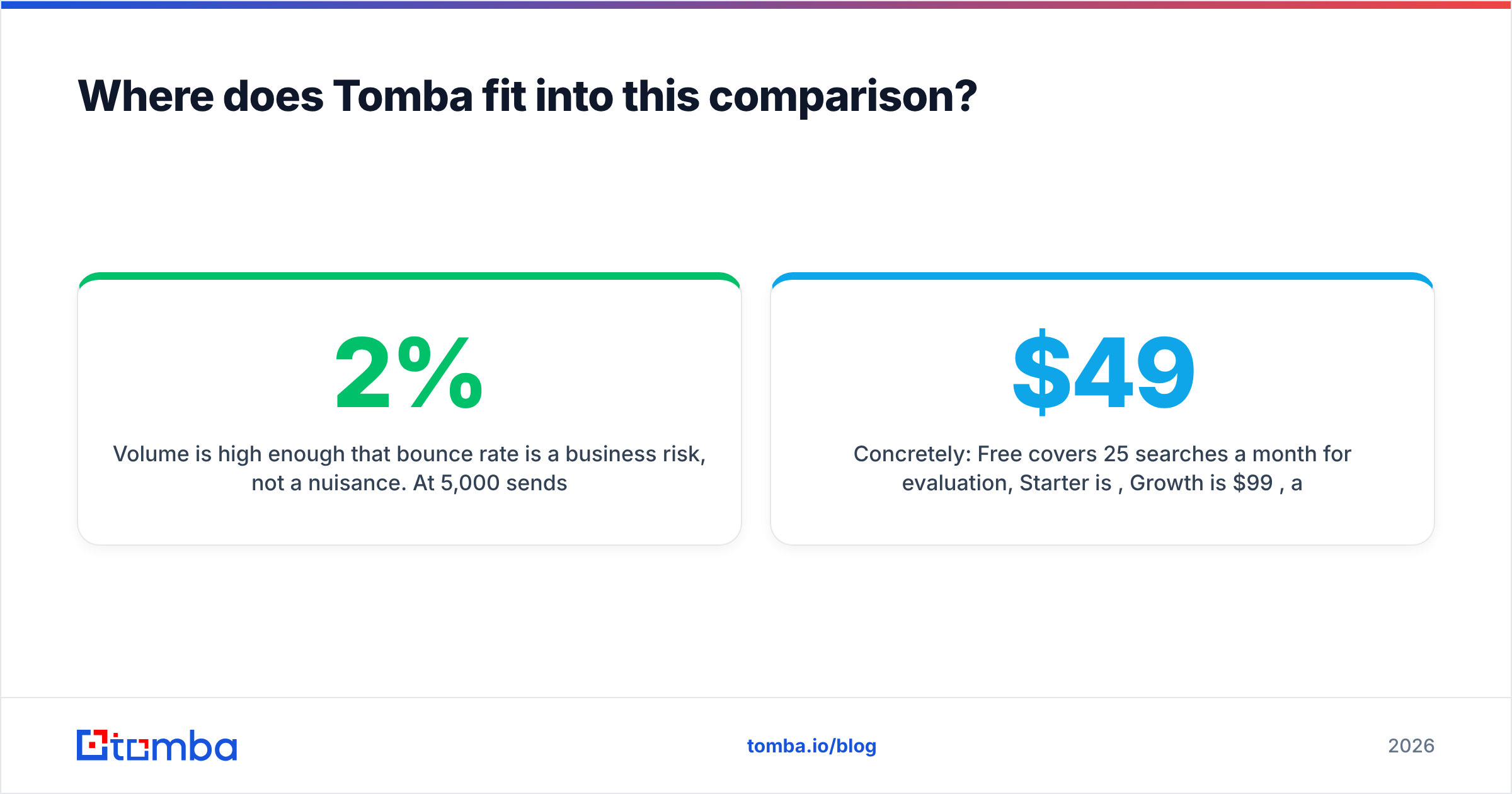
- Volume is high enough that bounce rate is a business risk, not a nuisance. At 5,000 sends a month, the gap between 2% and 7% bounces determines whether your domain stays out of spam folders.
- Your ICP includes long-tail and catch-all-heavy domains, where guess-based tools degrade fastest.
- You need the data inside systems, not in a CSV — which is where the API, CLI, bulk processing, and Google Sheets add-on earn their keep.
Concretely: Free covers 25 searches a month for evaluation, Starter is $49/mo, Growth is $99/mo, and Pro is $249/mo, with Enterprise custom. Full breakdown on the Tomba pricing page. Tomba also publishes its data sources, which is the disclosure I'd insist on from any vendor in this category — including the two in this comparison.
Jet Leads Pro vs Minelead: what's the verdict?#
Pick Minelead if you're a solo founder or small team, your targets are recognisable companies, your volume is modest, and you want to spend as close to zero as possible. It's a real tool with a real free tier, and the "unknown" flag on risky results shows better judgement than most budget competitors.
Be cautious with Jet Leads Pro until you've personally verified the things this post couldn't: published pricing, API documentation, catch-all behaviour, and data-sourcing policy. That's not a dismissal — it's the same diligence you'd apply to any vendor touching your deliverability. Ask for the docs. If they arrive and check out, run the same head-to-head test above.
Step up to a full platform when bounce rate, long-tail coverage, or engineering integration become the constraint. At that point you're no longer buying credits — you're buying the absence of a deliverability incident.
One closing note on framing: the cheapest email finder is never the one with the lowest sticker price. It's the one with the lowest cost per contact that actually replies. Run the test on your own list, with your own domains, and let the spreadsheet decide.
Ready to benchmark against your real list? Start with the Tomba Email Finder — the free tier gives you 25 searches a month, no card required, so you can run the exact side-by-side test described above. Feed it the same 100 long-tail domains you gave Jet Leads Pro and Minelead, verify all three outputs independently, and compare cost per verified contact. If the cheap tool wins on your data, keep it. If it doesn't, you'll know before your sender reputation does.
Related guides#
// get started
Find, verify and enrich your first contacts today
Start on the free plan with 25 searches a month, then scale when your team is ready.
Free plan · No credit card required · GDPR & CCPA
Get the Tomba newsletter
Product and data updates
// about the author