Jet Leads Pro vs Prosperfleet Valgen: 2026 Honest Comparison
Both tools promise cheap B2B contact data, but neither publishes much you can verify. Here is a neutral breakdown of what to test, what to demand in writing, and which option actually survives a bounce-rate audit.
TL;DR
- Neither Jet Leads Pro nor Prosperfleet Valgen publishes the kind of verifiable detail — sourcing, refresh cadence, bounce guarantees, audited review volume — that a serious buyer needs before wiring money. That absence is itself the most important finding in this comparison.
- If you only remember one rule from this post: buy on measured bounce rate on your own ICP sample, not on database size claims. A 400M-record database with 30% decay is worth less than a 20M-record database refreshed monthly.
- Run the same 200-contact test list through both tools plus one established vendor. Compare valid-rate, cost per verified contact, and how each one labels catch-all domains. Most of the time the cheapest tool becomes the most expensive after you price in bounces.
- Demand three things in writing before you pay: a documented data-sourcing policy, a bounce-rate SLA with credit-back, and an export you own outright.
- If either vendor fails that test, a transparent, published-pricing alternative like Tomba Email Finder (free tier, then $49/mo) is the lower-risk default.
Who are Jet Leads Pro and Prosperfleet Valgen?#
Both names circulate in the low-cost B2B contact-data corner of the market — the segment below the Apollo/ZoomInfo tier, where tools are sold on price per record and lifetime deals rather than on enterprise contracts.
Here is the honest situation as of 2026: neither vendor has a substantial, independently verifiable public footprint. There is no large body of audited reviews on G2's lead-capture category or Capterra's lead-generation directory for either name, no widely cited accuracy benchmark, and no public data-sourcing documentation that a compliance officer could read.
That does not automatically mean either product is bad. Plenty of good tools start small. But it changes what this comparison can responsibly be. Instead of inventing feature matrices from marketing copy, this post does what an actual buyer should do: define the criteria that separate a usable B2B data tool from an expensive CSV, then show you how to score Jet Leads Pro, Prosperfleet Valgen, or anything else against them in an afternoon.
If a vendor can't answer the questions below in writing, the comparison is already over.
What should you actually compare in a lead tool?#
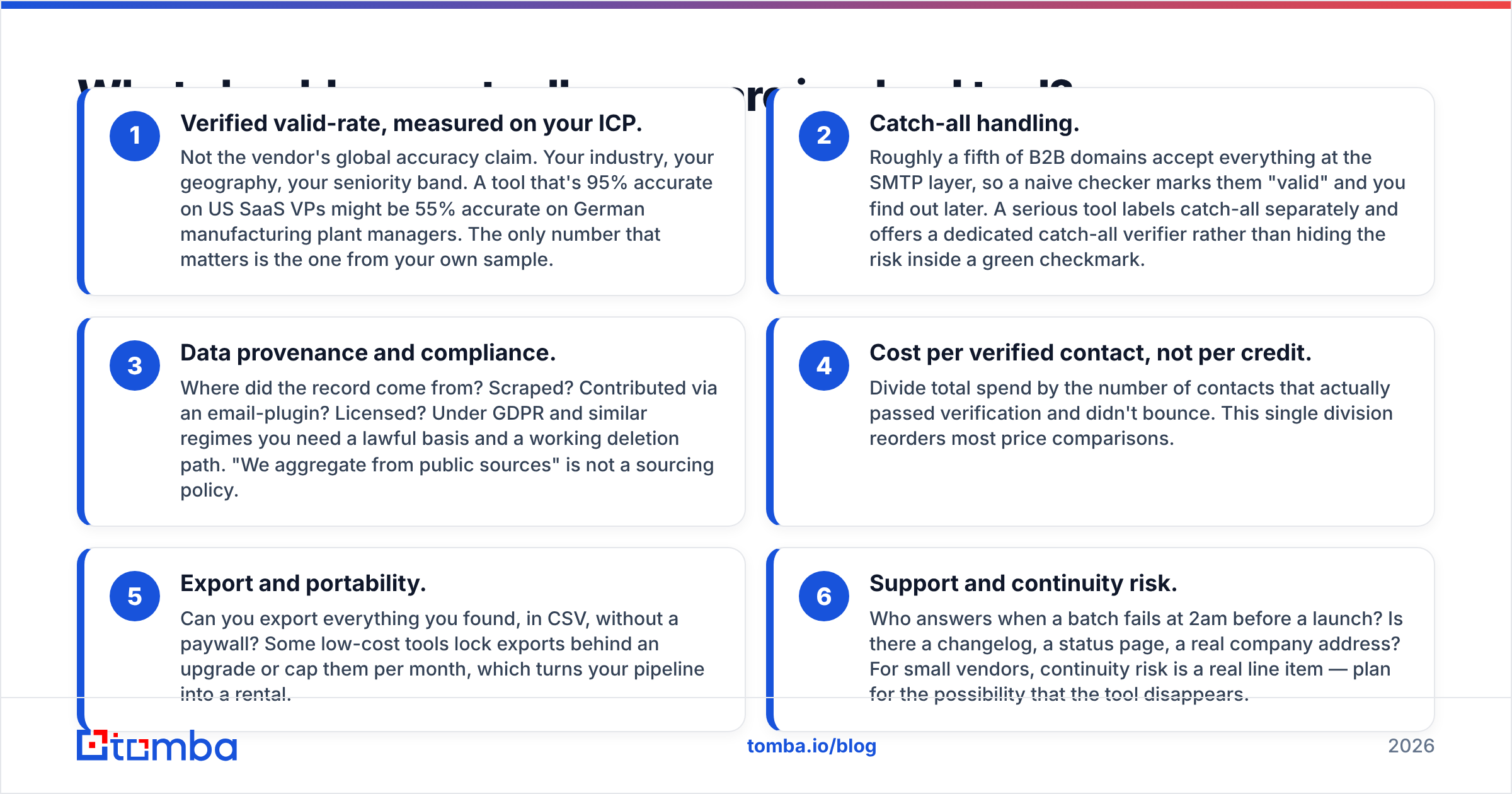
Six criteria decide whether a contact-data tool makes you money or quietly burns your sending domain. Rank them in this order:
- Verified valid-rate, measured on your ICP. Not the vendor's global accuracy claim. Your industry, your geography, your seniority band. A tool that's 95% accurate on US SaaS VPs might be 55% accurate on German manufacturing plant managers. The only number that matters is the one from your own sample.
- Catch-all handling. Roughly a fifth of B2B domains accept everything at the SMTP layer, so a naive checker marks them "valid" and you find out later. A serious tool labels catch-all separately and offers a dedicated catch-all verifier rather than hiding the risk inside a green checkmark.
- Data provenance and compliance. Where did the record come from? Scraped? Contributed via an email-plugin? Licensed? Under GDPR and similar regimes you need a lawful basis and a working deletion path. "We aggregate from public sources" is not a sourcing policy.
- Cost per verified contact, not per credit. Divide total spend by the number of contacts that actually passed verification and didn't bounce. This single division reorders most price comparisons.
- Export and portability. Can you export everything you found, in CSV, without a paywall? Some low-cost tools lock exports behind an upgrade or cap them per month, which turns your pipeline into a rental.
- Support and continuity risk. Who answers when a batch fails at 2am before a launch? Is there a changelog, a status page, a real company address? For small vendors, continuity risk is a real line item — plan for the possibility that the tool disappears.
Notice that four of the six have nothing to do with database size. Vendors lead with record counts because record counts are the easiest number to inflate.

How do Jet Leads Pro and Prosperfleet Valgen compare head-to-head?#
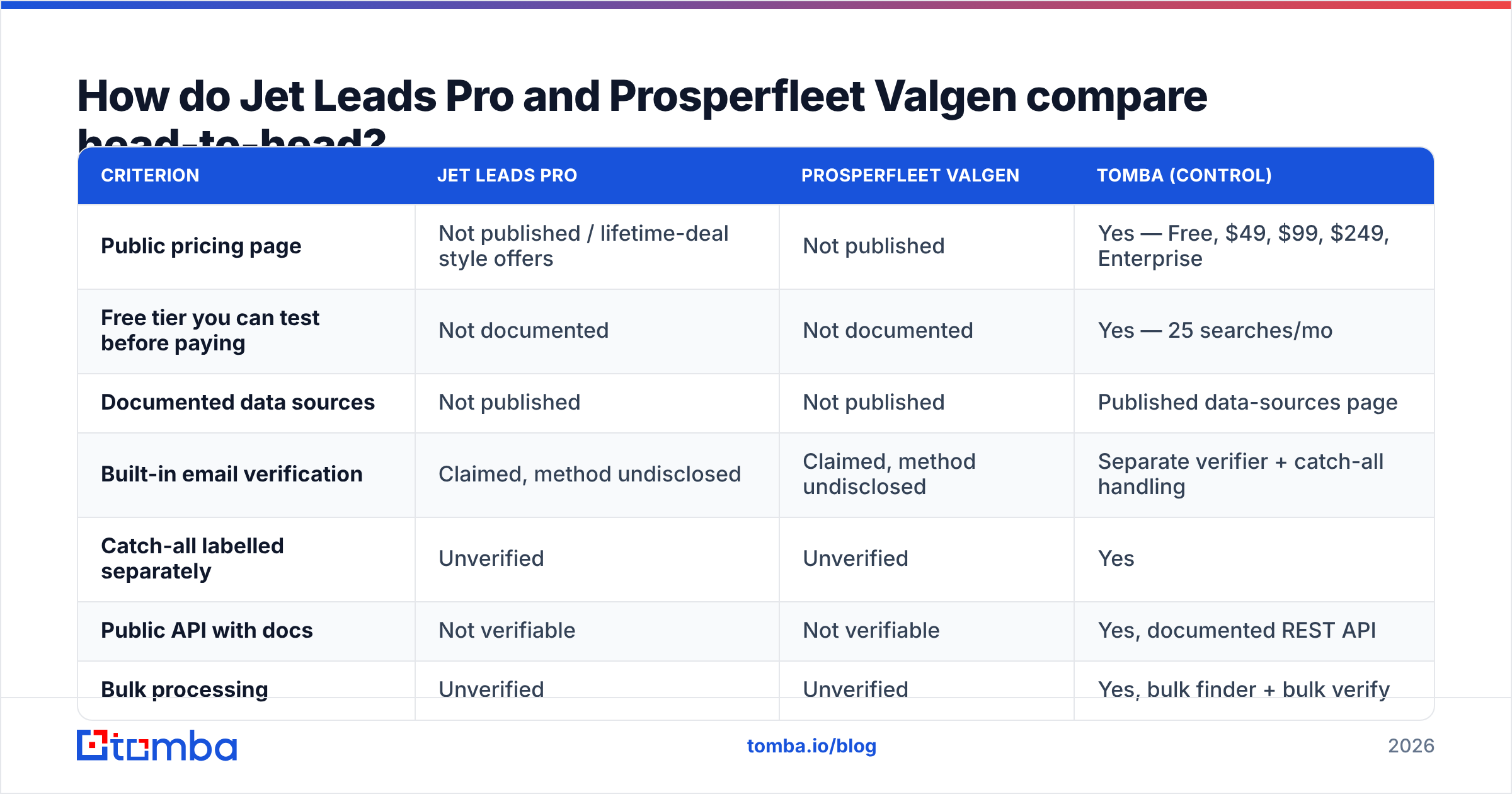
The table below is scored on what a buyer can independently verify in 2026 — not on vendor claims. Where a vendor does not publish a figure, the honest entry is "not published," and you should treat that as a finding rather than a blank. A transparent established vendor (Tomba) is included as a control so you can see what a fully documented column looks like.
| Criterion | Jet Leads Pro | Prosperfleet Valgen | Tomba (control) |
|---|---|---|---|
| Public pricing page | Not published / lifetime-deal style offers | Not published | Yes — Free, $49, $99, $249, Enterprise |
| Free tier you can test before paying | Not documented | Not documented | Yes — 25 searches/mo |
| Documented data sources | Not published | Not published | Published data-sources page |
| Built-in email verification | Claimed, method undisclosed | Claimed, method undisclosed | Separate verifier + catch-all handling |
| Catch-all labelled separately | Unverified | Unverified | Yes |
| Public API with docs | Not verifiable | Not verifiable | Yes, documented REST API |
| Bulk processing | Unverified | Unverified | Yes, bulk finder + bulk verify |
| Independent review volume (G2/Capterra) | Minimal | Minimal | Established listings |
| Bounce-rate SLA / credit-back | Not offered publicly | Not offered publicly | Verification-backed workflow |
Two takeaways. First, the two tools in the headline are nearly indistinguishable on public evidence, which means any "winner" declared without a hands-on test is marketing, not analysis. Second, the gap between either of them and a vendor with published pricing and documented sourcing is larger than the gap between them.
Which one has better data accuracy?#
You cannot answer this from the outside, and neither can anyone selling you an affiliate-laden "review." You answer it with a test that takes about ninety minutes.
The 200-contact bake-off:
Pull 200 contacts from your real ICP — same industry, same seniority, same regions you actually sell into. Split them into two identical halves so each tool gets the same difficulty. Then run the same first-name/last-name/domain inputs through each tool and record four numbers:
- Hit rate — how many inputs returned any email at all.
- Verified-valid rate — how many of those passed an independent third-party verifier (use a neutral one, not the vendor's own checker, or you're grading the vendor's homework).
- Catch-all share — how many landed on accept-all domains, which is the hidden-risk bucket.
- Hard-bounce rate — send a small, genuinely relevant batch and count the bounces after 48 hours.
Then compute cost per verified contact: total spend ÷ verified-valid contacts. Not per credit. Per contact you can actually mail.
This is where cheap tools frequently lose. A provider charging half as much per credit but returning half as many mailable addresses costs exactly the same — and you paid the difference in sender reputation, which is not refundable. HubSpot's overview of lead generation fundamentals makes the same point from the demand-gen side: volume without qualification just moves the failure downstream.
One practical note on step two: re-verify everything regardless of who found it. Contact data decays roughly 2-3% per month through job changes alone, so even a genuinely accurate record from six months ago is a coin flip today. A standing email verifier pass before every send is the cheapest insurance in outbound.
How should you read the pricing models?#
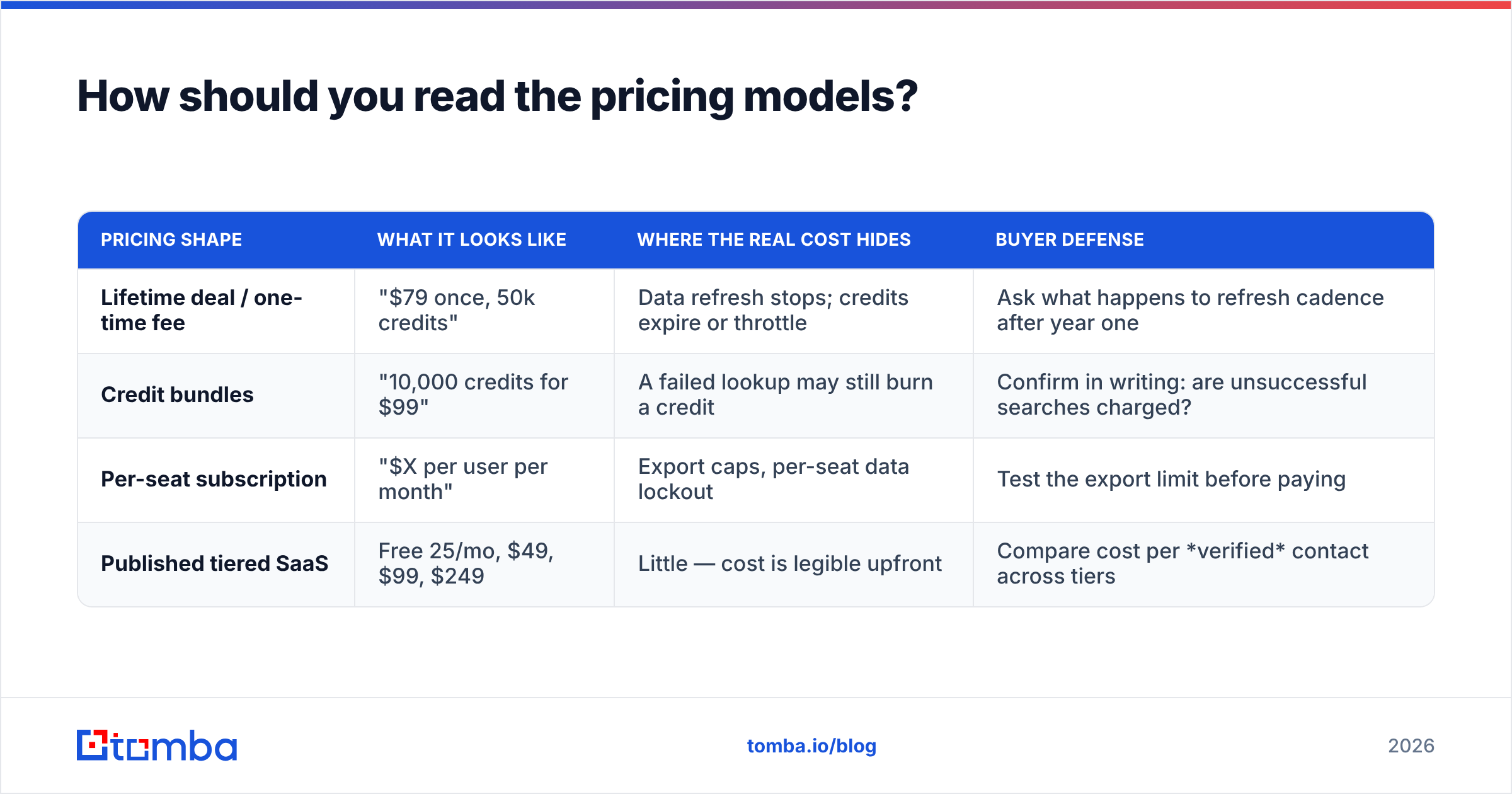
Low-profile vendors in this segment tend to sell in one of three shapes, and each hides cost in a different place.
| Pricing shape | What it looks like | Where the real cost hides | Buyer defense |
|---|---|---|---|
| Lifetime deal / one-time fee | "$79 once, 50k credits" | Data refresh stops; credits expire or throttle | Ask what happens to refresh cadence after year one |
| Credit bundles | "10,000 credits for $99" | A failed lookup may still burn a credit | Confirm in writing: are unsuccessful searches charged? |
| Per-seat subscription | "$X per user per month" | Export caps, per-seat data lockout | Test the export limit before paying |
| Published tiered SaaS | Free 25/mo, $49, $99, $249 | Little — cost is legible upfront | Compare cost per verified contact across tiers |
The last row is the one to benchmark against, because it is the only shape where you can compute your true unit cost before signing. If a vendor will not show you a price until you book a call, that is a pricing model too — it just means the price is "whatever they think you'll pay."
A fair caveat: opaque pricing is not proof of a bad product. Some small vendors genuinely do custom deals because their volume is lumpy. But it does shift risk onto you, and you should price that risk in.
Is either one good enough for cold outbound?#
It depends entirely on the bake-off result, but there are three disqualifiers that should end the evaluation on the spot no matter how good the price looks.
Disqualifier one: the tool marks catch-all domains as valid. This is the single most common way a cheap list destroys a sending domain. If your test sample includes known accept-all domains and the tool returns a clean green status on all of them, its verification is cosmetic.
Disqualifier two: no documented deletion path. If a prospect in the EU emails you a deletion request and your vendor has no mechanism to honor it upstream, you have inherited their compliance problem. Lead generation as a practice is legal; scraping and reselling personal data without a lawful basis is a different question, and it lands on the sender.
Disqualifier three: exports are capped or paywalled. Data you cannot export is data you are renting. For a vendor with an uncertain future, that is an unacceptable dependency.
If a tool clears all three and wins your bake-off on cost per verified contact, use it. That is a legitimate outcome, and it is more likely for narrow, regional, or niche-vertical datasets where a small vendor may genuinely out-cover the big names. Small does not mean bad. Unverifiable means unverifiable — and those are different problems with different fixes.

What about compliance and data sourcing?#
Ask both vendors the same four questions by email, and keep the replies:
- What are your data sources, by category (public web, licensed partners, user contributions, opt-in forms)?
- What is your average record age, and how often is each record re-validated?
- What is your process when a data subject requests deletion, and what is the SLA?
- Do you carry any bounce-rate guarantee, and what is the remedy if we exceed it?
A vendor that answers all four crisply has thought about the business. A vendor that answers with "our data is 99% accurate and fully compliant" has not. You are not being difficult by asking — you are doing the diligence that makes the eventual invoice defensible internally.
This is also where transparent data-sourcing documentation becomes a purchasing criterion rather than a nice-to-have. If your legal team ever asks where a contact came from, you want a URL to hand them, not a support ticket.
So which should you choose in 2026?#
Verdict: neither, on current public evidence — unless one of them wins your own bake-off outright.
Breaking it down by situation:
- You're testing outbound for the first time. Don't start with an unverifiable vendor. Start on a free tier with published pricing so your first measurement is clean. You need a reliable baseline before you can judge anything else.
- You have a narrow niche the big databases miss. Run the bake-off. If Jet Leads Pro or Prosperfleet Valgen genuinely covers your vertical better and clears the three disqualifiers, the price advantage is real. Keep a mainstream provider alongside as a fallback.
- You're running volume and your domain reputation is a real asset. Choose the vendor with verification you can inspect and a support channel that answers. The downside of a bad list at volume is measured in months of recovery, not dollars.
- You need API-level automation. Rule out anything without public API documentation. An undocumented API is a maintenance liability you will inherit.
- You're consolidating tools. Prioritize one provider that covers finding, verifying, enriching, and bulk processing — fewer integrations means fewer places for data quality to silently degrade.
The uncomfortable truth about this matchup is that the interesting decision isn't between these two tools. It's between any unverifiable low-cost vendor and a provider whose numbers you can check before you spend.
Where does Tomba fit?#
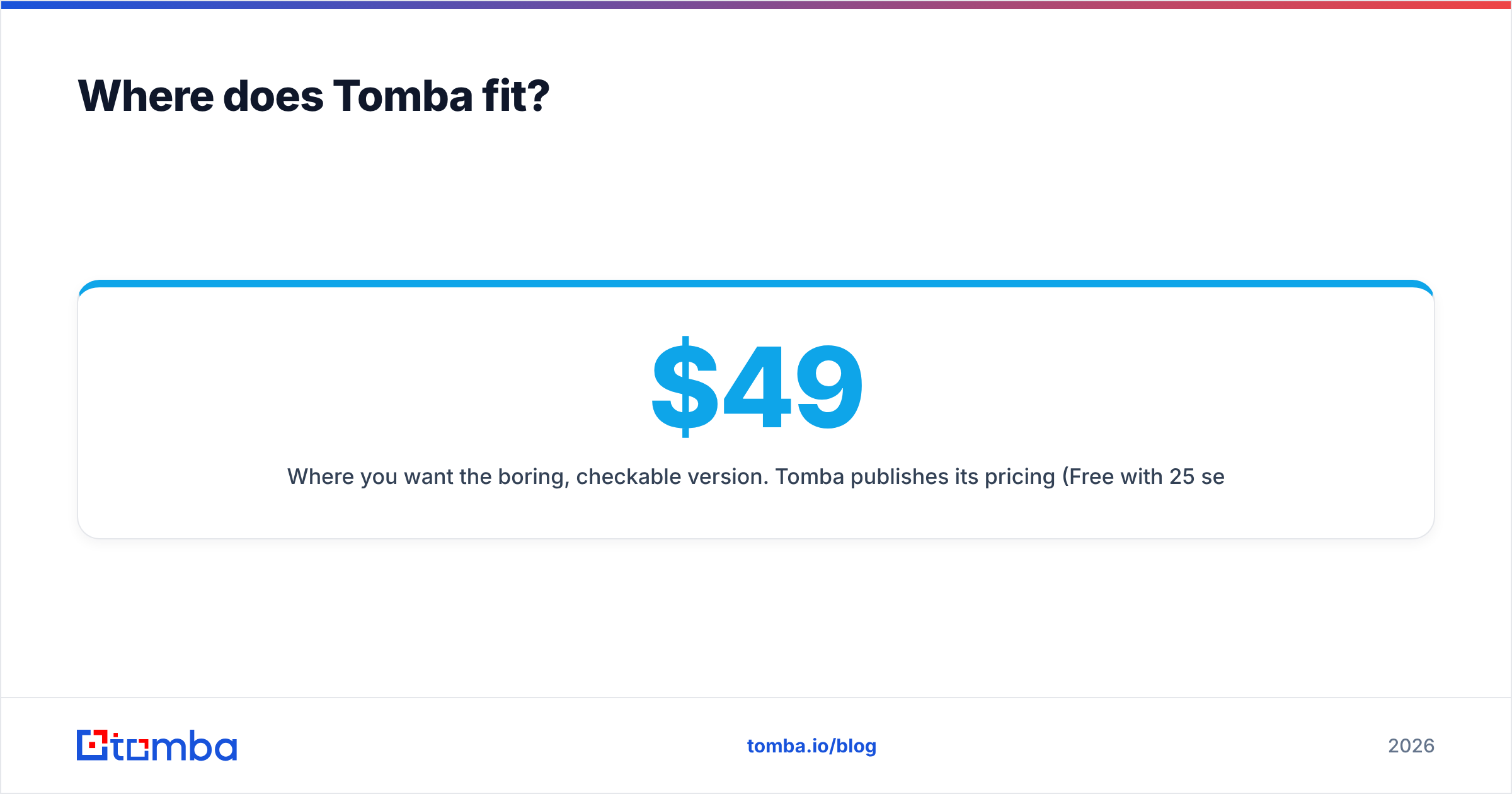
Where you want the boring, checkable version. Tomba publishes its pricing (Free with 25 searches/mo, Starter $49/mo, Growth $99/mo, Pro $249/mo, Enterprise custom), documents its data sources, separates catch-all results instead of burying them, and ships a documented email finder API for teams that automate.
Start with the free tier and run the 200-contact bake-off described above — against Jet Leads Pro, against Prosperfleet Valgen, against whatever else is on your shortlist. Measure hit rate, verified-valid rate, catch-all share, and cost per verified contact. Then buy the winner, whoever it turns out to be.
If you want a clean baseline to measure everything else against, start with Tomba Email Finder. It's free to test, the pricing is on the page, and the numbers it returns are the ones you can defend to your CFO.
Related guides#
Ready to find emails that actually work?
Join 150,000+ professionals who stopped guessing and started sending. Free credits on signup — no credit card required.
Get the Tomba newsletter
Practical outbound tactics and product updates — once every two weeks.
About the author