Jet Leads Pro vs Pubrio: Which B2B Lead Tool Wins in 2026?
A neutral, hands-on comparison of Jet Leads Pro and Pubrio on data accuracy, credit math, export limits and API depth — plus when a dedicated email finder beats both.
Jet Leads Pro vs Pubrio is a choice between a utility and a platform. Pubrio sells a full B2B data workflow. Jet Leads Pro sells a fast CSV export. Neither one verifies email deeply enough to protect your sending domain, so budget for that step either way.
TL;DR
- Pubrio is the broader platform: an AI-flavoured B2B database with contact search, intent-style filters, enrichment and outreach hooks. You buy a workflow, not just emails.
- Jet Leads Pro sits in the lighter, cheaper lane: scrape-and-export lead lists fast, get a CSV, move on. Less depth, less lock-in, fewer guardrails.
- Neither one is a verification engine. Both hand you addresses that still need an independent bounce check before you load a sequence.
- Credits are the real price tag. Per-seat pricing plus credit burn on failed lookups is where both tools quietly get expensive.
- If your bottleneck is "I have companies, I need valid inboxes," a dedicated email finder with a separate verifier will beat both on cost per usable contact.
What are Jet Leads Pro and Pubrio?#
They solve the same job — get contactable B2B leads into your sequencer — from opposite ends of the market.
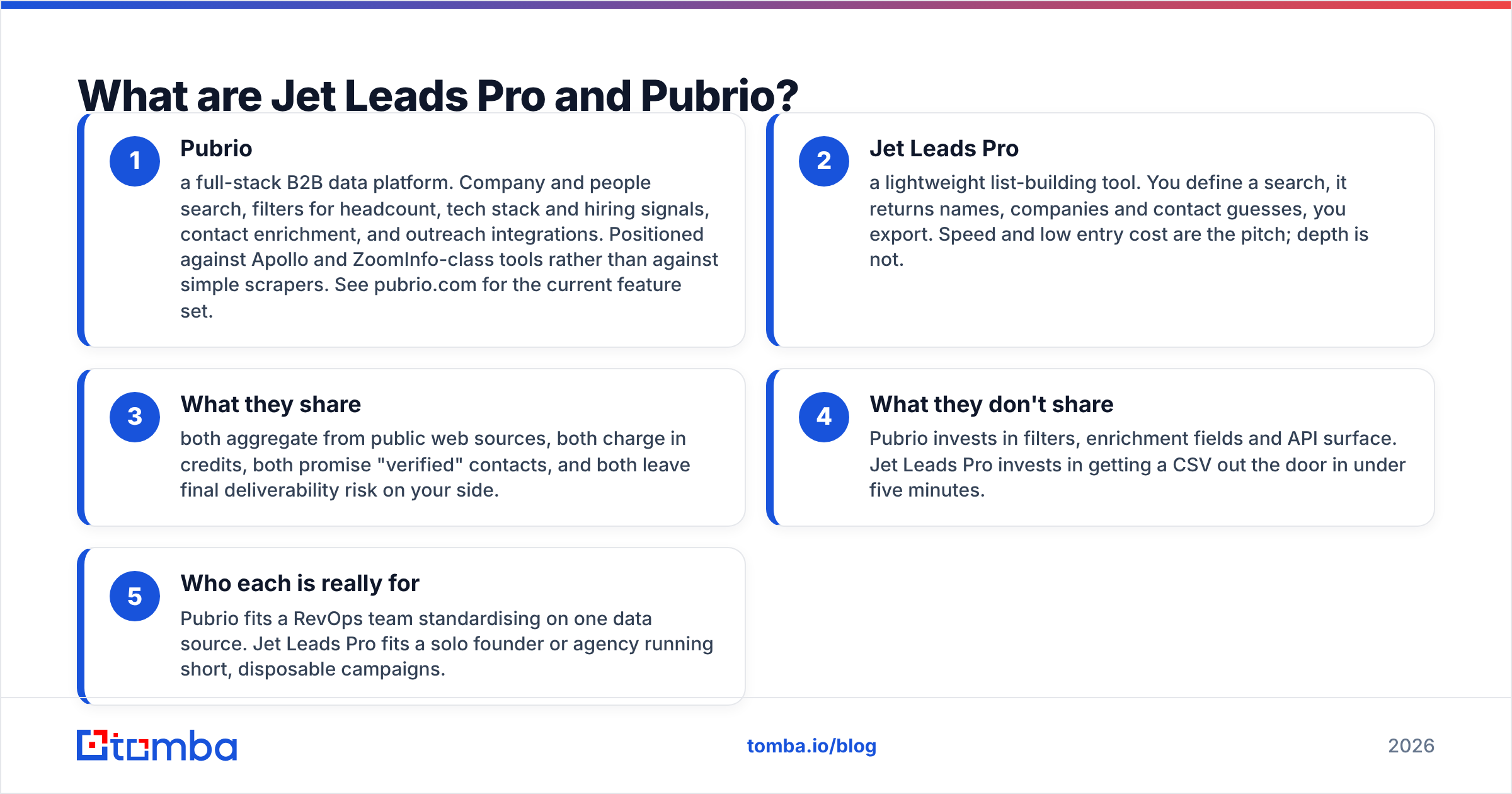
- Pubrio — a full-stack B2B data platform. Company and people search, filters for headcount, tech stack and hiring signals, contact enrichment, and outreach integrations. Positioned against Apollo and ZoomInfo-class tools rather than against simple scrapers. See pubrio.com for the current feature set.
- Jet Leads Pro — a lightweight list-building tool. You define a search, it returns names, companies and contact guesses, you export. Speed and low entry cost are the pitch; depth is not.
That is the pitch on each side. The rest of the picture matters more:
- What they share — both aggregate from public web sources, both charge in credits, both promise "verified" contacts, and both leave final deliverability risk on your side.
- What they don't share — Pubrio invests in filters, enrichment fields and API surface. Jet Leads Pro invests in getting a CSV out the door in under five minutes.
- Who each is really for — Pubrio fits a RevOps team standardising on one data source. Jet Leads Pro fits a solo founder or agency running short, disposable campaigns.
The framing that matters: platform versus utility. Most buyers pick wrong. They compare feature checklists instead of counting how many deliverable addresses each tool produces per dollar.

Jet Leads Pro vs Pubrio: how do the features compare?#
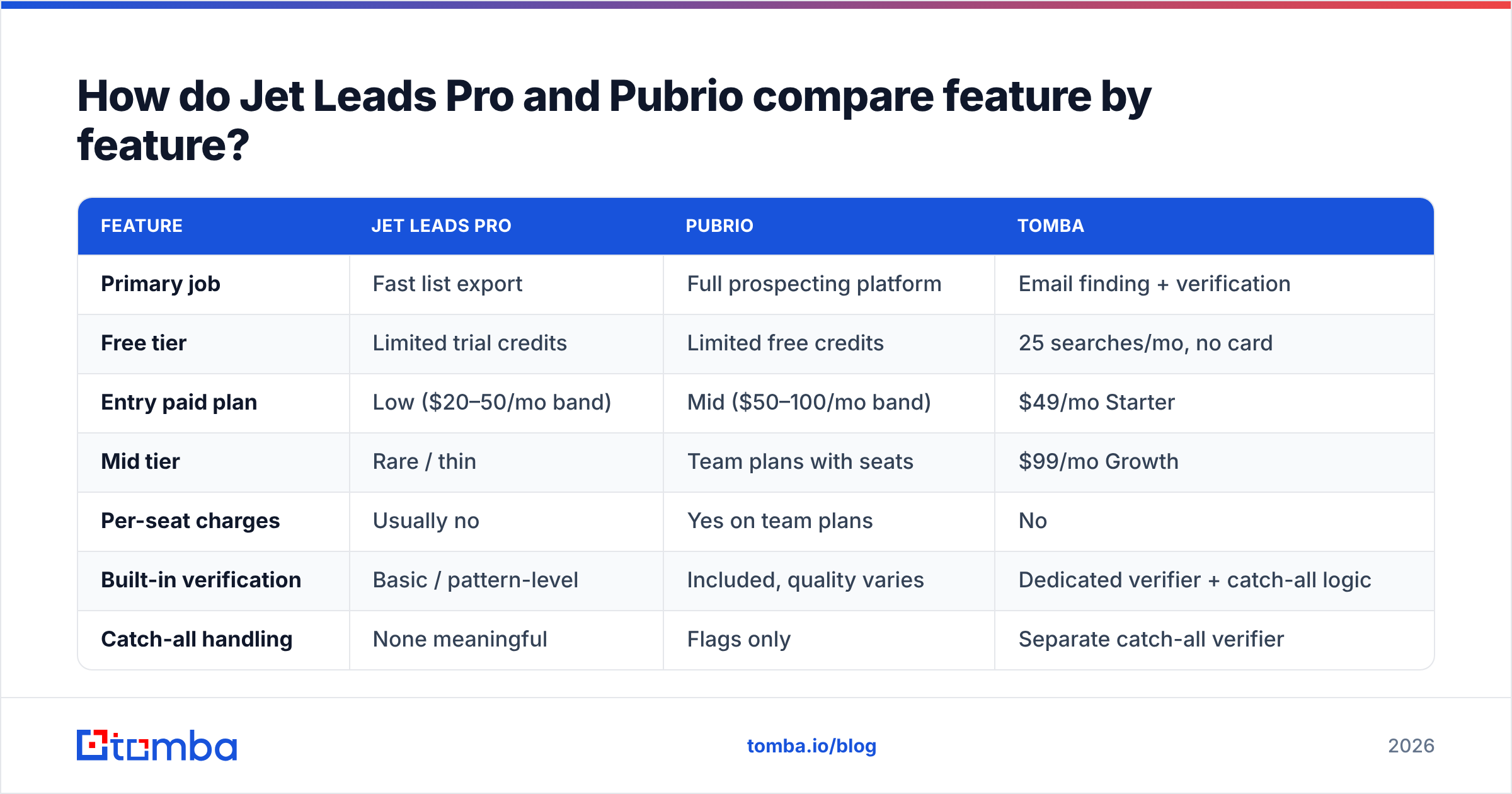
Pricing and packaging on both tools change frequently — treat the numbers below as bands to verify on the vendor's own pricing page, not quotes.
| Feature | Jet Leads Pro | Pubrio | Tomba |
|---|---|---|---|
| Primary job | Fast list export | Full prospecting platform | Email finding + verification |
| Free tier | Limited trial credits | Limited free credits | 25 searches/mo, no card |
| Entry paid plan | Low ($20–50/mo band) | Mid ($50–100/mo band) | $49/mo Starter |
| Mid tier | Rare / thin | Team plans with seats | $99/mo Growth |
| Per-seat charges | Usually no | Yes on team plans | No |
| Built-in verification | Basic / pattern-level | Included, quality varies | Dedicated verifier + catch-all logic |
| Catch-all handling | None meaningful | Flags only | Separate catch-all verifier |
| Bulk processing | CSV export | Bulk enrich on higher tiers | Bulk finder + bulk verify |
| Public API | Limited or none | Yes | Full REST API, CLI, MCP |
| Native integrations | Few | CRM + sequencer set | HubSpot, Salesforce, Pipedrive, Sheets, Zapier |
| Best for | Disposable campaigns | Standardised GTM data | Accuracy-first outbound |

Read that table as three decisions, not twelve. Do you need an API? Pubrio and Tomba, not Jet Leads Pro. Do you need seats for a team? Pubrio charges for them. Do you need verification you'd stake your domain on? Neither Jet Leads Pro nor Pubrio is built primarily for that.
Which tool has better data accuracy?#
Pubrio wins on breadth of correct records; both lose points on how they report confidence.
Here is the part vendors rarely spell out. A B2B contact database is not one thing — it is three layers stacked on top of each other:
- Discovery — does the tool know this person exists at this company? Pubrio's larger crawl and enrichment pipeline generally finds more people per target account than a lightweight scraper does.
- Pattern inference — can it guess
first.last@domain.comcorrectly? Almost every tool does this well, because it's mostly arithmetic on public examples. - Validation — does that inbox actually accept mail today? This is the expensive layer, and it's where cheap tools cut corners by returning a confidence label instead of an SMTP result.
Most "95% accuracy" claims in this category measure layer two and quietly skip layer three. That's why teams import a 2,000-row list, see an 11% bounce rate, and blame their sequencer.

Two practical rules regardless of which tool you pick:
- Never trust a green checkmark you didn't generate. Run exports through an independent email verifier before they touch a sending domain.
- Treat catch-all domains as their own bucket. A catch-all accepts everything at SMTP time, so a "valid" result means almost nothing. A catch-all verifier is the only honest way to score those, and on many enterprise domains catch-all is the default.
Google and Microsoft now cap spam complaints for bulk senders. They also read repeated invalid-recipient hits as a reputation signal. Google's sender guidelines are worth reading once a year. Bounce discipline is no longer a nice-to-have — it's the price of inbox placement.
How does pricing actually compare once you count credits?#
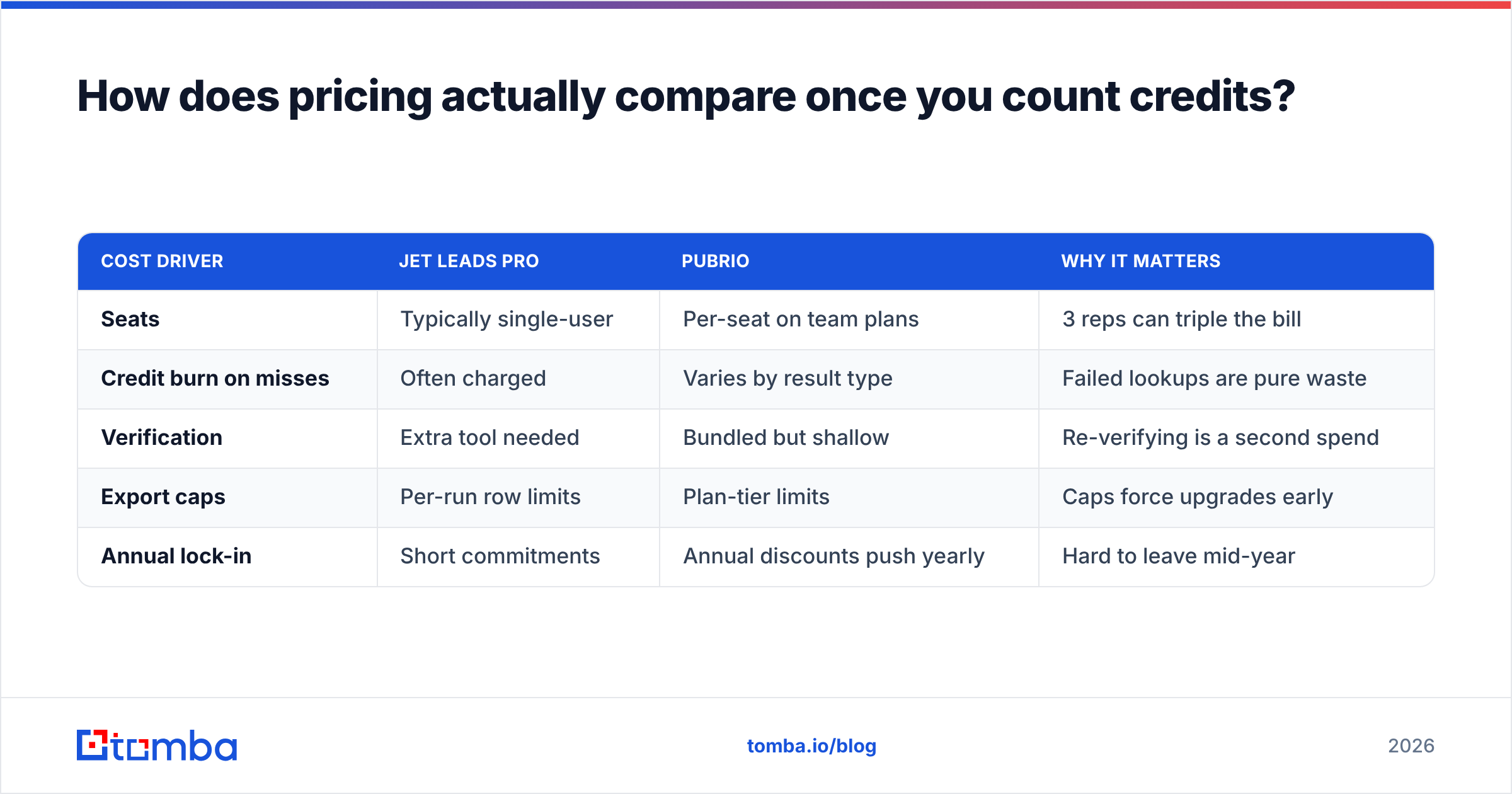
The sticker price is the smaller number. Three multipliers decide your real cost per contact:
| Cost driver | Jet Leads Pro | Pubrio | Why it matters |
|---|---|---|---|
| Seats | Typically single-user | Per-seat on team plans | 3 reps can triple the bill |
| Credit burn on misses | Often charged | Varies by result type | Failed lookups are pure waste |
| Verification | Extra tool needed | Bundled but shallow | Re-verifying is a second spend |
| Export caps | Per-run row limits | Plan-tier limits | Caps force upgrades early |
| Annual lock-in | Short commitments | Annual discounts push yearly | Hard to leave mid-year |
Do the arithmetic that matters: cost ÷ contacts that actually receive mail. A $30/mo tool that returns 1,000 addresses where 620 are deliverable costs you $0.048 per usable contact. A $99/mo tool returning 1,200 addresses at 92% deliverable costs $0.090. That is more per row. You also get a much cleaner sender reputation and far less list cleanup.
For reference, Tomba pricing runs a free tier at 25 searches/mo, Starter at $49/mo, Growth at $99/mo and Pro at $249/mo, with no per-seat surcharge — which changes the math for teams of three or more.
What is Pubrio genuinely better at?#
Breadth and workflow consolidation. Pubrio is the stronger pick when:
- You want one filter interface for firmographics, technographics and hiring signals instead of stitching three tools together.
- You need enrichment on records you already own — appending titles, company size and social profiles to an existing CRM export.
- You have a team and want shared lists, saved searches and some notion of governance over who pulled what.
- You want an API so RevOps can wire lookups into a workflow rather than hand-passing CSVs.
If you're evaluating it seriously, read the peer reviews on G2 rather than the vendor's own case studies. Filter for reviewers in your company-size band. A tool that performs well on 500-person SaaS accounts often performs poorly on sub-50-person regional businesses, and vice versa.
What is Jet Leads Pro genuinely better at?#
Time-to-CSV and low commitment. Jet Leads Pro makes sense when:
- You run short, one-off campaigns and don't want a platform subscription outliving the campaign.
- You're testing a new ICP and need 300 rows to see if the message lands before committing budget.
- You're an agency billing per project and want a tool cost you can expense to a single client.
- Your enrichment needs are shallow — name, company, email, done.
The honest caveat: lightweight scrapers tend to degrade in exactly the places you notice last. Titles go stale, job-changers stay in the index, and there is rarely a refresh cadence you can audit. For a 300-row test that's tolerable. For a quarterly outbound motion, it isn't.

Where do both tools fall short?#
Four gaps show up in almost every evaluation of tools in this class:
- Verification depth. Both report a status; neither is architected as a verification product. Confidence scores are not SMTP results, and the difference shows up in your bounce rate two weeks later.
- Catch-all blind spots. Catch-all domains are common across enterprise and agency accounts. Tools that flag them but don't resolve them effectively hand you a coin flip per row.
- Refresh cadence. B2B contact data decays roughly 2–3% per month through job changes alone. Ask any vendor when a given record was last re-verified — if there's no answer, assume it's old.
- Regional coverage. Both skew toward US and Western European data. If your ICP sits in APAC, LATAM or MENA, run a coverage test on 50 known accounts before you buy anything.
A fifth, structural one: neither tool owns your deliverability. Warmup, SPF/DKIM alignment, sending volume ramp and content quality sit with you. A clean list is necessary, not sufficient. If you're unsure where your domain stands, a sender reputation checker is a five-minute sanity check before you scale volume.
How do they compare against dedicated email finders?#
Different category, different cost curve. Platform tools bundle discovery, enrichment and outreach; dedicated finders optimise one number — deliverable addresses per credit.
| Need | Best served by |
|---|---|
| "Find everyone at 500 target accounts" | Pubrio-class platform |
| "Get 300 leads for a two-week test" | Jet Leads Pro-class utility |
| "I have 4,000 domains, get me valid inboxes" | Dedicated finder + verifier |
| "Validate a purchased list before sending" | Standalone verifier |
| "Wire lookups into our product or workflow" | Provider with a real API |
For the third and fourth rows, domain search plus bulk verify generally beats a platform subscription on cost per usable contact, because you're not paying for filters and dashboards you never open. The trade-off is real: you give up the unified interface and the intent-style signals.
Worth noting that this isn't a two-horse race. BookYourData takes a different approach: pay-as-you-go verified lists with no subscription. That suits teams that buy data in bursts rather than continuously. Include it in your shortlist if your volume is lumpy.
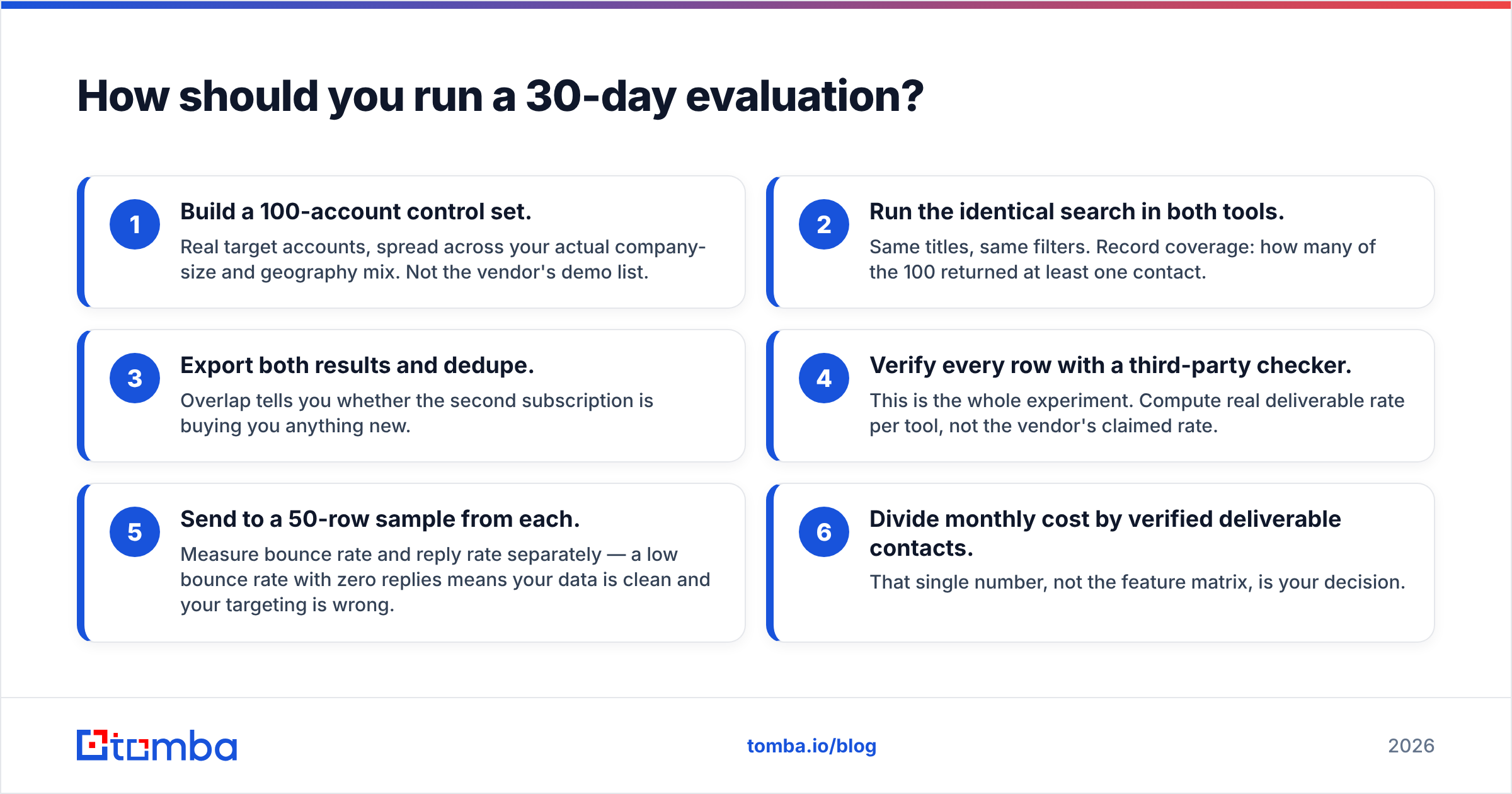
How should you run a 30-day evaluation?#
Don't compare feature pages. Compare outcomes on your ICP, with a test any vendor-neutral analyst would accept.
- Build a 100-account control set. Real target accounts, spread across your actual company-size and geography mix. Not the vendor's demo list.
- Run the identical search in both tools. Same titles, same filters. Record coverage: how many of the 100 returned at least one contact.
- Export both results and dedupe. Overlap tells you whether the second subscription is buying you anything new.
- Verify every row with a third-party checker. This is the whole experiment. Compute real deliverable rate per tool, not the vendor's claimed rate.
- Send to a 50-row sample from each. Measure bounce rate and reply rate separately — a low bounce rate with zero replies means your data is clean and your targeting is wrong.
- Divide monthly cost by verified deliverable contacts. That single number, not the feature matrix, is your decision.
Six steps, about four hours of work, and it settles arguments that otherwise run for a quarter. Run that test on Jet Leads Pro vs Pubrio and the winner picks itself. HubSpot's sales research shows what normal reply rates look like in your segment. Use it to judge whether your sample result is good or merely average.
Jet Leads Pro vs Pubrio: which should you pick?#
Pick Pubrio if you have a team, need filters beyond name-and-email, and want one data source your CRM can standardise on. The per-seat cost is defensible when three or more people use it daily.
Pick Jet Leads Pro if you're solo or agency-side, your campaigns are short, and you'd rather pay less and verify separately. Just budget for that verification step — it isn't optional.
Pick neither if your actual bottleneck is turning a list of companies into inboxes that accept mail. That's a narrower problem, and narrower tools solve it cheaper.
That last case is where Tomba fits. Start with the Tomba Email Finder — free tier at 25 searches/month, no card, Starter at $49/mo with no per-seat charges. Run your 100-account control set through it alongside whichever platform you're evaluating, verify both exports, and let the deliverable-contacts-per-dollar number pick the winner for you.
Related guides#
// get started
Find, verify and enrich your first contacts today
Start on the free plan with 25 searches a month, then scale when your team is ready.
Free plan · No credit card required · GDPR & CCPA
// about the author