9 Best Jiminny Alternatives in 2026: Compared and Ranked
Jiminny is solid conversation intelligence, but it is not the only option — and rarely the cheapest. Here are nine Jiminny alternatives compared on price, coaching depth, CRM fit, and what happens to your call history when you switch.
TL;DR
- Jiminny is a strong mid-market conversation intelligence platform — recording, transcription, coaching scorecards, and deal visibility in one place. Most teams leave over per-seat cost, not product quality.
- If you want enterprise-grade revenue intelligence, look at Gong or Chorus. If you want the same core value for a fraction of the price, look at Avoma, Clari Copilot, or Fathom.
- Free and near-free options (Fathom, Fireflies, tl;dv, Grain) cover recording and summaries well, but thin out fast on coaching analytics and forecasting.
- Ask about call-history export before you sign anything. Transcripts are the switching cost, not the software.
- Conversation intelligence only improves calls you already booked. If pipeline is the real constraint, spend the budget on contact data first.
What is Jiminny, and who is it actually for?#
Think of conversation intelligence as a dashcam for your sales calls. It records everything, transcribes it, flags the moments that matter, and lets a manager review the crash without having been in the car.
Jiminny does that for revenue teams. It captures calls and meetings across Zoom, Google Meet, Microsoft Teams, and its own dialer, transcribes and scores them, and pushes activity back into HubSpot, Salesforce, or Pipedrive. On top of the recordings sit the things managers actually buy: coaching scorecards, keyword and topic tracking, talk-ratio and monologue metrics, call libraries for onboarding, and deal-level views that show which opportunities have gone quiet.
Its sweet spot is the 10–100 rep team that has outgrown "record the call and hope someone watches it" but does not want an enterprise revenue platform with a six-figure floor. Jiminny is generally well-reviewed on support and ease of onboarding — this is not a post about a bad product. It is a post about fit and price.
Why do teams look for Jiminny alternatives?#
Five patterns show up repeatedly in switch conversations:
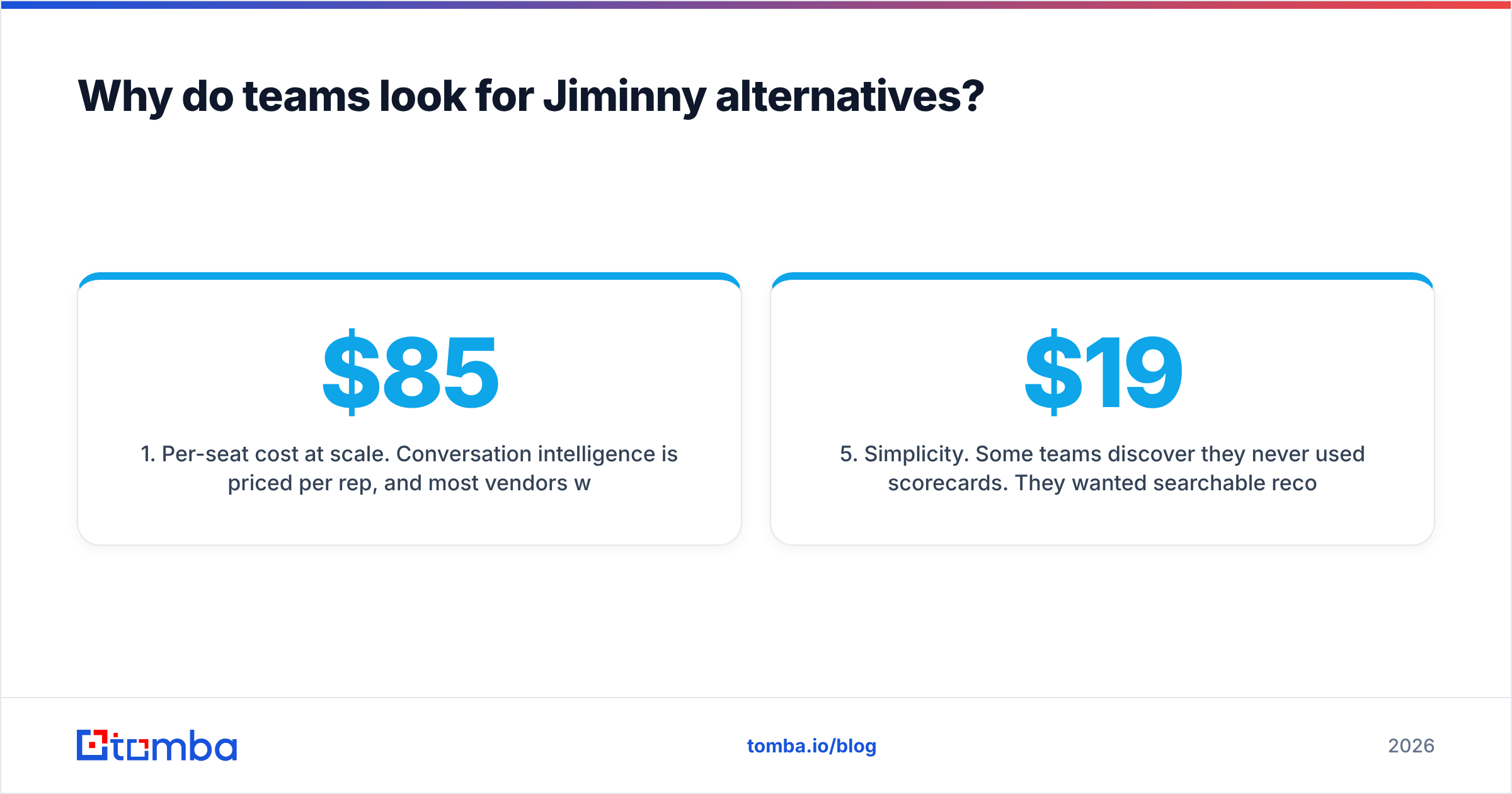
- Per-seat cost at scale. Conversation intelligence is priced per rep, and most vendors want every rep licensed — including the ones who take two calls a week. A 40-person team at roughly $85 per user per month is around $40,000 a year to review calls.
- Seat minimums and annual terms. Several platforms in this category, Jiminny included, are sold on annual contracts with a minimum seat count. That is fine at steady headcount and painful when you are hiring in waves or cutting.
- Forecasting depth. If your CRO wants pipeline inspection, scenario forecasting, and deal-risk scoring, dedicated revenue platforms (Gong, Clari) go deeper than a coaching-first tool.
- Feature overlap. If you already own ZoomInfo, Salesloft, or Clari, conversation intelligence may be bundled into a product you are paying for. Paying twice is the most common reason a renewal gets killed.
- Simplicity. Some teams discover they never used scorecards. They wanted searchable recordings and a summary in the CRM — which a $19/user notetaker does fine.
What should you compare before switching?#
Do not start from a feature grid. Start from these six questions, in this order.
- What is the real job? Recording and recall, rep coaching, or deal forecasting? These are three different products wearing the same label. Tools that are excellent at the first are usually mediocre at the third.
- Who needs a seat? Some vendors charge per recorded user, some per licensed user, some per host. The difference on a 60-person go-to-market org can be $30,000 a year for identical functionality.
- How good is the CRM write-back? A call summary that lands in a Slack channel is a nice-to-have. A call summary auto-logged to the right opportunity in Salesforce with next steps parsed out is a process change. Check field-level mapping, not just "integrates with."
- What is the transcription quality on your accents and languages? English-only accuracy benchmarks mean nothing if a third of your pipeline is in French, German, or Portuguese. Test on your own recordings during trial, not the vendor's demo call.
- How does data leave? Ask specifically: can you bulk-export transcripts, recordings, and metadata, in what format, and at what cost? Get the answer in writing before signing.
- What is the compliance posture? Two-party consent handling, regional data residency, SOC 2 and GDPR documentation, and per-recording deletion requests. This kills more deals in procurement than pricing does.
Which Jiminny alternatives are worth shortlisting in 2026?#
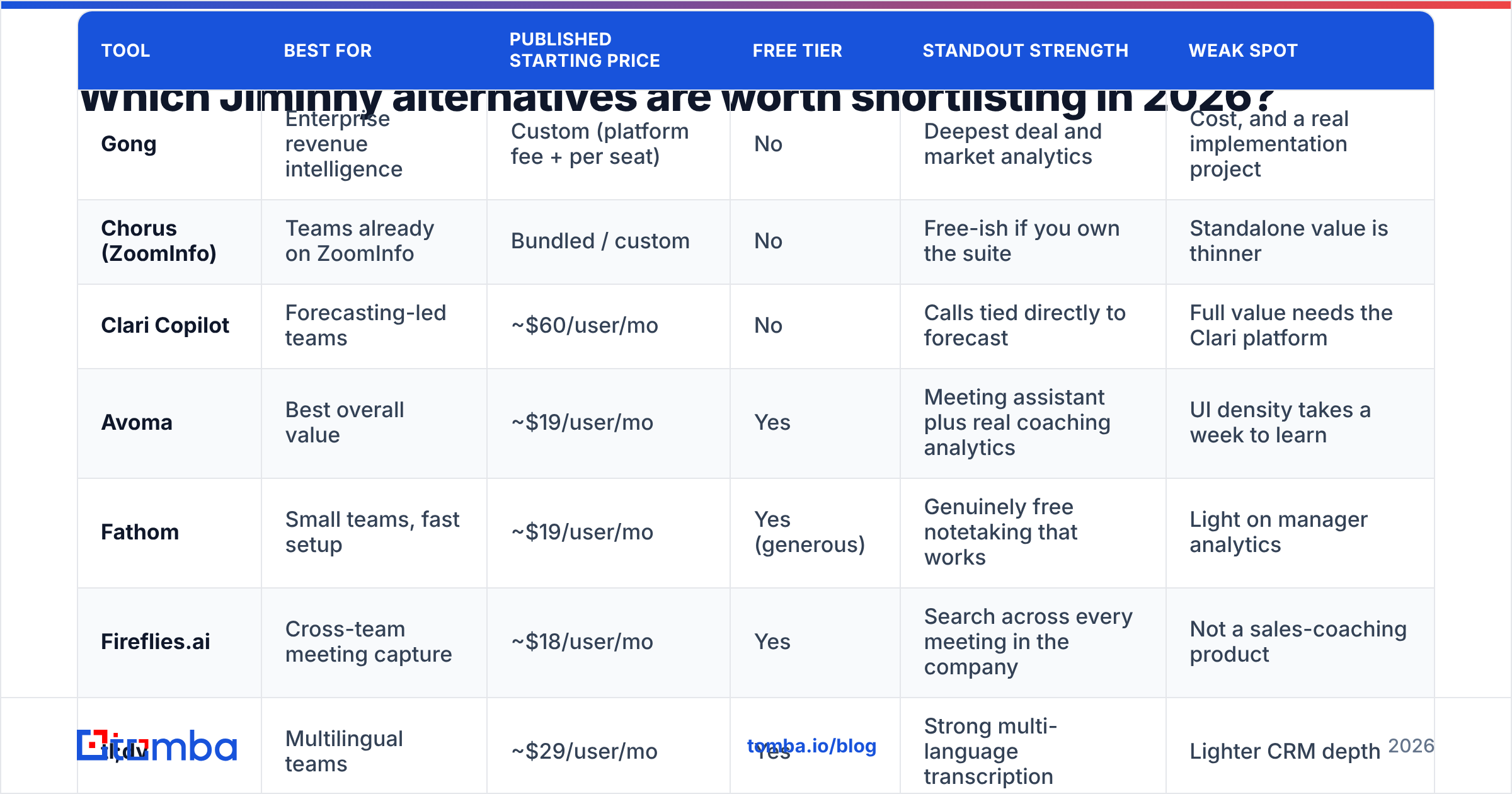
Here is the shortlist, scanned in one table. Prices are published list rates at the time of writing and move often — confirm on the vendor's own pricing page before you budget.
| Tool | Best for | Published starting price | Free tier | Standout strength | Weak spot |
|---|---|---|---|---|---|
| Gong | Enterprise revenue intelligence | Custom (platform fee + per seat) | No | Deepest deal and market analytics | Cost, and a real implementation project |
| Chorus (ZoomInfo) | Teams already on ZoomInfo | Bundled / custom | No | Free-ish if you own the suite | Standalone value is thinner |
| Clari Copilot | Forecasting-led teams | ~$60/user/mo | No | Calls tied directly to forecast | Full value needs the Clari platform |
| Avoma | Best overall value | ~$19/user/mo | Yes | Meeting assistant plus real coaching analytics | UI density takes a week to learn |
| Fathom | Small teams, fast setup | ~$19/user/mo | Yes (generous) | Genuinely free notetaking that works | Light on manager analytics |
| Fireflies.ai | Cross-team meeting capture | ~$18/user/mo | Yes | Search across every meeting in the company | Not a sales-coaching product |
| tl;dv | Multilingual teams | ~$29/user/mo | Yes | Strong multi-language transcription | Lighter CRM depth |
| Grain | Customer-facing storytelling | ~$19/user/mo | Yes | Clip creation and sharing | Limited forecasting |
| Salesloft Conversations | Teams standardizing on one sequencer | Bundled / custom | No | One workflow, one vendor | Only sensible if you buy the platform |
Gong#
The category leader, and priced like it. Gong does what Jiminny does and adds market intelligence, deal boards, and forecast modeling built on conversation data rather than rep self-reporting. If you have 100+ reps and a RevOps function to own it, Gong is the benchmark. Below that headcount, you will pay for depth you never open. Expect a platform fee on top of per-seat pricing, and expect an annual commitment.
Pick it if: you want one system of record for what buyers are saying across a large sales org.
Chorus by ZoomInfo#
Chorus is credible conversation intelligence that became most interesting as a bundle. If you already license ZoomInfo, adding Chorus is often the cheapest path to call recording and coaching your team will accept. Judged purely standalone against Jiminny, the coaching workflow feels less opinionated.
Pick it if: ZoomInfo is already a line item and you want to consolidate.
Clari Copilot#
Formerly Wingman. Clari Copilot's angle is that a call is only interesting because of what it does to the forecast. Live battlecards during calls, deal-risk signals, and tight coupling to Clari's forecasting make it the natural choice for teams whose weekly ritual is pipeline inspection, not call review. As a standalone at roughly $60 per user per month it is competitive with Jiminny; as part of Clari it is a different conversation.
Pick it if: your VP Sales lives in the forecast, not the call library.
Avoma#
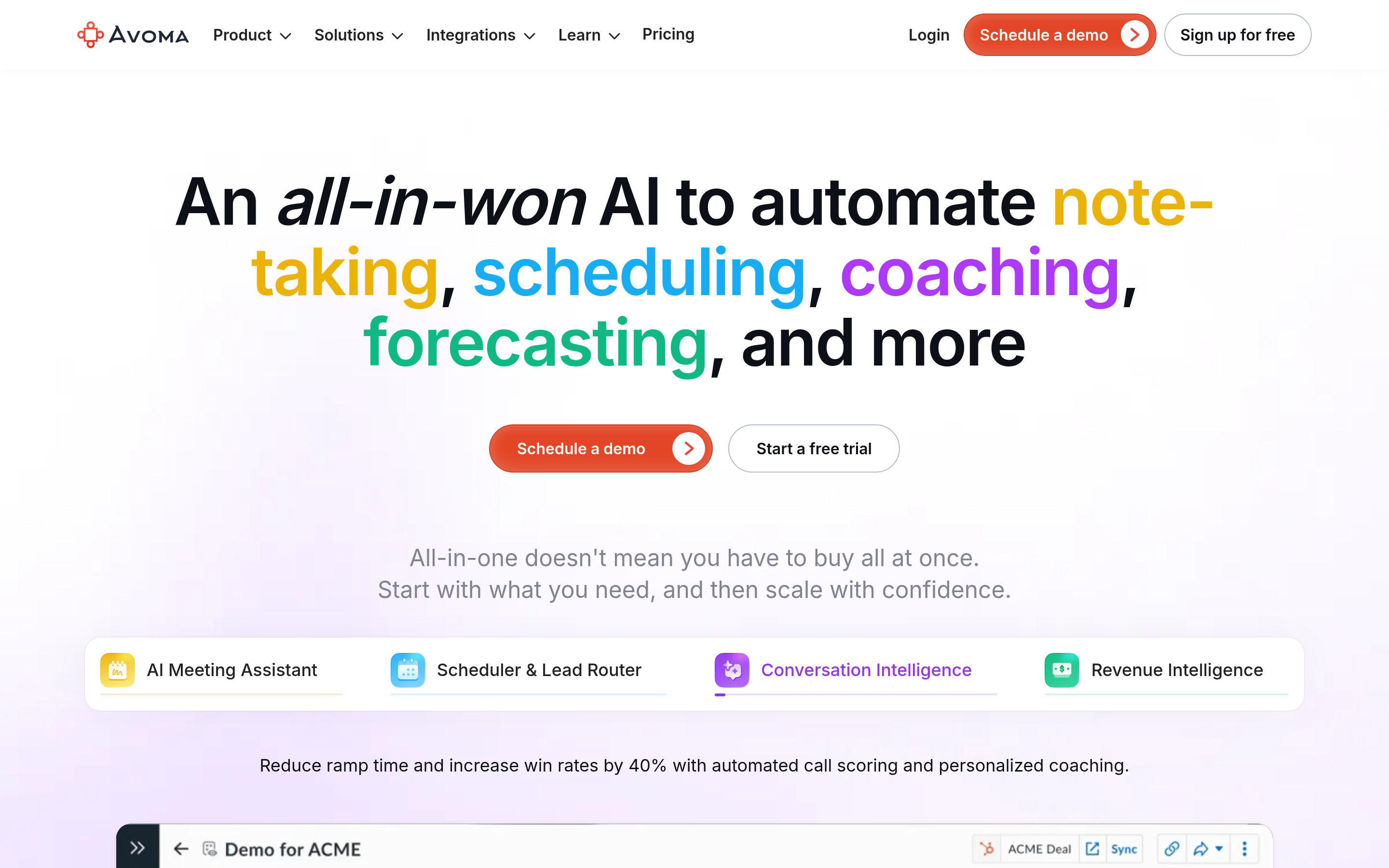
The best price-to-capability ratio on this list. Avoma started as an AI meeting assistant and grew into genuine revenue intelligence: agenda templates, collaborative notes, topic and filler-word analytics, scorecards, and conversation trends — with a free tier and paid plans starting near $19 per user per month, scaling to around $79 for the revenue-intelligence tier.
Pick it if: you want 80% of Jiminny at 30% of the cost and can live with a busier interface.
Fathom#
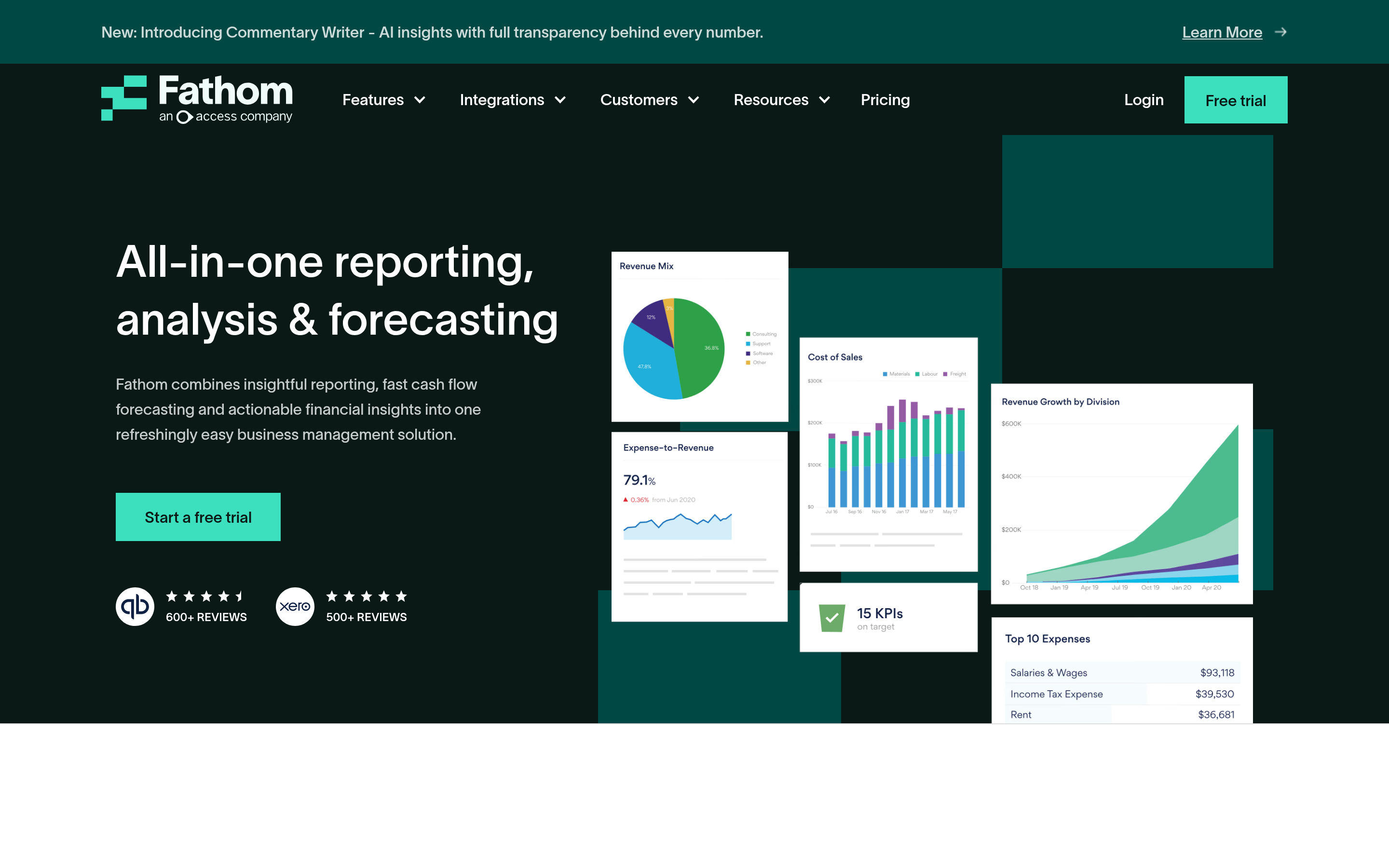
Fathom's free plan is the most generous in the category and it is not a trap — unlimited recording and transcription for individuals, with paid tiers around $19–$39 per user per month for team features and CRM sync. It is fast, unobtrusive, and reps actually adopt it. What you do not get is a serious manager analytics layer.
Pick it if: you want recordings and summaries tomorrow, with near-zero rollout friction.
Fireflies.ai#
Fireflies sits slightly outside the sales-coaching lane and covers the whole company: product interviews, standups, customer calls, all searchable in one place. Pricing starts around $18 per user per month with a usable free tier. If your requirement is "we can never find what was said," this wins. If it is "our AEs need coaching on discovery," it does not.
Pick it if: the buyer is the whole org, not just sales.
tl;dv#
Strong multilingual transcription and a workflow built around clipping and sharing moments, with a free tier and paid plans near $29 per user per month. It is the pragmatic pick for European teams selling in three or four languages, where accuracy on non-English calls is the deciding factor.
Pick it if: your pipeline is not English-first.
Grain#
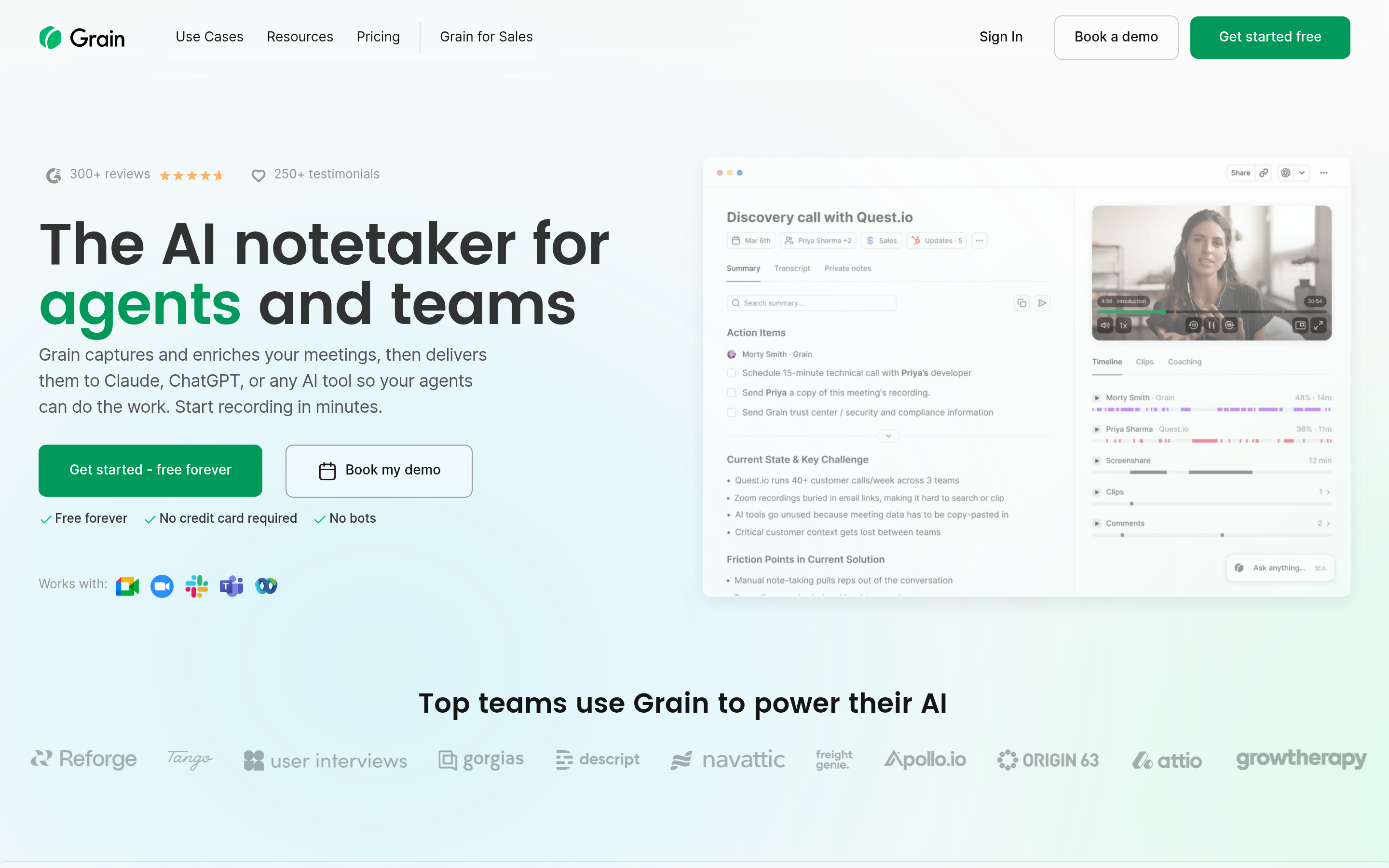
Grain is built for turning calls into artifacts other people consume — highlight reels for product, objection clips for enablement, customer quotes for marketing. Paid plans start around $19 per user per month. Coaching analytics exist but are not the center of gravity.
Pick it if: your bottleneck is getting the voice of the customer out of sales and into the rest of the company.
Salesloft Conversations#
Only interesting as part of the Salesloft platform, where recording, analysis, cadences, and dialer live in one workflow. Consolidation has a real value: fewer integrations to babysit, one place where activity is logged, one vendor to negotiate with. Standalone, it is not the strongest analysis engine here.
Pick it if: you are consolidating sequencing, dialing, and call review into a single contract.
Does conversation intelligence actually fix a weak pipeline?#
No — and this is the part vendors never lead with. Every tool on this list improves the quality of conversations you have already booked. None of them create conversations.
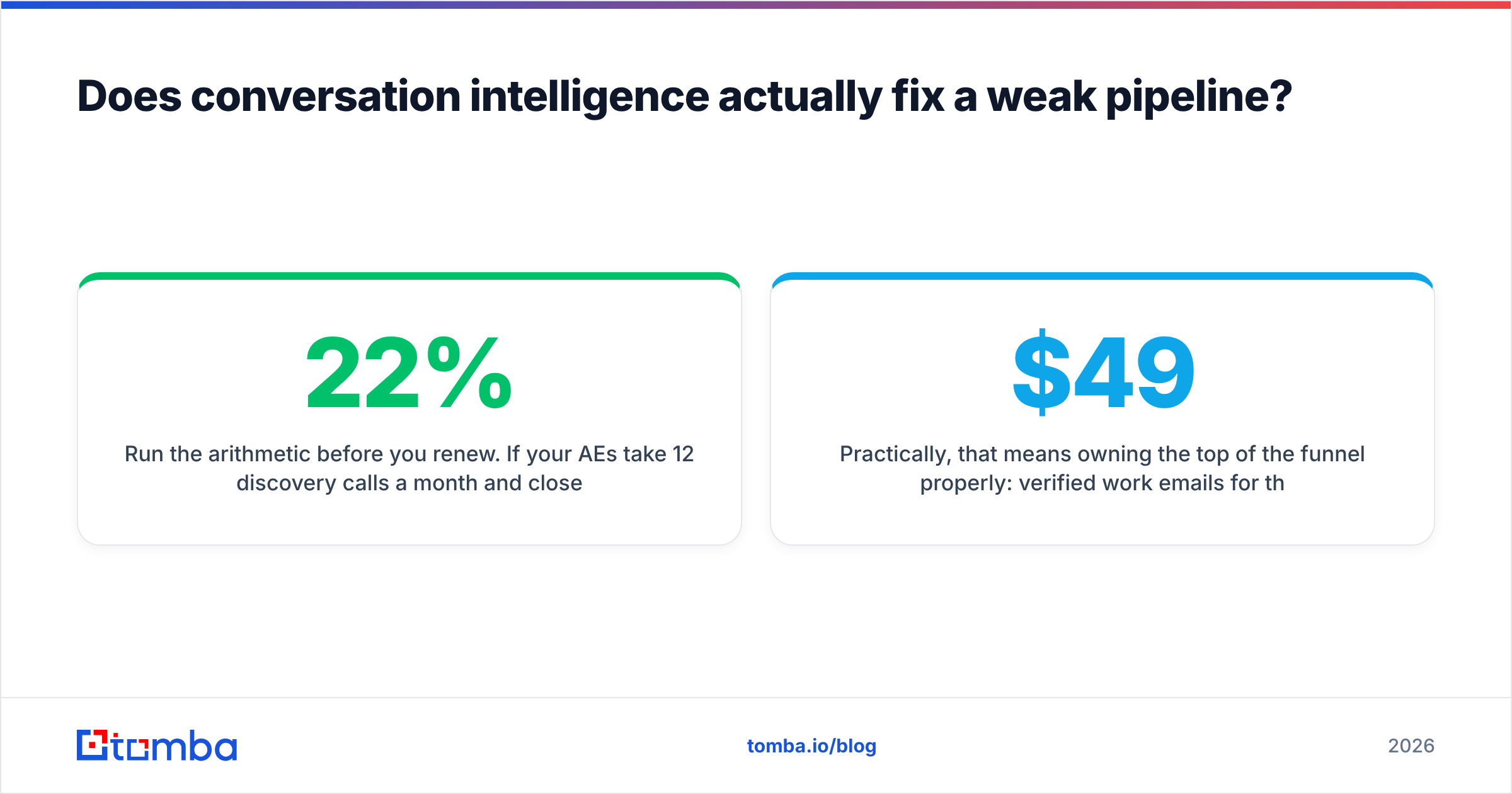
Run the arithmetic before you renew. If your AEs take 12 discovery calls a month and close at 22%, a coaching platform that lifts close rate to 26% adds roughly half a deal per rep per month. Real, but modest. If the same rep could take 18 calls instead of 12 at the current 22%, you get more than twice that lift. When call volume is the constraint, coaching software is an expensive way to solve the wrong problem.
That is why the healthier budget split for most teams under 50 reps is: a cheap, good-enough notetaker (Avoma or Fathom) plus serious investment in contact data and outbound targeting. Accurate emails and direct dials are what put meetings on the calendar; conversation intelligence is what you buy once the calendar is full.
Practically, that means owning the top of the funnel properly: verified work emails for the accounts you actually target, B2B phone numbers for the personas who never answer email, and contact enrichment so the records syncing into your CRM are complete rather than half-blank. Tomba's HubSpot integration handles that write-back so your CI tool has something to attach calls to. At $49/month for the Starter plan — see Tomba pricing for the full breakdown — that layer typically costs less than three conversation-intelligence seats.
How do you switch without losing your call history?#
Migrations fail on data, not features. Work this sequence:
- Export first, cancel second. Request a full export of transcripts, recordings, and metadata while your contract is live. Some vendors restrict export windows after termination.
- Decide what is worth keeping. In practice, teams keep the last 90 days of active deals plus the enablement library. Nobody rewatches a call from 2024.
- Run 30 days in parallel. Overlap costs one month of double spend and saves you from discovering that transcription accuracy on your calls is worse than the demo suggested.
- Rebuild scorecards deliberately. Do not port your old scorecard verbatim. Most teams find half their criteria were never scored.
- Re-check CRM field mapping. Every platform writes activity differently. Validate against ten real opportunities before you cut over, not after.
- Re-confirm consent and recording notices. New vendor, new processor, new disclosure language in your privacy notice.
Which Jiminny alternative should you pick?#
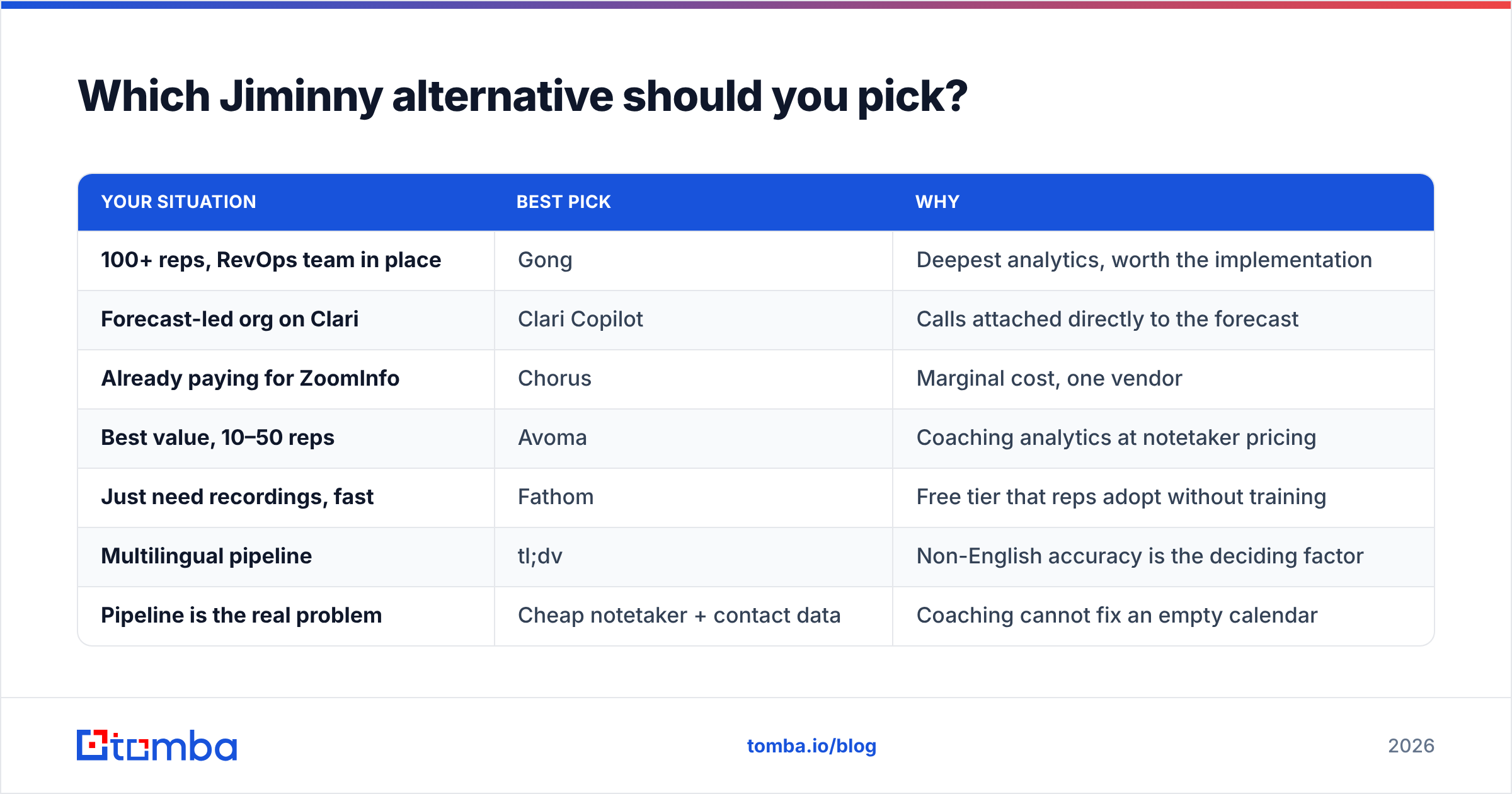
Short version, by situation:
| Your situation | Best pick | Why |
|---|---|---|
| 100+ reps, RevOps team in place | Gong | Deepest analytics, worth the implementation |
| Forecast-led org on Clari | Clari Copilot | Calls attached directly to the forecast |
| Already paying for ZoomInfo | Chorus | Marginal cost, one vendor |
| Best value, 10–50 reps | Avoma | Coaching analytics at notetaker pricing |
| Just need recordings, fast | Fathom | Free tier that reps adopt without training |
| Multilingual pipeline | tl;dv | Non-English accuracy is the deciding factor |
| Pipeline is the real problem | Cheap notetaker + contact data | Coaching cannot fix an empty calendar |
If you want a neutral scoreboard alongside this, the conversation intelligence category on G2 is the least biased volume of recent reviews available, and worth ten minutes of filtering by company size before you book demos.
And be honest about the do-nothing option. If Jiminny is working, your reps use it, and the renewal is flat, switching to save $15 per seat is a quarter of RevOps time you will not get back.
Fill the calendar before you buy the coach#
Every tool on this list makes good calls better. None of them make the phone ring. If your reps have gaps in their week, the highest-ROI purchase is not another seat license — it is a reliable way to reach the right people at the right accounts.
Start with Tomba Email Finder: find verified professional email addresses by name, domain, or company, check them before you send, and push clean records into your CRM so your conversation intelligence tool has something to record. The free tier gives you 25 searches a month to test accuracy on your own target accounts — run it against a list you already know, and judge it on the hit rate.
Related guides#
// get started
Find, verify and enrich your first contacts today
Start on the free plan with 25 searches a month, then scale when your team is ready.
Free plan · No credit card required · GDPR & CCPA
Get the Tomba newsletter
Product and data updates
// about the author