Job Description for Sales Development Representative (2026)
Most SDR job postings are copy-paste quota fantasies. Here's what the role actually involves in 2026, with real duties, comp bands, KPI targets, and a template you can paste into your ATS today.
TL;DR
- A job description for sales development representative should describe pipeline creation, not "generating leads" — the difference is whether the role owns meetings held or just activity counts.
- SDR and BDR are not interchangeable. SDR usually means outbound cold prospecting; BDR often means inbound qualification. Pick one and say which in the posting.
- 2026 US base pay for an SDR sits around $50K–$65K base with $75K–$95K OTE. Senior/enterprise SDRs run $65K–$80K base, $110K+ OTE.
- The KPI section is where most postings lie. Publish meetings-held targets and ramp timelines, not just "150 activities/day."
- Name your actual stack. Candidates screen you on tooling now — a posting that lists a CRM, a sequencer, and a real email finder signals you won't make them scrape LinkedIn by hand.
What is a sales development representative?#
An SDR is the person who turns a list of companies into calendar invites for someone else. That's the whole job, compressed.
Think of a restaurant. The account executive is the chef — they cook the deal and get judged on the plate that goes out. The SDR is the person who fills the dining room. No diners, no dinner service, no matter how good the chef is. The SDR does not close revenue, does not negotiate contracts, and usually does not run demos. They create qualified first meetings.
That framing matters when you write the posting, because the two most common failure modes both come from blurring it:
- Writing an AE job description and calling it an SDR role. If the posting mentions "own the full sales cycle" or "carry a revenue quota," you are hiring an AE at SDR pay. Good candidates spot this in ten seconds and skip.
- Writing a call-center job description and calling it sales development. If the only numbers in the posting are dials and emails sent, you are advertising an activity job. You will attract people who optimize for activity.
The honest definition to anchor on: an SDR owns the top of the funnel, from raw account list to accepted meeting, and is measured on meetings that actually happen.
What does an SDR actually do all day?#
Break the day into four buckets. A good job description for sales development representative describes all four, because candidates who have done the job will notice if you left one out.
- Research and list building (1–2 hrs). Pulling target accounts that match the ICP, finding the right title at each one, confirming contact data is current. This is unglamorous and it is where most SDR time actually leaks.
- Outbound execution (3–4 hrs). Cold calls, personalized email sequences, LinkedIn touches. Real multichannel work — not "blast 400 emails and hope."
- Inbound response and qualification (1–2 hrs). Working demo requests, content downloads, and website signals within minutes, not days. Speed-to-lead is still the single biggest lever on inbound conversion.
- Handoff and hygiene (30–60 min). Logging notes, writing the context brief for the AE, keeping CRM fields clean so forecasting isn't fiction.
Notice what's missing: closing, pricing conversations, and contract work. If your reps do those, retitle the role.
What's the difference between an SDR, a BDR, and an AE?#
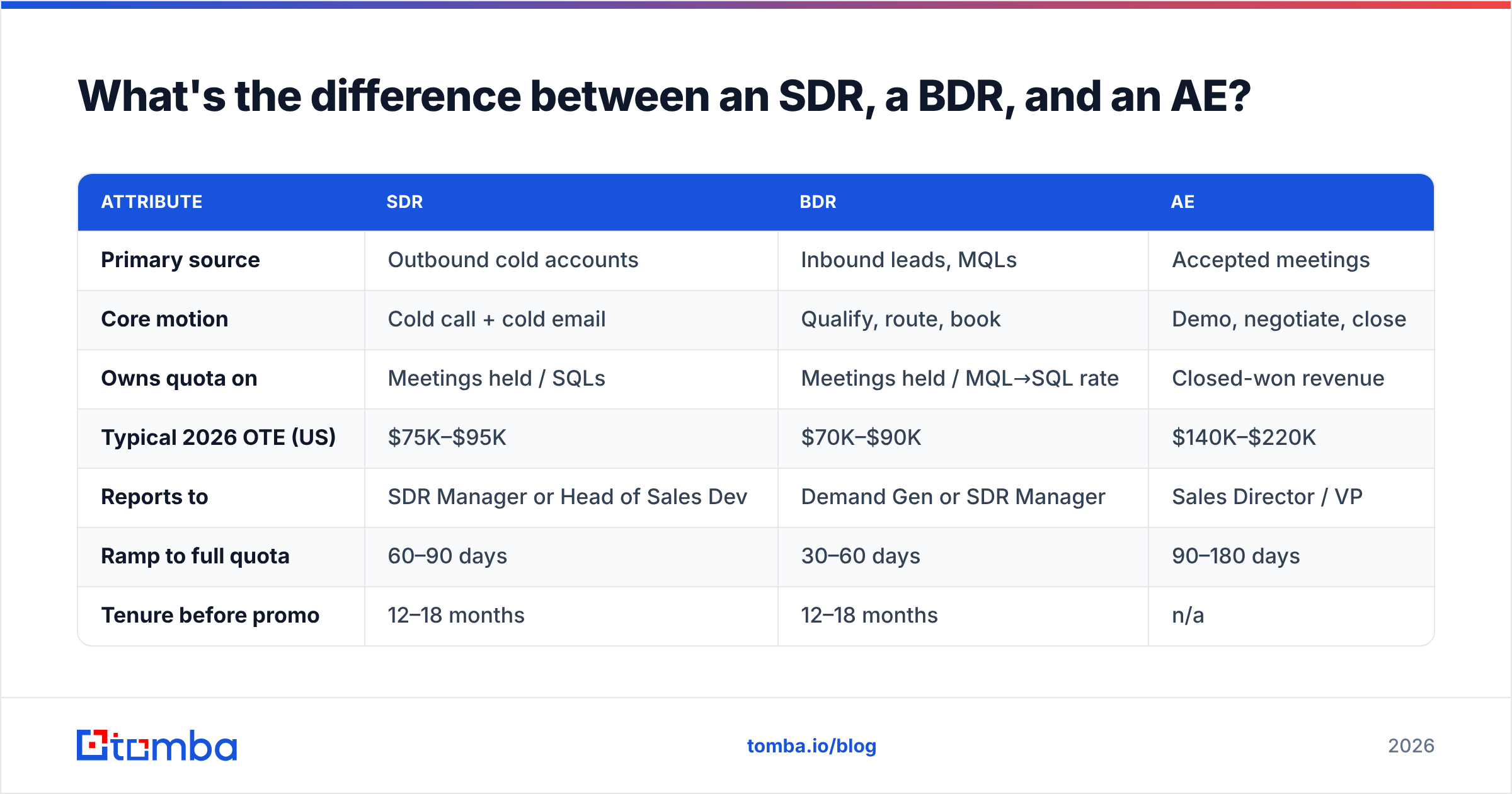
Companies use these titles inconsistently, which is exactly why your posting should define them. Here's the most common split in B2B SaaS, and the version most candidates will assume unless you say otherwise.
| Attribute | SDR | BDR | AE |
|---|---|---|---|
| Primary source | Outbound cold accounts | Inbound leads, MQLs | Accepted meetings |
| Core motion | Cold call + cold email | Qualify, route, book | Demo, negotiate, close |
| Owns quota on | Meetings held / SQLs | Meetings held / MQL→SQL rate | Closed-won revenue |
| Typical 2026 OTE (US) | $75K–$95K | $70K–$90K | $140K–$220K |
| Reports to | SDR Manager or Head of Sales Dev | Demand Gen or SDR Manager | Sales Director / VP |
| Ramp to full quota | 60–90 days | 30–60 days | 90–180 days |
| Tenure before promo | 12–18 months | 12–18 months | n/a |
Some organizations flip SDR and BDR entirely — at a few large enterprises, BDR is the outbound cold role and SDR handles inbound. Neither convention is "correct." State yours in the first paragraph of the posting and move on.
What should go in a job description for a sales development representative?#
Use this structure. It maps to how candidates actually read a posting: they scan for comp, then for what they'll be doing, then for whether they can win.
1. Role summary (3 sentences max). Who you sell to, what motion (outbound/inbound/both), and who the SDR reports to. Example: "You'll run outbound prospecting into mid-market logistics companies (200–2,000 employees), booking discovery calls for two enterprise AEs. You'll report to the Head of Sales Development."
2. Compensation, stated up front. Base range, OTE, and whether commission is capped. Pay transparency is legally mandated in a growing number of US states and increasingly expected everywhere else. Postings without a range get materially fewer qualified applicants.
3. What you'll do (5–7 bullets, verbs first). Concrete actions, not aspirations. "Run 60–80 cold calls per day into a named account list of 150 accounts" beats "leverage multichannel outreach to drive engagement."
4. What success looks like at 30/60/90 days. This is the single highest-signal section and almost nobody writes it. It tells a candidate you've thought about ramp, and it protects you from a rep who expected six months of grace.
5. What we're looking for (split must-have vs nice-to-have). Three must-haves, maximum. Every additional "required" bullet shrinks your applicant pool disproportionately — and research on job postings consistently shows it shrinks it most among the candidates you were hoping to attract.
6. Your stack. Name the CRM, the sequencer, the dialer, and the data source. Candidates evaluate the tooling as a proxy for whether the job is survivable.
7. Career path. Where does this role go in 18 months — AE, senior SDR, sales ops? If you can't answer, expect 9-month attrition.
What should you pay an SDR in 2026?#
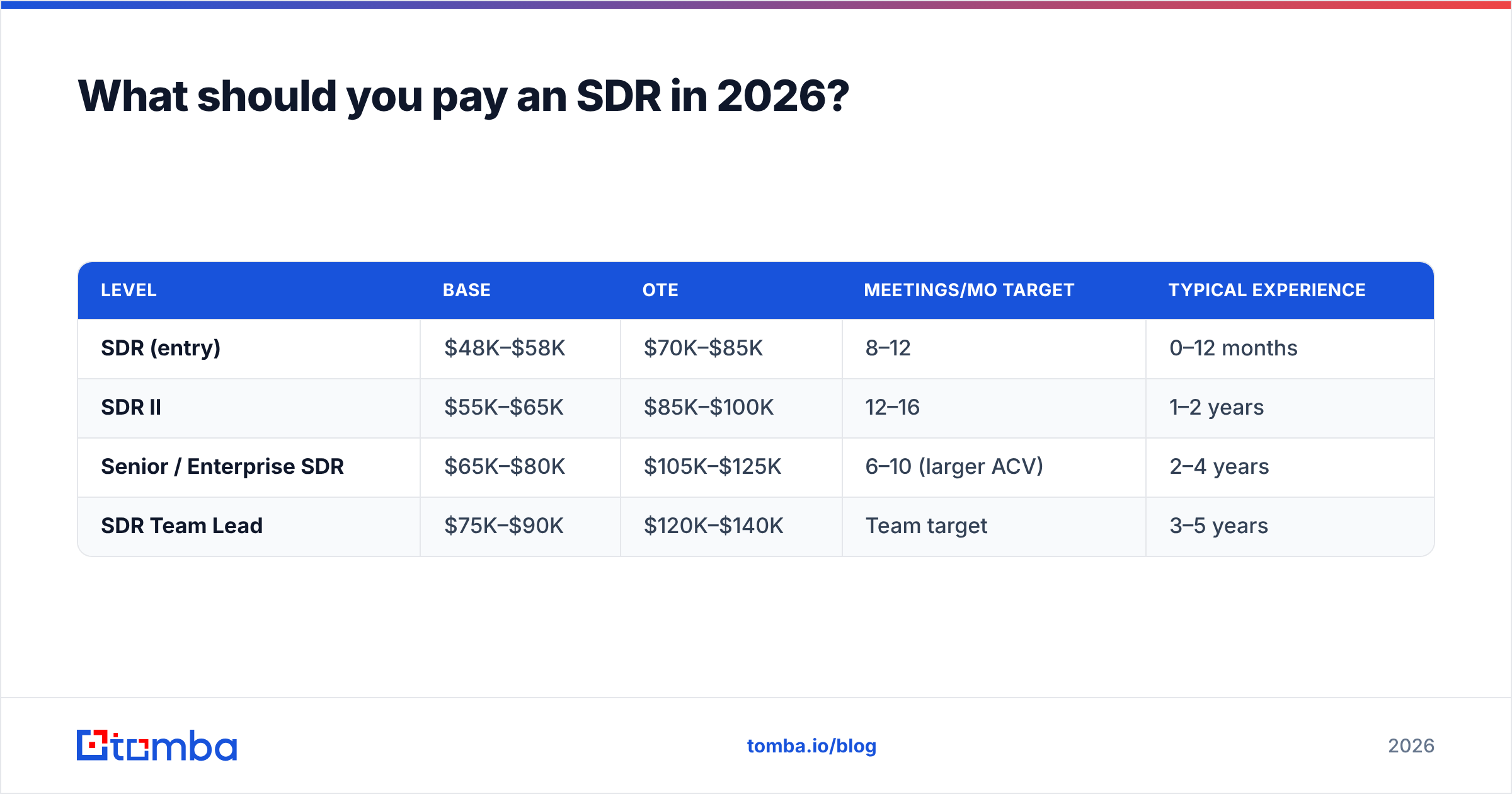
Ranges vary by market and segment, but here's a realistic US band structure. Adjust down roughly 15–25% for most non-coastal markets and considerably more for EMEA/LATAM hubs.
| Level | Base | OTE | Meetings/mo target | Typical experience |
|---|---|---|---|---|
| SDR (entry) | $48K–$58K | $70K–$85K | 8–12 | 0–12 months |
| SDR II | $55K–$65K | $85K–$100K | 12–16 | 1–2 years |
| Senior / Enterprise SDR | $65K–$80K | $105K–$125K | 6–10 (larger ACV) | 2–4 years |
| SDR Team Lead | $75K–$90K | $120K–$140K | Team target | 3–5 years |
Two notes on the commission side. First, pay on meetings held, not meetings booked — otherwise you're paying for no-shows and you'll get them. Second, many teams now add a small kicker on sourced closed-won (often 1–3% of first-year ACV), which keeps SDRs caring about quality after the handoff. You can sanity-check your bands against public data on G2's sales software category reviews and published comp reports before you commit numbers to a posting.
Which KPIs belong in the job description?#
Publish the numbers. A vague posting attracts vague candidates.
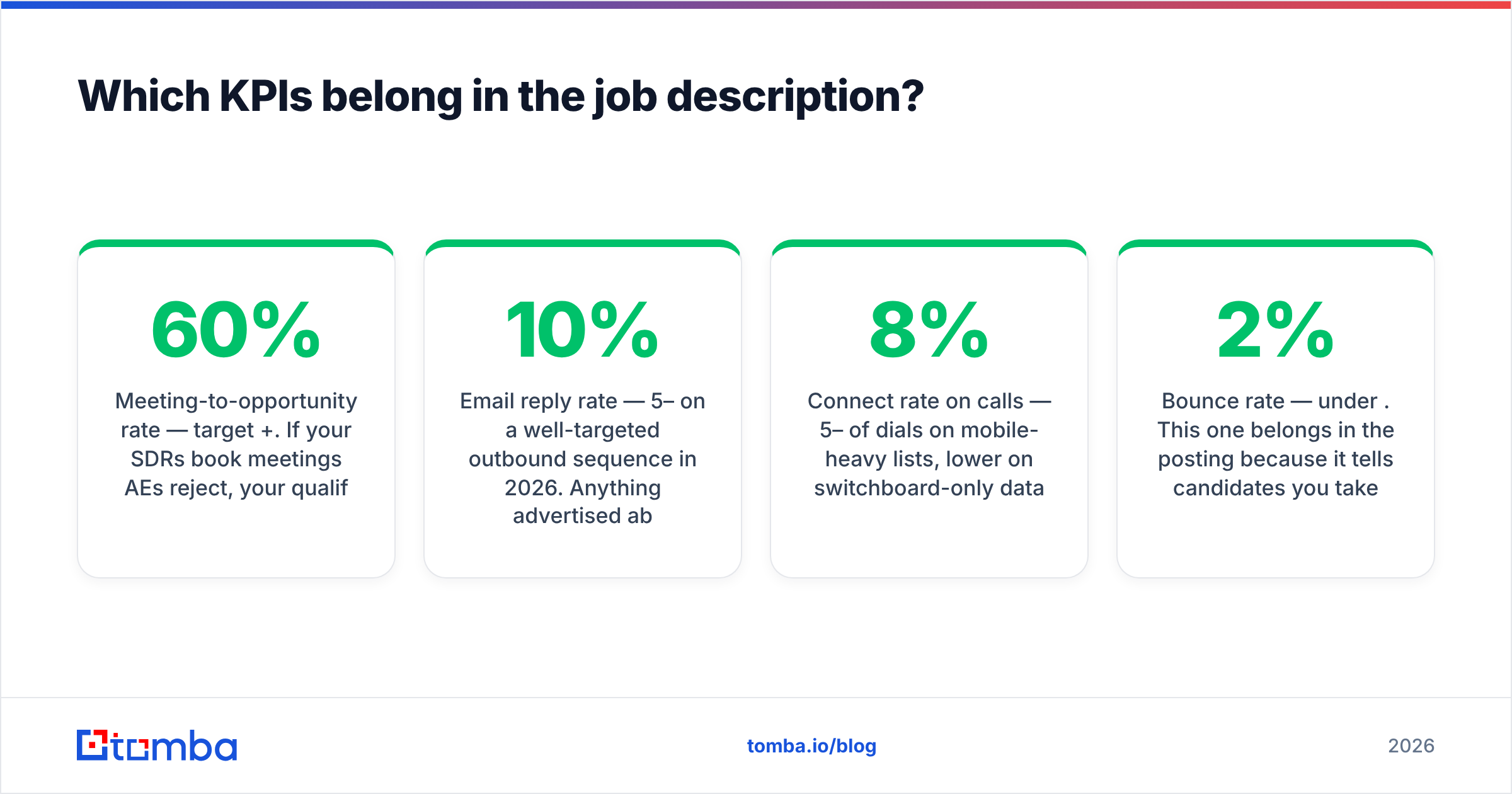
- Meetings held per month — the headline number. 8–12 for mid-market, 6–10 for enterprise.
- Meeting-to-opportunity rate — target 60%+. If your SDRs book meetings AEs reject, your qualification criteria are broken, not your reps.
- Email reply rate — 5–10% on a well-targeted outbound sequence in 2026. Anything advertised above 15% is either warm inbound or fiction.
- Connect rate on calls — 5–8% of dials on mobile-heavy lists, lower on switchboard-only data.
- Bounce rate — under 2%. This one belongs in the posting because it tells candidates you take data quality seriously. Teams that don't verify emails before sending routinely run 8–15% bounce rates, and the rep pays for it in sender reputation and in quota.
That last point deserves its own section, because it's the quiet reason good SDRs quit.

Why does data quality belong in an SDR job description?#
Because the job is arithmetic, and bad data breaks the arithmetic before the rep ever opens their mouth.
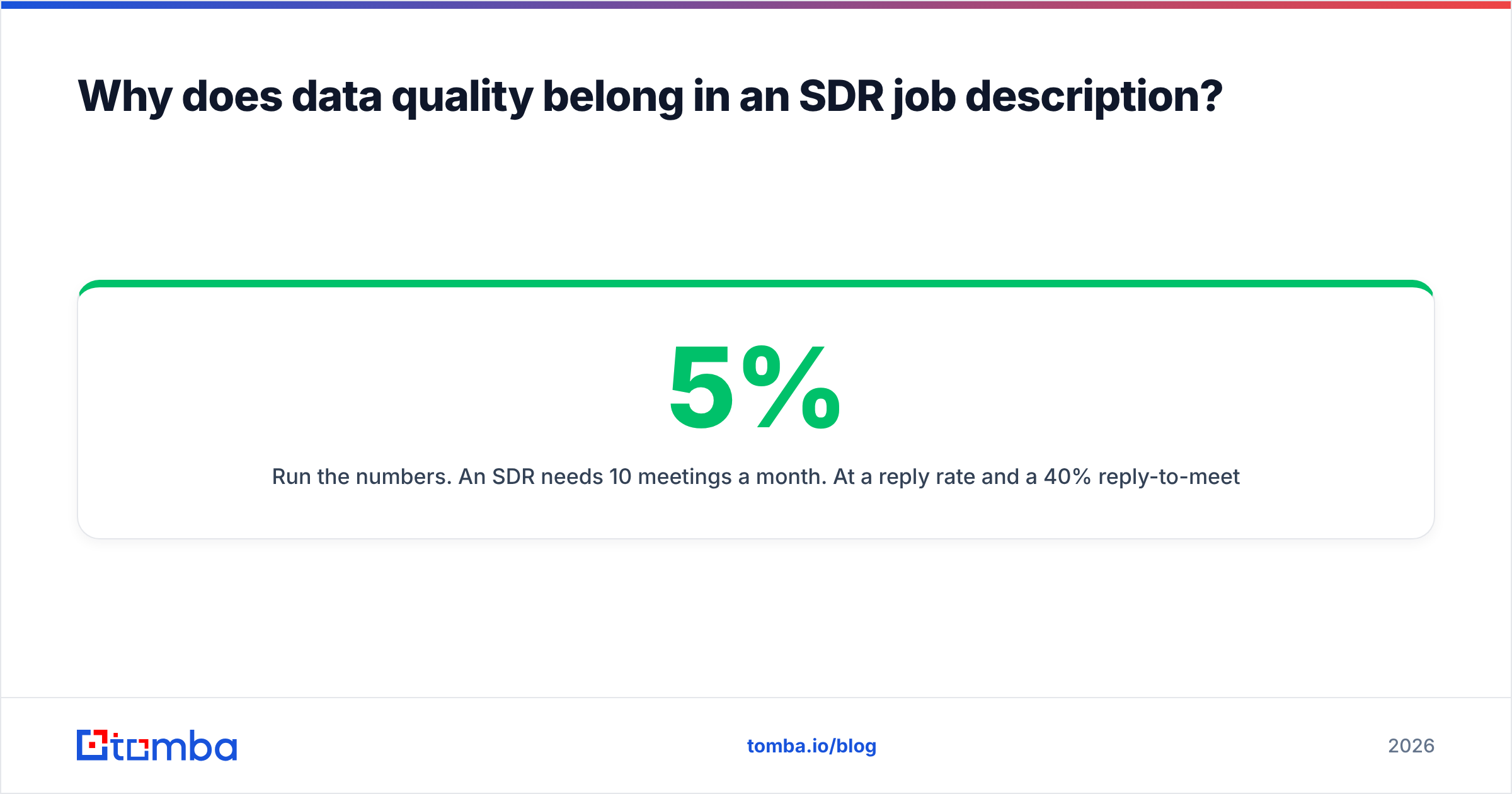
Run the numbers. An SDR needs 10 meetings a month. At a 5% reply rate and a 40% reply-to-meeting conversion, that's 500 contacted prospects. If 12% of those emails bounce or route to a dead mailbox, the rep isn't working a 500-person list — they're working 440, and they're doing it from a domain whose reputation is degrading with every send. The rep misses quota, you assume it's an effort problem, and a decent hire churns out in seven months.
So when you write the posting, name your data infrastructure the same way an engineering posting names its language. Something like:
"You'll work from a CRM-synced account list. Contact discovery runs through our enrichment stack — you won't be manually scraping LinkedIn. Every address is verified before it enters a sequence."
That single paragraph does more for candidate quality than three bullets of adjectives. If you're building that stack now, the components are straightforward: a domain search to map who works at a target account, an email finder to resolve specific names, verification before send, and a bulk email finder so list-building doesn't eat the rep's morning. HubSpot's own sales research has been consistent on this point for years: prospecting time lost to manual data work is the largest single drain on SDR productivity.
What do most SDR job descriptions get wrong?#
Five recurring mistakes, ranked by how much damage they do.
- No comp range. You lose the candidates with options — which is all the good ones.
- Quota stated as activity. "150 touches/day" tells a candidate you measure motion, not outcomes. Experienced SDRs read it as a red flag.
- Requirements inflation. "3–5 years SaaS sales experience" on a $55K base role. Someone with four years of SaaS closing experience is not taking an entry SDR seat.
- No ramp plan. If the posting implies full quota from month one, you're telling candidates you'll fire them in month four.
- Buzzword stack. "Hunter mentality," "rockstar," "wear many hats." These phrases carry no information and correlate with chaotic orgs. Replace each one with a fact.
A useful test: would a current SDR at a competitor read your posting and learn something specific about the job? If not, rewrite it. For a broader view of how the role fits into modern GTM structure, the Salesforce sales resources library is a reasonable neutral reference on team design.
What does a good SDR job description template look like?#
Paste this and fill the brackets.
Sales Development Representative — [Company] [Location / Hybrid / Remote] · $[base] base, $[OTE] OTE (uncapped)
You'll run outbound prospecting into [segment], booking discovery calls for [N] AEs. Reporting to [manager title]. This is a cold-outbound role — inbound leads are handled by [team].
What you'll do
- Own a named list of [150–250] target accounts and build the contact map for each.
- Run [50–80] cold calls and [40–60] personalized emails per day across a multichannel sequence.
- Book [10] qualified meetings per month that meet our [BANT/MEDDIC/custom] criteria.
- Write a written context brief for the AE on every accepted meeting.
- Keep CRM records accurate — we forecast off your data.
First 90 days
- Day 30: product certified, 100 accounts researched, first 3 meetings booked.
- Day 60: 60% of full quota, running sequences independently.
- Day 90: full quota, contributing sequence copy to the team library.
You'll need
- 12+ months in a quota-carrying outbound role (or demonstrable equivalent).
- Comfort on the phone with cold prospects — this role makes real calls.
- Clear written English and the discipline to personalize at volume.
Nice to have: experience selling into [industry], familiarity with [CRM].
Our stack: [CRM] · [sequencer] · [dialer] · [data/enrichment tool].
Where it goes: top performers move to AE or Senior SDR in 12–18 months. [N] of our current AEs started here.
Hiring an SDR is the easy half. The harder half is making sure the person you hire spends their day talking to prospects instead of hunting for contact details that turn out to be wrong. That's an infrastructure problem, and it's solvable before day one: give your new rep verified, current contact data from the moment they log in. Tomba's Email Finder resolves work emails by name and domain with verification built into the same call, with a free tier at 25 searches/month and paid plans starting at $49/month — see Tomba pricing for the full breakdown. Hire well, then hand them a list that actually connects.
Related guides#
// get started
Find, verify and enrich your first contacts today
Start on the free plan with 25 searches a month, then scale when your team is ready.
Free plan · No credit card required · GDPR & CCPA
// about the author