Joint Go-To-Market Strategy: A Practical 2026 Partner Playbook
Most co-selling partnerships die in the spreadsheet stage. Here is how a joint go-to-market strategy actually gets built, staffed, measured, and killed when it stops working.
TL;DR
- A joint go-to-market strategy is a written agreement between two companies to sell into a shared customer segment with shared targets, shared motions, and shared accountability — not a logo swap and a webinar.
- The three workable models are co-marketing, co-selling, and embedded/OEM. Pick one. Partnerships that try all three at once usually deliver none.
- The number one failure point is not strategy. It is the account-mapping and contact-data step: partners exchange lists, half the emails bounce, and the "joint pipeline" never reaches a human.
- Measure four things: overlap coverage, sourced vs. influenced pipeline, partner-attached win rate, and time-to-second-deal. Everything else is vanity.
- Budget 90 days to first joint opportunity and 6–9 months to a defensible revenue line. If you are not there, kill it and reallocate.
What is a joint go-to-market strategy?#
A joint go-to-market strategy is a documented plan where two (occasionally three) companies agree to target the same buyer segment together, with defined roles for who generates demand, who owns the deal, who delivers, and how revenue or credit is split.
Think of it like two restaurants on the same street agreeing to run a shared prix fixe: one does the mains, one does dessert, they print one menu, they split the check, and they both measure whether the street got busier. If either one keeps quietly steering customers back to their own full menu, the arrangement collapses in a month. Partnerships fail the same way — through quiet defection, not loud disagreement.
Technically, a joint GTM plan has five components that must be written down before any activity starts:
- Shared ICP definition — the specific firmographic and technographic profile both companies can serve. Not "mid-market SaaS." Something like "Series B–D B2B SaaS, 50–500 employees, North America, already running HubSpot or Salesforce, with an outbound SDR team of 3+."
- The compelling joint narrative — one sentence explaining why buying both is better than buying either. If you cannot write it without the word "synergy," you do not have one.
- Motion ownership — who sources, who qualifies, who demos, who closes, who onboards. Ambiguity here is what turns a partnership into two sales teams stepping on each other in the same account.
- Economics — referral fee, revenue share, reseller margin, or pure pipeline trade. Write the percentage and the payment trigger.
- Exit criteria — the numbers and the date at which you stop. Almost nobody writes this. It is the single highest-leverage clause in the document.
Revenue operations owns the plumbing for all five. If your RevOps function is not involved in the partnership from week one, you are building something that will not be trackable in the CRM and therefore will not be defensible at the next board meeting.
Why do most joint go-to-market partnerships stall?#
They stall because the incentive math is asymmetric and nobody checked before signing.
Here is the pattern. Company A has 4,000 customers. Company B has 400. Both sign a "mutual" agreement. Company A's reps have zero reason to mention Company B — their quota does not move. Company B's reps mention Company A constantly. Six months later, Company B has delivered 60 referrals, received 3, and the relationship is quietly over.
Other recurring failure modes:
- No executive sponsor with quota exposure. Partnerships owned purely by a partnerships manager with no revenue line get deprioritized the first time either company has a bad quarter.
- Overlapping products. If 30% of your feature set competes, the field will treat the partner as a threat regardless of what the press release said.
- Sales-cycle mismatch. A 21-day self-serve motion cannot co-sell with a 9-month enterprise procurement cycle. The fast partner will always feel starved.
- No shared data layer. Account mapping done in a one-time spreadsheet decays roughly 2–3% per month as people change jobs. By month six you are co-selling into a list that is a quarter wrong.
- Marketing-only activation. A webinar is not a go-to-market strategy. It is a lead-capture event that produces a list nobody follows up on.
Forrester's research on partner ecosystems has been consistent for years: ecosystem-influenced deals close at meaningfully higher rates than direct-only deals, but only in organizations that instrument attribution properly. You can read their ongoing coverage at forrester.com. The instrumentation is the hard part, not the handshake.
What are the main joint GTM models, and which should you pick?#
There are three viable structures. Pick one for the first two quarters. Add a second only after the first is producing repeatable revenue.
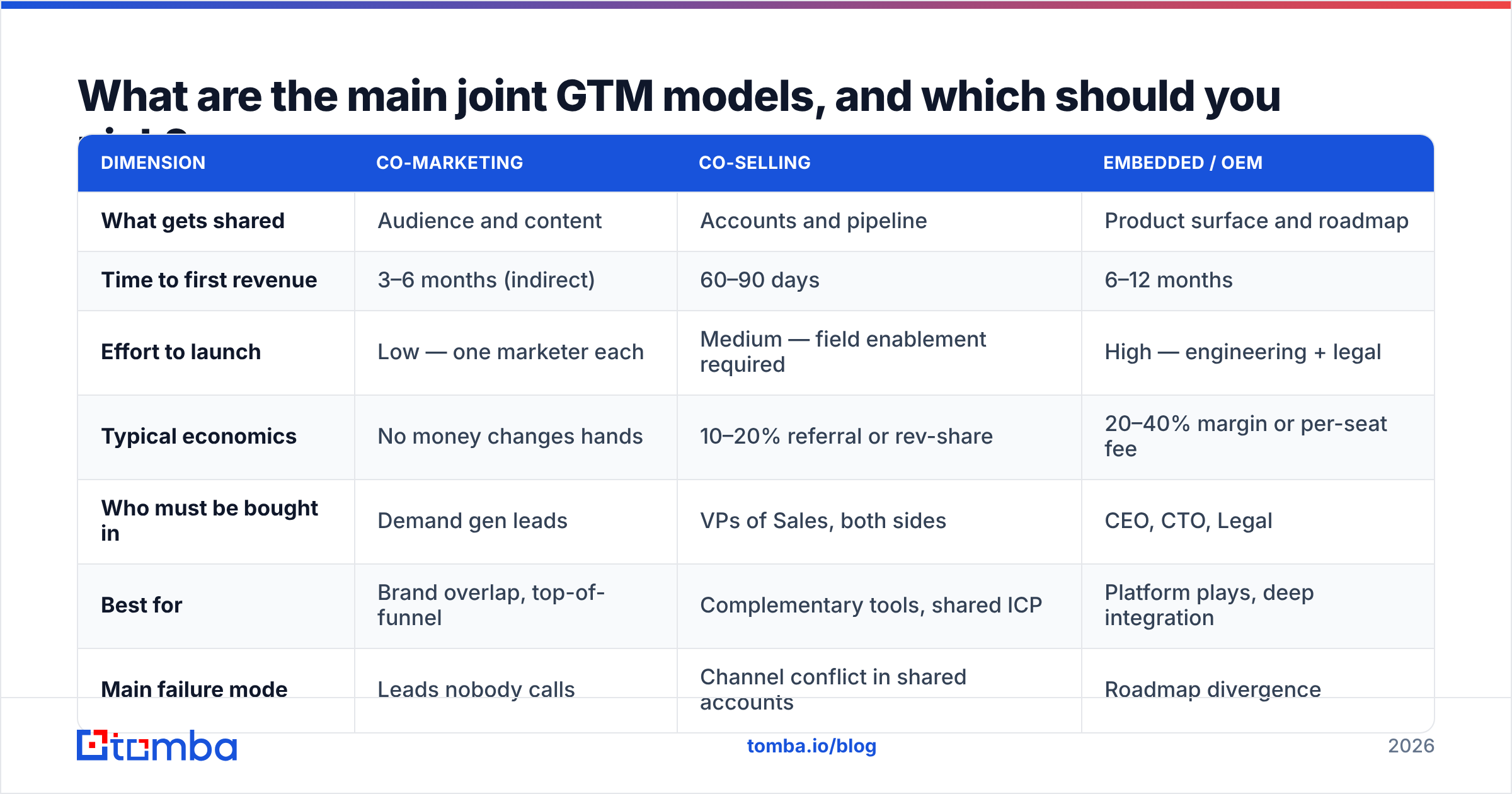
| Dimension | Co-marketing | Co-selling | Embedded / OEM |
|---|---|---|---|
| What gets shared | Audience and content | Accounts and pipeline | Product surface and roadmap |
| Time to first revenue | 3–6 months (indirect) | 60–90 days | 6–12 months |
| Effort to launch | Low — one marketer each | Medium — field enablement required | High — engineering + legal |
| Typical economics | No money changes hands | 10–20% referral or rev-share | 20–40% margin or per-seat fee |
| Who must be bought in | Demand gen leads | VPs of Sales, both sides | CEO, CTO, Legal |
| Best for | Brand overlap, top-of-funnel | Complementary tools, shared ICP | Platform plays, deep integration |
| Main failure mode | Leads nobody calls | Channel conflict in shared accounts | Roadmap divergence |
| Realistic year-one outcome | 5–15% lift in qualified leads | 10–25% of new pipeline partner-attached | 1–3 large contracts, high LTV |
The honest guidance: if this is your first serious partnership, start with co-selling into a mapped account overlap. Co-marketing is easy to start and almost impossible to attribute. OEM is attributable but takes a year and a legal budget. Co-selling sits in the middle and gives you a real answer within one quarter.
How do you build a joint go-to-market plan in 90 days?#
Run it as a project with dates, not as a relationship with vibes.
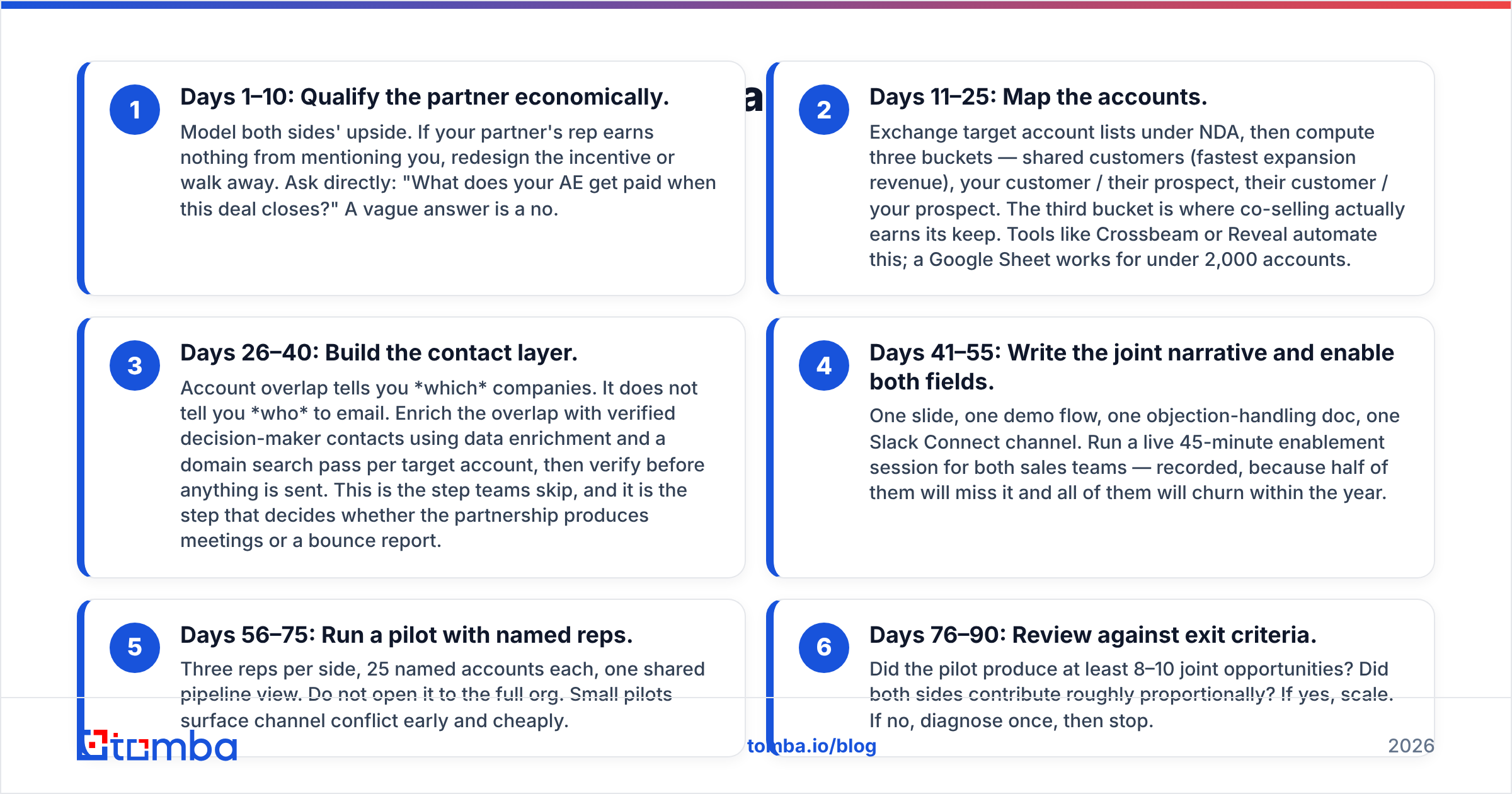
- Days 1–10: Qualify the partner economically. Model both sides' upside. If your partner's rep earns nothing from mentioning you, redesign the incentive or walk away. Ask directly: "What does your AE get paid when this deal closes?" A vague answer is a no.
- Days 11–25: Map the accounts. Exchange target account lists under NDA, then compute three buckets — shared customers (fastest expansion revenue), your customer / their prospect, their customer / your prospect. The third bucket is where co-selling actually earns its keep. Tools like Crossbeam or Reveal automate this; a Google Sheet works for under 2,000 accounts.
- Days 26–40: Build the contact layer. Account overlap tells you which companies. It does not tell you who to email. Enrich the overlap with verified decision-maker contacts using data enrichment and a domain search pass per target account, then verify before anything is sent. This is the step teams skip, and it is the step that decides whether the partnership produces meetings or a bounce report.
- Days 41–55: Write the joint narrative and enable both fields. One slide, one demo flow, one objection-handling doc, one Slack Connect channel. Run a live 45-minute enablement session for both sales teams — recorded, because half of them will miss it and all of them will churn within the year.
- Days 56–75: Run a pilot with named reps. Three reps per side, 25 named accounts each, one shared pipeline view. Do not open it to the full org. Small pilots surface channel conflict early and cheaply.
- Days 76–90: Review against exit criteria. Did the pilot produce at least 8–10 joint opportunities? Did both sides contribute roughly proportionally? If yes, scale. If no, diagnose once, then stop.
The discipline that separates working partnerships from ceremonial ones is the named-rep pilot. Broad launches let everyone avoid accountability. Six people with a shared target cannot hide.
Why does contact data decide whether joint GTM works?#
Because a joint go-to-market strategy converts a list of companies into a list of conversations, and that conversion is entirely a data problem.
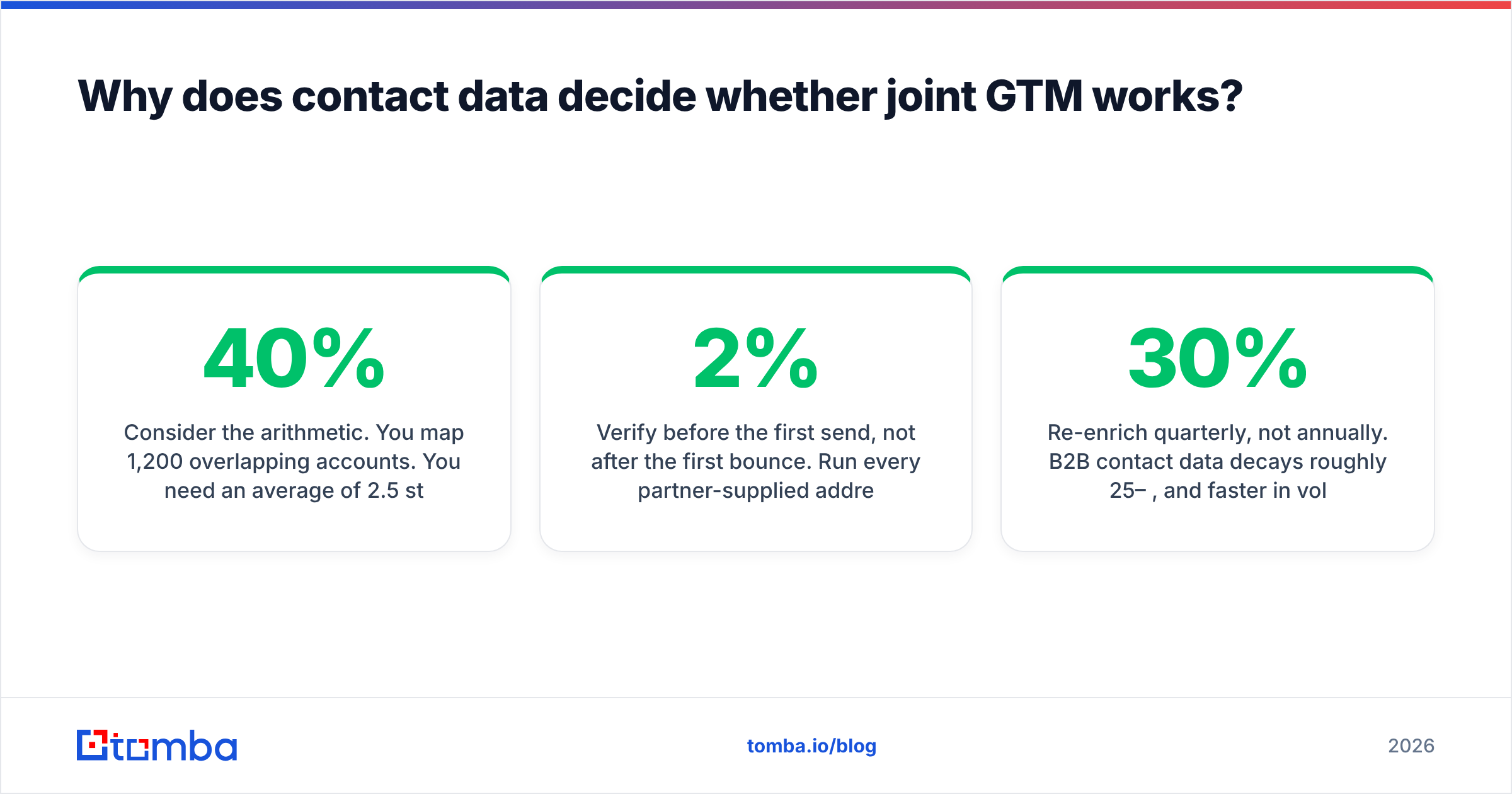
Consider the arithmetic. You map 1,200 overlapping accounts. You need an average of 2.5 stakeholders per account — the economic buyer, the champion, and often a technical evaluator. That is 3,000 contacts. If your partner's CRM export is 18 months old, expect 25–40% of those addresses to be dead, role-changed, or generic catch-alls. You send 3,000 emails, 1,000 bounce, your domain reputation drops, and the deliverability hit lands on both companies' sending infrastructure — because you are both emailing the same accounts in the same window.

Three safeguards, in order of importance:
- Verify before the first send, not after the first bounce. Run every partner-supplied address through an email verifier and quarantine anything risky. A 2% bounce rate is healthy; anything over 5% starts damaging sender reputation.
- Re-enrich quarterly, not annually. B2B contact data decays roughly 25–30% per year, and faster in volatile segments. Set a recurring bulk refresh on the shared account list so the joint target list stays current without a manual project each quarter.
- Handle catch-all domains explicitly. Large enterprises frequently accept all mail at the domain level, so standard verification returns "unknown." Segment those separately and route them to a lower-volume, higher-personalization sequence rather than dumping them into the main blast.
One more sequencing rule that costs nothing: agree on who emails first. Two partners hitting the same VP of Sales in the same week with near-identical pitches is the fastest way to burn a shared account and look uncoordinated to the buyer.
How do you measure a joint go-to-market strategy?#
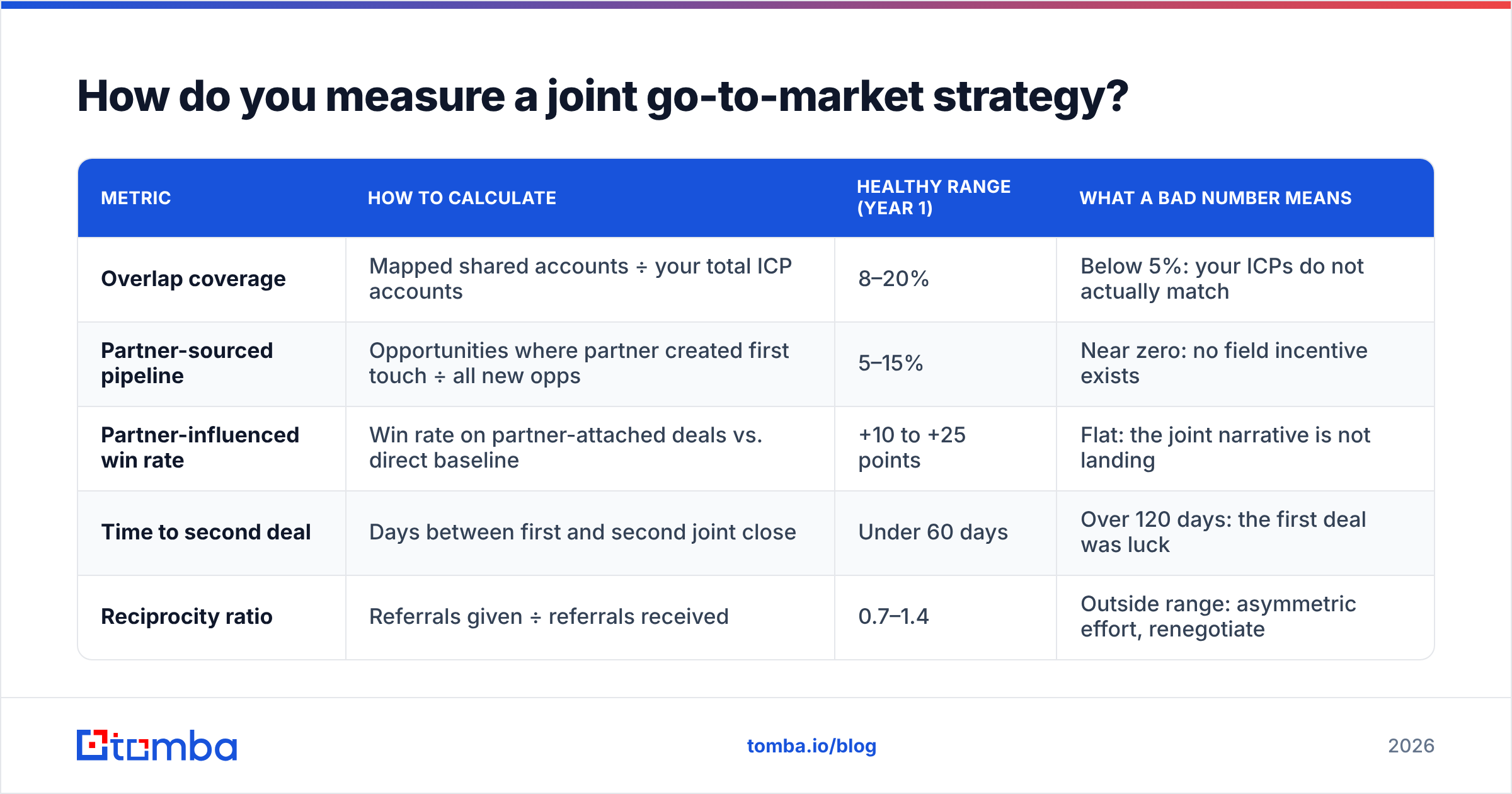
Four metrics. Everything else is a slide decoration.
| Metric | How to calculate | Healthy range (year 1) | What a bad number means |
|---|---|---|---|
| Overlap coverage | Mapped shared accounts ÷ your total ICP accounts | 8–20% | Below 5%: your ICPs do not actually match |
| Partner-sourced pipeline | Opportunities where partner created first touch ÷ all new opps | 5–15% | Near zero: no field incentive exists |
| Partner-influenced win rate | Win rate on partner-attached deals vs. direct baseline | +10 to +25 points | Flat: the joint narrative is not landing |
| Time to second deal | Days between first and second joint close | Under 60 days | Over 120 days: the first deal was luck |
| Reciprocity ratio | Referrals given ÷ referrals received | 0.7–1.4 | Outside range: asymmetric effort, renegotiate |
Track sourced and influenced separately, and define both in writing before the first deal closes. Retroactive attribution debates poison otherwise healthy partnerships. Your CRM needs a partner field on the opportunity object from day one — this is a 20-minute admin task in Salesforce or HubSpot that saves a quarter of arguing later.
Also watch the qualitative signal: are reps on both sides bringing each other into deals without being asked? That is the real leading indicator. When a partnership works, it stops needing a partnerships manager to push it.
When should you kill a joint GTM partnership?#
Kill it when any of these are true at the 6-month mark:
- Fewer than 5 joint opportunities created, despite a mapped overlap of 500+ accounts.
- The reciprocity ratio has sat below 0.5 or above 2.0 for two consecutive quarters and renegotiation failed.
- The partner has shipped, or announced, a feature that competes with your core product.
- Neither company's sales leadership can name the joint narrative from memory.
- Every deal still requires the partnerships manager to personally broker the introduction.
Killing a partnership is not a failure of the partnerships function. Running three dead partnerships to protect the appearance of momentum is. Publishing your exit criteria at the start makes the conversation administrative instead of emotional.
One caveat worth naming: a co-marketing partnership that produces brand credibility with an important buyer segment can be worth keeping even with weak pipeline numbers — just classify it as marketing spend and stop reporting it as GTM revenue.
What should you do next?#
Start with the overlap, because it is the only part of a joint go-to-market strategy that gives you a factual answer within a week. Exchange target account lists, compute the three buckets, and look at the size of bucket three — their customers who are not yet yours. If that number is under a few hundred accounts, the partnership is a co-marketing relationship, not a co-selling one, and you should scope it accordingly.
Once the overlap is real, the bottleneck moves immediately to contacts. Mapped accounts with stale or missing decision-maker emails produce meetings for nobody. Run the shared list through Tomba Email Finder to get verified, role-matched contacts for every target account on both sides, then verify and refresh on a quarterly cadence so the joint list stays live for the length of the partnership. The free tier covers 25 searches a month for a pilot, and the Starter plan at $49/mo handles a full first-quarter overlap; see Tomba pricing for team-level volumes. Get the data layer right and the rest of the partnership is just sales execution.
Related guides#
// get started
Find, verify and enrich your first contacts today
Start on the free plan with 25 searches a month, then scale when your team is ready.
Free plan · No credit card required · GDPR & CCPA
// about the author