Joomag Pricing Reviews Pros and Cons: A 2026 Buyer's Guide
An independent look at what Joomag actually costs, what reviewers praise and complain about, and when a cheaper digital publishing stack — plus a real contact-data tool — beats it.
Joomag pricing reviews pros and cons all lead back to one question: do you publish often enough to pay for a platform? This guide walks through the tiers, the praise, the gripes, and the cheaper paths.
TL;DR
- Joomag turns PDFs into interactive flipbooks, catalogs, and reports. You then track how readers use them.
- Entry pricing has long started near $39–$49 a month, billed yearly. But the plans most B2B teams need sit behind a sales quote: CRM sync, lead capture, extra seats, white-label domains.
- Reviewers praise the output quality and the analytics. The repeat gripes: cost next to simpler flipbook tools, a steep editor learning curve, and slow support on low tiers.
- Joomag is a strong fit if interactive content is your channel (catalogs, investor reports, member magazines). It is overkill if you just need a shareable PDF with a view counter.
- Publishing tools measure engagement. They do not tell you who to send the catalog to. That still takes a contact-data layer like an email finder.
What is Joomag, and who actually uses it?#
Joomag is a content experience platform for interactive digital publications. You upload a PDF, or design one in their editor. It becomes a browser-based flipbook with video, hotspots, forms, shopping links, and reader analytics. The company pitches it well beyond "flipbook maker". Think of it as a way to ship and measure long-form content. You can read their own framing on joomag.com.
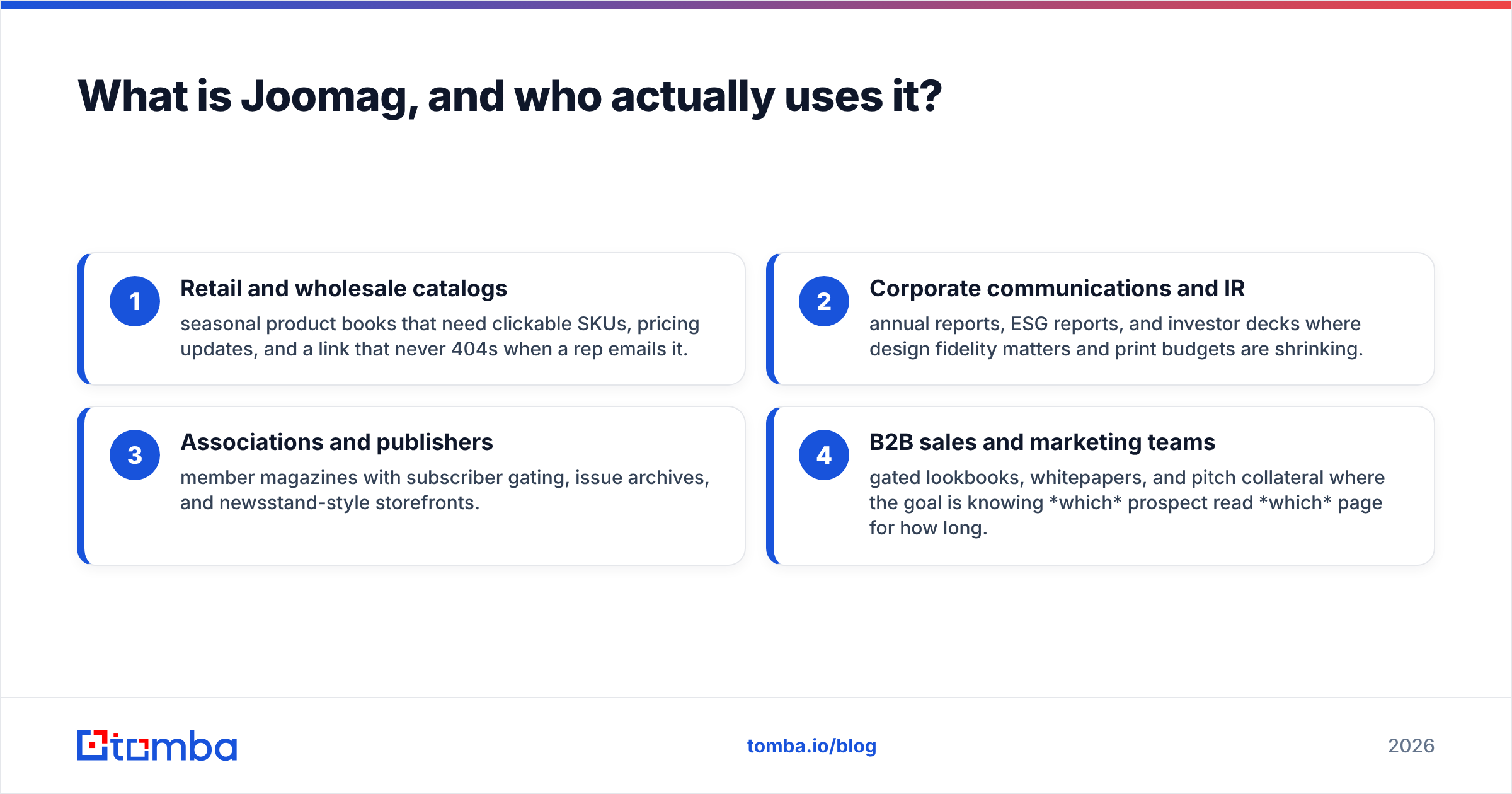
The typical buyer falls into one of four buckets:
- Retail and wholesale catalogs — seasonal product books that need clickable SKUs, price updates, and a link that never 404s when a rep emails it.
- Corporate communications and IR — annual reports, ESG reports, and investor decks where design matters and print budgets are shrinking.
- Associations and publishers — member magazines with subscriber gating, issue archives, and newsstand-style storefronts.
- B2B sales and marketing teams — gated lookbooks, whitepapers, and pitch collateral. Here the goal is knowing which prospect read which page, and for how long.
Pricing questions get sharpest in that fourth group. Those teams weigh Joomag against their whole content and outbound stack, not just against other flipbook tools. The shift toward electronic publishing has produced a dozen tools that do 70% of Joomag's job for far less. So the real question is simple: is the last 30% what you are buying?

How does Joomag pricing work in 2026?#
Cost sits at the heart of any Joomag pricing reviews pros and cons check, so start with the tiers. Joomag uses tiered plans with the usual SaaS levers: number of publications, storage, seats, page views, and feature gates. Two things matter more than the headline number.
First, annual billing is the real price. Monthly rates run 20–30% higher. Almost every figure quoted around the web is the annual rate.
Second, the useful features live upstairs. Lead-capture forms, CRM integrations, custom domains, white-labeling, and deep analytics are not entry-tier items. Does your case depend on pushing reader behavior into HubSpot or Salesforce? Then you are shopping at the business tier or above.
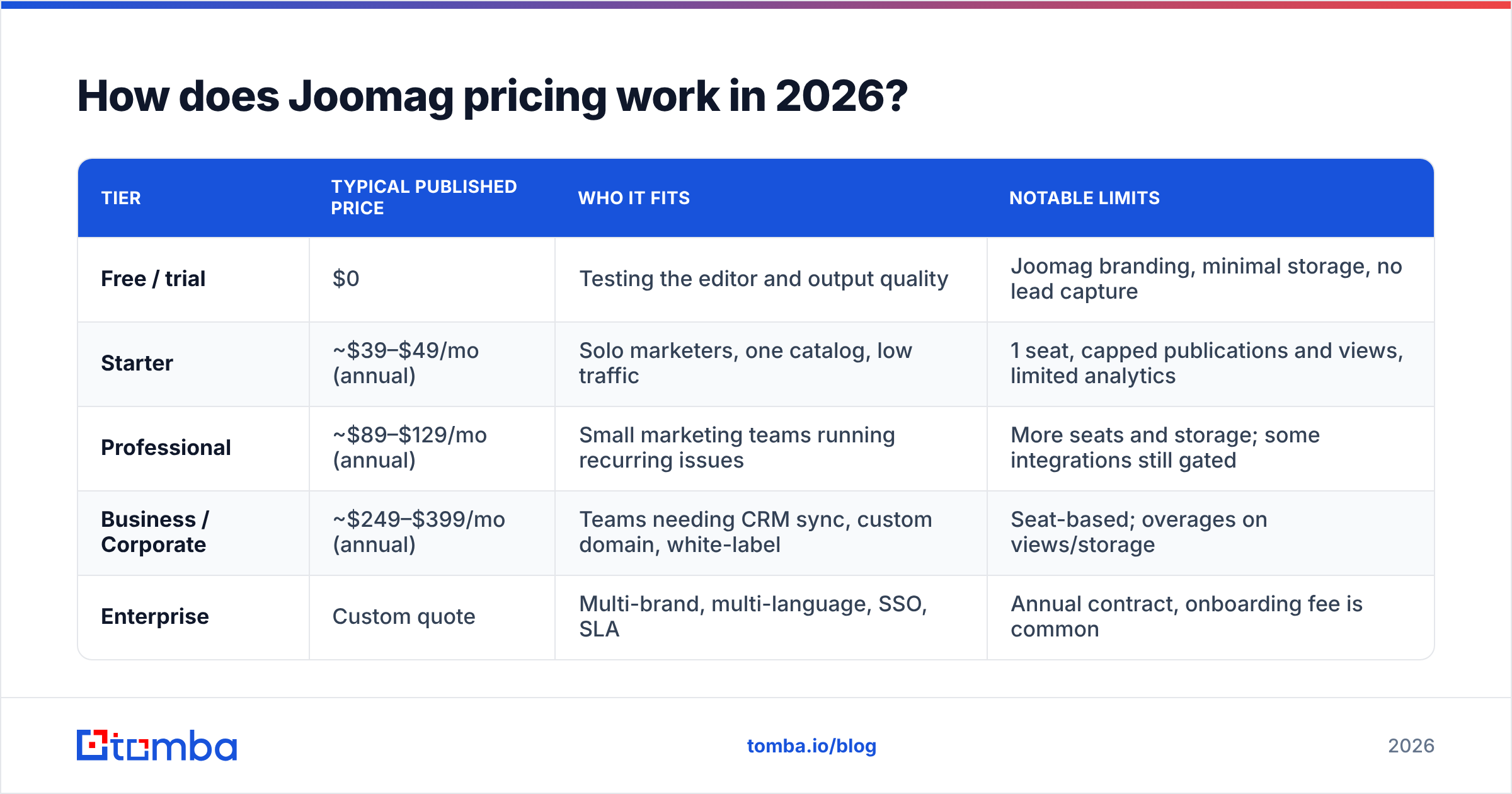
Here is the shape of the lineup as published. Treat it as directional. Joomag has repackaged its plans more than once, and enterprise deals are negotiated:
| Tier | Typical published price | Who it fits | Notable limits |
|---|---|---|---|
| Free / trial | $0 | Testing the editor and output quality | Joomag branding, minimal storage, no lead capture |
| Starter | ~$39–$49/mo (annual) | Solo marketers, one catalog, low traffic | 1 seat, capped publications and views, limited analytics |
| Professional | ~$89–$129/mo (annual) | Small marketing teams running recurring issues | More seats and storage; some integrations still gated |
| Business / Corporate | ~$249–$399/mo (annual) | Teams needing CRM sync, custom domain, white-label | Seat-based; overages on views/storage |
| Enterprise | Custom quote | Multi-brand, multi-language, SSO, SLA | Annual contract, onboarding fee is common |
Three cost lines buyers routinely miss:
- Overages. Page views and storage are metered. A catalog that does unexpectedly well can push you into a higher bracket mid-term.
- Seats. Design, marketing, and sales all want access. Seat math often doubles the quoted number.
- Onboarding and setup. Enterprise deals often carry a one-time setup fee. Custom templates and migrations add to it.
The pricing logic matches most B2B SaaS. A low entry point advertises well, and the real spend lands after seats and integrations. Want a flat-pricing reference point? Compare it to published Tomba pricing. Every tier is listed end to end, with no quote gate until enterprise.
What do Joomag reviews actually say?#
Feedback on review sites is mostly positive, but not blindly so. Scan Joomag reviews on G2 and similar directories, and the themes cluster like this:
What reviewers consistently like
- Output quality. The finished publication looks sharp on desktop and mobile, with no dev work.
- Analytics depth. Page-level dwell time, drop-off points, and click maps beat a PDF parked on your own CDN.
- Speed to publish. Non-technical marketers can ship an interactive issue in hours, not sprints.
- Consolidation. One tool replaces a flipbook host, a gated-asset tool, and a basic engagement tracker.
What reviewers consistently criticize
- Price. The top complaint is value for money next to cheaper flipbook tools. That bites hardest for teams that publish rarely.
- Editor learning curve. The interactive parts are strong but not obvious. Teams report real ramp-up time.
- Support variability. Response times draw praise at enterprise tiers and complaints at lower ones.
- Feature gating. Users are surprised when a feature they saw in a demo turns out to be an upsell.
None of that rules it out. It is the normal profile of a mid-market platform that does one job well and charges for it. The question is whether your publishing volume earns back platform pricing.
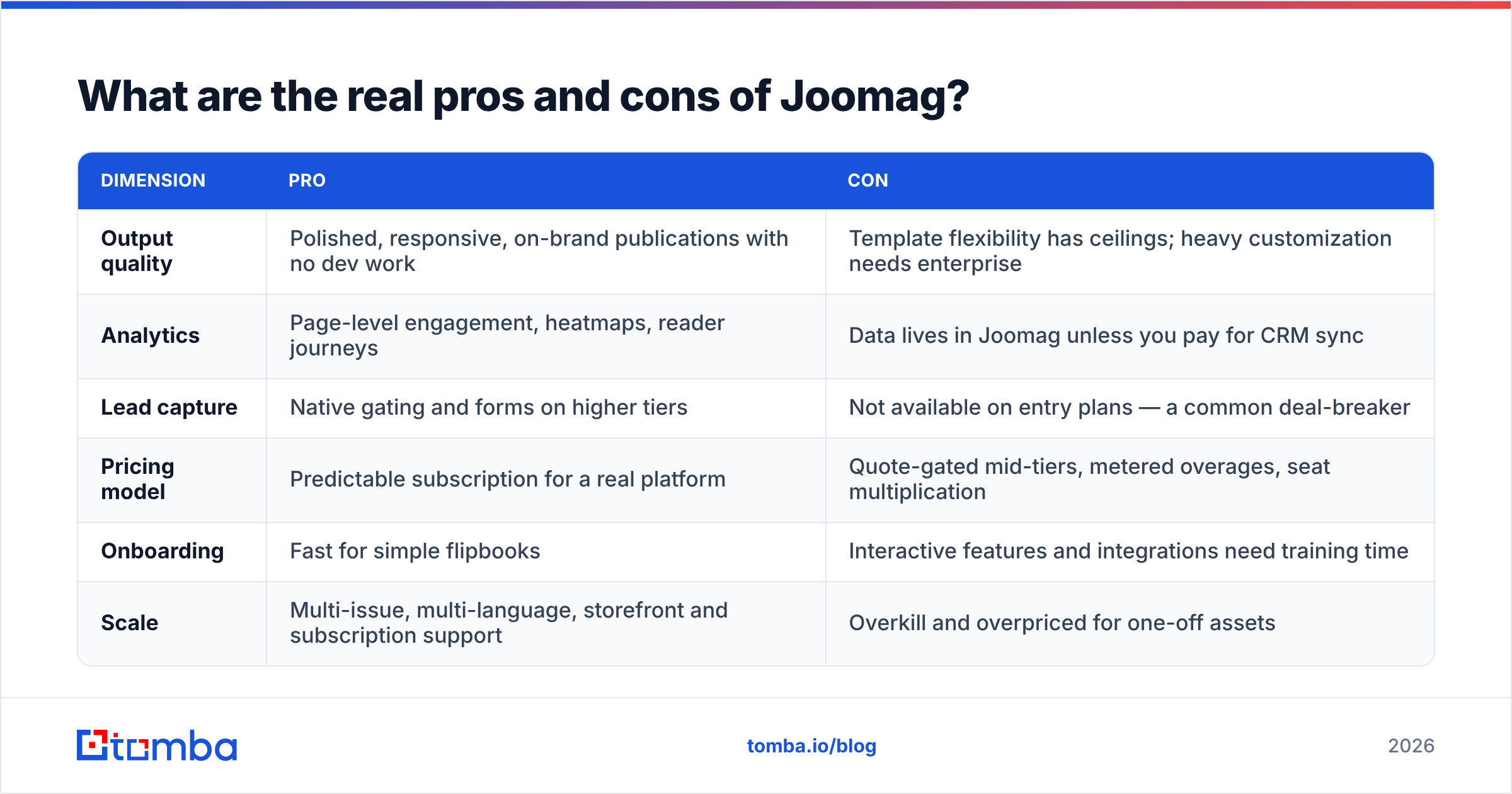
Joomag pricing reviews pros and cons at a glance#
| Dimension | Pro | Con |
|---|---|---|
| Output quality | Polished, responsive, on-brand publications with no dev work | Template flexibility has ceilings; heavy customization needs enterprise |
| Analytics | Page-level engagement, heatmaps, reader journeys | Data lives in Joomag unless you pay for CRM sync |
| Lead capture | Native gating and forms on higher tiers | Not available on entry plans — a common deal-breaker |
| Pricing model | Predictable subscription for a real platform | Quote-gated mid-tiers, metered overages, seat multiplication |
| Onboarding | Fast for simple flipbooks | Interactive features and integrations need training time |
| Scale | Multi-issue, multi-language, storefront and subscription support | Overkill and overpriced for one-off assets |
The honest summary: Joomag is priced as a platform, and it acts like one. Some teams publish all year — a monthly member magazine, a quarterly catalog, an annual report and its supporting pieces. They get real value from the analytics and the workflow. Teams that publish twice a year pay platform rates for what is, in practice, a hosted PDF.
How does Joomag compare to other digital publishing tools?#
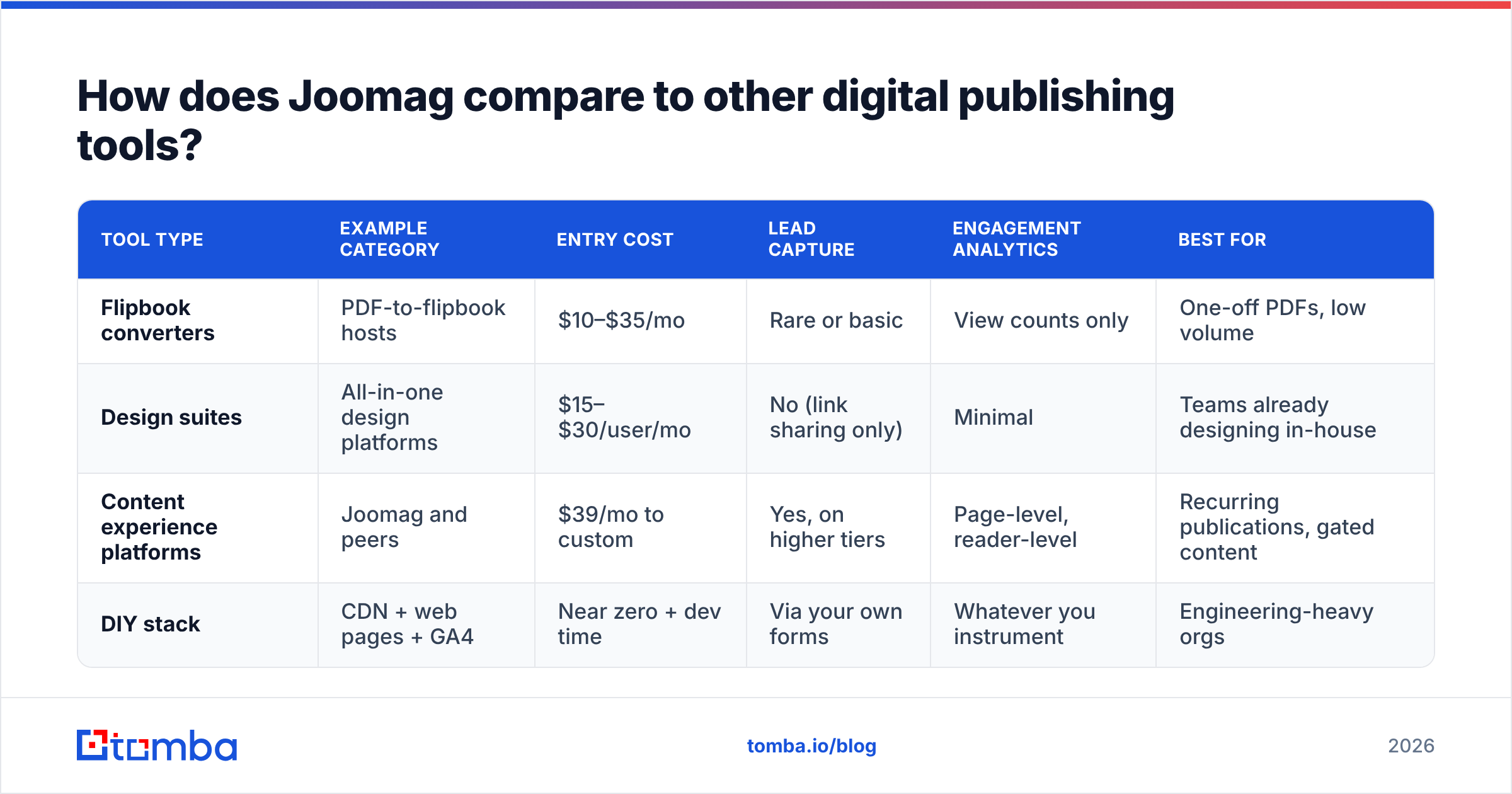
The field splits into three groups: cheap flipbook converters, design suites with publishing add-ons, and content-experience platforms. Joomag sits in the third group, but it competes on price with the first.
| Tool type | Example category | Entry cost | Lead capture | Engagement analytics | Best for |
|---|---|---|---|---|---|
| Flipbook converters | PDF-to-flipbook hosts | $10–$35/mo | Rare or basic | View counts only | One-off PDFs, low volume |
| Design suites | All-in-one design platforms | $15–$30/user/mo | No (link sharing only) | Minimal | Teams already designing in-house |
| Content experience platforms | Joomag and peers | $39/mo to custom | Yes, on higher tiers | Page-level, reader-level | Recurring publications, gated content |
| DIY stack | CDN + web pages + GA4 | Near zero + dev time | Via your own forms | Whatever you instrument | Engineering-heavy orgs |
Here is a quick test. Can you name the business decision you would make from page-level dwell time? If not, you do not need a content experience platform yet. Buy the $19 flipbook host, keep the difference, and revisit in two quarters.

Does Joomag actually generate leads — or just measure them?#
This one distinction decides most Joomag purchases. It is also where buyers get the ROI math wrong.
Joomag is great at telling you what happened after someone opened your catalog. It is not a demand source. It cannot tell you to send your Q3 lookbook to a buyer at a 400-person distributor. It only shows you how that person behaved once they arrived.
So the full funnel looks like this:
- Identify the accounts worth sending interactive content to — firmographics, tech stack, hiring signals.
- Find the people at those accounts and their verified work addresses. That is a contact-data problem, not a publishing one. A domain search returns the named contacts and the company email pattern in one pass.
- Verify before sending. A lovely catalog sent to a dead mailbox is a bounce, and bounces hurt your sending domain. Run the list through an email verifier first.
- Distribute the Joomag link through email, sales outreach, or paid.
- Measure and route. This is where Joomag earns its keep, feeding page-level engagement back to the rep or into your CRM.
Skip steps 1–3 and you get a well-tracked publication that few qualified buyers ever open. The analytics then confirm the obvious: low traffic, shallow reading. That is a distribution failure dressed up as a platform failure.
Is Joomag worth it for B2B sales and marketing teams?#
Worth it if three things are true:
- You publish on a cadence. Recurring issues spread the subscription across many assets. One annual report does not.
- Engagement data changes behavior. If a rep will actually call the prospect who spent four minutes on the pricing page, the analytics have value. If nobody acts on it, it is a vanity dashboard.
- Design fidelity is non-negotiable. Banks, luxury retail, and investor relations all have reasons a plain web page cannot meet.
Not worth it if:
- Your "publication" is a two-page whitepaper. An HTML landing page would do better, and it would rank in search too.
- You need lead capture but can only afford the starter tier. You would pay platform rates and still gate assets with a separate form tool.
- Your bottleneck is contact volume, not content quality. Spending $300 a month on polish while your list holds 200 stale records fixes the wrong problem.
Run the math honestly. Take your annual Joomag quote. Divide it by the number of issues you will really ship. Then compare that per-asset cost to what the same budget buys in verified contact data or paid reach. For many mid-market teams, the second column wins. That is not a knock on Joomag. It is a reminder that reach limits pipeline before polish does.
What should you ask before signing a Joomag contract?#
Five questions that meaningfully change the total cost:
- Which tier includes lead-capture forms and CRM sync? Get it in writing. This is the most common post-signature surprise.
- What happens at view and storage overage? Ask for the overage rate, and ask whether you are auto-upgraded.
- How many seats are included, and what does an extra seat cost? Design plus marketing plus two reps is four seats, not one.
- Is there an implementation or template fee? Common on enterprise, rarely volunteered.
- What is the renewal uplift? Multi-year deals often carry an annual raise. Negotiate the cap up front, not at renewal.
Ask for a trial with your real catalog, not their demo file. Page count, image weight, and SKU volume all change load times and editor feel. A curated demo hides that.
The bottom line#
Joomag is a real content experience platform. The analytics and the output quality earn its category, as long as you publish often enough to use it. The Joomag pricing reviews pros and cons net out cleanly: you trade higher cost and a learning curve for polish, measurement, and one tool instead of three. Reviewers who publish monthly are happy. Reviewers who publish twice a year are the ones writing about price.
Before you spend more on how your content looks, test who receives it. If your list is thin, stale, or full of guessed addresses, no amount of interactivity saves the outcome. Start with Tomba Email Finder and build a verified list of the buyers who should open your next catalog. The free tier covers 25 searches a month, and paid plans start at $49/mo. Then let the publishing platform do the job it is good at: telling you what those people did once they arrived.
Related guides#
// get started
Find, verify and enrich your first contacts today
Start on the free plan with 25 searches a month, then scale when your team is ready.
Free plan · No credit card required · GDPR & CCPA
Get the Tomba newsletter
Product and data updates
// about the author