Joonbot Pricing 2026: Reviews, Pros, Cons and Real Costs
Joonbot sells itself as the fastest way to build a no-code lead-qualification chatbot. Here is what the plans really cost, what reviewers complain about, and when a chatbot is the wrong tool for the job.
TL;DR
- Joonbot is a no-code chatbot builder aimed at lead capture and qualification on websites and landing pages, not a full customer-support suite.
- Public Joonbot pricing has historically run from a free tier up to roughly $29, $99 and $199 per month, metered by chatbot responses — the unit that decides your real bill.
- Reviewers consistently praise the drag-and-drop builder and speed to launch; the recurring complaints are response-limit surprises, shallow analytics and thin native CRM integrations.
- A chatbot only converts traffic you already have. If your pipeline problem is "not enough qualified contacts," a chatbot is the wrong line item.
- Best fit: small marketing teams with steady inbound traffic. Wrong fit: outbound teams who need verified contact data before a conversation ever starts.
What is Joonbot, and who is it actually for?#
Joonbot is a no-code conversational form builder. You drag blocks onto a canvas, branch the conversation with conditions, and drop the bot onto a website, a landing page or a standalone link. The output is usually the same: a structured record of who the visitor is, what they want, and whether they are worth a sales follow-up.
Think of it like a receptionist for a small office. A receptionist does not generate foot traffic. They greet whoever already walked through the door, ask a few smart questions, and route the good ones to the right desk. That analogy matters when you evaluate the price, because you are paying per conversation, not per lead won.
Technically, Joonbot sits in the "conversational marketing" category alongside Landbot and Tidio, but with a lighter footprint. It is not a support ticketing system, it is not a live-chat inbox with agent seats, and it is not a data provider. It is a branching questionnaire that feels like a chat.
The teams that get the most out of it look like this:
- Inbound-heavy SaaS marketers who want to replace a 9-field contact form with a 5-step conversation and lift completion rates.
- Agencies building client-facing lead magnets and quizzes without writing front-end code.
- Ecommerce operators running product finders or sizing quizzes that end in an email capture.
- Event and course businesses qualifying registrations before a human ever picks up the phone.
- Solo founders who need something live this afternoon and cannot wait on an engineering sprint.
If your team is not in that list — particularly if you run outbound — keep reading, because the cost math changes completely.
How much does Joonbot pricing cost in 2026?#
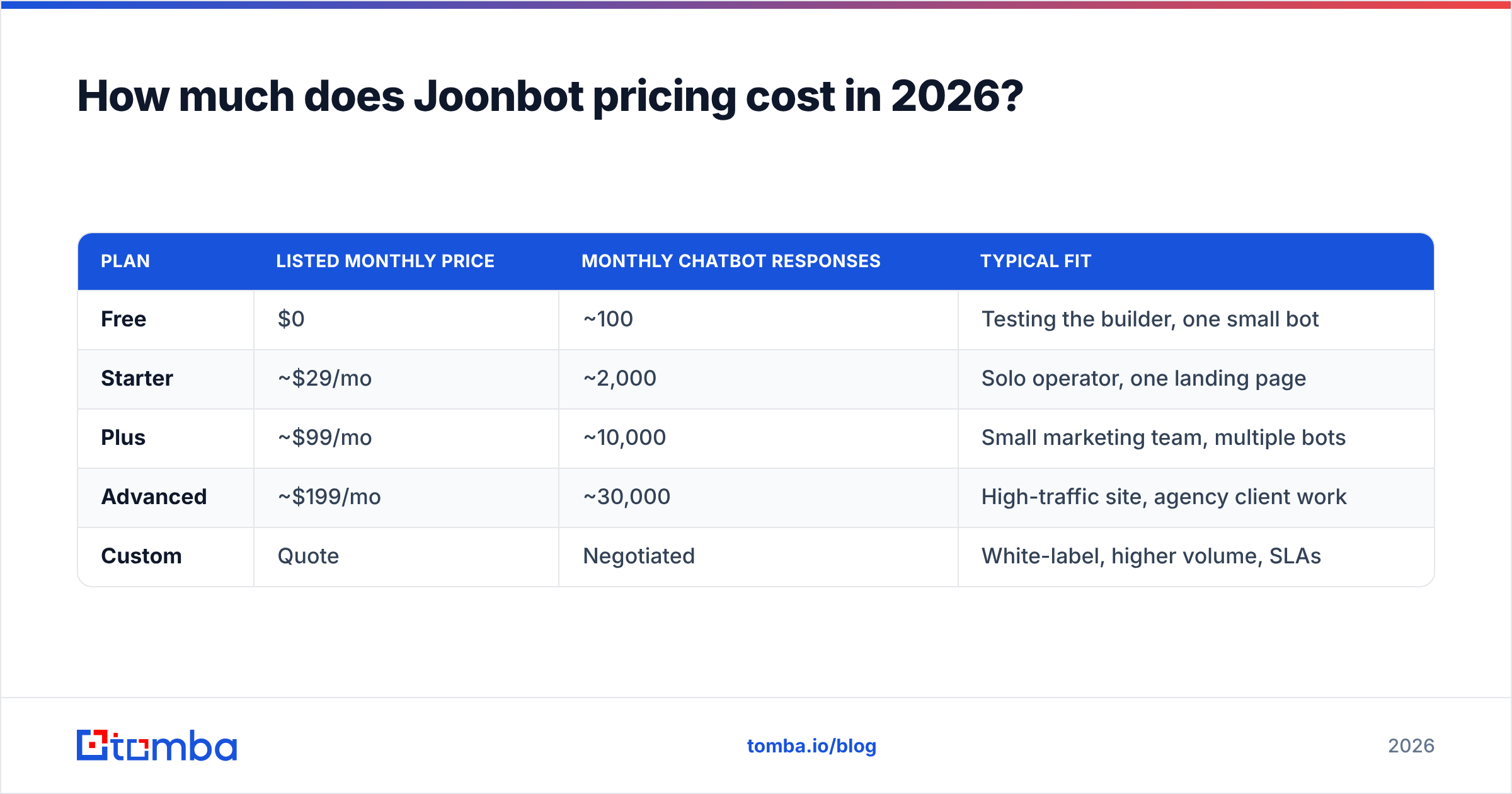
Joonbot's publicly listed structure has been a free tier plus three paid tiers, metered by the number of chatbot responses per month. Here is the shape of it:
| Plan | Listed monthly price | Monthly chatbot responses | Typical fit |
|---|---|---|---|
| Free | $0 | ~100 | Testing the builder, one small bot |
| Starter | ~$29/mo | ~2,000 | Solo operator, one landing page |
| Plus | ~$99/mo | ~10,000 | Small marketing team, multiple bots |
| Advanced | ~$199/mo | ~30,000 | High-traffic site, agency client work |
| Custom | Quote | Negotiated | White-label, higher volume, SLAs |
Two honest caveats before you budget from that table. First, Joonbot has repositioned its plans and limits more than once, and prices have been listed in both USD and EUR depending on the region. Treat the numbers above as the shape of the pricing, not a quote — confirm current figures on the official Joonbot site before you put a card down. Second, the annual billing discount (typically around 20%) only pays off if your traffic is predictable. If it is seasonal, monthly billing is cheaper insurance.
The real question is not the sticker price. It is the unit.
What counts as a "response," and why does it matter?#
A response is a message the bot sends, not a completed lead. A conversation with 12 bot messages burns 12 units even if the visitor bounces at step three. That is the single most misunderstood line in Joonbot pricing, and it is where budgets break.
Run the math before you commit:
- Bot length drives cost. A 15-step qualification flow consumes roughly 3x the credits of a 5-step flow for the same visitor count.
- Bounced conversations still bill. Abandonment at step two is not free — you paid for those two steps.
- Bots on high-traffic pages are dangerous. Putting a bot on your homepage instead of a pricing or demo page can multiply consumption tenfold with no extra pipeline.
- Overages are the surprise. Hitting the ceiling mid-month means either an upgrade or a bot that stops responding, and neither is a good look on a paid campaign.
A practical rule: estimate monthly sessions on the pages where the bot lives, multiply by your average bot-message count, then add 40% headroom. If that number lands above your plan's ceiling, you are budgeting for the tier above the one you were planning to buy.
What do Joonbot reviews actually say?#
Aggregate sentiment across public review platforms like G2 and Capterra is genuinely positive on usability and more mixed on depth. Filtering out the promotional noise, the same themes repeat.
What reviewers consistently like:
- Speed to first bot. Non-technical users report getting a working flow live in under an hour. This is the strongest and most repeated praise.
- Visual clarity. The canvas makes branching logic legible in a way that spreadsheet-driven form tools never manage.
- Design control. Colors, images, GIFs and custom styling let the bot match a brand without CSS hacks.
- Responsive support. Small-vendor advantage: people report getting real humans quickly.
What reviewers consistently criticize:
- Analytics depth. You can see completion and drop-off, but attribution back to revenue usually requires exporting data elsewhere.
- Integration breadth. Native connectors cover the popular destinations; anything else means Zapier, webhooks, or engineering time.
- Response-limit friction. The most common billing complaint is discovering the meter runs on bot messages, not on conversations or leads.
- Feature velocity. Compared with larger conversational platforms, the roadmap moves slowly. That is a fair trade for a lean tool, but it is a trade.
None of that makes Joonbot a bad product. It makes it a narrow product, and narrow products are great when your use case fits and frustrating when it does not.
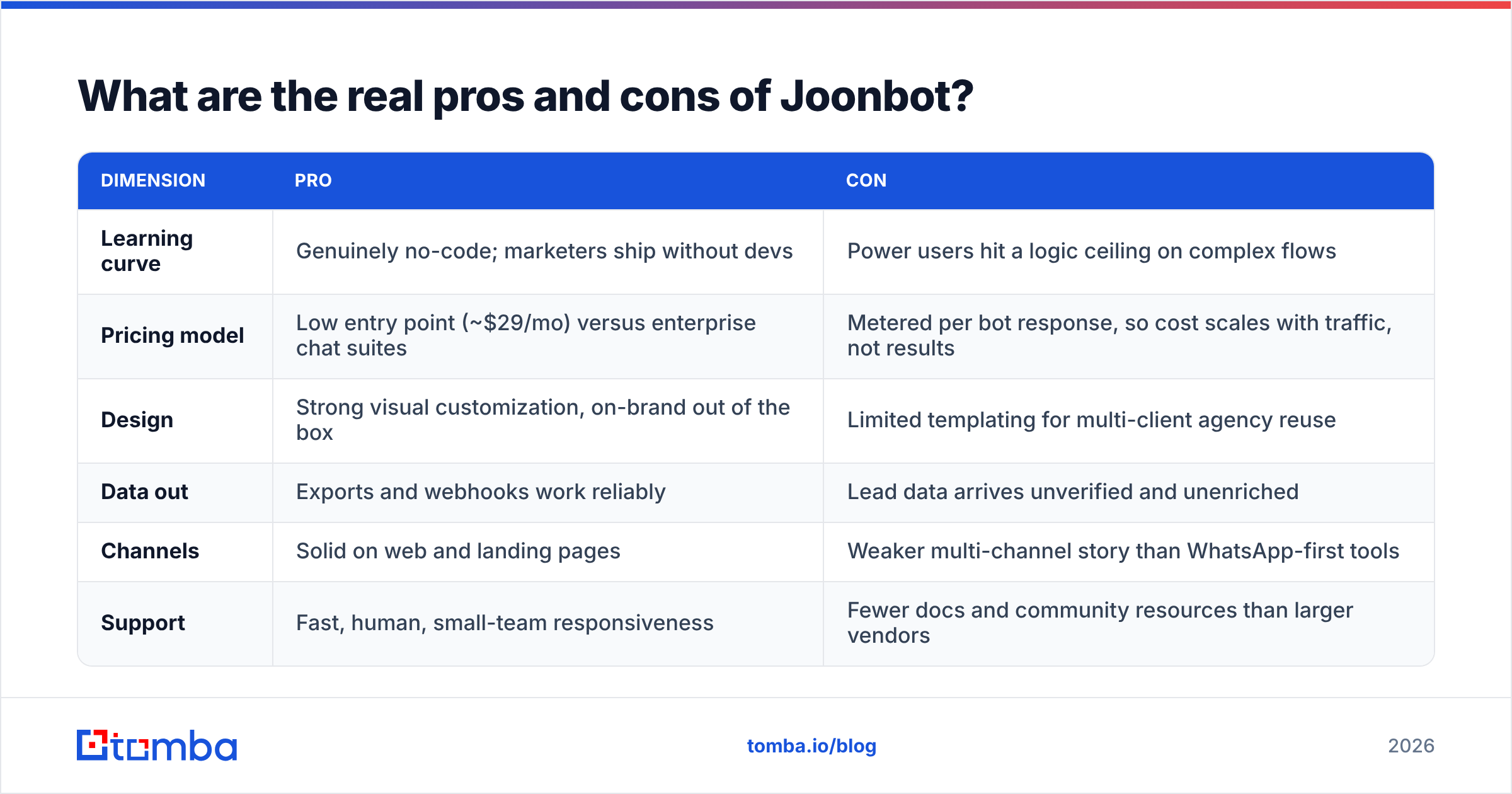
What are the real pros and cons of Joonbot?#
| Dimension | Pro | Con |
|---|---|---|
| Learning curve | Genuinely no-code; marketers ship without devs | Power users hit a logic ceiling on complex flows |
| Pricing model | Low entry point (~$29/mo) versus enterprise chat suites | Metered per bot response, so cost scales with traffic, not results |
| Design | Strong visual customization, on-brand out of the box | Limited templating for multi-client agency reuse |
| Data out | Exports and webhooks work reliably | Lead data arrives unverified and unenriched |
| Channels | Solid on web and landing pages | Weaker multi-channel story than WhatsApp-first tools |
| Support | Fast, human, small-team responsiveness | Fewer docs and community resources than larger vendors |
That fourth row is the one sales teams underestimate. A chatbot captures whatever the visitor typed. Typos, personal Gmail addresses, throwaway domains and deliberate junk all land in your CRM looking exactly like real leads. If you pipe raw chatbot output straight into a sequence, your bounce rate becomes a deliverability problem within two weeks. Running captured addresses through an email verifier before they hit a sending tool is the cheapest insurance in the stack.
Is Joonbot worth it compared to the alternatives?#
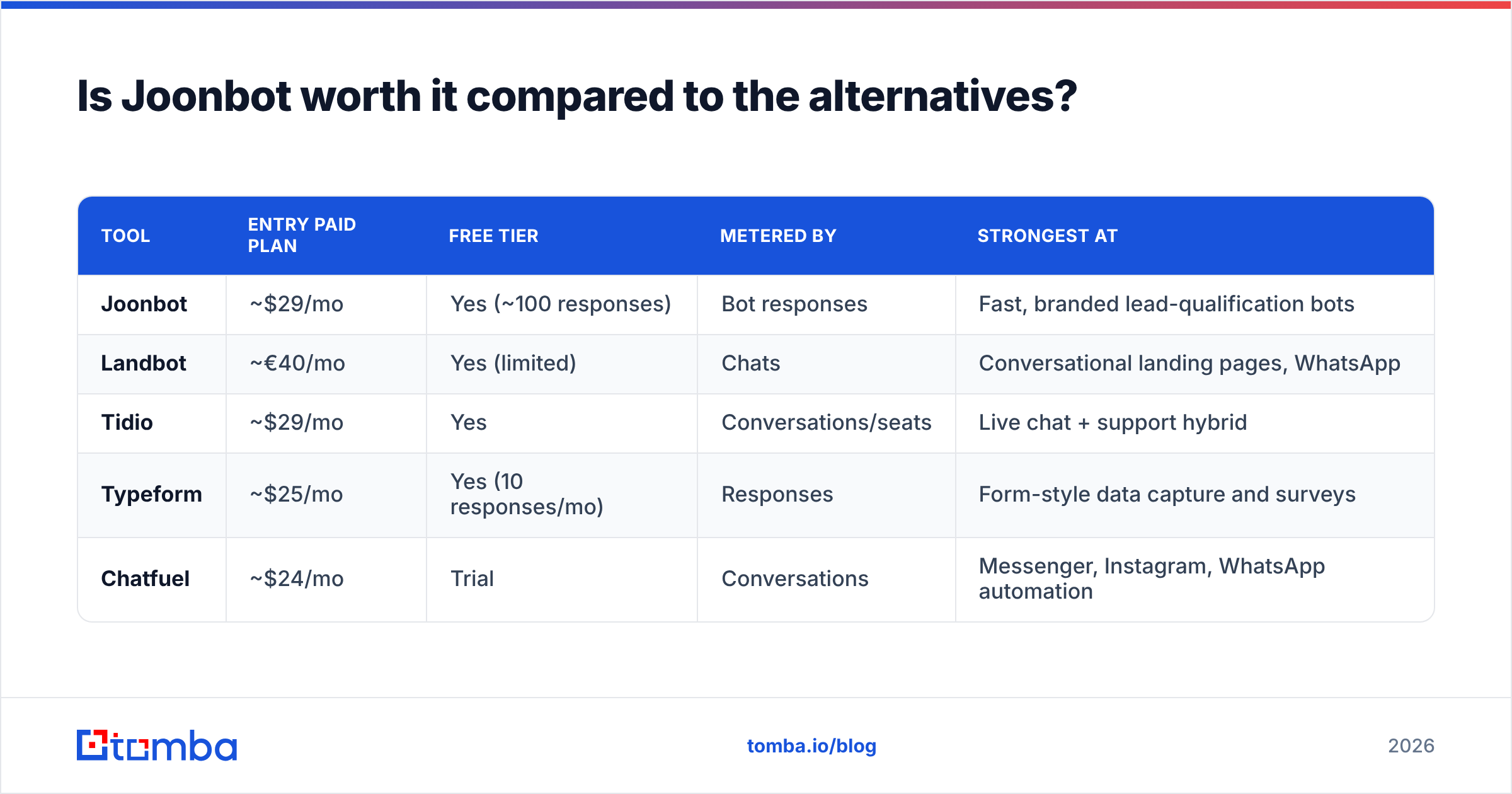
Here is how the entry-level economics stack up against the tools buyers usually shortlist alongside it:
| Tool | Entry paid plan | Free tier | Metered by | Strongest at |
|---|---|---|---|---|
| Joonbot | ~$29/mo | Yes (~100 responses) | Bot responses | Fast, branded lead-qualification bots |
| Landbot | ~€40/mo | Yes (limited) | Chats | Conversational landing pages, WhatsApp |
| Tidio | ~$29/mo | Yes | Conversations/seats | Live chat + support hybrid |
| Typeform | ~$25/mo | Yes (10 responses/mo) | Responses | Form-style data capture and surveys |
| Chatfuel | ~$24/mo | Trial | Conversations | Messenger, Instagram, WhatsApp automation |
Read that table as a positioning map, not a leaderboard. If your bot lives on a website and ends in a lead record, Joonbot and Typeform are competing for the same job with different interaction styles. If your conversations happen on WhatsApp or Instagram, Joonbot is not really in the running. If you need an agent inbox with humans taking over mid-conversation, Tidio wins by default.
Joonbot's actual advantage is that it does one thing cleanly at a price a small team can approve without a procurement conversation. That is a real advantage. It just is not a moat.
When is a chatbot the wrong line item entirely?#
A chatbot converts traffic. It does not create it. This is the single most expensive mistake in the conversational-marketing category: teams with a top-of-funnel problem buy a bottom-of-funnel tool and wonder why pipeline did not move.
Run this diagnostic before you spend anything:
- Do you have at least 3,000 relevant monthly visitors on the pages where the bot would live? Below that, a 20% conversion lift is a rounding error. Fix traffic first.
- Is your current form completion rate under 15%? If it is already healthy, a bot buys you marginal gains, not a step change.
- Does your sales motion start with inbound intent, or with you reaching out? Outbound teams need contact data, not a widget.
- Do unqualified leads currently waste rep time? If yes, qualification logic pays for itself fast. If your problem is empty calendars, it does not.
- Can you act on captured leads within an hour? Conversational capture creates a speed expectation. Slow follow-up wastes the premium.
If questions 3 and 5 gave you pause, your budget belongs upstream. For outbound motions, the equivalent spend goes into building a verified contact list: run domain search against your ICP account list, pull decision-maker addresses with an email finder, then enrich and dedupe before a single email goes out. That workflow produces contacts whether or not anyone visits your site this month.
The two budgets are not competing, they are sequential. Fill the top of the funnel with reliable data, then use a chatbot to qualify the traffic that shows up. Buying the second without the first is paying a receptionist to greet an empty lobby.
What does the total cost of a Joonbot setup look like?#
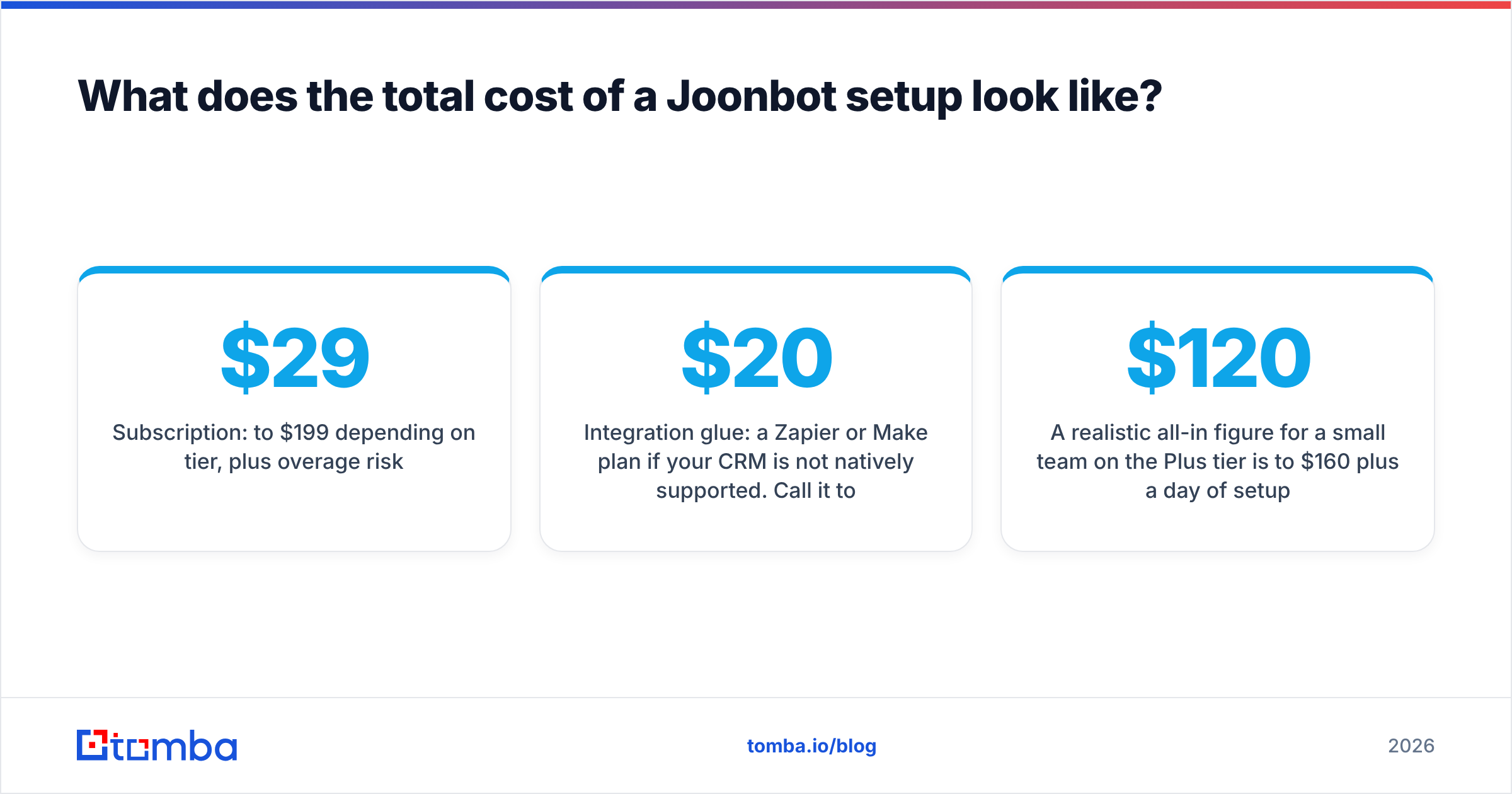
The subscription is rarely the whole bill. Budget for these:
- Subscription: $29 to $199/mo depending on tier, plus overage risk.
- Build time: 4 to 12 hours for a serious multi-branch flow, including copy, testing and edge cases.
- Integration glue: a Zapier or Make plan if your CRM is not natively supported. Call it $20 to $50/mo.
- Data hygiene: verification on captured addresses so your sending reputation survives. A bulk verify run costs cents per record and prevents a much bigger problem.
- Maintenance: flows drift. Someone needs to own copy updates and broken-branch fixes every quarter.
A realistic all-in figure for a small team on the Plus tier is $120 to $160 per month plus a day of setup. Compare that against what you currently pay per qualified lead. If the bot lifts form conversion from 10% to 16% on 5,000 monthly visitors, that is roughly 300 extra leads a month — comfortably worth it. On 500 visitors, it is 30 extra leads, and the math gets thin fast.
Who should buy Joonbot, and who should skip it?#
Buy it if: you have meaningful inbound traffic, a form that underperforms, a marketer who will own the flow, and a CRM that Joonbot connects to without heroics. At around $29 to $99 per month it is a low-risk experiment with a fast, measurable read.
Skip it if: your pipeline depends on outbound, your traffic is under a few thousand relevant sessions a month, you need multi-channel messaging on WhatsApp or Instagram, or you require deep revenue attribution inside the tool itself.
Try before committing: the free tier exists for a reason. Build the real flow, push 100 responses through it with actual traffic, and look at where people drop. That test costs nothing and tells you more than any review roundup — including this one.
Fill the funnel before you optimize it#
A chatbot makes your existing traffic work harder. It cannot manufacture accounts that were never going to visit. If your problem is a thin list rather than a leaky form, start with contact data you can trust: Tomba Email Finder pulls verified professional email addresses by domain, name or company, so your outbound motion has somewhere to go on the days nobody fills in a form. The free tier covers 25 searches a month, and paid plans start at $49/mo — see Tomba pricing for the full breakdown. Build the list first, then let a chatbot qualify whoever shows up.
Related guides#
// get started
Find, verify and enrich your first contacts today
Start on the free plan with 25 searches a month, then scale when your team is ready.
Free plan · No credit card required · GDPR & CCPA
// about the author