Jordan Belfort Sales Pitch: The Straight Line System in 2026
The Straight Line System made Jordan Belfort famous and infamous. Here is what still closes deals in B2B, what gets you blocked, and how to rebuild the pitch on clean data.
TL;DR
- The Jordan Belfort sales pitch is the Straight Line System: control the conversation on a direct path from open to close, looping back through objections instead of arguing them.
- Three mechanics still hold up in B2B — tonality, the "three tens" qualification model, and structured looping. Those are worth stealing.
- Three parts do not survive contact with 2026 buyers: high-pressure scarcity, the assumptive hard close on cold contacts, and the entire boiler-room premise of dialing anyone with a pulse.
- The pitch is a conversion multiplier, not a lead source. A 4x better script on a list with 30% dead numbers still produces a dead quarter.
- Rebuild order that works: clean contact data → research-based opener → Straight Line control → consultative close.
What is the Jordan Belfort sales pitch?#
The Jordan Belfort sales pitch is a sales methodology called the Straight Line System, developed by Jordan Belfort during his time running the brokerage Stratton Oakmont in the late 1980s and 1990s, and later packaged as a training program after his conviction for securities fraud and money laundering.
The metaphor is simple. Picture your call as a straight line drawn between two points: the open on the left, the close on the right. Above and below that line are two boundaries. Your job is to move the prospect steadily along the line while keeping the conversation inside the boundaries. Every time the prospect drifts off — a tangent, an objection, a "let me think about it" — you steer back onto the line rather than following them into the ditch.
That is the whole architecture. Everything else in the system is tooling for staying on the line: tonality patterns, scripted transitions, looping sequences, and a qualification model Belfort calls the three tens.
It was built for one specific context: outbound phone sales of a transactional product to a consumer, one call, one decision-maker, one close. Understanding that origin matters, because it explains precisely which parts transfer to modern B2B and which parts will get your domain blacklisted and your rep hung up on.
What are the "three tens" in the Straight Line System?#
Belfort's core claim is that a prospect will buy when three certainties all sit near a 10 out of 10 in their head at the same moment:
- Certainty in the product. They believe the thing itself solves their problem. In B2B terms: does the platform actually do the job they need done?
- Certainty in you. They believe the person on the other end is competent and not wasting their time. Tonality and pacing do most of the work here, not credentials.
- Certainty in the company. They believe the vendor will still exist, still support them, and still honor the contract in eighteen months.
The insight that survives is the simultaneity requirement. A prospect at 10/10 on product and 3/10 on company does not buy. Most losing pitches over-invest in the first ten — feature dumping — while leaving the other two untouched. If you have ever had a demo go beautifully and then die in silence, you probably scored a 10, a 6, and a 4.
Belfort adds a fourth axis worth noting: the prospect's action threshold and pain level. Someone with a high threshold needs more certainty before moving. Someone in active pain moves on less. That is functionally the same idea modern frameworks encode as urgency or compelling event.

How does the Straight Line pitch actually flow?#
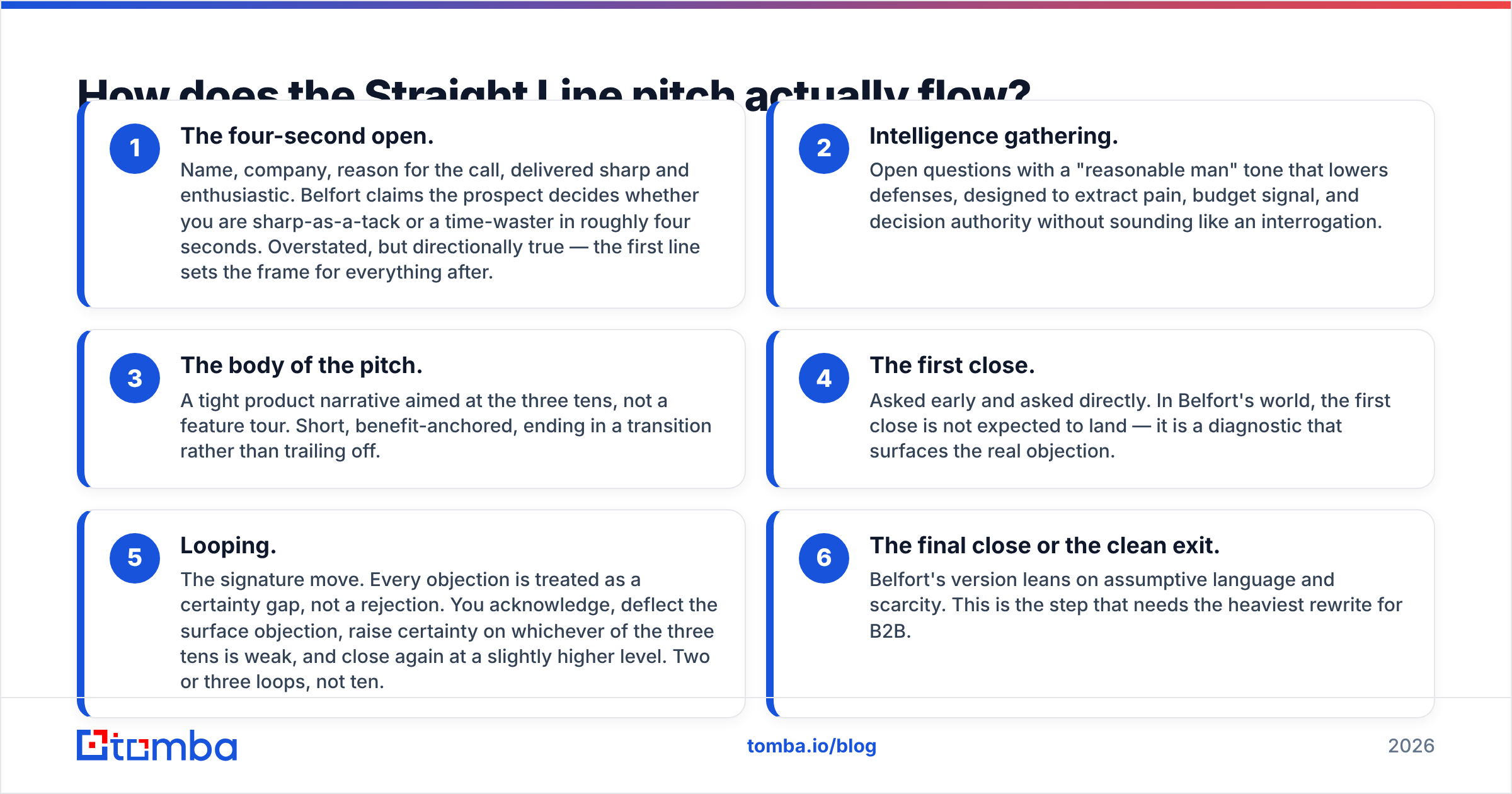
The Belfort script has a fixed shape. Here is the sequence as taught, with what each step is actually doing:
- The four-second open. Name, company, reason for the call, delivered sharp and enthusiastic. Belfort claims the prospect decides whether you are sharp-as-a-tack or a time-waster in roughly four seconds. Overstated, but directionally true — the first line sets the frame for everything after.
- Intelligence gathering. Open questions with a "reasonable man" tone that lowers defenses, designed to extract pain, budget signal, and decision authority without sounding like an interrogation.
- The body of the pitch. A tight product narrative aimed at the three tens, not a feature tour. Short, benefit-anchored, ending in a transition rather than trailing off.
- The first close. Asked early and asked directly. In Belfort's world, the first close is not expected to land — it is a diagnostic that surfaces the real objection.
- Looping. The signature move. Every objection is treated as a certainty gap, not a rejection. You acknowledge, deflect the surface objection, raise certainty on whichever of the three tens is weak, and close again at a slightly higher level. Two or three loops, not ten.
- The final close or the clean exit. Belfort's version leans on assumptive language and scarcity. This is the step that needs the heaviest rewrite for B2B.
Steps 1 through 5 are genuinely good sales mechanics. They map cleanly onto what HubSpot's sales research and most modern enablement programs describe as objection handling with a structured return to value. Step 6 is where the 1990s boiler room shows through.
Is the Jordan Belfort sales pitch better than modern B2B frameworks?#
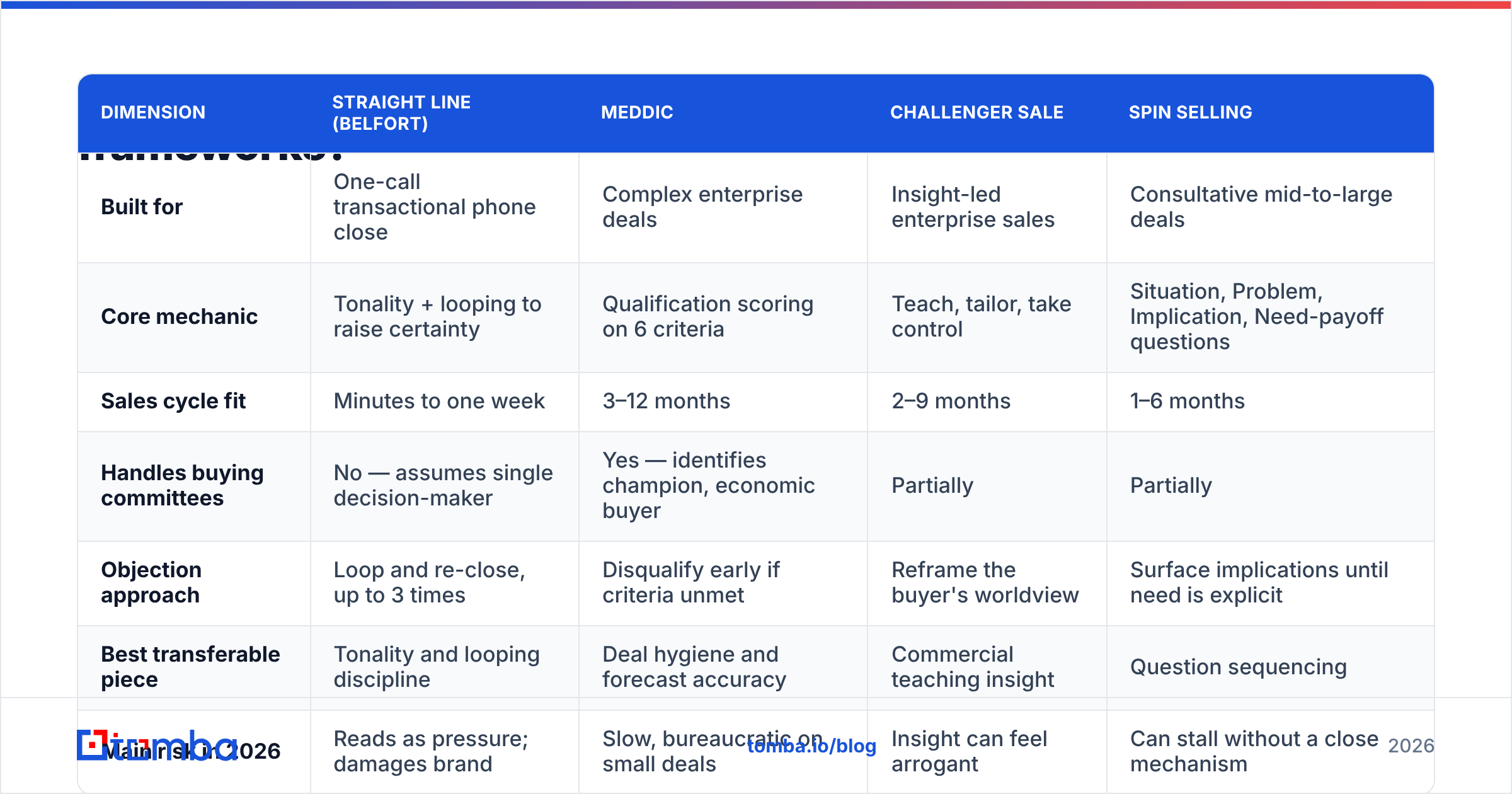
It is better at one thing — call control — and worse at almost everything involving multi-stakeholder, multi-month deals. Here is the honest comparison:
| Dimension | Straight Line (Belfort) | MEDDIC | Challenger Sale | SPIN Selling |
|---|---|---|---|---|
| Built for | One-call transactional phone close | Complex enterprise deals | Insight-led enterprise sales | Consultative mid-to-large deals |
| Core mechanic | Tonality + looping to raise certainty | Qualification scoring on 6 criteria | Teach, tailor, take control | Situation, Problem, Implication, Need-payoff questions |
| Sales cycle fit | Minutes to one week | 3–12 months | 2–9 months | 1–6 months |
| Handles buying committees | No — assumes single decision-maker | Yes — identifies champion, economic buyer | Partially | Partially |
| Objection approach | Loop and re-close, up to 3 times | Disqualify early if criteria unmet | Reframe the buyer's worldview | Surface implications until need is explicit |
| Best transferable piece | Tonality and looping discipline | Deal hygiene and forecast accuracy | Commercial teaching insight | Question sequencing |
| Main risk in 2026 | Reads as pressure; damages brand | Slow, bureaucratic on small deals | Insight can feel arrogant | Can stall without a close mechanism |
| Training cost | Low — script-based, days to learn | Medium — process change required | High — requires market insight | Medium |
The practical answer for most B2B teams: run MEDDIC or a similar qualification layer for deal hygiene, and borrow Straight Line tonality and looping for the live conversation. They are not competitors. One is a deal framework, the other is a conversation framework.
Which parts of the Belfort pitch should you cut in 2026?#
Three, without hesitation.
Cut the manufactured scarcity. "This window closes today" works on an individual buying a stock on impulse. A procurement lead who has seen eight vendor cycles reads it as a tell that your pipeline is thin. Gartner's B2B buying research consistently shows buyers spend the majority of their cycle away from vendors entirely — pressure tactics do not compress that, they just remove you from the shortlist.
Cut the hard assumptive close on cold contacts. Belfort closes within one call because the product is transactional. If your ACV is $12,000 and involves a security review, closing on call one is not aggression, it is a category error. Keep the asking — most reps genuinely under-ask — and drop the assumption.
Cut the volume premise. The Stratton Oakmont model was dial everything, qualify on the phone, burn the rest. That math collapsed once spam filtering, call blocking, and STIR/SHAKEN attestation arrived. Volume without targeting now actively degrades your sender reputation and your number's answer rate, which means your next hundred good prospects never hear the pitch at all.
What remains after those cuts is still substantial: a disciplined open, real qualification, tonality control, and a looping structure that keeps you in the conversation after the first no.
What does the Belfort pitch need that Belfort never talked about?#
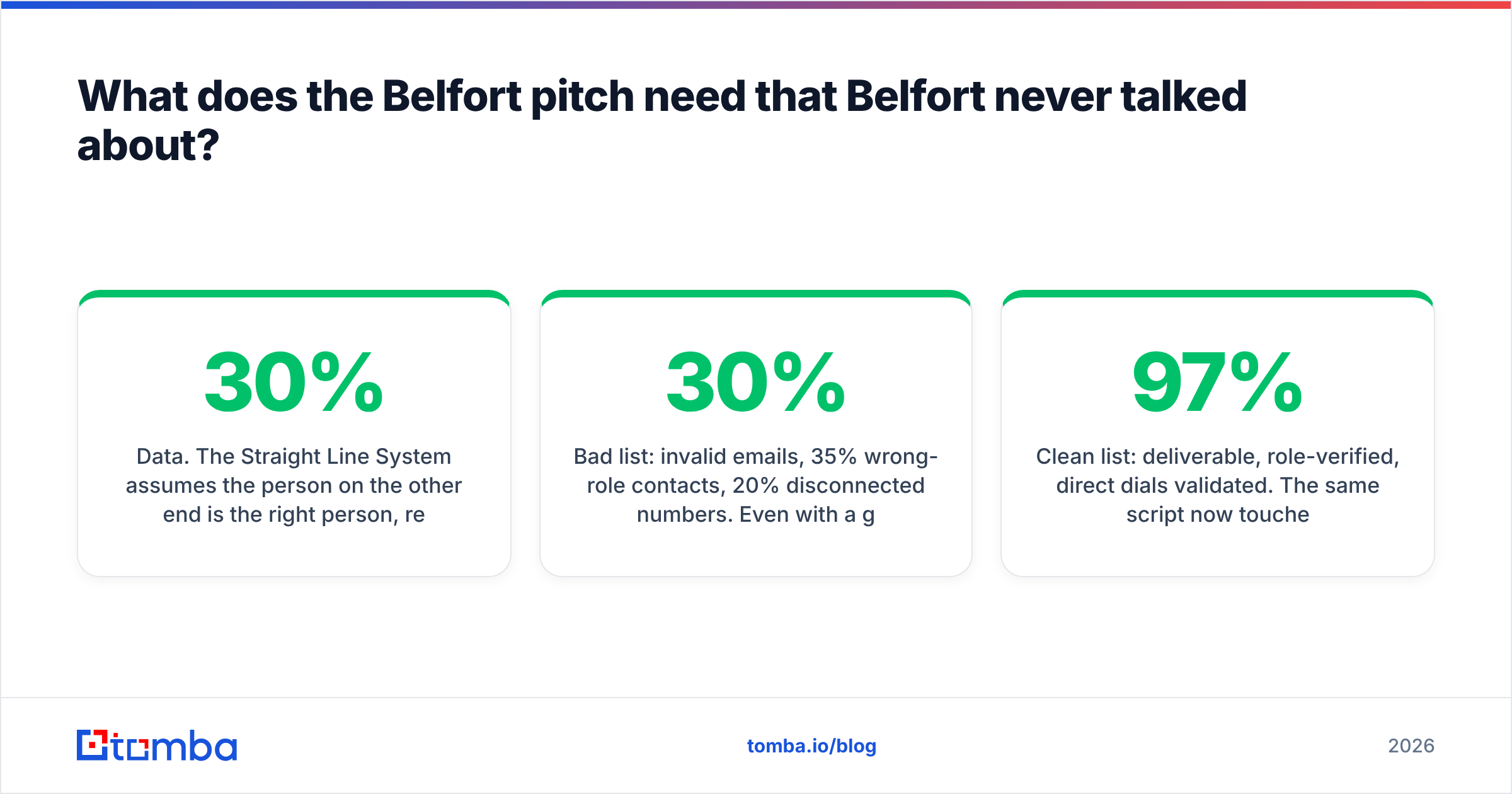
Data. The Straight Line System assumes the person on the other end is the right person, reachable, and in-market. In 1993, a phone book and a lead broker mostly delivered that. In 2026, contact decay runs roughly 25–30% a year as people change roles, companies rebrand, and catch-all domains swallow anything you send.
This is the part that quietly determines whether any script works. Run the arithmetic on a 1,000-contact list:
- Bad list: 30% invalid emails, 35% wrong-role contacts, 20% disconnected numbers. Even with a great pitch converting at 4% of conversations, you end up with a handful of conversations and almost no meetings.
- Clean list: 97% deliverable, role-verified, direct dials validated. The same script now touches four to five times as many real conversations, and the pitch quality actually shows up in the numbers.
The script multiplies conversations. It does not create them. That is why teams who spend six weeks on Straight Line training and zero hours on list hygiene report that "the methodology didn't work."

Practically, that means building the input layer first:
- Use an email finder to resolve names and domains into deliverable addresses rather than guessing patterns.
- Run the list through an email verifier before any sequence touches it, so bounces never reach your sending domain.
- For the phone leg of the Belfort pitch — which is the leg it was actually designed for — a phone finder that returns direct dials beats a switchboard number by an order of magnitude on connect rate.
- Providers differ in coverage by region and segment. Tomba is strong on domain-level discovery and verification; a database vendor like BookYourData is a reasonable complement when you need pre-built lists by industry filter. Test both against your own ICP rather than trusting any vendor's headline accuracy figure.
How do you rewrite the Straight Line pitch for B2B cold outreach?#
Keep the skeleton, change the pressure. A workable 2026 adaptation:
Open (4–8 seconds). Name, company, and a reason for the call that references something real about their business. Not "I'm calling about our platform" — "I'm calling because you posted three SDR roles this month." Certainty in you starts here.
Permission micro-close. "Can I take thirty seconds to tell you why I called, then you can tell me to go away?" This replaces Belfort's pure momentum with consent, and it costs you nothing in control.
Intelligence gathering. Two or three questions maximum on a cold call. Pain, current state, and who else touches the decision. You are filling in the buying committee Belfort never had to think about.
Body aimed at the weakest ten. Listen for which certainty is low. If they say "we already use something," that is product certainty — differentiate. If they say "never heard of you," that is company certainty — name a comparable customer. If they go quiet, that is certainty in you — slow your pace and get more specific.
First close, softened. Not "let's get you started," but "worth a twenty-minute look next Tuesday?" Same directness, appropriate stake size.
Loop up to twice. Acknowledge, address the specific certainty gap, re-close. Two loops. A third turns a professional call into the thing the movie was about.
Clean exit. If it is a no, ask one qualifying question for the CRM and get off the phone. Belfort would keep going. Your response rate on the next attempt is better if you do not.
Should you trust sales advice from a convicted fraudster?#
Separate the mechanics from the man. Belfort pleaded guilty to securities fraud, served time, and was ordered to pay over $110 million in restitution — the Stratton Oakmont operation defrauded real investors, and the techniques were deployed to sell worthless penny stocks. That history is not a footnote you can skip.
What you can take from it is narrow and specific: tonality affects trust, objections are usually certainty gaps rather than final answers, and most reps quit one loop too early. Those observations are true regardless of who first wrote them down, and they show up independently in legitimate sales research.
What you should not take is the ethical frame. The Straight Line System was optimized to create certainty whether or not certainty was warranted. Applied to a product that genuinely works, it is persuasion. Applied to one that does not, it is exactly what it was the first time.
The bottom line#
Use the Jordan Belfort sales pitch as a conversation-control layer, not as a sales philosophy. Steal the four-second open, the three tens diagnostic, and the looping discipline. Bin the scarcity, the one-call hard close, and the spray-and-pray volume model. Then put the whole thing on top of contact data that is actually current, because the best script ever written cannot ring a disconnected number.
Start with the input layer. Tomba Email Finder resolves names and company domains into verified, deliverable email addresses, with a free tier of 25 searches a month to test against your own list before you commit — paid plans start at $49/mo for Starter and $99/mo for Growth. Check current Tomba pricing for credit volumes, then point your rebuilt Straight Line pitch at contacts who will actually pick up.
Related guides#
// get started
Find, verify and enrich your first contacts today
Start on the free plan with 25 searches a month, then scale when your team is ready.
Free plan · No credit card required · GDPR & CCPA
// about the author