Just a Gentle Reminder on the Below Email: What to Send Instead
"Just a gentle reminder on the below email" is the most common follow-up opener in B2B inboxes - and one of the weakest. Here's what it signals, why it stalls replies, and the exact lines to send instead.
TL;DR
- "Just a gentle reminder on the below email" is a hedge. It apologises for existing, adds no new information, and gives the reader nothing to act on.
- The phrase itself is grammatically acceptable in Indian and South-East Asian business English ("the below email"), but it reads as stiff or dated to US/UK buyers.
- The bigger problem is structural: most reminder emails repeat the original ask instead of adding a reason to reply now.
- Replace the hedge with a one-line context reset, a single question, and a deadline or a takeaway. Reply rates move when the ask gets smaller, not louder.
- Before you blame your copy, check that the address is deliverable. A large share of "no reply" is actually "never arrived" — verify the list first.
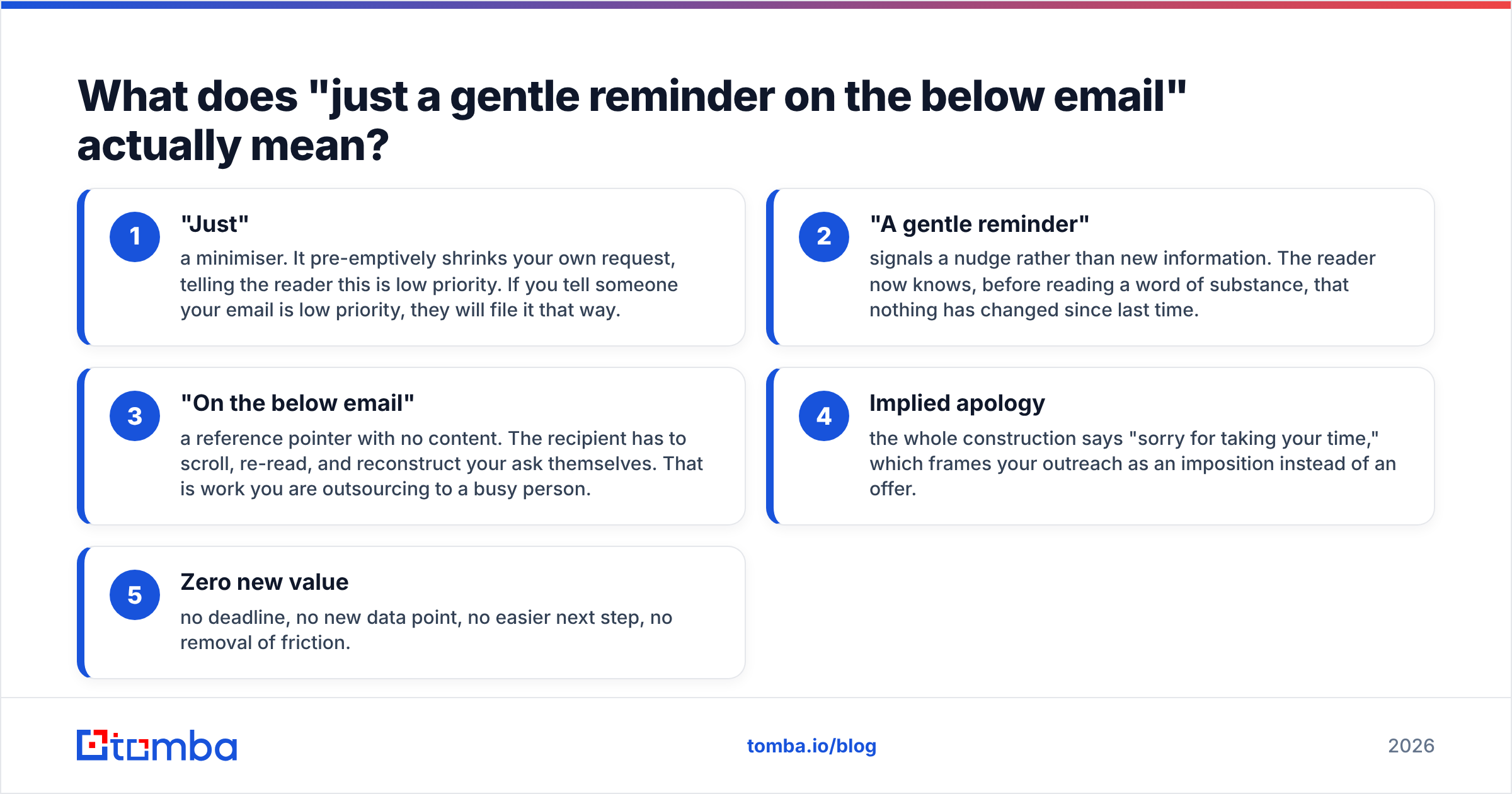
What does "just a gentle reminder on the below email" actually mean?#
It means: I already asked you something, you did not answer, and I am uncomfortable about asking again.
That is the entire payload. The phrase is a social cushion, not a message. It appears at the top of millions of B2B follow-ups because it feels safe — polite, non-pushy, low-risk. The problem is that safety and persuasion pull in opposite directions. A sentence engineered to avoid annoying someone also avoids moving them.
Break the phrase into its parts and you can see how little work it does:
- "Just" — a minimiser. It pre-emptively shrinks your own request, telling the reader this is low priority. If you tell someone your email is low priority, they will file it that way.
- "A gentle reminder" — signals a nudge rather than new information. The reader now knows, before reading a word of substance, that nothing has changed since last time.
- "On the below email" — a reference pointer with no content. The recipient has to scroll, re-read, and reconstruct your ask themselves. That is work you are outsourcing to a busy person.
- Implied apology — the whole construction says "sorry for taking your time," which frames your outreach as an imposition instead of an offer.
- Zero new value — no deadline, no new data point, no easier next step, no removal of friction.
Put together: the opener burns the two most valuable lines of your email — the preview text and the first sentence — on an apology for the email's own existence.
Wait, that renders oddly — here it is properly:
Is "the below email" grammatically wrong?#
Not wrong, but regionally marked. "Below" as a pre-modifier ("the below email," "the below details," "please find the below table") is standard in Indian English and widespread across South Asian, Gulf, and South-East Asian business correspondence — a documented feature of the variety, not an error (see the overview of Indian English). In US and UK corporate writing the more common forms are "the email below," "my email below," or simply "my note from Tuesday."
Practical guidance depends on who you are writing to:
- Writing within a market where the construction is standard? Keep it. Editing it out can read as needlessly foreign.
- Writing cold to a US, UK, or Australian buyer? "The email below" is the lower-friction phrasing, and "my note from Tuesday" is better still because it adds a timestamp the reader can anchor to.
- Writing to a mixed audience? Skip the reference entirely and restate the ask in one clause. Reference pointers are the real problem, not the word order.
The grammar debate is a distraction. Nobody has ever declined a meeting over a fronted adverb. They decline because the follow-up asked them to do the same unrewarding thing a second time.
Why does "gentle reminder" hurt your reply rate?#
Because it competes for attention using politeness, and politeness is not a differentiator in a crowded inbox. Every other vendor is also being polite.
Three mechanisms drag the reply rate down:
Preview-text waste. Most inbox clients show 40–90 characters of body copy next to the subject line. "Just a gentle reminder on the below email" eats all of it and communicates nothing. The recipient decides whether to open based on a sentence that says "this is a repeat."
Ask repetition without ask reduction. If someone ignored a 30-minute demo request, sending the identical 30-minute demo request with an apology attached does not change the maths. The correct move is to shrink the ask — a yes/no question, a one-line reply, a single link.
Signalling low stakes. HubSpot's sales research on follow-up cadence consistently finds that specificity and a clear next step outperform softened language; their follow-up email guidance leans on concrete reasons to reply, not apologetic framing. Gartner's B2B buying research points the same direction: buyers are overloaded with information and reward messages that reduce their decision effort, not messages that add another undifferentiated touch (Gartner B2B buying research).
None of this means you should be aggressive. "Circling back," "bumping this," and "just following up" fail for exactly the same reason. The fix is not a harder tone — it is a different payload.
What should you write instead of "just a gentle reminder"?#
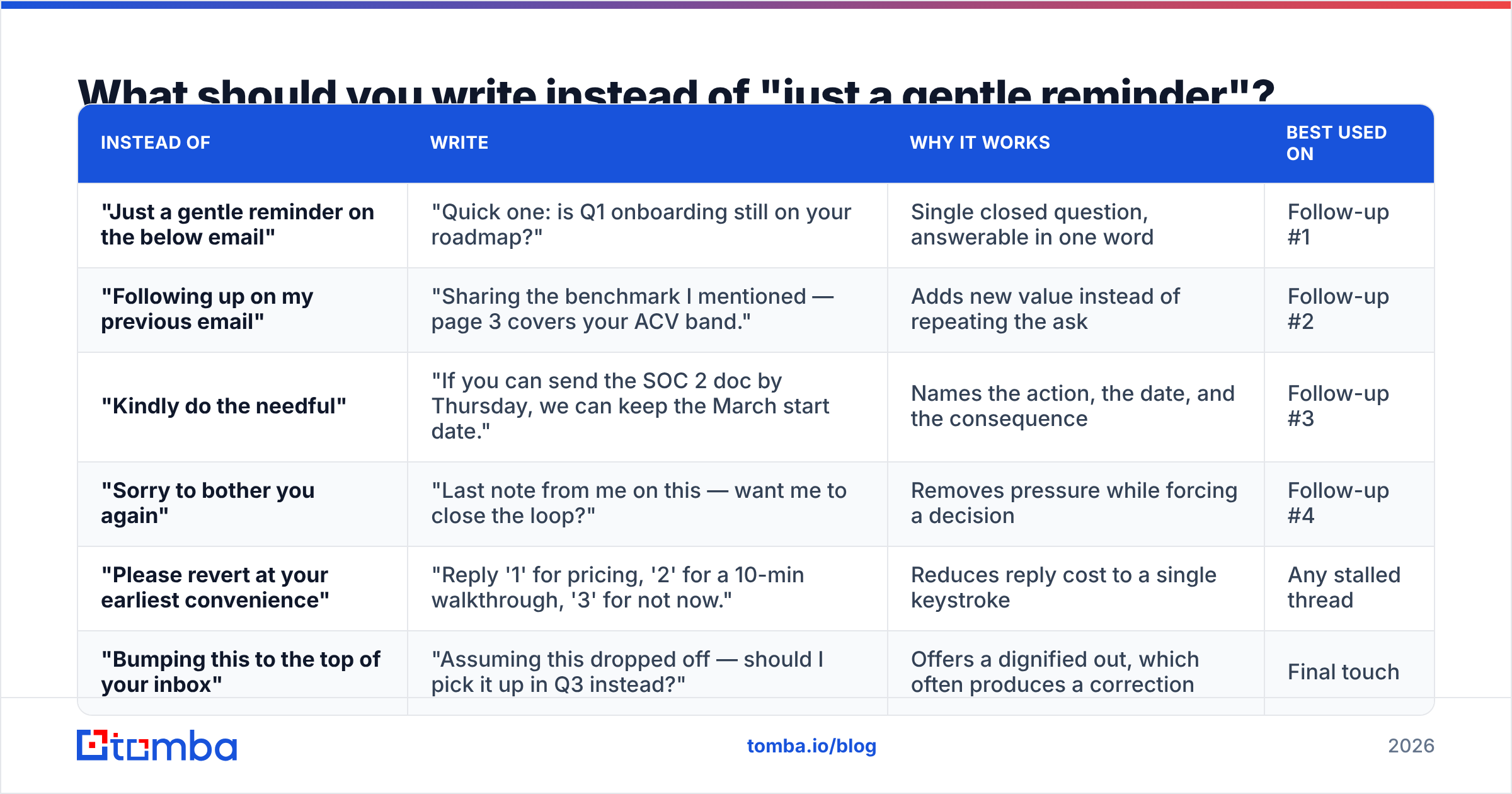
Replace the hedge with one of four payload types: a deadline, a new data point, a smaller ask, or a graceful exit. Here is the swap table.
| Instead of | Write | Why it works | Best used on |
|---|---|---|---|
| "Just a gentle reminder on the below email" | "Quick one: is Q1 onboarding still on your roadmap?" | Single closed question, answerable in one word | Follow-up #1 |
| "Following up on my previous email" | "Sharing the benchmark I mentioned — page 3 covers your ACV band." | Adds new value instead of repeating the ask | Follow-up #2 |
| "Kindly do the needful" | "If you can send the SOC 2 doc by Thursday, we can keep the March start date." | Names the action, the date, and the consequence | Follow-up #3 |
| "Sorry to bother you again" | "Last note from me on this — want me to close the loop?" | Removes pressure while forcing a decision | Follow-up #4 |
| "Please revert at your earliest convenience" | "Reply '1' for pricing, '2' for a 10-min walkthrough, '3' for not now." | Reduces reply cost to a single keystroke | Any stalled thread |
| "Bumping this to the top of your inbox" | "Assuming this dropped off — should I pick it up in Q3 instead?" | Offers a dignified out, which often produces a correction | Final touch |
Notice what every right-hand column shares: the recipient can answer without scrolling, without opening an attachment, and without thinking about your quarter.
How many follow-ups should you send, and when?#
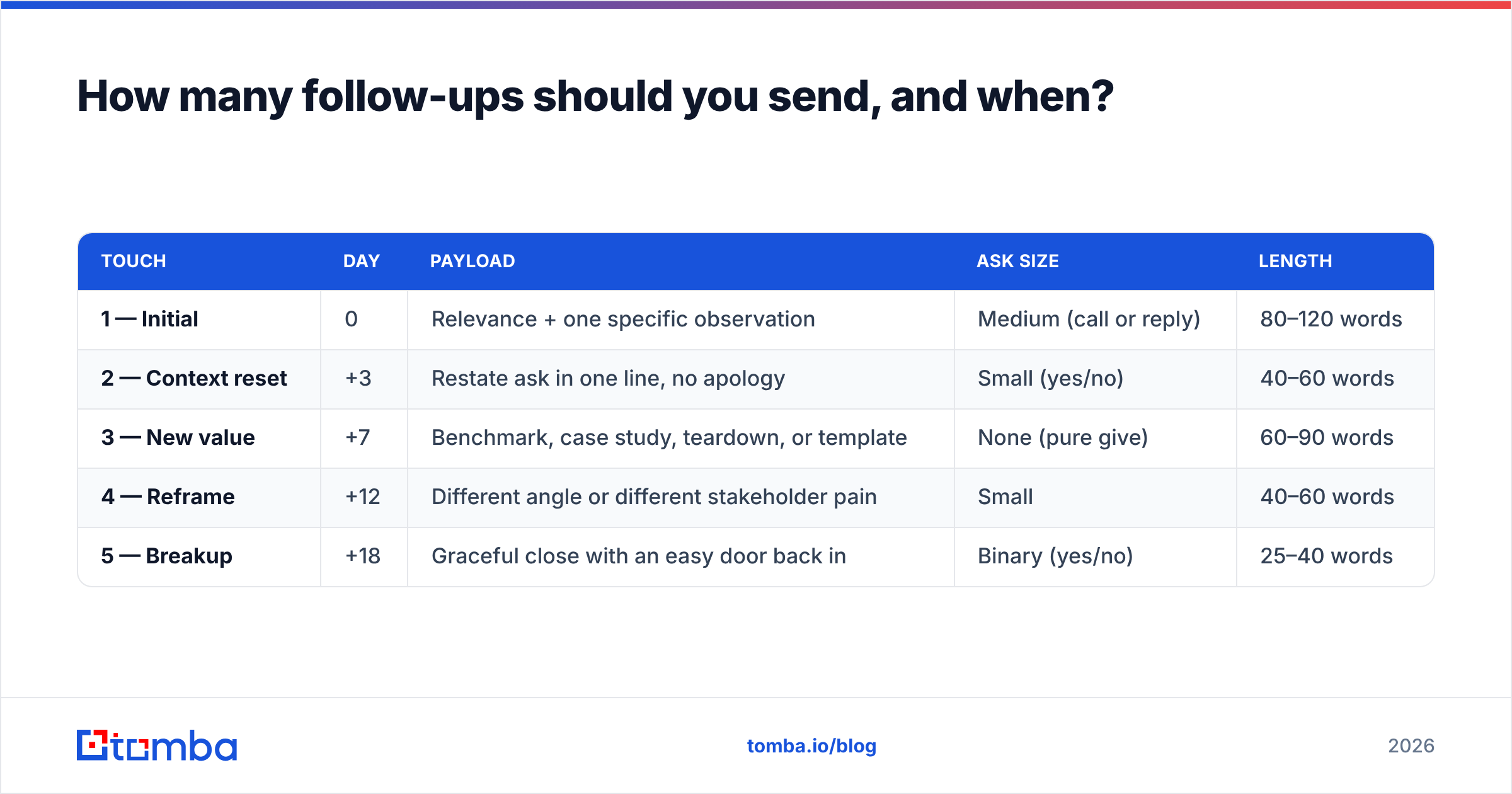
The honest answer is three to five touches over two to three weeks for most B2B motions, with the value density increasing rather than the volume. What matters more than the count is what each touch carries.
| Touch | Day | Payload | Ask size | Length |
|---|---|---|---|---|
| 1 — Initial | 0 | Relevance + one specific observation | Medium (call or reply) | 80–120 words |
| 2 — Context reset | +3 | Restate ask in one line, no apology | Small (yes/no) | 40–60 words |
| 3 — New value | +7 | Benchmark, case study, teardown, or template | None (pure give) | 60–90 words |
| 4 — Reframe | +12 | Different angle or different stakeholder pain | Small | 40–60 words |
| 5 — Breakup | +18 | Graceful close with an easy door back in | Binary (yes/no) | 25–40 words |
Two rules that matter more than the table:
- Never send touch N without changing something from touch N-1. Same subject, same ask, same length, new date is not a follow-up — it is noise with a timestamp.
- Shorten as you go. Touch 5 should be the shortest email in the sequence. Long final emails read as desperate; short ones read as confident.
If you are testing subject lines across the sequence, run them through a subject line tester before you queue the campaign rather than after the reply data disappoints you.
What does a good reminder email actually look like?#
Three examples you can adapt. All of them are shorter than the original message they follow up on.
1. The context reset (touch 2)
Subject: Q1 onboarding — still live?
Hi Priya,
Sent you a note Tuesday about cutting your list-building time on the SDR team.
One question so I know whether to keep this on your radar: is Q1 onboarding still the plan, or has it slipped?
Either answer is useful.
— Sam
2. The value drop (touch 3)
Subject: Benchmark for 40-person SDR teams
Hi Priya,
No ask here. We pulled connect-rate data across 120 mid-market SDR teams and the 40–60 headcount band had the widest spread — page 3 has the breakdown.
Link: [benchmark]
If the numbers look off versus what you're seeing, I'd genuinely like to know.
— Sam
3. The graceful close (touch 5)
Subject: Closing the loop
Hi Priya,
Last note from me — I'll assume the timing isn't right and stop here.
If that changes, one line back and I'll pick it up.
— Sam
Every one of these could have opened with "just a gentle reminder on the below email." None of them needed to. If you want more starting points, the library of cold email templates covers the surrounding sequence.
Is your follow-up failing, or is your data failing?#
This is the part most copy advice skips. Before you rewrite the opener for the fourth time, confirm the email is actually arriving.
A stalled thread has four possible causes, and only one of them is a copy problem:
- The address is wrong or dead. Role accounts, departed employees, typo'd domains. The message bounces or silently disappears.
- The domain is catch-all. It accepts everything, so your bounce rate looks perfect while half your sends land nowhere a human reads.
- It landed in spam or Promotions. Authentication gaps, aggressive links, or a cold domain sending at volume.
- It arrived, was read, and ignored. This is the copy problem.
Rewriting the subject line fixes cause 4 only. If your list has never been validated, you are optimising a message that a meaningful share of recipients never saw. Run the list through an email verifier first, and use a catch-all verifier for the domains that accept everything — those are the ones that quietly inflate your "no reply" bucket and make good copy look bad.
The order of operations is: valid address → inbox placement → message quality. Reversing it wastes months.
How do you measure whether the change worked?#
Track replies, not opens. Open rates have been unreliable since privacy-protection features started pre-fetching images, and they were never a proxy for intent anyway.
Use these four:
- Reply rate per touch. Segment by touch number. If touch 4 outperforms touch 2, your early emails are the weak ones.
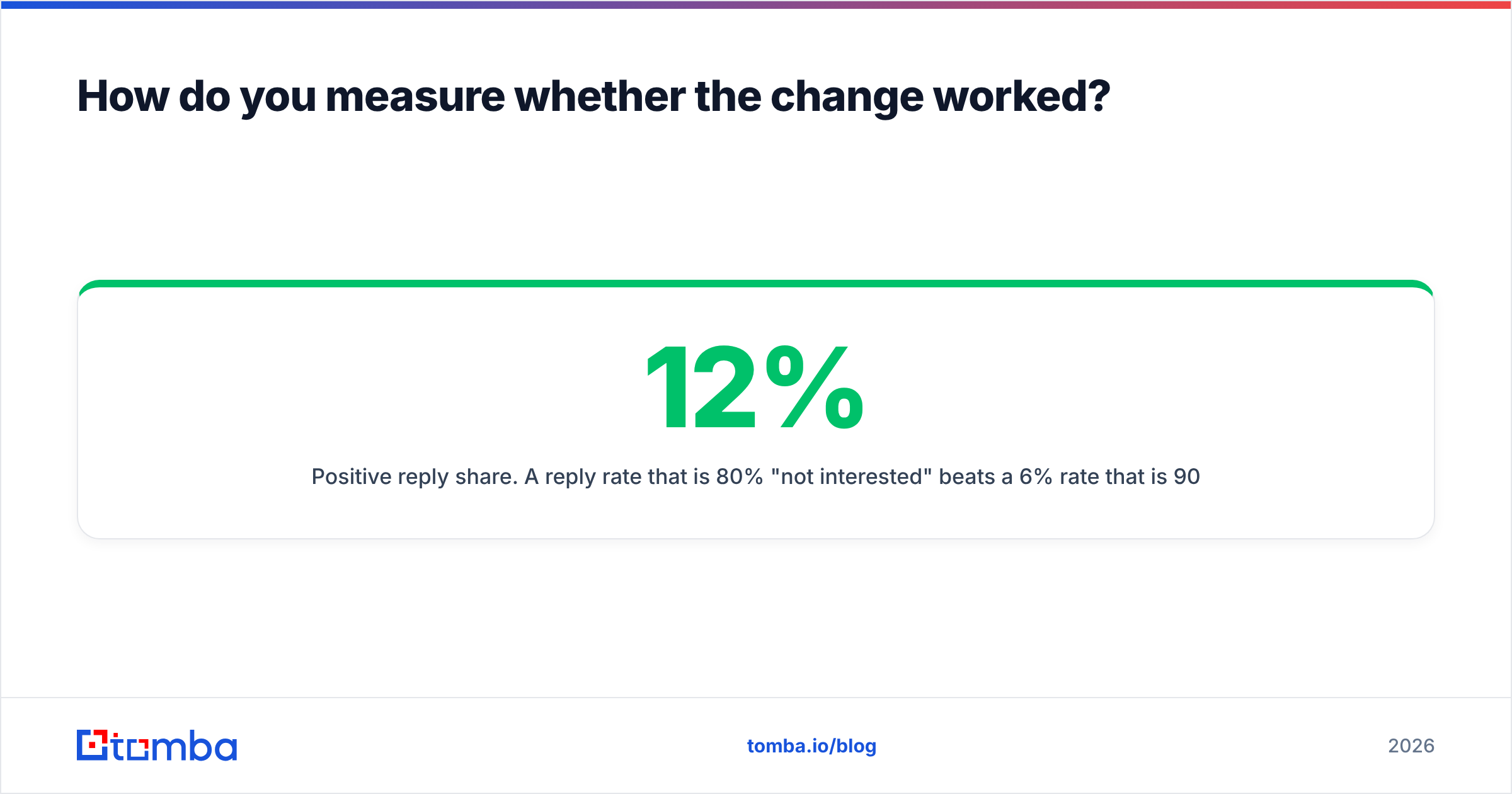
- Positive reply share. A 12% reply rate that is 80% "not interested" beats a 6% rate that is 90% "not interested" — but only if you count it.
- Time to first reply. Shrinking from 9 days to 3 usually means your ask got smaller, not that your prospects got keener.
- Bounce and catch-all share. If this is above single digits, fix data before copy. Full stop.
Benchmarks vary wildly by industry and list quality, so compare against your own baseline rather than a blog post average. If you need working definitions for the metrics your team argues about, the entry on response rate is a reasonable starting point, and G2's sales engagement category gives you peer reviews of the tools that report them.
Quick answers#
Is "gentle reminder" rude? No — it is the opposite problem. It is so deferential that it reads as low-stakes, which is why it gets deprioritised.
Should I change the subject line on a follow-up or keep the thread? Keep the thread for touches 2 and 3 so the context travels with it. Break into a fresh subject for touch 4 when you change the angle.
Is it ever fine to write "the below email"? Yes, within markets where it is standard business register. Just do not rely on it to carry the ask — restate the request in the same sentence.
How long should I wait between reminders? Three days for touch 2, then widen. Daily follow-ups signal that your pipeline matters more than their calendar.
What about "kindly do the needful"? Same class of phrase. It is polite and regionally standard, but it hides the action. Name the action, the owner, and the date.
Where to start#
Rewrite one sequence this week. Delete every instance of "just a gentle reminder on the below email," "circling back," and "bumping this," and replace each with a one-line question the recipient can answer without scrolling. Then shorten every follow-up so it is visibly briefer than the one before it.
Then fix the input side. Better follow-up copy sent to stale addresses still produces silence — and silence from a dead mailbox is indistinguishable from silence from a disinterested buyer, which means you learn nothing from either. Build the list with the Tomba Email Finder so every contact starts verified, and spend your editing time on the messages that will actually be read. Plans start free at 25 searches a month, with Starter at $49/mo — see Tomba pricing for the full breakdown.
Related guides#
// get started
Find, verify and enrich your first contacts today
Start on the free plan with 25 searches a month, then scale when your team is ready.
Free plan · No credit card required · GDPR & CCPA
Get the Tomba newsletter
Product and data updates
// about the author