Just a Quick Reminder: Better Follow-Up Email Phrasing
"Just a quick reminder" is the most-used opening line in B2B follow-ups and one of the weakest. Here is what it actually signals to a prospect, the rare moments it still works, and six replacements that earn replies instead of bumps.
TL;DR
- "Just a quick reminder" is a status update about your pipeline, not a reason for the prospect to reply. That mismatch is why bump emails flatline.
- The phrase is not always wrong. It works when a real deadline, a scheduled meeting, or a commitment the prospect made is on the line — and nowhere else.
- Every follow-up should add one new thing: a new angle, a new proof point, a new question, or a graceful exit. Never just a new send date.
- Six replacement openers below, plus a four-touch sequence you can copy into any sending tool.
- If your follow-ups get zero replies and zero bounces on a cold list, the phrasing may not be the problem — bad or unverified contact data usually is.
What does "just a quick reminder" actually signal?#
Think about a nudge from a friend versus a nudge from a parking-ticket office. The friend says "still up for Thursday?" — you both agreed to something, and they're closing a loop. The ticket office says "this is a reminder that payment is due" — an obligation exists whether you like it or not.
Cold and semi-cold B2B follow-ups usually have neither. The prospect never agreed to anything and owes you nothing. So when you open with "just a quick reminder," you are borrowing the grammar of obligation without having earned it. The recipient reads it in under a second and decodes three things:
- You're tracking them. Your CRM says "no reply, day 4," and they can tell.
- Nothing new has happened. The word "reminder" explicitly announces there is no new information in this email.
- The burden is on them. You've reframed your unanswered pitch as their outstanding task.
The word "just" makes it worse. It's a hedge — a pre-apology for taking up space. Strip it and you get "a quick reminder," which is blunter and, oddly, more respectable. Strip the whole construction and you have to write something with actual content, which is the point.
There is real psychology behind why reminders feel effective to the sender. The Zeigarnik effect describes how unfinished tasks stay mentally sticky — for the person who has the open loop. Your unanswered email is an open loop for you. For the prospect, it was closed the moment they decided not to reply.
When is a reminder email actually the right move?#
There is a narrow band where the phrase is honest, and inside that band it performs fine. Use it when all three of these are true:
- A commitment exists. They booked the call, requested the proposal, asked you to circle back in Q3, or downloaded something with a stated follow-up.
- A date is attached. A meeting tomorrow, a trial expiring Friday, a quote valid for 14 days, a webinar starting in an hour.
- The reminder is a service, not a pitch. If removing your product from the email still leaves something useful (a calendar link, an expiring discount, a document they need to sign), you're fine.
Transactional reminders — appointment confirmations, renewal notices, contract-signature nudges — are among the highest-open-rate emails any B2B team sends, because the recipient asked for the loop to be closed. The failure mode is copying that tone into cold outbound where no loop was ever opened.
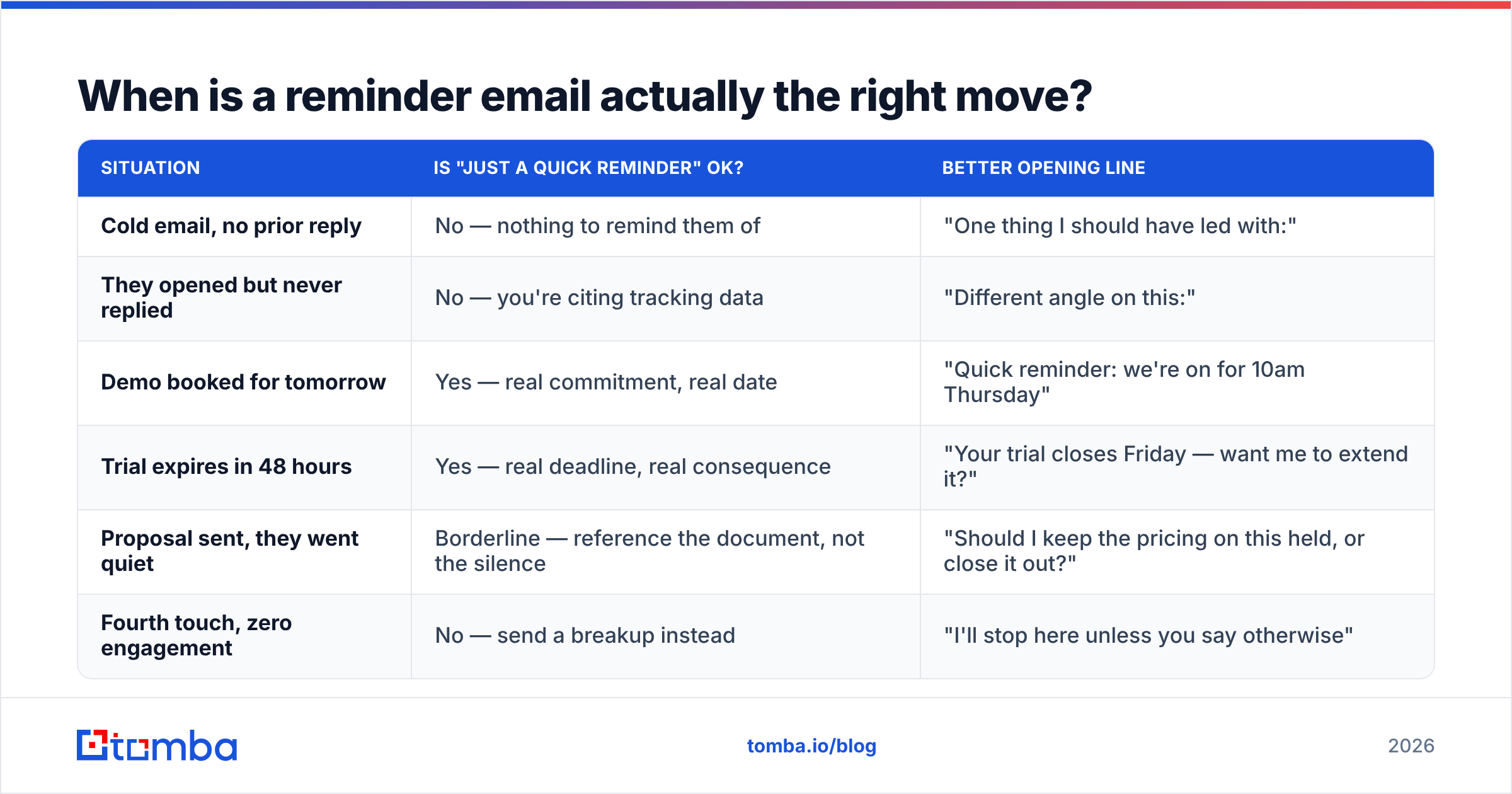
Here's the practical split:
| Situation | Is "just a quick reminder" OK? | Better opening line |
|---|---|---|
| Cold email, no prior reply | No — nothing to remind them of | "One thing I should have led with:" |
| They opened but never replied | No — you're citing tracking data | "Different angle on this:" |
| Demo booked for tomorrow | Yes — real commitment, real date | "Quick reminder: we're on for 10am Thursday" |
| Trial expires in 48 hours | Yes — real deadline, real consequence | "Your trial closes Friday — want me to extend it?" |
| Proposal sent, they went quiet | Borderline — reference the document, not the silence | "Should I keep the pricing on this held, or close it out?" |
| Fourth touch, zero engagement | No — send a breakup instead | "I'll stop here unless you say otherwise" |
What should replace it in a follow-up email?#
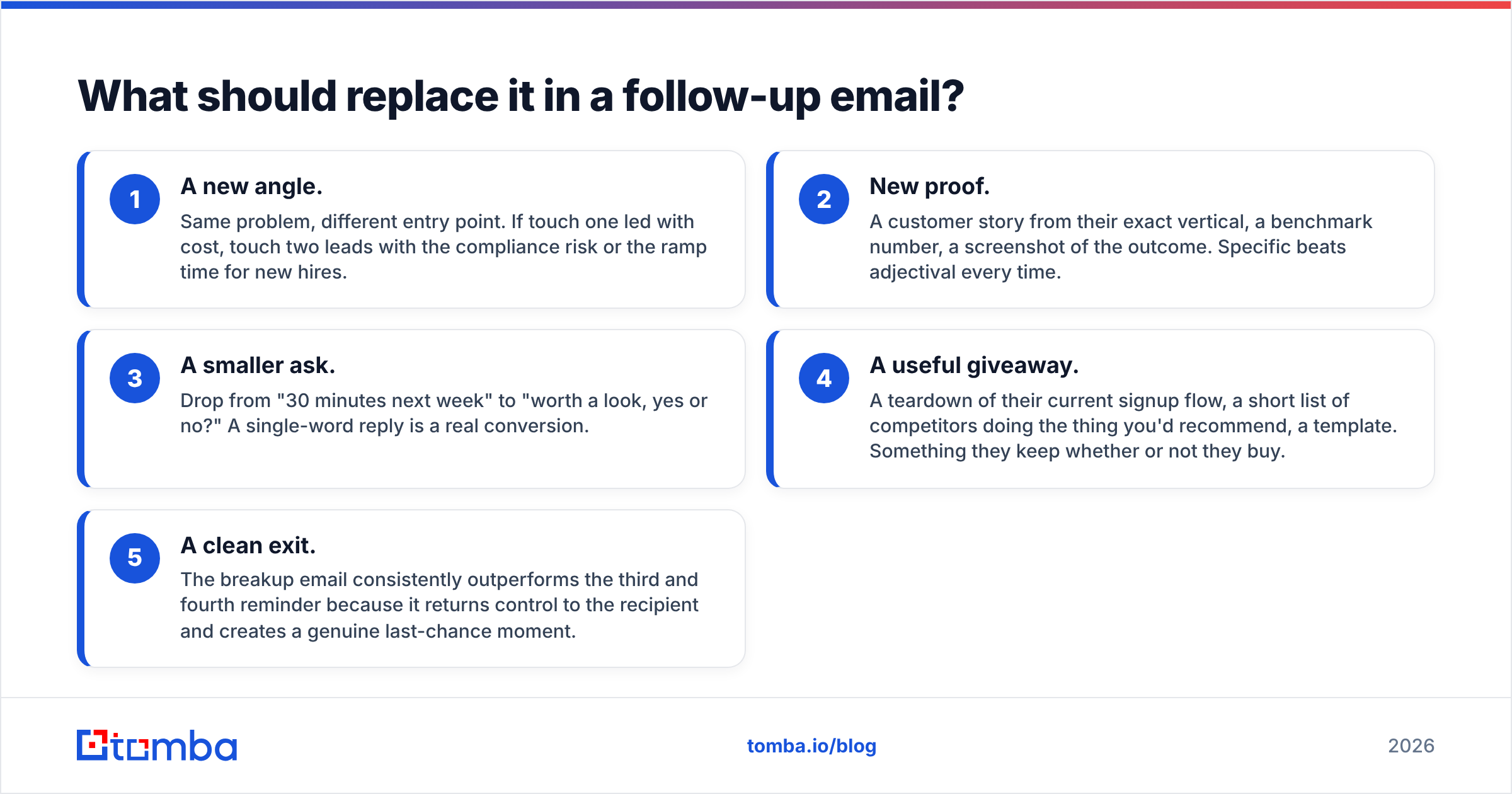
Every follow-up needs a reason to exist that is independent of your last email. That's the whole rule. Five reasons that qualify:
- A new angle. Same problem, different entry point. If touch one led with cost, touch two leads with the compliance risk or the ramp time for new hires.
- New proof. A customer story from their exact vertical, a benchmark number, a screenshot of the outcome. Specific beats adjectival every time.
- A smaller ask. Drop from "30 minutes next week" to "worth a look, yes or no?" A single-word reply is a real conversion.
- A useful giveaway. A teardown of their current signup flow, a short list of competitors doing the thing you'd recommend, a template. Something they keep whether or not they buy.
- A clean exit. The breakup email consistently outperforms the third and fourth reminder because it returns control to the recipient and creates a genuine last-chance moment.
Notice what none of these are: a restatement of the previous email with a politeness wrapper.
Six openers that beat "just a quick reminder"#
Copy these, then rewrite them in your own voice — a template you don't adapt reads exactly like a template.
1. The new-angle open
Different angle on my last note. When [similar company] moved to [approach], the thing that surprised them wasn't the cost — it was that onboarding dropped from six weeks to nine days. Is ramp time a live issue for your team this quarter, or is that already solved?
2. The one-line proof drop
Nothing needed from you here. [Competitor in their space] published their Q2 numbers last week and the retention jump lines up almost exactly with what we see after teams fix [problem]. Sending in case it's useful ammunition internally.
3. The smaller ask
I'll make this easy — is this a "not now," a "wrong person," or a "not interesting"? Any one of those is a genuinely useful answer and I'll act on it.
4. The assumption close
My read is that [priority X] is eating the whole quarter and this sits behind it. If that's right, I'll check back in January. If it's wrong, tell me and I'll send the 4-minute version today.
5. The forward-to-the-right-person
Chances are this belongs with whoever owns [function] rather than you. If you point me at a name I'll take it off your plate entirely.
6. The breakup
This is my last email on this. If [problem] moves up the list, my door's open — no hard feelings either way, and I'd rather leave your inbox clean than keep bumping this.
Test the subject lines that carry these with a subject line tester before you queue the sequence. "Re: quick reminder" and "Following up" are the two most fatigued strings in B2B inboxes.
How many follow-ups should a sequence have?#
Most teams land between three and five touches over two to three weeks, and reply volume concentrates heavily in the first two. HubSpot's sales blog and most sequencing vendors converge on the same shape: front-load value, space the touches out, and end deliberately rather than fading away. Vendor-reported benchmarks on G2 show the same pattern across sales-engagement platforms — added touches past the fifth mostly add unsubscribes, not meetings.
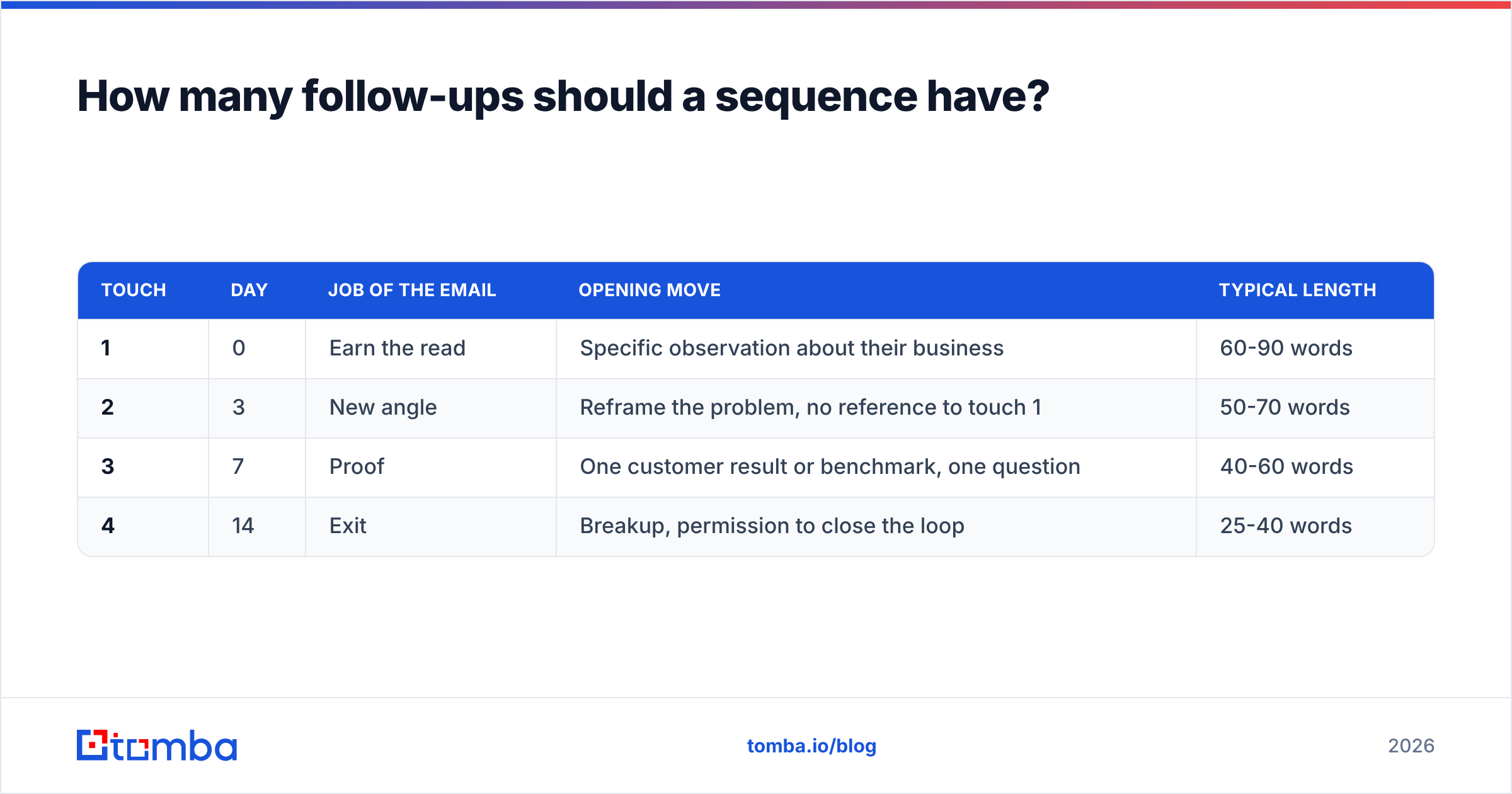
A four-touch structure that avoids reminder language entirely:
| Touch | Day | Job of the email | Opening move | Typical length |
|---|---|---|---|---|
| 1 | 0 | Earn the read | Specific observation about their business | 60-90 words |
| 2 | 3 | New angle | Reframe the problem, no reference to touch 1 | 50-70 words |
| 3 | 7 | Proof | One customer result or benchmark, one question | 40-60 words |
| 4 | 14 | Exit | Breakup, permission to close the loop | 25-40 words |
Two things this structure does that a reminder cadence doesn't. First, each email stands alone — if touch two is the only one that lands in the inbox, it still makes sense. Second, it never references your own prior sends, which means it never advertises that you've been ignored.
Is the problem your phrasing or your list?#
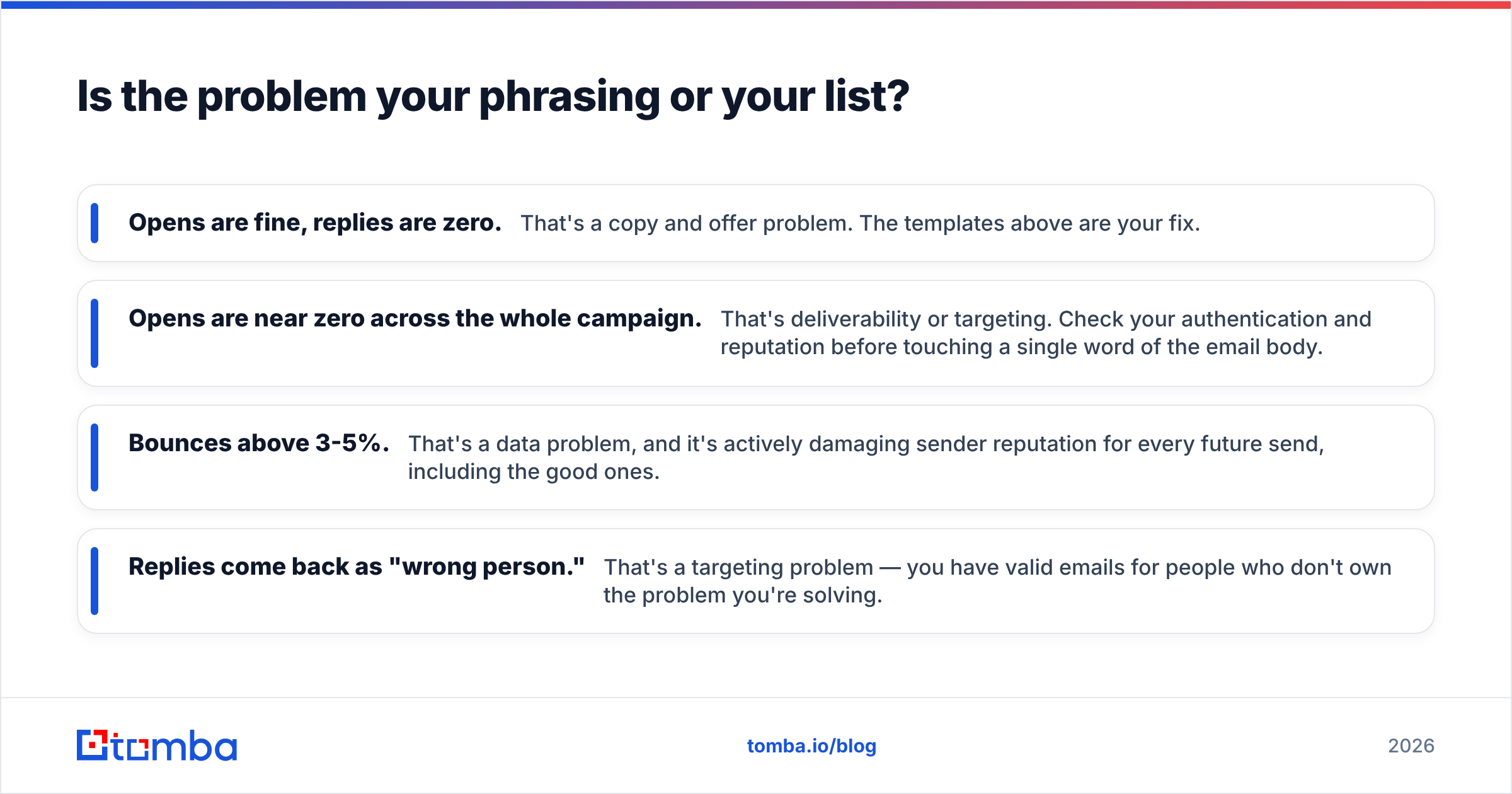
Before you rewrite another opener, run a quick diagnostic — because copy fixes a copy problem and nothing else.
- Opens are fine, replies are zero. That's a copy and offer problem. The templates above are your fix.
- Opens are near zero across the whole campaign. That's deliverability or targeting. Check your authentication and reputation before touching a single word of the email body.
- Bounces above 3-5%. That's a data problem, and it's actively damaging sender reputation for every future send, including the good ones.
- Replies come back as "wrong person." That's a targeting problem — you have valid emails for people who don't own the problem you're solving.
The third case is the one that quietly ruins follow-up sequences. When a chunk of your list is invalid, each additional touch multiplies the damage: four sends to a dead address is four bounces, not one. Running the list through an email verifier before the sequence starts, rather than after the first bounce report, is the single highest-leverage thing most teams skip. For domains that accept everything, a catch-all verifier tells you whether a mailbox is genuinely reachable or just silently swallowed.
And when "wrong person" comes back, treat it as a gift rather than a rejection — a domain search on the same company surfaces the colleagues who actually own that function, which turns a dead thread into a warm referral path.
It's also worth being honest about the ceiling. Even a well-written four-touch sequence to a clean, well-targeted list lands in the low-single-digit reply range for cold outbound. If you're measuring against a fantasy number, you'll keep rewriting copy that was already fine. Benchmark against your own response rate from last quarter, not against a screenshot on LinkedIn.
What about internal reminders and warm follow-ups?#
Different rules apply once a relationship exists. Internally — or with a customer who has already signed — "just a quick reminder" is mostly harmless, because the obligation is real and mutual. Even there, two upgrades are free:
- Name the deadline, not the reminder. "The security questionnaire is due Thursday" beats "just a reminder about the questionnaire." One is information; the other is a wrapper around information.
- Make the next action a single click. Attach the doc, embed the link, pre-fill the calendar slot. A reminder that requires the recipient to go find the thing is half a reminder.
For warm prospects who have gone quiet after a demo, the strongest move is usually a status question rather than a nudge: "Is this still on the roadmap for Q1, or has it slipped?" That's answerable in five words and gives you forecast-grade information either way. Compare that to a reminder, which is answerable only by doing the thing you originally asked for — a much higher bar.
What should you do next?#
Audit your last 20 follow-ups. Count how many open with a reminder, a bump, or a reference to your own previous email. That number is your rewrite queue. Replace each one with a new angle, new proof, a smaller ask, or an exit — and delete the fourth and fifth touches that were pure repetition.
Then fix the input side. Better phrasing sent to a stale list still produces silence, and silence from a bad address looks identical to silence from an uninterested buyer, which makes your whole cadence impossible to diagnose. Start with verified, correctly targeted contacts: Tomba Email Finder returns professional addresses by name, company, or domain with confidence scoring attached, and the free tier covers 25 searches a month so you can sanity-check a segment before committing budget. Paid plans start at $49/mo on Starter and $99/mo on Growth — see Tomba pricing for the full breakdown.
Clean list, honest follow-ups, a deliberate ending. That's the whole system — and none of it starts with "just a quick reminder."
Related guides#
// get started
Find, verify and enrich your first contacts today
Start on the free plan with 25 searches a month, then scale when your team is ready.
Free plan · No credit card required · GDPR & CCPA
// about the author