Just Following Up: Better Follow-Up Emails That Get Replies
"Just following up" is the most-sent, least-effective sentence in B2B sales. Here's the data on why it fails, plus 9 replacement openers and a follow-up cadence that actually earns replies.
TL;DR
- "Just following up" is a status update about you, not a reason for them to reply. It carries zero new information, which is why threads that open with it get ignored.
- The phrase isn't cursed — the empty follow-up is. A bump that adds a new fact, a new angle, or a new artifact performs far better than one that restates the last email.
- Most B2B deals need 4-7 touches before a reply. The problem is almost never persistence; it's that touches 2 through 7 are all the same email with a different timestamp.
- Replace the bump with one of nine openers below — each one gives the recipient a reason to open, and a low-cost way to respond.
- Before you blame your copy, check your list. A "no reply" on a stale or wrong address looks identical to a "no reply" on a bad opener, and one of those is fixable in 30 seconds.
Why does "just following up" fail so consistently?#
Because it's a message about your calendar, not their problem.
Think of it like knocking on the same door twice with nothing in your hands. The first knock at least had a pitch behind it. The second knock says, in effect, "I noticed you didn't answer." That's not new information — it's mild social pressure, and mild social pressure is very easy to ignore in an inbox that gets 120 messages a day.
Break the sentence down and you'll see it has three failure modes stacked on top of each other:
- "Just" is an apology. It pre-shrinks your message. You're telling the reader this email isn't important before they've read a word of it.
- "Following up" describes your action, not their benefit. The subject of the sentence is you. Nothing in it answers "why should I stop what I'm doing?"
- It implies a debt. The subtext is "you owe me a reply." Prospects who feel mildly guilty tend to avoid the thread rather than resolve it — the email gets archived so the guilt goes away.
There's a second, quieter problem: volume. Because it's the default phrase, your prospect has probably received four versions of it this week from four different vendors. Pattern-matching kicks in before comprehension does. The eye sees the shape of the email and files it.
None of this means follow-ups don't work. They work extremely well. HubSpot's sales research has consistently shown that a meaningful share of replies arrive after the first message, and most reps stop long before that point. Persistence pays. Empty persistence doesn't.

What separates a follow-up that works from one that doesn't?#
Every follow-up that earns a reply adds at least one of four things. If your draft adds none of them, delete it and start over.
- New information — a stat, a benchmark, a competitor move, a regulatory change, something that didn't exist when you sent email #1.
- New angle — same company, different problem. You pitched cost savings; try onboarding speed instead.
- New artifact — a one-pager, a 90-second Loom, a teardown of their current setup, a relevant customer story with numbers in it.
- New ask — lower the cost of replying. "Want the doc?" beats "do you have 30 minutes Thursday?" every time on touch three.
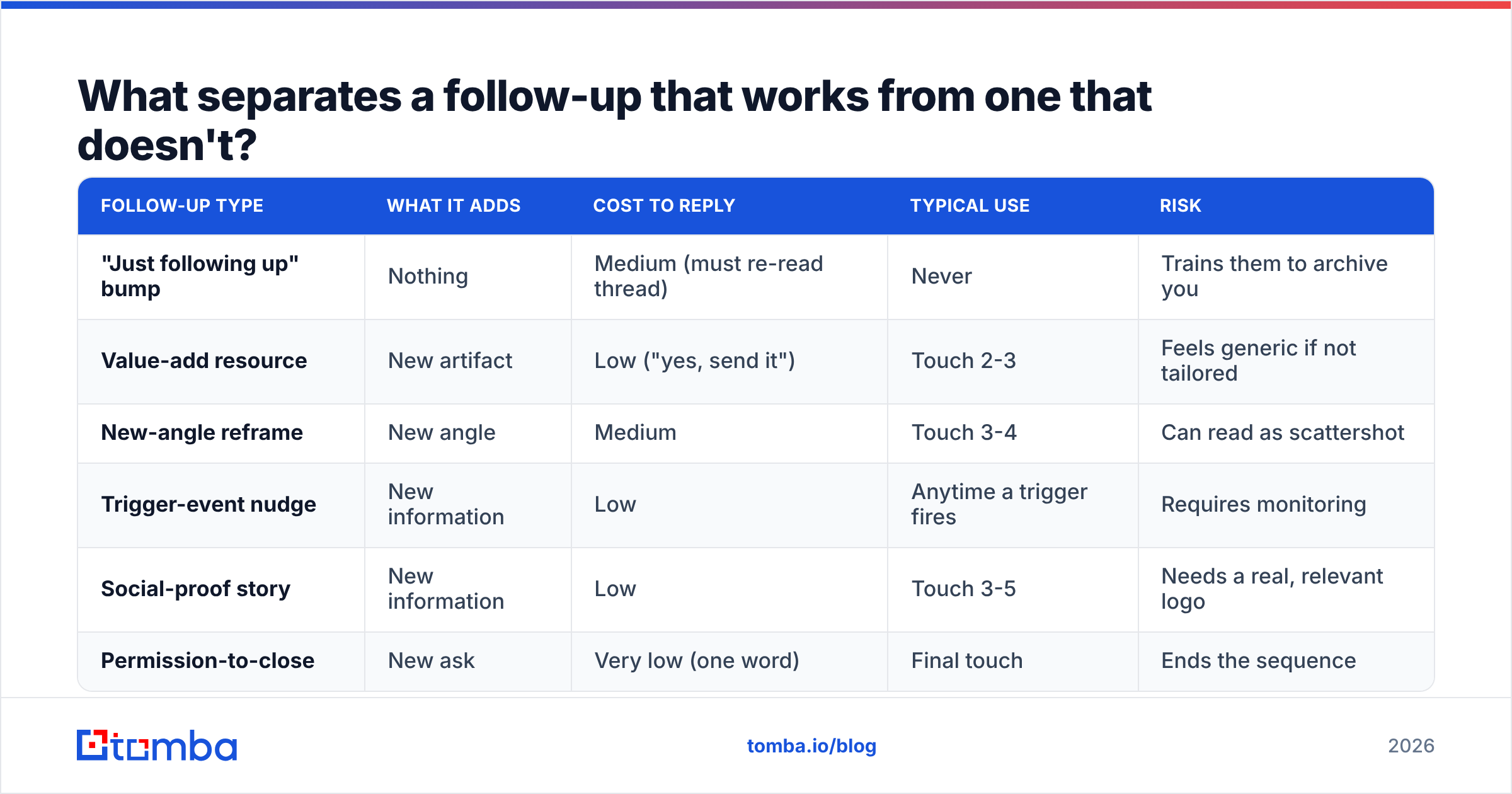
Here's how the common follow-up types stack up against each other in practice:
| Follow-up type | What it adds | Cost to reply | Typical use | Risk |
|---|---|---|---|---|
| "Just following up" bump | Nothing | Medium (must re-read thread) | Never | Trains them to archive you |
| Value-add resource | New artifact | Low ("yes, send it") | Touch 2-3 | Feels generic if not tailored |
| New-angle reframe | New angle | Medium | Touch 3-4 | Can read as scattershot |
| Trigger-event nudge | New information | Low | Anytime a trigger fires | Requires monitoring |
| Social-proof story | New information | Low | Touch 3-5 | Needs a real, relevant logo |
| Permission-to-close | New ask | Very low (one word) | Final touch | Ends the sequence |
The pattern across that table: the best follow-ups reduce the recipient's effort while increasing the information you deliver. The bump does the exact opposite — it demands effort (go re-read my last email) and delivers nothing.
What should you say instead of "just following up"?#
Nine openers that do real work. Each one is a first line, not a whole email — pair it with two sentences of substance and a single, low-friction ask.
1. The new-information open
"Saw [Company] just opened a second office in Austin — that usually breaks whatever onboarding process worked at one location."
Ties the bump to something that actually happened. Works best when you're tracking hiring pages, funding announcements, or product launches.
2. The one-line reframe
"I pitched you on reporting last month. I think I led with the wrong thing — the bigger issue is probably how long your reps spend building lists."
Admitting you framed it badly is disarming, and it legitimately gives them something new to react to.
3. The artifact drop
"Put together a two-page teardown of how three companies in your space handle this. Want me to send it?"
Yes/no ask. Nearly free to answer. The reply itself re-opens the thread.
4. The specific question
"Quick one: are you handling lead enrichment in-house or through a vendor right now?"
One question, answerable in four words, no meeting implied. Questions get replies; statements get archives.
5. The relevant story
"A RevOps lead at a 40-person SaaS told me last week they were re-verifying lists three times a month because of bounces. Sound familiar, or is that not your world?"
Social proof plus an exit ramp. The "or is that not your world" makes "no" easy, which paradoxically increases replies.
6. The trigger nudge
"Noticed you're hiring two SDRs. Worth talking before they start rather than after?"
Timing is the whole message. Keep it to two lines.
7. The reply-to-yourself context add
"Adding one thing I left out: this runs entirely through API, so nobody on your team touches a CSV."
Answers the objection they were probably going to raise. Best sent 3-4 days after the original.
8. The permission-to-close
"I don't want to keep landing in your inbox if this isn't a priority. Want me to close the file?"
The single highest-reply-rate follow-up in most sequences, because it hands them control. Use it once, at the end, and mean it.
9. The direct honest ask
"Is this a 'not now' or a 'not ever'? Either answer is genuinely useful to me."
Works with people who appreciate directness. Doesn't work if you've already sent four bumps — you've spent that credit.
Notice what none of these do: none of them mention that you emailed before. The thread already shows that. Saying it out loud just draws attention to the fact you're being ignored.
How many follow-ups should you send, and how far apart?#
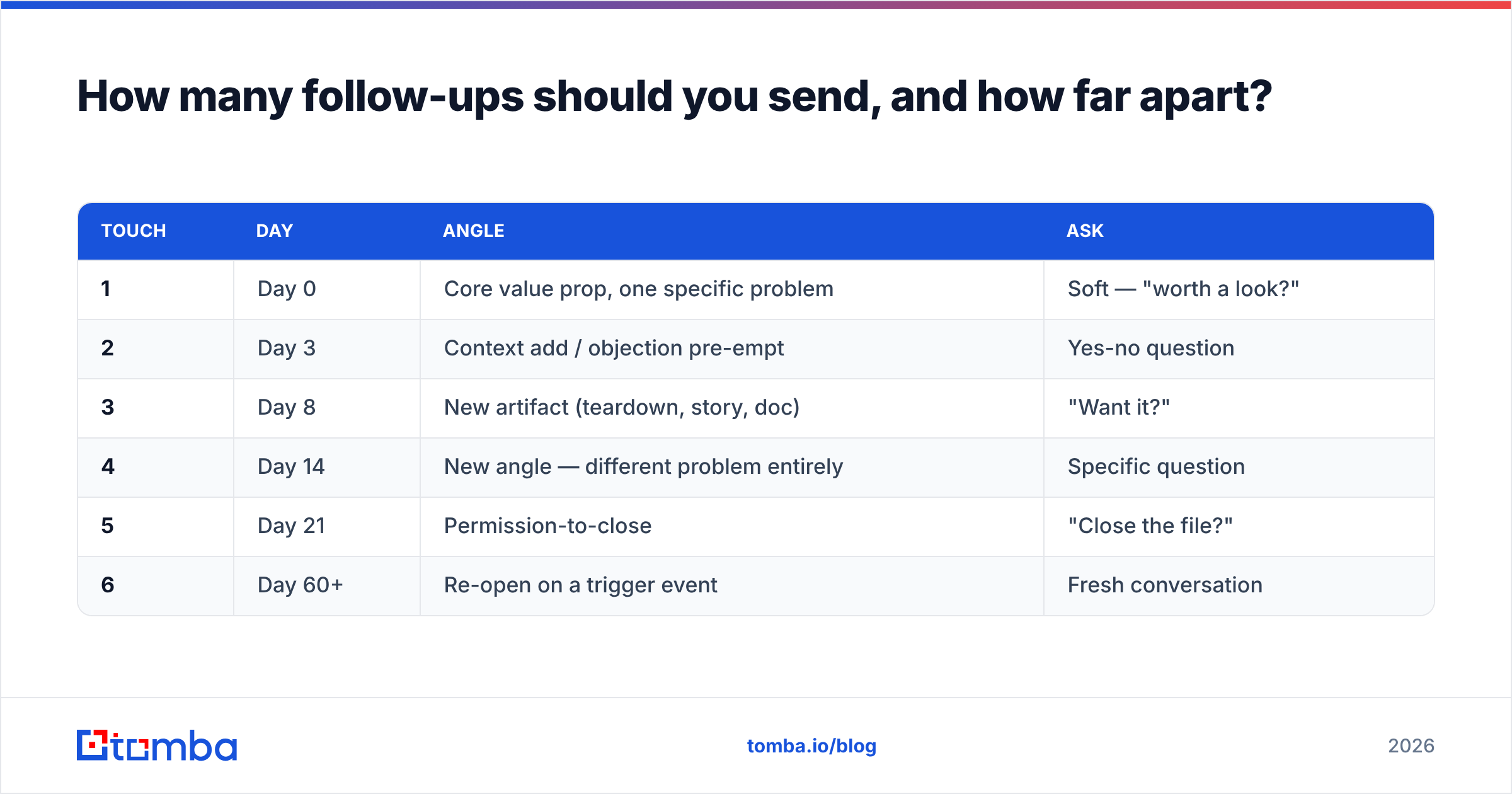
Four to six after the initial email, spread over roughly three weeks, with each touch doing different work.
The single biggest mistake is spacing. Reps either send five emails in eight days (which reads as desperate, and can hurt your sender reputation when it triggers complaints) or they send one follow-up and give up. Neither matches how buying decisions actually get made.
A cadence that holds up across most B2B segments:
| Touch | Day | Angle | Ask |
|---|---|---|---|
| 1 | Day 0 | Core value prop, one specific problem | Soft — "worth a look?" |
| 2 | Day 3 | Context add / objection pre-empt | Yes-no question |
| 3 | Day 8 | New artifact (teardown, story, doc) | "Want it?" |
| 4 | Day 14 | New angle — different problem entirely | Specific question |
| 5 | Day 21 | Permission-to-close | "Close the file?" |
| 6 | Day 60+ | Re-open on a trigger event | Fresh conversation |
Two rules that matter more than the exact days:
- Reply in-thread for touches 2-3, start a new thread for touch 4. A long thread with no responses looks like a monologue. A new subject line on touch 4 gives you a clean shot at the preview pane.
- Never send two follow-ups with the same ask. If touch 2 asked for a meeting and touch 3 also asks for a meeting, touch 3 is a bump wearing a costume.
Also worth saying plainly: a tight, well-spaced cadence protects your email deliverability. Blasting the same non-responsive contacts repeatedly drives spam complaints, and complaints damage the domain reputation that determines whether any of your emails land. Fewer, better follow-ups beat more, worse ones on every axis.
Is it your copy, or is it your list?#
Often it's the list — and this is the part most "stop saying just following up" articles skip entirely.
Silence is ambiguous. A prospect who read your email and decided not to reply produces exactly the same signal as a prospect whose address bounced into a catch-all void, or whose address was a guess that happened to be wrong, or who left the company in March. You cannot rewrite your way out of a data problem.
Before you rewrite a sequence, run three checks:
- Are the addresses real? Run the list through an email verifier before the sequence starts, not after it fails. Bounces don't just lose you a lead — they cost you sender reputation on every other lead in the batch.
- Are they catch-all domains? Catch-all servers accept everything, which means a standard verification says "valid" even when nobody reads that mailbox. A dedicated catch-all verifier is the only way to separate real inboxes from black holes on those domains.
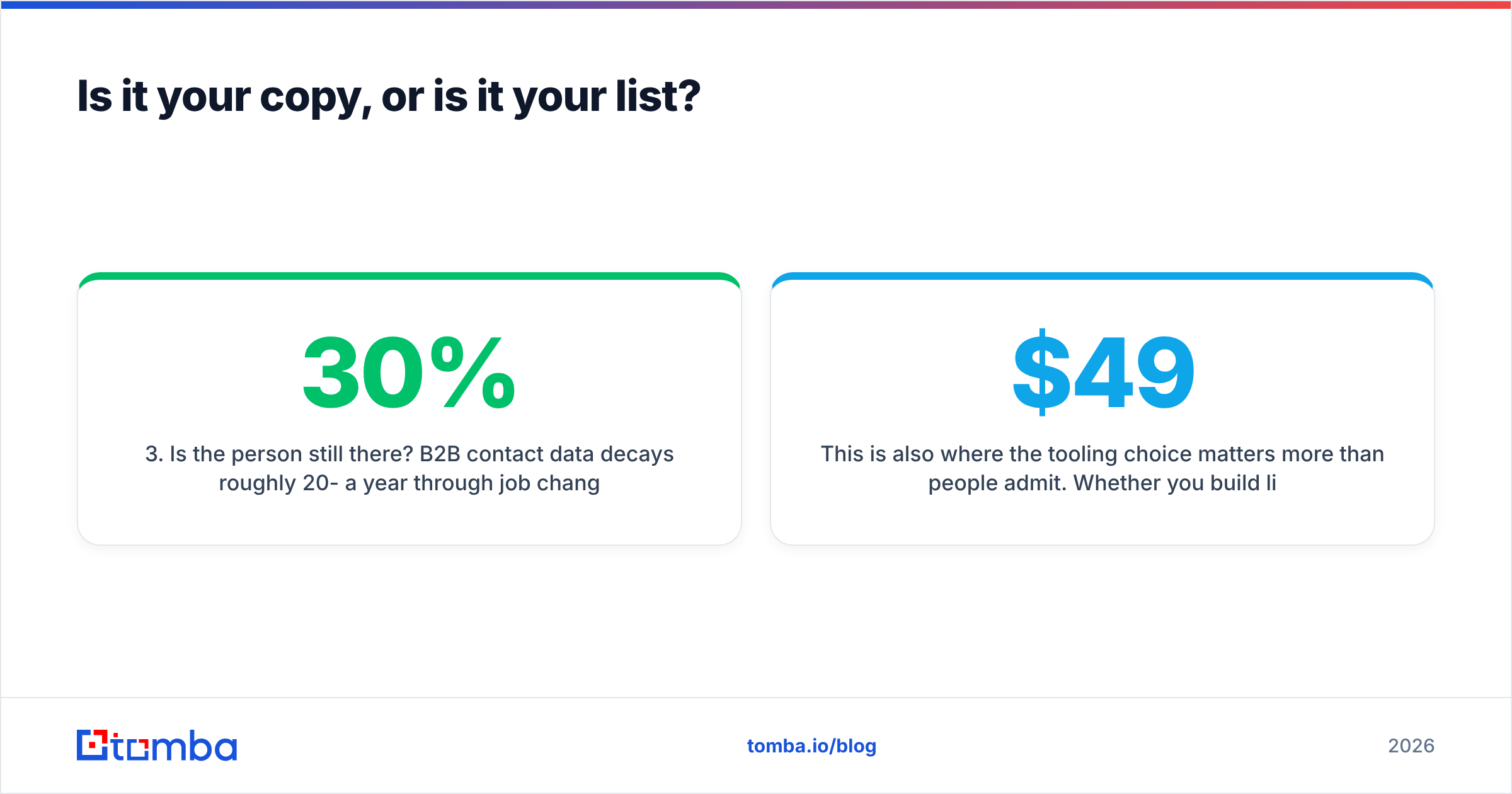
- Is the person still there? B2B contact data decays roughly 20-30% a year through job changes alone. A follow-up sent to someone who left is not a copy problem.
Once the data is clean, the copy question becomes answerable. If you're emailing 200 verified, correct, currently-employed people with a strong offer and getting zero replies across five touches, that's a copy or targeting problem and you should fix it. If you're emailing 200 addresses of unknown quality, you're reading noise.
This is also where the tooling choice matters more than people admit. Whether you build lists via domain search, enrich an existing CRM export with data enrichment, or pull contacts in bulk, the accuracy of that step sets the ceiling on everything downstream. Tomba pricing starts with a free tier at 25 searches a month, then Starter at $49/mo and Growth at $99/mo — enough to verify a real sequence list before you commit to sending against it. Peers in the space like BookYourData take a different route, selling pre-built verified B2B lists outright, which suits teams that would rather buy a list than build one. Both approaches beat sending into the dark.
What does a good follow-up actually look like, end to end?#
Here are two complete examples. Same prospect, same offer, different execution.
The bump (don't send this):
Subject: Re: Quick question
Hi Dana,
Just following up on my email below. Let me know if you'd like to set up 30 minutes this week to discuss.
Best,
Marcus
Word count: 24. New information: zero. Cost to reply: the recipient has to scroll down, re-read the original, form an opinion, and commit to half an hour. The ask is the most expensive thing you can ask for, attached to the least amount of value you can offer.
The rewrite (send this):
Subject: The catch-all problem, specifically
Dana —
I mentioned bounce rates last week and I think I buried the actual issue.
About 15-20% of B2B domains are catch-alls. Standard verification marks those "valid" because the server accepts everything, so they pass QA and then bounce or vanish in production. That's usually where the surprise bounce spike comes from after a clean-looking list.
I pulled a short breakdown of how to separate live catch-all inboxes from dead ones. Want me to send it over?
Marcus
Word count: 92. New information: a specific mechanism the reader may not have known. The ask: four letters. No mention of the previous email as a debt — just as context.
The second one isn't better because it's longer. It's better because a busy person can read it, learn something, and respond in under fifteen seconds.
What are the follow-up mistakes that still sink good copy?#
Four that show up constantly in sequence audits:
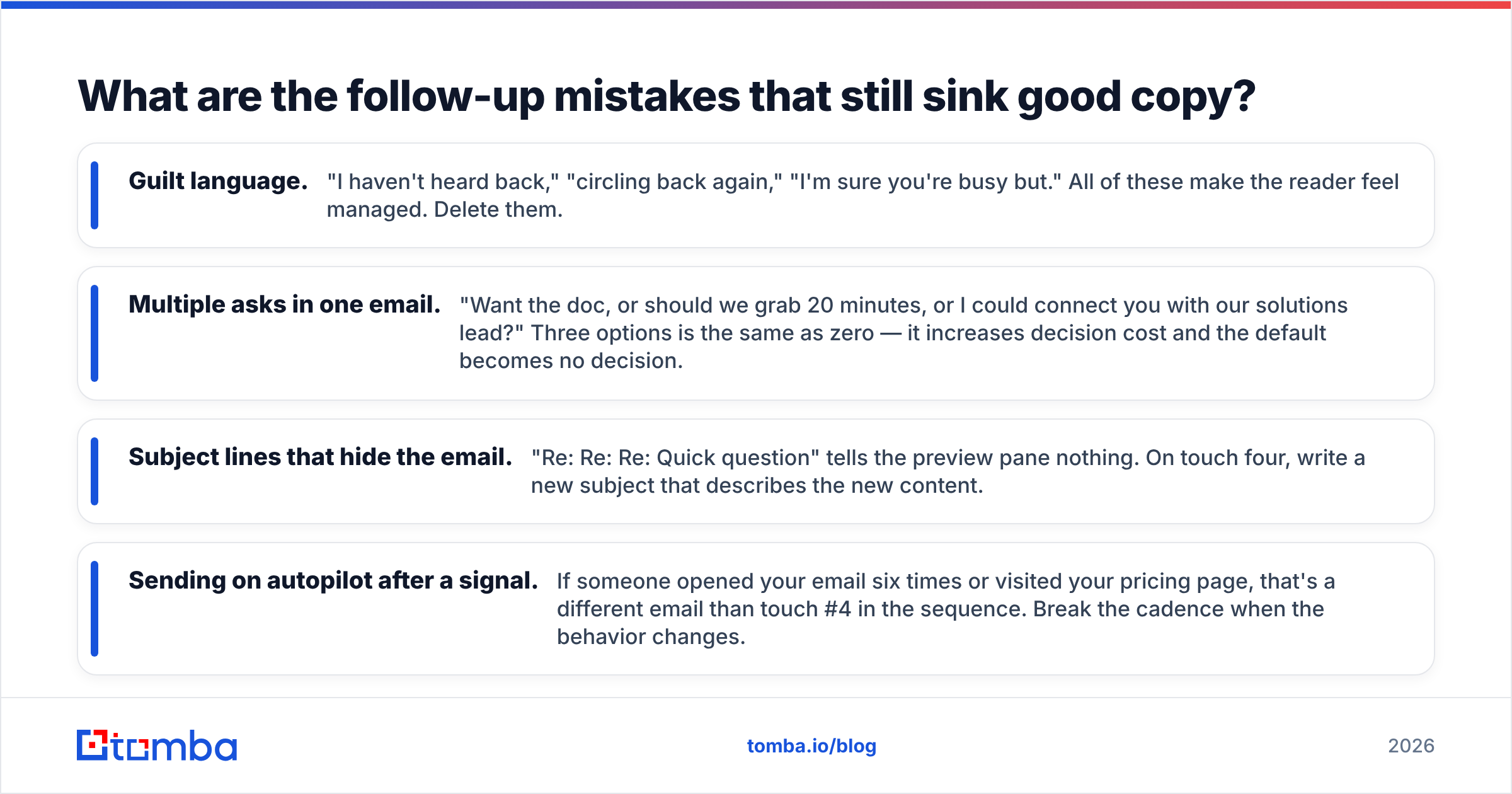
- Guilt language. "I haven't heard back," "circling back again," "I'm sure you're busy but." All of these make the reader feel managed. Delete them.
- Multiple asks in one email. "Want the doc, or should we grab 20 minutes, or I could connect you with our solutions lead?" Three options is the same as zero — it increases decision cost and the default becomes no decision.
- Subject lines that hide the email. "Re: Re: Re: Quick question" tells the preview pane nothing. On touch four, write a new subject that describes the new content.
- Sending on autopilot after a signal. If someone opened your email six times or visited your pricing page, that's a different email than touch #4 in the sequence. Break the cadence when the behavior changes.
One more, less obvious: don't follow up on a bad first email. If the original message was generic, five follow-ups won't rescue it. Rewrite the first email, wait three weeks, and start over with a better angle. Sending better bumps on top of a weak premise is polishing the wrong thing.
How do you know your follow-ups are actually improving?#
Track three numbers, not one.
- Reply rate by touch number. If touch 3 outperforms touch 1, your follow-ups are doing real work. If touch 2 onward is flat near zero, you're bumping.
- Positive reply share. Total replies can rise while quality falls. Measure the percentage of replies that are actual conversations versus opt-outs. A rising opt-out share on touches 4-5 means your cadence is too aggressive.
- Bounce rate per campaign. If it's above 2-3%, stop optimizing copy and go fix the list. Everything else you measure is contaminated until this is clean.
For benchmarks on what "good" looks like in your segment, G2's sales software category reviews and vendor-published aggregate reports are a reasonable starting point — treat any single published number as directional, since reply rates vary enormously by industry, deal size, and list quality.
The one-sentence rule#
If you can't finish the sentence "I'm emailing again because I now have ___", don't send the email.
New data, new angle, new artifact, new ask — one of those four goes in the blank. If the honest answer is "because it's been four days," close the draft. Wait until you have something. Silence costs you far less than training a prospect to ignore your name in their inbox.
Follow-ups aren't about persistence. They're about having enough to say that persistence becomes unnecessary.
Start with a list worth following up on. Weak reply rates are a copy problem about half the time — the rest of the time you're emailing addresses that were never going to respond. Use the Tomba Email Finder to build verified, current contact lists by domain, name, or company, so every follow-up you write lands in a real inbox belonging to a real person who still works there. Free tier includes 25 searches a month; no card required to test it against your next campaign.
Related guides#
// get started
Find, verify and enrich your first contacts today
Start on the free plan with 25 searches a month, then scale when your team is ready.
Free plan · No credit card required · GDPR & CCPA
// about the author