"Just Following Up on the Email Below": What to Send Instead
The four words that kill more deals than any subject line. Here's why "just following up on the email below" gets ignored, and six replacement angles with templates, cadence, and reply-rate benchmarks.
TL;DR
- "Just following up on the email below" is a status update about you, not a reason for them to reply. It adds zero new information to the thread.
- Bump emails still work occasionally — but only because of volume and timing luck, not because the copy earns attention.
- Replace the bump with one of six angles: new information, a narrower ask, social proof, a relevant trigger, a different decision-maker, or a clean break-up.
- Cadence beats cleverness: 4-6 touches across 18-21 days, each one shorter than the last, each one carrying something new.
- Before you blame your copy, check your data. A large share of "no reply" is actually "no human at that address" — verify the list first.
What does "just following up on the email below" actually say to your prospect?#
It says: I sent you something, you didn't respond, and I noticed.
That's the whole payload. When you write "just following up on the email below," you are forwarding the burden of the conversation back to someone who already decided — consciously or not — that the first email wasn't worth 30 seconds. You've given them nothing new to evaluate. You've only reminded them of a decision they already made.
Compare the two mental models:
- Your model: the first email got buried. A gentle nudge floats it back to the top.
- Their model: this is the second time this week someone has asked me for time I don't have, for a reason I still don't understand.
Both can be true. The problem is that the bump email only serves the first model. If the prospect ignored you because your value proposition was unclear, irrelevant, or badly timed, restating the same email with four words of preamble doesn't change a single variable. You've run the same experiment twice and expected a different outcome.
There's one narrow case where the pure bump is defensible: a warm thread that went quiet after real engagement — a demo that happened, a proposal that was read, a referral that was made. There, the relationship supplies the context that the copy omits. Everywhere else, and especially in cold outbound, "just following up" is filler that costs you a touch from a limited budget.
Why do bump-style follow-ups get ignored?#
Four reasons, in rough order of how often they're the real culprit.
1. Nothing changed. The prospect's inbox is a queue sorted by perceived payoff. Your second email has the same payoff as the first, minus the novelty. It sorts lower, not higher.
2. The ask is still too big. "Do you have 30 minutes next week?" is an expensive request from a stranger. Repeating an expensive request doesn't make it cheaper.
3. The thread is now visibly a sequence. Once someone sees a quoted chain under a one-line bump, the email reads as automation. Gartner's research on the B2B buying journey is blunt about how little time buyers actually spend with any single supplier — roughly 5-6% of the total buying cycle. Signalling "this is a sequence, you are in slot 2 of 5" spends that sliver badly.
4. The email never arrived, or arrived at nobody. This is the uncomfortable one. Bounces, spam placement, catch-all domains that accept everything and deliver nothing, and stale contacts who left the company all masquerade as "ignored me." You cannot copywrite your way out of a data problem.
What should you write instead of a bump?#
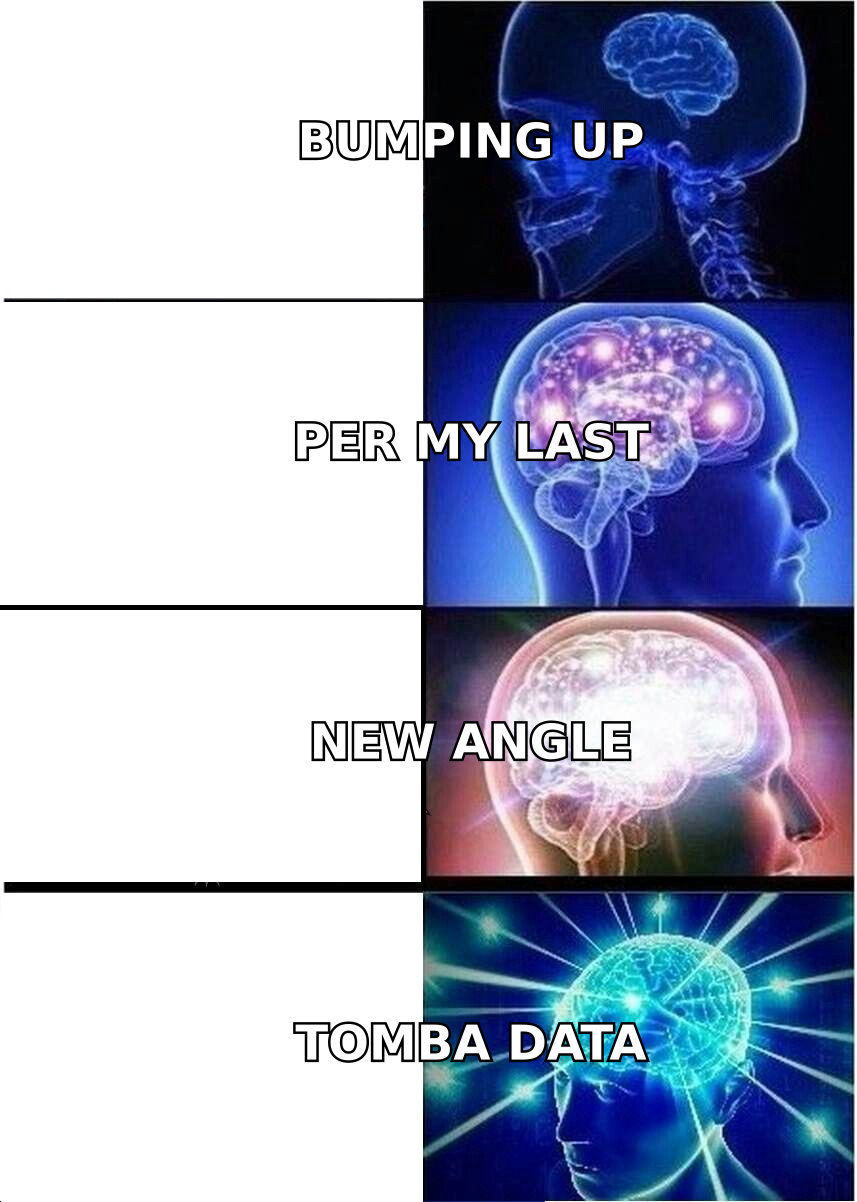
Every follow-up needs one new unit of value. Here are the six angles that reliably supply it, ordered from easiest to hardest to execute.
- New information. Share something the prospect didn't have when they ignored you: a benchmark, a teardown of their competitor's approach, a single stat from your own data. "Three companies in your category cut list-bounce from 14% to under 2% last quarter — here's how" is a reason to open.
- A narrower ask. Downgrade from "30 minutes" to a yes/no question. "Is list hygiene owned by you or by marketing ops?" costs four seconds to answer, and a reply of any kind restarts the conversation.
- Relevant proof. One named customer in the same segment, one number, one sentence. Not a case-study link dump — a specific outcome a peer achieved.
- A trigger event. Funding, a new hire in the relevant function, a pricing-page change, a job posting for the role you sell into. Triggers make a follow-up feel like observation rather than persistence.
- A different decision-maker. If the individual doesn't respond across a full sequence, the account isn't dead — the contact might be. Move laterally or upward, with a polite note that you reached out to their colleague first.
- The clean break. "I'll assume this isn't a priority and close the loop — happy to revisit next quarter if that changes." It's the single highest-reply-rate message in most sequences, because it removes the obligation instead of adding one.
Each of these can be written in under 60 words. That is the actual constraint: your second, third, and fourth emails should get progressively shorter, not longer, while the information density goes up.
Is a forwarded thread better than a fresh email?#
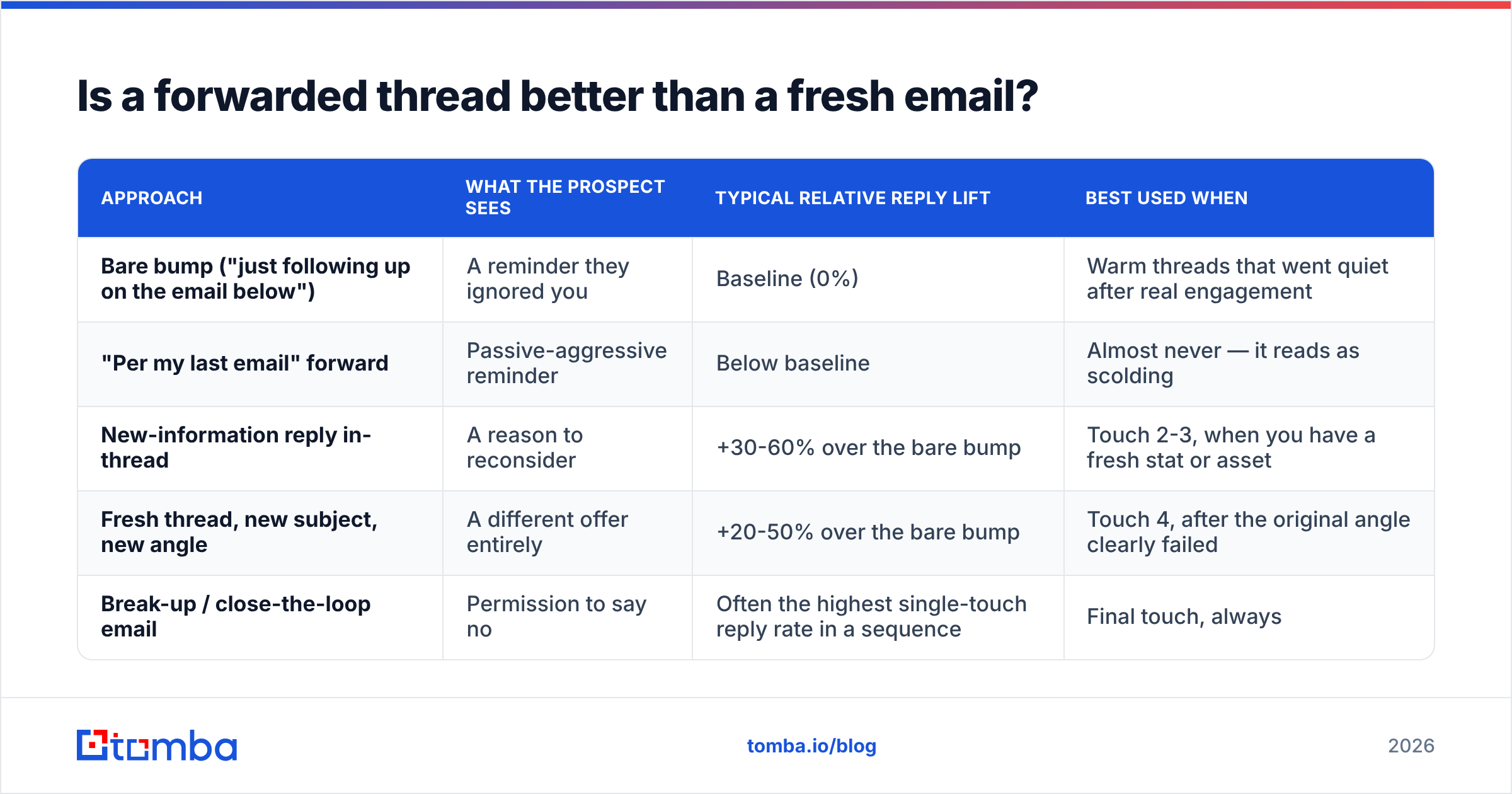
It depends on what you're optimizing. Forwarding keeps context and threads neatly in Gmail; a fresh email gets a fresh subject line and a fresh first impression. Here's the honest trade-off across the five most common follow-up formats.
| Approach | What the prospect sees | Typical relative reply lift | Best used when |
|---|---|---|---|
| Bare bump ("just following up on the email below") | A reminder they ignored you | Baseline (0%) | Warm threads that went quiet after real engagement |
| "Per my last email" forward | Passive-aggressive reminder | Below baseline | Almost never — it reads as scolding |
| New-information reply in-thread | A reason to reconsider | +30-60% over the bare bump | Touch 2-3, when you have a fresh stat or asset |
| Fresh thread, new subject, new angle | A different offer entirely | +20-50% over the bare bump | Touch 4, after the original angle clearly failed |
| Break-up / close-the-loop email | Permission to say no | Often the highest single-touch reply rate in a sequence | Final touch, always |
Two practical notes on that table. First, the "lift" numbers are directional — they move with list quality, industry, and seniority, so treat them as a ranking rather than a promise. Measure your own; that's what the response rate metric is for. Second, the break-up email's strong performance is not a trick you can run repeatedly. It works because it's genuinely final. Send a "break-up" and then follow up anyway, and you've taught the prospect your emails mean nothing.
How many follow-ups should you send, and how far apart?#
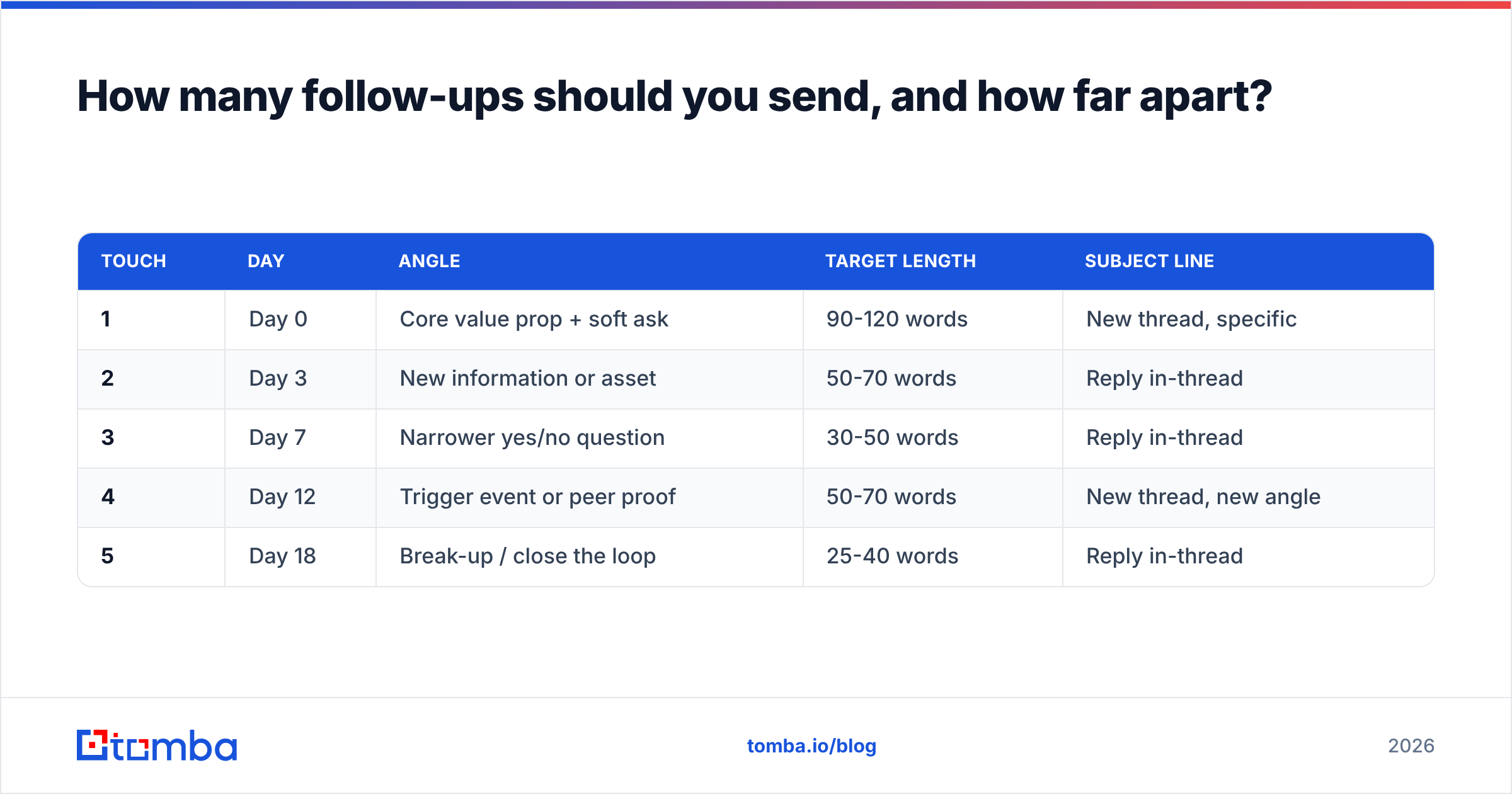
Four to six touches over roughly three weeks is the range most outbound teams converge on. Fewer than three and you're quitting before the average buyer has even surfaced from a busy week. More than six and you're paying reputation costs for diminishing returns.
| Touch | Day | Angle | Target length | Subject line |
|---|---|---|---|---|
| 1 | Day 0 | Core value prop + soft ask | 90-120 words | New thread, specific |
| 2 | Day 3 | New information or asset | 50-70 words | Reply in-thread |
| 3 | Day 7 | Narrower yes/no question | 30-50 words | Reply in-thread |
| 4 | Day 12 | Trigger event or peer proof | 50-70 words | New thread, new angle |
| 5 | Day 18 | Break-up / close the loop | 25-40 words | Reply in-thread |
Spacing matters as much as count. Back-to-back sends on consecutive days read as pressure; two-week gaps lose the thread entirely. And if you're running this cadence across hundreds of contacts, ramp volume slowly — sending patterns, not just content, drive email deliverability outcomes at the mailbox provider.
One more variable people ignore: the subject line on touch 4. When you break to a new thread, you're competing against the inbox from scratch. Run the line through a subject line tester before you commit it to a sequence — a 15-second check beats a week of silence.
What do the replacement emails actually look like?#
Templates below. Keep the structure, replace everything else — a template you paste verbatim is a template your prospect has already seen from three other vendors this month.
Touch 2 — new information
Subject: (reply in thread)

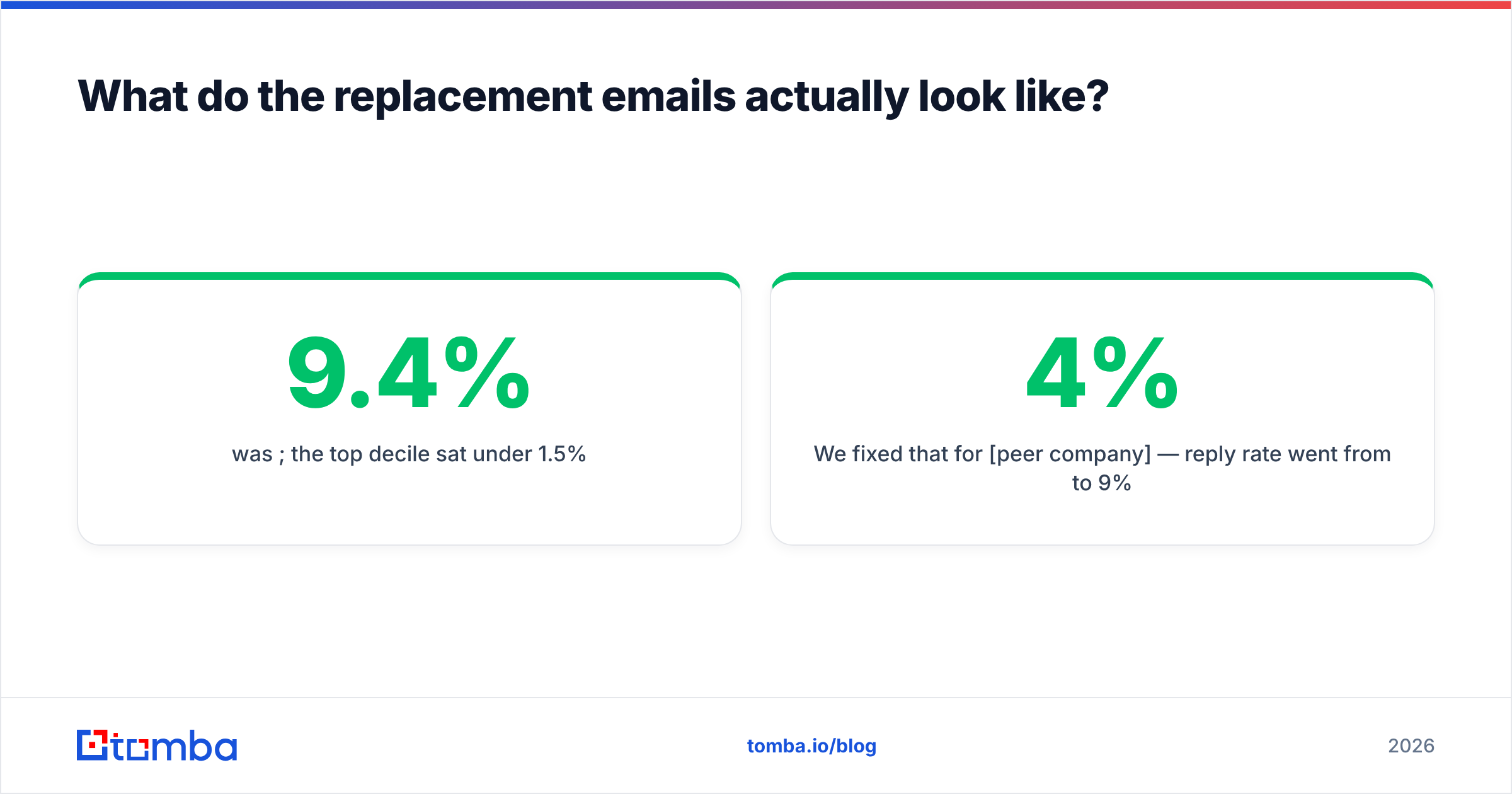
Quick addition to the note below: we pulled bounce data across
40 mid-market SaaS senders last quarter. Median hard-bounce rate
was 9.4%; the top decile sat under 1.5%.

If your number is closer to the median, the fix is usually list
verification, not copy. Want the one-page breakdown?
Touch 3 — narrower ask
Subject: (reply in thread)

One question and I'll get out of your inbox: does list hygiene
sit with you, or with marketing ops?

Either answer helps — I'll stop guessing.
Touch 4 — trigger event, new thread
Subject: your new SDR hires + list quality

Saw you're hiring two SDRs. The most common thing that breaks at
that headcount is data: three people now work the same accounts
from three different exports.

We fixed that for [peer company] — reply rate went from 4% to 9%
in six weeks, no change to the copy.

Worth 10 minutes before the new reps start?
Touch 5 — break-up
Subject: (reply in thread)

I'll close the loop here — sounds like this isn't a priority
right now, which is completely fair.

If list quality comes up in Q2 planning, I'm easy to find.
Notice what none of these contain: "just following up on the email below," "circling back," "bumping this," "per my last email," or "I wanted to reach out." Every one of those phrases spends words describing the act of emailing rather than the reason for it. If you want more raw material, the standard reference libraries — including cold email templates and HubSpot's sales follow-up guides — are worth skimming for structure, not for copy-paste.
Why is your reply rate low even when the copy is good?#
Because the email may never have reached a human.
Run this diagnostic before you rewrite anything:
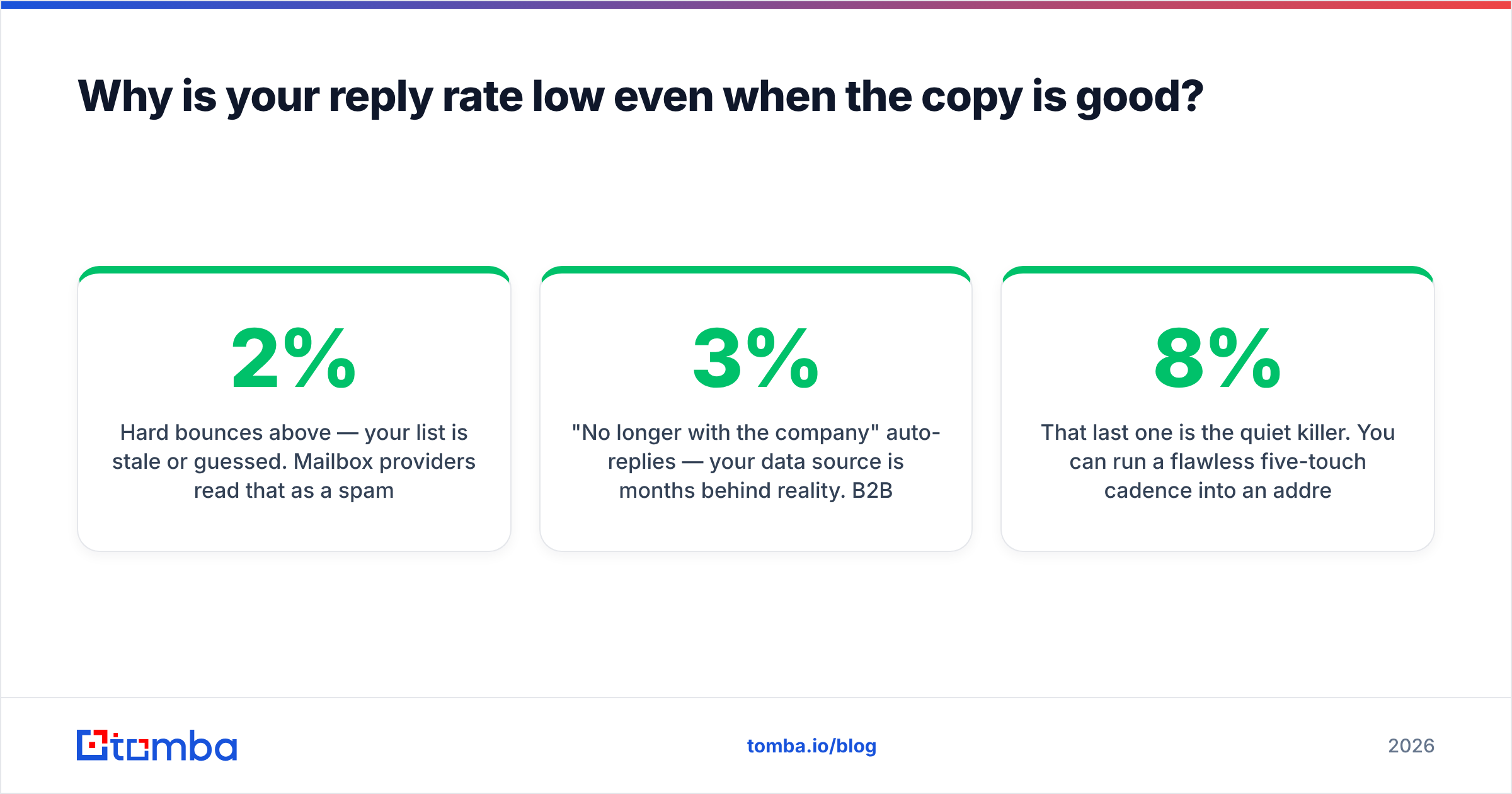
- Hard bounces above 2% — your list is stale or guessed. Mailbox providers read that as a spam signal, and it drags down every subsequent send.
- Opens fine, replies zero — genuine copy or targeting problem. Rewrite the ask, not the greeting.
- Opens near zero on a verified list — deliverability. Check authentication, domain reputation, and sending volume ramp.
- Replies from the wrong person — you're targeting the wrong job title, not sending the wrong message.
- "No longer with the company" auto-replies — your data source is months behind reality. B2B contact data decays roughly 2-3% per month as people change roles.
That last one is the quiet killer. You can run a flawless five-touch cadence into an address that stopped existing in March, and the only feedback you'll get is silence that looks exactly like rejection. Verifying a list before it enters a sequence — not after — is the cheapest reply-rate improvement available. An email verifier pass that removes 8% of a list often lifts measured reply rate more than any rewrite, simply because the denominator becomes honest.
The psychology is worth understanding too. Open loops nag — the Zeigarnik effect is why an unanswered question sits in someone's head longer than a closed one. That's the real mechanism behind a good follow-up: leave a specific, easy-to-close loop. "Just following up" leaves no loop at all; it's a closed statement about your own behavior.
What should you stop writing today?#
A short kill-list, with replacements:
- "Just following up on the email below" → lead with the new information itself.
- "Per my last email" → delete entirely; there is no non-hostile version.
- "Bumping this to the top of your inbox" → you don't control their inbox; say what changed.
- "I wanted to reach out because..." → cut to "because."
- "Let me know your thoughts" → ask one specific question with a binary answer.
- "Hope this finds you well" → it finds them busy. Skip it.
The pattern across all six: replace a sentence about the email with a sentence about the prospect's business. If a line would still make sense pasted into an email to any other company on earth, it's filler.
Ready to fix the input, not just the copy?#
Great follow-up copy on a bad list is an expensive way to talk to nobody. Start by making sure the addresses in your sequence belong to real, current, reachable people — then run the six-angle cadence above and watch your reply rate move for a reason you can actually explain.
Tomba's Email Finder gets you verified, current professional addresses by name or domain, with bulk lookups and an API when you're ready to automate the whole intake. The free tier covers 25 searches a month; paid plans start at $49/mo on Tomba pricing. Clean the list first — then never write "just following up on the email below" again.
Related guides#
Ready to find emails that actually work?
Join 150,000+ professionals who stopped guessing and started sending. Free credits on signup — no credit card required.
Get the Tomba newsletter
Practical outbound tactics and product updates — once every two weeks.
About the author