7 Best Kapta Alternatives in 2026 for Key Account Teams
Kapta is a solid key account management platform, but it is not the only way to run QBRs, account plans, and relationship maps. Here are seven alternatives compared on price, CRM fit, and the data underneath them.
TL;DR
- Kapta is a purpose-built key account management (KAM) platform for retention and growth inside existing accounts — voice-of-customer capture, account plans, and QBR prep. It is not a prospecting or data tool.
- The best Kapta alternative depends on where your process actually lives: DemandFarm, ARPEDIO, Prolifiq, and Altify run inside your CRM; Revegy and Planhat run beside it; Gainsight runs the post-sale motion end to end.
- Kapta does not publish pricing. Buyers consistently report enterprise-style annual contracts with seat minimums, which prices out most sub-50-rep teams.
- Every KAM tool has the same blind spot: it inherits whatever contact data your CRM already has. Stale champions and dead email addresses break account plans faster than bad software does.
- Pair whichever platform you pick with a contact-data layer — that is the gap Tomba fills for under $100/month.
What is Kapta and who actually uses it?#
Kapta is key account management software. It sits after the deal closes, not before it. Where a CRM tracks pipeline and a customer success platform tracks health scores, Kapta is built around a specific methodology: capture the customer's stated goals in their own words, turn those into a joint account plan, assign owners and dates, and review progress on a cadence.
The company positions itself around the "voice of customer" interview and a structured account planning workflow. You can see the current product framing on kapta.com. Typical buyers are professional services firms, staffing companies, logistics providers, and mid-market B2B vendors where 10–40 named accounts produce most of the revenue and churn in one of them is a board-level event.
That focus is Kapta's strength and the reason people go looking for alternatives. Three complaints come up repeatedly in review sites like G2:
- Pricing is opaque and enterprise-shaped. No public tiers, no self-serve trial, annual commitments. If you have eight account managers, you may not clear the minimum.
- CRM integration is a sync, not a home. Teams that live in Salesforce all day want the account plan to be a Salesforce object, not a linked record in another tab.
- Adoption depends entirely on discipline. Kapta assumes your AMs will run structured customer interviews. If they won't, the software becomes an expensive template library.
None of that makes Kapta bad. It makes it specific. The question is whether your failure mode is process, platform, or data.
What should you actually compare Kapta alternatives on?#
Most comparison posts list features. Features are the least useful axis here, because every KAM tool ships account plans, org charts, and whitespace grids. The decisions that matter are structural:
- Where the plan lives. CRM-native (DemandFarm, ARPEDIO, Prolifiq, Altify) vs. standalone (Kapta, Revegy, Planhat). CRM-native wins adoption; standalone wins flexibility and works when half your data sits outside Salesforce.
- Which motion it serves. Pure account planning (Revegy, DemandFarm) vs. post-sale health and renewal (Gainsight, ChurnZero, Planhat) vs. both (Kapta, Altify). Buying a CS platform to fix account planning is a common and expensive mistake.
- Minimum viable team size. Enterprise tools assume 50+ seats and a RevOps admin. Prolifiq and ChurnZero are realistic at 10 seats. Gainsight and Revegy usually are not.
- Implementation reality. Ask for the median go-live time, not the best case. Salesforce-native tools install in days; standalone platforms with data mapping take 6–12 weeks.
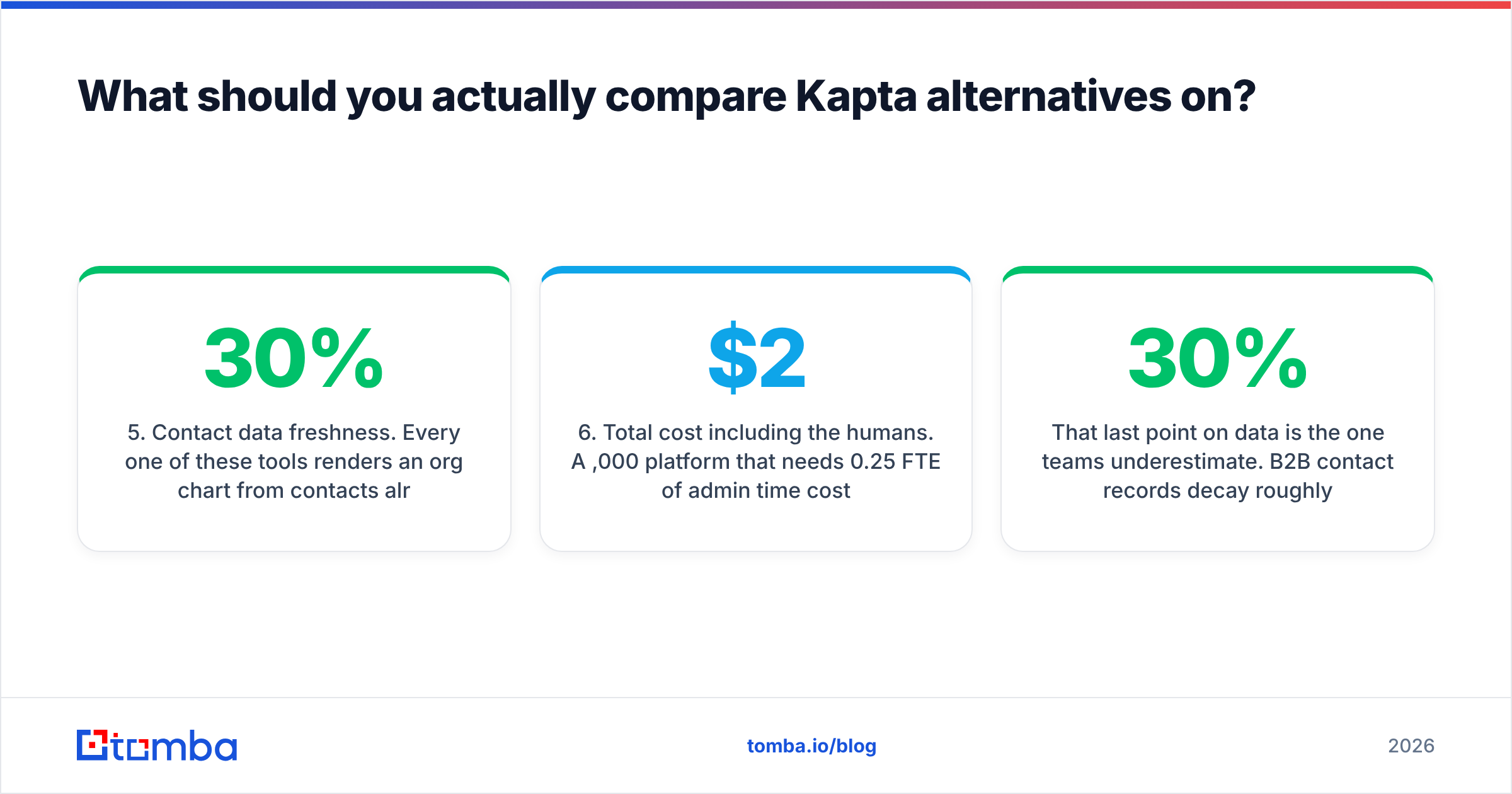
- Contact data freshness. Every one of these tools renders an org chart from contacts already in your CRM. If 30% of those contacts have left the company, your relationship map is fiction. This is not a feature any KAM vendor solves — it is a separate layer.
- Total cost including the humans. A $2,000/month platform that needs 0.25 FTE of admin time costs closer to $5,000/month.
That last point on data is the one teams underestimate. B2B contact records decay roughly 25–30% per year through job changes alone. A whitespace map built on two-year-old contacts will confidently tell you to expand into a department whose head left in 2024.
Which Kapta alternatives are worth shortlisting in 2026?#
Here are the seven that show up most often in competitive evaluations, with the honest version of who each one is for.
DemandFarm#
CRM-native account planning for Salesforce, Dynamics, and HubSpot. Strong org charts, relationship maps, and whitespace analysis rendered directly on CRM objects. See demandfarm.com for the current module breakdown. Best for enterprise sales orgs that already treat Salesforce as the system of record and want plans that never leave it. Weaker if your customer data is scattered across a CRM, a PSA tool, and finance.
ARPEDIO#
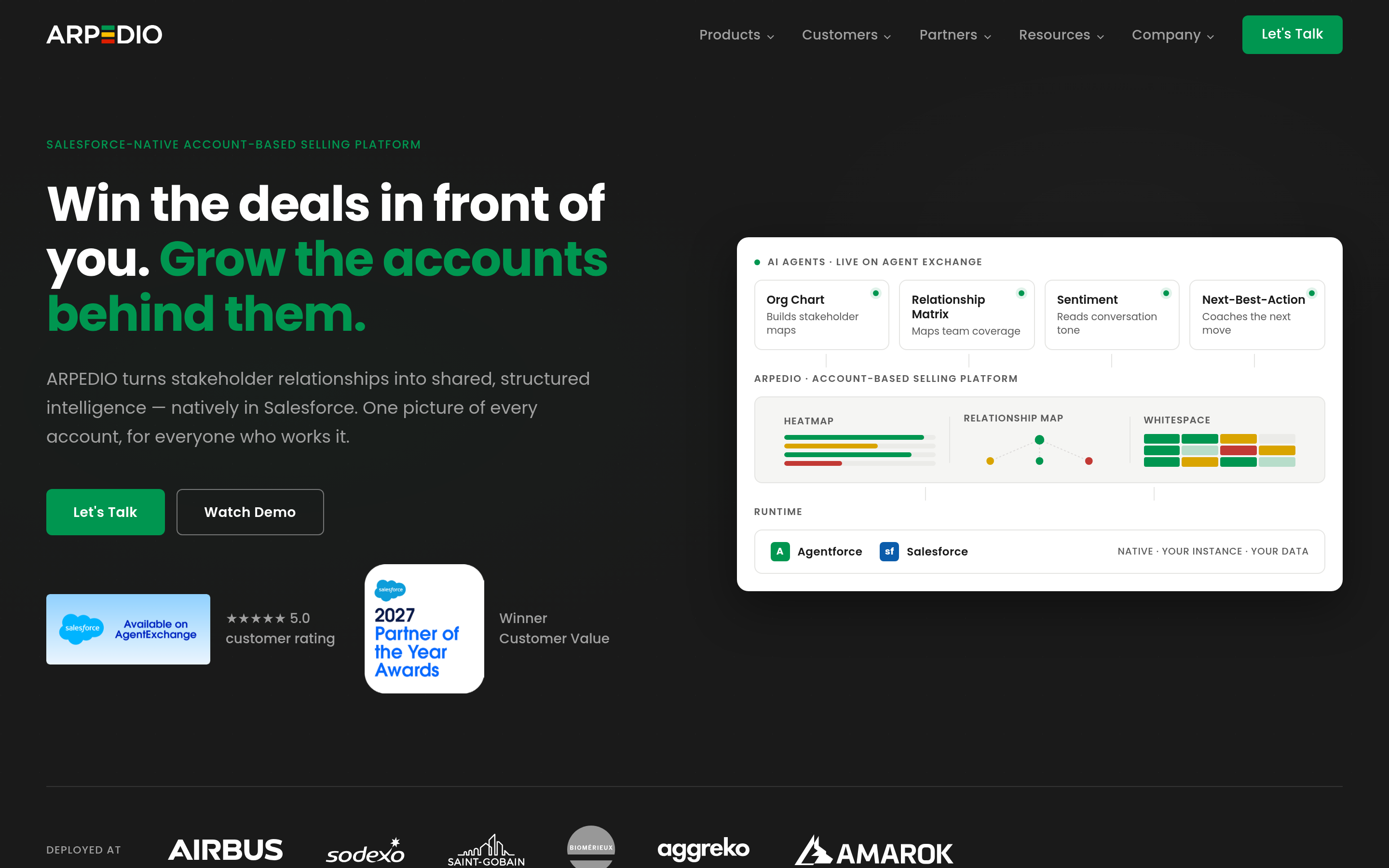
Also Salesforce-native, with a heavier emphasis on relationship and stakeholder mapping — who knows whom, who influences whom, and where the coverage gaps are. Popular with European enterprise teams. It is the most direct answer to "Kapta is good but I want it inside Salesforce."
Revegy#
The enterprise-grade account planning platform. Deep whitespace modeling, multi-year revenue planning, and sophisticated visualizations. This is the tool for a $500M+ organization with a formal strategic account program and someone whose job title includes "account planning." Overkill — and overpriced — for a 15-person team.
Upland Altify#
Methodology-first. Altify bundles account planning with opportunity management and is built around a specific sales framework. If your organization already trains on a named methodology, Altify makes that methodology enforceable in Salesforce. If you don't, you are buying the framework whether you want it or not.
Prolifiq#
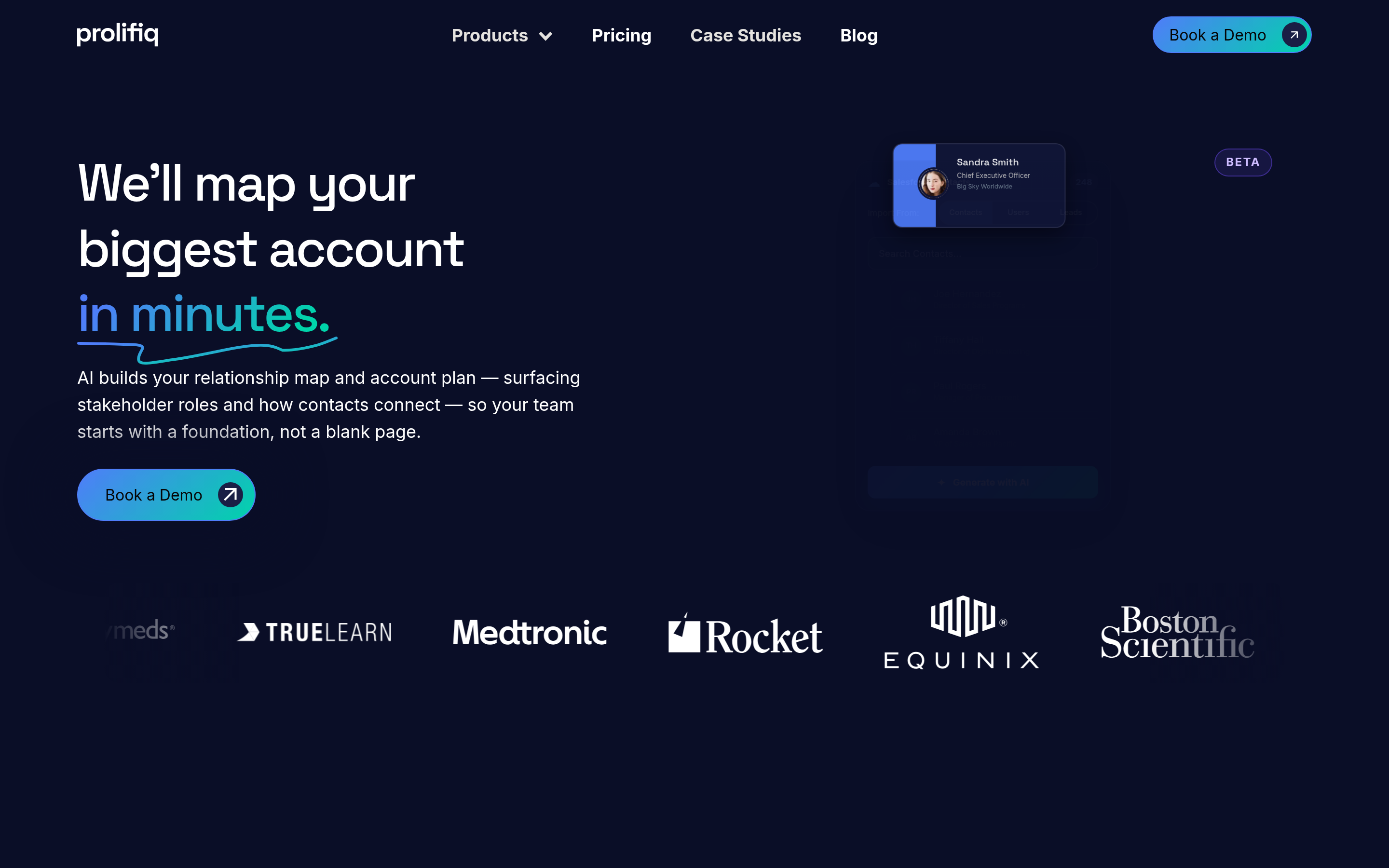
The pragmatic pick. Salesforce-native account planning at a meaningfully lower price point than Revegy or Altify, with faster implementation. Fewer bells, but it covers relationship maps, account plans, and whitespace. The strongest option for teams between 10 and 50 reps who found Kapta's contract too large.
Planhat#
A customer platform rather than a KAM tool — health scores, usage data, revenue signals, and playbooks, with account planning layered on top. Best when your product is SaaS and product-usage data should drive the account conversation. Less useful for services businesses where there is no telemetry to score.
Gainsight CS#
The category leader in customer success. If the real problem is that nobody knows which accounts are at risk, Gainsight solves that better than Kapta ever will. But it is a bigger, more expensive commitment, and account planning is a supporting act rather than the headline.
How do Kapta alternatives compare on price and fit?#
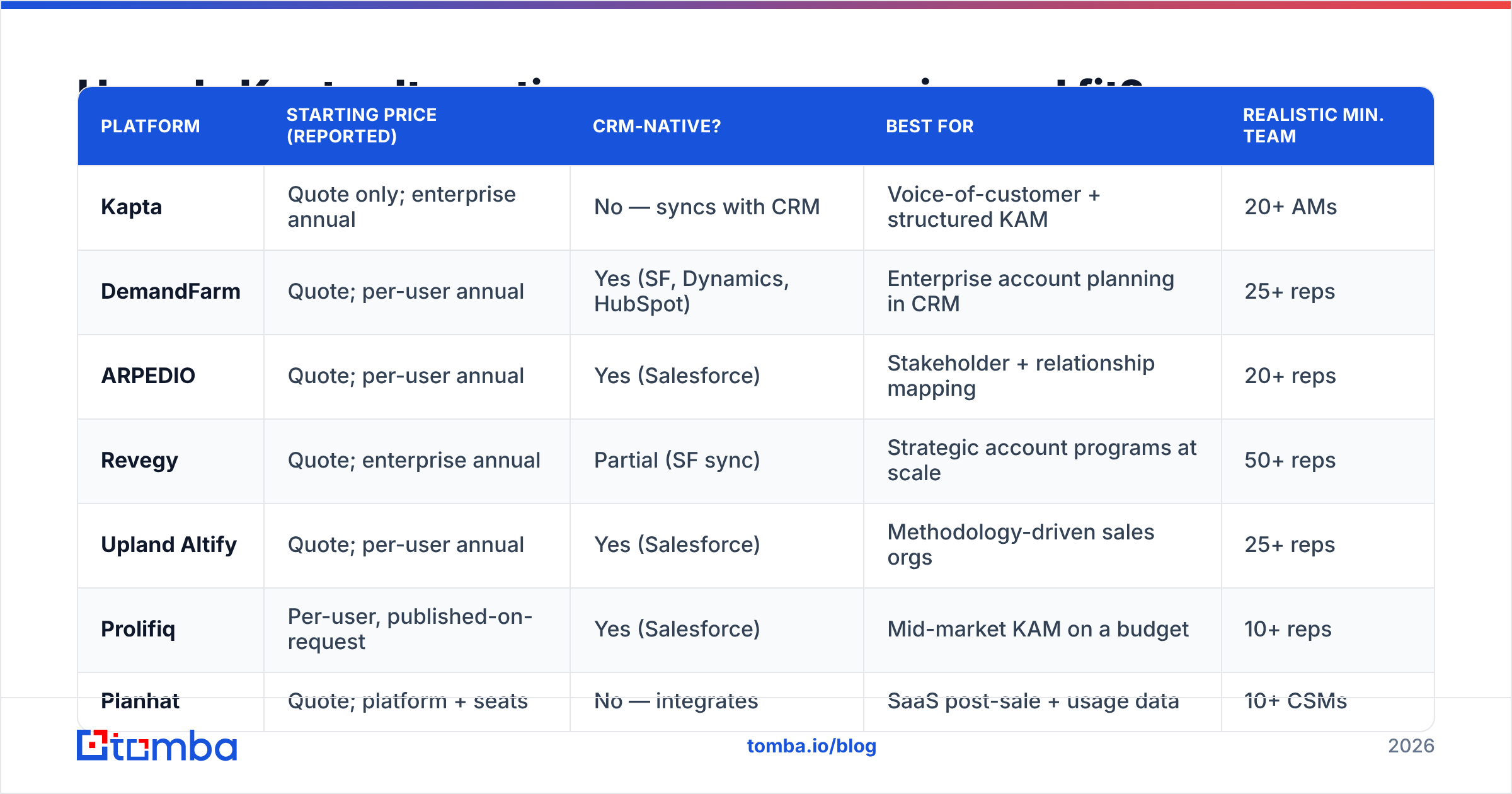
Pricing across this category is largely quote-based, which is itself a signal. The figures below reflect typical published starting points and commonly reported buyer ranges as of 2026 — always confirm with the vendor, because seat minimums move the real number more than list price does.
| Platform | Starting price (reported) | CRM-native? | Best for | Realistic min. team |
|---|---|---|---|---|
| Kapta | Quote only; enterprise annual | No — syncs with CRM | Voice-of-customer + structured KAM | 20+ AMs |
| DemandFarm | Quote; per-user annual | Yes (SF, Dynamics, HubSpot) | Enterprise account planning in CRM | 25+ reps |
| ARPEDIO | Quote; per-user annual | Yes (Salesforce) | Stakeholder + relationship mapping | 20+ reps |
| Revegy | Quote; enterprise annual | Partial (SF sync) | Strategic account programs at scale | 50+ reps |
| Upland Altify | Quote; per-user annual | Yes (Salesforce) | Methodology-driven sales orgs | 25+ reps |
| Prolifiq | Per-user, published-on-request | Yes (Salesforce) | Mid-market KAM on a budget | 10+ reps |
| Planhat | Quote; platform + seats | No — integrates | SaaS post-sale + usage data | 10+ CSMs |
| Gainsight CS | Quote; enterprise annual | No — integrates | Full customer success operation | 25+ CSMs |
Two patterns fall out of that table. First, nothing in the category is cheap, and nothing is self-serve. Second, the split between CRM-native and standalone is the real fork in the road — everything else is a preference.

Is Kapta better than a CRM plus a good process?#
Sometimes, no. This is the uncomfortable answer that vendors skip.
If you run 12 strategic accounts and your account managers already do quarterly business reviews with a shared deck template, a dedicated KAM platform may add less than you think. What it adds is consistency across people — a standard structure so that when an AM leaves, the account knowledge doesn't leave with them. That is a real problem and worth real money at 30 AMs. At six AMs, a disciplined Salesforce or HubSpot setup with custom objects and a shared template will get you 70% of the value for 5% of the cost.
Run this test before you buy anything: pull your last four QBR decks. If they look structurally identical and every action item has an owner and a date, you have a process and a platform will scale it. If they look like four different companies made them, you have a process problem, and software will document the chaos rather than fix it.
The other test is data. Open your three largest accounts in your CRM and check the contact records. How many of those people still work there? How many email addresses would bounce today? If you can't answer, no KAM platform will help, because every org chart and relationship map it draws will be built on those records.
What does Kapta not solve at all?#
Contact data. None of these platforms — Kapta, Revegy, DemandFarm, Gainsight — source or refresh contact information. They visualize what you give them.
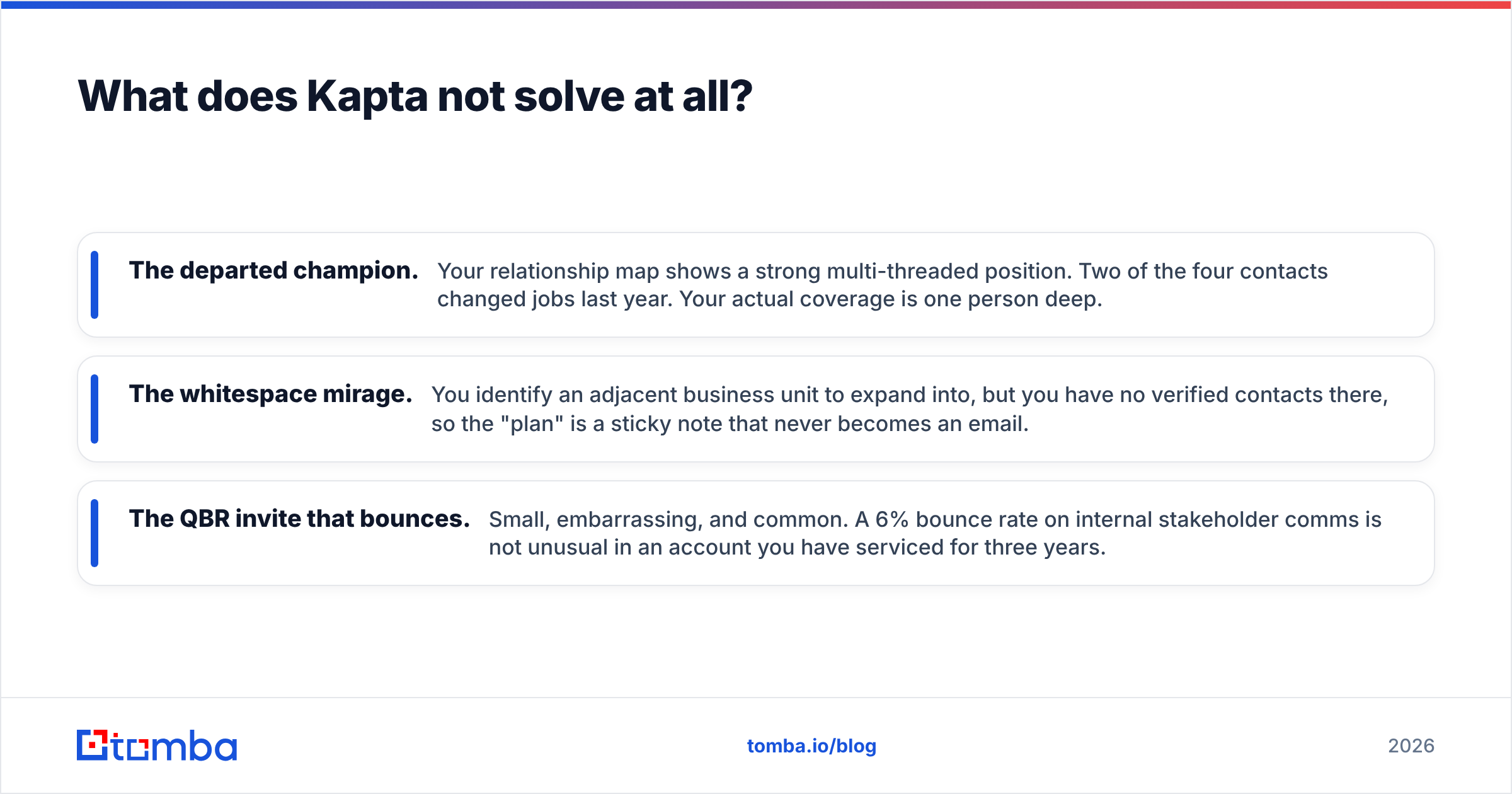
That creates three concrete failure modes inside key account management:
- The departed champion. Your relationship map shows a strong multi-threaded position. Two of the four contacts changed jobs last year. Your actual coverage is one person deep.
- The whitespace mirage. You identify an adjacent business unit to expand into, but you have no verified contacts there, so the "plan" is a sticky note that never becomes an email.
- The QBR invite that bounces. Small, embarrassing, and common. A 6% bounce rate on internal stakeholder comms is not unusual in an account you have serviced for three years.
This is where a data layer earns its keep alongside whichever platform you pick. Before a planning cycle, run your account contact lists through an email verifier to strip the dead addresses, then use domain search to pull the current roster at each account's domain and spot the new decision-makers you were never introduced to. For expansion targets in adjacent divisions, contact enrichment fills in titles, seniority, and departments so the whitespace grid reflects an actual org rather than a guess.
For teams running this on a schedule, the Tomba API handles the refresh as a job rather than a manual export — re-verify every key account contact quarterly, push the deltas into Salesforce, and let your KAM platform render a map that is true this quarter rather than true in 2024.
How should you choose between them?#
Work through it in this order:
1. Decide CRM-native or standalone. If your reps live in Salesforce and adoption is your biggest risk, shortlist ARPEDIO, DemandFarm, Prolifiq, or Altify and stop there. If your data is fragmented across systems, Kapta, Revegy, or Planhat make more sense.
2. Match the motion, not the marketing. Account planning and customer success are different jobs. Buy Gainsight or Planhat for health, retention signals, and playbooks. Buy Revegy, DemandFarm, or Kapta for planning and expansion. Buying the wrong one and hoping is how you end up with a $60K shelfware contract.
3. Size-check the vendor. Ask directly: what is your seat minimum and what is your smallest current customer in my industry? If the honest answer is 50 seats and you have 14, move on rather than negotiating into a bad fit.
4. Fix the data before go-live, not after. Clean, verified contacts at implementation time are the difference between a platform your AMs trust and one they quietly abandon in month four. Check Tomba pricing — the Free tier gives you 25 searches a month to audit a couple of accounts before you commit to anything.
5. Pilot on three accounts, not thirty. Every vendor will push a full rollout. Run one quarter on your three most important accounts, measure whether the QBRs actually improved, then expand.
The bottom line#
Kapta is a legitimate choice for structured key account management, particularly if the voice-of-customer methodology matches how your team already thinks. It loses deals to CRM-native tools on adoption, to Prolifiq on price, and to Gainsight on post-sale breadth. Pick based on where your process lives and how many seats you actually have, not on feature checklists that all look the same.
Whichever platform wins your evaluation, it will only be as accurate as the contact records feeding it. Start with a clean base: use the Tomba Email Finder to identify and verify the real decision-makers inside every key account — current titles, valid addresses, and the stakeholders you haven't met yet — so your account plans describe the company as it is today. Free tier to test, $49/month when you're ready to run it across the book.
Related guides#
// get started
Find, verify and enrich your first contacts today
Start on the free plan with 25 searches a month, then scale when your team is ready.
Free plan · No credit card required · GDPR & CCPA
// about the author