Kaspr Pros and Cons: An Honest 2026 Review for B2B Teams
Kaspr turns LinkedIn profiles into phone numbers and emails in one click, but the credit system, seat pricing, and EMEA-weighted coverage decide whether it actually fits your team. Here is the honest breakdown.
TL;DR
- Kaspr is a LinkedIn-first contact finder: install the Chrome extension, open a profile or a Sales Navigator list, and pull mobile numbers plus email addresses in a click.
- Its strongest pro is mobile phone coverage in Europe — if you sell into France, Benelux, DACH, or the UK and you actually call your prospects, the hit rate is competitive.
- Its biggest cons are structural: three separate credit buckets, per-seat pricing with annual commitments, and a workflow that only works when the prospect has a LinkedIn profile open in front of you.
- Kaspr has been part of Cognism since 2022, which is good for data pipelines and compliance, but it also means Kaspr is positioned as the entry-level tier of a much more expensive stack.
- If your outbound is email-led rather than phone-led, a dedicated email finder with API and bulk access usually costs less per usable contact.
What is Kaspr and who is it actually built for?#
Kaspr is a B2B contact-data tool that lives, mostly, inside a Chrome extension. You browse to a LinkedIn profile, a Sales Navigator search, a LinkedIn group, or an event attendee list, click the Kaspr icon, and it returns the contact's phone numbers, professional email addresses, and company details. You can push those records to a list, to your CRM, or straight into a sequencing tool.
The company is French, launched in 2018, and was acquired by Cognism in 2022. That acquisition matters more than most reviews admit. Cognism is an enterprise-priced sales-intelligence platform; Kaspr is now the self-serve, extension-shaped front door to a similar data universe. The upside is a serious compliance posture and a deep phone dataset behind it. The downside is that Kaspr is deliberately capped — the moment your needs get wide (large exports, API-driven enrichment, global coverage), you are being nudged upmarket.
The honest user profile for Kaspr looks like this:
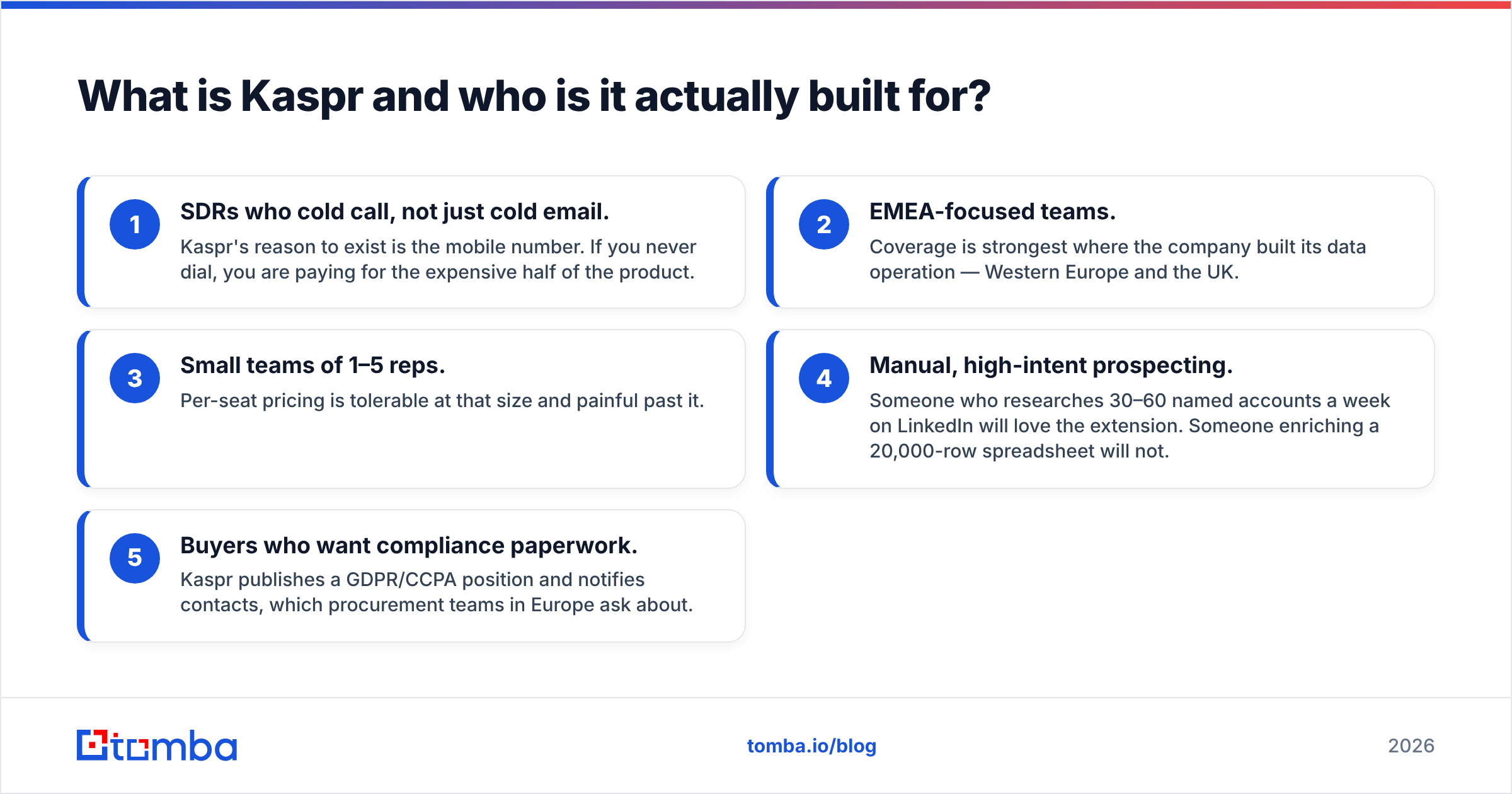
- SDRs who cold call, not just cold email. Kaspr's reason to exist is the mobile number. If you never dial, you are paying for the expensive half of the product.
- EMEA-focused teams. Coverage is strongest where the company built its data operation — Western Europe and the UK.
- Small teams of 1–5 reps. Per-seat pricing is tolerable at that size and painful past it.
- Manual, high-intent prospecting. Someone who researches 30–60 named accounts a week on LinkedIn will love the extension. Someone enriching a 20,000-row spreadsheet will not.
- Buyers who want compliance paperwork. Kaspr publishes a GDPR/CCPA position and notifies contacts, which procurement teams in Europe ask about.
If two or more of those describe you, keep reading with an open mind. If none do, the cons section will save you a trial.
What are Kaspr's biggest pros?#
1. Mobile phone numbers, at a self-serve price. This is the headline. Most tools that reliably surface direct dials in Europe start at enterprise contracts. Kaspr puts that data behind a credit card and a Chrome extension. For a rep whose quota depends on connect rate, that alone can justify the line item.
2. The extension workflow is genuinely fast. Kaspr does not ask you to leave LinkedIn. Profile open, one click, contact revealed, record saved, sequence enrolled. There is almost no friction between "I found someone interesting" and "they are in my cadence." Speed of workflow is an underrated evaluation criterion, and Kaspr wins it against most database-first competitors.
3. It works on lists, not just single profiles. You can run Kaspr across a Sales Navigator search, a LinkedIn group's member list, or an event's attendee list and bulk-reveal contacts. For event-led or community-led prospecting, that is a real advantage over tools that only enrich one profile at a time.
4. A free plan that is actually usable. Kaspr's free tier gives you a small number of phone credits plus email reveals each month — enough to validate the data quality on your own ICP before spending anything. Vendors that hide their data behind a demo call deserve less trust than vendors that let you test it.
5. Compliance is handled seriously. Kaspr documents its data sources and notification process, and being inside the Cognism group means the legal machinery exists. If you sell in Germany or France, this is not a nice-to-have.
6. Native CRM and sequencer connections. HubSpot, Pipedrive, Lemlist, Salesforce (on higher tiers), plus Zapier and an API. Contacts land where your process already lives.

What are Kaspr's cons, honestly?#
The credit model is the number one complaint, and it is a fair one. Kaspr splits entitlements into separate buckets — phone credits, direct email credits, and export credits — each metered differently. Running out of export credits while you still have phone credits left is a normal Tuesday. Budgeting becomes guesswork because "1,200 credits" does not map cleanly onto "1,200 usable contacts." Before you commit to a plan, model your actual month: how many reveals, how many of those need exporting, how many are phone versus email.
Pricing is per seat, and seats compound. A three-person SDR pod is three licenses. A ten-person team is ten. Compare that to a credit pool your whole team draws from and the math diverges quickly past four or five users. Higher tiers also carry seat minimums and annual billing, so the sticker price on the pricing page is rarely the invoice.
LinkedIn is a hard dependency. No LinkedIn profile, no Kaspr record. That rules out a surprising slice of B2B: operations leads at industrial firms, owner-operators, public-sector contacts, and most of the long tail in markets where LinkedIn penetration is thin. A domain search tool that works from a company website has no such constraint — it finds the people who never posted a thing.
Coverage skews European. That is a pro for EMEA teams and a con for everyone else. If your ICP is US mid-market SaaS or APAC manufacturing, run a side-by-side test on 100 known contacts before you sign anything. Do not trust anyone's published coverage percentage, including Kaspr's, including this post's.
Extension-driven reveals at volume carry platform risk. Any tool that automates activity through your personal LinkedIn session raises the odds of a restriction if you push it hard. Kaspr is more conservative than aggressive scrapers, but the risk is not zero, and it is a risk you carry personally, not the vendor.
Verification is thin. Kaspr surfaces contact data; it is not a deliverability suite. There is no serious catch-all handling, no bounce-risk scoring you would want to bet a domain on. Teams that run high-volume email still need a separate email verifier in the pipeline, which is a second line item.
The API is a side dish. Kaspr's API exists but is not the product's center of gravity. If your plan is to enrich records programmatically inside your own data pipeline, you are shopping in the wrong aisle.
How accurate is Kaspr's data?#
Accuracy claims in this category are close to meaningless in the abstract. Every vendor publishes a number in the 90s, and every number is measured on a sample that flatters the vendor. What varies is which contacts a dataset is good at.

Here is how the accuracy picture generally breaks down for Kaspr specifically:
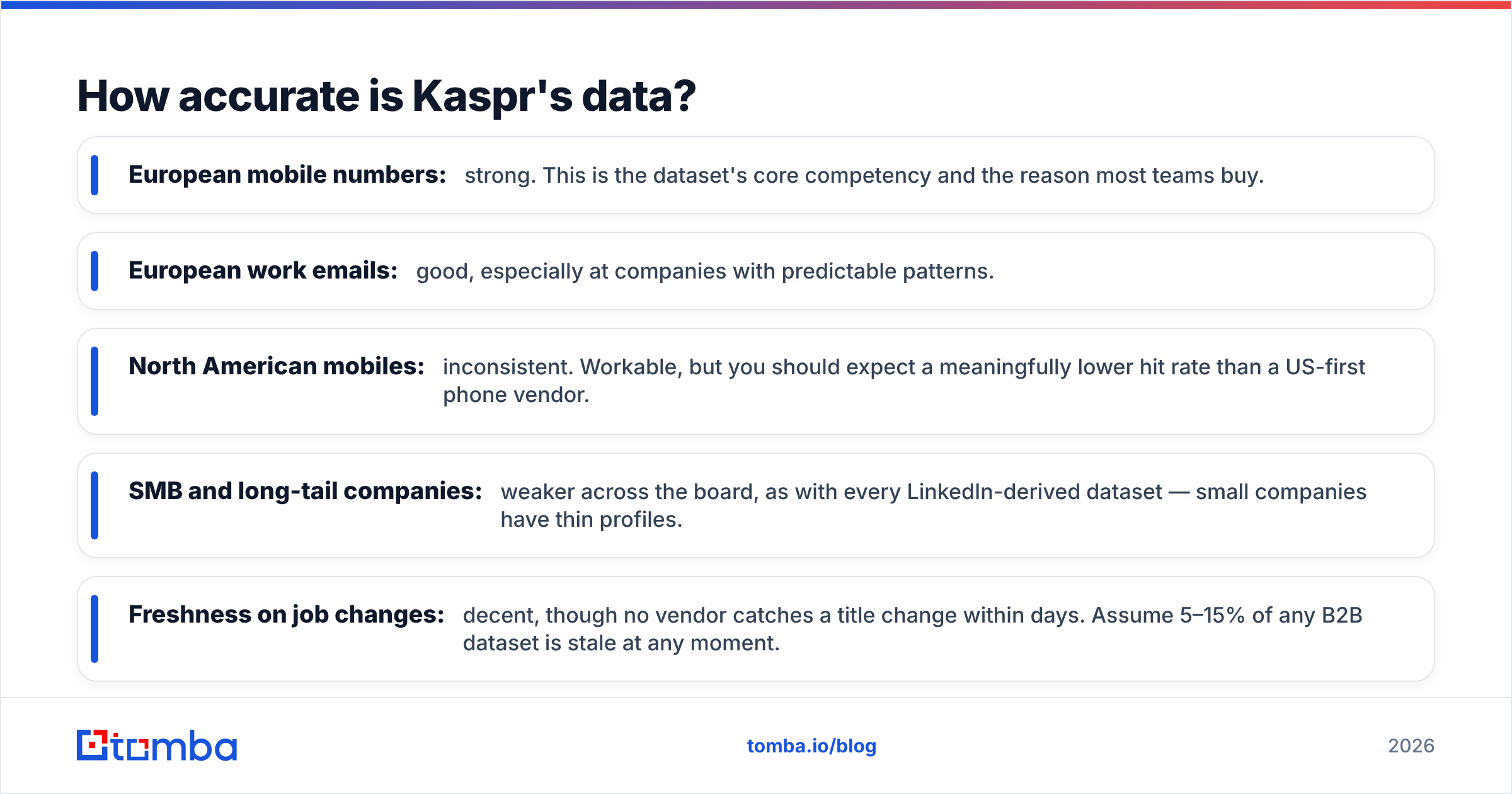
- European mobile numbers: strong. This is the dataset's core competency and the reason most teams buy.
- European work emails: good, especially at companies with predictable patterns.
- North American mobiles: inconsistent. Workable, but you should expect a meaningfully lower hit rate than a US-first phone vendor.
- SMB and long-tail companies: weaker across the board, as with every LinkedIn-derived dataset — small companies have thin profiles.
- Freshness on job changes: decent, though no vendor catches a title change within days. Assume 5–15% of any B2B dataset is stale at any moment.
The only test that matters: take 100 contacts you already have verified truth for, run them through a trial, and count. Do it on your ICP, not on a demo list. Then run the same 100 through whatever alternative you are considering. Two hours of work will tell you more than a month of review sites.
How much does Kaspr cost?#
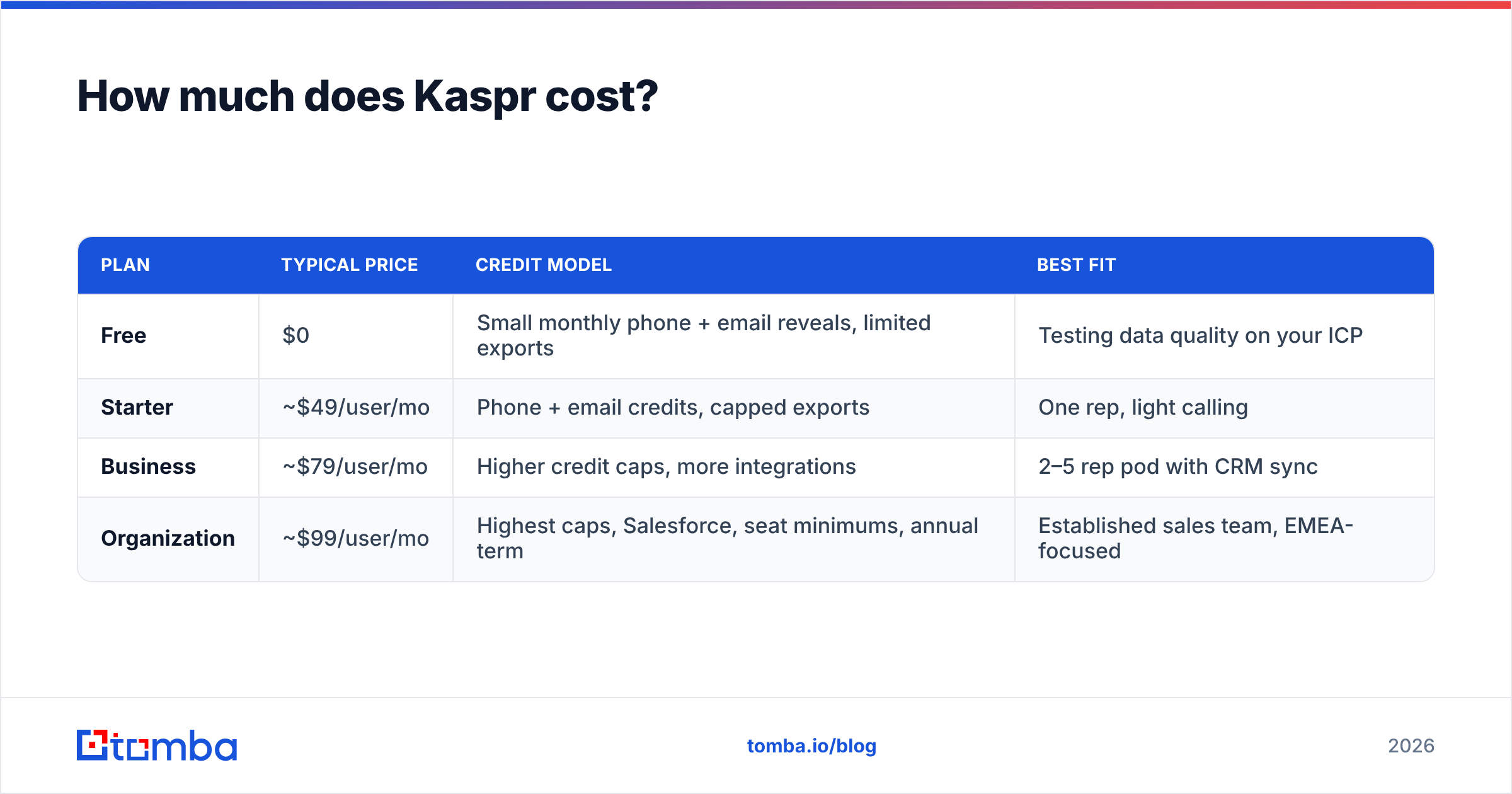
Kaspr's published plans have been broadly stable, but tiers and credit allocations change — treat the table below as a shape, not a quote, and confirm on Kaspr's own pricing page before you buy.
| Plan | Typical price | Credit model | Best fit |
|---|---|---|---|
| Free | $0 | Small monthly phone + email reveals, limited exports | Testing data quality on your ICP |
| Starter | ~$49/user/mo | Phone + email credits, capped exports | One rep, light calling |
| Business | ~$79/user/mo | Higher credit caps, more integrations | 2–5 rep pod with CRM sync |
| Organization | ~$99/user/mo | Highest caps, Salesforce, seat minimums, annual term | Established sales team, EMEA-focused |
Two things to note. First, annual billing is where the advertised prices come from; monthly costs more. Second, the meaningful unit is not price per seat, it is price per usable contact. A $79 seat that produces 300 exportable, accurate, reachable contacts costs $0.26 each. The same seat producing 90 usable records costs $0.88 each. Run that division before and after your trial.
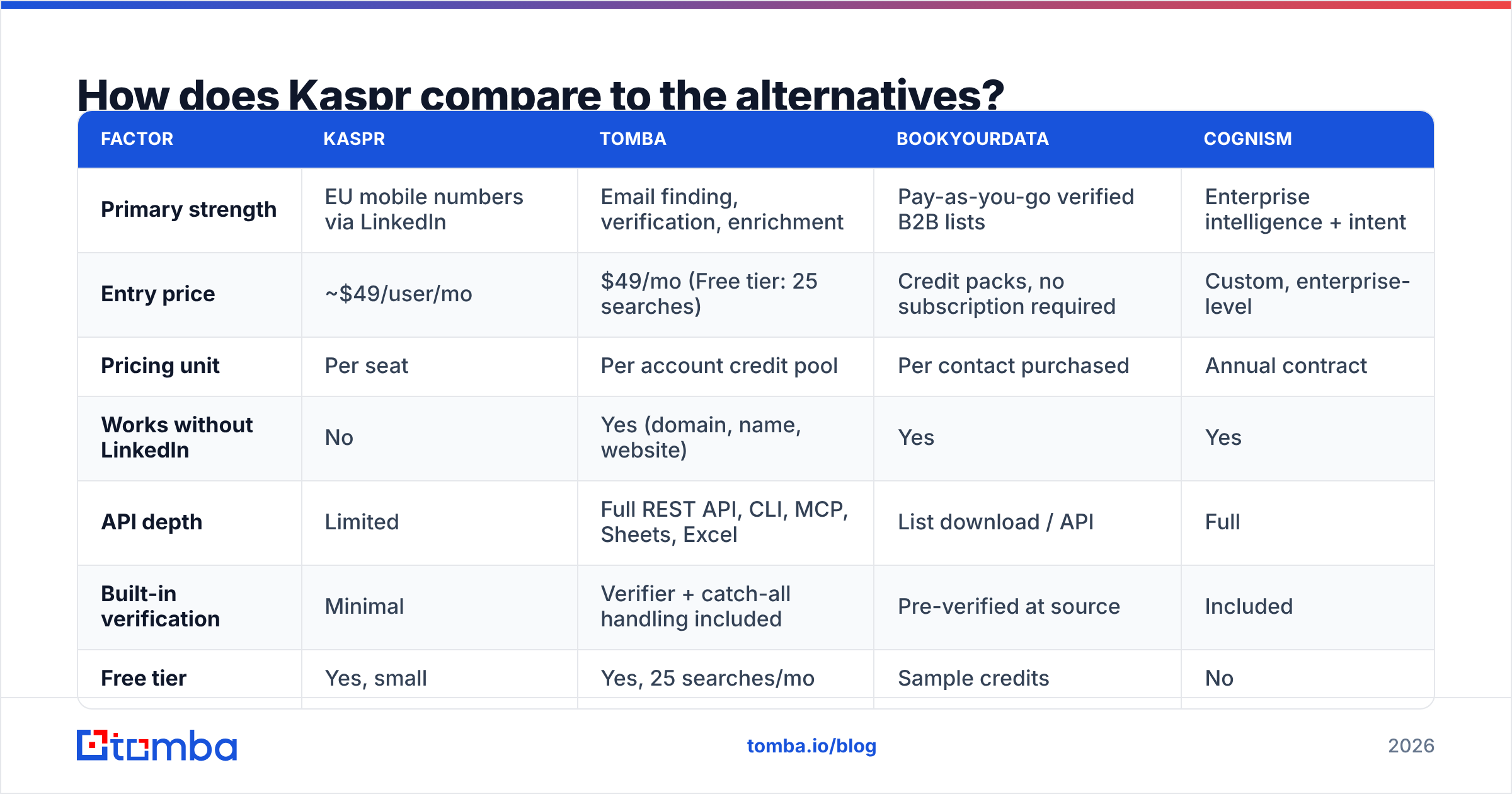
How does Kaspr compare to the alternatives?#

| Factor | Kaspr | Tomba | BookYourData | Cognism |
|---|---|---|---|---|
| Primary strength | EU mobile numbers via LinkedIn | Email finding, verification, enrichment | Pay-as-you-go verified B2B lists | Enterprise intelligence + intent |
| Entry price | ~$49/user/mo | $49/mo (Free tier: 25 searches) | Credit packs, no subscription required | Custom, enterprise-level |
| Pricing unit | Per seat | Per account credit pool | Per contact purchased | Annual contract |
| Works without LinkedIn | No | Yes (domain, name, website) | Yes | Yes |
| API depth | Limited | Full REST API, CLI, MCP, Sheets, Excel | List download / API | Full |
| Built-in verification | Minimal | Verifier + catch-all handling included | Pre-verified at source | Included |
| Free tier | Yes, small | Yes, 25 searches/mo | Sample credits | No |
| Ideal buyer | Cold-calling SDR in EMEA | Email-led outbound, RevOps, developers | Teams buying a defined list once | Enterprise GTM org |
The pattern is clear enough. Kaspr wins when the deliverable is a phone number and the workflow is manual LinkedIn research. It loses when the deliverable is thousands of verified emails, when your team is large enough that seats hurt, or when enrichment needs to run inside your own systems.
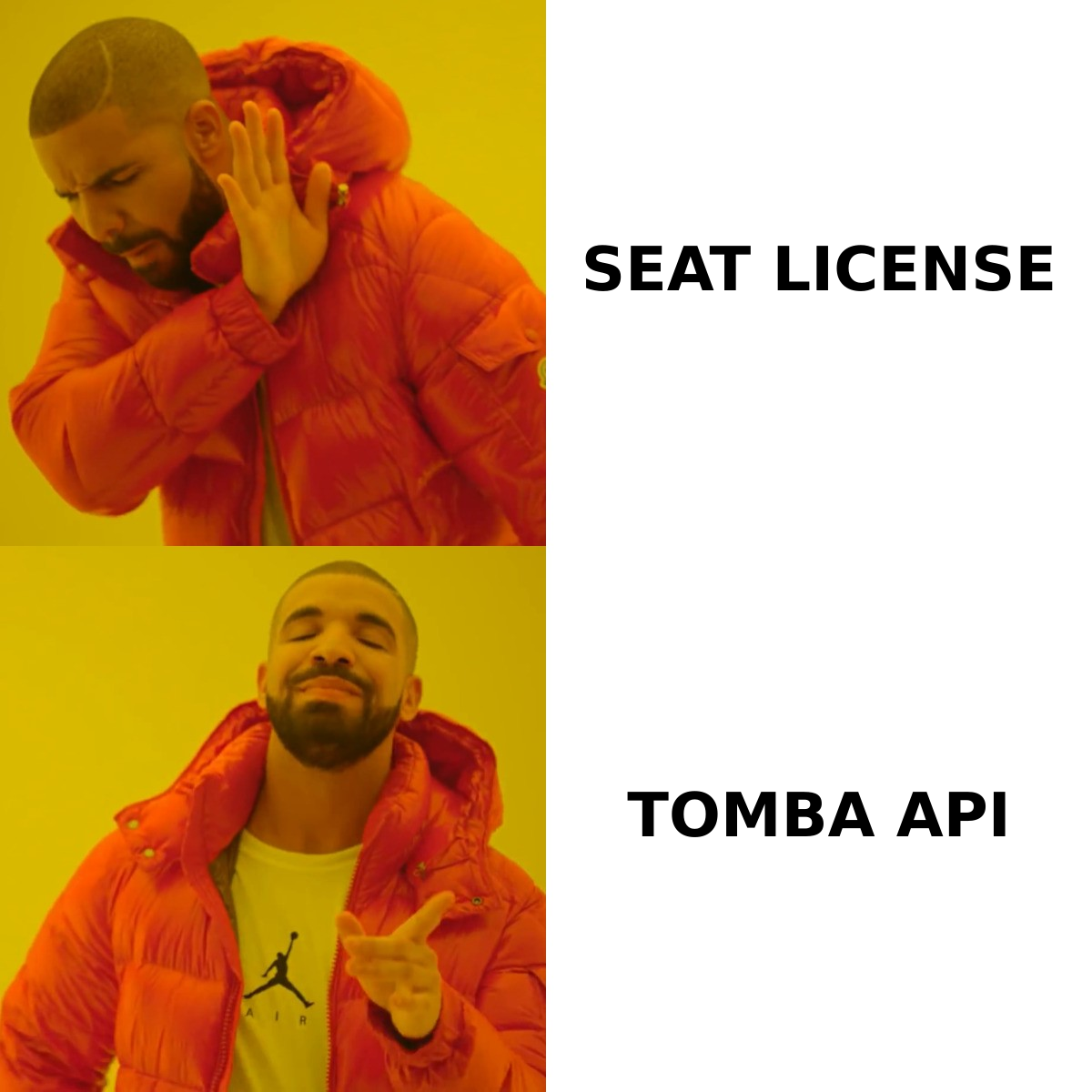
BookYourData sits in a genuinely different lane and is worth a look if you want a defined, pre-verified list without a subscription at all — credits you buy, contacts you keep, no seats to count. Cognism is the upmarket answer if budget is not the constraint. And a dedicated email platform is the answer when volume and automation are the constraints: Tomba pricing pools credits at the account level rather than the seat level, which is the single biggest structural difference once your team passes three people.
Who should buy Kaspr, and who should skip it?#
Buy it if: you are a small EMEA-focused sales team, your reps dial, you prospect manually on LinkedIn, and you want a tool your SDRs will actually adopt on day one. The workflow is the product, and the workflow is good. Start on the free plan, test 100 known contacts, then buy the smallest tier that clears your math.
Skip it if: your motion is email-first, your ICP is heavily North American or APAC, your team is bigger than five, you need programmatic enrichment, or your contacts live outside LinkedIn. In those cases you will spend more and get less than a purpose-built bulk email finder plus a verifier — and you will still need a separate phone source.
A pragmatic middle path: many teams run both. Kaspr for the 50 named accounts a quarter that deserve a phone call, and a cheaper API-based finder for the wide top of funnel. Splitting by job rather than forcing one tool to do everything usually lowers total cost per meeting.
What should you check during a Kaspr trial?#
- Reveal 100 contacts from your real ICP and measure the phone hit rate separately from the email hit rate.
- Export those contacts and count how many export credits it consumed versus reveal credits.
- Call 20 of the mobiles. Connect rate is the only number that pays your quota.
- Bounce-test the emails through an independent verifier — do not assume a revealed email is a deliverable one.
- Price the invoice for your team size at 12 months, not one seat at monthly rates.
- Confirm the integration you need is on the tier you can afford, not two tiers up.
If Kaspr clears those six, buy it with confidence. If it stumbles on exports, coverage, or seat math, you now know exactly why, and you can shop with a specific requirement instead of a vague feeling.
Need the email half of the equation solved first? Tomba's Email Finder finds professional email addresses from a name and domain, a company website, or a bulk list — no LinkedIn profile required, no per-seat licensing, and credits shared across your whole team. Start on the free tier with 25 searches a month, test it against the same 100 contacts you tested Kaspr with, and let the hit rate decide. Paid plans start at $49/mo, and the Tomba API is available on every tier if you want enrichment running inside your own pipeline rather than inside a browser tab.
Related guides#
// get started
Find, verify and enrich your first contacts today
Start on the free plan with 25 searches a month, then scale when your team is ready.
Free plan · No credit card required · GDPR & CCPA
// about the author