Kaspr vs LakeB2B (2026): Which B2B Contact Data Wins?
Kaspr sells LinkedIn-sourced credits one prospect at a time. LakeB2B sells built-to-order lists by the thousand. They solve different problems — here is how to tell which one your pipeline actually needs.
TL;DR
- Kaspr is a per-contact tool. LakeB2B is a per-list vendor. Kaspr reveals one prospect's mobile and email while you browse LinkedIn. LakeB2B builds a file of thousands of records and ships it as a CSV.
- Kaspr wins for SDR-led, EMEA-heavy outbound. Mobile numbers matter there, and reps already work LinkedIn every day.
- LakeB2B wins for niche verticals like healthcare, education and technology install base. No self-serve tool covers those well.
- Neither fits a domain-first motion. If you start from a company list, a domain-first email finder costs less per usable contact.
- Budget reality: Kaspr is cheap to start and priced in public. LakeB2B is quote-only with order minimums, so the first invoice is the surprise.
What are Kaspr and LakeB2B, exactly?#
They are not really competitors. They are two answers to one question: how do I get contact data into my sequence? Teams line up Kaspr vs LakeB2B because both rank for B2B contact data.
Kaspr is a contact-reveal extension. Cognism bought it in 2022. You install it, browse LinkedIn, and it shows mobile numbers, direct dials and work emails for the profile on screen. It also works on search results, group member lists and event attendee lists. Each reveal costs a credit. No LinkedIn tab, no Kaspr.
LakeB2B is a data provider in the older sense. You describe the audience you want, and their team builds the file. Think cardiologists in three US states, or IT buyers at firms running a given ERP. They also run appends, phone verification and done-for-you email campaigns. You get a file or a feed, not a browser extension.
That one gap shapes the rest of the Kaspr vs LakeB2B comparison. It drives price, freshness, legal risk, and who on your team touches the tool.
Kaspr vs LakeB2B: how do the data models differ?#
Think of it like groceries. Kaspr is the corner shop. You walk in, grab the one item you need, and pay a premium per unit. It is fresh because it was pulled today. LakeB2B is the wholesale supplier. You order a pallet, the unit price drops hard, and freshness depends on the packing date.
Three differences change your numbers right away:
- Trigger point. Kaspr is pull-based. A rep decides a person is worth a credit, then reveals. LakeB2B is push-based: you define a segment, then receive everyone in it.
- Freshness window. Kaspr resolves against the live profile in front of you. A bought list reflects the database at export time. B2B contact data decays 2-3% per month, so a January file is tired by June.
- Phone coverage. Kaspr sells mobile numbers, mostly in Western Europe. LakeB2B ships phones too, but its strength is segment building, not mobile depth.
Two more show up once the invoice lands:
- Who operates it. Kaspr is a rep tool and needs no ops help after setup. LakeB2B is an ops purchase, with a scoping call, a sample file and a negotiation.
- Unit economics. Kaspr costs more per contact, but you pick every contact. LakeB2B costs far less per record, and you pay for the 40% you never sequence.
How do Kaspr and LakeB2B compare feature by feature?#
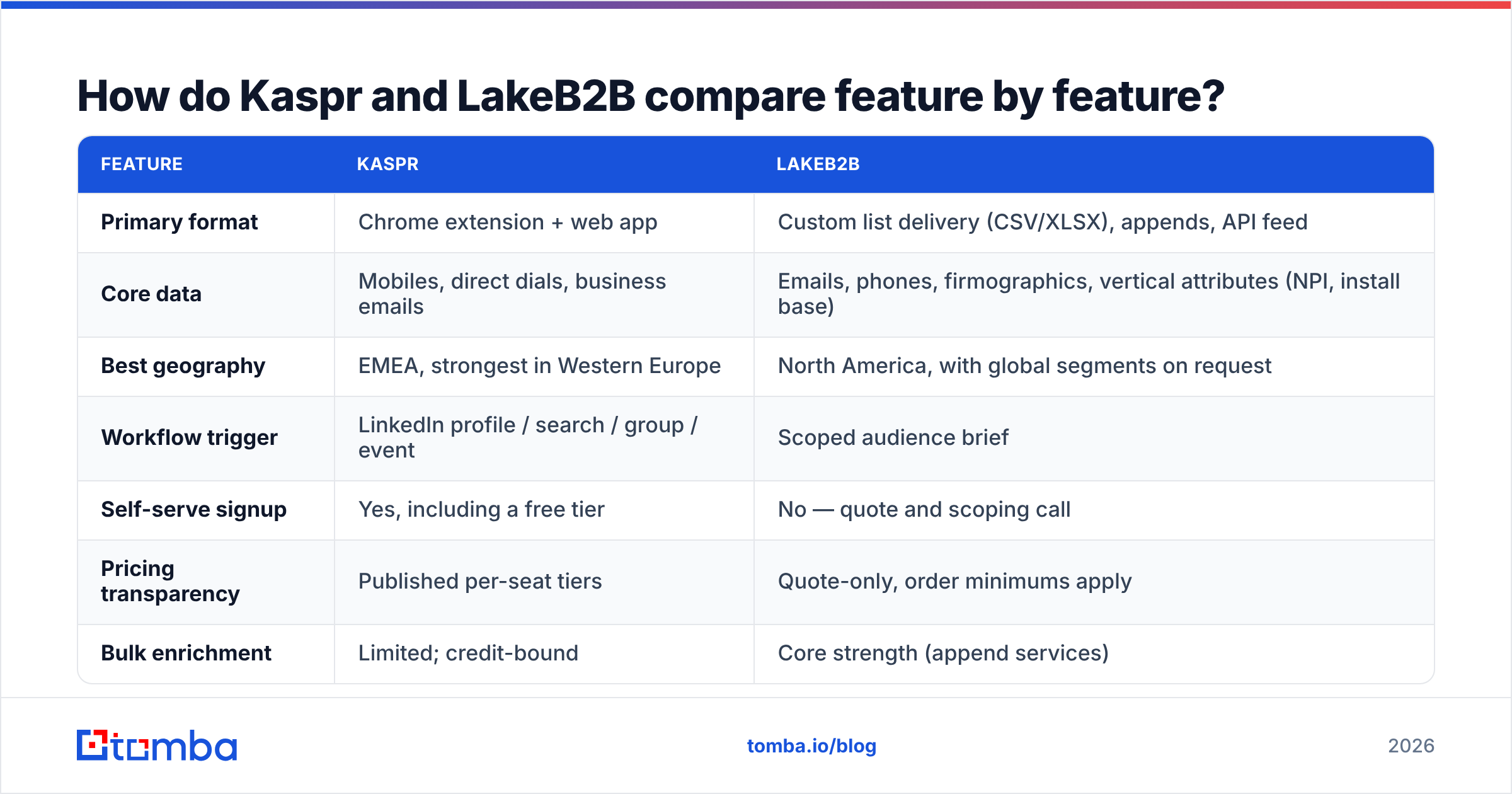
Here is Kaspr vs LakeB2B side by side.
| Feature | Kaspr | LakeB2B |
|---|---|---|
| Primary format | Chrome extension + web app | Custom list delivery (CSV/XLSX), appends, API feed |
| Core data | Mobiles, direct dials, business emails | Emails, phones, firmographics, vertical attributes (NPI, install base) |
| Best geography | EMEA, strongest in Western Europe | North America, with global segments on request |
| Workflow trigger | LinkedIn profile / search / group / event | Scoped audience brief |
| Self-serve signup | Yes, including a free tier | No — quote and scoping call |
| Pricing transparency | Published per-seat tiers | Quote-only, order minimums apply |
| Bulk enrichment | Limited; credit-bound | Core strength (append services) |
| Verification | Automated validation at reveal | Automated plus human/tele-verification options |
| Refresh after purchase | Live per reveal | Depends on contract terms |
| Typical buyer | SDR manager, individual rep | Demand gen, RevOps, agency |

Two notes on the table. Kaspr's free tier is real but capped hard, and export credits are metered apart from reveal credits. Read the credit types before you assume a plan covers your volume. LakeB2B's "custom" is genuine, so two buyers can get very different files. Quality tracks how tight the brief was. Vague briefs produce vague files.
Whose contact data is actually more accurate?#
Short answer on Kaspr vs LakeB2B accuracy: Kaspr lands closer on single reveals. Bulk segments need their own verification pass, whoever sells them.
Never take a published accuracy figure at face value. Every provider measures it differently. Some count a record as valid when the SMTP handshake works. Others count it when a human checked the job title six months ago. Those are not the same claim.

The only number that matters is your bounce rate on your ICP. Run this test before you sign anything:
- Pull 200 records from each source, on the same segment definition.
- Run all 400 through an independent email verifier, not the vendor's own checker.
- Sequence both sets in the same week, with the same copy and sending domains.
- Compare three metrics: hard bounce rate, phone connect rate and reply rate.
Teams that run this find the same pattern. Reveal tools bounce less but yield fewer records per hour of rep time. Bulk files bring volume with 10-25% dead weight. You either clean that or let it torch your sender reputation. Skip the cleaning step and email deliverability damage shows up within two sends. It then takes weeks to unwind.
One caveat applies to LinkedIn-sourced tools. The profile is current, but the email may be a pattern guess against a domain the person has left. In layoff-heavy quarters, LinkedIn lags reality by weeks.
What does Kaspr vs LakeB2B actually cost?#
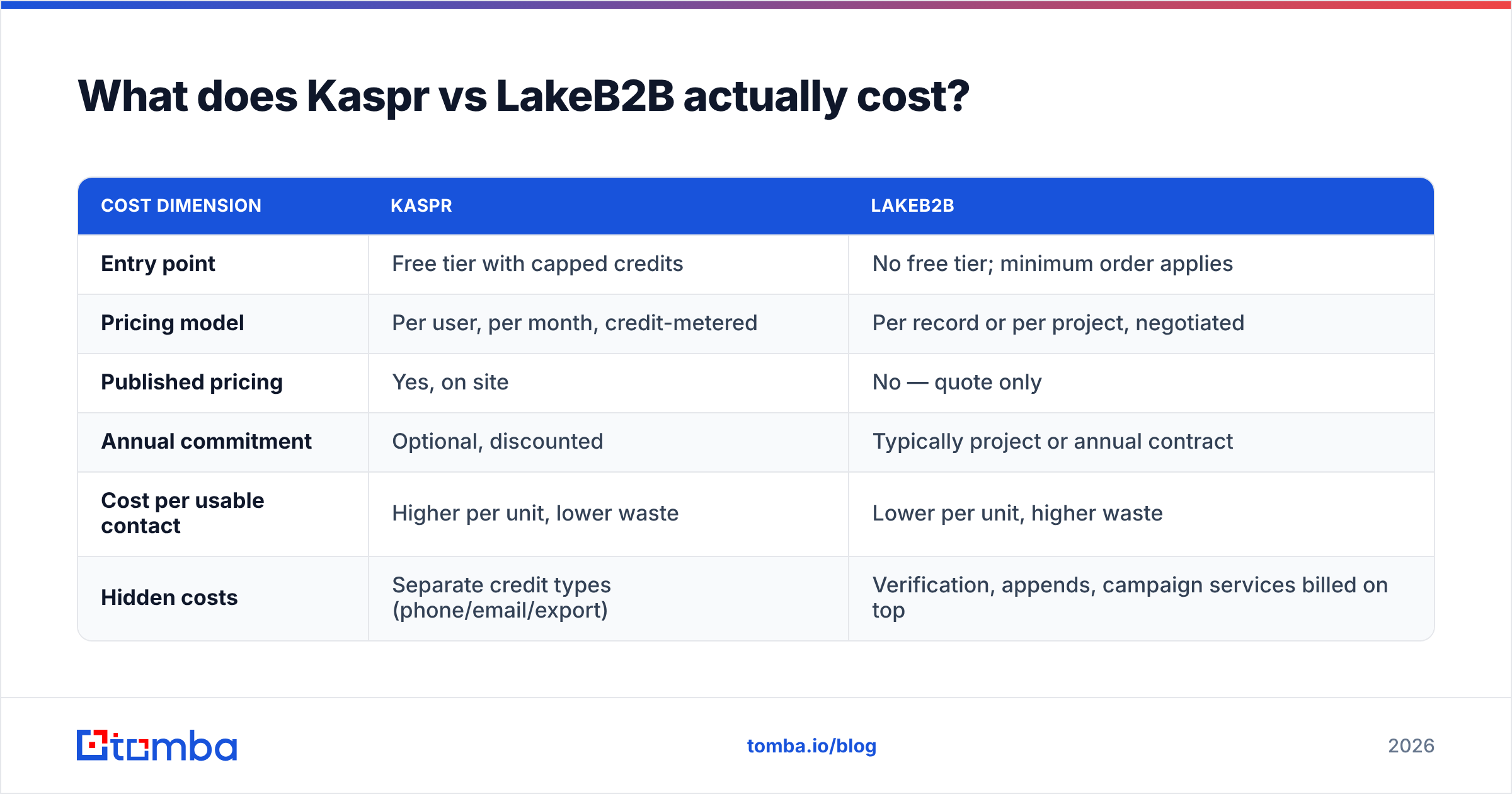
| Cost dimension | Kaspr | LakeB2B |
|---|---|---|
| Entry point | Free tier with capped credits | No free tier; minimum order applies |
| Pricing model | Per user, per month, credit-metered | Per record or per project, negotiated |
| Published pricing | Yes, on site | No — quote only |
| Annual commitment | Optional, discounted | Typically project or annual contract |
| Cost per usable contact | Higher per unit, lower waste | Lower per unit, higher waste |
| Hidden costs | Separate credit types (phone/email/export) | Verification, appends, campaign services billed on top |
Kaspr publishes its tiers, which helps a lot. You can model a 6-rep team on a spreadsheet in ten minutes. Check the current numbers on their site first, since tiers and credit limits get revised.
LakeB2B does not publish pricing, and that is normal for custom list vendors. Expect the call to start with segment size, then attribute depth, then licensing terms. One-time use versus perpetual is the clause people forget to read. A file licensed for one campaign that lives in your CRM forever is a contract problem, not a data problem.

Here is the honest budget framing for Kaspr vs LakeB2B. Need 300 well-chosen contacts a month? Per-seat credits win. Need 30,000 records in a vertical no self-serve tool indexes properly? A list purchase wins on math, even after you bin a third of it. Anything in between — a few thousand contacts at companies you can name — is the zone where both answers are expensive.
Which one fits your team?#
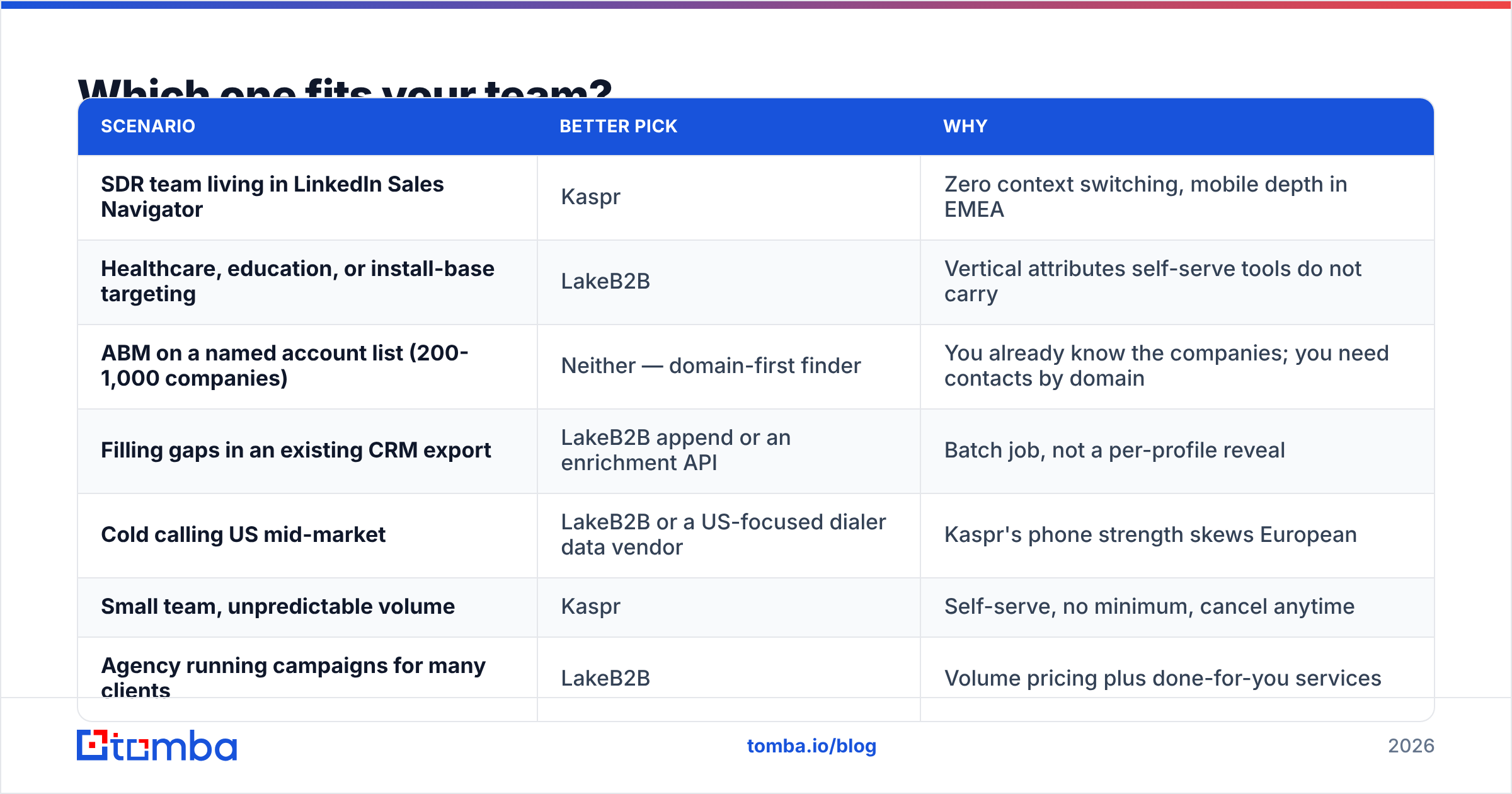
Match the Kaspr vs LakeB2B call to your motion, not to the feature list.
| Scenario | Better pick | Why |
|---|---|---|
| SDR team living in LinkedIn Sales Navigator | Kaspr | Zero context switching, mobile depth in EMEA |
| Healthcare, education, or install-base targeting | LakeB2B | Vertical attributes self-serve tools do not carry |
| ABM on a named account list (200-1,000 companies) | Neither — domain-first finder | You already know the companies; you need contacts by domain |
| Filling gaps in an existing CRM export | LakeB2B append or an enrichment API | Batch job, not a per-profile reveal |
| Cold calling US mid-market | LakeB2B or a US-focused dialer data vendor | Kaspr's phone strength skews European |
| Small team, unpredictable volume | Kaspr | Self-serve, no minimum, cancel anytime |
| Agency running campaigns for many clients | LakeB2B | Volume pricing plus done-for-you services |
Notice how often the answer is "neither." That is the most useful finding here. Both tools assume a starting point: a LinkedIn profile, or a segment brief. A lot of B2B outbound starts somewhere else. Think a list of target domains from a funding round, a conference exhibitor list, or a competitor's customer page.
Where does Kaspr vs LakeB2B break down?#
Kaspr's limits. The LinkedIn dependency is a single point of failure. Automation limits, account restrictions and profile-view caps all cap throughput. Credit types are split, so a plan that looks generous on email can run dry on phones mid-quarter. US mobile coverage is thinner than European coverage. There is no bulk path either: you cannot hand it 5,000 domains and walk away.
LakeB2B's limits. Quote-only pricing makes it slow to evaluate and hard to compare. Quality varies by vertical, so a strong healthcare file does not predict a strong fintech one. The data is a snapshot, so last quarter's file needs a fresh check before reuse. The services layer is where the bill grows, not the base file.
Shared limit. Neither gives you an always-on way to resolve a person at a company inside your own product or workflow. That is an API problem, and a third category handles it.
Is there a better third option for domain-first outbound?#
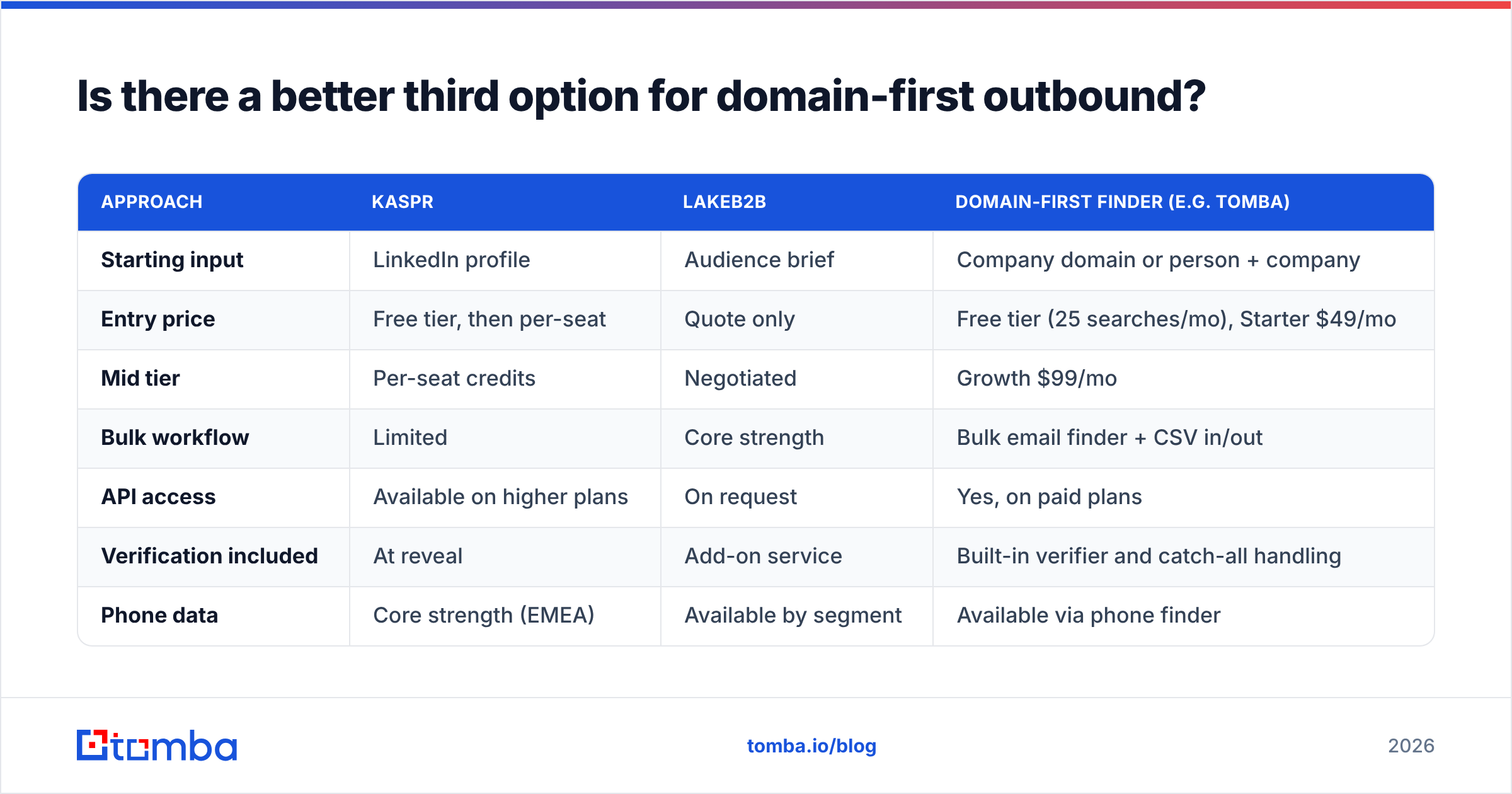
If your prospecting starts with companies, a domain-first finder changes the unit economics. It skips the two starting points that Kaspr vs LakeB2B both assume.
The pattern is simple. Take your target company domains. Run a domain search to pull every public contact at each one, with role and department. Verify before send, then push into your sequencer. No browsing, no scoping call, no waiting on a file.
| Approach | Kaspr | LakeB2B | Domain-first finder (e.g. Tomba) |
|---|---|---|---|
| Starting input | LinkedIn profile | Audience brief | Company domain or person + company |
| Entry price | Free tier, then per-seat | Quote only | Free tier (25 searches/mo), Starter $49/mo |
| Mid tier | Per-seat credits | Negotiated | Growth $99/mo |
| Bulk workflow | Limited | Core strength | Bulk email finder + CSV in/out |
| API access | Available on higher plans | On request | Yes, on paid plans |
| Verification included | At reveal | Add-on service | Built-in verifier and catch-all handling |
| Phone data | Core strength (EMEA) | Available by segment | Available via phone finder |
Tomba pricing is published, so you can model cost per usable contact before you commit. Want a pre-built list instead of a search workflow? Vendors like BookYourData sit in that middle ground. Their self-serve list builder has per-record pricing you can see, which splits the difference between Kaspr's per-reveal model and LakeB2B's custom build.
For an outside read on these categories, browse the sales intelligence category on G2 and filter by company size. Reviews from teams your size beat the aggregate score.
So what is the verdict on Kaspr vs LakeB2B?#
Pick Kaspr if your reps live on LinkedIn, you sell into Europe, and mobile numbers drive your connect rate. It is self-serve, priced in public, and needs no ops support.
Pick LakeB2B if you need a vertical segment the self-serve databases miss, you have budget for a project purchase, and you will verify the file before every send.
Pick neither if your motion is domain-first, your volumes are mid-sized, or you need contact lookup inside an automated workflow rather than a browser tab.
The common failure in a Kaspr vs LakeB2B choice is not picking wrong. It is buying either one without the 200-record bake-off first. Three months later, half the file bounces and the budget is gone.
Ready to test domain-first sourcing against your current vendor? Run 25 free searches through the Tomba Email Finder. Pull contacts at your real target accounts. Then compare bounce and reply rates against your Kaspr or LakeB2B sample. If domain-first wins, Starter is $49/mo with verification built in. No scoping call required.
Related guides#
Ready to find emails that actually work?
Join 150,000+ professionals who stopped guessing and started sending. Free credits on signup — no credit card required.
Get the Tomba newsletter
Practical outbound tactics and product updates — once every two weeks.
About the author