Kaspr vs LeadFuze (2026): Which B2B Data Tool Wins?
Kaspr pulls phones and emails off LinkedIn profiles. LeadFuze builds bulk lists from a static database. They solve different problems — here is which one actually fits your outbound motion, and what both cost you.
Kaspr vs LeadFuze is not a like-for-like fight. One reveals phone numbers on LinkedIn. The other builds bulk email lists from a database. Here is what each tool does, how good the data is, what both cost in 2026, and which one fits your team.
TL;DR
- Kaspr is a LinkedIn-first contact revealer. You browse a profile, click the extension, and it returns mobile numbers and emails one prospect (or one list) at a time. It is owned by Cognism.
- LeadFuze is a list-building database. You set filters — industry, headcount, role, tech stack — and it returns bulk lead lists with emails, no LinkedIn tab required.
- The pricing models are not comparable. Kaspr charges per user per month with separate credit buckets for phones and emails. LeadFuze charges per lead credit on plans that start in the $140+/mo range.
Two more points decide most Kaspr vs LeadFuze calls.
- Neither is a pure email-finder. If your only job is turning a name plus a domain into a verified work email at scale, both are heavier and more expensive than a dedicated finder like Tomba at $49/mo.
- Pick by workflow, not by feature list. Live LinkedIn prospecting with phone dials → Kaspr. Repeatable bulk list pulls for cold email → LeadFuze. High-volume email resolution with an API → a dedicated finder.
Kaspr vs LeadFuze: What Does Each Tool Do?#
They sit on opposite ends of the B2B data spectrum. Most head-to-head articles get this wrong and treat them as interchangeable.
Kaspr is a browser extension. It works on the page you already have open: a LinkedIn profile, a Sales Navigator list, a group, or an event attendee list. You click, and Kaspr shows the contact details. Mobile phone numbers are its historical edge. Cognism bought Kaspr in 2022. That deal gave it a bigger pool of verified phone data and a place in a larger sales stack. The mental model: Kaspr is a scope you attach to a rifle you already own.
LeadFuze is a search engine over a contact database. You never touch LinkedIn. You define an ideal customer profile with filters — "VP of Marketing, SaaS, 50–200 employees, uses HubSpot, hiring" — and LeadFuze returns a list of matching people with work emails attached. Its "Fuzebot" feature keeps adding new matches on a schedule and dedupes against contacts you already own. The mental model: LeadFuze is a net you drop into the water on a timer.
That one split drives the rest of the Kaspr vs LeadFuze comparison: accuracy, price per contact, and whether the tool still earns its place six months into your outbound program.

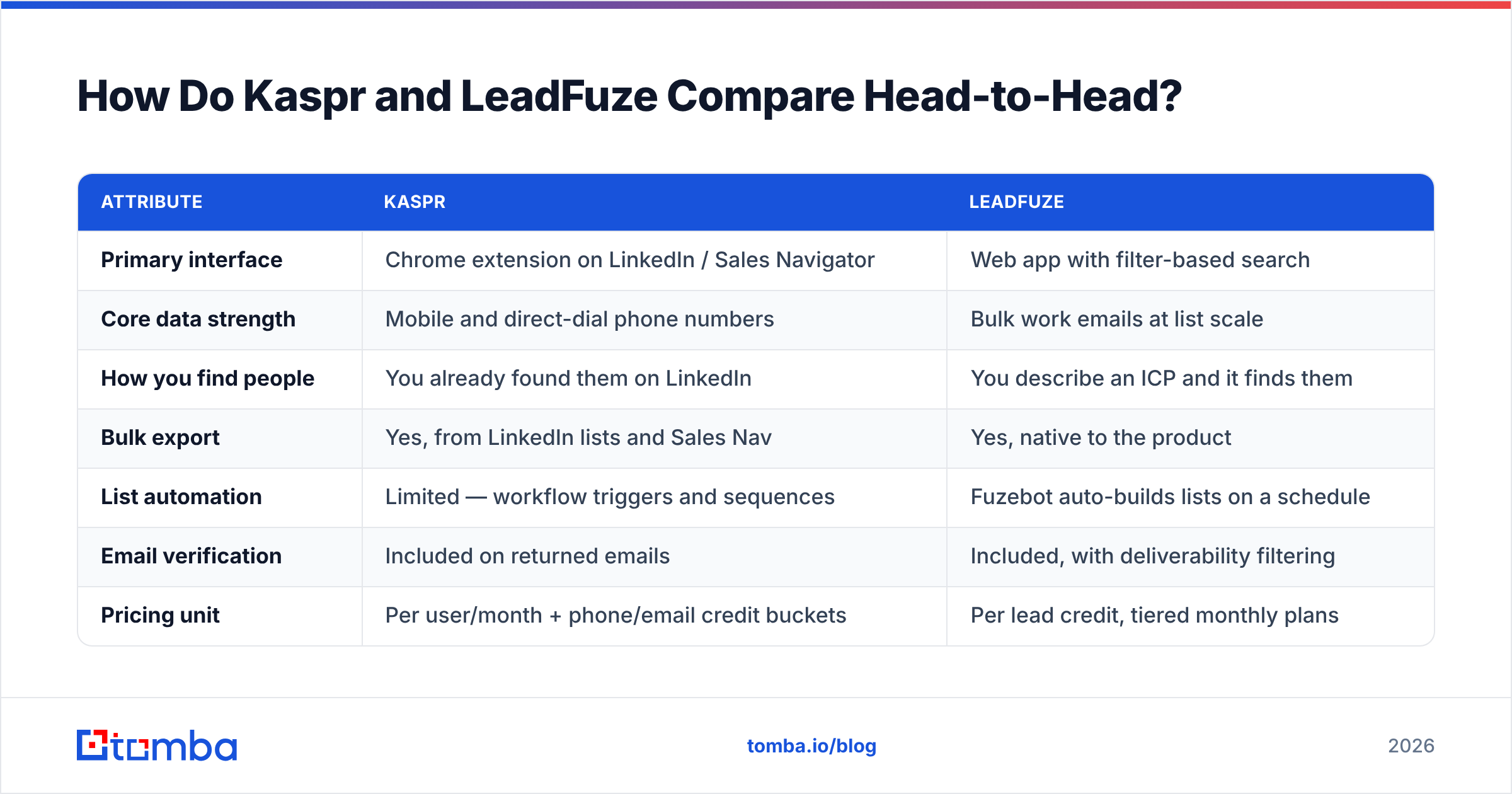
Kaspr vs LeadFuze: How Do They Compare Head-to-Head?#
| Attribute | Kaspr | LeadFuze |
|---|---|---|
| Primary interface | Chrome extension on LinkedIn / Sales Navigator | Web app with filter-based search |
| Core data strength | Mobile and direct-dial phone numbers | Bulk work emails at list scale |
| How you find people | You already found them on LinkedIn | You describe an ICP and it finds them |
| Bulk export | Yes, from LinkedIn lists and Sales Nav | Yes, native to the product |
| List automation | Limited — workflow triggers and sequences | Fuzebot auto-builds lists on a schedule |
| Email verification | Included on returned emails | Included, with deliverability filtering |
| Pricing unit | Per user/month + phone/email credit buckets | Per lead credit, tiered monthly plans |
| Free option | Free plan with limited credits | Free trial (limited leads), no permanent free tier |
| Best-fit motion | SDRs doing live LinkedIn prospecting + cold calling | Marketers and agencies building cold email lists |
| Weakest for | Programmatic API-first enrichment at volume | Phone numbers and real-time LinkedIn workflows |
The Kaspr vs LeadFuze table above makes the trade explicit. Kaspr wins when a human is already looking at a specific person and needs to reach them today — ideally by phone. LeadFuze wins when nobody has picked the targets yet and you need 800 of them by Friday.
Both stumble on the middle case that rules most RevOps stacks in 2026. You already have a CRM full of company domains and contact names. You just need verified emails appended by API. That is an email finder job, not a prospecting-UI job, and paying per seat or per lead credit for it is expensive.
Which Tool Has Better Data Accuracy?#
Kaspr vs LeadFuze accuracy is not one question. Each tool answers a different one, so judge them on the right axis.
Kaspr's claim is strongest on phone numbers. Users contribute the data and the network cross-checks it, and the Cognism pool adds more depth. Mobile coverage on European contacts is genuinely competitive. Email accuracy is decent but secondary. It is not the metric the product is built around.
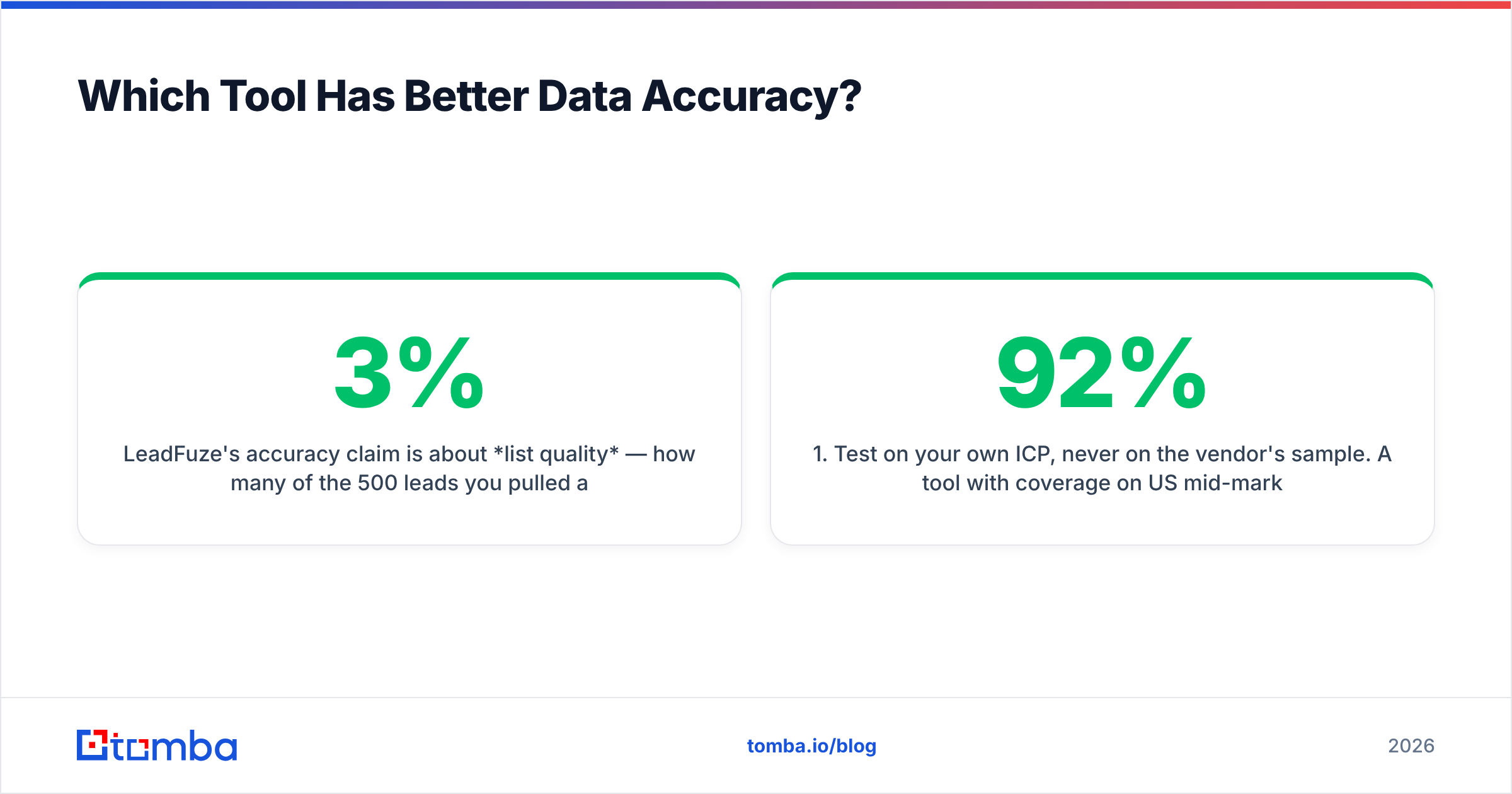
LeadFuze's claim is about list quality — how many of the 500 leads you pulled are real, still employed, and reachable. It verifies records before delivery and filters out known bounces. That is why each lead costs more than a raw scrape. The failure mode is staleness. Records decay by 2–3% a month as people change jobs, so a list built in March is much weaker by September.

Use these four rules to judge either vendor's accuracy claims:
- Test on your own ICP, never on the vendor's sample. A tool with 92% coverage on US mid-market SaaS may sit at 45% on German manufacturing. Run 100 known-good contacts through both and count.
- Separate coverage from accuracy. Coverage is "did it return anything?" Accuracy is "was it right?" A tool that guesses on every row will show great coverage and wreck your sender reputation.
The last two rules apply after the data lands in your sending tool.
- Always re-verify before send. Whatever the source, run the export through an email verifier the week you send. Verification at list-build time is worthless three months later.
- Check the catch-all handling. Both tools return addresses on catch-all domains that no verifier can confirm over standard SMTP. Decide in advance whether you send to them, and use a catch-all verifier rather than guessing.
That last point is where many "the data was bad" complaints start. The record was fine. The domain was accept-all, and the campaign counted it as a hard bounce.
How Much Do Kaspr and LeadFuze Cost in 2026?#
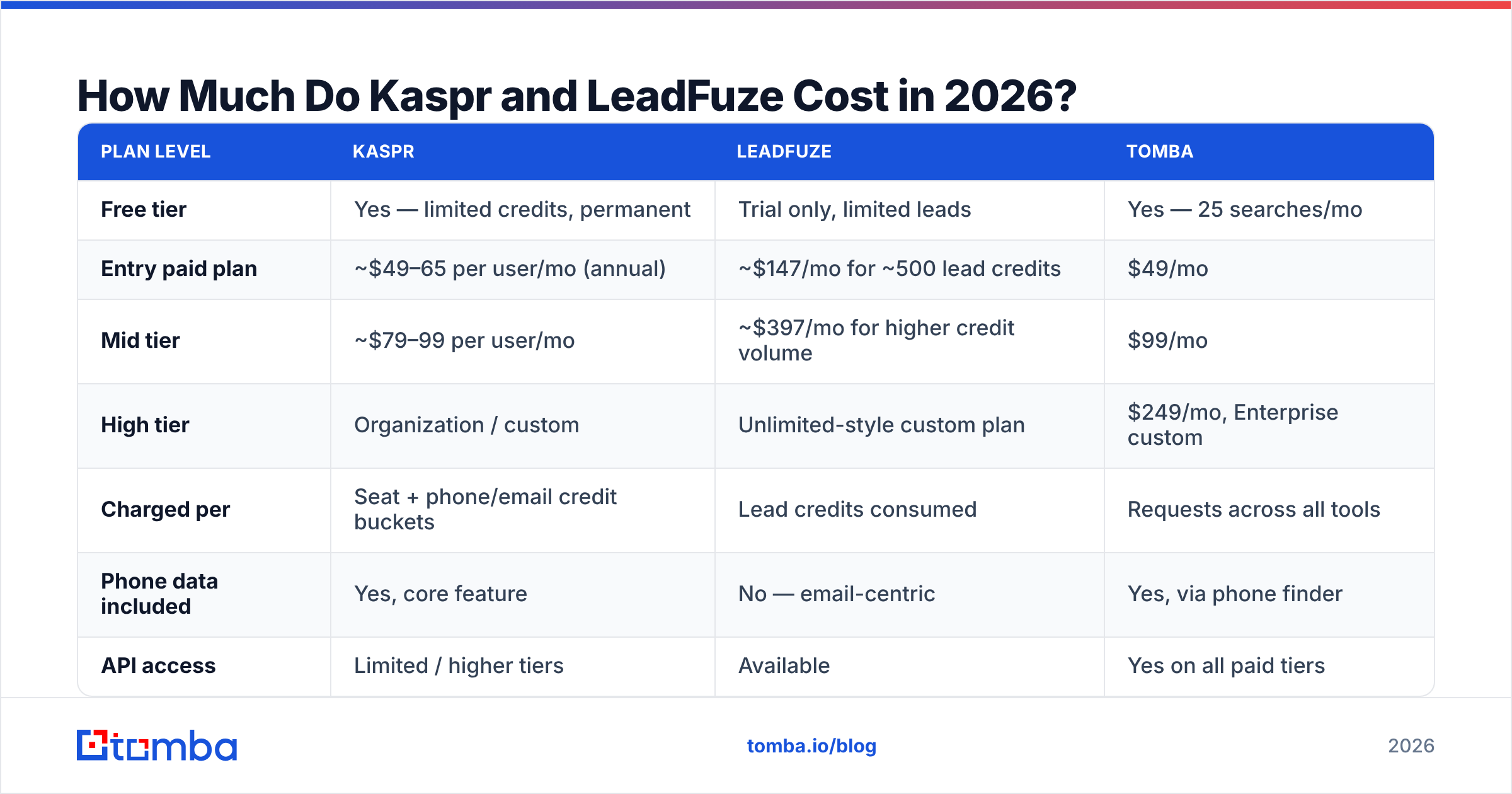
Kaspr vs LeadFuze pricing is hard to compare because the vendors bill on different units. Treat the figures below as list-price ballparks. Both vendors adjust tiers and annual discounts, so check their own pricing pages before you sign.
| Plan level | Kaspr | LeadFuze | Tomba |
|---|---|---|---|
| Free tier | Yes — limited credits, permanent | Trial only, limited leads | Yes — 25 searches/mo |
| Entry paid plan | ~$49–65 per user/mo (annual) | ~$147/mo for ~500 lead credits | $49/mo |
| Mid tier | ~$79–99 per user/mo | ~$397/mo for higher credit volume | $99/mo |
| High tier | Organization / custom | Unlimited-style custom plan | $249/mo, Enterprise custom |
| Charged per | Seat + phone/email credit buckets | Lead credits consumed | Requests across all tools |
| Phone data included | Yes, core feature | No — email-centric | Yes, via phone finder |
| API access | Limited / higher tiers | Available | Yes on all paid tiers |
| Team of 5 entry cost | ~$245–325/mo | ~$147/mo (shared credits) | $49–99/mo (shared) |

Read the last row carefully. It is the one that changes budgets. Kaspr's per-seat model scales with headcount: five SDRs cost five times one SDR, whatever the usage. LeadFuze's credit model ignores seats but punishes volume. Ask for 5,000 contacts a month instead of 500 and you are in four-figure territory. That is the real Kaspr vs LeadFuze budget question: seats or volume.
Neither model is wrong. Per-seat fits teams where each rep does individual research. Per-credit fits teams where list volume is the constraint. But a small team pulling large volumes — the standard shape of a 2026 outbound org — fights both models. So teams split the stack. A cheap, high-volume data layer handles resolution and enrichment. One or two seats of a specialist tool cover the reps who really need phone dials. Compare the tiers on Tomba pricing and the per-credit gap is obvious.

Which One Fits Your Outbound Motion?#
Match the tool to how your team actually works, not to the feature grid.
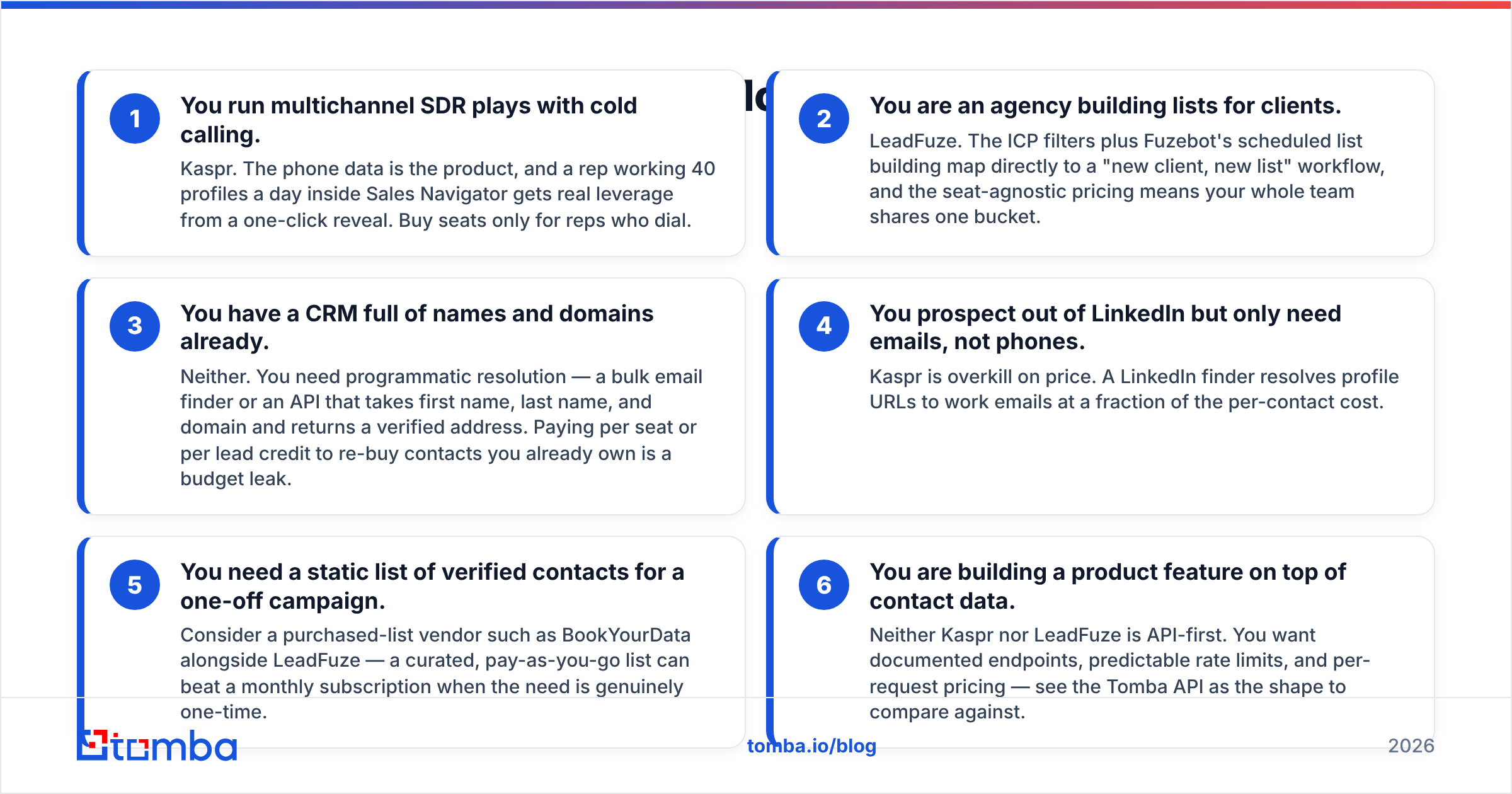
- You run multichannel SDR plays with cold calling. Kaspr. The phone data is the product, and a rep working 40 profiles a day in Sales Navigator gets real leverage from a one-click reveal. Buy seats only for reps who dial.
- You are an agency building lists for clients. LeadFuze. The ICP filters and Fuzebot's scheduled builds map to a "new client, new list" workflow, and the seat-free pricing lets your whole team share one bucket.
- You have a CRM full of names and domains already. Neither. You need a bulk email finder or an API that takes first name, last name, and domain and returns a verified address. Paying per seat or per lead credit to re-buy contacts you own is a budget leak.
The Kaspr vs LeadFuze answer changes again in these three cases.
- You prospect on LinkedIn but need emails, not phones. Kaspr is overkill on price. A LinkedIn finder turns profile URLs into work emails for a fraction of the cost per contact.
- You need a static list of verified contacts for a one-off campaign. Look at a purchased-list vendor such as BookYourData next to LeadFuze. A curated, pay-as-you-go list can beat a monthly subscription when the need is truly one-time.
- You are building a product feature on top of contact data. Neither tool is API-first. You want documented endpoints, predictable rate limits, and per-request pricing — see the Tomba API as the shape to compare against.
What About GDPR and Data Compliance?#
Both vendors publish compliance positions. The practical difference is where the data comes from and what you owe after you receive it.
Kaspr is a French company and has worked under the GDPR from day one. It documents a process for data subject access and deletion requests, so a prospect who asks to be removed has a route. Phone numbers add a second layer: local calling-consent rules. Those vary a lot across the EU, and Germany and France are much stricter than the UK.
LeadFuze runs on a mostly US dataset and publishes a compliance statement. Bulk list building into EU territories still carries the usual legitimate-interest analysis. An accurate record does not make the outreach lawful.
Do two things whichever you buy. Document your legitimate-interest assessment before you send. Keep a suppression list that survives tool changes, because vendor-side suppression does not transfer when you switch platforms. Independent reviews on G2 help here — compliance complaints show up in review text long before they reach a vendor's marketing.
Is There a Better Alternative to Both?#
That depends on what you were buying them for.
If you wanted phone numbers plus a live LinkedIn workflow, Kaspr is genuinely strong. The alternatives — Lusha, ContactOut, Cognism proper — sit in the same price band. Stay.
If you wanted bulk lists, LeadFuze competes with Apollo, Seamless.AI, and BookYourData. Apollo bundles sequencing. BookYourData sells verified lists with no subscription, which suits one-off campaigns. LeadFuze's edge is ICP filter depth and Fuzebot automation.
If what you actually needed was verified work emails at volume, cheaply, with an API, then Kaspr vs LeadFuze is the wrong question. A dedicated finder handles name-plus-domain resolution, domain search for every address at a company, verification, and enrichment on one credit pool, with no per-seat fees. Tomba's free tier gives 25 searches a month, so you can test coverage on your own ICP before you spend anything.
Kaspr vs LeadFuze: Which Should You Buy?#
Buy Kaspr if cold calling is a real channel, your reps live in Sales Navigator, and you can justify per-seat pricing for the people who dial. Start on the free plan and measure the phone-number hit rate on 100 of your actual targets.
Buy LeadFuze if you need net-new lists built to a spec and nobody on your team wants to find those people by hand. The $147-ish entry tier is a fair test. Model the cost at 3x your current volume before you commit annually.
Buy neither if your pipeline problem is "we have the accounts, we just cannot reach the right person's inbox." That is a resolution-and-verification problem. Paying prospecting-UI prices to solve it is how outbound budgets quietly double.
Run the same 100 contacts through all three options in one afternoon. Coverage rate, accuracy rate, and cost per usable contact will tell you more than any comparison post — including this one.
Ready to test the email layer on its own? Start with the Tomba Email Finder — find verified work emails by name, domain, or company, with 25 free searches a month and no seat fees. Run it against the same list you would give Kaspr or LeadFuze and compare cost per verified contact directly.
Related guides#
// get started
Find, verify and enrich your first contacts today
Start on the free plan with 25 searches a month, then scale when your team is ready.
Free plan · No credit card required · GDPR & CCPA
// about the author