Kaspr vs Leadrocks: Which B2B Contact Tool Wins in 2026?
Kaspr sells live LinkedIn phone and email reveals. Leadrocks sells a cheap lifetime database. We break down accuracy, pricing, GDPR risk, and which one actually fits your outbound motion.
Kaspr vs Leadrocks is not a fair fight. One tool reveals contacts live. The other sells you a stored list once, cheap. Here is how they differ, and which one fits your outbound.
TL;DR
- Kaspr is a LinkedIn-first reveal tool. You open a profile, and the Chrome extension shows mobile numbers and emails on demand. Its best trait is phone coverage in Europe.
- Leadrocks is a static B2B database, sold mostly as a lifetime deal (LTD). You set filters, export contacts, and you're done. Its best trait is price per record.
- They are not true rivals. One is a live enrichment layer. The other is a bulk list you own forever. Pick wrong and you lose either budget or deliverability.
- Accuracy is the deciding variable. Live-reveal tools age well. Static LTD databases decay about 22-30% per year as people change jobs.
- Need to find and verify work emails at scale through an API? A dedicated email finder will beat both on cost per valid contact.
What exactly are Kaspr and Leadrocks?#
Different product categories wearing similar marketing.
Kaspr (kaspr.io) is a LinkedIn prospecting extension. Cognism bought it in 2022. You install the Chrome extension, open a LinkedIn profile or a Sales Navigator list, and Kaspr shows phone numbers and emails in the sidebar. Its data comes from two places: users who install the extension share contacts from their own address books, and licensed third-party sources. It also bundles light sequencing — tasks, notes, LinkedIn invites, and basic email steps.
Leadrocks (leadrocks.io) is a searchable B2B contact database. It usually sells through AppSumo-style lifetime deals. You filter by job title, company, industry, location, and headcount, then export a CSV or push it to a CRM. There is no live check at reveal time. You are querying a stored index that someone built earlier.
That difference drives everything else. Kaspr's cost grows with usage, and its data is pulled the moment you ask. Leadrocks costs almost nothing after you buy it. But its data is only as fresh as the last refresh, and you do not control that.
Kaspr vs Leadrocks: how do they compare head to head?#
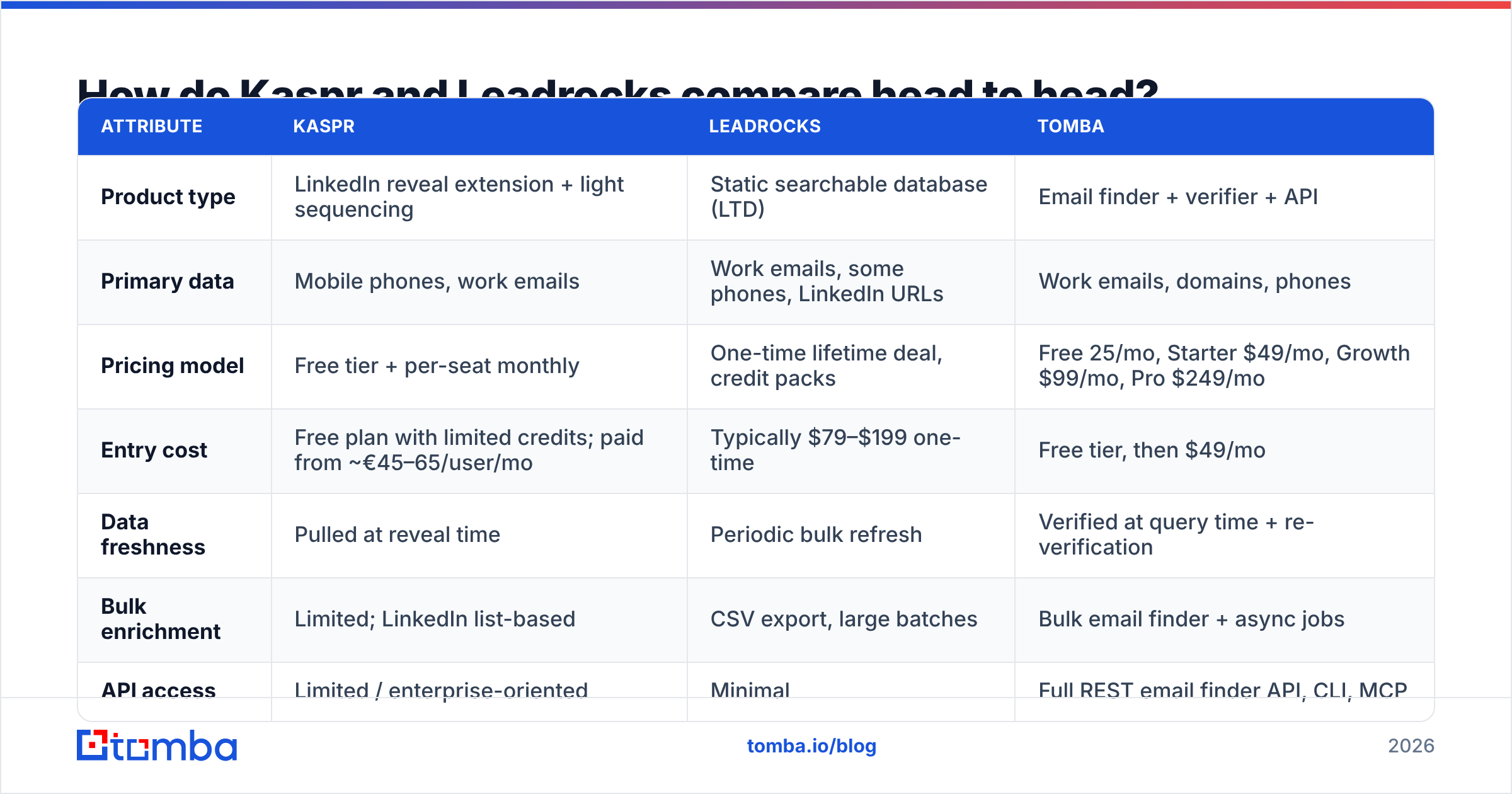
Here is the practical breakdown. Pricing reflects publicly listed plans as of early 2026. Both vendors change tiers often, so check the vendor site before you buy.
| Attribute | Kaspr | Leadrocks | Tomba |
|---|---|---|---|
| Product type | LinkedIn reveal extension + light sequencing | Static searchable database (LTD) | Email finder + verifier + API |
| Primary data | Mobile phones, work emails | Work emails, some phones, LinkedIn URLs | Work emails, domains, phones |
| Pricing model | Free tier + per-seat monthly | One-time lifetime deal, credit packs | Free 25/mo, Starter $49/mo, Growth $99/mo, Pro $249/mo |
| Entry cost | Free plan with limited credits; paid from ~€45–65/user/mo | Typically $79–$199 one-time | Free tier, then $49/mo |
| Data freshness | Pulled at reveal time | Periodic bulk refresh | Verified at query time + re-verification |
| Bulk enrichment | Limited; LinkedIn list-based | CSV export, large batches | Bulk email finder + async jobs |
| API access | Limited / enterprise-oriented | Minimal | Full REST email finder API, CLI, MCP |
| Email verification | Basic | Claimed, not transparent | Dedicated email verifier + catch-all handling |
| GDPR posture | EU-based, DPA + opt-out flow documented | Less documented | EU-compliant, documented sources |
| Best for | EU phone-first SDR teams | Budget list building, agencies | Scaled, verified email outbound |
The table makes the split clear. Need a phone number to dial in the next 30 seconds? Kaspr wins. Need 50,000 rows for under $200, and can you live with decay? Leadrocks wins. Need verified emails on tap with an API? Neither tool is the right shape.
Is Kaspr accurate enough for cold calling?#
Yes for European mobile numbers. Weaker for North America.
Cognism, Kaspr's parent company, built its name on phone-verified mobile data in Europe. That pedigree shows. Teams report solid connect rates in Germany, France, Benelux, and the UK. Coverage thins out for US mid-market accounts. It gets sparse for companies under 50 people anywhere.
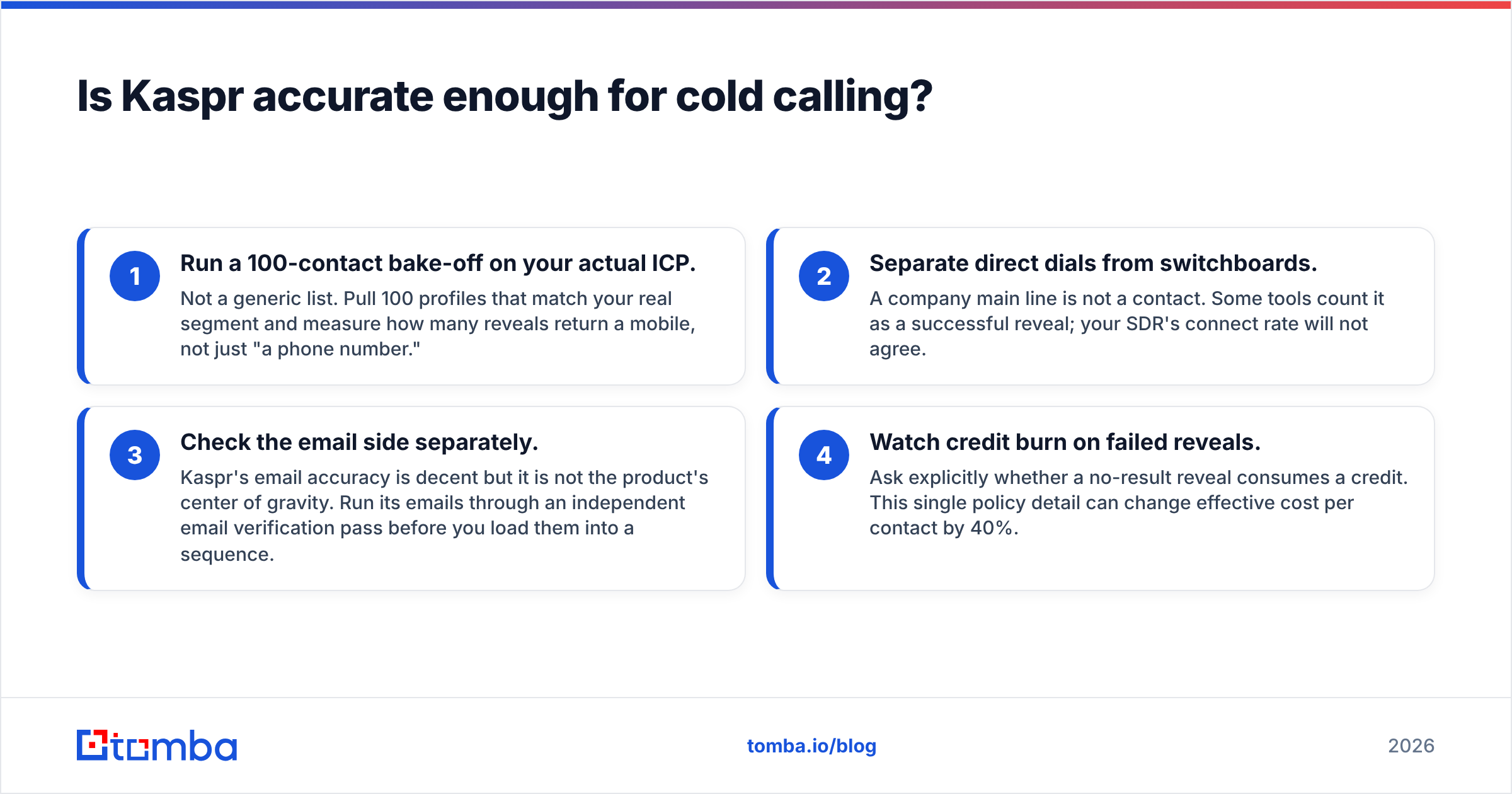
Three things to test before you commit:
- Run a 100-contact test on your real ICP. Not a generic list. Pull 100 profiles that match your true segment. Then count how many reveals return a mobile, not just "a phone number."
- Separate direct dials from switchboards. A company main line is not a contact. Some tools still count it as a win. Your SDR's connect rate will not agree.
- Check the email side on its own. Kaspr's email accuracy is decent, but email is not the core product. Run its emails through an independent email verification pass before you load a sequence.
- Watch credit burn on failed reveals. Ask whether a no-result reveal still costs a credit. That one policy can change your cost per contact by 40%.
The shared-address-book model raises a legal question too. If a contact lands in the pool because another user synced their phone, the lawful basis for processing gets murky. Kaspr does publish a notice and an opt-out process, which is more than most peers do. Even so, run it past your data protection officer if you sell into regulated EU markets.
Is a Leadrocks lifetime deal actually cheaper?#
Only if you measure cost per valid contact, not cost per row.
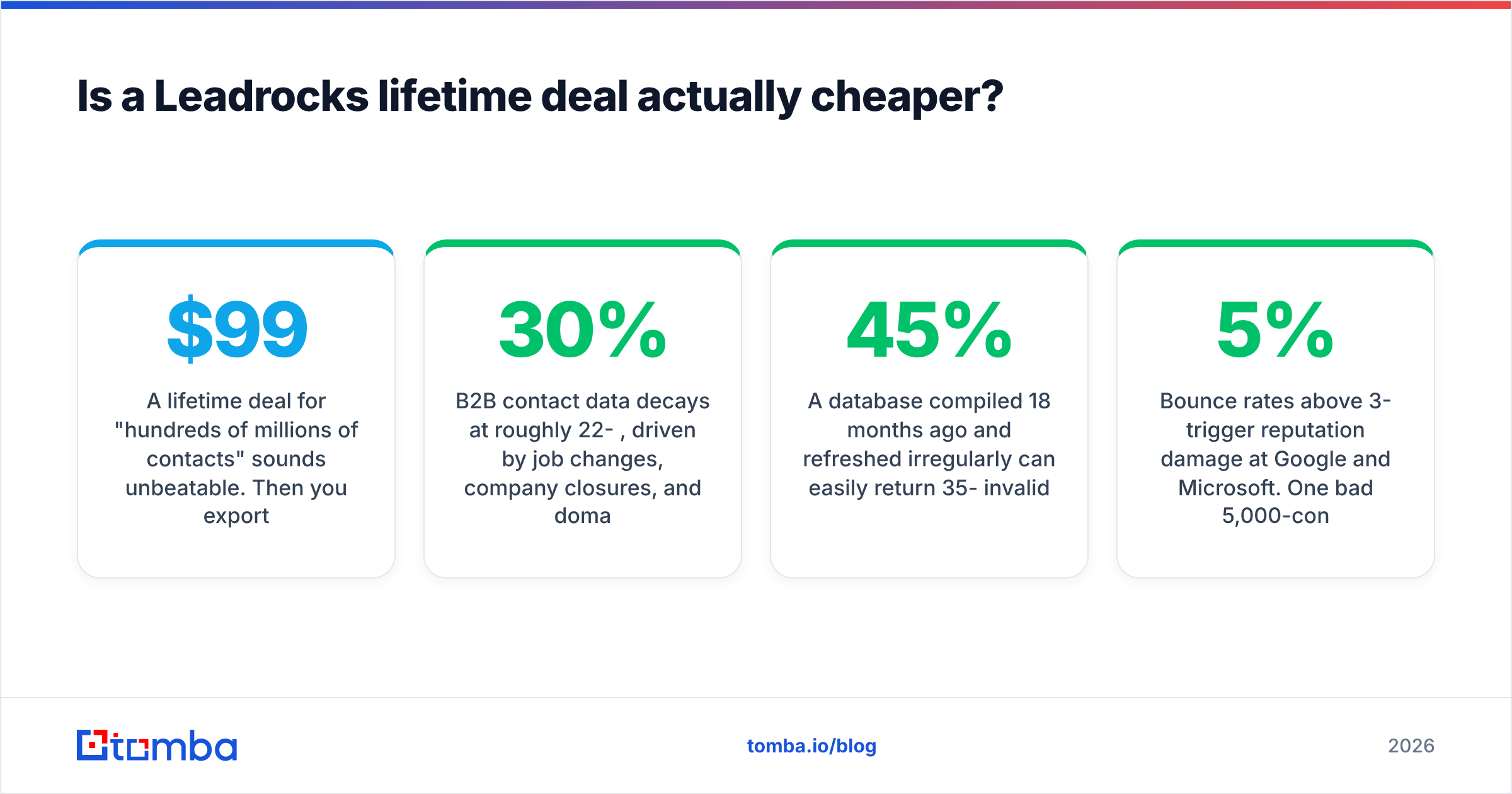
A $99 lifetime deal for "hundreds of millions of contacts" sounds unbeatable. Then you export 10,000 rows, and the math changes:
- B2B contact data decays about 22-30% per year. People change jobs, companies close, and domains move. Analysts including Gartner flag CRM data decay as a standing revenue cost.
- A database built 18 months ago and refreshed at random can return 35-45% invalid or role-based addresses on niche segments.
- Bounce rates above 3-5% hurt your reputation at Google and Microsoft. One bad 5,000-contact send can cost you weeks of email deliverability recovery. That is far more than the $99 you saved.
So the honest math is simple. $99 for 6,000 usable contacts is still cheap, if you verify first. The trap is skipping verification because the data "came from a database." Always run an LTD export through a free email checker or a bulk verifier before it touches your sending domain.
Where Leadrocks genuinely wins: agencies and solo founders who need volume for TAM mapping, ABM list seeding, or research. If a 60% hit rate is fine for that job, it is a reasonable line item.
Which one fits your outbound motion?#
Match the tool to the motion, not the feature list. Kaspr vs Leadrocks stops being an abstract question the moment you name your main channel.
Pick Kaspr if:
- Your primary channel is the phone and your ICP is European
- SDRs work profile-by-profile inside LinkedIn rather than from static lists
- You want reveal + task + basic sequence in one seat
- You can absorb €45-65 per user per month
Pick Leadrocks if:
- You need a large list once, not continuously
- Budget is fixed and small
- You already own a verification step downstream
- Your segment is broad enough that coverage gaps don't kill the campaign
Pick a dedicated email-finding stack if:
- You need programmatic enrichment inside a CRM, product, or workflow
- Deliverability is a KPI you're accountable for
- You process thousands of contacts monthly and need per-contact confidence scores
- You need catch-all domains handled explicitly rather than guessed at
That last case is where most scaling teams land. Neither tool was built as an enrichment backbone. Kaspr is a human-in-the-loop UI. Leadrocks is a file you download.

What about data compliance and sourcing?#
Procurement will ask this, and it splits the two tools cleanly.
Kaspr is based in the EU. It publishes a DPA, documents its notice-and-opt-out flow, and inherits compliance process from Cognism. For European buyers with a real legal review, that paperwork exists and can be handed over.
Leadrocks publishes less. Lifetime-deal vendors usually carry thinner compliance documents, because their buyer is a founder with a credit card, not a procurement committee. That is not an accusation of wrongdoing. It is a statement about what you can prove if a data subject files a request. If you sell into the EU or UK, or handle CCPA duties, ask for the source-of-data statement before you buy.
A third benchmark helps: check whether a vendor says where its data comes from at all. Naming sources is a cheap signal of operational maturity. Vendors that can name them usually refresh them too.
How do both compare to a purpose-built email finder?#
On email, both lose. Finding an email is a different engineering problem than revealing a phone or storing a list.
A dedicated finder does three things neither tool does well:
- Pattern inference and verification in one call. It works out the likely address format for a domain, then checks the candidate over SMTP. You get a confidence score, not a guess.
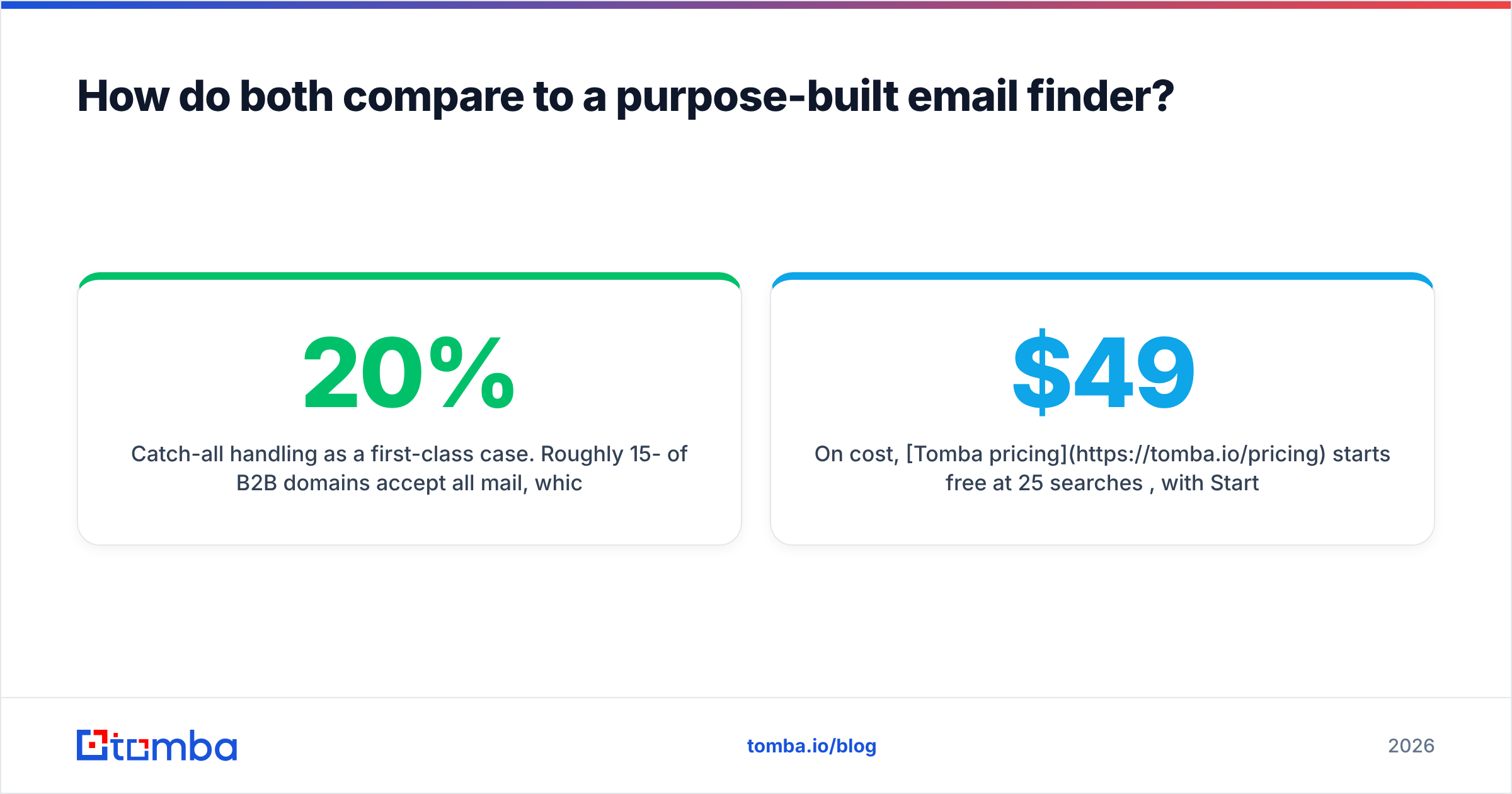
- Catch-all handling as a first-class case. Roughly 15-20% of B2B domains accept all mail, so a standard check returns a useless "unknown." A catch-all verifier applies secondary signals instead of shrugging.
- Programmatic access. A REST API, a CLI, spreadsheet add-ons, and an MCP server let enrichment run where your data already lives, not in a browser tab.
On cost, Tomba pricing starts free at 25 searches per month. Starter is $49/mo and Growth is $99/mo. That sits between Leadrocks' one-time fee and Kaspr's per-seat plan, but you pay against verified results rather than raw rows. For a two-person team doing 3,000 verified contacts a month, it is usually the cheapest per valid contact of the three.
To be fair about the gaps: a pure email finder will not hand you a mobile number for a cold call the way Kaspr will, and it will not give you a 100M-row CSV to sit on. Many teams run two layers — a finder as the always-on enrichment API, plus a phone tool when dialing is the motion. That stack is more common than picking a single winner.
What's the honest verdict?#
In the Kaspr vs Leadrocks matchup there is no universal winner, but there is a default.
Building a repeatable outbound engine in 2026? Start with a verified email layer and an API. Add a phone tool only if dialing is truly part of your motion. Kaspr earns its seat price for EU phone-led teams. Leadrocks earns its one-time fee for budget list building, when verification is already handled. Both fail as the sole source of truth for a team that sends volume.
Avoid one mistake: treating "number of contacts" as the buying criterion. A 100-million-record database with 40% decay is worth less to your pipeline than 5,000 addresses you can send to without wrecking your sender reputation. Peer reviews on G2 and Capterra help here. Read the one-star reviews for bounce complaints — that is where data quality shows up.
Run the test. 100 contacts from your real ICP, through each tool, verified on your own, scored on valid-and-deliverable. The answer for your segment will be clear within an hour, and it will beat any comparison table, including this one.
Where should you start?#
Start with the layer that everything else depends on: a verified, current email address.
Try the Tomba Email Finder free — 25 searches a month, no card. Run the same 100 ICP contacts you would test against Kaspr or Leadrocks. Compare hit rate, confidence scores, and how many survive an independent check. If it wins on cost per valid contact, plug it in via the API and let it run underneath whatever phone or list tool you keep.
Related guides#
// get started
Find, verify and enrich your first contacts today
Start on the free plan with 25 searches a month, then scale when your team is ready.
Free plan · No credit card required · GDPR & CCPA
// about the author