Kaspr vs Leadsrush (2026): Which Lead Data Tool Wins?
Kaspr sells LinkedIn phone numbers by the seat. Leadsrush sells list volume by the credit. We compare data sourcing, accuracy, pricing structure and compliance risk — and name the case where neither is the right buy.
TL;DR
- Kaspr is a phone-first LinkedIn extension. It lives in your browser, reveals mobile numbers and emails on profiles you open, and prices per seat. Owned by Cognism since 2022.
- Leadsrush is a volume-first list builder. It leans on search-and-export workflows and credit bundles rather than per-profile reveals. Its public documentation is thinner, so verify every claim against the vendor before you buy.
- They fail differently. Kaspr's cost scales with headcount; Leadsrush's cost scales with list size. Pick based on which of those two numbers is growing faster at your company.
- Neither is a great programmatic data layer. If you need emails inside a CRM workflow, an enrichment job, or a product feature, a credit-based API beats both.
- Verify before you send, always. Both tools return contacts that decay at roughly 2–3% per month. Verification is not optional overhead — it's the difference between a 3% bounce rate and a burned domain.
What are Kaspr and Leadsrush?#
They solve the same problem from opposite ends of the funnel.
Kaspr is a Chrome extension that overlays LinkedIn. You open a profile, click the Kaspr widget, and it attempts to return that person's mobile number, direct line, and work email. It was acquired by Cognism in 2022 and now sits as the self-serve, SDR-facing product in that portfolio. Its identity is phone data — specifically European mobile numbers, where most US-centric databases go thin. Pricing is per user, per month, with separate credit pools for phone reveals, email reveals, and exports. You can check current rates on the Kaspr site, since tiers move.
Leadsrush approaches it as a list problem. Instead of reveal-one-profile-at-a-time, the workflow is filter a database or a search result, then export in bulk. Credits are consumed per contact pulled, not per seat occupied. It is the less-documented of the two by a wide margin — fewer third-party reviews, less public detail on where the data originates, and pricing that has changed more than once. That's not automatically a strike against it, but it changes how you should evaluate it: demand a trial, run your own sample, and don't take any coverage percentage at face value.
The short version of Kaspr vs Leadsrush: one is a per-seat tool for reps who work accounts one at a time, the other is a per-credit tool for operators who build lists.

How do Kaspr and Leadsrush actually source their data?#
This is the question that determines everything downstream, and it's the one most comparison posts skip.
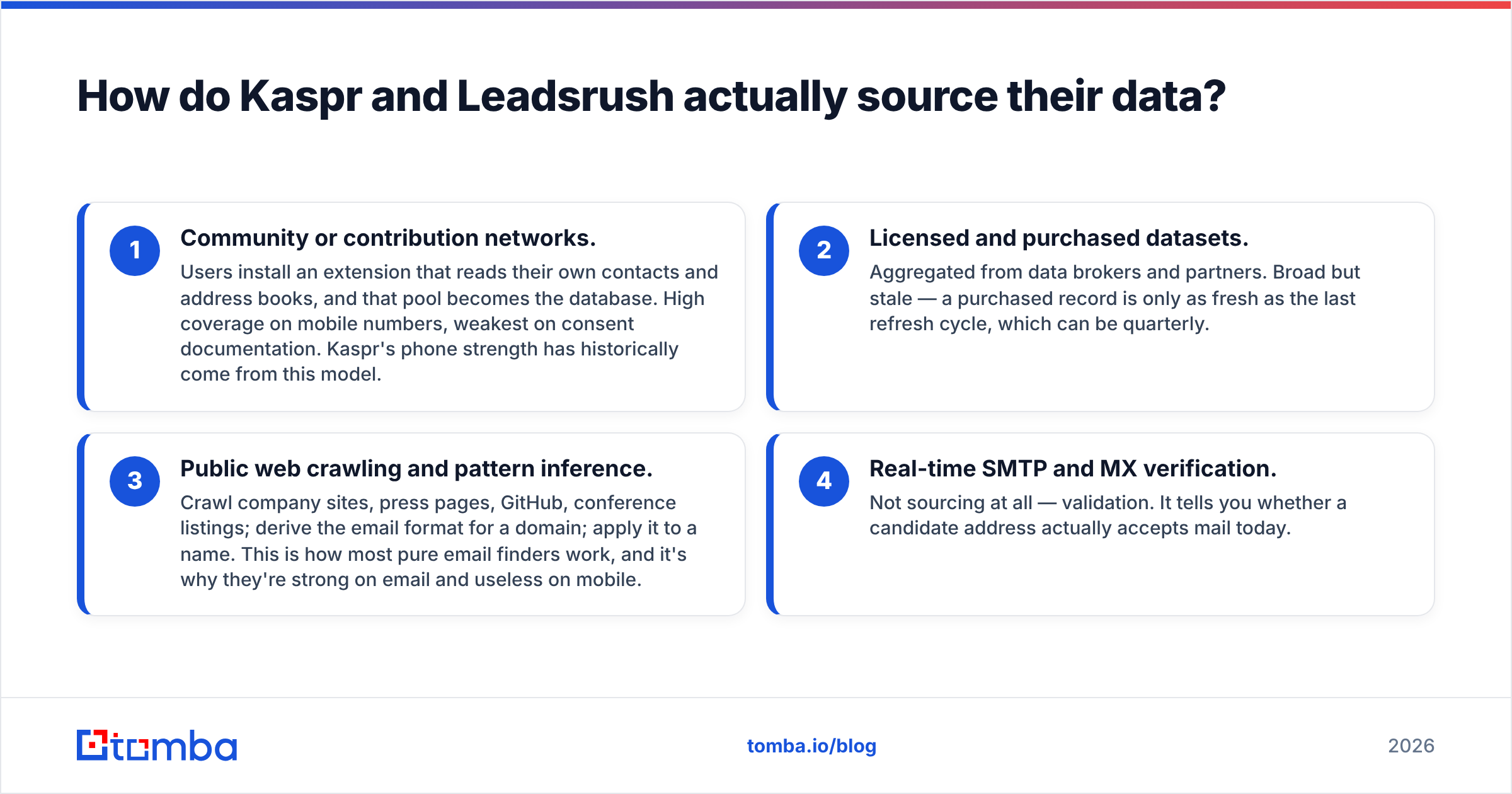
There are only four ways any B2B contact tool gets a phone number or email:
- Community or contribution networks. Users install an extension that reads their own contacts and address books, and that pool becomes the database. High coverage on mobile numbers, weakest on consent documentation. Kaspr's phone strength has historically come from this model.
- Licensed and purchased datasets. Aggregated from data brokers and partners. Broad but stale — a purchased record is only as fresh as the last refresh cycle, which can be quarterly.
- Public web crawling and pattern inference. Crawl company sites, press pages, GitHub, conference listings; derive the email format for a domain; apply it to a name. This is how most pure email finders work, and it's why they're strong on email and useless on mobile.
- Real-time SMTP and MX verification. Not sourcing at all — validation. It tells you whether a candidate address actually accepts mail today.
Every vendor blends these. Kaspr's blend skews toward 1 and 2, which is why its mobile coverage is genuinely good in Europe and its email coverage is merely acceptable. Volume-oriented tools like Leadsrush typically skew toward 2 and 3, which produces long lists fast and pushes the quality problem onto you. A pure email finder skews toward 3 and 4, which is why it wins on email accuracy and doesn't pretend to sell you mobile numbers.
Ask any vendor which of the four they use and in what proportion. If the answer is vague, treat the coverage claims on their homepage as marketing, not measurement.
Which one has better data accuracy?#
Neither has a defensible claim to "most accurate" across the board, because accuracy is category-specific.

Here's the honest breakdown:
- Mobile phone numbers: Kaspr wins, especially EMEA. Contribution-network data is the only realistic way to get personal mobiles at scale, and Kaspr has been collecting for years. Expect meaningfully lower hit rates on APAC and mid-market US.
- Work emails: Roughly a wash, and both trail dedicated email tooling. Contribution networks return whatever address the contributor had saved — which is frequently an old one. Pattern-inference plus live verification usually beats it.
- Job titles and company data: Leadsrush-style database exports tend to have more fields but more drift, because a licensed dataset refreshes on a schedule, not on demand.
- Catch-all domains: Both struggle, as does everyone. If a domain accepts all mail, no SMTP check can confirm an individual mailbox. You need a dedicated catch-all verifier or you need to accept the risk.
The practical test costs you an afternoon. Take 100 contacts you already know are valid — current customers, people who replied to you last quarter. Run them through each tool's trial. Count exact matches, near matches, and misses. Then run the returned emails through an independent email verifier. The gap between "tool says valid" and "verifier says valid" is the number that actually matters, and it's usually 10–20 points wider than anyone's marketing page suggests.

Kaspr vs Leadsrush: how do they compare feature by feature?#

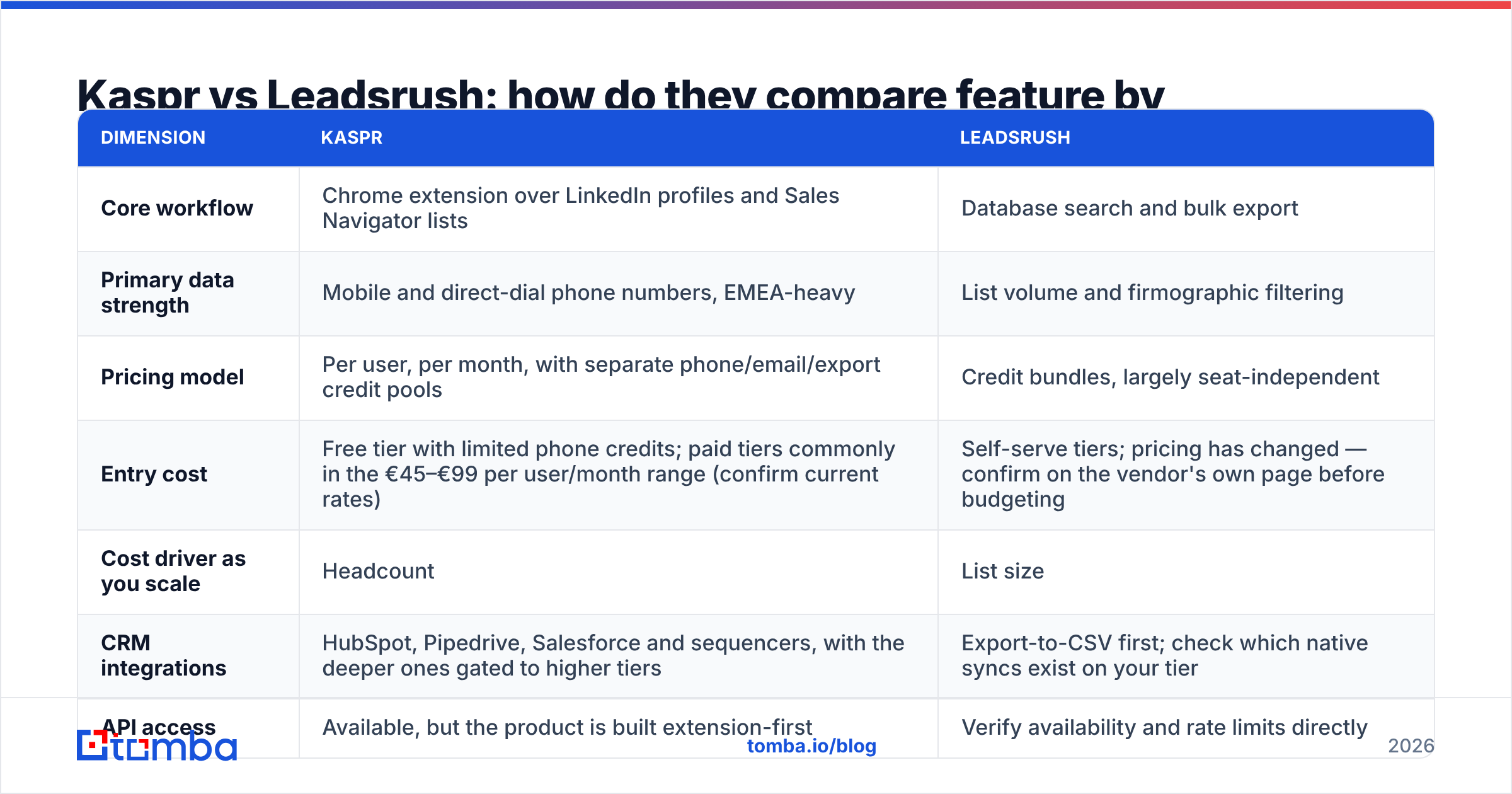
| Dimension | Kaspr | Leadsrush |
|---|---|---|
| Core workflow | Chrome extension over LinkedIn profiles and Sales Navigator lists | Database search and bulk export |
| Primary data strength | Mobile and direct-dial phone numbers, EMEA-heavy | List volume and firmographic filtering |
| Pricing model | Per user, per month, with separate phone/email/export credit pools | Credit bundles, largely seat-independent |
| Entry cost | Free tier with limited phone credits; paid tiers commonly in the €45–€99 per user/month range (confirm current rates) | Self-serve tiers; pricing has changed — confirm on the vendor's own page before budgeting |
| Cost driver as you scale | Headcount | List size |
| CRM integrations | HubSpot, Pipedrive, Salesforce and sequencers, with the deeper ones gated to higher tiers | Export-to-CSV first; check which native syncs exist on your tier |
| API access | Available, but the product is built extension-first | Verify availability and rate limits directly |
| Email verification | Included at a basic level | Verify what's included; assume you'll need a separate verifier |
| Ownership and stability | Backed by Cognism, an established vendor | Independent, smaller footprint, less public track record |
| Best for | AEs and SDRs who call, working accounts one at a time | Ops and growth teams building large lists for email sequences |
Two cells in that table deserve emphasis. First, Kaspr's credit pools are separate — burning through phone credits does not give you more email credits, and teams routinely discover this in week three. Second, the per-seat versus per-credit split is the real decision. A four-person SDR team that each opens 40 profiles a day is a natural Kaspr shape. A one-person growth team pulling 20,000 contacts a quarter is a natural credit-based shape, and paying per seat for that is economically absurd.
Which tool should your team actually pick?#
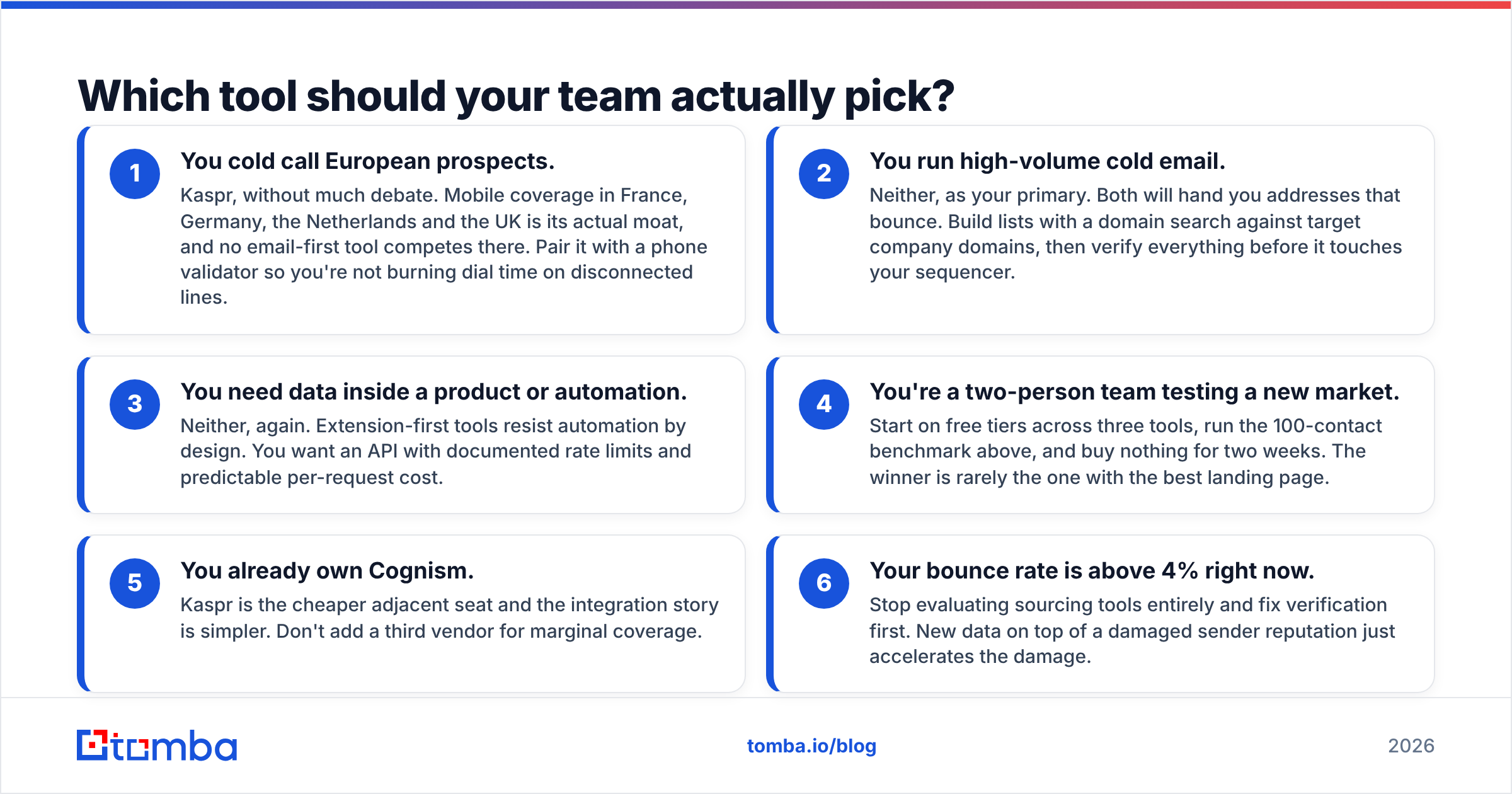
Match the tool to the motion, not to the feature list:
- You cold call European prospects. Kaspr, without much debate. Mobile coverage in France, Germany, the Netherlands and the UK is its actual moat, and no email-first tool competes there. Pair it with a phone validator so you're not burning dial time on disconnected lines.
- You run high-volume cold email. Neither, as your primary. Both will hand you addresses that bounce. Build lists with a domain search against target company domains, then verify everything before it touches your sequencer.
- You need data inside a product or automation. Neither, again. Extension-first tools resist automation by design. You want an API with documented rate limits and predictable per-request cost.
- You're a two-person team testing a new market. Start on free tiers across three tools, run the 100-contact benchmark above, and buy nothing for two weeks. The winner is rarely the one with the best landing page.
- You already own Cognism. Kaspr is the cheaper adjacent seat and the integration story is simpler. Don't add a third vendor for marginal coverage.
- Your bounce rate is above 4% right now. Stop evaluating sourcing tools entirely and fix verification first. New data on top of a damaged sender reputation just accelerates the damage.
What about compliance and LinkedIn risk?#
Two risks, and they're unevenly distributed.
GDPR exposure. Contribution-network data is collected from users' address books, which means the people in the database never gave the vendor consent directly. Vendors handle this with legitimate-interest arguments and notification emails in stricter jurisdictions. Kaspr is comparatively transparent about its EU posture — reasonable, given a European user base and European regulators. For any vendor, ask for the DPA, ask where data is processed, and ask what their opt-out flow looks like in practice. If you're selling into Germany or France, this is a procurement blocker, not a footnote.
Platform risk. Any tool that scrapes or automates against LinkedIn operates against the platform's User Agreement. Extensions that read profiles you manually open sit in a grayer, safer area than tools that automate bulk profile visits. Bulk-export tools are structurally more exposed. If your reps' LinkedIn accounts are business-critical, weigh that: an account restriction costs more than any subscription.
Independent reviews on G2 are useful here, but read the one- and two-star reviews specifically. Complaints about credit expiry, refund policy, and support responsiveness are the ones that predict your own experience.
Where do both tools leave a gap?#
The gap is programmatic, verified email at a cost that doesn't scale with headcount.
Kaspr is excellent when a human is looking at a profile and about to dial. It's a poor fit when a workflow needs 5,000 verified addresses at 2am with no human in the loop. Leadsrush handles volume, but volume without verification is how domains get blacklisted — a list of 20,000 unverified contacts is a liability, not an asset.
That's the space a dedicated finder-plus-verifier occupies. Tomba pricing runs a free tier at 25 searches a month, Starter at $49/mo, Growth at $99/mo, and Pro at $249/mo — flat, not per seat, so adding a fifth rep doesn't add a fifth invoice line. The same credits work across the finder, the verifier, bulk jobs, and the Tomba API, which matters when the request is coming from a script rather than a browser tab.
It is not a phone tool, and it's not trying to be. If dialing European mobiles is your core motion, Kaspr is the better instrument and you should buy it. The realistic stack for most outbound teams is two tools, not one: a phone-data tool for the callers, and an email finder plus verifier for everything that runs on autopilot.
Frequently asked questions#
Is Kaspr just a cheaper Cognism? Roughly, yes — same ownership, different buyer. Cognism targets enterprise revenue teams with intent data and larger contracts; Kaspr targets individual reps and small teams with a self-serve extension. Overlapping data assets, different packaging.
Does Leadsrush have a free trial? Check the vendor's current site — this has changed. Do not commit to an annual contract on any tool in this category without running your own sample against contacts you can independently verify.
Can I use both? Yes, and plenty of teams do: Kaspr for phone reveals on named accounts, a bulk tool for list building. Watch for credit waste — two overlapping subscriptions that each go 60% unused is a common and expensive outcome.
Which is better for cold email specifically? Neither is purpose-built for it. Whichever you pick, route every address through independent verification before it enters a sequencer.
Test the email side before you commit to either. The Tomba Email Finder gives you 25 free searches a month — enough to run the 100-contact benchmark described above against whatever Kaspr or Leadsrush returns and see the accuracy gap for yourself, with your own list, in about an hour. No seat minimums, no annual contract, and the same credits carry into bulk jobs and the API when you're ready to automate.
Related guides#
// get started
Find, verify and enrich your first contacts today
Start on the free plan with 25 searches a month, then scale when your team is ready.
Free plan · No credit card required · GDPR & CCPA
// about the author