Kaspr vs LeadzenAI (2026): Which Lead Data Tool Wins?
Kaspr and LeadzenAI both promise verified emails and direct dials from a LinkedIn profile, but they solve different problems at very different price points. Here is the honest breakdown, with the per-seat math nobody shows you.
TL;DR
- Kaspr is a LinkedIn-first Chrome extension owned by Cognism. Its strength is European direct dials pulled while you browse a profile. Its weakness is per-seat pricing and credit types that are metered separately.
- LeadzenAI is a broader lead-intelligence platform with search, bulk lookup, and a browser extension. It is priced aggressively (INR-denominated plans), with strongest coverage in India and APAC and thinner verified-phone depth in North America and Western Europe.
- They are not really competitors. Kaspr is a dialer-feeding tool for SDRs working LinkedIn one profile at a time. LeadzenAI is a list-building and enrichment tool for teams that need volume on a budget.
- Pricing structure matters more than list price. Kaspr bills per seat with separate email/phone/export credit buckets. LeadzenAI bills per credit pool. Five SDRs on Kaspr costs roughly 5x; five users on a shared LeadzenAI pool does not.
- If your bottleneck is verified email at scale via API, neither is the natural fit. A dedicated email finder like Tomba starts at $49/mo with a real API and pooled credits instead of per-seat billing.
What are Kaspr and LeadzenAI, exactly?#
Both tools answer the same surface-level question — "what is this person's email and phone number?" — but they were built by different teams for different buyers, and it shows the moment you look past the landing page.
Kaspr launched as a Chrome extension that overlays contact data on LinkedIn profiles, LinkedIn Sales Navigator lists, and group member pages. Cognism acquired it in 2022 and positions it as the self-serve, bottom-of-the-funnel entry point into the Cognism data ecosystem. The workflow is deliberately narrow: open a profile, click the extension, get a mobile number and a business email, push it to your CRM or a Kaspr sequence.
LeadzenAI comes from the other direction. It is a lead-intelligence suite built around a searchable contact database, with real-time search, bulk search by CSV, a browser extension, and enrichment on top. It markets to sales, recruiting, and marketing teams who want to build lists first and then reach out, rather than enrich one profile at a time.
| Dimension | Kaspr | LeadzenAI |
|---|---|---|
| Primary job | Direct dials + emails from a LinkedIn profile | Build and enrich lead lists at volume |
| Core surface | Chrome extension on LinkedIn | Web app search + bulk upload + extension |
| Strongest geography | Europe (especially FR/UK/DACH) | India and APAC, growing elsewhere |
| Billing model | Per user/seat, split credit types | Credit pools by plan |
| Typical buyer | SDR team already living in Sales Navigator | Founder, agency, or lean growth team |
| Data philosophy | Curated + community-contributed | Aggregated web + public sources |
That table is the whole comparison in miniature. If you never leave LinkedIn and your job is to dial people today, Kaspr's shape fits your day. If your job is to produce 3,000 qualified contacts by Friday, LeadzenAI's shape fits better.
How accurate is the data in each tool?#
Accuracy claims in this category are close to meaningless when stated as a single number. Every vendor quotes a headline percentage — 95%, 98%, "verified" — and every one of those numbers is measured on a sample the vendor chose. What actually determines your bounce rate is the intersection of three things: the geography you sell into, the seniority you target, and the company size.
Here is what holds up in practice across this tool class:
- Coverage decays with company size. Both tools do well on 200+ employee companies with public web footprints. Below 20 employees, hit rates on both fall sharply, and LeadzenAI's aggregated approach tends to return more pattern-guessed addresses that were never SMTP-tested.
- Phone data is a different product from email data. Kaspr's mobile-number coverage in Europe is genuinely strong — that is the reason to buy it. LeadzenAI returns phone numbers too, but a much higher share are company switchboards rather than direct dials.
- "Verified" means at least three different things. Syntax-valid, MX-record-valid, and SMTP-accepted are wildly different bars. Ask which one the vendor means before you trust a percentage.
- Catch-all domains break everyone's score. Roughly one in five B2B domains accepts all mail. Neither tool resolves catch-alls with confidence; you need a dedicated catch-all verifier layer or you will treat unknowns as valid.
- Refresh cadence beats raw size. A 200M-record database refreshed annually is worse than a 60M-record one refreshed monthly. Neither vendor publishes a refresh SLA — treat that as a question for your sales call.

The practical move: run the same 100-contact sample through both trials, then push the output through an independent email verifier that you do not buy from either vendor. Self-graded exams are not evidence. A 100-row test costs you an hour and will tell you more than every G2 review combined.

Kaspr vs LeadzenAI: the full comparison table#
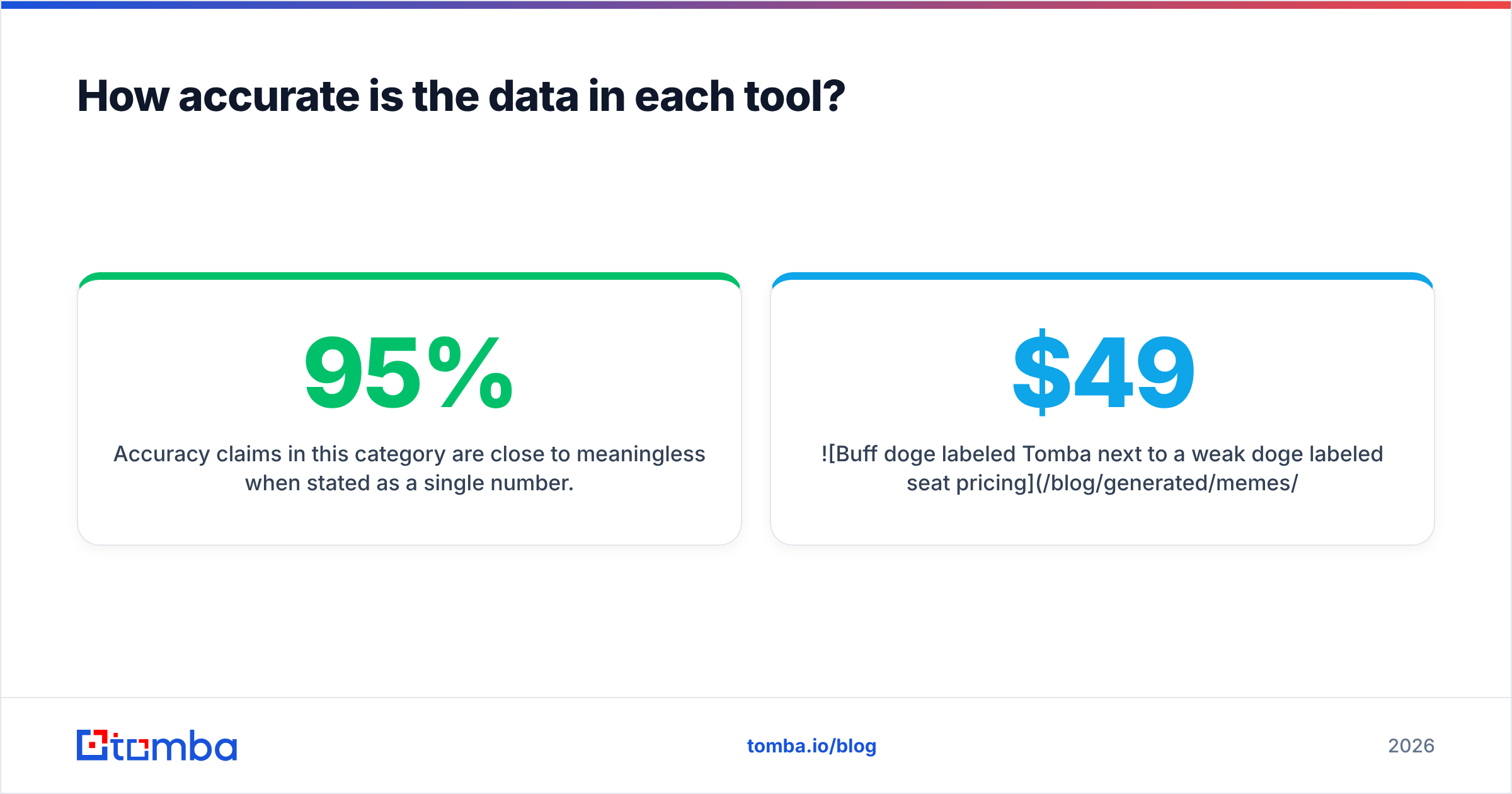
Prices below reflect publicly listed plans at the time of writing and are rounded; both vendors change tiers often and LeadzenAI publishes in INR, so the dollar figures move with the exchange rate. Always confirm on the vendor page before you sign.
| Feature | Kaspr | LeadzenAI | Tomba |
|---|---|---|---|
| Free tier | Yes — limited credits, LinkedIn only | Yes — trial credits | Yes — 25 searches/mo |
| Entry paid plan | ~$49–65 per user/mo | ~$20–40 per user/mo (INR-based) | $49/mo (Starter) |
| Billing unit | Per seat + split credit types | Credit pool per plan | Pooled credits, not per seat |
| Mobile/direct dials | Core strength, strong in Europe | Available, more switchboards | Phone finder add-on |
| Bulk CSV enrichment | Limited on lower tiers | Yes, core feature | Yes, bulk email finder |
| Domain-wide search | No | Partial | Yes, domain search |
| Public API | Limited / higher tiers | Yes | Yes, documented email finder API |
| Email verification included | Basic | Basic | Dedicated verifier + catch-all |
| LinkedIn workflow | Best-in-class extension | Extension available | LinkedIn finder |
| GDPR posture | Explicit EU notification process | Less documented | Documented data sources |
| Best for | EU SDRs dialing from Sales Navigator | Budget list building, APAC focus | Verified email at scale via API |

Two rows in that table do most of the decision work. The billing unit row explains why Kaspr's quote balloons on a five-person team and LeadzenAI's does not. The public API row explains why neither tool is a good spine for an automated enrichment pipeline — you will end up bolting a proper API on top anyway.
Which tool wins for LinkedIn prospecting?#
Kaspr, clearly, and it is not close.
The extension is the product. It renders inside LinkedIn, Sales Navigator, and Recruiter, surfaces mobile numbers without a page reload, and lets you push a contact into a sequence or CRM in one click. For an SDR whose day is "open 60 profiles, dial 40 of them," that friction difference compounds into real hours. Kaspr also handles LinkedIn list pages — you can work a Sales Navigator search or an event attendee list without opening each profile individually, which is where most extension competitors fall down.
LeadzenAI has an extension, and it works, but it was clearly built as a companion to the web app rather than as the main event. If your motion starts in a search UI and ends in a CSV, that is fine. If your motion starts and ends on linkedin.com, you will feel the difference within a week.
One honest caveat on both: LinkedIn actively fights automated extraction. Aggressive extension usage risks account restrictions regardless of vendor. Keep volume human-plausible, and never run an extension on the account that holds your network.
Which tool wins for volume list building?#
LeadzenAI, for cost reasons more than capability reasons.
Its bulk search accepts a CSV of names and companies and returns enriched rows without per-seat licensing for every person who touches the file. On a lean team — a founder, one marketer, two contractors — that model is dramatically cheaper than buying four Kaspr seats. LeadzenAI also exposes an API on paid plans, so you can wire it into a workflow instead of living in the UI.
The tradeoff is data depth outside its home markets. If your ICP is US mid-market SaaS, expect a meaningful share of returned emails to be pattern inferences rather than observed addresses. Run everything through verification before it touches a sending domain, or your sender reputation will absorb the cost of that shortcut.
Kaspr can do bulk enrichment, but it is gated and metered in a way that makes high-volume list building expensive. That is a deliberate product decision, not a bug — Cognism sells the volume motion under its own brand, and Kaspr is the self-serve on-ramp.
What does each one actually cost at team scale?#
Run the math on a five-person SDR team doing 1,000 lookups per rep per month.
Kaspr: five seats, each needing its own subscription, with email credits, phone credits, and export credits metered separately. Teams routinely find that the phone-credit bucket empties first and forces an upgrade that doubles the effective price of the plan they thought they bought. Budget for the tier above the one the pricing page makes you want.
LeadzenAI: one plan, a shared credit pool, more users at marginal cost. Total spend for the same volume typically lands well under the Kaspr equivalent. The catch: you will spend some of that saving on verification and on the deals you lose to wrong numbers in markets where coverage is thin.
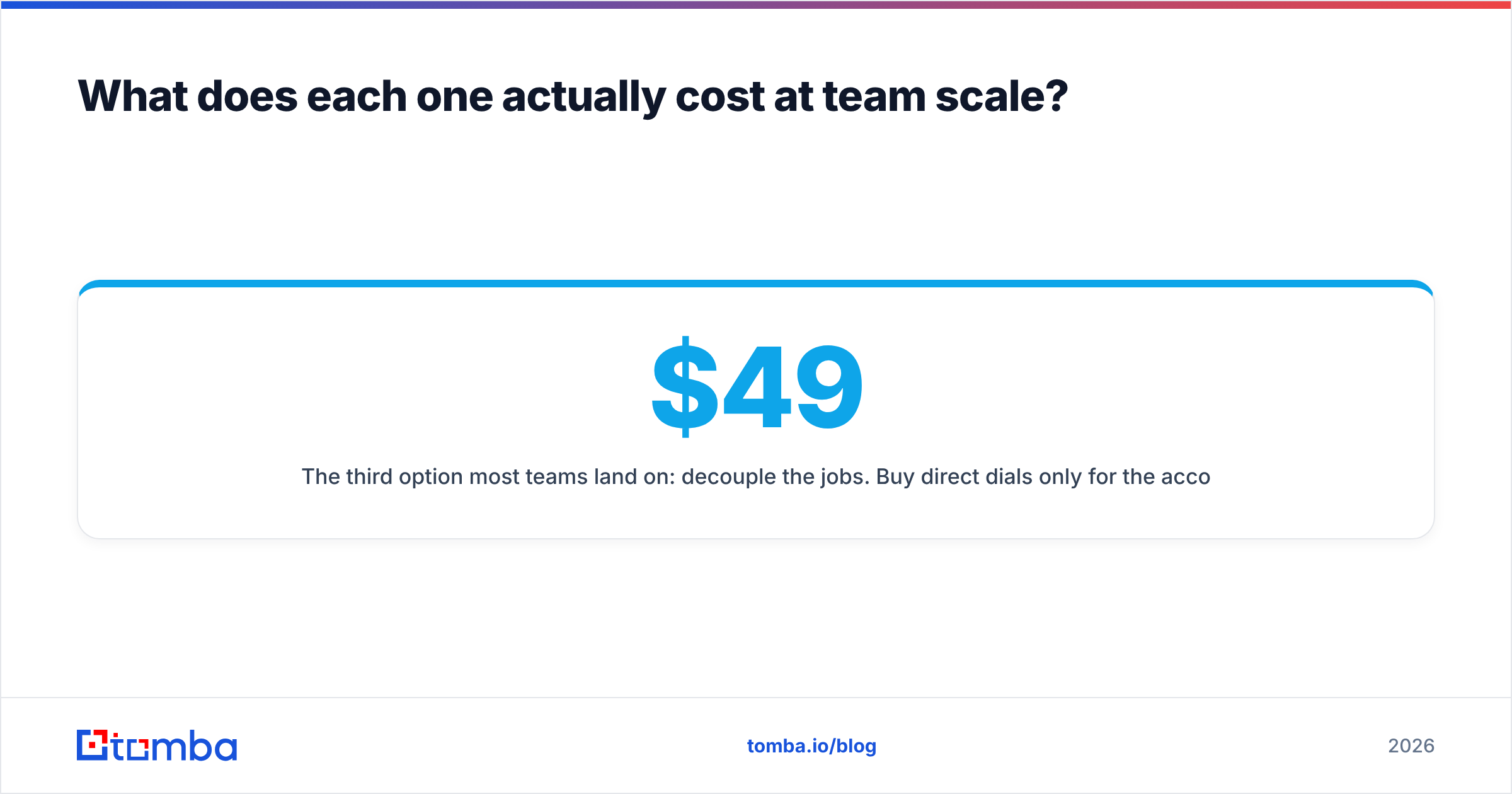
The third option most teams land on: decouple the jobs. Buy direct dials only for the accounts where a phone call is the actual channel, and handle email discovery through a pooled-credit tool with an API. Tomba pricing runs $49/mo Starter, $99/mo Growth, and $249/mo Pro with credits shared across the whole workspace rather than fenced per seat, plus a free tier at 25 searches/month to test the data before you commit. Splitting the two jobs is usually cheaper than buying one tool that does both adequately.

Where does each tool fall short?#
Kaspr's weak points:
- Per-seat economics. Every rep is a line item. Growth is linear in cost with no volume relief.
- Credit fragmentation. Separate buckets for emails, phones, and exports make forecasting spend genuinely hard.
- US coverage is the weaker half. European dials are the product's reason to exist; North American depth trails.
- API access is not the headline feature. If you want programmatic enrichment as the primary interface, you are fighting the product's design.
LeadzenAI's weak points:
- Geographic concentration. Excellent where its sources are dense, noticeably thinner in Western Europe and parts of North America.
- Verification depth. Returned addresses need independent checking more often than you would like.
- Direct-dial quality. Phone numbers skew toward main lines rather than mobiles.
- Less documented compliance posture. If you sell into the EU and your legal team asks pointed GDPR questions, you will need answers the docs do not currently give you.
Neither list disqualifies either tool. They just tell you which one you will be apologizing for in six months.
So which should you choose?#
Pick by the shape of your motion, not the feature grid.
Choose Kaspr if your reps live in Sales Navigator, phone is a real channel for you, you sell primarily into Europe, and your team is small enough that per-seat pricing stays tolerable. The extension quality is worth paying for when dialing is the job.
Choose LeadzenAI if you are cost-sensitive, building lists in bulk, selling into India or APAC, and you already have a verification step in your pipeline. The credit-pool model is the right shape for a lean team.
Choose neither, or add a third layer, if your real bottleneck is verified business email at scale, delivered through an API into your own systems. That is a different product category, and buying a LinkedIn extension to solve it is how teams end up with three subscriptions and one working workflow. Cross-check any shortlist against independent review volume on G2 before you sign anything longer than monthly.
The test that settles it: take 100 real contacts from your actual ICP — not a demo list — and run them through both trials plus one independent verifier. Measure valid-rate, direct-dial rate, and cost per usable contact. Whichever tool wins on cost per usable contact wins the deal, regardless of what the pricing page implies.
Ready to fix the email half of the problem?#
If the real gap in your stack is finding and verifying business email addresses — reliably, in bulk, through an API you can automate against — start with the Tomba Email Finder. Free tier gives you 25 searches a month to test the data against your own ICP, Starter runs $49/mo with pooled credits your whole team shares, and every result can be pushed through the built-in verifier and catch-all checks before it reaches your sending domain. Test it on the same 100-contact sample you use for Kaspr and LeadzenAI, and let the valid-rate decide.
Related guides#
Ready to find emails that actually work?
Join 150,000+ professionals who stopped guessing and started sending. Free credits on signup — no credit card required.
Get the Tomba newsletter
Practical outbound tactics and product updates — once every two weeks.
About the author