Kaspr vs Lusha in 2026: Which B2B Contact Data Tool Wins
Kaspr and Lusha both sell LinkedIn-sourced phone numbers and emails, but they charge, limit, and verify very differently. Here is the honest breakdown of credits, accuracy, GDPR exposure, and who each one actually fits.
TL;DR
- Kaspr is the cheaper LinkedIn-first phone tool. It lives almost entirely in a Chrome extension pointed at LinkedIn profiles and Sales Navigator lists, and it is owned by Cognism — which means it inherits Cognism's European phone data pipeline.
- Lusha is the broader platform. Prospecting database, intent signals, CRM enrichment, API, and a larger US-heavy contact pool. You pay for that breadth in per-seat pricing.
- Both bill per seat and per credit. That is the single biggest cost trap in this comparison: a five-person SDR team pays five times, and unused credits usually do not roll over the way you expect.
- Neither is a great fit for pure email volume. If your workflow is "give me every verified email at 400 target domains," a dedicated email finder with domain search and bulk processing will cost a fraction of either.
- Pick Kaspr for European mobile numbers on a small team. Pick Lusha for US-heavy multi-team prospecting with CRM sync. Pick neither if email is your primary channel.
What are Kaspr and Lusha, exactly?#
Both tools answer the same question — "what is this person's email and phone number?" — but they were built from opposite ends.
Kaspr started as a LinkedIn Chrome extension. You open a profile, click the widget, and it returns emails and mobile numbers. It was acquired by Cognism in 2022 and now sits as the lightweight, self-serve tier underneath Cognism's enterprise product. Its centre of gravity is still the browser: LinkedIn profiles, Sales Navigator searches, LinkedIn group members, and event attendee lists.
Lusha also began as an extension, but has spent the last several years turning itself into a platform. Today it ships a prospecting database you can filter without touching LinkedIn, buying-intent signals, job-change alerts, CRM enrichment for Salesforce and HubSpot, bulk enrichment, and a documented API. The extension is now one surface among several.
That difference explains almost every other difference. Kaspr optimises for the single-record reveal. Lusha optimises for list building and systems of record.

How do Kaspr and Lusha compare head-to-head?#
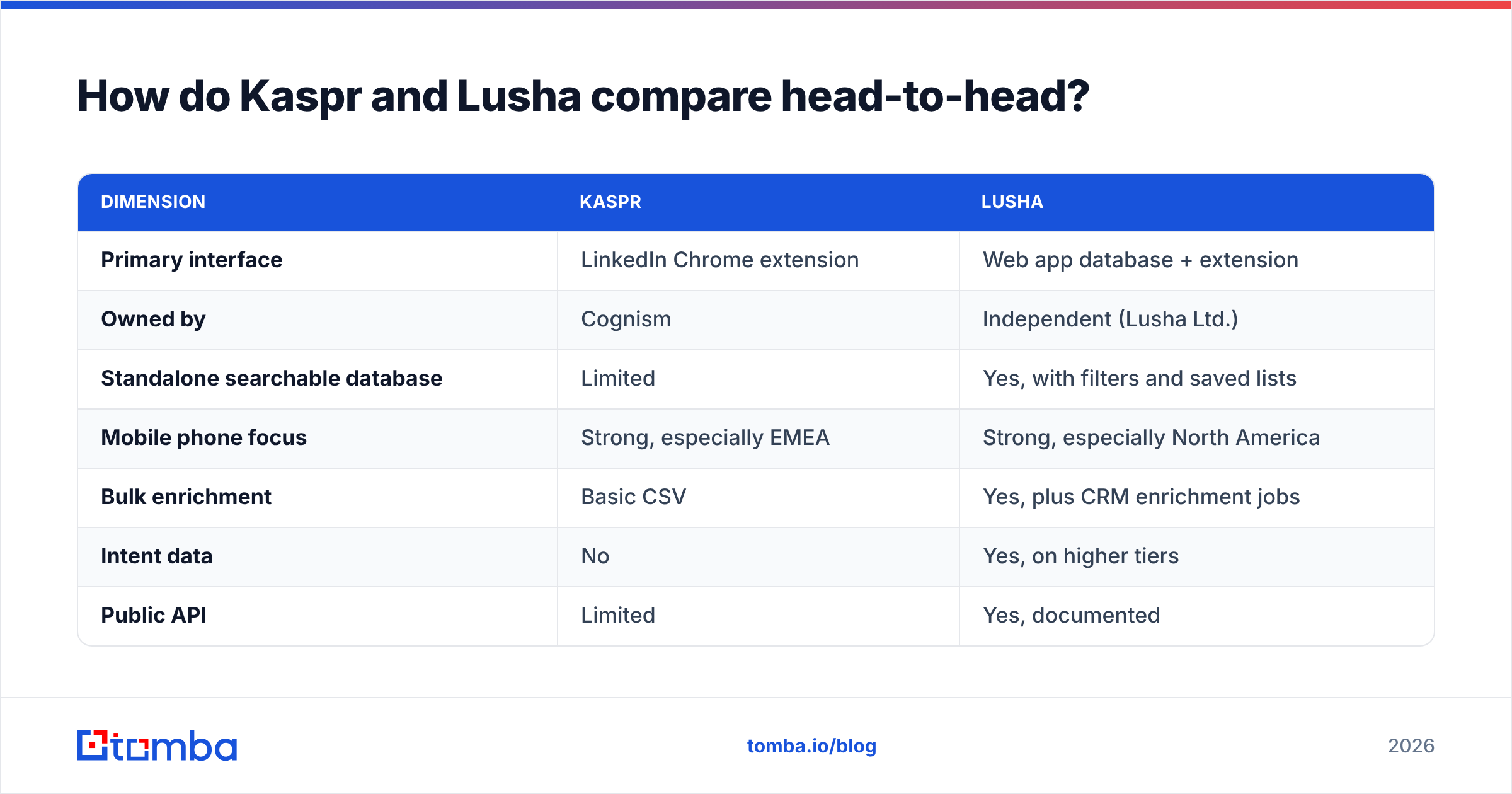
Here is the structural comparison before we get into data quality and price.
| Dimension | Kaspr | Lusha |
|---|---|---|
| Primary interface | LinkedIn Chrome extension | Web app database + extension |
| Owned by | Cognism | Independent (Lusha Ltd.) |
| Standalone searchable database | Limited | Yes, with filters and saved lists |
| Mobile phone focus | Strong, especially EMEA | Strong, especially North America |
| Bulk enrichment | Basic CSV | Yes, plus CRM enrichment jobs |
| Intent data | No | Yes, on higher tiers |
| Public API | Limited | Yes, documented |
| Native CRM sync | HubSpot, Pipedrive, Salesforce, Lemlist | Salesforce, HubSpot, Pipedrive, Outreach, Salesloft |
| Free plan | Yes, small monthly credit grant | Yes, small monthly credit grant |
| Billing model | Per user, per month | Per user, per month |
| Best-fit team size | 1-10 reps | 5-100+ reps |
The honest summary: Kaspr is a tool, Lusha is a platform. If your entire motion is "SDR opens Sales Navigator, reveals contact, dials," Kaspr does that job with less software to learn. If you need RevOps to enrich 12,000 CRM records overnight and route them by intent score, Kaspr will run out of road quickly.
Whose data is actually more accurate?#
Accuracy claims from contact-data vendors are marketing until you test them on your own ICP. Both companies publish high numbers. Kaspr cites strong mobile coverage across Europe. Lusha publishes accuracy figures in the high-80s to mid-90s depending on the field and region. Neither number will hold on a niche vertical in a market they under-index.
What is reliably true after testing tools in this category:
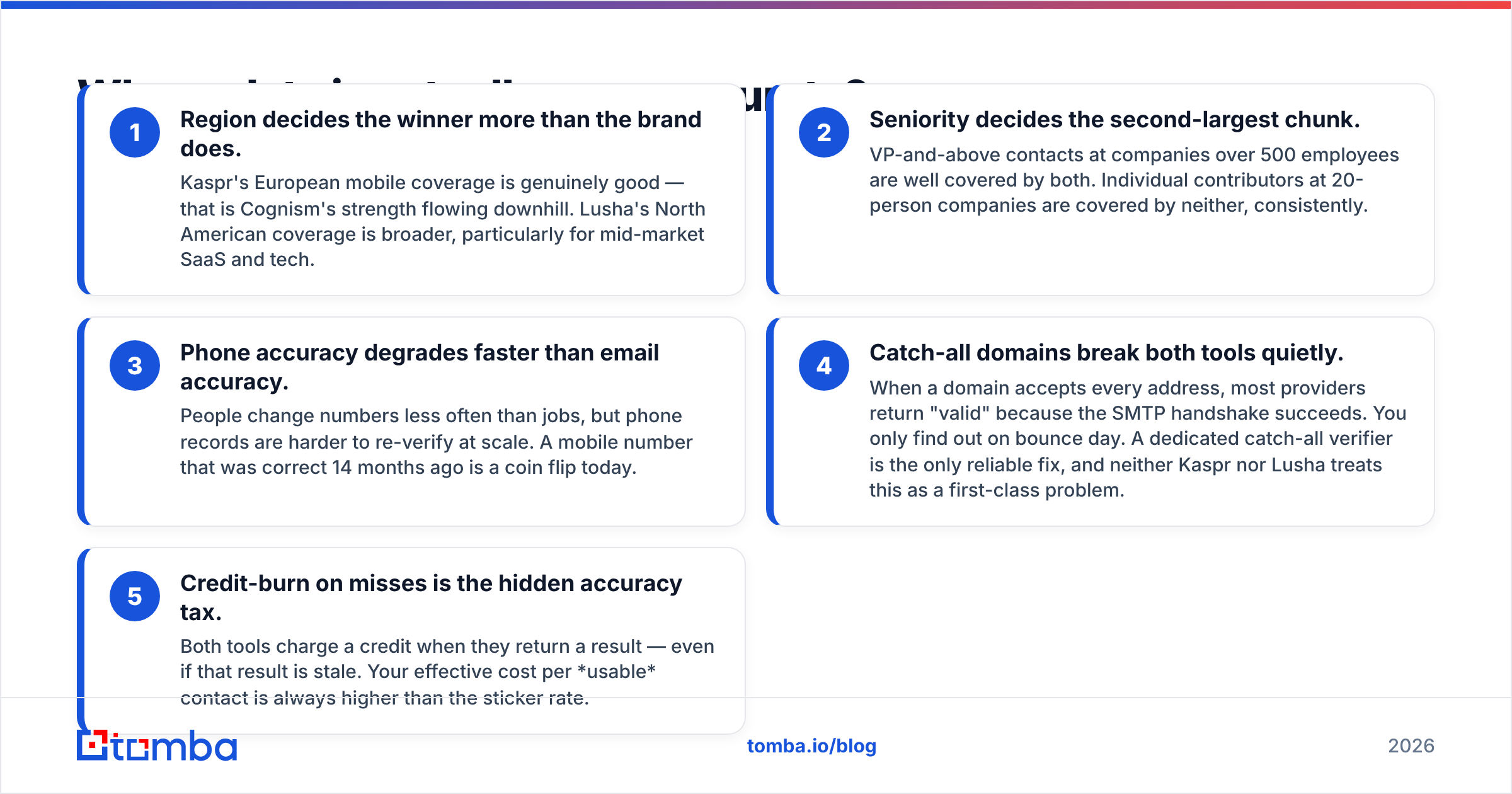
- Region decides the winner more than the brand does. Kaspr's European mobile coverage is genuinely good — that is Cognism's strength flowing downhill. Lusha's North American coverage is broader, particularly for mid-market SaaS and tech.
- Seniority decides the second-largest chunk. VP-and-above contacts at companies over 500 employees are well covered by both. Individual contributors at 20-person companies are covered by neither, consistently.
- Phone accuracy degrades faster than email accuracy. People change numbers less often than jobs, but phone records are harder to re-verify at scale. A mobile number that was correct 14 months ago is a coin flip today.
- Catch-all domains break both tools quietly. When a domain accepts every address, most providers return "valid" because the SMTP handshake succeeds. You only find out on bounce day. A dedicated catch-all verifier is the only reliable fix, and neither Kaspr nor Lusha treats this as a first-class problem.
- Credit-burn on misses is the hidden accuracy tax. Both tools charge a credit when they return a result — even if that result is stale. Your effective cost per usable contact is always higher than the sticker rate.

The practical move is to run the same 100-contact sample through both free tiers, dial and email the results, and measure two numbers: percentage returned and percentage that actually connected. Vendors will quote you the first. Only the second pays your salary.
How does pricing really work for each?#
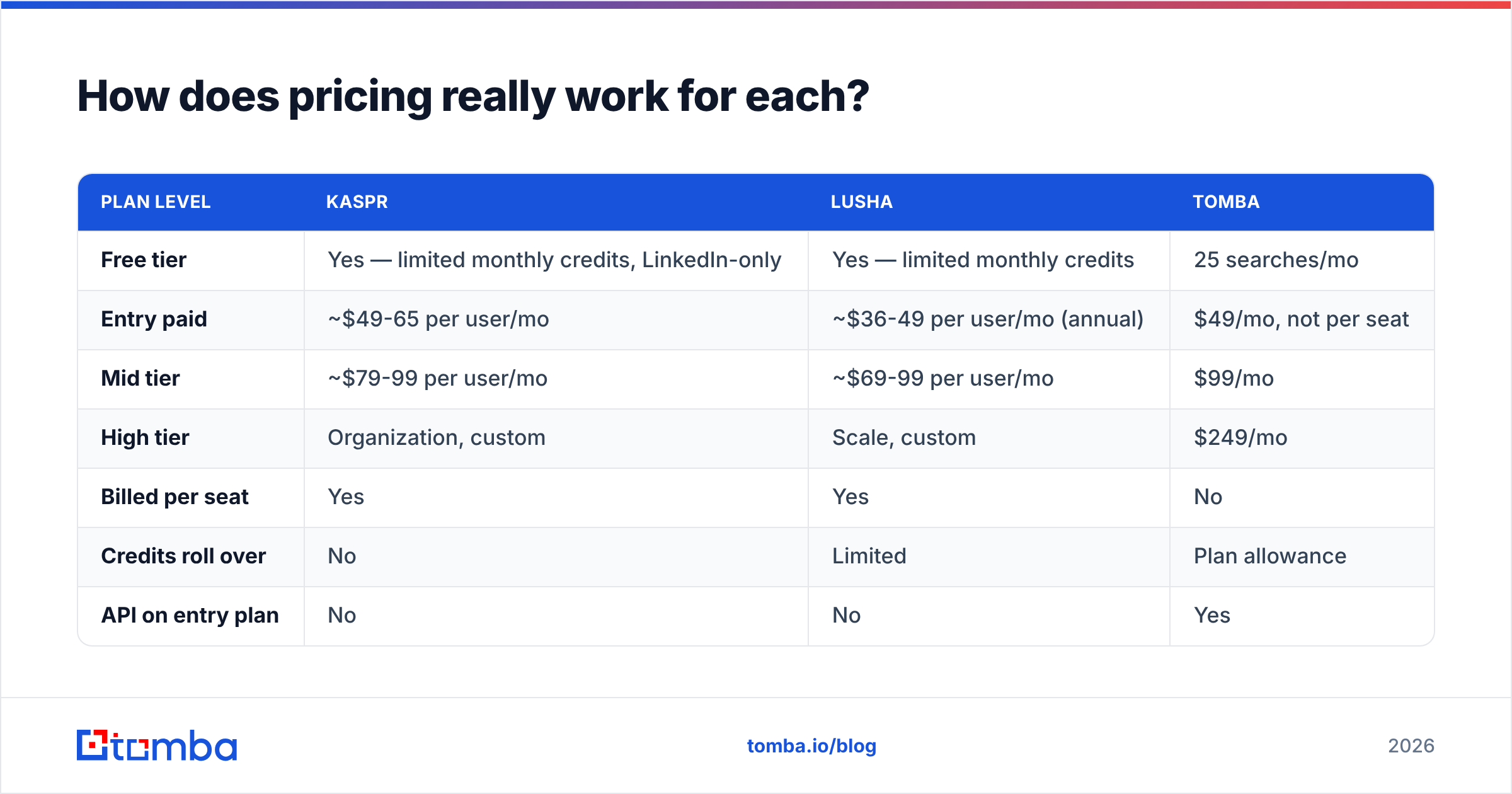
Both companies price per user per month, with a credit allowance attached to each seat. Published list prices shift, so treat the table below as the shape of the pricing rather than a quote — check each vendor's page before you sign.
| Plan level | Kaspr | Lusha | Tomba |
|---|---|---|---|
| Free tier | Yes — limited monthly credits, LinkedIn-only | Yes — limited monthly credits | 25 searches/mo |
| Entry paid | ~$49-65 per user/mo | ~$36-49 per user/mo (annual) | $49/mo, not per seat |
| Mid tier | ~$79-99 per user/mo | ~$69-99 per user/mo | $99/mo |
| High tier | Organization, custom | Scale, custom | $249/mo |
| Billed per seat | Yes | Yes | No |
| Credits roll over | No | Limited | Plan allowance |
| API on entry plan | No | No | Yes |
| Phone numbers included | Yes | Yes, separate credit pool | Add-on via phone finder |
Three things matter more than the headline number.
Per-seat billing compounds. A six-person SDR team on a $79 seat is $474/month, and every new hire is another $79 — even if that rep only reveals 40 contacts a month. Tools that price by volume instead of by seat get dramatically cheaper as the team grows. That is the structural argument, not a brand argument.
Phone credits and email credits are often separate pools. Lusha in particular splits these. Burning your phone credits in week two while email credits sit unused is the most common billing surprise teams report.
API access is gated. If you want to enrich programmatically — a signup form, a lead-routing job, a nightly CRM sweep — you are usually pushed to a higher tier. Compare that against Tomba pricing, where the email finder API is available from the entry plan, because the product was built API-first rather than extension-first.

Is Kaspr better than Lusha for LinkedIn prospecting?#
For the narrow job of "I am on a LinkedIn profile right now and I want a mobile number," Kaspr is the smoother experience. Fewer clicks, less UI, and it handles Sales Navigator lists, LinkedIn groups, and event attendee lists without making you leave the page.
Lusha wins the moment your workflow stops being one profile at a time. Its database lets you build a list without LinkedIn at all — useful because LinkedIn actively rate-limits and occasionally restricts accounts running heavy extraction. Sourcing contacts through a database instead of a scraped profile view removes a real account-suspension risk from your process.
There is a third path most teams miss: skip the LinkedIn dependency entirely for the email half of the job. If you know the company, domain search returns the email pattern and the known addresses at that domain in one call, no browser extension and no LinkedIn session required. Use LinkedIn-based tools for the phone number, and a domain-based tool for the email. The stack costs less and breaks less.

What about GDPR and compliance risk?#
This is where the two diverge in a way that matters to legal, not just to sales.
Kaspr is French, operates under GDPR by default, and Cognism has invested heavily in notified-contact processes — screening against do-not-call registries across European markets. If your outbound targets EU prospects and your legal team asks hard questions, that lineage is an asset.
Lusha is compliance-certified as well (ISO 27001, SOC 2, CCPA and GDPR programs), but its data centre of gravity is North America, where the regulatory bar for B2B contact data is lower. Teams calling EU mobiles from a US-centric dataset carry more exposure, regardless of the vendor's certificate wall.
Neither vendor removes your obligation. You still need a lawful basis, a documented legitimate-interest assessment if you are relying on one, and a working opt-out. See the European Commission's GDPR guidance rather than a vendor's compliance page for what your own process needs to cover.
Which tool should you actually pick?#
Match the tool to the motion, not to the feature list.
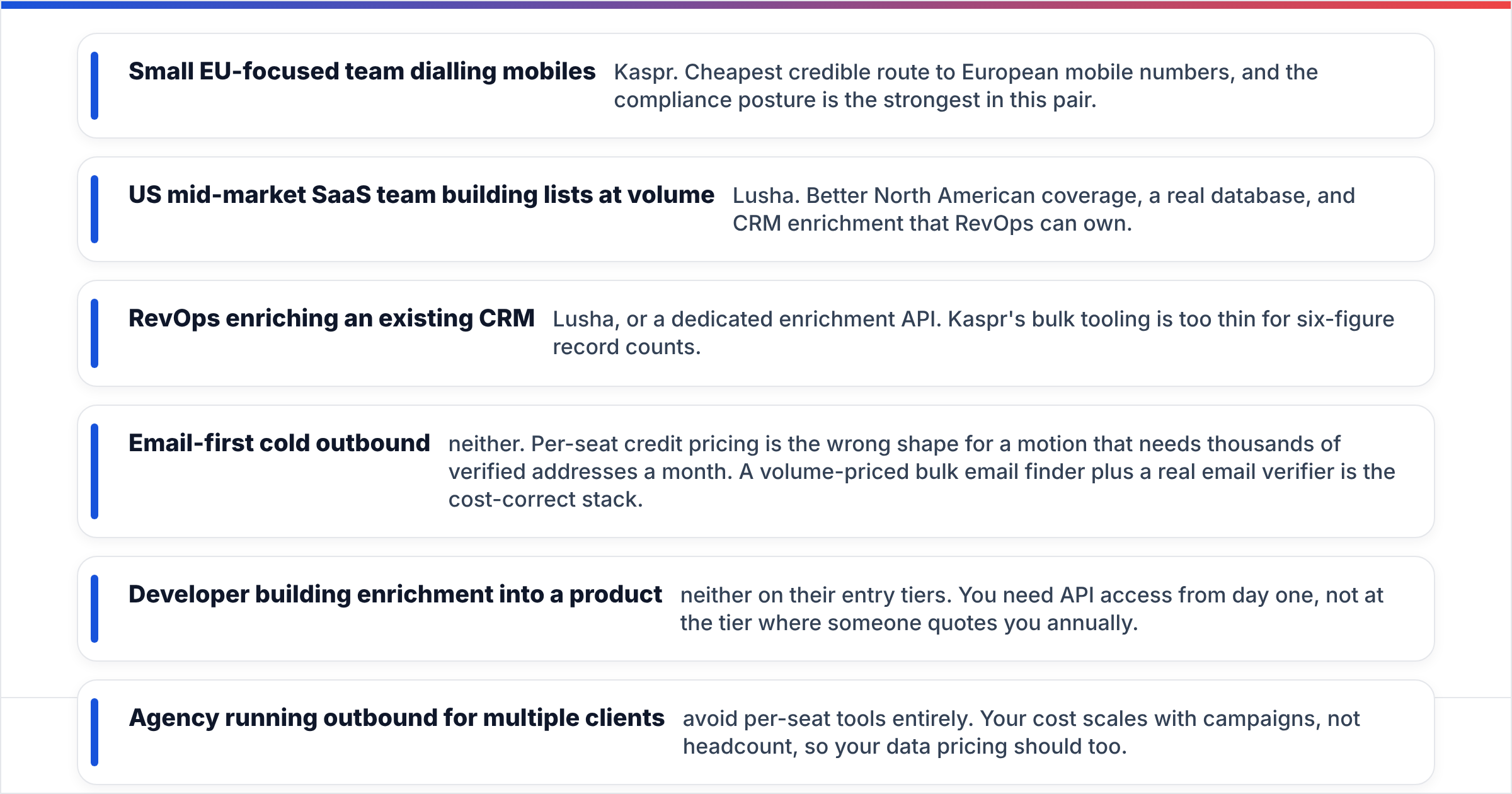
- Small EU-focused team dialling mobiles — Kaspr. Cheapest credible route to European mobile numbers, and the compliance posture is the strongest in this pair.
- US mid-market SaaS team building lists at volume — Lusha. Better North American coverage, a real database, and CRM enrichment that RevOps can own.
- RevOps enriching an existing CRM — Lusha, or a dedicated enrichment API. Kaspr's bulk tooling is too thin for six-figure record counts.
- Email-first cold outbound — neither. Per-seat credit pricing is the wrong shape for a motion that needs thousands of verified addresses a month. A volume-priced bulk email finder plus a real email verifier is the cost-correct stack.
- Developer building enrichment into a product — neither on their entry tiers. You need API access from day one, not at the tier where someone quotes you annually.
- Agency running outbound for multiple clients — avoid per-seat tools entirely. Your cost scales with campaigns, not headcount, so your data pricing should too.
Worth noting: this is a crowded category, and Kaspr and Lusha are not the only two names on the shortlist. Teams evaluating this pair usually also look at Cognism (the parent), ZoomInfo, Apollo, RocketReach, and BookYourData — the last of which takes a very different approach, selling verified lists outright rather than metering credits per seat, which suits teams that want a one-time dataset instead of an ongoing subscription. Cross-check current user sentiment on G2 before committing; both products ship changes faster than review roundups get updated.
Where do Kaspr and Lusha both fall short?#
Three gaps show up in nearly every evaluation.
Verification is assumed, not proven. Both return contacts marked valid. Neither gives you a confidence score you can act on per-record, and neither handles catch-all domains honestly. Running your export through independent email verification before it touches a sequence is not paranoia — it is the difference between a 1% bounce rate and a burned sending domain.
Cost per usable contact is opaque. Credits consumed ≠ contacts reached. Track your own ratio for 30 days and you will usually find the real cost is 1.5-3x the sticker price.
Email volume is priced like a premium feature. Both tools treat email as a secondary output of a phone-first product. If email is your primary channel, you are paying phone-data prices for email-data needs.
That last gap is the practical reason to run a split stack: a phone-first tool for dialling, and a purpose-built email tool for everything sent. It is almost always cheaper than forcing one vendor to do both badly.
What is the verdict on Kaspr vs Lusha?#
Kaspr wins on price and European mobile data. Lusha wins on breadth, database access, and CRM depth. If you are a five-rep team in Europe running a call-first motion, Kaspr is the better-value choice and the compliance story is cleaner. If you are a growing North American org that needs list building, intent, enrichment, and an API in one place, Lusha is the more complete platform and is worth the per-seat premium.
If, on reading both columns, you noticed that your actual bottleneck is verified email addresses at scale rather than mobile numbers — that is the most common outcome of this comparison, and neither tool is built for it.
Testing the email side before you commit to a seat-based contract? Start with the Tomba Email Finder. The free tier gives you 25 searches a month with no card, plans start at $49/mo billed by volume rather than per seat, and API access is included from the first paid tier — so you can benchmark it against whatever Kaspr or Lusha return on the same 100 contacts and let the connect rate settle the argument.
Related guides#
// get started
Find, verify and enrich your first contacts today
Start on the free plan with 25 searches a month, then scale when your team is ready.
Free plan · No credit card required · GDPR & CCPA
// about the author