Kaspr vs Market Location: Which B2B Data Tool Wins in 2026
Kaspr sells LinkedIn-sourced mobiles and emails by the credit. Market Location sells licensed UK business files by the record. They solve different problems — here is which one actually fits your outbound motion, and what each really costs.
TL;DR
- Kaspr is a LinkedIn-first contact tool. A Chrome extension shows mobile numbers and emails on profiles. You pay per credit, per seat. Cognism owns it, and the data leans European.
- Market Location is a UK B2B data house. It sells licensed, phone-researched business files by the record or by annual licence. It is built for direct mail, telemarketing and list campaigns.
- In a Kaspr vs Market Location test, the two are not really rivals. One arms a rep clicking through LinkedIn. The other feeds a campaign that needs 20,000 UK SIC-coded records at once.
- Pricing splits hard. Kaspr posts per-seat plans. Market Location quotes per project. Budget certainty is the hidden difference.
- If you already know the company and just need the work email, a finder API with per-record checks usually wins on cost per usable contact.
Most Kaspr vs Market Location searches start the same way. A team has burned a quarter on bad data. Now they want to know if the fix is a browser extension or a bought file. That framing is wrong. Ask what your pipeline looks like instead. Are you enriching a list you already have? Or buying a list you do not have yet? Answer that, and the Kaspr vs Market Location choice mostly makes itself.
What is Kaspr and who is it actually for?#
Kaspr is a contact-data extension. You install it in Chrome. Open a LinkedIn profile, a Sales Navigator search or a LinkedIn group, and it shows phone numbers and emails for the people on screen. You can save those contacts to a Kaspr list, add them to a sequence, or send them to HubSpot, Pipedrive, Salesforce or Lemlist.
Cognism bought the company in 2022. Kaspr is now the self-serve, SMB layer of that stack. That matters in two ways. First, it picks up some of Cognism's European stance on data. Kaspr markets GDPR and CCPA alignment, and it tells contacts when their data is processed. Second, it sits below Cognism on price and depth by design. Need company filters, intent signals or big exports? Kaspr will push you upmarket.
Who it fits:
- SDRs who live inside LinkedIn. If your day starts with a Sales Navigator search, Kaspr cuts out the copy-paste step.
- Teams that need mobiles, not just emails. Phone coverage is its strongest claim, above all in France, the UK, Germany and the Benelux.
- Small teams with no data ops. There is no schema to design and no file to load. Install, click, reveal.
- European outbound. Coverage thins outside EMEA. Reviewers on G2 keep flagging North American and APAC gaps.
Where it strains: bulk work. Each reveal burns a credit, per seat. Plans with real export limits sit at the higher tiers. Ten reps burning credits on the same account list is a common and costly failure.
What is Market Location and who is it actually for?#
Market Location is a very different animal. It is a UK business data provider with roots in the late 1980s. The core asset is a researched database of UK companies and decision-makers. The output is a file, not a browser overlay. You pick a selection — SIC code, staff band, turnover, region, job function. You get a count and a quote. Then you licence the records for one use: direct mail, telemarketing, email or CRM append.
They also sell the services that wrap around a list business. That means data cleaning, TPS and CTPS suppression, dedupe, and adding missing company details to your own file.
Who it fits:
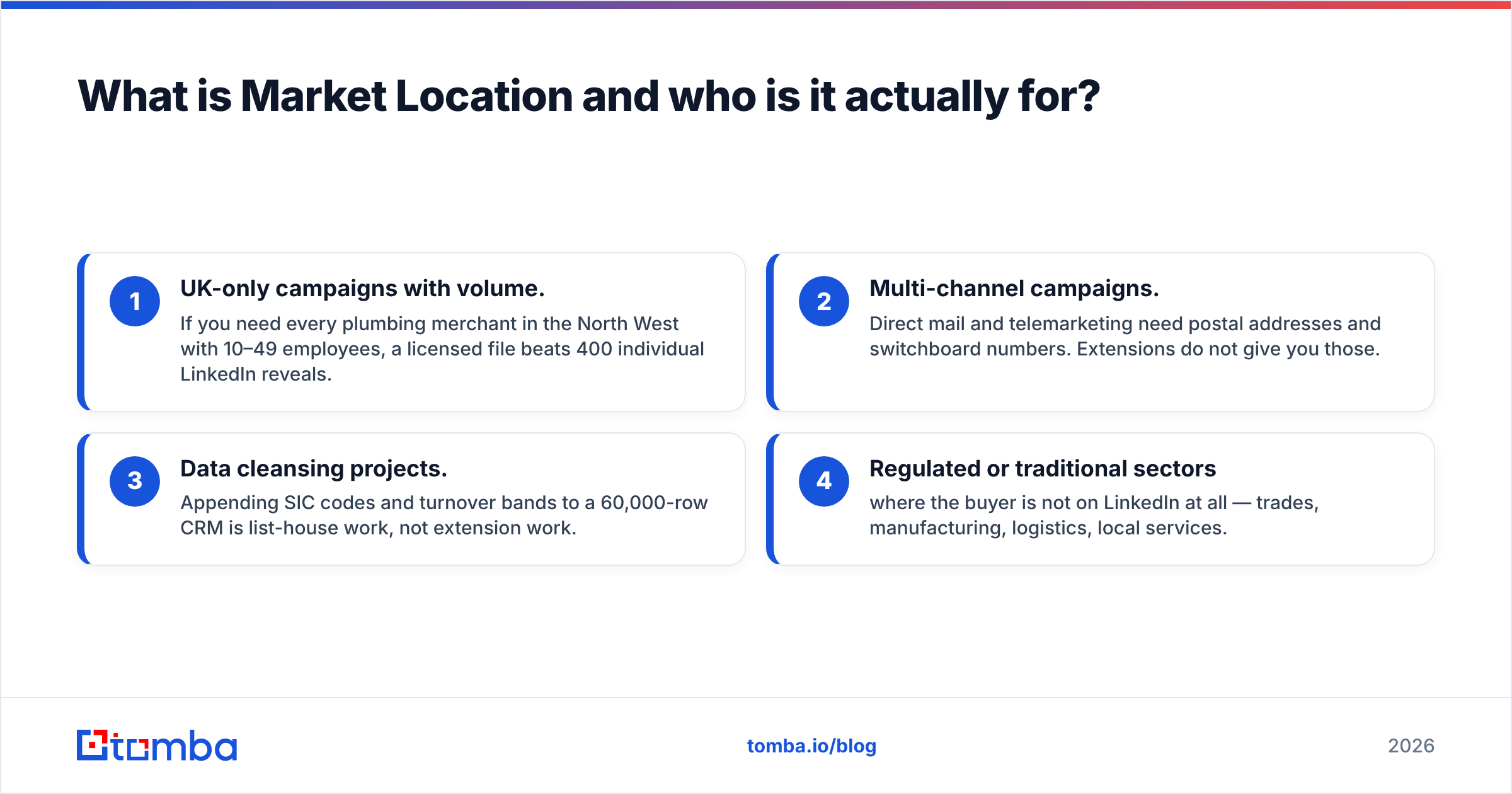
- UK-only campaigns with volume. Need every plumbing merchant in the North West with 10–49 staff? A licensed file beats 400 hand reveals.
- Multi-channel campaigns. Direct mail and telemarketing need postal addresses and switchboard numbers. Extensions do not give you those.
- Data cleaning projects. Adding SIC codes and turnover bands to a 60,000-row CRM is list-house work, not extension work.
- Traditional or regulated sectors where the buyer is not on LinkedIn at all — trades, manufacturing, logistics, local services.
Where it strains: freshness and self-serve. Researched files refresh on a cycle, not on demand. A record checked eight months ago is a coin flip for a job-title campaign. There is no public price list and no instant API key. You talk to someone.

Kaspr vs Market Location: how do they compare head-to-head?#
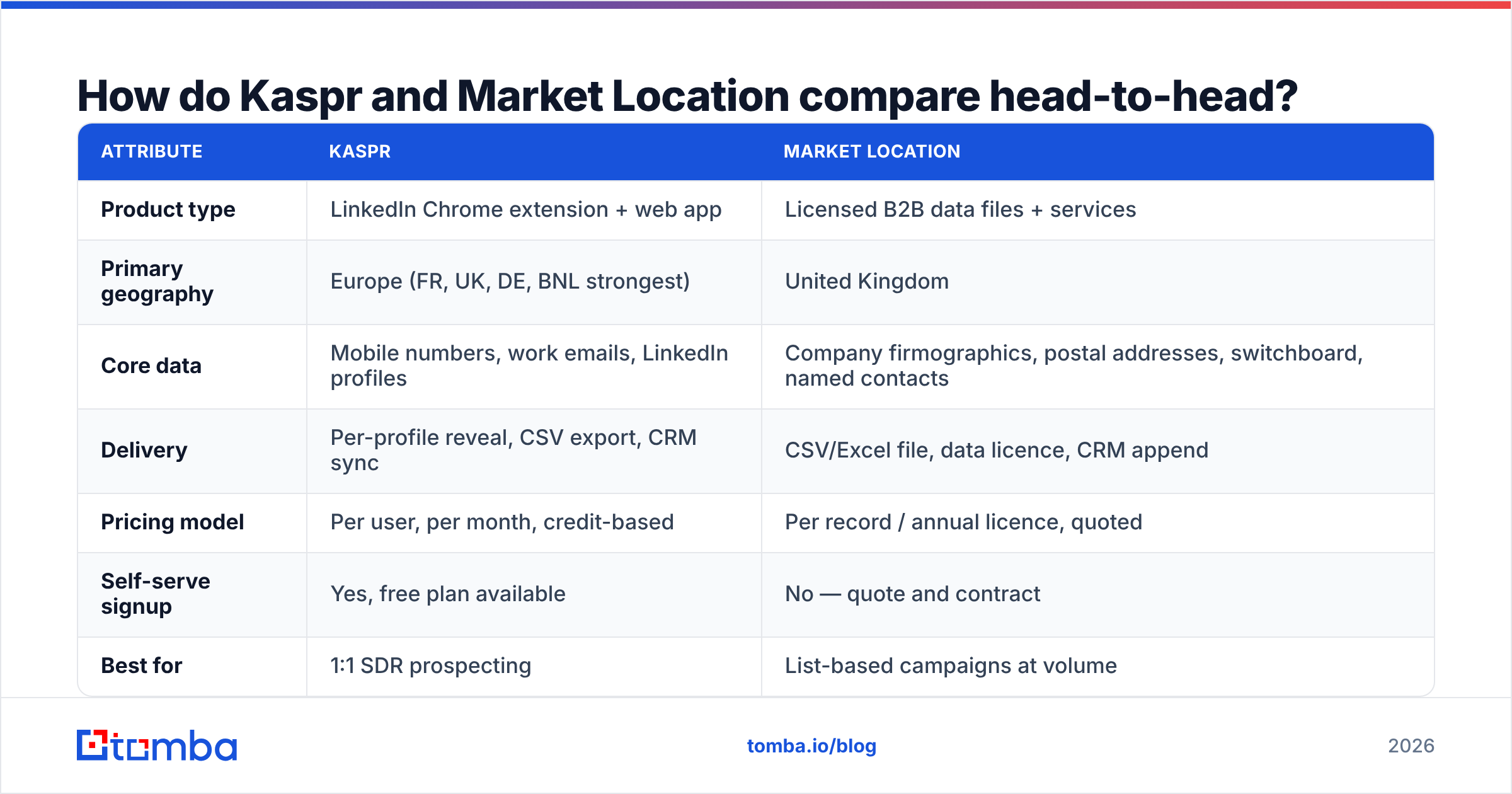
| Attribute | Kaspr | Market Location |
|---|---|---|
| Product type | LinkedIn Chrome extension + web app | Licensed B2B data files + services |
| Primary geography | Europe (FR, UK, DE, BNL strongest) | United Kingdom |
| Core data | Mobile numbers, work emails, LinkedIn profiles | Company firmographics, postal addresses, switchboard, named contacts |
| Delivery | Per-profile reveal, CSV export, CRM sync | CSV/Excel file, data licence, CRM append |
| Pricing model | Per user, per month, credit-based | Per record / annual licence, quoted |
| Self-serve signup | Yes, free plan available | No — quote and contract |
| Best for | 1:1 SDR prospecting | List-based campaigns at volume |
| Weak spot | Bulk cost, non-EMEA coverage | Freshness, no real-time API, UK-only |
| Compliance stance | GDPR/CCPA notification model | DMA membership, TPS/CTPS suppression |
| Typical buyer | SDR manager, founder-led sales | Marketing ops, direct mail agency |
The row that settles most calls is delivery. Kaspr is a per-contact motion. Market Location is a per-campaign motion. Buying the wrong one is not a quality problem. It is a shape problem — like buying a delivery van when you needed a taxi account.
Kaspr vs Market Location: which one has better data accuracy?#
Neither vendor number is easy to compare, because they measure different things.
Kaspr measures reveal validity. When it returns a mobile number, is that number still live for that person? Extension data is contributed and inferred, so accuracy swings by country. Teams report strong French and UK mobile hit rates. Results are much weaker in the US, where the same profile often returns a work email only.
Market Location measures record currency. When the file says a company has 45 staff and a buyer named X, how recently was that checked? Phone-researched files score well on company facts and worse on people. People change jobs faster than companies change SIC codes.

The takeaway: never treat either source as verified. Run everything through an email verifier before it touches a sending domain. A bought file at 88% deliverability will burn your sender reputation as fast as a scraped one. Checking is cheap. A burned domain is not.
Three checks worth running on any sample before you sign:
- Bounce-test 500 records through an outside verifier. Count hard bounces, catch-alls and unknowns apart.
- Spot-check 25 named contacts against their current LinkedIn headline. Over 15% title drift means the file is stale.
- Check the duplicate rate against your CRM. Paying for records you already own is the most common hidden cost in list buying.
Kaspr vs Market Location pricing: how does it really compare?#
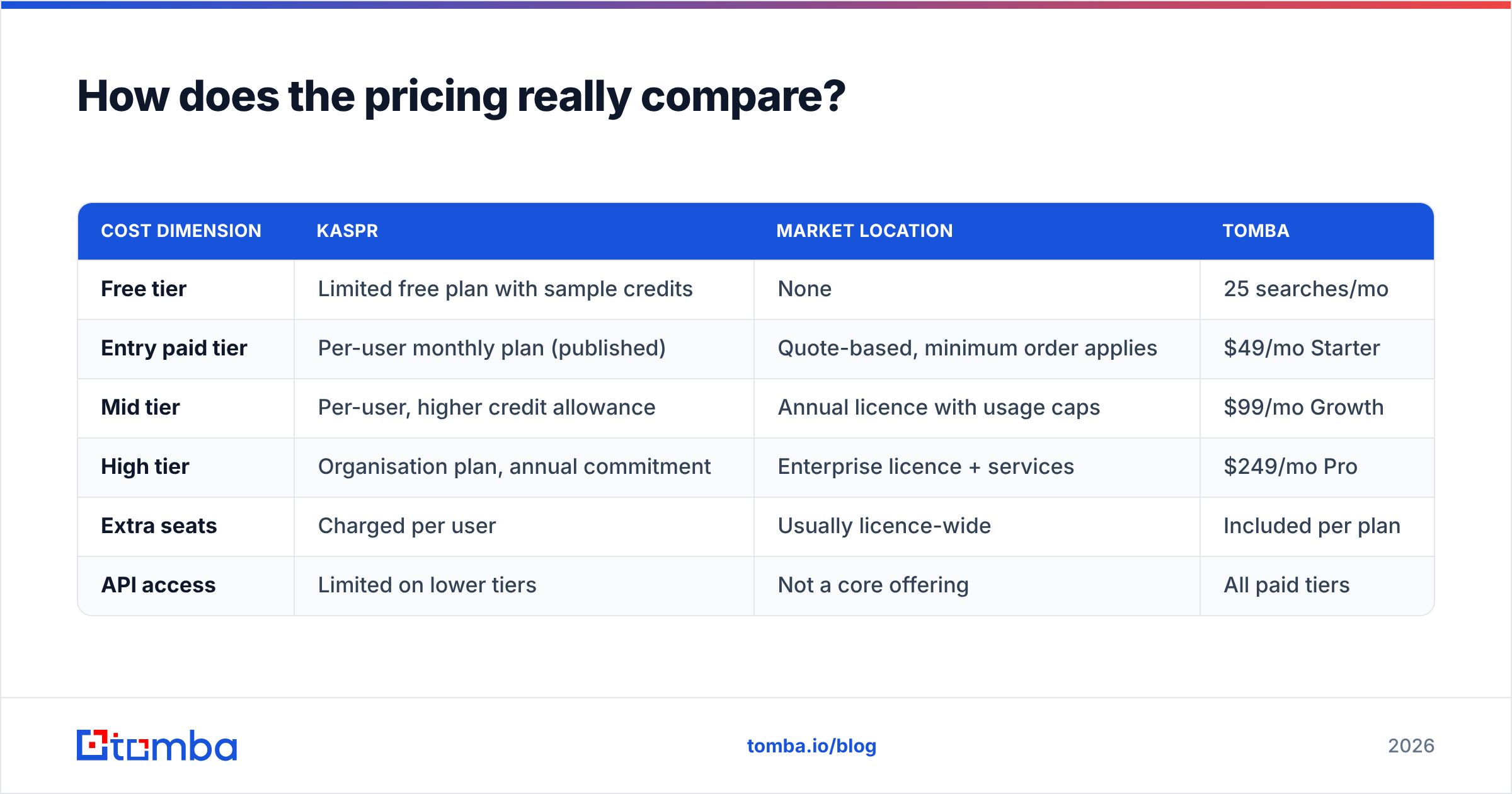
Kaspr posts plans. Market Location does not. That gap is itself a decision input.
| Cost dimension | Kaspr | Market Location | Tomba |
|---|---|---|---|
| Free tier | Limited free plan with sample credits | None | 25 searches/mo |
| Entry paid tier | Per-user monthly plan (published) | Quote-based, minimum order applies | $49/mo Starter |
| Mid tier | Per-user, higher credit allowance | Annual licence with usage caps | $99/mo Growth |
| High tier | Organisation plan, annual commitment | Enterprise licence + services | $249/mo Pro |
| Extra seats | Charged per user | Usually licence-wide | Included per plan |
| API access | Limited on lower tiers | Not a core offering | All paid tiers |
Vendor pricing moves. Check Kaspr's current per-seat numbers, and ask Market Location for a live quote before you model anything. The shape holds either way: Kaspr's cost scales with headcount. Market Location's scales with volume. An API-first finder scales with usage. Three reps working 200 accounts each? Seat pricing is fine. One ops person enriching 40,000 rows? Seat pricing is absurd.
Run the only metric that matters — cost per usable contact:
- Take total spend for the period.
- Divide by contacts that were found, verified and a fit for your ICP.
- Compare tools on that number, not on headline credit counts.
Teams that do this honestly often find the "cheap" tool costs more per usable record. Half the credits went to reveals that returned nothing, or a number in the wrong country.
Kaspr vs Market Location: which one fits your GTM motion?#
Pick by motion, not by feature list:
- Founder-led sales, under 50 accounts a month. Kaspr, or two free tiers stitched together. The volume does not justify a licence.
- SDR team prospecting on LinkedIn in EMEA. Kaspr earns its seat cost here, above all if mobile connect rate is your key metric. Pair it with cold calling discipline, or the mobiles are wasted.
- UK direct mail or telemarketing. Market Location, with TPS/CTPS suppression included. No extension replaces a postal file.
- Enrichment inside your own stack. Neither. You want an API that takes a domain and a name and returns a checked address. See the alternatives below.
- ABM with a fixed account list. Start with domain search to map every contact at each target company. Add phone data only for the accounts that engage.
- Mixed EU and US outbound. Kaspr alone leaves a US gap. Budget for a second source on day one, not in month three.

What are the real limitations you should test for?#
Kaspr. Credit burn is the top complaint. Reveals eat credits whether or not the data is useful. Shared team accounts multiply duplicate reveals. Export limits on lower tiers surprise people who assumed they could pull their own data out. And the workflow is tied to LinkedIn. Anyone not on LinkedIn is invisible to you, which quietly tilts your pipeline toward tech and services.
Market Location. The classic list-house limits apply. Licence terms cap how often and how long you may use the data. Records are researched on a cycle, not on demand. The UK-only footprint is a hard ceiling if you expand. Ask how often each field is refreshed. Company fields and contact fields are almost never on the same schedule.
Both. Neither is a checking layer. Both will hand you addresses that need testing before you send. Both sit upstream of email deliverability, and neither is accountable for it.
Are there better alternatives to both?#
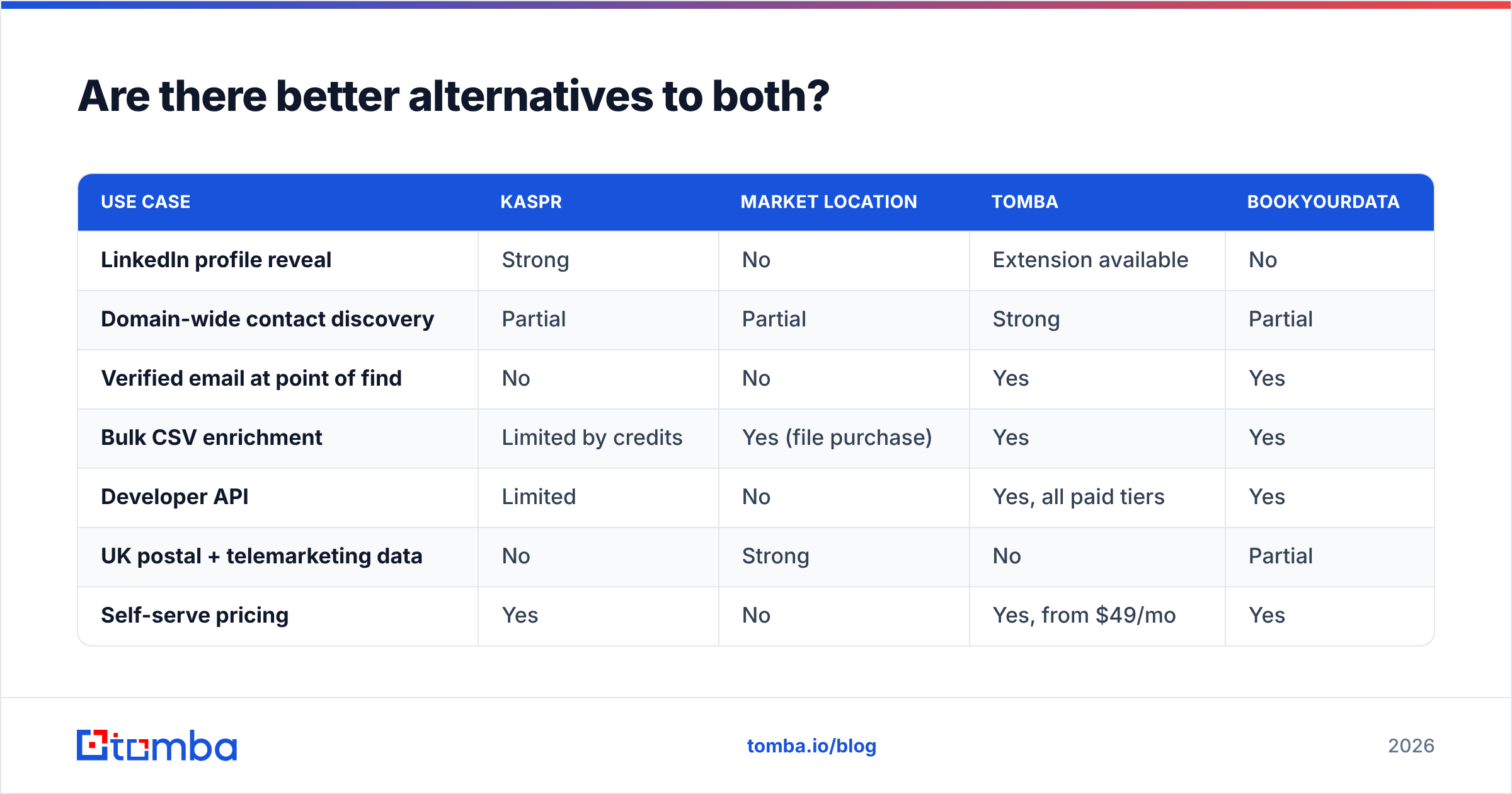
For one job — "I know the company, I need the right person's verified work email" — a dedicated finder beats both. It wins on cost and on how easily it plugs in. That is a narrower job than either vendor sells. It is also the job most outbound teams actually have.

| Use case | Kaspr | Market Location | Tomba | BookYourData |
|---|---|---|---|---|
| LinkedIn profile reveal | Strong | No | Extension available | No |
| Domain-wide contact discovery | Partial | Partial | Strong | Partial |
| Verified email at point of find | No | No | Yes | Yes |
| Bulk CSV enrichment | Limited by credits | Yes (file purchase) | Yes | Yes |
| Developer API | Limited | No | Yes, all paid tiers | Yes |
| UK postal + telemarketing data | No | Strong | No | Partial |
| Self-serve pricing | Yes | No | Yes, from $49/mo | Yes |
| Free entry point | Yes | No | 25 searches/mo | Sample available |
BookYourData is worth a look if you want pay-as-you-go verified lists with no subscription. It suits one-off campaign buys, and it sits next to a finder rather than replacing it. Cognism is the natural step up if you started on Kaspr and now need company filters and intent data.
Tomba's fit is narrower and cheaper. Point it at a domain and it returns the contactable people with verified addresses. Use the UI, Google Sheets or the Tomba API. Plans start free at 25 searches a month, then Starter at $49, Growth at $99 and Pro at $249. See current Tomba pricing for exact credit allowances. It will not give you a UK postal file. It will not reveal a mobile from a LinkedIn profile. It will give you steady, verified email discovery at a per-record cost that does not move when you hire another rep.
Kaspr vs Market Location: so which should you choose?#
Choose Kaspr if your reps work inside LinkedIn every day, you sell into Europe, and mobile connect rate is the metric your board watches. Accept the per-seat maths, and cap credit use per rep.
Choose Market Location if you run UK campaigns that need postal addresses, switchboard numbers or SIC-coded volume. It only pays off if direct mail and telemarketing are a real part of the plan, not an afterthought. Ask for the refresh schedule in writing.
Choose neither if what you need is email discovery at a steady, predictable cost. In that case the Kaspr vs Market Location debate is beside the point. Both tools are overbuilt where you do not need them, and thin where you do.
Whatever you pick, put a checking step between the data source and your sending setup. That one step is worth more to your reply rate than the gap between any two vendors on this page.
Ready to test the narrow version of this problem? Run 25 free searches through the Tomba Email Finder. Drop in the domains of ten target accounts. Compare the verified hit rate against whatever Kaspr or your last bought file returned for the same companies. Ten minutes of testing beats ten pages of vendor comparison — including this one.
Related guides#
Ready to find emails that actually work?
Join 150,000+ professionals who stopped guessing and started sending. Free credits on signup — no credit card required.
Get the Tomba newsletter
Practical outbound tactics and product updates — once every two weeks.
About the author