Kaspr vs Mattermark (2026): Which B2B Data Tool Wins?
Kaspr sells contact data. Mattermark sells company signals. Most teams comparing them are actually asking the wrong question — here is the honest breakdown of coverage, accuracy, pricing and fit for 2026.
Kaspr vs Mattermark is the wrong fight for most teams. One tool sells contact data. The other sells company signals. This guide covers what each one does, how accurate it is, what it costs, and which one fits your 2026 outbound stack.
TL;DR
- Kaspr vs Mattermark is not a like-for-like race. Kaspr gives you a person's phone number and email from a LinkedIn profile. Mattermark gives you company data — funding, headcount trends, growth signals — with no real contact layer.
- If your rep needs someone to call today, Kaspr wins. If your RevOps team has to score 10,000 accounts first, Mattermark is closer to what you want.
- Neither one is a "does everything" buy. Most teams end up with a contact provider plus a signal source.
- The pricing models do not line up. Kaspr charges per seat with credit buckets. Mattermark has long been a data subscription with a much higher floor.
- Mattermark has changed owners more than once since 2012. Check the current product status before you sign a long deal.
What are Kaspr and Mattermark, really?#
Think of it like building a house. Mattermark tells you which streets are growing and which builders are hiring. Kaspr hands you the phone number of the person who owns the lot. Both help. Only one lets you start a conversation today.
Kaspr is a contact-data tool built around a Chrome extension for LinkedIn. You open a profile or a Sales Navigator list and click the extension. Kaspr returns direct dials, mobile numbers, and work emails. Cognism bought it in 2022. It now sits at the lighter, self-serve end of that family. Its strength is Europe, where mobile coverage beats most US-first vendors.
Mattermark came from a different era. It launched in 2012 and earned the nickname "the Bloomberg terminal for startups." It tracked funding rounds, employee growth, web traffic, and a growth score that VCs used to rank private companies. FullContact bought it in 2017, and it changed hands again later. The product has been quiet since. That matters if you plan to lean on it through 2026.
So the honest framing of Kaspr vs Mattermark is not "which tool is better." It is "which layer of my data stack am I trying to fill?"

Kaspr vs Mattermark: how do they compare head to head?#
Here is the side-by-side that matters before you open a pricing page.
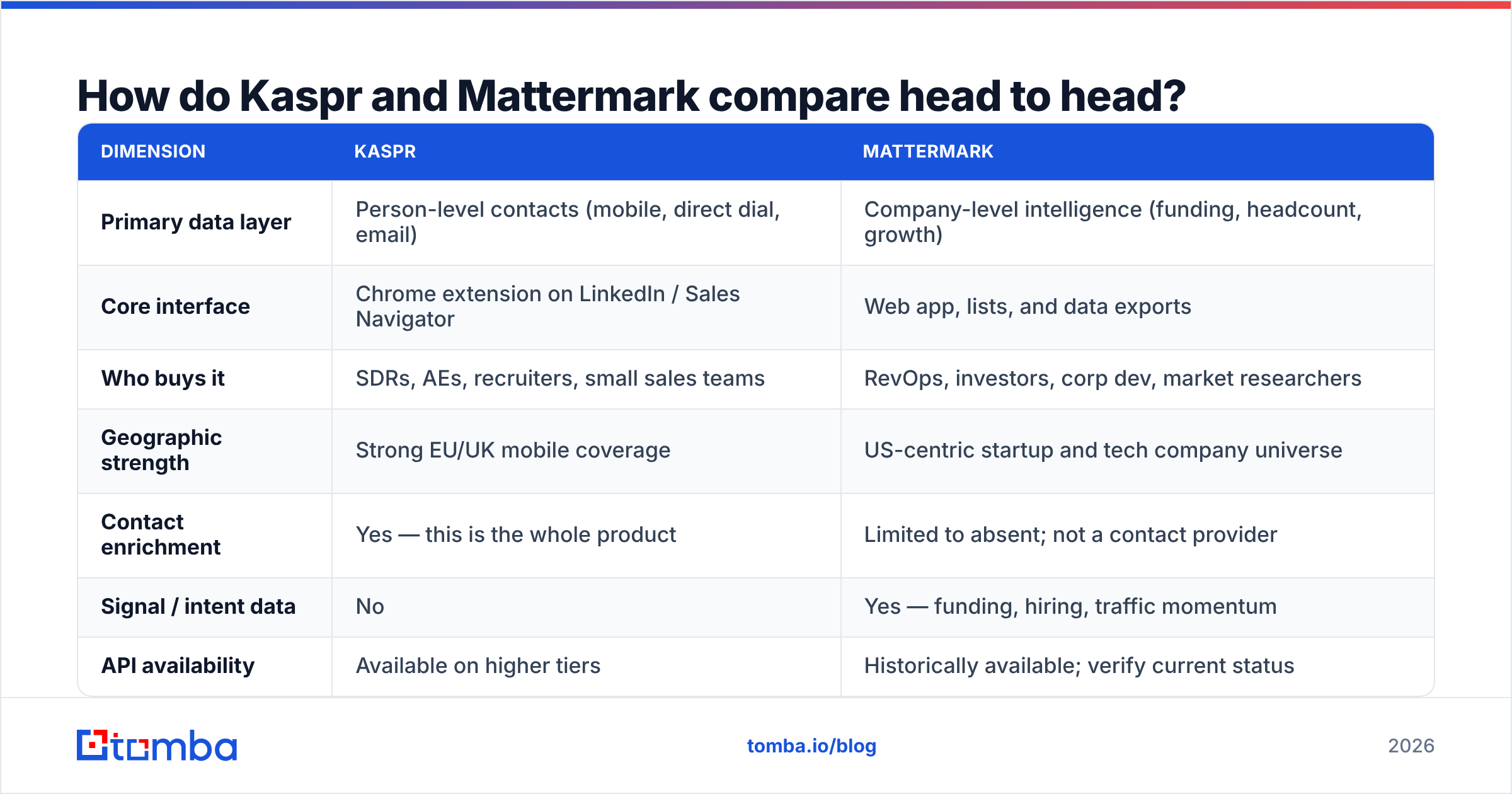
| Dimension | Kaspr | Mattermark |
|---|---|---|
| Primary data layer | Person-level contacts (mobile, direct dial, email) | Company-level intelligence (funding, headcount, growth) |
| Core interface | Chrome extension on LinkedIn / Sales Navigator | Web app, lists, and data exports |
| Who buys it | SDRs, AEs, recruiters, small sales teams | RevOps, investors, corp dev, market researchers |
| Geographic strength | Strong EU/UK mobile coverage | US-centric startup and tech company universe |
| Contact enrichment | Yes — this is the whole product | Limited to absent; not a contact provider |
| Signal / intent data | No | Yes — funding, hiring, traffic momentum |
| API availability | Available on higher tiers | Historically available; verify current status |
| Bulk workflow | Extension + list enrichment + CSV export | List building and CSV export |
| Buying trigger | "I need to reach this person now" | "I need to decide which accounts are worth reaching" |
| Realistic monthly floor | Roughly $50–$100 per seat | Historically a four-figure annual commitment at the pro tier |
Two things fall out of that table.
First, they are partners, not rivals. You can use company signals to pick target accounts. Then you use a contact tool to find the people inside them. Picking one instead of the other usually means account choice and contact sourcing are still tangled together.
Second, the buyer is different. Kaspr is a rep tool, and a rep can expense it. Mattermark is an ops or investor tool, and it comes with a budget approval.

How accurate is the data in each tool?#
Accuracy is where Kaspr vs Mattermark stops being a fair fight. Each layer means something different by the word, and vendors use that gap.
For Kaspr, accuracy is easy to test. A mobile number either reaches the right human or it does not. An email either lands or it bounces. Kaspr posts strong numbers for European mobile coverage. Reps back that up on UK, French, and DACH prospects. US mobile coverage is the weak flank. Email accuracy is fine but not best in class. If your sequences lean on email, put a dedicated email verifier between the export and your sending tool.
For Mattermark, accuracy is fuzzier. Funding data is right or wrong, and you can check it against public filings. Headcount and growth scores are estimates. Their value rests on how often the data is refreshed. A growth score built on stale headcount is worse than no score, because it makes you trust a bad ranking. So ask any signal vendor one question. When was this record last updated, and how often does each field refresh?
Run this test before you buy either tool:
- Build a 100-row control list from accounts you know well. Use current customers, churned logos, and closed-lost deals. You know the truth on those.
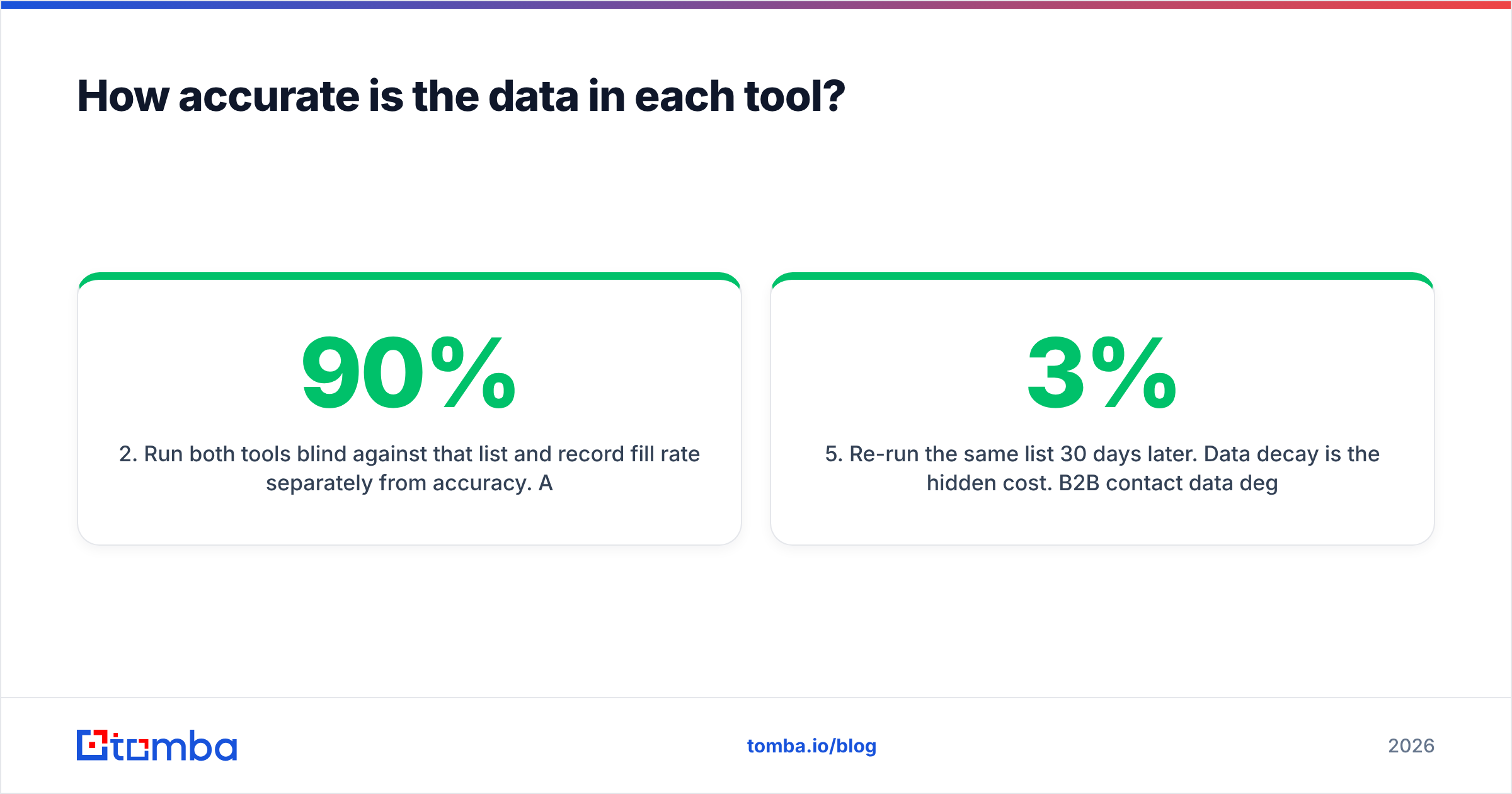
- Run both tools blind against that list. Record fill rate and accuracy as two separate numbers. A 90% fill rate at 60% accuracy is worse than a 60% fill rate at 95% accuracy.
- Check bounce rate, not marketing claims. Send the emails through a third-party checker and count the hard bounces.
- Time-stamp the phone test. Dial 25 numbers. Log connect rate, wrong-person rate, and dead-line rate. Vendors rarely publish wrong-person rates.
- Re-run the same list 30 days later. Data decay is the hidden cost. B2B contact data goes stale at roughly 2–3% per month. A vendor that never refreshes is selling you a snapshot, not a subscription.
That test costs you a week and saves you a year on a bad contract. Run it on every vendor on your list, including ours.
What does Kaspr actually cost?#
Cost is where Kaspr vs Mattermark splits hardest. Kaspr charges per seat and tracks phone, email, and export credits in separate buckets. That split is the part that catches people out. You can burn the phone credits in week two and still hold unused export credits. Your month stops there.
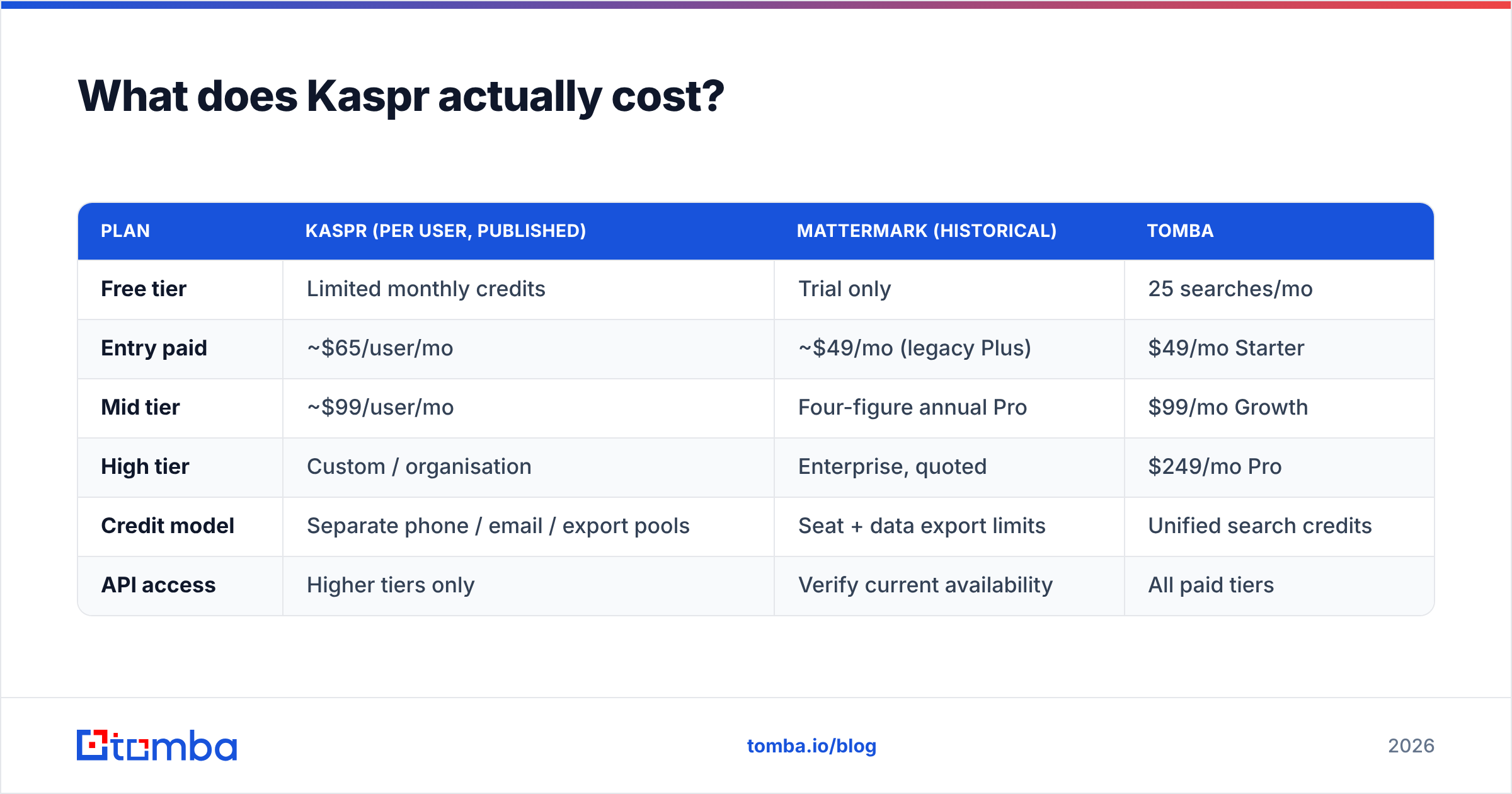
| Plan | Kaspr (per user, published) | Mattermark (historical) | Tomba |
|---|---|---|---|
| Free tier | Limited monthly credits | Trial only | 25 searches/mo |
| Entry paid | ~$65/user/mo | ~$49/mo (legacy Plus) | $49/mo Starter |
| Mid tier | ~$99/user/mo | Four-figure annual Pro | $99/mo Growth |
| High tier | Custom / organisation | Enterprise, quoted | $249/mo Pro |
| Credit model | Separate phone / email / export pools | Seat + data export limits | Unified search credits |
| API access | Higher tiers only | Verify current availability | All paid tiers |
Treat both sets of figures as rough. Both vendors have changed pricing, and Mattermark's public page has not kept up. Pull live numbers before you build a business case. Our own Tomba pricing is published in full, and that is the bar to hold every vendor to.
Model the per-seat cost with care. Kaspr at about $65 per user across six reps is close to $400 a month. That is before anyone enriches a bulk list. If your team works one profile at a time, the maths holds up. If you enrich 5,000 accounts from a CSV each quarter, per-seat pricing is the wrong shape. A credit-based bulk email finder will cost a fraction of it.

Where does Mattermark still make sense?#
The Kaspr vs Mattermark split is not a knock on Mattermark. The original idea was good, and the jobs it did have not gone away.
- Investor sourcing. If you screen private companies for a fund, funding history plus headcount growth is the signal set you want. Contact data comes second.
- Market sizing and TAM work. Counting how many firms in a segment passed 50 staff last year is a Mattermark question, not a Kaspr one.
- Account priority before outbound. Ranking a 5,000-account list so reps work the top 500 first is a smart use of company signals.
- Competitor and partner research. Tracking who raised, who grew, and who stalled inside a category.
What Mattermark cannot do is hand a rep a phone number. Buy it as a prospecting tool and you will be unhappy within two weeks.
Which one should you pick for your use case?#
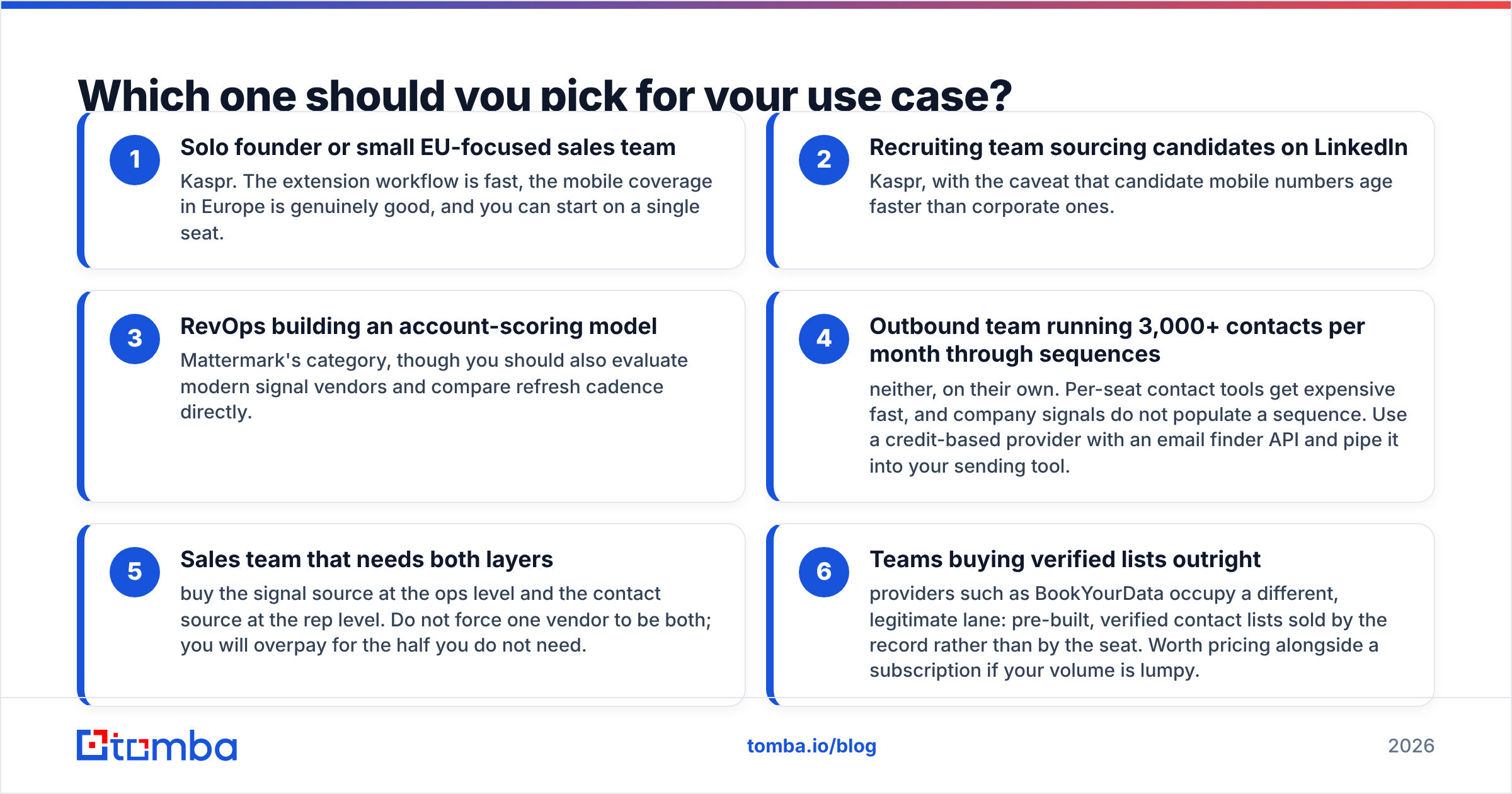
Here is how Kaspr vs Mattermark plays out by team.
- Solo founder or small EU sales team — Kaspr. The extension is fast, the European mobile coverage is good, and you can start on one seat.
- Recruiting team sourcing on LinkedIn — Kaspr. Just note that candidate mobile numbers go stale faster than office ones.
- RevOps building an account score — Mattermark's category. Also test newer signal vendors and compare how often they refresh.
The next three cases need more than one tool.
- Outbound team running 3,000+ contacts a month — neither, on its own. Per-seat contact tools get costly fast, and company signals do not fill a sequence. Use a credit-based provider with an email finder API and pipe it into your sending tool.
- Sales team that needs both layers — buy the signal source at ops level and the contact source at rep level. Do not force one vendor to be both. You will overpay for the half you do not need.
- Teams buying verified lists outright — providers such as BookYourData sit in a different lane. They sell pre-built, verified lists by the record, not by the seat. Worth pricing if your volume is lumpy.
Are there better alternatives to both?#
Both halves of the Kaspr vs Mattermark question now have newer rivals. The market has split since Mattermark launched, and that is good news for buyers.
On the contact side, look at Cognism (Kaspr's parent, moving upmarket), Apollo (broad reach, mixed accuracy), Lusha, ContactOut, and Tomba. Test them on the same control list. Vendor accuracy claims are marketing. Review sites such as G2 tell you more than any vendor benchmark page.
Tomba's honest position here: it is a contact-data specialist. It is not a sequencer, and it is not a signal provider. The email finder and domain search cover person and company-wide lookups. The LinkedIn finder covers the profile-to-email path Kaspr users care about, and the phone finder covers direct dials. Pricing is credit-based, not per seat. That shape suits bulk work. It suits one rep clicking profiles all day less well, and there Kaspr's extension is genuinely slicker.

On the signal side, look at modern intent and company-data platforms. Do not try to rebuild a 2014 workflow. The category has moved to live triggers such as job changes, hiring spikes, and new tech in the stack, rather than static growth scores.
What is the final verdict on Kaspr vs Mattermark?#
The Kaspr vs Mattermark answer turns on your next step.
Kaspr wins when that step is a conversation. It is cheaper to start, faster to use, and its European mobile data is a real edge. Its weak points are per-seat cost at team scale, split credit pools, and email accuracy that trails the specialists.
Mattermark wins when that step is a decision. It answers "which accounts deserve attention" in a way Kaspr never will. The risk is whether the product lasts. A tool that has changed owners twice deserves a short contract and hard questions about refresh rates.
If you can only buy one and you carry a quota, buy the contact layer. Account scores with no contacts give you a pretty spreadsheet and zero meetings. Contacts with rough ranking still build pipeline.
Where should you start?#
Run the 100-row control test on your real target market before you spend a cent, whichever way your Kaspr vs Mattermark call goes. If your bottleneck is finding and verifying work emails at volume, start with the Tomba Email Finder. The free tier gives you 25 searches a month, so the test costs nothing. Starter is $49/mo. Credits work across finding, verifying, and enrichment instead of sitting in separate pools. Test it against your own known-good list, count the bounces, and let the data pick the vendor.
Related guides#
// get started
Find, verify and enrich your first contacts today
Start on the free plan with 25 searches a month, then scale when your team is ready.
Free plan · No credit card required · GDPR & CCPA
Get the Tomba newsletter
Product and data updates
// about the author