Kaspr vs Minelead 2026: Phone Data vs Email Finder Depth
Kaspr sells LinkedIn mobile numbers. Minelead sells cheap domain-wide email discovery. They solve different problems badly if you pick the wrong one — here's the honest breakdown, with pricing, accuracy and export limits.
TL;DR
- Kaspr is a LinkedIn-first contact extension. Its real differentiator is mobile phone numbers pulled while you browse profiles and Sales Navigator lists. Email is a secondary output, not the core asset.
- Minelead is a domain-first email finder. You feed it a company domain (or a name + domain) and it returns addresses and patterns. There are no phone numbers and no LinkedIn workflow to speak of.
- They barely overlap. Comparing "kaspr vs minelead" only makes sense if what you actually need is contact data for outbound and you haven't decided whether that means calls or email.
- Price shapes the decision more than features. Kaspr is per-seat and priced like a sales-team tool. Minelead is credit-based and priced like a utility.
- Neither one is a complete data stack. Both need a separate verification step before you send, and both cap exports in ways that hurt at scale.
What are Kaspr and Minelead, actually?#
Think of it like buying a phone plan versus buying a phone book. Kaspr is the plan: it rides along with you, profile by profile, and hands you a person's mobile number the moment you need it. Minelead is the phone book: you look up a company, get back the addresses it holds, and do what you like with them.
Kaspr is a Chrome extension plus a light web dashboard, owned by Cognism since 2022. Its whole design assumes a rep is sitting inside LinkedIn or Sales Navigator. You open a profile, the sidebar fires, and you get a phone number, an email, and a "add to sequence" button. Kaspr also ships basic LinkedIn automation — connection requests, follow-up messages — which is unusual for a data vendor and is genuinely part of why people buy it.
Minelead is a straightforward email-discovery API and web app. Type stripe.com, get back the addresses associated with that domain plus the detected pattern (first.last@, finitial+last@, etc.). There's a free tier, a Chrome extension, an API, and bulk lookup. No dialer, no sequencing, no LinkedIn sidebar automation. It does one job and it's cheap at it.
The practical translation: Kaspr is a rep tool. Minelead is a builder tool. If your outbound motion involves a human clicking through LinkedIn all day, Kaspr's shape fits. If your motion involves a script that enriches 5,000 rows overnight, Minelead's shape fits.
How do Kaspr and Minelead compare head-to-head?#
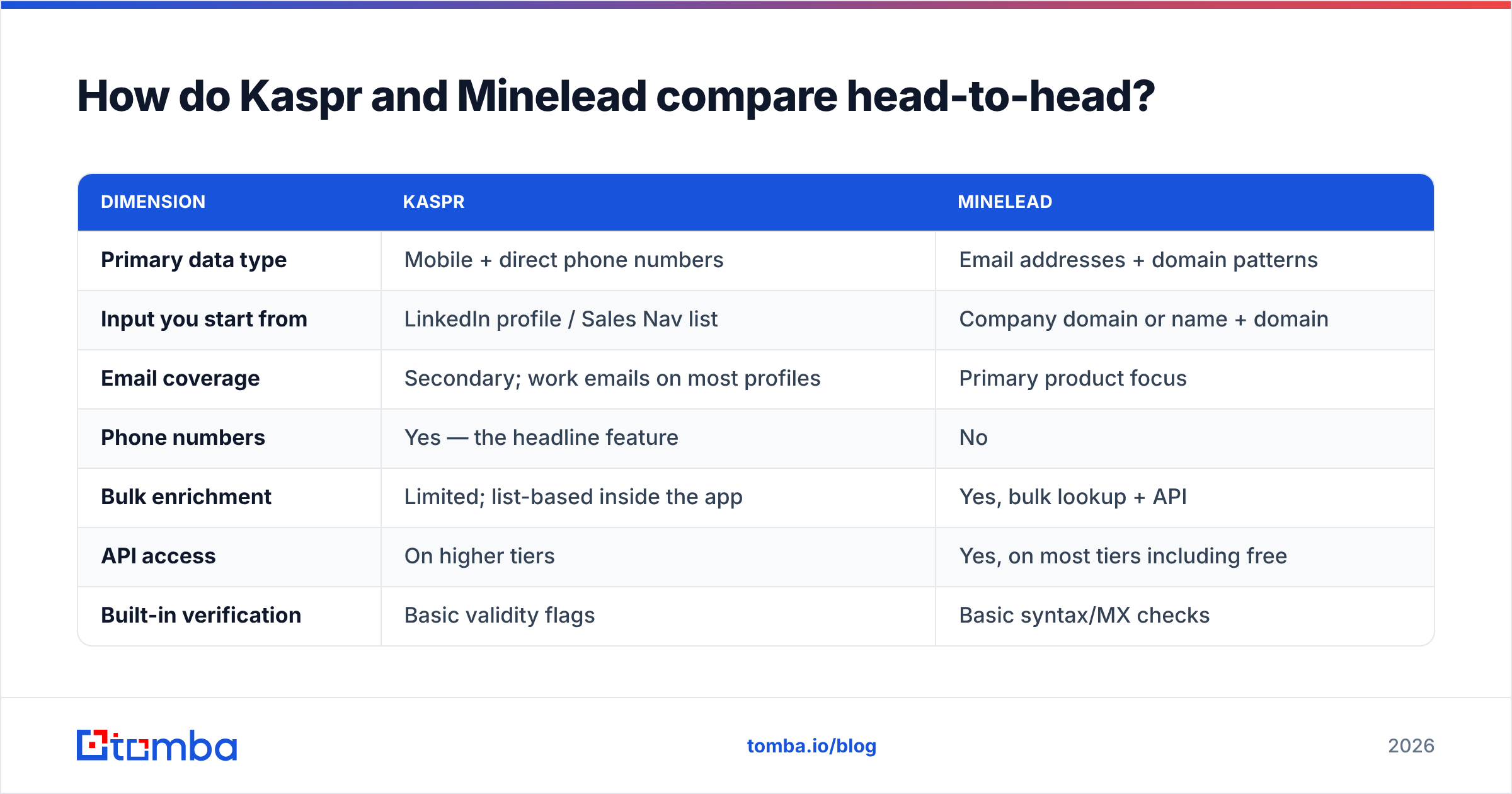
Here is the side-by-side on the dimensions that actually change your outcome. Pricing reflects publicly listed plans as of September 2026 — both vendors change tiers often, so confirm on their own pages before you commit.
| Dimension | Kaspr | Minelead |
|---|---|---|
| Primary data type | Mobile + direct phone numbers | Email addresses + domain patterns |
| Input you start from | LinkedIn profile / Sales Nav list | Company domain or name + domain |
| Email coverage | Secondary; work emails on most profiles | Primary product focus |
| Phone numbers | Yes — the headline feature | No |
| Bulk enrichment | Limited; list-based inside the app | Yes, bulk lookup + API |
| API access | On higher tiers | Yes, on most tiers including free |
| Built-in verification | Basic validity flags | Basic syntax/MX checks |
| LinkedIn automation | Yes (invites, messages) | No |
| Free tier | Yes, limited credits | Yes, limited monthly searches |
| Entry paid tier | ~€45–€49 per user / month | ~$49 / month, credit-based |
| Billing model | Per seat | Per account / credits |
| Best for | SDRs calling from LinkedIn | Devs and growth teams enriching domains |
Two things jump out of that table.
First, the billing model difference is bigger than any feature gap. Kaspr charges per seat. A five-person SDR team is five licences whether or not everyone uses their credits. Minelead charges the account. One subscription can feed an entire RevOps pipeline. For a team of one, Kaspr is fine. For a team of ten where only three people prospect manually, per-seat pricing quietly becomes the most expensive line item in your stack.
Second, only one of them gives you phone numbers. If cold calling is part of your plan, this comparison is already over — Minelead cannot do it, and no amount of email coverage substitutes. If calling isn't part of your plan, you're paying Kaspr's premium for an asset you'll never dial.

Which one finds more accurate emails?#
Accuracy is where these tools get uncomfortable, because both report confidence differently and neither publishes an independently audited hit rate.
Kaspr's email accuracy on LinkedIn profiles is decent for mid-market and enterprise targets in Europe and North America, which is where Cognism's underlying data is strongest. It degrades on small companies, on APAC and LATAM contacts, and on anyone whose LinkedIn profile is sparse. Kaspr's data is partly community-contributed — users share their own contact books in exchange for credits on the free plan — which means freshness varies a lot by segment.
Minelead's accuracy is pattern-driven. It's very good at telling you the shape of a company's email format, which is enormously useful, and reasonably good at returning real, in-use addresses for companies with a public web footprint. Where it struggles is the same place every pattern-based finder struggles: catch-all domains. A catch-all domain accepts every address you throw at it, so pattern inference returns a "valid-looking" result that may bounce or land in a black hole. Neither Kaspr nor Minelead resolves catch-alls with confidence, which is why a dedicated catch-all verifier belongs in any serious stack.

The honest summary on accuracy:
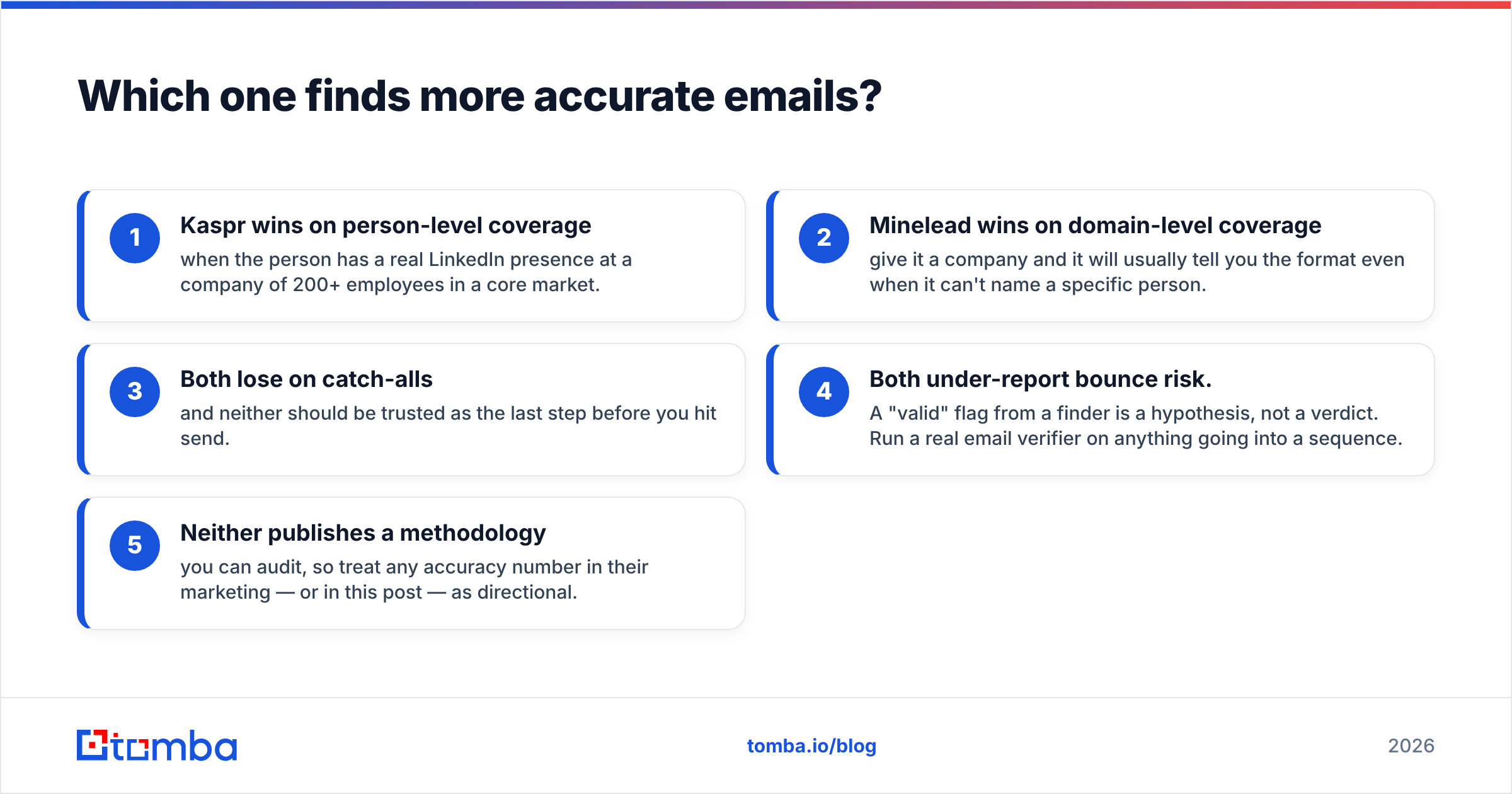
- Kaspr wins on person-level coverage when the person has a real LinkedIn presence at a company of 200+ employees in a core market.
- Minelead wins on domain-level coverage — give it a company and it will usually tell you the format even when it can't name a specific person.
- Both lose on catch-alls and neither should be trusted as the last step before you hit send.
- Both under-report bounce risk. A "valid" flag from a finder is a hypothesis, not a verdict. Run a real email verifier on anything going into a sequence.
- Neither publishes a methodology you can audit, so treat any accuracy number in their marketing — or in this post — as directional.
If you want a sanity check before you buy either, pull 50 contacts you already know are correct, run them through both free tiers, and measure. Thirty minutes of testing beats any vendor comparison chart, including this one.
What does each one actually cost you?#
List price is only half the story. The other half is how the credit system behaves when you miss.
Kaspr charges credits per revealed contact, split across phone credits, email credits and export credits. That last one catches people out: revealing a contact and exporting a contact can draw from different buckets depending on your tier. On per-seat billing at roughly €45–€99 per user per month, a four-rep team lands somewhere between €2,100 and €4,700 a year before anyone has exported a single list. Check Kaspr's current pricing directly — the tiers have moved twice since the Cognism acquisition.
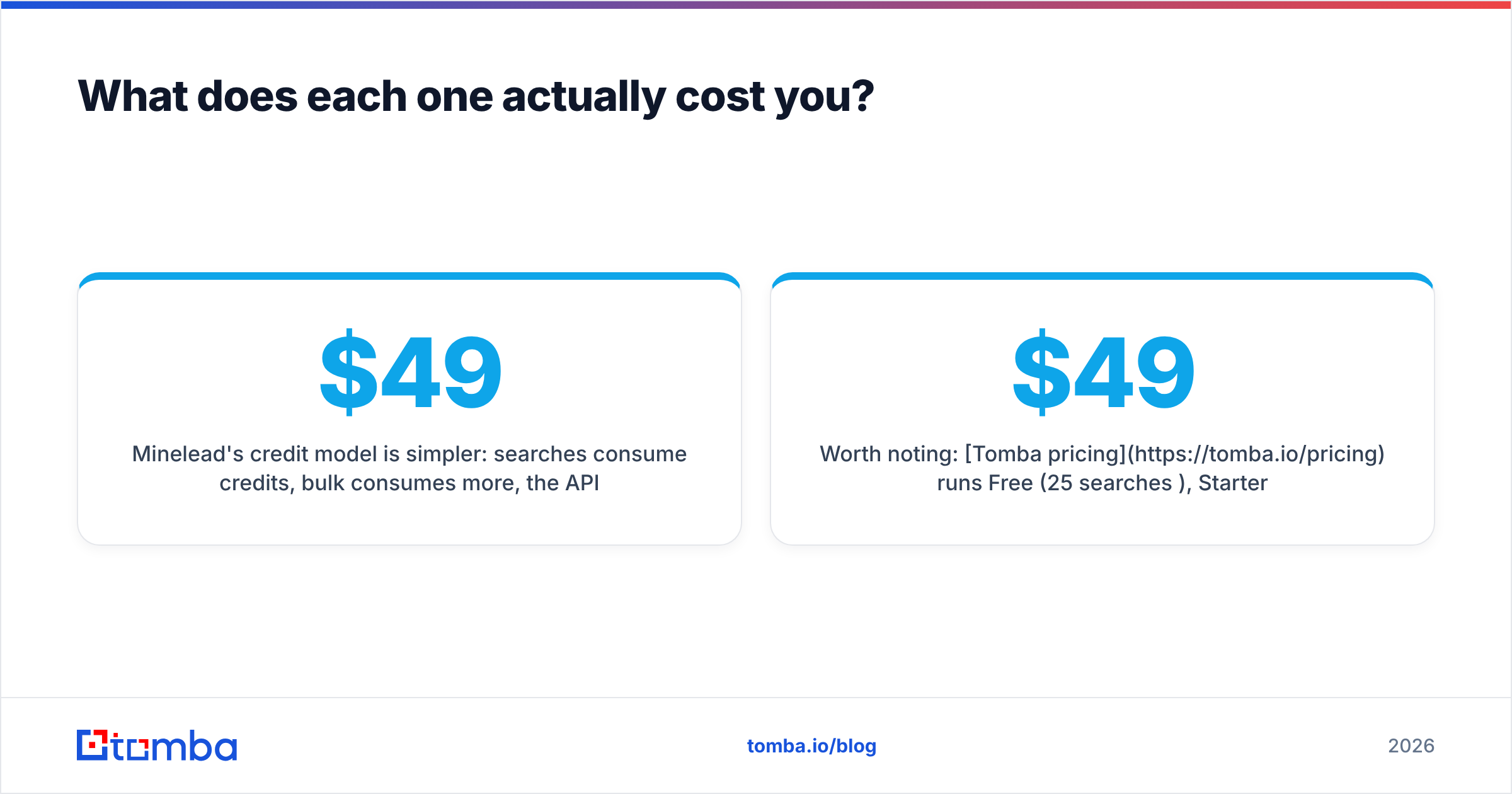
Minelead's credit model is simpler: searches consume credits, bulk consumes more, the API draws from the same pool. Around $49/month at the entry paid tier for an account rather than a seat, it's the cheaper option for anything programmatic. The trade-off is that you're buying a narrower product.
For reference on where both sit against the broader market:

Worth noting: Tomba pricing runs Free (25 searches/month), Starter at $49/mo, Growth at $99/mo and Pro at $249/mo — account-based, not per seat, with the API included from the paid tiers up. That structure matters if your prospecting is half-human and half-script, which for most teams in 2026 it is.
Who should choose Kaspr?#
Pick Kaspr if three things are true at once:
- You call. Mobile numbers are the product. If dialing isn't in your motion, you're funding someone else's feature.
- Your reps live in LinkedIn. The extension is the experience. Used outside that context, Kaspr loses most of its advantage.
- Your ICP is European or North American mid-market and up. That's where the underlying Cognism-adjacent data is densest, and Kaspr's European phone coverage is genuinely a strength — GDPR-conscious sourcing included.
Kaspr is a bad fit if you're enriching in bulk, if your team is small and price-sensitive, or if your targets are SMBs where LinkedIn presence is thin. It's also a bad fit if you need a data layer that feeds a CRM automatically at volume — the export ceilings will bite before the data quality does.
Who should choose Minelead?#
Pick Minelead if:
- Email is your only channel. No phone spend, no seat spend, no automation you don't use.
- You start from domains, not people. Target-account lists, scraped company lists, partner directories — Minelead's input shape matches.
- You're technical. The API is the best part of the product, and the free tier is generous enough to prototype against before you pay anything.
- Budget is tight. At the entry tier it's one of the cheaper ways to get structured email data with programmatic access.
Minelead is a bad fit the moment you need a phone number, person-level enrichment from a LinkedIn URL, or confident catch-all resolution. It's also thin on the data hygiene side — you will need a verification layer regardless.

What about compliance and data sourcing?#
This is the section most comparisons skip, and it's the one your legal team will ask about.
Kaspr operates under GDPR with a documented opt-out process and, through Cognism, a notified-contacts framework for EU data. That's meaningfully better than the industry floor. The community-contribution mechanic — users sharing their own address books for credits — is more legally ambiguous, and worth reading the terms on if you operate in a strict jurisdiction.
Minelead's sourcing is primarily public-web crawling plus pattern inference. That's lower-risk in one sense (no scraped private address books) but gives you less provenance detail per record. Neither vendor publishes a per-record source trail, which is standard for the category but still a gap. If provenance matters to your compliance posture, ask both vendors directly and get the answer in writing; check independent reviews on G2 for what current customers report about support responsiveness on these questions.
Whatever you pick, the compliance work doesn't end at the vendor. Suppression lists, honoring opt-outs across tools, and not re-importing a contact you already removed are your responsibility, not theirs.
Is there a third option worth considering?#
Yes — and not only because you're reading this on a vendor's blog.
The structural problem with the "kaspr vs minelead" framing is that you're choosing between a phone tool with weak email and an email tool with no phone. Most outbound teams need both, plus verification, plus a way to run it in bulk without buying another seat.
A consolidated stack looks like this: domain search to map an account's addresses and format, an email finder for named contacts, a LinkedIn finder when your list starts from profile URLs, verification on everything before it enters a sequence, and a bulk email finder or the Tomba API so none of it depends on a human clicking through tabs. When phone numbers are genuinely part of the plan, a phone finder sits alongside rather than replacing the email layer.
That's not an argument that Kaspr is bad — for a European SDR team that dials all day, it's a legitimately strong purchase. It's an argument that "which of these two" is usually the wrong question when both tools cover half the surface you need.
How should you run the decision?#
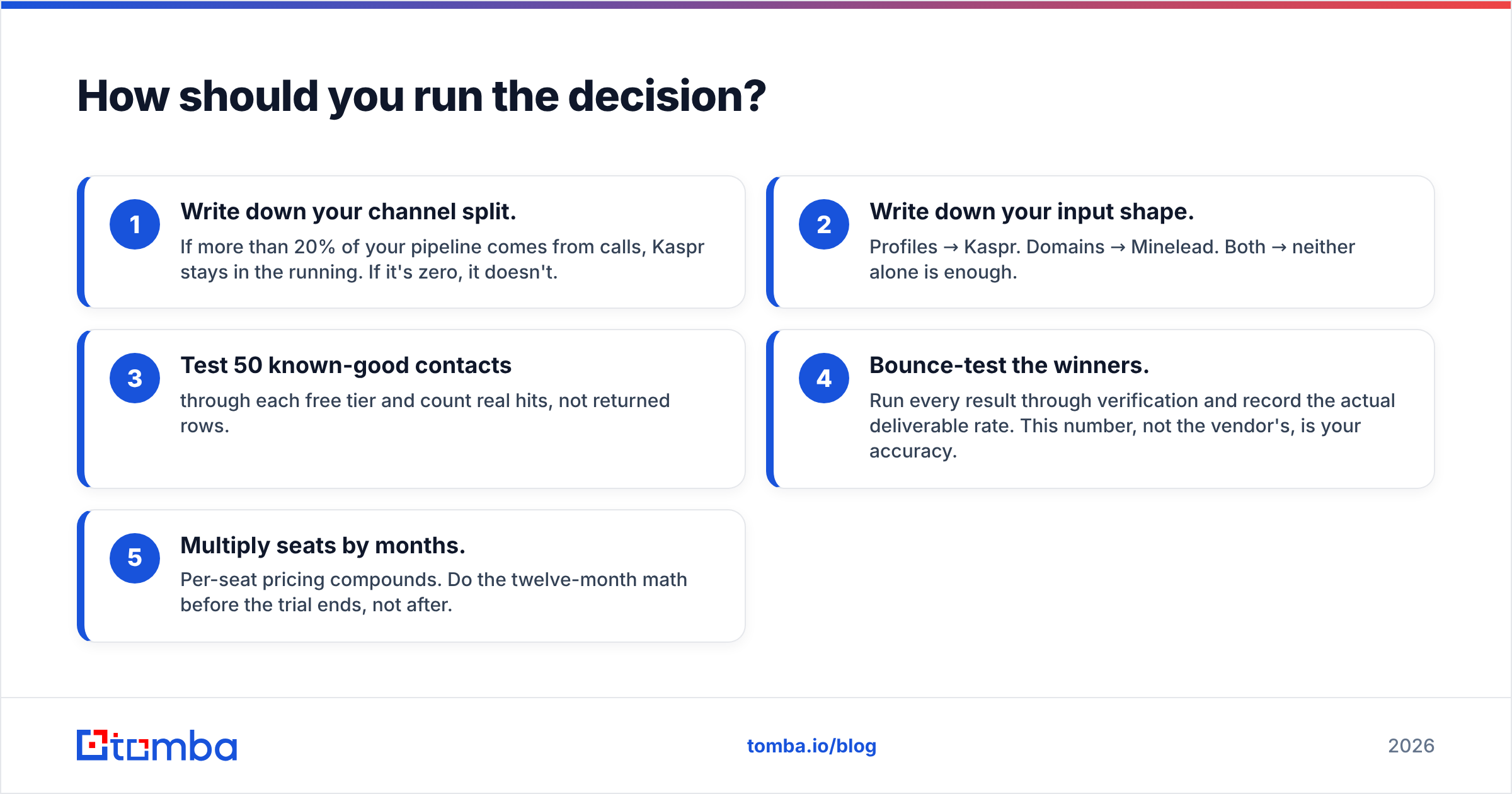
Do this in an afternoon:
- Write down your channel split. If more than 20% of your pipeline comes from calls, Kaspr stays in the running. If it's zero, it doesn't.
- Write down your input shape. Profiles → Kaspr. Domains → Minelead. Both → neither alone is enough.
- Test 50 known-good contacts through each free tier and count real hits, not returned rows.
- Bounce-test the winners. Run every result through verification and record the actual deliverable rate. This number, not the vendor's, is your accuracy.
- Multiply seats by months. Per-seat pricing compounds. Do the twelve-month math before the trial ends, not after.
Most teams who run this honestly discover that their real constraint wasn't finding contacts — it was that 20–30% of what they found never should have been sent to.
Ready to fix the accuracy half of the problem?#
If your bottleneck is email quality rather than phone coverage, start with the Tomba Email Finder. The free tier gives you 25 searches a month to benchmark against whatever you're using now, Starter is $49/mo on an account basis rather than per seat, and verification is built into the same workflow instead of bolted on afterward. Run your next 50 prospects through it alongside Kaspr and Minelead, compare the bounce rates, and let the numbers pick your stack.
Related guides#
// get started
Find, verify and enrich your first contacts today
Start on the free plan with 25 searches a month, then scale when your team is ready.
Free plan · No credit card required · GDPR & CCPA
// about the author