Kaspr vs No2bounce (2026): Which Email Tool Do You Need?
Kaspr finds contacts. No2bounce cleans them. They solve opposite halves of the same problem — here's how the two compare on data, pricing, and accuracy, and which one your outbound stack actually needs in 2026.
TL;DR
- Kaspr and No2bounce are not really competitors. Kaspr is a contact-discovery tool (LinkedIn-first, strong on European mobile numbers). No2bounce is an email verification service that exists to stop bounces before you send.
- If your problem is "I don't have contact details," Kaspr is the relevant purchase. If your problem is "my bounce rate is killing my domain," No2bounce is.
- Pricing models differ structurally: Kaspr charges per seat with monthly credit allowances; No2bounce charges per verification from credit packs. Comparing their sticker prices side by side is close to meaningless.
- Buying both means two vendors, two dashboards, and two failure points between "found a lead" and "email actually delivered."
- A combined finder-plus-verifier stack (Tomba, Dropcontact, or Cognism's own bundle) usually costs less than Kaspr + a standalone verifier once you're above ~2,000 contacts a month.
What are Kaspr and No2bounce, exactly?#
Start here, because the entire comparison hinges on it: these two tools sit on opposite sides of the same workflow.
Kaspr is a B2B contact-data platform best known for its Chrome extension. You open a LinkedIn profile, a LinkedIn Sales Navigator list, or a group member list, click the Kaspr widget, and it returns phone numbers, mobile numbers, and email addresses for the people on screen. It was acquired by Cognism in 2022 and now functions as the lighter, self-serve entry point into that data ecosystem. Its reputation is built on one specific strength: European mobile numbers, particularly in France, the UK, DACH, and Benelux — a region where most US-built data vendors go thin.
No2bounce is an email verification service. You upload a list (or hit the API), and it runs each address through syntax checks, MX record lookups, SMTP handshake probing, disposable-domain detection, role-account flagging, and — its main selling point — an attempt at resolving catch-all domains, which most verifiers simply return as "unknown" and charge you for anyway. It does not find email addresses. It tells you whether the ones you already have will land.
So the honest framing of "Kaspr vs No2bounce" is not which is better. It's: which half of the broken pipeline are you fixing this quarter?
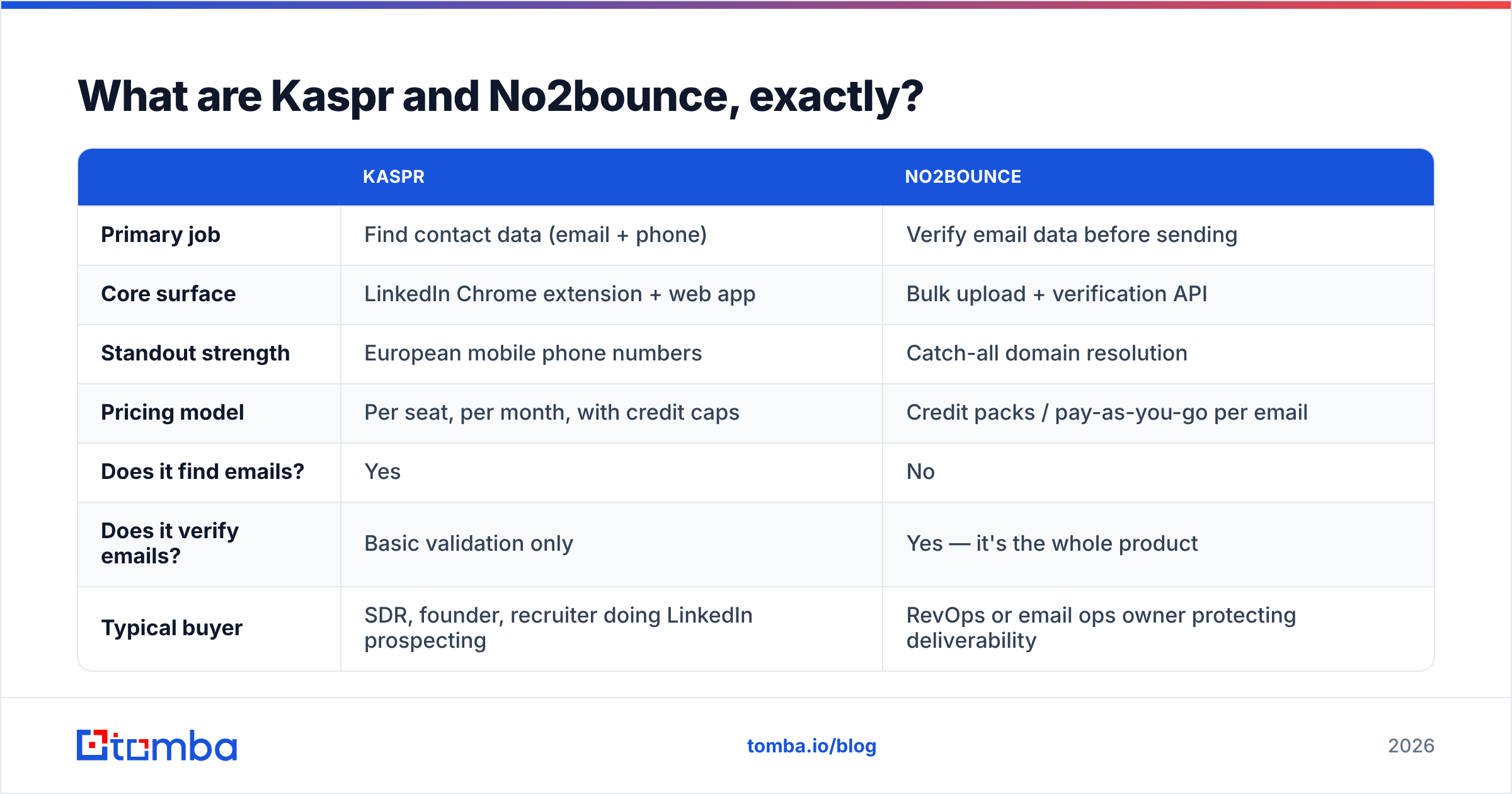
| Kaspr | No2bounce | |
|---|---|---|
| Primary job | Find contact data (email + phone) | Verify email data before sending |
| Core surface | LinkedIn Chrome extension + web app | Bulk upload + verification API |
| Standout strength | European mobile phone numbers | Catch-all domain resolution |
| Pricing model | Per seat, per month, with credit caps | Credit packs / pay-as-you-go per email |
| Does it find emails? | Yes | No |
| Does it verify emails? | Basic validation only | Yes — it's the whole product |
| Typical buyer | SDR, founder, recruiter doing LinkedIn prospecting | RevOps or email ops owner protecting deliverability |
| Free option | Free plan with limited monthly credits | Free trial credits |
Why do people compare Kaspr and No2bounce at all?#
Because of how the pain actually presents itself.
A rep runs Kaspr across 500 LinkedIn profiles, exports the emails, loads them into Instantly or Smartlead, and sends. Three days later the bounce rate is 11%, Google is throttling the domain, and open rates have collapsed. The rep searches for "Kaspr email accuracy," finds a thread recommending a verifier, and lands on a shortlist that includes No2bounce, ZeroBounce, NeverBounce, and Bouncer.
At that point the question feels like "Kaspr vs No2bounce" — but it's really "do I need a second tool, or a better first one?" That distinction is worth real money, so let's take it seriously.

How accurate is each tool's data?#
Accuracy means two different things here, and conflating them is the most common mistake buyers make.
Kaspr's accuracy is discovery accuracy: of the contacts you look up, what percentage return a usable record, and how often is that record correct? In practice, Kaspr's coverage is uneven by geography. European mobile hit rates are genuinely strong — often the best reason to buy it. Email coverage is solid on mid-market and enterprise domains, thinner on small companies, micro-agencies, and non-Western markets. Kaspr's email records are typically drawn from contributory data (extension users sharing their address books) plus partner databases, which means freshness varies: a record sourced two years ago from someone's CRM may point at a job the person has since left.
No2bounce's accuracy is classification accuracy: of the addresses you feed it, how often does it correctly label valid as valid and invalid as invalid? The hard part of that job is catch-all domains. Roughly one in five B2B domains is configured to accept mail for any local part, which defeats naive SMTP probing. Most verifiers return "accept-all / unknown," bill you, and hand the decision back to you. Tools that attempt genuine catch-all resolution — No2bounce among them, alongside Tomba's catch-all verifier — use heuristics, pattern inference, and provider-specific behaviour to make a call rather than a shrug.
The failure mode to watch: a verifier that is aggressive on catch-alls will mark more addresses valid and shrink your "unknown" bucket, which looks great in the dashboard and terrible in your bounce logs. Always test a verifier against a seed list where you already know the outcomes — 200 addresses you've personally emailed, half of which bounced — before trusting its scores at volume.

Suggested visual: side-by-side screenshot of a Kaspr LinkedIn profile lookup and a No2bounce bulk verification results screen showing valid / invalid / catch-all buckets.
What does Kaspr cost versus No2bounce in 2026?#
This is where the comparison gets slippery, because the two vendors don't price the same unit.
Kaspr sells seats. Each seat gets a monthly allowance of phone credits, email credits, and export credits. Its free plan exists but is deliberately limited, and the published paid tiers sit in the roughly €45–€99 per user per month range depending on plan and annual commitment. Add a second rep and you add a second seat — the cost scales with headcount, not with volume. Check the Kaspr pricing page directly before budgeting; these tiers have moved more than once.
No2bounce sells verifications. You buy credits, one credit burns per email checked, and the per-email rate drops as pack size grows. There's no seat tax — one person or ten, same price for the same volume. Which means your cost is driven entirely by how many addresses you push through, and how many of those you shouldn't have collected in the first place.
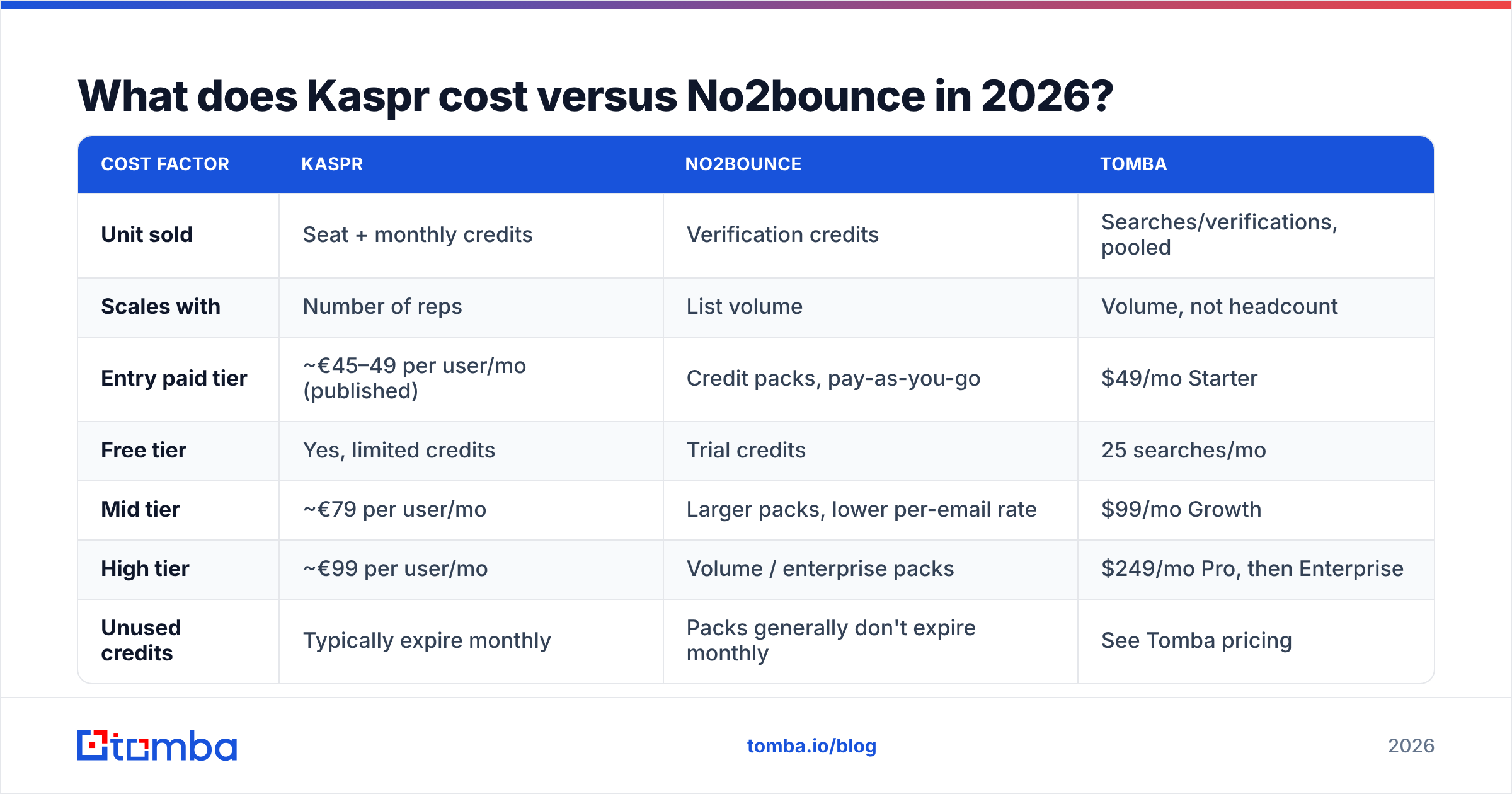
| Cost factor | Kaspr | No2bounce | Tomba |
|---|---|---|---|
| Unit sold | Seat + monthly credits | Verification credits | Searches/verifications, pooled |
| Scales with | Number of reps | List volume | Volume, not headcount |
| Entry paid tier | ~€45–49 per user/mo (published) | Credit packs, pay-as-you-go | $49/mo Starter |
| Free tier | Yes, limited credits | Trial credits | 25 searches/mo |
| Mid tier | ~€79 per user/mo | Larger packs, lower per-email rate | $99/mo Growth |
| High tier | ~€99 per user/mo | Volume / enterprise packs | $249/mo Pro, then Enterprise |
| Unused credits | Typically expire monthly | Packs generally don't expire monthly | See Tomba pricing |
| API access | Available on higher plans | Yes, core to the product | Yes, all paid plans |
Vendor pricing changes frequently. Treat the figures above as directional and confirm on each vendor's own page before you sign anything.
The practical arithmetic: a four-rep team on Kaspr's mid tier is spending somewhere north of €300/month before a single email is verified. Bolt a verifier on top and you're managing two contracts to get one clean, sendable contact record.

Is Kaspr better than No2bounce for outbound?#
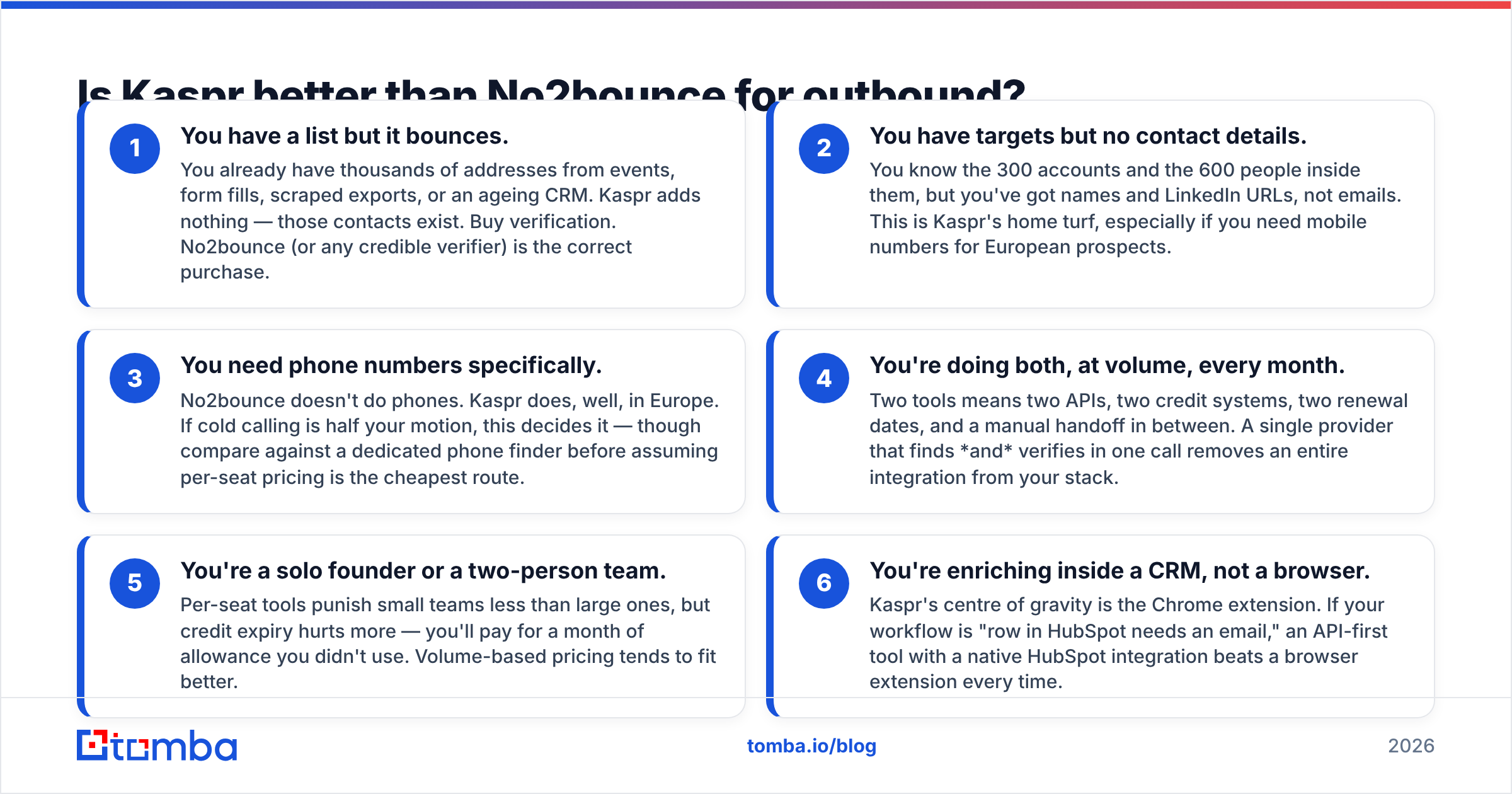
Only if your bottleneck is discovery. Here's the honest decision tree:
- You have a list but it bounces. You already have thousands of addresses from events, form fills, scraped exports, or an ageing CRM. Kaspr adds nothing — those contacts exist. Buy verification. No2bounce (or any credible verifier) is the correct purchase.
- You have targets but no contact details. You know the 300 accounts and the 600 people inside them, but you've got names and LinkedIn URLs, not emails. This is Kaspr's home turf, especially if you need mobile numbers for European prospects.
- You need phone numbers specifically. No2bounce doesn't do phones. Kaspr does, well, in Europe. If cold calling is half your motion, this decides it — though compare against a dedicated phone finder before assuming per-seat pricing is the cheapest route.
- You're doing both, at volume, every month. Two tools means two APIs, two credit systems, two renewal dates, and a manual handoff in between. A single provider that finds and verifies in one call removes an entire integration from your stack.
- You're a solo founder or a two-person team. Per-seat tools punish small teams less than large ones, but credit expiry hurts more — you'll pay for a month of allowance you didn't use. Volume-based pricing tends to fit better.
- You're enriching inside a CRM, not a browser. Kaspr's centre of gravity is the Chrome extension. If your workflow is "row in HubSpot needs an email," an API-first tool with a native HubSpot integration beats a browser extension every time.

What are the real limitations of each?#
Where Kaspr frustrates buyers:
- Credits reset monthly and generally don't roll over, so seasonal prospecting patterns waste allowance.
- Coverage outside Europe and North America drops noticeably. If you sell into APAC, LATAM, or the Middle East, run a trial on your own ICP before committing.
- Email records lack deep verification. You get an address; you don't get a confident deliverability verdict, which is exactly why this comparison exists.
- Per-seat pricing means the cost of adding a junior SDR includes a data licence, whether or not they use it fully.
Where No2bounce frustrates buyers:
- It cannot generate a single new lead. It's a quality gate, not a source.
- Catch-all resolution is probabilistic by nature. Any vendor claiming 100% certainty on accept-all domains is overselling; the useful question is what confidence band they report and how calibrated it is.
- Verification is a point-in-time snapshot. An address verified in March may be dead by September — people change jobs at roughly 20% a year in tech sales. Re-verification is an ongoing cost, not a one-off.
- Standalone verifiers create a data round-trip: export from your finder, upload, wait, download, re-import. At weekly cadence that's real operational drag.
Neither of these is a knock on the products. They're category limitations. A finder that doesn't verify and a verifier that doesn't find are both doing exactly what they were built to do — the gap is in the seam between them, and the seam is yours to own.
For a broader view of how buyers rate both categories, G2's software reviews are worth skimming for recency-filtered comments rather than aggregate star ratings, and HubSpot's sales blog has solid baseline material on how bounce rate feeds into sender reputation.
How does Tomba compare to Kaspr and No2bounce?#
Disclosure up front: this is the Tomba blog, so treat the following as a positioned view, not an impartial verdict. The structural argument still holds independent of who's making it.
Tomba covers both halves in one place. The email finder resolves an address from a name plus domain or from a LinkedIn profile; the email verifier scores it before you send; catch-all domains get their own resolution path rather than an "unknown" shrug. Same credits, same dashboard, same API key — a find-then-verify chain is one request pattern, not two vendors.
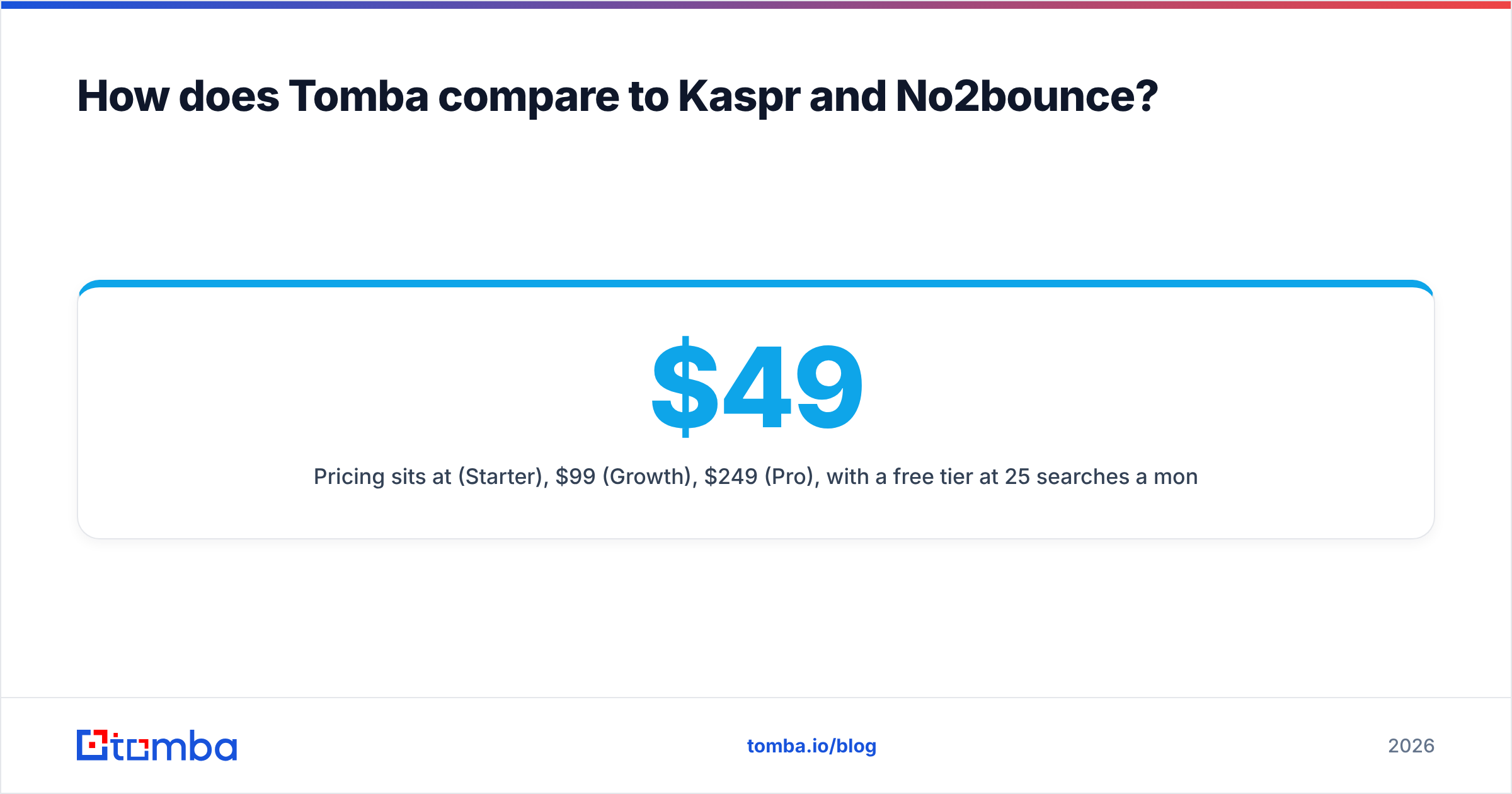
Pricing sits at $49/mo (Starter), $99/mo (Growth), $249/mo (Pro), with a free tier at 25 searches a month and custom Enterprise terms above that. It's volume-based, not per-seat, so a five-person team and a one-person team pay the same for the same throughput.
Where Tomba doesn't win: if your single hardest requirement is European mobile numbers pulled live from a LinkedIn profile, Kaspr's contributory phone data is genuinely strong in that niche and worth the seat cost. And if you've inherited a 400,000-record database that needs a one-time deep clean and nothing else, a dedicated verifier bought on a credit pack may be cheaper for that single job than any subscription.
| Decision factor | Best fit |
|---|---|
| European mobile numbers from LinkedIn | Kaspr |
| One-time bulk clean of a huge legacy list | Standalone verifier (No2bounce et al.) |
| Ongoing find + verify in one workflow | Unified platform |
| API-first enrichment inside a CRM | Unified platform |
| Team growing past 3–4 seats | Volume pricing beats per-seat |
| Catch-all-heavy target market | Any vendor with real catch-all resolution |
What should you actually do next?#
Run a bake-off on your own data — not on the vendor's demo list. Take 200 contacts from your genuine ICP, split them, and push them through each candidate. Measure three things: hit rate (how many records came back), bounce rate (what actually happened when you sent), and cost per usable contact. That last metric is the only one that matters, and it's the one no pricing page shows you.
If the test confirms your bottleneck is discovery, Kaspr is a reasonable buy for European-heavy, LinkedIn-driven prospecting. If it confirms your bottleneck is deliverability on a list you already own, a dedicated verifier earns its keep immediately. If — as is true for most teams — you're losing time and money in both places, stop paying two vendors to hand data to each other.
Start with the Tomba Email Finder: find the address, verify it in the same call, and push it straight into your CRM through the Tomba API. The free tier gives you 25 searches a month to run the bake-off above before you spend anything — enough to see your real hit rate on your real accounts, which is the only benchmark worth trusting.
Related guides#
// get started
Find, verify and enrich your first contacts today
Start on the free plan with 25 searches a month, then scale when your team is ready.
Free plan · No credit card required · GDPR & CCPA
// about the author