Kaspr vs Ocean.io (2026): Which B2B Contact Data Tool Wins?
Kaspr sells phone numbers off LinkedIn profiles. Ocean.io sells lookalike account lists. They get compared constantly and they solve different halves of the same problem — here is how to pick, with pricing, coverage and accuracy side by side.
TL;DR
- Kaspr and Ocean.io are not really competitors. Kaspr is a contact-level tool (phone numbers and emails, mostly pulled while you browse LinkedIn). Ocean.io is an account-level tool (find companies that look like your best customers). Teams compare them because both get filed under "B2B data," not because they do the same job.
- Pick Kaspr if your reps live in LinkedIn Sales Navigator and your bottleneck is mobile numbers for cold calling.
- Pick Ocean.io if your bottleneck is which accounts to target — ICP definition, lookalike expansion, territory carving, TAM sizing.
- Pricing models diverge hard. Kaspr is per-seat and self-serve with a free tier; Ocean.io is quote-based with annual contracts that typically land well above a self-serve budget. Confirm both on the vendors' own pricing pages before you model cost.
- Neither is a cheap way to get verified work emails at volume. If that is the actual job, a dedicated email finder with credit-based pricing (Tomba starts at $49/mo after a free 25-search tier) is the cheaper path, and it slots in next to either tool.
What are Kaspr and Ocean.io?#
Kaspr is a prospecting data tool built around a Chrome extension. You open a LinkedIn profile, a Sales Navigator list, or a LinkedIn group, click the extension, and Kaspr surfaces the person's work email, direct dial, and mobile number where it has them. It was acquired by Cognism in 2022 and now sits as the self-serve, SMB-facing tier of that family — Cognism for enterprise, Kaspr for the rep who wants a credit card and a browser extension today. Its centre of gravity is the individual contact and, more specifically, the phone number.
Ocean.io approaches the same funnel from the opposite end. Instead of "who is this person," it answers "which companies should I be talking to at all." You feed it a list of your best customers or a description of your ideal profile, and it returns lookalike companies scored by similarity, using website content, technology signals, and firmographics rather than SIC/NAICS codes alone. Contact data exists in the product, but the headline value is account discovery, ICP modelling, and TAM work. Their own site leads with lookalike search and GTM targeting, not with dials.
That distinction drives every real decision in this comparison. A team that buys Ocean.io expecting a dialer-feeding phone database will be disappointed. A team that buys Kaspr expecting a market map will be equally disappointed.

How do Kaspr and Ocean.io differ in what they actually find?#
Here is the practical split, in the order it matters when you are building a list:
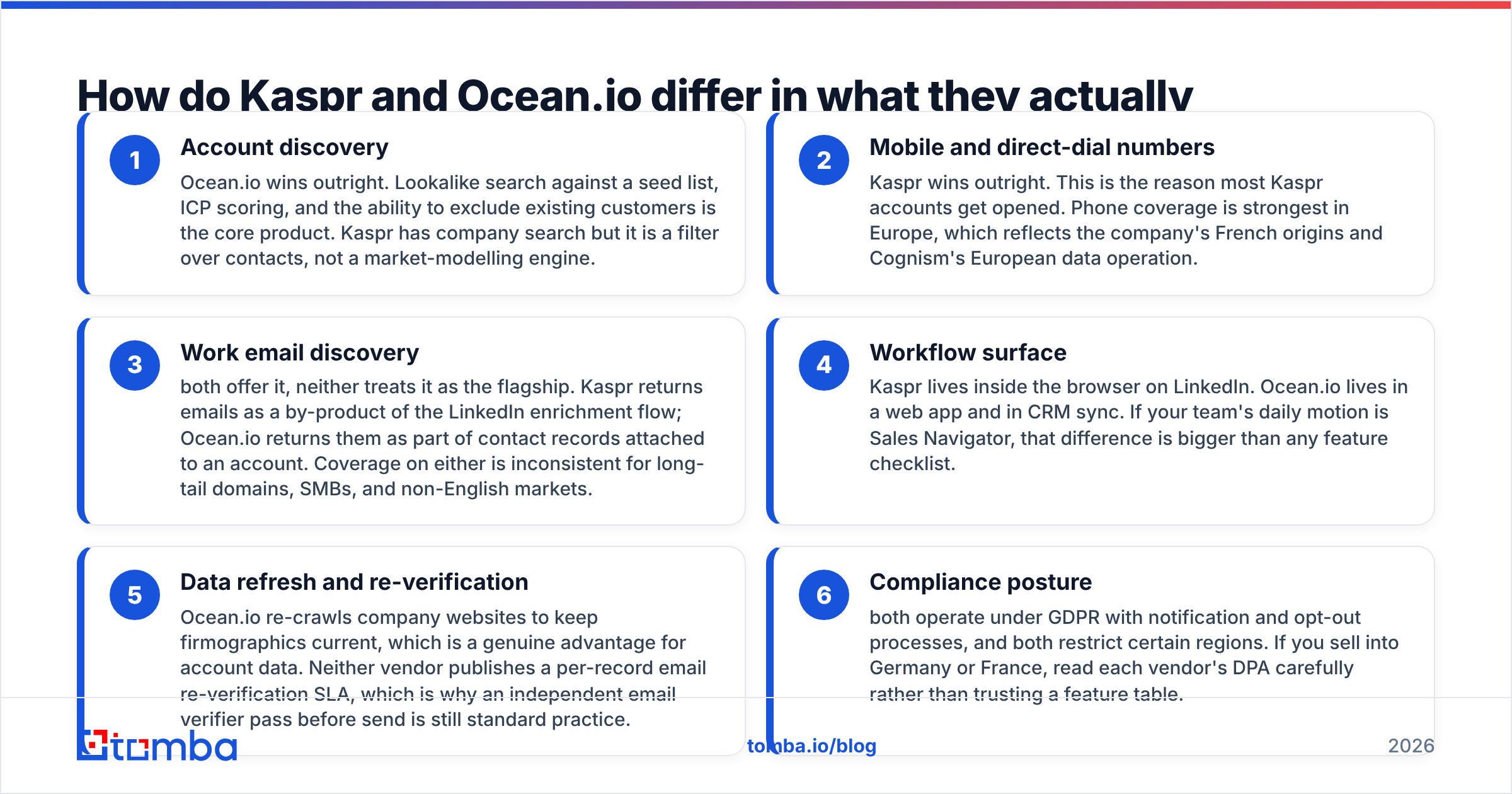
- Account discovery — Ocean.io wins outright. Lookalike search against a seed list, ICP scoring, and the ability to exclude existing customers is the core product. Kaspr has company search but it is a filter over contacts, not a market-modelling engine.
- Mobile and direct-dial numbers — Kaspr wins outright. This is the reason most Kaspr accounts get opened. Phone coverage is strongest in Europe, which reflects the company's French origins and Cognism's European data operation.
- Work email discovery — both offer it, neither treats it as the flagship. Kaspr returns emails as a by-product of the LinkedIn enrichment flow; Ocean.io returns them as part of contact records attached to an account. Coverage on either is inconsistent for long-tail domains, SMBs, and non-English markets.
- Workflow surface — Kaspr lives inside the browser on LinkedIn. Ocean.io lives in a web app and in CRM sync. If your team's daily motion is Sales Navigator, that difference is bigger than any feature checklist.
- Data refresh and re-verification — Ocean.io re-crawls company websites to keep firmographics current, which is a genuine advantage for account data. Neither vendor publishes a per-record email re-verification SLA, which is why an independent email verifier pass before send is still standard practice.
- Compliance posture — both operate under GDPR with notification and opt-out processes, and both restrict certain regions. If you sell into Germany or France, read each vendor's DPA carefully rather than trusting a feature table.
Which tool has more accurate data?#
The honest answer: they are accurate at different things, and neither publishes an audited, third-party accuracy benchmark you can hold them to.
Ocean.io's account data tends to hold up well because it is derived from live website content — a company that rewrote its homepage last quarter gets reclassified. That is a structural advantage over providers leaning on stale industry codes. Where it gets softer is headcount and revenue on private companies, which is modelled rather than reported almost everywhere in this market.
Kaspr's accuracy story is the inverse. Phone numbers, especially EU mobiles, are its strong suit, and reps consistently report usable connect rates on G2. Email accuracy draws more mixed feedback — the common complaint pattern is a returned address that bounces or belongs to a former employer, which is what happens when a record was captured once and not re-verified since.
Two things to do before you trust either number:
- Run a blind sample. Take 100 contacts you already know are correct (closed-won accounts, current customers) and see how each tool performs against ground truth. Vendor-published accuracy figures are marketing; your own sample is evidence.
- Verify before you send, always. Whatever source the address came from, a verification pass costs a fraction of a cent and protects sender reputation that takes months to rebuild.

How do Kaspr and Ocean.io compare on pricing?#
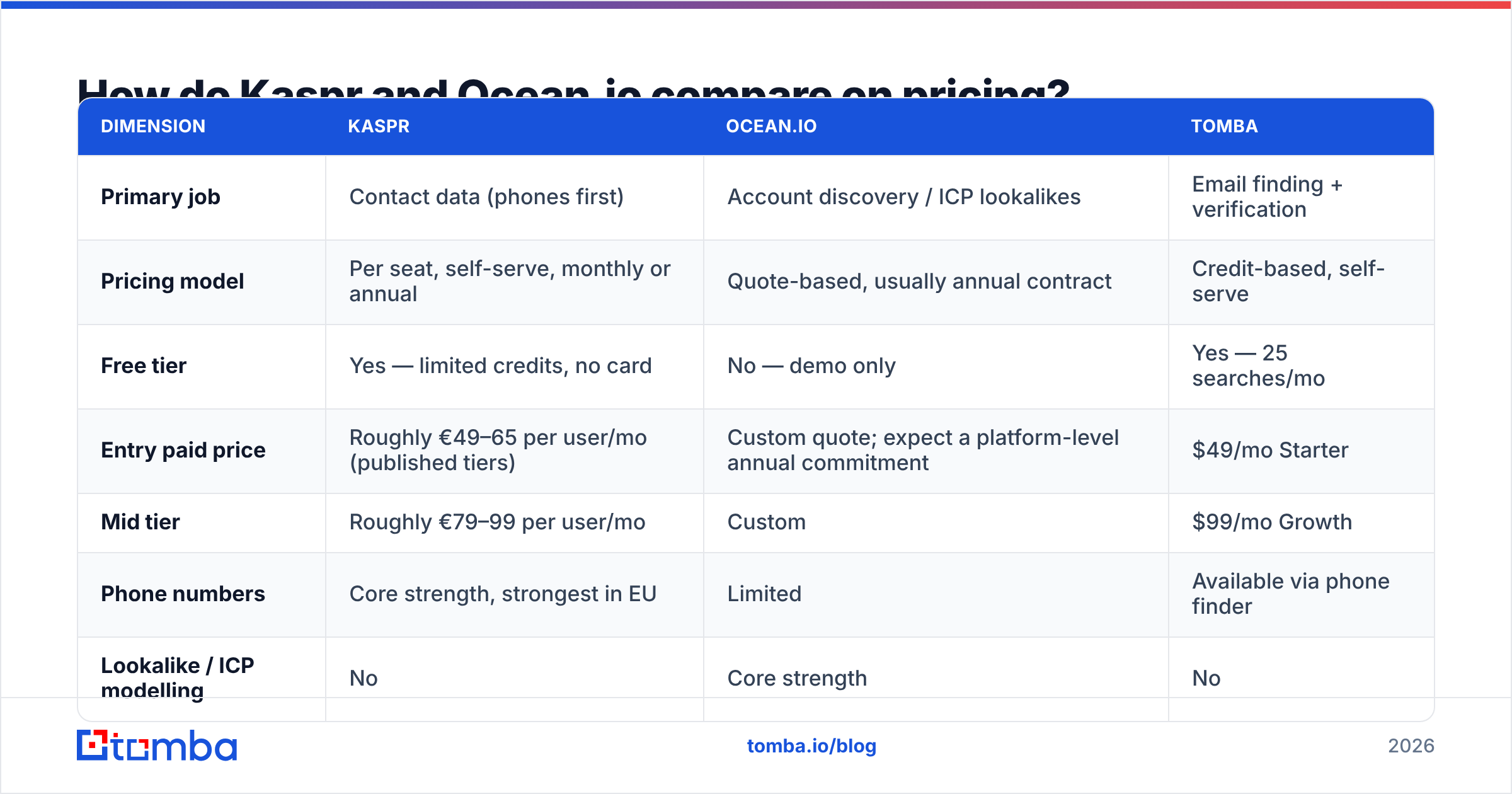
This is where most evaluations end, because the two pricing models are not comparable in kind. Kaspr is a self-serve, per-seat subscription with a usable free tier. Ocean.io is a quote-based platform sale, typically annual, and typically scoped by credit volume and seats together. Figures below reflect publicly listed information at the time of writing — verify on each vendor's pricing page, since both change.
| Dimension | Kaspr | Ocean.io | Tomba |
|---|---|---|---|
| Primary job | Contact data (phones first) | Account discovery / ICP lookalikes | Email finding + verification |
| Pricing model | Per seat, self-serve, monthly or annual | Quote-based, usually annual contract | Credit-based, self-serve |
| Free tier | Yes — limited credits, no card | No — demo only | Yes — 25 searches/mo |
| Entry paid price | Roughly €49–65 per user/mo (published tiers) | Custom quote; expect a platform-level annual commitment | $49/mo Starter |
| Mid tier | Roughly €79–99 per user/mo | Custom | $99/mo Growth |
| Phone numbers | Core strength, strongest in EU | Limited | Available via phone finder |
| Lookalike / ICP modelling | No | Core strength | No |
| Bulk processing | Limited by seat credits | Yes, list-level | Yes — bulk email finder |
| API access | Available on higher tiers | Available | Yes on all paid plans |
| Best for | SDRs cold calling from LinkedIn | RevOps defining and sizing the ICP | Anyone who needs verified work emails at volume |

The structural cost difference matters more than the sticker price. Per-seat tools punish team growth: ten SDRs means ten subscriptions, whether or not all ten pull data every day. Credit-based tools punish volume instead. If you have three people pulling 10,000 contacts, credits are cheaper. If you have twenty people pulling 200 contacts each, seats may be cheaper. Model your own shape before you sign anything — and factor in that the per-seat vendor's cheapest plan usually withholds the API, which is exactly the feature that makes the data useful downstream.
Is Kaspr better than Ocean.io for cold outbound?#
For the execution half of outbound, yes — Kaspr is the more direct fit. A rep working a Sales Navigator search needs a number and an address in two clicks, and that is the entire Kaspr product experience. Ocean.io does not try to win that moment.
For the targeting half, Ocean.io is better by a wide margin. Most outbound underperforms because the list was wrong, not because the email was wrong. A tool that tells you the 400 companies most similar to your 30 best customers changes results more than a tool that shaves twenty seconds off contact lookup. If your response rate is flat across a broad list, the problem is upstream of contact data.
The practical answer many teams land on: use Ocean.io (or an equivalent ICP engine) quarterly to define and refresh the target account list, then use a cheaper contact-level tool continuously to work it. Buying two overlapping contact tools is waste; buying one account tool and one contact tool is architecture.

What are the real limitations of each?#
Kaspr's constraints:
- Coverage skews European. North American mobile coverage exists but is not the differentiator it is in the EU.
- The LinkedIn-extension workflow caps throughput. It is excellent for 50 contacts a day and awkward for 5,000.
- Credits are per seat and do not pool cleanly across a team on lower tiers, so utilisation is usually poor.
- Email results benefit from independent verification — treat a returned address as a candidate, not a fact.
Ocean.io's constraints:
- No free tier and no self-serve entry point. You will sit through a demo cycle before you can test it, which is a real cost for a small team.
- Contact-level depth is thinner than a dedicated contact provider. It is not the tool that fills your dialer.
- Lookalike quality depends entirely on your seed list. Feed it 15 random closed-won logos and you get a fuzzy model; feed it a clean, segmented ICP and it is genuinely strong.
- Annual commitments do not suit teams still testing whether outbound works for them at all.
Where does a dedicated email finder fit alongside either?#
Both tools leave the same gap: verified work email at volume, cheaply, on demand, through an API.
Concretely, the stack most teams converge on looks like this:
- Define the account list — Ocean.io, or a manual ICP exercise if the budget is not there.
- Identify the people — LinkedIn, Sales Navigator, or an existing B2B database.
- Resolve the contact — a domain search to pull every known address at the target company, or a LinkedIn finder to go profile-to-email.
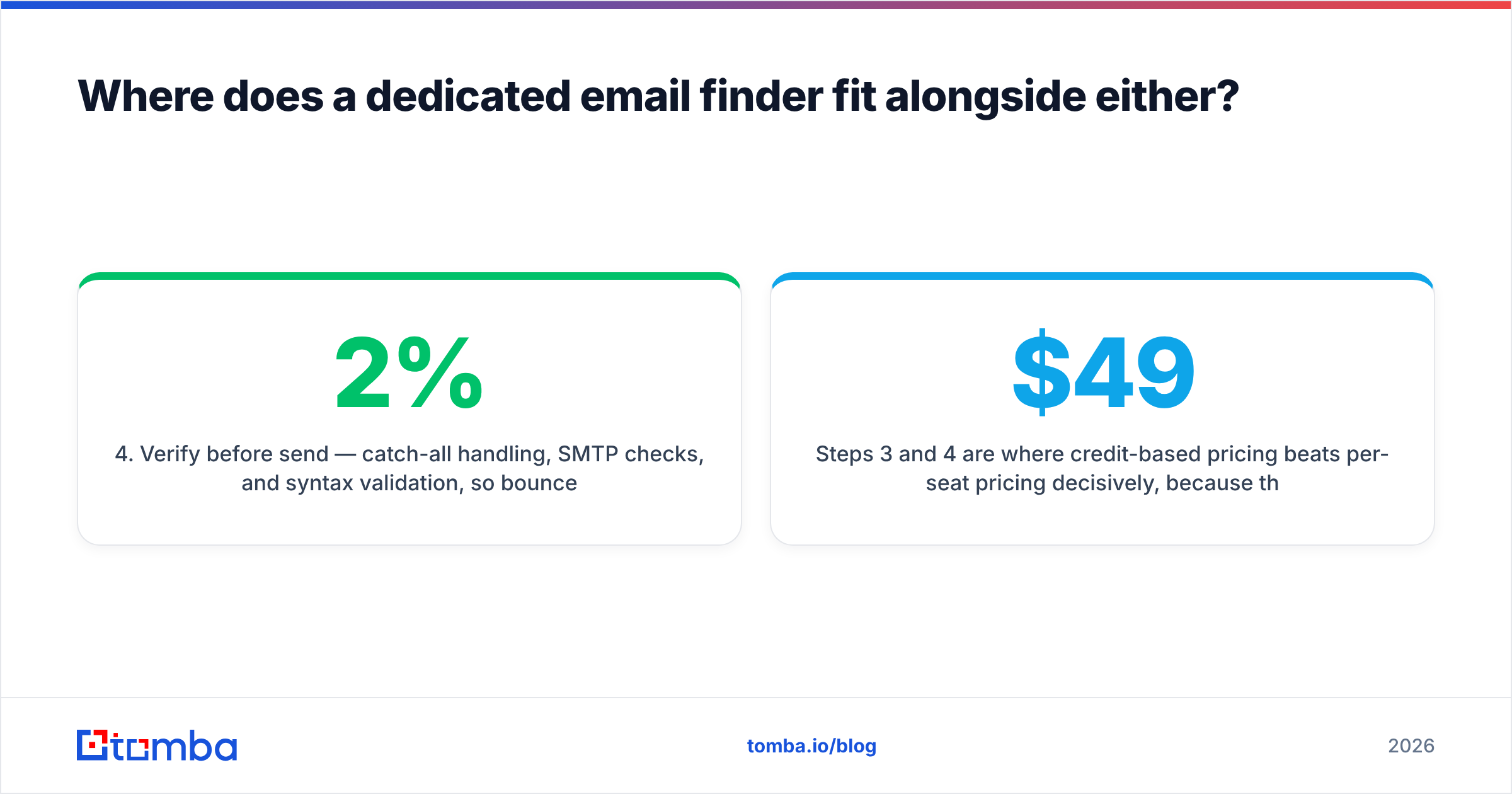
- Verify before send — catch-all handling, SMTP checks, and syntax validation, so bounce rate stays under 2%.
- Enrich the CRM — push titles, domains, and social profiles back so the record is useful the next quarter.
Steps 3 and 4 are where credit-based pricing beats per-seat pricing decisively, because they scale with list size rather than headcount. This is not a knock on either tool in this comparison; it is just a different unit of consumption. Kaspr charges you for a rep. Ocean.io charges you for a platform. An email finder charges you for the rows you actually looked up — see Tomba pricing for how that maps to 25 free searches, then $49, $99, and $249 tiers.
Kaspr vs Ocean.io: which should you choose?#
Choose Kaspr if: your reps cold call, you sell into Europe, your daily motion runs through LinkedIn, and you want to be live this afternoon without a procurement cycle. Its free tier makes the trial cost effectively zero, which is rare in this category.
Choose Ocean.io if: you have a RevOps function, your ICP is either undefined or drifting, you are carving territories or sizing TAM for a board deck, and you can justify an annual platform spend. The value shows up in list quality across a quarter, not in a single rep's day.
Choose neither, or both plus a third tool, if the actual bottleneck is verified email volume. That is a different purchase, and paying platform or seat pricing to solve it is the most common budget leak we see in mid-market GTM stacks. It is also worth benchmarking against adjacent options — a Clearbit alternative for enrichment, or a purpose-built provider like BookYourData if you would rather buy pre-built lists than build them — before you assume one contract covers everything.
One closing caution on all three categories: no vendor's data is static, and no vendor's accuracy claim survives contact with your own segment. Sample 100 records, measure bounces and connect rates yourself, and let that decide. Public review aggregates on G2 and Capterra are useful for spotting support and billing patterns, but they will never tell you how a database performs against your niche.
Ready to fix the email half of the problem?#
If you have landed here because Kaspr's email results bounce more than you would like, or because Ocean.io gave you a great account list with thin contact coverage, the missing piece is a dedicated finder. Tomba Email Finder resolves work emails by name and domain, verifies them before they reach your sequencer, and runs through an API, a Chrome extension, Google Sheets, or bulk CSV — with 25 free searches a month to test it against your own list before you spend anything. Run your next 100 prospects through it, compare the bounce rate to what you are getting today, and let the numbers make the call.
Related guides#
// get started
Find, verify and enrich your first contacts today
Start on the free plan with 25 searches a month, then scale when your team is ready.
Free plan · No credit card required · GDPR & CCPA
// about the author