Kaspr vs OutboundView: Data Tool or Outsourced SDR Team?
Kaspr sells you contact data by the credit. OutboundView sells you a whole outbound team. This is a comparison of two different answers to the same problem — and a look at what each one actually costs before it produces a meeting.
Kaspr vs OutboundView is not really a software shootout. One sells contact data by the credit. The other sells a whole outbound team by the month. Here is how to tell which gap you are actually trying to fill.
TL;DR
- Kaspr is software — a LinkedIn-first contact data tool (owned by Cognism) that returns phone numbers and emails per credit, priced per seat per month.
- OutboundView is a service — a US outbound agency that runs lists, sequences, calls and appointment setting for you on a monthly retainer.
- They are not really competitors. Comparing them is comparing "buy a drill" against "hire a contractor." The right question is whether you have someone to pull the trigger on outbound at all.
- Kaspr wins on cost per contact and speed of setup. OutboundView wins when you have budget but no SDR headcount and no appetite to build a process.
- If your bottleneck is data coverage rather than execution, a dedicated finder-plus-verifier stack (Tomba, Cognism, Apollo) usually beats both on cost per verified contact.
What are Kaspr and OutboundView, exactly?#
They solve the same business problem — "we need more qualified conversations" — from opposite ends.
Kaspr is a B2B contact data platform built around a Chrome extension. You open a LinkedIn profile, a search result page, or a Sales Navigator list and click the extension. Kaspr returns mobile numbers, direct dials and business emails for those people. Cognism bought it in 2022, so it now draws on shared European data. That is why its EMEA mobile coverage is its strongest selling point. It also adds light workflow: lead lists, LinkedIn connection-request sequences, and CRM sync to HubSpot, Pipedrive, Salesforce and Lemlist.
OutboundView is not software at all. It is an Indianapolis-based outbound lead generation agency. You sign a retainer and their team takes over. That covers ICP definition, list building, cold email infrastructure, cold calling and appointment setting. Some engagements add inside-sales consulting or SDR team buildout. The deliverable is not a contact record. It is a meeting on your AE's calendar, or a documented outbound playbook your own team can run.
That difference dictates everything else in this comparison. One is a per-credit input cost. The other is a per-month operating expense that replaces headcount.

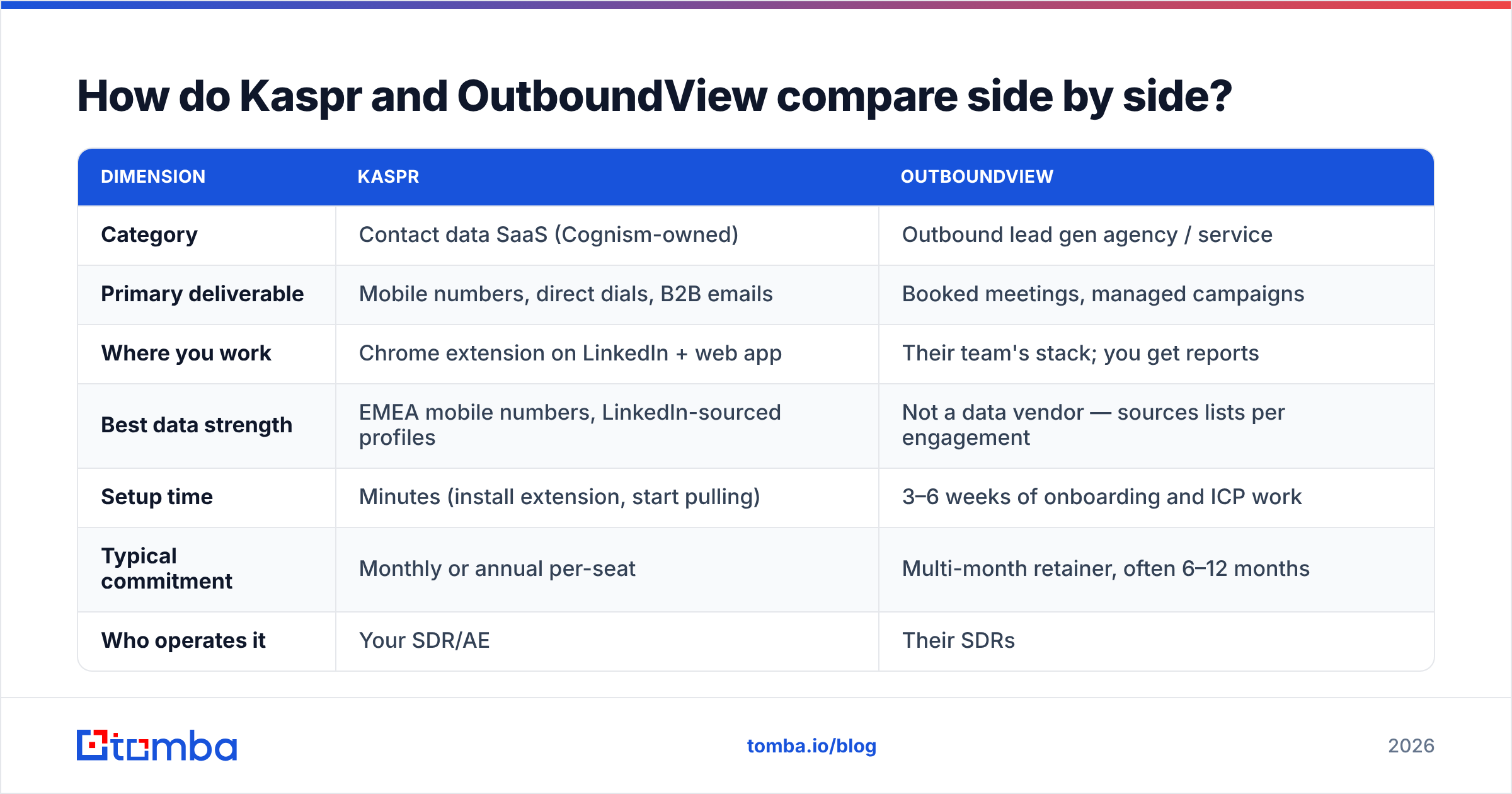
Kaspr vs OutboundView: how do they compare side by side?#
| Dimension | Kaspr | OutboundView |
|---|---|---|
| Category | Contact data SaaS (Cognism-owned) | Outbound lead gen agency / service |
| Primary deliverable | Mobile numbers, direct dials, B2B emails | Booked meetings, managed campaigns |
| Where you work | Chrome extension on LinkedIn + web app | Their team's stack; you get reports |
| Best data strength | EMEA mobile numbers, LinkedIn-sourced profiles | Not a data vendor — sources lists per engagement |
| Setup time | Minutes (install extension, start pulling) | 3–6 weeks of onboarding and ICP work |
| Typical commitment | Monthly or annual per-seat | Multi-month retainer, often 6–12 months |
| Who operates it | Your SDR/AE | Their SDRs |
| Scales by | Buying more credits and seats | Buying more agency hours |
| Fails when | Your team has no outbound process | Your ICP is niche or your offer is unproven |
| Bulk / API use | Limited; extension-first workflow | N/A — services, not endpoints |
The table makes the real decision visible. If nobody at your company is going to make 40 dials a day, Kaspr credits just buy you a spreadsheet of phone numbers nobody calls. If you already have two SDRs who are call-hungry but list-starved, the math flips. Paying an agency $5,000 a month for work those SDRs could do with a $49 tool is wasted spend.
What does each one actually cost?#
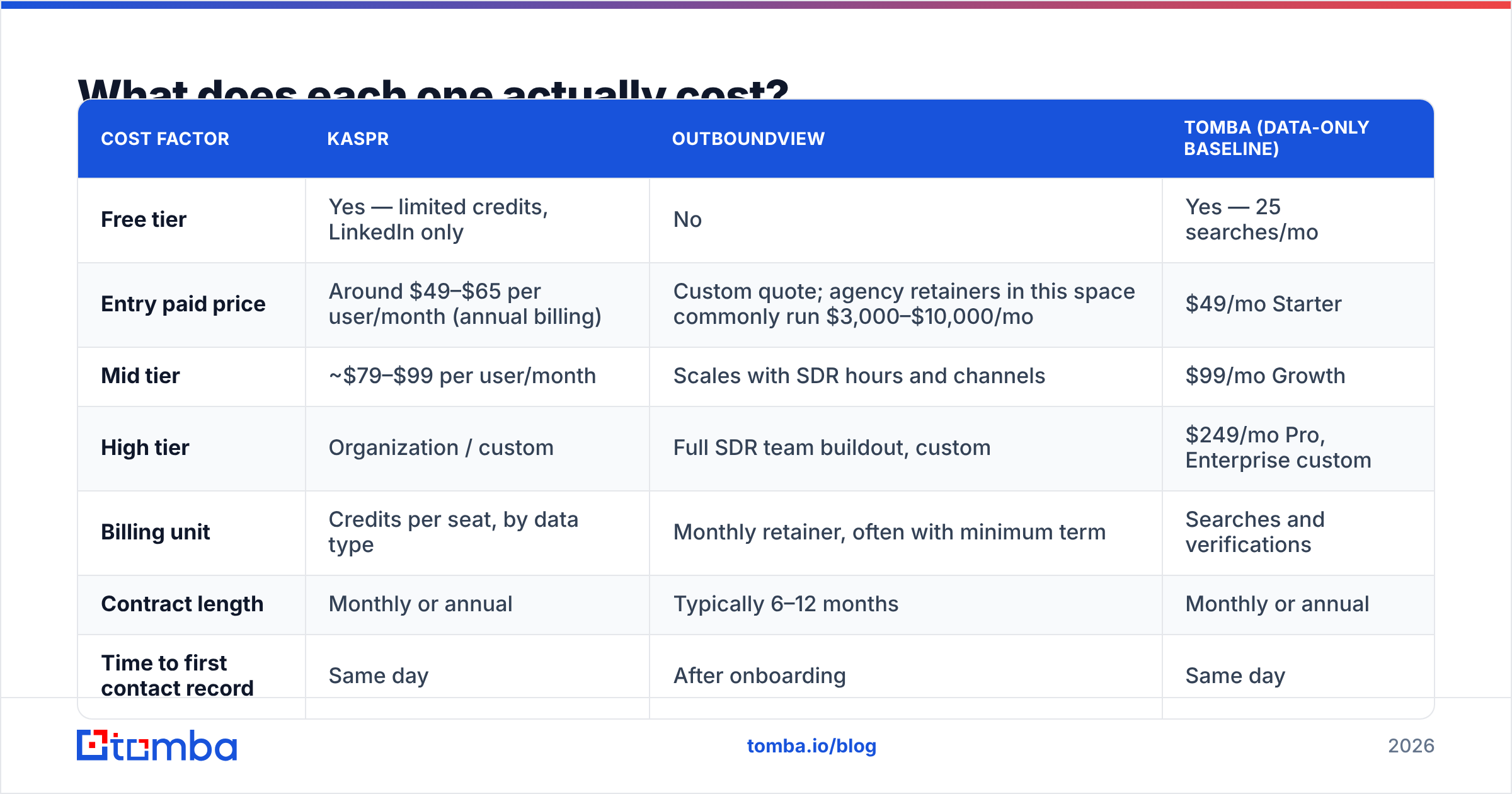
Kaspr publishes pricing. OutboundView, like most agencies, does not — it quotes per engagement. Here is the honest shape of it, with a data-tool baseline for reference.
| Cost factor | Kaspr | OutboundView | Tomba (data-only baseline) |
|---|---|---|---|
| Free tier | Yes — limited credits, LinkedIn only | No | Yes — 25 searches/mo |
| Entry paid price | Around $49–$65 per user/month (annual billing) | Custom quote; agency retainers in this space commonly run $3,000–$10,000/mo | $49/mo Starter |
| Mid tier | ~$79–$99 per user/month | Scales with SDR hours and channels | $99/mo Growth |
| High tier | Organization / custom | Full SDR team buildout, custom | $249/mo Pro, Enterprise custom |
| Billing unit | Credits per seat, by data type | Monthly retainer, often with minimum term | Searches and verifications |
| Contract length | Monthly or annual | Typically 6–12 months | Monthly or annual |
| Time to first contact record | Same day | After onboarding | Same day |
Two caveats. First, verify current numbers on each vendor's site. SaaS pricing changes quarterly and agency quotes are bespoke. Kaspr splits phone, email and export credits, so the sticker price and your real cost per usable contact can drift far apart. Burn phone credits on prospects who never answer and that gap widens fast.
Second, judge an agency retainer on cost per booked meeting, not cost per month. A $6,000 retainer that reliably produces 15 qualified meetings costs $400 a meeting. That is cheap for enterprise ACVs and ruinous for a $2,000 ACV product.
Check Tomba pricing if you want a straight per-search comparison point — it is the clearest way to see what raw data costs when you strip out the service layer.
Is Kaspr better than OutboundView for LinkedIn-led prospecting?#
Yes, if LinkedIn is where your ICP lives and you have people to work the list.
Kaspr's entire design assumes a human sitting on LinkedIn. You are browsing a Sales Navigator search of VP Engineering titles in Germany. You want their mobile numbers now, not in a batch export tomorrow. That workflow is genuinely good. The EMEA mobile coverage inherited from Cognism is as strong as anything else in the category.
OutboundView does not compete on that axis at all. Their LinkedIn work, where it exists, is part of a broader multichannel motion they run on your behalf. You do not get a browser extension. You get a weekly report.
So for a founder-led sales motion or a two-person SDR team working LinkedIn daily, Kaspr is the obvious pick between these two. For a 50-person company with a $40K ACV and no sales development function to speak of, OutboundView is solving a problem Kaspr cannot touch.
Where does each one break down?#
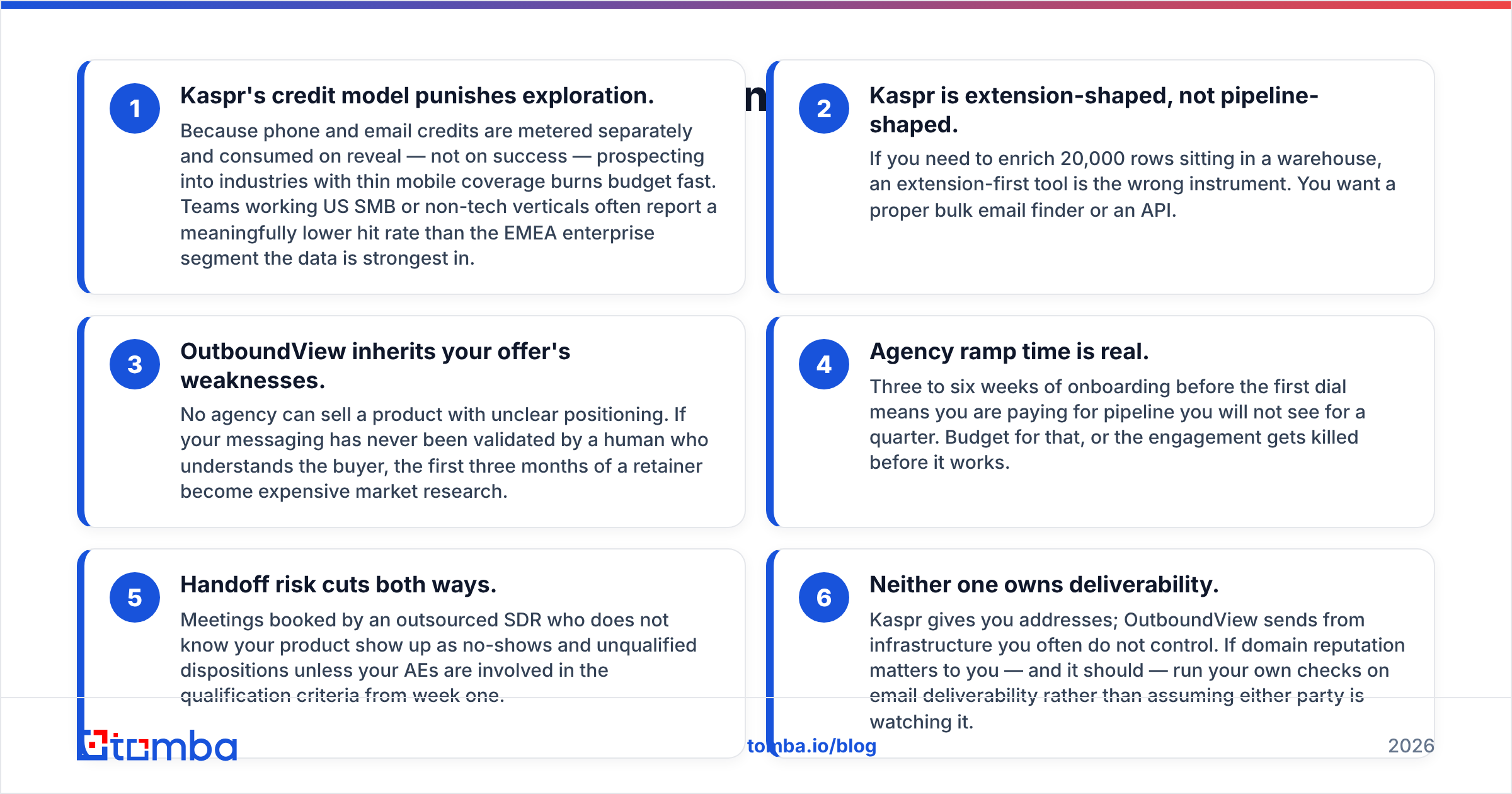
Both have failure modes worth naming before you sign anything.
Kaspr's credit model punishes exploration. Phone and email credits are metered apart, and they are spent on reveal rather than on success. Prospecting into industries with thin mobile coverage burns budget fast. Teams working US SMB or non-tech verticals often see a much lower hit rate than the EMEA enterprise segment.
Kaspr is extension-shaped, not pipeline-shaped. If you need to enrich 20,000 rows sitting in a warehouse, an extension-first tool is the wrong instrument. You want a proper bulk email finder or an API.
OutboundView inherits your offer's weaknesses. No agency can sell a product with unclear positioning. If a human who knows the buyer has never tested your messaging, the first three months of a retainer become expensive market research.
Agency ramp time is real. Onboarding runs three to six weeks before the first dial. You pay for pipeline you will not see for a quarter. Budget for that, or the engagement gets killed before it works.
Handoff risk cuts both ways. An outsourced SDR who does not know your product books weak meetings. Those turn into no-shows and bad dispositions. Keep your AEs on the qualification criteria from week one.
Neither one owns deliverability. Kaspr gives you addresses. OutboundView sends from infrastructure you often do not control. Domain reputation matters, so run your own checks on email deliverability instead of assuming someone else is watching it.
Do you actually need a data tool, an agency, or neither?#
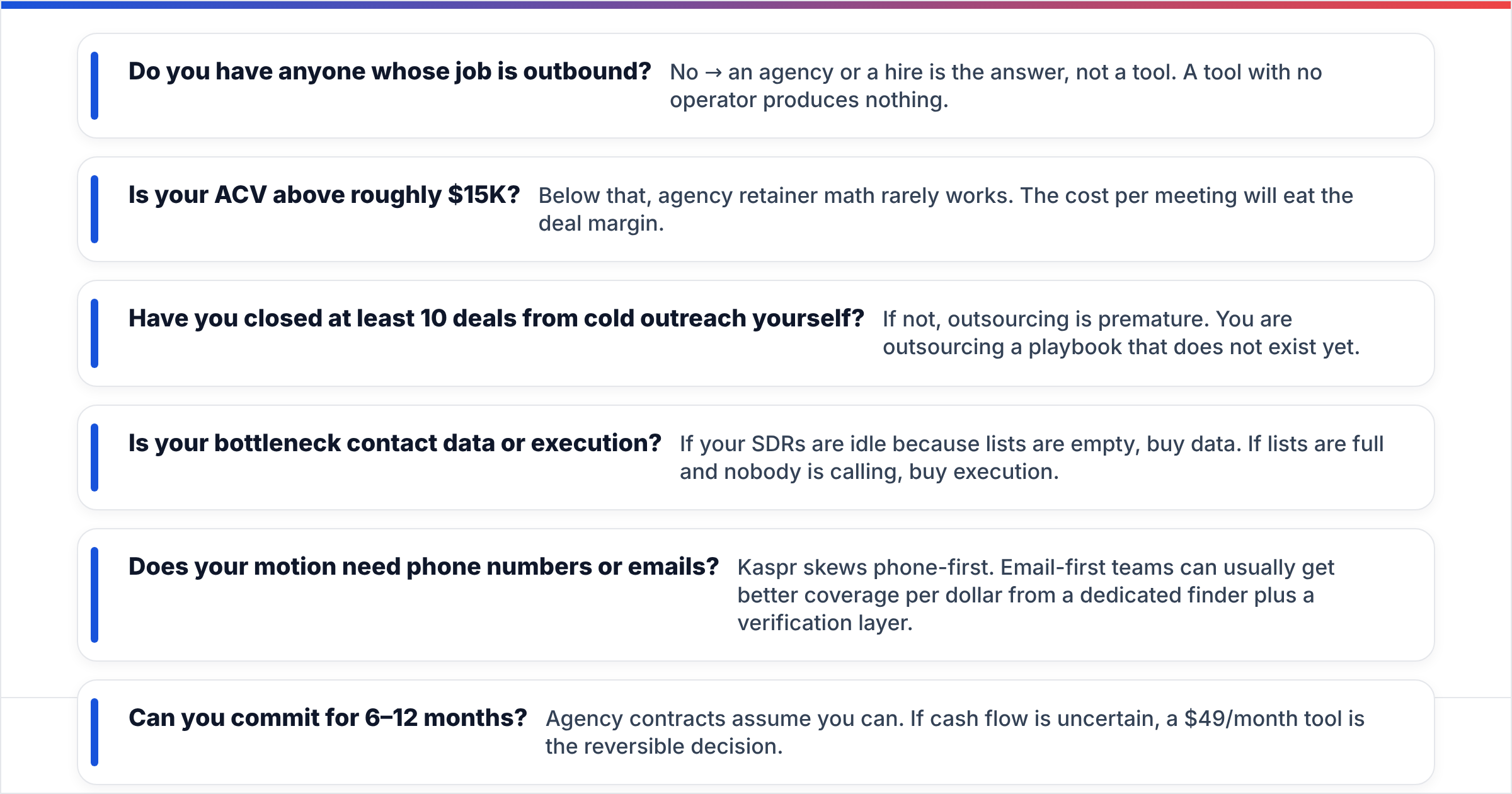
Run this sequence before spending anything.
Do you have anyone whose job is outbound? No → an agency or a hire is the answer, not a tool. A tool with no operator produces nothing.
Is your ACV above roughly $15K? Below that, agency retainer math rarely works. The cost per meeting will eat the deal margin.
Have you closed at least 10 deals from cold outreach yourself? If not, outsourcing is premature. You are outsourcing a playbook that does not exist yet.
Is your bottleneck contact data or execution? If your SDRs are idle because lists are empty, buy data. If lists are full and nobody is calling, buy execution.
Does your motion need phone numbers or emails? Kaspr skews phone-first. Email-first teams can usually get better coverage per dollar from a dedicated finder plus a verification layer.
Can you commit for 6–12 months? Agency contracts assume you can. If cash flow is uncertain, a $49/month tool is the reversible decision.

How does a dedicated data stack compare to both?#
If the honest answer to the checklist above is "our bottleneck is data, not people," then the real comparison is not Kaspr vs OutboundView — it is Kaspr versus other data vendors.
That is where a purpose-built finder stack earns its place. Tomba works from the domain side rather than the LinkedIn-profile side. You give it a company domain and a name. It returns the address and verifies it. In practice the two approaches complement each other. LinkedIn-sourced tools are strong when you have a person and need their mobile. Domain-based tools are strong when you have a company and need the whole org chart's addresses.
Concretely, the pieces most teams actually need:
- A domain search to pull every public address at a target account in one call, rather than clicking profiles one at a time.
- An email verifier running before send, because unverified lists are the fastest route to a burned sending domain.
- A phone finder for the accounts where a dial beats an email.
- An API or CSV path for volume, so enrichment lives in your pipeline instead of in a browser tab.
Peer tools worth pricing in the same evaluation: Cognism (Kaspr's parent, enterprise-priced), Apollo (data plus sequencing in one), Lusha, and BookYourData for pay-as-you-go verified list purchases without a subscription. Read the category reviews on G2 before you commit — the pattern of complaints per vendor is more useful than any single review score.
Kaspr vs OutboundView: which should you choose in 2026?#
Choose Kaspr if you sell into EMEA and your prospects live on LinkedIn. It fits teams that need mobile numbers more than email addresses. You also need at least one person who will work the list every day. The free tier is enough to test coverage against your own ICP. Run that test on 50 real target accounts before you buy an annual seat.
Choose OutboundView if your ACV supports a four- or five-figure monthly retainer. It fits companies with no sales development function that can wait a quarter for ramp. You also get the outbound process documented, so you can bring it in-house later. Ask for references in your vertical. Insist on a defined qualification standard before kickoff.
Choose neither if your bottleneck is simply that you cannot get verified email addresses at scale for a reasonable price. In that case you are shopping in the wrong aisle — you want a finder and verifier, not an extension or an agency.
Start with the cheapest reversible test. Run 25 free searches through the Tomba Email Finder against the exact accounts you would hand an agency. Verify the results and check your real coverage rate. Do that before anyone signs a 12-month retainer. If the data is there, you need execution. If it isn't, no agency in the world can sequence its way around an empty list.
Related guides#
// get started
Find, verify and enrich your first contacts today
Start on the free plan with 25 searches a month, then scale when your team is ready.
Free plan · No credit card required · GDPR & CCPA
// about the author