Kaspr vs Pipileads 2026: Data Accuracy, Pricing, and Fit
Kaspr sells LinkedIn-sourced mobile numbers by the seat. Pipileads sells bulk email discovery by the credit. Here's which one actually fits your outbound motion in 2026 — and where both fall short.
TL;DR
- Kaspr is a LinkedIn-first contact revealer (now part of the Cognism group) built around a Chrome extension. Its differentiator is mobile phone numbers, and it charges per seat.
- Pipileads is a bulk-oriented email discovery and verification platform. Its differentiator is throughput at low cost per record, and it charges per credit.
- They are not really competitors in the same lane: one is a rep-level dialer-feeding tool, the other is an ops-level list-building tool. Picking wrong costs you either coverage or budget.
- Choose Kaspr if your reps live inside LinkedIn Sales Navigator and phone connects drive pipeline. Choose Pipileads if you build lists in bulk and need cheap, verified email at volume.
- If you need both — API-first email discovery and phone data and verification under one billing model — a platform like Tomba usually costs less than stacking two seat-based tools.
What are Kaspr and Pipileads?#
Think of it like buying transport. Kaspr is a motorbike courier: fast, precise, one package at a time, perfect inside a dense city. Pipileads is a freight truck: slower to load, cheap per kilo, useless for a single urgent envelope. Both move things. Neither replaces the other.
Kaspr is a browser-extension-driven prospecting tool. You open a LinkedIn profile, a Sales Navigator list, or a LinkedIn group, and Kaspr reveals phone numbers and email addresses for those people. It was acquired by Cognism in 2022 and now sits as the SMB/self-serve end of that group's data stack. The workflow is inherently manual-ish and rep-centric: a human is browsing, a human clicks reveal, credits get spent.
Pipileads approaches the same problem from the opposite end. It is a lead-generation and email-finding platform aimed at people who work in lists: upload a CSV of domains or names, run domain search, find the email pattern, verify the result, export. The pricing model reflects that — credits, not seats — and the interface is dashboard-first rather than extension-first.
Here is the practical split, in the order it usually matters:
- Entry point. Kaspr starts from a LinkedIn profile. Pipileads starts from a domain or a company list.
- Unit of work. Kaspr = one contact revealed by one rep. Pipileads = one batch processed by one ops person.
- Primary data type. Kaspr leans mobile numbers. Pipileads leans professional email.
- Billing unit. Kaspr charges per user seat with credit allowances attached. Pipileads charges for credit volume.
- Who owns the tool internally. Kaspr belongs to the SDR team. Pipileads belongs to RevOps or growth.
- Failure mode. Kaspr gets expensive as headcount grows. Pipileads gets useless when you need a phone number today.
How do Kaspr and Pipileads compare head-to-head?#
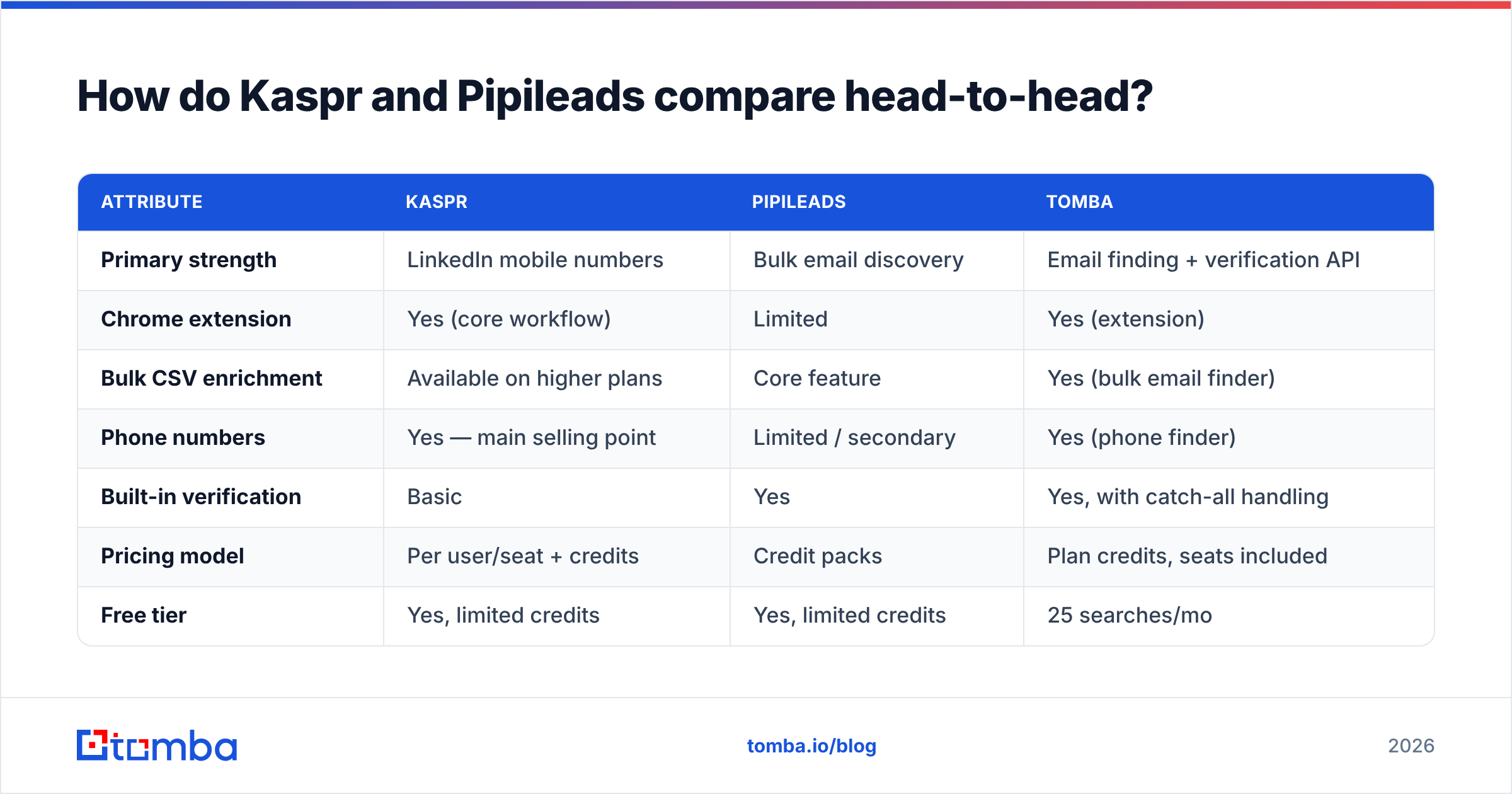
| Attribute | Kaspr | Pipileads | Tomba |
|---|---|---|---|
| Primary strength | LinkedIn mobile numbers | Bulk email discovery | Email finding + verification API |
| Chrome extension | Yes (core workflow) | Limited | Yes (extension) |
| Bulk CSV enrichment | Available on higher plans | Core feature | Yes (bulk email finder) |
| Phone numbers | Yes — main selling point | Limited / secondary | Yes (phone finder) |
| Built-in verification | Basic | Yes | Yes, with catch-all handling |
| Pricing model | Per user/seat + credits | Credit packs | Plan credits, seats included |
| Free tier | Yes, limited credits | Yes, limited credits | 25 searches/mo |
| Entry paid price | ~€45–€65 per user/mo | Low double digits/mo | $49/mo (Tomba pricing) |
| API access | Limited | Yes | Full REST API |
| Best for | SDRs cold calling from LinkedIn | Ops building large lists | Teams needing both at API scale |
Pricing above reflects publicly listed plans at the time of writing and shifts regularly — always confirm on the vendor's own page before you budget. Kaspr publishes per-user pricing in euros; Pipileads sells credit bundles, so your effective cost per contact depends entirely on how many records you pull.

The most important line in that table is the billing model, not the feature list. A five-rep team on Kaspr pays five times. A five-person team on a credit platform pays once and shares the pool. That single difference swings annual cost by thousands of dollars before you evaluate a single data point.
Which tool has better data accuracy?#
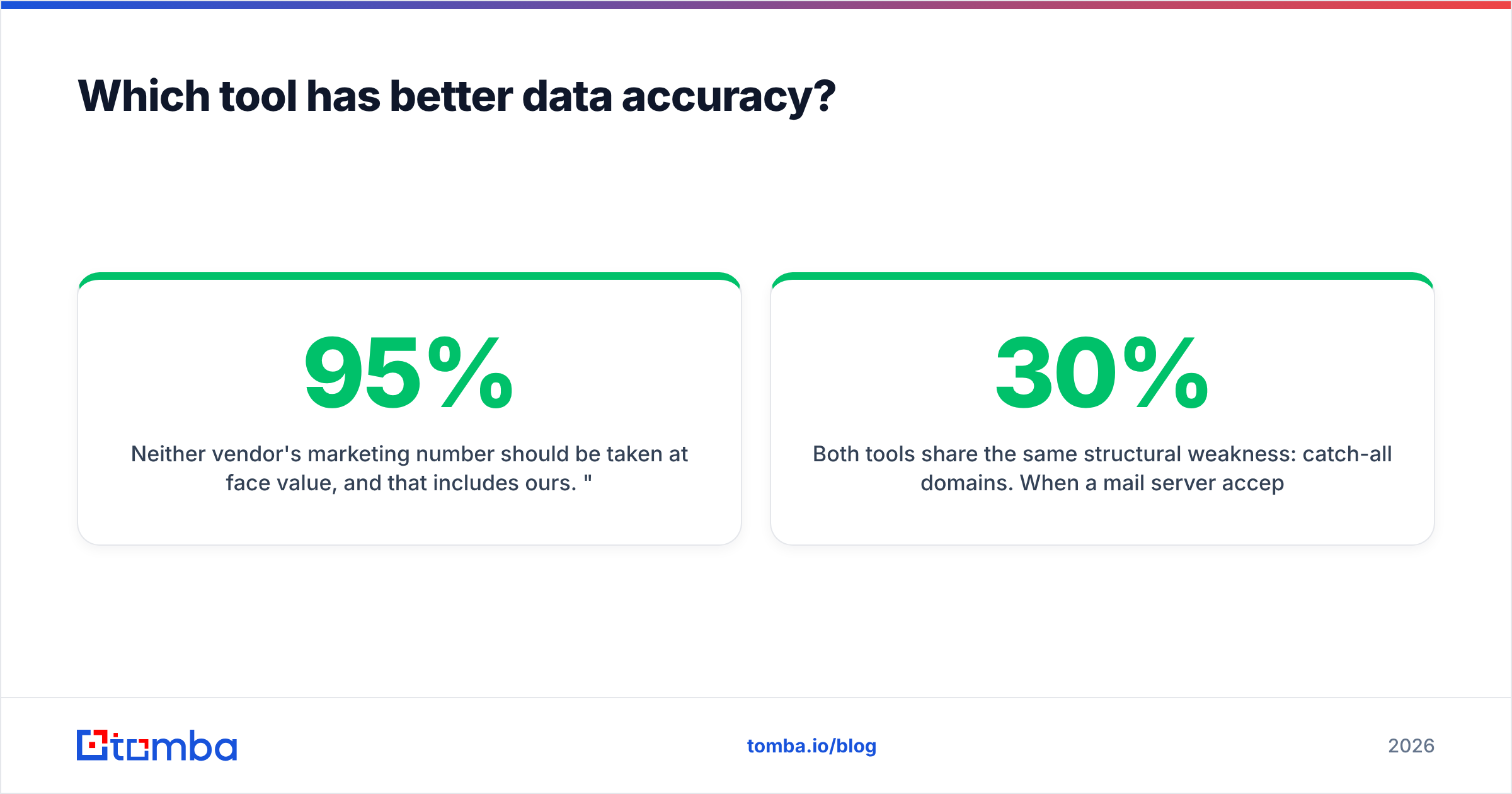
Neither vendor's marketing number should be taken at face value, and that includes ours. "95% accuracy" claims are almost always measured on the subset of records the tool was confident enough to return — which quietly excludes every contact it failed to find. A tool that returns 40% of your list at 95% accuracy is worse than one returning 75% at 90%.
Run the test yourself. Take 200 contacts you already have confirmed emails and numbers for, strip the contact data, and push the list through each trial. Then measure three things:
- Match rate — what percentage came back with any result at all.
- Precision — of the returned results, how many matched your known-good value.
- Deliverability — of returned emails, how many survive a third-party verification pass.

In practice, the patterns we see repeatedly in these tests: Kaspr's phone match rate holds up well in Western Europe and thins out noticeably in APAC and Latin America, which is what you'd expect from a dataset heavily fed by European user contributions. Its email side is competent but not its differentiator. Pipileads is the inverse — solid email coverage on companies with discoverable web presence, weak on phone, and more variable on very small or stealth-mode companies where no pattern exists to infer from.
Both tools share the same structural weakness: catch-all domains. When a mail server accepts every address at a domain, a standard SMTP check returns "valid" for addresses that will hard bounce. If 20–30% of your target accounts run catch-all — common in enterprise — you need a dedicated catch-all verifier layer or your bounce rate will not match the vendor's dashboard.

The honest summary: run both trials, on your actual ICP, and let the numbers decide. Anyone who tells you which is more accurate without knowing your target geography and company size is guessing.
How does pricing really work for each?#
This is where most teams miscalculate.
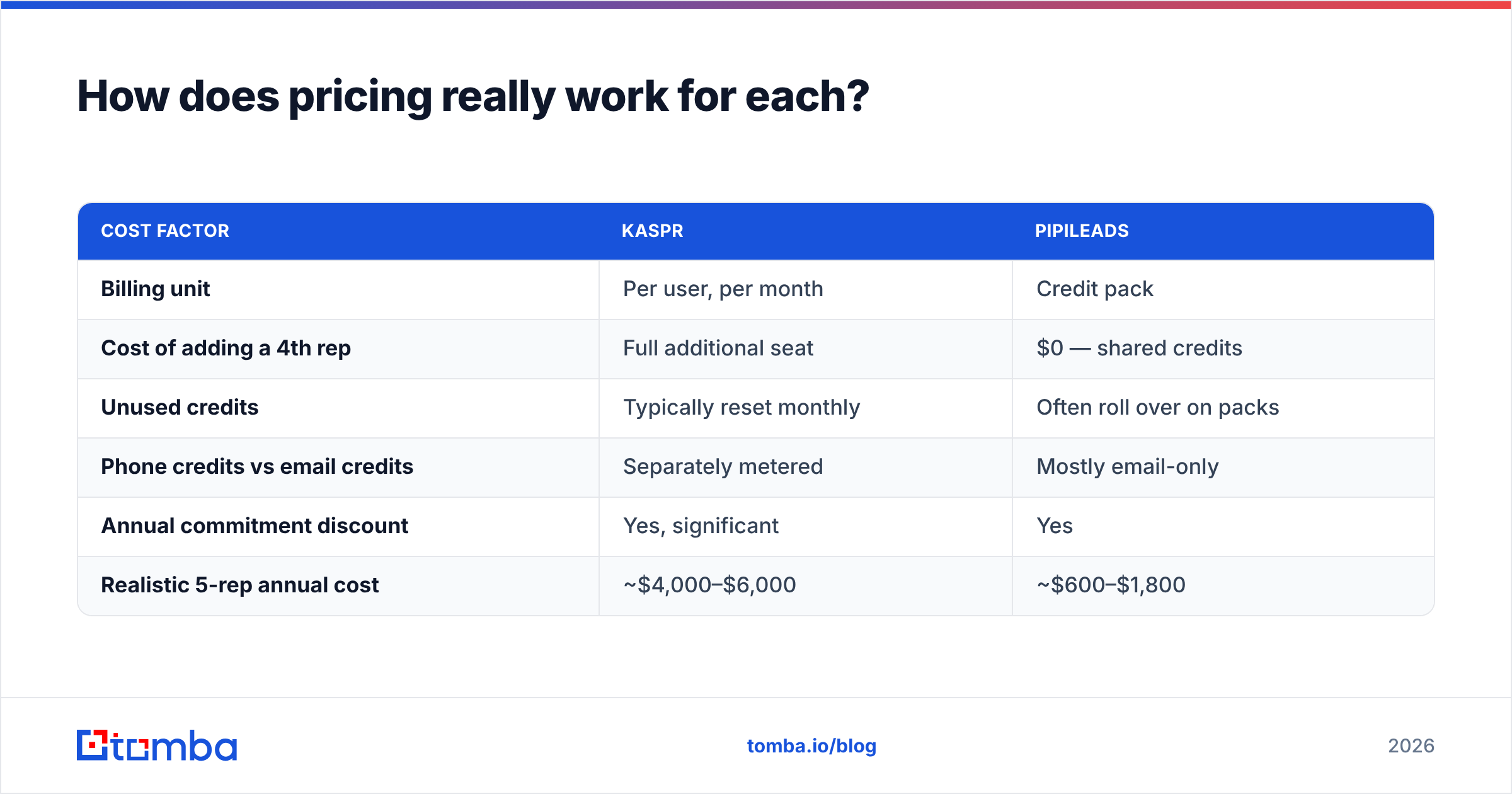
| Cost factor | Kaspr | Pipileads |
|---|---|---|
| Billing unit | Per user, per month | Credit pack |
| Cost of adding a 4th rep | Full additional seat | $0 — shared credits |
| Unused credits | Typically reset monthly | Often roll over on packs |
| Phone credits vs email credits | Separately metered | Mostly email-only |
| Annual commitment discount | Yes, significant | Yes |
| Realistic 5-rep annual cost | ~$4,000–$6,000 | ~$600–$1,800 |
Kaspr's per-seat model is defensible when each rep genuinely generates pipeline from the tool daily. It becomes indefensible the moment you have occasional users — a founder, a marketer, a partner manager — who need ten lookups a month but cost a full seat.
Pipileads' credit model has the opposite trap: it looks cheap until you scale. Ten thousand enrichments a month on cheap credits is fine; a hundred thousand with a 55% match rate means you burn credits on failures. Always ask whether the vendor charges for unsuccessful lookups. Credit-only-on-success billing is the single best clause you can get in a data contract.
One more line item people forget: verification is not free. If your finder returns unverified emails and you pay a separate verifier per record, your true cost per usable contact is the sum of both. Platforms that bundle finding and email verification in one credit generally beat two cheaper tools stacked.
Is Kaspr better than Pipileads for LinkedIn prospecting?#
Yes — for the specific motion of "I am looking at a person on LinkedIn right now and I want to call them in the next five minutes."
Kaspr's extension is genuinely well-built for that. It surfaces on the profile, you click, you get a mobile, you dial. It also supports revealing across Sales Navigator search results and LinkedIn group member lists, which turns a saved search into a call list without leaving the tab. If your team's core metric is connect rate and your ICP is EMEA mid-market, Kaspr earns its seat cost.
Pipileads is not trying to win that workflow. Asking it to compete there is like complaining a freight truck can't park outside a café.
But be clear-eyed about the constraints:
- LinkedIn rate limits apply. Aggressive extension use against LinkedIn's UI carries account risk. That risk sits with your rep's profile, not the vendor.
- GDPR obligations are yours. Both tools surface personal data on EU citizens. Notification requirements under GDPR fall on you as the data controller, regardless of vendor claims. Check the ICO's guidance on lawful basis discussions with your own counsel — the compliance burden does not transfer with the contract.
- Phone data decays fast. Mobile numbers age at roughly 20–30% per year in B2B. A number that was accurate at scrape time may be dead by the time you dial.
When should you choose Pipileads instead?#
Pick Pipileads (or a credit-based finder generally) when any of these describe you:
- You build target lists from firmographic filters, not from browsing individual profiles.
- Your outbound is email-led, with calling as a secondary channel.
- More than three people need occasional access, making per-seat math ugly.
- You want to enrich an existing CRM export rather than prospect net-new one at a time.
- Your ICP is outside Western Europe, where LinkedIn-sourced mobile coverage thins.
The workflow looks different too. Instead of a rep clicking reveal, an ops person runs a domain search across 500 target accounts, pulls every matching role, verifies, dedupes, and pushes clean records into the CRM. That is a Tuesday-afternoon batch job, not a daily rep habit — and it should not be billed like one.
What about alternatives to both?#
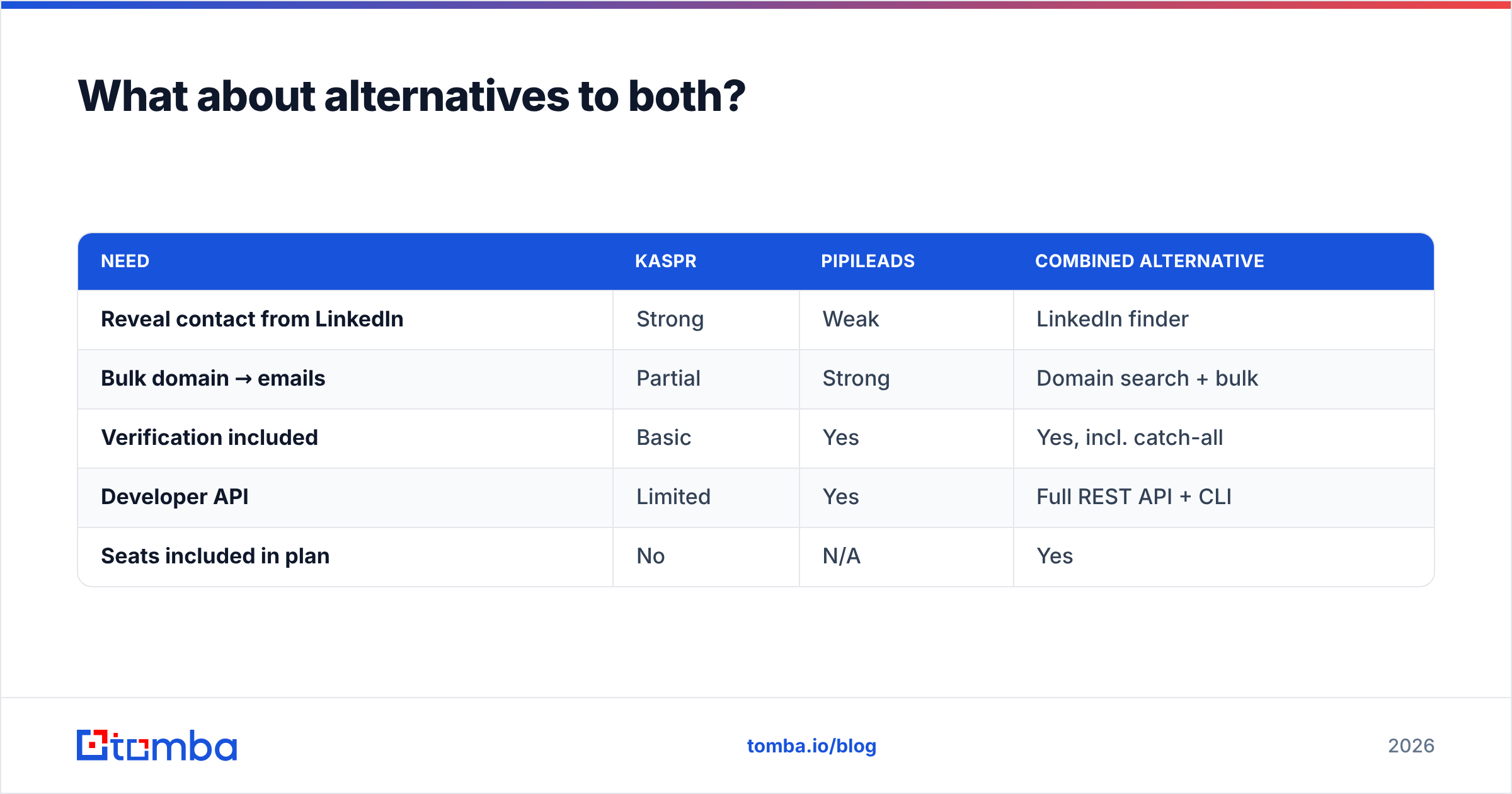
The two-tool stack is common and usually wasteful. Before you sign, price a single platform that covers both jobs.
| Need | Kaspr | Pipileads | Combined alternative |
|---|---|---|---|
| Reveal contact from LinkedIn | Strong | Weak | LinkedIn finder |
| Bulk domain → emails | Partial | Strong | Domain search + bulk |
| Verification included | Basic | Yes | Yes, incl. catch-all |
| Developer API | Limited | Yes | Full REST API + CLI |
| Seats included in plan | No | N/A | Yes |
Other credible options depending on your motion: Cognism if you're enterprise and want Kaspr's data with compliance tooling and intent; BookYourData if you'd rather buy a verified, pay-as-you-go list outright than run lookups — it's a solid fit for teams who want the data delivered rather than discovered; and Tomba if you want find-plus-verify plus phone under one API with seats included. Tomba's plans run Free (25 searches/mo), Starter $49/mo, Growth $99/mo, and Pro $249/mo, with enterprise pricing on request — no per-rep multiplier.
Before committing to any of them, read recent verified reviews on G2 filtered to your company size. Reviews from 500-person enterprises tell you nothing about how the tool behaves on a 6-person team, and vice versa.
Which should you pick?#
Answer three questions in order:
- Do phone connects drive your pipeline, or does email? Phone → Kaspr. Email → Pipileads.
- How many humans need access? One to three power users → seats are fine. Four or more, or mixed occasional use → credits win.
- Do you need this inside your own systems? If your enrichment must run in a workflow, a CRM sync, or a script, you need a real API — and that pushes you toward Pipileads or a platform-grade alternative rather than an extension-first tool.
If your honest answer is "both, sometimes," don't buy both. Stacking a €65/user seat tool on top of a credit platform means paying twice for overlapping coverage and reconciling two conflicting records for the same person. Consolidate, then spend the savings on the channel, not the tooling.
Ready to test it against your own list?#
Take the 200-contact benchmark described above and run it through Tomba's Email Finder alongside your Kaspr and Pipileads trials. You get 25 free searches to start — enough to see real match and bounce rates on your actual ICP rather than a vendor's curated sample. Find emails by domain, name, or company, verify them in the same pass including catch-all domains, and pull the whole thing through one API if you'd rather automate it than click it. Compare the numbers, not the marketing pages.
Related guides#
// get started
Find, verify and enrich your first contacts today
Start on the free plan with 25 searches a month, then scale when your team is ready.
Free plan · No credit card required · GDPR & CCPA
// about the author