Kaspr vs Plusvibe: Which One Does Your Outbound Need in 2026?
Kaspr finds the contact. Plusvibe sends the email. Comparing them head-to-head only makes sense once you know which half of your outbound stack is actually broken — here's the honest breakdown.
TL;DR
- Kaspr and Plusvibe are not really competitors. Kaspr is a contact-data tool (a LinkedIn Chrome extension that reveals phone numbers and emails). Plusvibe is a cold email sending platform (sequences, inbox rotation, warmup, deliverability).
- If your problem is "I don't have contact details," Kaspr is the relevant purchase. If your problem is "my emails aren't landing or I can't scale sends," Plusvibe is.
- Kaspr's strongest asset is mobile phone coverage in EMEA, backed by Cognism. Its weakness is per-seat credit caps that get expensive at team scale.
- Plusvibe's strongest asset is unlimited-mailbox sending with built-in warmup at a low monthly price. Its bundled lead data is a convenience feature, not a primary data source.
- Most teams end up running a dedicated data layer plus a dedicated sending layer. A bulk-capable finder like the Tomba Email Finder feeding a sender like Plusvibe is the more common 2026 setup than either tool alone.
Why does Kaspr vs Plusvibe feel like an unfair comparison?#
Because it is one — until you reframe it.
Comparing Kaspr to Plusvibe is like comparing a grocery store to an oven. One gives you ingredients, the other cooks them. You can argue about which is better only if you already know whether your kitchen is out of food or out of heat.
Kaspr is a prospecting data tool. You install a browser extension, open a LinkedIn profile or a Sales Navigator list, click, and it returns direct dials, mobile numbers, and business emails. It was acquired by Cognism in 2022, which matters because Kaspr now draws on a larger European data ecosystem and inherits a stricter compliance posture (notification-based processing, GDPR/CCPA workflows).
Plusvibe is a cold email execution platform. You connect mailboxes, warm them up, build sequences, rotate sending across inboxes, and track replies. It sits in the same product category as Instantly, Smartlead, and Saleshandy. It also ships a bundled lead database, which is the only reason the two tools show up in the same search query at all.
So the real question isn't "which tool is better." It's: which layer of your outbound engine is currently the bottleneck?

What does Kaspr actually do well?#
Kaspr is at its best in one specific motion: a rep is on LinkedIn, sees a person worth calling, and needs a phone number in under five seconds.
Four things Kaspr does genuinely well:
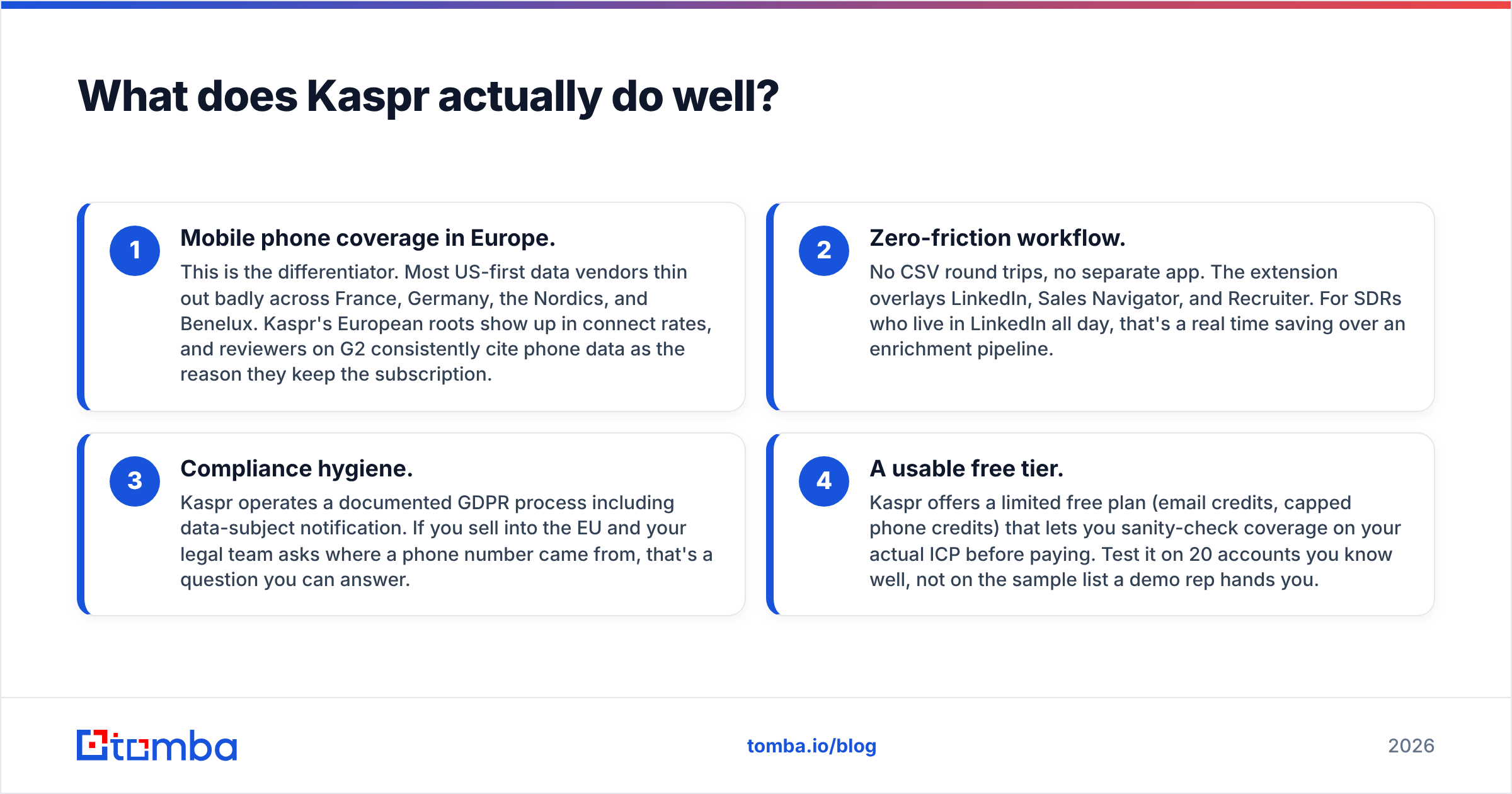
- Mobile phone coverage in Europe. This is the differentiator. Most US-first data vendors thin out badly across France, Germany, the Nordics, and Benelux. Kaspr's European roots show up in connect rates, and reviewers on G2 consistently cite phone data as the reason they keep the subscription.
- Zero-friction workflow. No CSV round trips, no separate app. The extension overlays LinkedIn, Sales Navigator, and Recruiter. For SDRs who live in LinkedIn all day, that's a real time saving over an enrichment pipeline.
- Compliance hygiene. Kaspr operates a documented GDPR process including data-subject notification. If you sell into the EU and your legal team asks where a phone number came from, that's a question you can answer.
- A usable free tier. Kaspr offers a limited free plan (email credits, capped phone credits) that lets you sanity-check coverage on your actual ICP before paying. Test it on 20 accounts you know well, not on the sample list a demo rep hands you.
Where Kaspr gets frustrating: it's priced per user, with per-user credit ceilings. That model is fine for five reps clicking profiles. It becomes painful the moment someone asks for 30,000 contacts enriched by Friday for a campaign, because Kaspr's shape is "one rep, one profile, one click" — not "one list, one job, one file."
What does Plusvibe actually do well?#
Plusvibe solves the other half: getting the message delivered at volume without torching your domains.
Its core strengths:
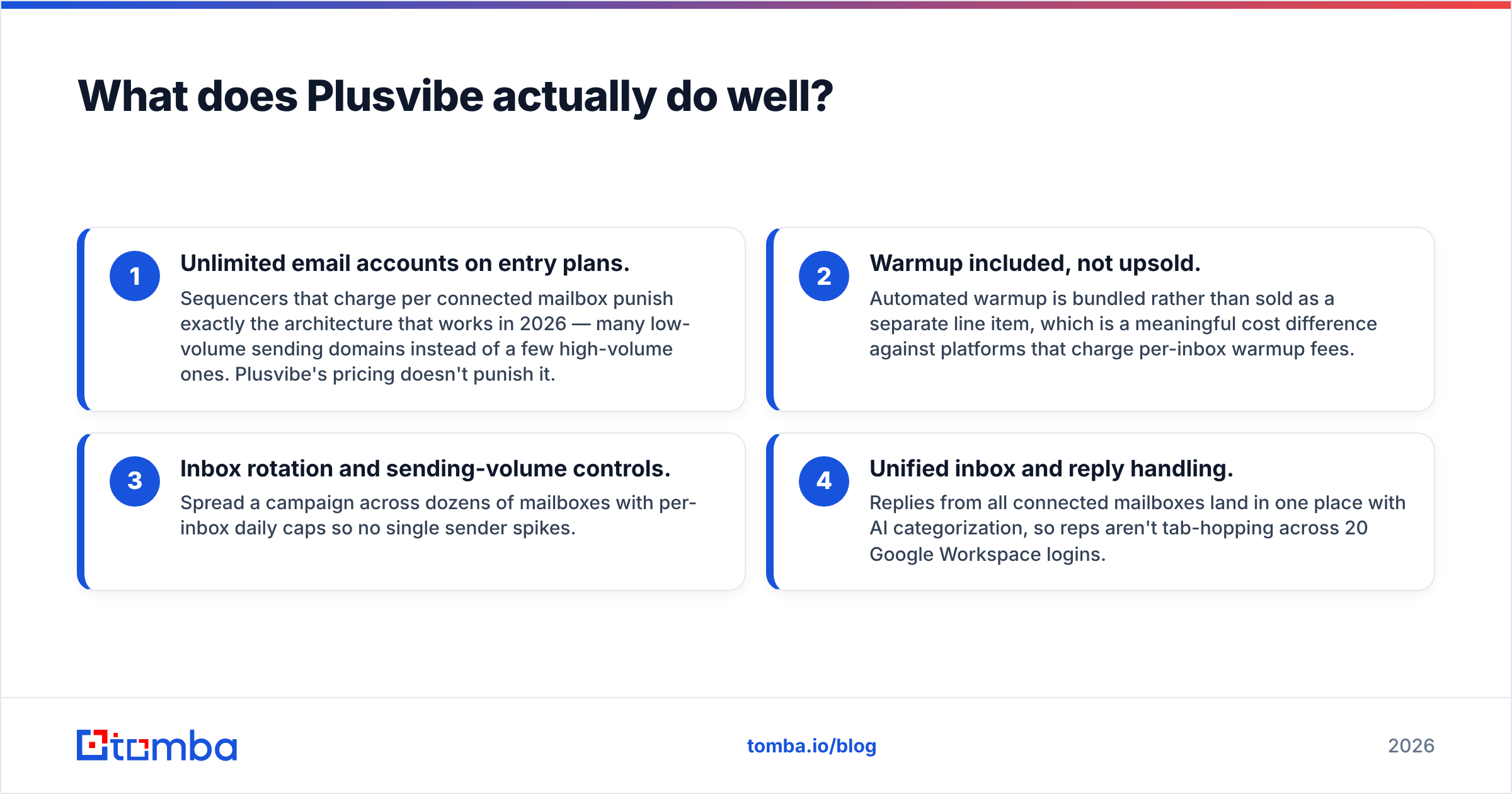
- Unlimited email accounts on entry plans. Sequencers that charge per connected mailbox punish exactly the architecture that works in 2026 — many low-volume sending domains instead of a few high-volume ones. Plusvibe's pricing doesn't punish it.
- Warmup included, not upsold. Automated warmup is bundled rather than sold as a separate line item, which is a meaningful cost difference against platforms that charge per-inbox warmup fees.
- Inbox rotation and sending-volume controls. Spread a campaign across dozens of mailboxes with per-inbox daily caps so no single sender spikes.
- Unified inbox and reply handling. Replies from all connected mailboxes land in one place with AI categorization, so reps aren't tab-hopping across 20 Google Workspace logins.
Where Plusvibe gets oversold: the bundled B2B lead database. It's fine for filling a gap, but a sending platform's data is almost never its core competency. If you build your entire pipeline on a sequencer's bundled list, you inherit whatever its refresh cycle happens to be — and you have no independent way to verify what you're about to send to. That's how a 12% bounce rate happens on a brand-new domain.
Kaspr vs Plusvibe: how do they compare feature by feature?#
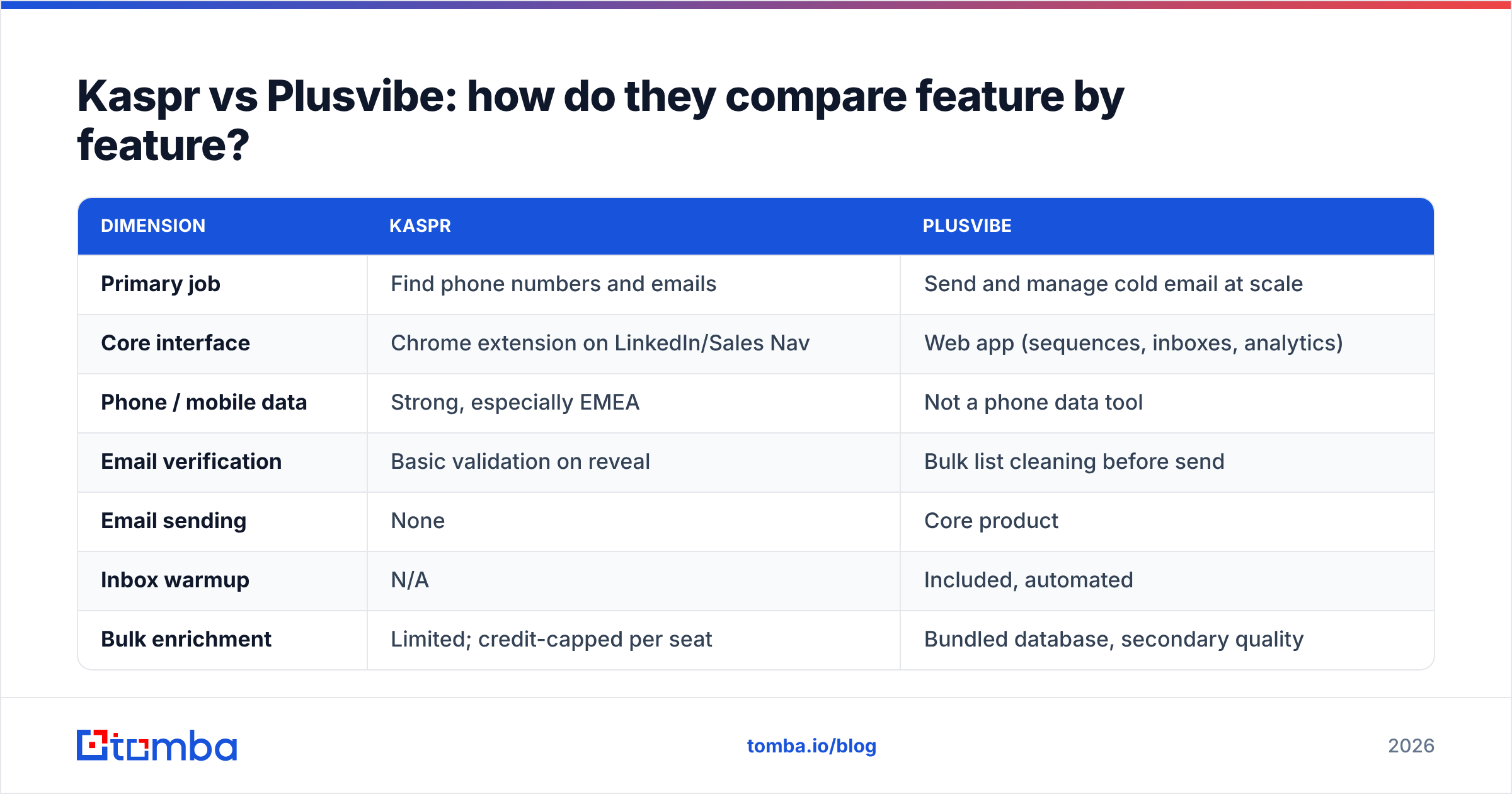
| Dimension | Kaspr | Plusvibe |
|---|---|---|
| Primary job | Find phone numbers and emails | Send and manage cold email at scale |
| Core interface | Chrome extension on LinkedIn/Sales Nav | Web app (sequences, inboxes, analytics) |
| Phone / mobile data | Strong, especially EMEA | Not a phone data tool |
| Email verification | Basic validation on reveal | Bulk list cleaning before send |
| Email sending | None | Core product |
| Inbox warmup | N/A | Included, automated |
| Bulk enrichment | Limited; credit-capped per seat | Bundled database, secondary quality |
| CRM sync | HubSpot, Pipedrive, Salesforce, Zapier | Native CRM + webhook/API |
| Pricing model | Per user, per month, credit-tiered | Per workspace, scaled by contacts/emails |
| Free option | Free plan with limited credits | Free trial |
| Best for | SDRs doing manual, high-value prospecting | Teams running volume outbound sequences |
Two notes on that table. First, vendor pricing changes constantly — check Kaspr's pricing page and Plusvibe's before you budget; treat any number in a blog post (including this one) as directional. Second, "CRM sync" means very different things here: Kaspr pushes a contact record in, Plusvibe pushes engagement activity in. You may want both.
Which one costs more in practice?#
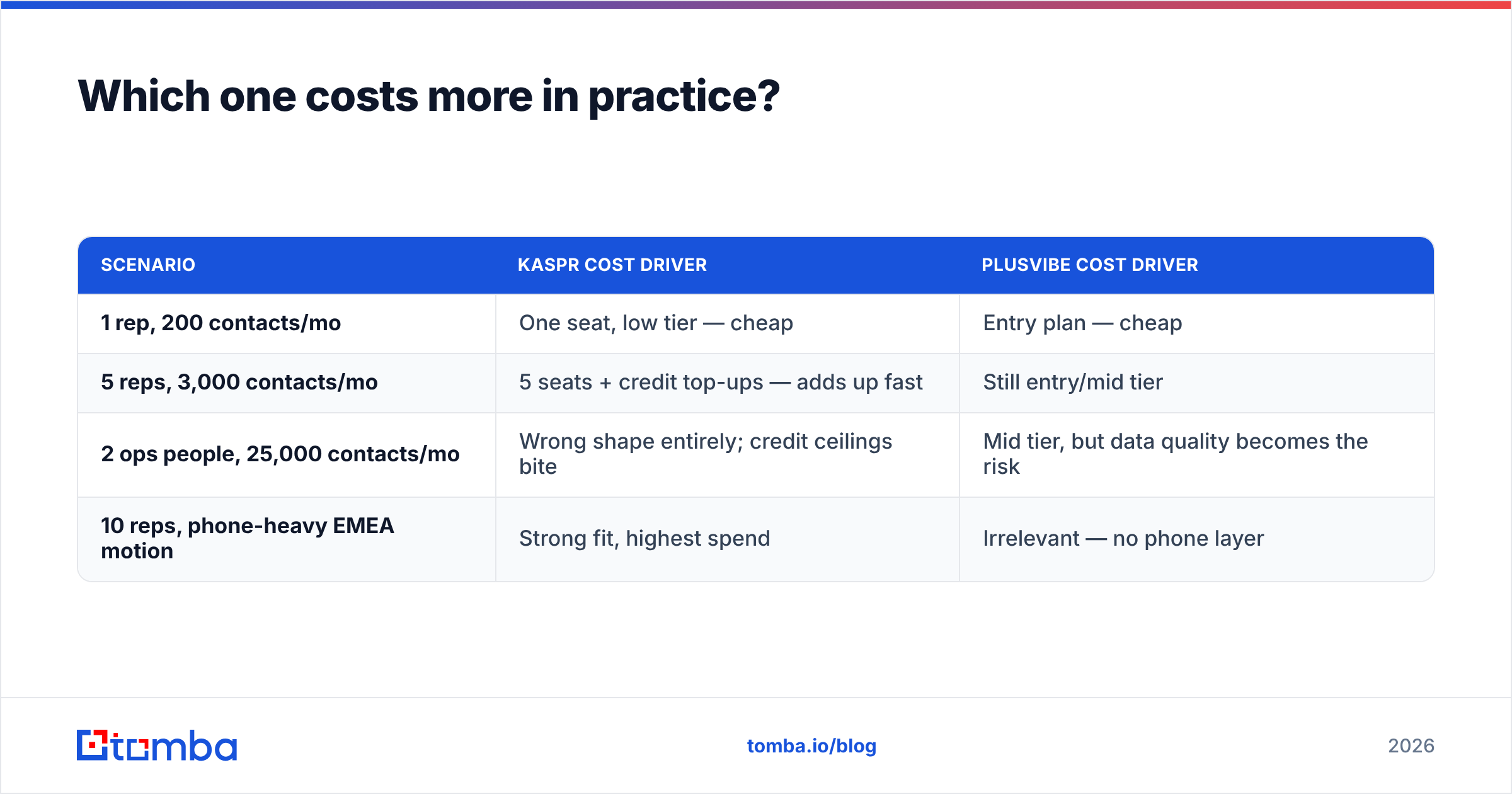
The list prices mislead you, because the two tools scale on different axes.
| Scenario | Kaspr cost driver | Plusvibe cost driver |
|---|---|---|
| 1 rep, 200 contacts/mo | One seat, low tier — cheap | Entry plan — cheap |
| 5 reps, 3,000 contacts/mo | 5 seats + credit top-ups — adds up fast | Still entry/mid tier |
| 2 ops people, 25,000 contacts/mo | Wrong shape entirely; credit ceilings bite | Mid tier, but data quality becomes the risk |
| 10 reps, phone-heavy EMEA motion | Strong fit, highest spend | Irrelevant — no phone layer |
The pattern: Kaspr's cost scales with headcount. Plusvibe's scales with volume. A 12-person SDR team that each needs 400 mobile numbers a month is a very expensive Kaspr account. A two-person growth team blasting 40,000 emails a month is a cheap Plusvibe account with an expensive data problem sitting underneath it.
This is also where a third line item usually appears on the invoice — a standalone data layer priced by lookups rather than by seat. Tomba's pricing runs Free (25 searches/mo), Starter at $49/mo, Growth at $99/mo, and Pro at $249/mo, with credits pooled across the workspace rather than fenced per user. For an ops-led team enriching lists centrally, pooled credits are structurally cheaper than per-seat credits — you're not paying for the seven reps who used 4% of their allowance this month.
Is data accuracy the real differentiator?#
Yes, and it's the part both product pages gloss over.
Cold email economics are brutal about bounces. Google and Microsoft's 2024 bulk-sender rules put a hard spam-complaint threshold on senders, and mailbox providers treat high invalid-recipient rates as a strong negative signal. If 10% of a list is dead, you're not just wasting sends — you're actively degrading the sender reputation of every domain in the rotation. Plusvibe's warmup can't out-run a bad list. Warmup builds credibility; a dirty list spends it.
So the accuracy question splits in two:
- Kaspr's accuracy question is coverage-shaped. Does it return a number for the people you actually target? Coverage varies hugely by geography and seniority. Test on your own ICP.
- Plusvibe's accuracy question is hygiene-shaped. Whatever list you load, is it verified immediately before send — not three months ago when it was scraped?
The practical fix for both is the same: run every list through a dedicated email verifier as a gate before it touches a sequencer, and use a catch-all verifier for the domains that return ambiguous SMTP responses. Catch-all domains are where most "verified" lists quietly hide their bounce risk, because a naive checker marks everything on those domains as valid.

When should you pick Kaspr over Plusvibe?#
Pick Kaspr when:
- Your motion is phone-first or multi-channel, and mobile numbers are the constraint.
- You sell into Europe and your current vendor's EMEA coverage is thin.
- Reps prospect manually inside LinkedIn rather than working from ops-built lists.
- Compliance documentation is a procurement requirement, not a nice-to-have.
Pick Plusvibe when:
- You already have contact data and the bottleneck is sending infrastructure.
- You're running multi-domain, multi-inbox campaigns and per-mailbox pricing elsewhere is killing you.
- You want warmup, rotation, and a unified inbox in one bill.
- Your volume is high enough that a sequencer's per-contact pricing beats a seat-based tool.
Pick neither as your data source when:
- You need to enrich thousands of rows at a time from a CSV, a CRM export, or a scraped account list.
- You need programmatic access — an email finder API called from your own pipeline, not a browser extension a human has to click.
- You need phone and email from the same provider, with pooled credits, via bulk email finder jobs rather than per-profile reveals.
What does the practical 2026 stack look like?#
Three layers, not two tools:
- Targeting — build the account and persona list (Sales Navigator, a B2B database, intent signals, your own CRM history).
- Data — resolve those people to verified contact details at scale. This is where a finder plus verifier plus phone finder belongs, running centrally over lists rather than per-rep over profiles.
- Execution — warm the mailboxes, sequence, rotate, reply. This is Plusvibe's lane, and it's a good one.
Kaspr fits layer 2, but in a specific, rep-driven shape. Plusvibe owns layer 3 and offers a convenience version of layer 2. The failure mode teams hit is assuming one purchase covers both — then blaming the sequencer when a poorly sourced list produces a 9% bounce rate and a burned domain.
A reasonable 2026 configuration for a ten-person team: Sales Navigator for targeting, Kaspr seats for the two or three reps who genuinely live in LinkedIn and need mobiles, a pooled-credit data layer for every bulk list the ops team builds, and Plusvibe as the sending engine. That's four line items, and it's cheaper than trying to force one tool to do all four jobs badly.
The verdict#
If you're forced to buy one: Plusvibe, for most teams. Sending infrastructure is harder to replace and its failure mode (burned domains) is more expensive than the failure mode of manual data sourcing (slow reps). But the honest answer is that "Kaspr vs Plusvibe" is the wrong axis — they're complements separated by a search query, not rivals.
What actually decides outbound results in 2026 is the data layer between them: whether the addresses you load into the sequencer are real, current, and verified the week you send, rather than the quarter they were scraped.
That's the layer to fix first. The Tomba Email Finder resolves names and domains to verified business emails with pooled workspace credits — 25 free searches a month to test against your own ICP, $49/mo on Starter, and an API for teams that would rather enrich a list than click a profile. Run your next campaign list through it before it reaches your sequencer, and compare the bounce rate against your last one. That single number will tell you more than any vendor comparison table, including this one.
Related guides#
// get started
Find, verify and enrich your first contacts today
Start on the free plan with 25 searches a month, then scale when your team is ready.
Free plan · No credit card required · GDPR & CCPA
Get the Tomba newsletter
Product and data updates
// about the author